Class 7 . Mathematics . Ganita Prakash Part I . Working with Fractions
Chapter 8: Working with Fractions
Ch 8
Mathematics
Class 7
Multiplication of Fractions Part -1
Multiplying a Distance by a Whole Number of Hours
Whole number multiplied by a fraction — Multiplying a fraction by a whole number means adding that fraction repeatedly.
Multiply the whole number by the numerator and keep the denominator unchanged: .
Use when a fractional amount is repeated a whole number of times.
Finding the Total for Whole Number Hours
- Identify the distance covered in one hour and the number of hours.
- Multiply the hourly distance by the number of hours.
- Simplify the product and include the distance unit.
How far can the tortoise walk in three hours?
- A tortoise walks km in one hour. Find its distance in three hours.
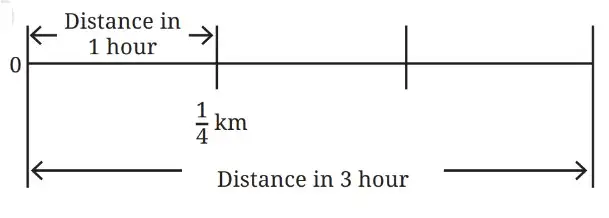
Finding Distance for a Fraction of an Hour
Distance for fractional time — When speed is given per hour, distance for a fractional number of hours is the hourly distance multiplied by that time fraction.
Distance equals speed multiplied by time, provided the units of speed and time match.
Use when speed and time are known.
Finding Distance for a Fraction of an Hour
- Identify the distance travelled in one hour and the fraction of an hour.
- Multiply the hourly distance by the time fraction.
- Simplify the result and include the distance unit.
How far can Aaron walk in hour?
- Aaron walks km in one hour. Find his distance in hour.
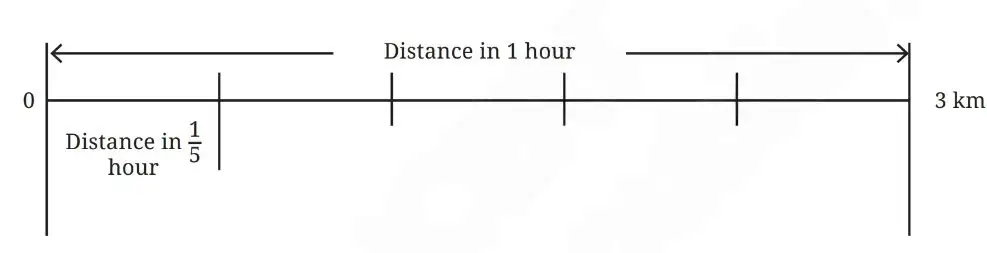
A cyclist covers km in one minute. How far does the cyclist travel in four minutes?
A runner covers km in one hour. How far does the runner travel in hour?
Do not add the time to the hourly distance; multiply them. For example, three hours at km per hour gives km, not km.
Quick recap
- Multiplication can represent repeated addition of the same amount.
- For , multiply the numerator by and keep the denominator.
- At km per hour, Aaron walks km in hours.
- At km per hour, the tortoise walks km in hours.
- Distance equals speed multiplied by time: .
- At km per hour, Aaron walks km in hour.
Multiplication of Fractions Part -2
Multiplying a Fraction by a Whole Number
Multiplication of a fraction and a whole number — It finds a whole-number count of equal fractional amounts, or a fraction of a whole number.
Key Ideas
- Repeated addition: means adding five times.
- Fraction of a whole: means two-fifths of .
- Order: The whole number and fraction can be multiplied in either order.
- Multiplier and multiplicand: In , is the multiplier and is the multiplicand.
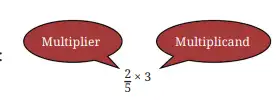
Multiply the whole number by the fraction's numerator and keep the denominator unchanged. Multiplication can be written in either order.
Use this rule for either order of multiplication.
Multiply a Fraction by a Whole Number
- Divide the whole-number multiplicand by the multiplier's denominator.
- Multiply that result by the multiplier's numerator.
- Alternatively, multiply the whole number by the fraction's numerator and keep its denominator.
- Simplify the answer; convert an improper fraction to a mixed number if needed.
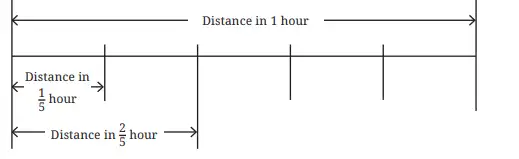
If Aaron walks 3 km in 1 hour, how far does he walk in of an hour?
- At 3 km per hour, find the distance covered in one-fifth of an hour by dividing 3 km into 5 equal parts.
- Two-fifths of an hour is twice one-fifth of an hour, so double that distance.
- Thus, Aaron walks one and one-fifth kilometres in two-fifths of an hour.
Convert a mixed number before multiplying when necessary.
Examples and Applications
- Land shared as gifts: Giving acre to each of 5 grandchildren gives acres in all.
- Internet cost: At Rs. 8 per hour, hours costs .
- Daily amount: Drinking glass daily gives glasses in a week and glasses in January.
- Work rate: Making km of canal per day gives km in five working days.
- Equal sharing over time: Sharing 5 litres among 3 families gives litres per family each week; in 4 weeks, each gets litres.
| Product | Improper fraction | Mixed number |
|---|---|---|
Do not multiply the denominator by the whole number. For example, , not .
Find and write the answer as a mixed number.
Manju and two neighbours share 5 litres of oil equally. How much does one family get in one week and in four weeks?
The Moon sets hour later each day. If it sets at 10 pm on Monday, how many hours later than 10 pm will it set on Thursday, and what time is that?
Quick recap
- Multiplying by a whole number means taking that many equal fractional amounts.
- ; multiply the numerator and keep the denominator.
- For , divide 3 by 5, then multiply the result by 2: .
- Convert mixed numbers to improper fractions before multiplying.
- Simplify the result and write an improper fraction as a mixed number when asked.
Multiplying Two Fractions
Meaning of Fraction Multiplication
Product of two fractions — The product of two fractions gives a fractional part of one fraction, and is found by multiplying their numerators and denominators.
To multiply fractions, multiply the numerators together and the denominators together. Simplify the result when possible.
Use when multiplying any two fractions; simplify the product if possible.
Multiply two fractions
- Multiply the numerators.
- Multiply the denominators.
- Write the numerator product over the denominator product, then simplify.
How far does the tortoise walk in half an hour if it walks km in one hour?
- The tortoise walks at km per hour. Find its distance in half an hour.
- Multiply the numerators and the denominators.
A tortoise walks km in one hour. How far does it walk in of an hour?
Calculate .
Do not add the numerators or denominators when multiplying; multiply numerator by numerator and denominator by denominator.
Quick recap
- Fraction multiplication means finding a fractional part of another fraction.
- Multiply the numerators together and the denominators together.
- Simplify the product when possible.
- .
- .
- Improper fractions follow the same multiplication rule: .
Connection between the Area of a Rectangle and Fraction Multiplication
Area Model for Fraction Multiplication
The area of a rectangle is its length multiplied by its breadth. For fractional sides, the product gives the area in square units.
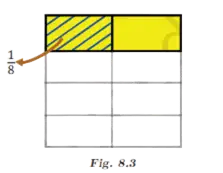
Find the area of a rectangle with sides unit and unit.
- Take the fractional sides as the rectangle’s length and breadth.
- Multiply the side lengths to find the area.
- The rectangle’s area is one-eighth of a square unit.
Multiplying Two Fractions
Use this rule for any two fractions.
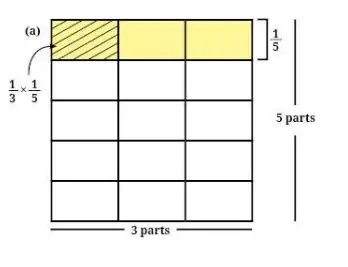
Multiply fractions
- Multiply the numerators.
- Multiply the denominators.
- Write the numerator product over the denominator product, then reduce to lowest form.
Find .
- Multiply the numerators and the denominators.
- Simplify the result if possible; this fraction is already in lowest form.
Do not add the numerators or denominators when multiplying fractions; multiply across instead.
Whole Numbers and Simplifying Products
A whole number can be used in the fraction multiplication rule by writing it over .
Multiply and cancel
- Rewrite any whole number with denominator one.
- Cancel common factors between numerators and denominators.
- Multiply the remaining numerators and denominators, then check that the answer is in lowest form.
Whole-number examples
- Whole number first: .
- Whole number second: .
Multiply and give the answer in lowest form.
- Cancel the common factor between the first numerator and second denominator.
- Multiply the remaining numerators and denominators.
Find .
Find .
Find in lowest form.
Quick recap
- Area: Rectangle area equals length times breadth, even when the sides are fractions.
- Unit fractions: .
- Fraction products: Multiply numerators together and denominators together.
- Whole numbers: Write them as fractions over before multiplying.
- Simplifying: Cancel common numerator-denominator factors and give the answer in lowest form.
A Pinch of History
A Historical Note
- Apavartana: Reducing a fraction to its lowest terms was known in ancient India.
- Historical reference: Jaina scholar Umasvati (c. 150 CE) used apavartana as a simile in a philosophical work.
Multiplying Fractions in Context
Multiply the numerators together and the denominators together; simplify the result if possible.
Finding a Fraction of a Quantity
- Write the fraction and the quantity as factors.
- Multiply, then simplify the answer if possible.
How much of the tank is filled in hour?
- A tap fills of a tank in one hour. Find how much it fills in hour.
- Multiply numerators and denominators, then simplify.
How Multiplication Changes Size
For positive and , multiplying by a factor below makes the other factor smaller; multiplying by a factor greater than makes it larger.
Comparing a Product with Its Factors
- Check whether each factor is less than, equal to, or greater than .
- Use the factor below or above to determine whether the other factor shrinks or grows.
- If comparing with both factors, compare their values directly or use a common denominator.
Is greater or less than its factors?
- Find the product of and .
- Compare using a common denominator: the product is below both factors.
Order of Multiplication
The factors may be interchanged without changing the product.
Using the Commutative Property
- Write the two factors in the given order.
- Interchange their order; the product remains unchanged.
- Multiply either arrangement using the fraction multiplication rule.
Show that changing the order of and does not change their product.
- Multiply the fractions in the first order.
- Reverse their order and multiply again.
After of Somu’s land is taken for a road, Krishna receives half of what remains, Bora receives one-third of what remains, and Somu keeps the rest. Find each share as a fraction of the original land.
Which is heavier: of g or of kg?
A rectangle has sides ft and ft. Also, four saplings in a row are spaced m apart. Find the rectangle’s area and the distance from the first to the last sapling.
Quick recap
- Apavartana means reducing a fraction to its lowest terms.
- To find a fraction of a quantity, multiply the fraction by that quantity.
- A factor between and reduces a positive number; a factor greater than increases it.
- The product of two factors between and is smaller than both.
- Multiplication is commutative: interchanging the factors does not change the product.
Division of Fractions
Dividing by a Fraction
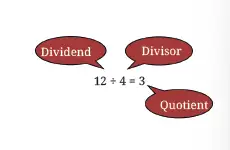
Dividend, divisor, and quotient — The dividend is the number being divided, the divisor is the number we divide by, and the quotient is the result.
Reciprocal — The reciprocal of a non-zero fraction is formed by swapping its numerator and denominator.
A non-zero fraction multiplied by its reciprocal equals .
Why Division Becomes Multiplication
- Idea: To divide by a fraction, find what multiplied by the divisor gives the dividend.
- Reciprocal: Since a fraction times its reciprocal gives , multiply the dividend by the divisor's reciprocal.
- Examples: and .
- Another example: .
Rule and Method
- Rule: Keep the dividend unchanged, change division to multiplication, and take the reciprocal of the divisor.
- Restriction: The divisor cannot be zero, because zero has no reciprocal.
- Attribution: Brahmagupta explicitly stated the general formula for fraction division in the *Brāhmasphuṭasiddhānta* in CE.
Use this to divide by a non-zero fraction.
How to Divide Fractions
- Identify the divisor and find its reciprocal.
- Replace division with multiplication by that reciprocal.
- Multiply the numerators and denominators, then simplify if possible.
Evaluate .
- Take the reciprocal of the divisor and multiply it by the dividend.
- Multiply the numerators and denominators.
Do not take the reciprocal of the dividend. Keep the dividend unchanged and take the reciprocal of the divisor.
Comparing the Quotient and Dividend
- Dividing by a number greater than makes a positive quotient smaller than the dividend: , and .
- Dividing by a number between and makes a positive quotient greater than the dividend: .
- Example with a fractional dividend: , and .
- Dividing by leaves the dividend unchanged.
Evaluate .
Evaluate .
Evaluate .
Quick recap
- The reciprocal of is , and their product is .
- To divide fractions, multiply the dividend by the reciprocal of the divisor.
- For , the quotient is , provided the divisor is non-zero.
- For positive numbers, dividing by a number greater than makes the quotient smaller than the dividend; dividing by a number between and makes it larger.
- Brahmagupta explicitly stated the general division formula in the *Brāhmasphuṭasiddhānta* in CE.
Some Problems Involving Fractions
Using Fraction Division in Problems
- Division in problems: Use division when a quantity is shared equally or when finding how many fractional units fit into a total.
- Method: To divide by a fraction, multiply by its reciprocal; divide by a whole number by multiplying by its reciprocal.
Combining Rates
- Combining rates: Add the amounts each source produces in one unit of time to find their combined rate.
- Example: Four fountains fill 1, 2, 4, and 5 cisterns per day respectively, so together they fill 12 cisterns per day and fill one cistern in day.
Finding a Fraction of a Geometric Area
A total area of square units is covered with square bricks whose sides are unit long. How many brick-areas are needed?
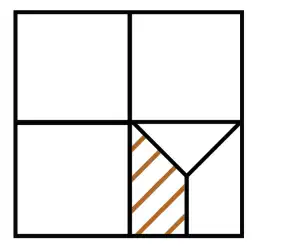
In a diagram, the shaded part of the big square in figure (a) is of the whole, and the red shaded part in figure (b) is of the whole. State each shaded fraction.
Quick recap
- Divide by a non-zero fraction by multiplying by its reciprocal.
- For equal sharing, divide the total quantity by the number of groups.
- Convert completion times into rates per unit time before combining work.
- Add simultaneous rates, then take the reciprocal to find the completion time.
- Multiply nested area fractions to find a region's fraction of the whole.
A Dramma-tic Donation Part-1
The Miser’s Donation
Multiply the Fractions
- Multiply all numerators together and all denominators together.
- Reduce the product to lowest terms.
- Use the stated conversion to identify the number of cowrie shells.
How many cowrie shells did the beggar receive?
- Find the fraction of a dramma given in the donation.
- Multiply the numerators and denominators.
- Simplify, then convert the fraction of a dramma to cowrie shells.
Coins and Their Assumed Conversions
| Type | Names | Typical use |
|---|---|---|
| Gold | Dinars/gadyanas and hunas | Large transactions and storing wealth |
| Silver | Drammas/tankas | Everyday transactions |
| Copper | Kasus/panas and mashakas | Smaller transactions |
| Lowest denomination | Cowrie shells | Very small transactions and change |
Conversion example
- Assumed rates: gold dinar silver drammas; dramma copper panas; pana mashakas and cowrie shells.
- Rates varied: Actual coin values differed by region, period, economic conditions, weight, and purity.
Using the assumed rates, express one cowrie shell in gold dinars.
- Convert one pana into gold dinars using the assumed rates.
- One pana equals gold dinar, and one cowrie is one-thirtieth of a pana.
Fractions and Their Arithmetic
Key historical milestones
- About 800 BCE: The Śhulbasūtra texts used general non-unit fractions, including division of fractions.
- About 150 BCE: Jain scholar Umasvati referred to reducing fractions to lowest terms.
- 628 CE: Brahmagupta codified rules for fraction arithmetic in the Brāhmasphuṭasiddhānta.
- 1150 CE: Bhāskara II’s Līlāvatī explained division by using the reciprocal of the divisor.
Multiplication of fractions — Multiply the numerators together and the denominators together, then simplify the result.
Use this rule to multiply fractions.
Reciprocal — The reciprocal of a non-zero fraction is found by interchanging its numerator and denominator.
Division of fractions — To divide by a non-zero fraction, multiply the first fraction by the reciprocal of the second.
The divisor must be non-zero.
Divide Fractions
- Keep the first fraction unchanged.
- Take the reciprocal of the divisor.
- Multiply and simplify.
Calculate .
- Keep the first fraction and invert the divisor.
- Multiply and simplify if possible.
Find .
Calculate .
Using the stated conversion rates, how many cowrie shells equal one gold dinar?
Quick recap
- A fraction of a quantity is found by multiplying the relevant fractions.
- The donation equals dramma; at cowries per dramma, that is one cowrie.
- With the assumed rates, pana gold dinar and cowrie gold dinar.
- Gold, silver, copper and cowries served progressively lower-value transactions; coin conversion rates varied.
- Multiply fractions by multiplying numerators and denominators, then simplify.
- Divide by a non-zero fraction by multiplying by its reciprocal.
A Dramma-tic Donation Part-2
Development and Geometric Meaning of Fractions
| Date / period | Milestone |
|---|---|
| 499 CE; commentary in 629 CE | Āryabhaṭa’s work was explained by Bhāskara I in Āryabhaṭīyabhāṣya; he described fraction multiplication geometrically by dividing a square into rectangles. |
| c. 750–1150 CE | Śhrīdharāchārya (c. 750), Mahāvīrāchārya (c. 850), Caturveda Pṛithūdakasvāmī (c. 860), and Bhāskara II (c. 1150) further developed fraction arithmetic. |
| c. 1192 CE onward | Indian fraction arithmetic spread through Arab and African mathematicians, including al-Hassâr of Morocco, and reached Europe via Arab scholars. |
| Around the 17th century | Fraction arithmetic came into general use in Europe and later spread worldwide. |
Fraction of a fraction — To find a fraction of another fraction, multiply the two fractions.
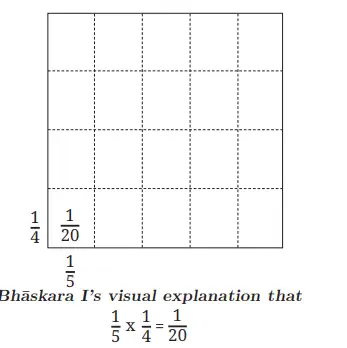
Multiply the numerators together and the denominators together; simplify the result if possible.
Dividing Fractions
Division of fractions — Dividing by a non-zero fraction means multiplying by its reciprocal.
Keep the first number, change division to multiplication, and invert the divisor.
How to divide fractions
- Write any whole number as a fraction over one.
- Replace division by multiplication and take the reciprocal of the divisor.
- Multiply and simplify; convert an improper fraction to a mixed number if useful.
Evaluate .
- Write the whole number over one and invert the divisor.
- Multiply to find the quotient.
- Express the improper fraction as a mixed number.
Do not invert the first number; only the divisor is replaced by its reciprocal.
Fraction Operations in Word Problems
Divide a total by the amount per item to find the number of items; divide the total by the number of equal shares to find each share. Multiply a rate by the quantity to find the total.
Let be the total amount, the amount per portion, the number of equal shares, and the rate applied to quantity .
Model a fraction word problem
- Identify the total and what the question asks you to find.
- Use division for the number of portions or the size of each equal share.
- Use multiplication when applying a rate or finding a fractional part.
- Check that the units and result match the question.
A baker has kg of flour and uses kg per loaf. How many loaves can be made?
- Divide the flour available by the amount needed for one loaf.
- Calculate the number of loaves.
| Situation | Expression | Result |
|---|---|---|
| Use m of lace per bag from m | bags | |
| Share m of ribbon equally among badges | m per badge | |
| kg makes rotis; find flour for | kg | |
| A -page novel: read yesterday and today | pages remain | |
| Travel km per litre using litres | km | |
| Train takes h; plane takes h | h saved | |
| The remaining cake is shared by friends | of the cake each |
Products and Comparing Fractions
If two positive factors are both greater than , their product is greater than each factor and greater than .
Compare with each factor and with .
- Both fractions are greater than one.
- Multiplying either factor by a number greater than one makes the product larger.
- The product is therefore also greater than one.
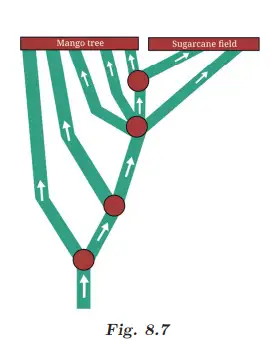
| Destination | Fraction of original group |
|---|---|
| Mango trees | |
| Sugarcane field |
A Telescoping Product
Telescoping product — A product in which consecutive factors cancel, leaving only the first and last parts.
Rewrite each factor as a fraction; intermediate numerators and denominators cancel.
Evaluate a telescoping product
- Rewrite each difference as a fraction of consecutive integers.
- Cancel each numerator against the matching denominator in the next factor.
- The final result is the reciprocal of the last denominator.
Evaluate .
- Rewrite every factor as a fraction.
- Cancel the intermediate factors.
Evaluate .
A train journey takes hours and a plane journey takes hour. How much time does the plane save?
Find .
Quick recap
- The geometric interpretation of fraction multiplication represents a fraction of a fraction as a product.
- To divide by a fraction, multiply by its reciprocal; invert only the divisor.
- Total divided by amount per item gives the number of portions; total divided by the number of shares gives each share.
- Apply a rate by multiplying it by the quantity; use the correct units in the answer.
- A product of two positive factors greater than is greater than either factor and greater than .
- In the product , consecutive terms cancel and leave .
Summary
Multiplying Fractions
Product of fractions — Multiply the numerators together and the denominators together.
For positive numbers, multiplying by a factor between and makes the product smaller than the other number; multiplying by a factor greater than makes it larger. Common factors in numerators and denominators may be cancelled before multiplying.
Multiply the numerators and the denominators.
How to multiply
- Cancel any common factors across numerators and denominators.
- Multiply the remaining numerators and denominators.
- Simplify the result if possible.
Find .
- Cancel common factors before multiplying.
- Multiply the remaining numerators and denominators.
Reciprocals
Reciprocal — The reciprocal of a non-zero fraction is found by interchanging its numerator and denominator.
A fraction multiplied by its reciprocal equals .
The fraction must be non-zero.
How to find a reciprocal
- Swap the numerator and denominator.
- Check that the original fraction is not zero.
Find the reciprocal of and verify it.
- Interchange the numerator and denominator.
- Verify by multiplying the fraction by its reciprocal.
Dividing Fractions
Division of fractions — To divide by a fraction, multiply by its reciprocal.
For positive numbers, dividing by a divisor between and gives a quotient greater than the dividend; dividing by a divisor greater than gives a quotient less than the dividend.
The divisor must be non-zero.
How to divide
- Keep the first fraction unchanged.
- Change division to multiplication and flip the second fraction.
- Multiply and simplify.
Find .
- Keep the first fraction, change division to multiplication, and invert the second fraction.
- Multiply and simplify.
Keep, change, flip
For fraction division: keep the first fraction, change to , and flip the second fraction.
Calculate .
Find the reciprocal of and state their product.
Calculate .
Quick recap
- Brahmagupta’s formula for multiplying fractions multiplies numerators together and denominators together.
- Cancel common factors before multiplying when possible.
- For positive numbers, multiplying by a factor below decreases the other number; multiplying by a factor above increases it.
- The reciprocal of is , where the fraction is non-zero; their product is .
- To divide by a fraction, multiply by its reciprocal; this is Brahmagupta’s formula for fraction division.
- For positive numbers, division by a number below increases the dividend; division by a number above decreases it.
Formula sheet
Mathematics — ALL CHAPTERS
1
Large Numbers Around Us
2
Arithmetic Expressions
3
A Peek Beyond the Point
4
Expressions using Letter-Numbers
5
Parallel and Intersecting Lines
6
Number Play
7
A Tale of Three Intersecting Lines
8
Working with Fractions
1
Geometric Twins
2
Operations with Integers
3
Finding Common Ground
4
Another Peek Beyond the Point
5
Connecting the Dots
6
Constructions and Tilings
7
Finding the Unknown