Class 11 Humanities . Political Science . India Constitution At Work . Constitution Why and How
Chapter 1: Constitution: Why And How?
Ch 1
Political Science
Class 11 Humanities
Introduction & Why do we need a Constitution?
Introduction
What the Constitution does and what this chapter covers
- Foundation: The structure of government and the principles that bind its institutions have their origin in the Constitution.
- Institutions: Studying the Constitution helps explain how government institutions work and relate to one another.
- Chapter topics: The chapter examines what a constitution means, its effects on society, how it allocates power, and how the Constitution of India was made.
Why Do We Need a Constitution?
Constitution — A constitution is a set of basic rules, publicly known and legally enforceable, that helps a society live and function together.
A diverse, interdependent society
- Diversity: People differ in religion, profession, ability, interests, age and wealth.
- Disagreements: Members may disagree about property ownership, schooling, public spending and discrimination.
- Interdependence: Despite differences, people live together and depend on one another, so cooperation is necessary.
Coordination and Assurance
The Constitution’s first function
- Basic rules: Shared rules make it possible for people to coordinate their actions and settle how they may treat one another.
- Public knowledge: Rules must be made known to everyone; otherwise, people may be unsure of others’ actions and claims.
- Enforceability: Rules must be legally enforceable. Punishment for breaking them assures people that others are expected to follow them too.
- Without rules: Insecurity and uncertainty make cooperation difficult.
Coordination and assurance — A constitution provides basic rules for minimal coordination and gives people confidence that others will follow those rules.
How constitutional rules support cooperation
- Rules are made public and known to members
- Members can anticipate what others may do
- Legal enforcement discourages rule-breaking
- People gain assurance and can cooperate
- Basic rules
- Shared rules that guide conduct and help members coordinate.
- Publicly known
- Made available and clear to all members of society.
- Legally enforceable
- Rules that can be upheld by law, with punishment for violations.
- Assurance
- Confidence that others are also expected to obey the rules.
Why must constitutional rules be both publicly known and enforceable?
What is the first function of a constitution?
Quick recap
- The Constitution is the foundation for government structure and the principles binding its institutions.
- The chapter covers constitutional meaning, effects on society, allocation of power and how India’s Constitution was made.
- Societies are diverse, yet their members depend on one another and need to cooperate.
- Disagreements make shared basic rules necessary.
- Constitutional rules should be publicly known and legally enforceable.
- Enforcement gives people assurance that others are expected to follow the rules.
- The Constitution’s first function is to enable minimal coordination in society.
Specification of decision making powers
Constitution — A constitution is a body of fundamental principles according to which a state is constituted or governed.
Who Gets to Decide?
Allocating decision-making power
- Core question: Before deciding which laws should govern society, a constitution must determine who has the authority to make them.
- Constitution’s role: It allocates basic powers and establishes who may decide laws and policies.
- Different systems: A monarch decides in a monarchy; in the former Soviet Union, a single party had decision-making power; in a democracy, the people broadly hold that power.
- Democratic choices: People may decide directly or elect representatives. A constitution helps establish how representatives are chosen and how government is organized.
- India: Parliament makes laws and policies in most instances. The Constitution gives Parliament that authority and specifies how it is organized.
| Point | Direct | Representative |
|---|---|---|
| How people take part | People vote on each matter themselves. | People elect representatives to make decisions on their behalf. |
| Example or issue | The ancient Greeks used direct voting. | The constitution must specify how representatives are elected and how many there are. |

Limiting Government Powers
Why limits are necessary
- Authority is not enough: A government formed through proper procedures could still pass unjust laws.
- Examples of injustice: Laws might restrict religion, speech, property, or freedom from arbitrary arrest, or discriminate by caste, religion, or skin colour.
- Constitutional limit: A constitution sets fundamental boundaries on what government may impose; the government must not trespass them.
Fundamental rights as safeguards
- Main protection: Constitutions commonly protect fundamental rights that governments are not normally allowed to violate.
- Basic safeguards: These include protection from arbitrary arrest and liberties such as speech, conscience, association, and conducting a trade or business.
- Variation: The exact content and interpretation of rights differ between constitutions.
- Emergency exception: Rights may be limited or withdrawn during a national emergency, under circumstances specified by the constitution.
- Allocation of power
- The assignment of authority to make laws and decisions among institutions or people.
- Fundamental rights
- Basic rights protected by the constitution against government violation, subject to specified limits.
- Arbitrary arrest
- Detaining someone without proper reason or legal safeguards.
What is one major function of a constitution in allocating decision-making power?
How does a constitution limit government power?
Quick recap
- A constitution establishes who has authority to make laws and decisions.
- Decision-making power may rest with a monarch, a single party, or—in a democracy—the people.
- People can decide directly or through elected representatives.
- The Indian Constitution empowers Parliament to make laws and policies in most instances.
- Constitutions limit government power and safeguard fundamental rights.
- Rights may be limited during emergencies in circumstances specified by the constitution.
Aspirations and goals of a society
Enabling Government to Fulfil Social Aspirations
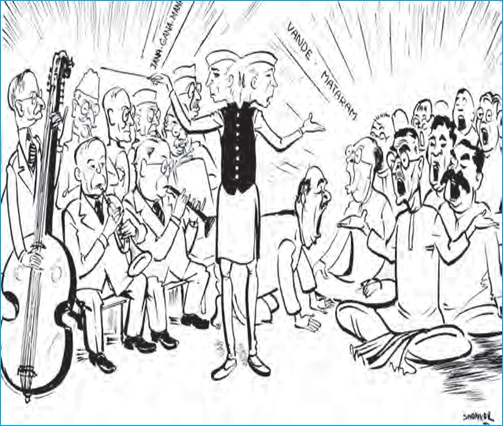
Cartoon in the Lecture
- 4 December 1949A cartoon depicts Nehru balancing different visions and ideologies during constitution-making.
Enabling Provisions and Welfare
| Constitution | Government responsibility |
|---|---|
| South Africa | Promote nature conservation; protect people or groups facing unfair discrimination; progressively secure adequate housing and health care. |
| Indonesia | Establish and run a national education system; care for poor and destitute children. |
How Constitutional Enabling Powers Support Justice
- Social aspiration to overcome inequality or deprivation
- Constitution empowers government to take positive measures
- Measures help create conditions for a more just society
Fundamental Identity of a People

Competing Interests in Constitution-Making
- Iraq: After Saddam Hussein’s regime collapsed, constitution-writing involved conflict among Shiites, Sunnis and Kurds.
- Cartoon’s point: The groups agree to join hands but each seeks influence over the document, showing that cooperation can coexist with competing interests.
Constitutions and National Identity
| Point | Germany | India |
|---|---|---|
| Basis described in the lecture | Ethnic German identity | Citizenship is not limited by ethnicity, caste or religion |
Functions of Constitutional Provisions
| Provision | Function |
|---|---|
| Government cannot order citizens to follow or not follow a religion. | Limits government power. |
| Government must try to reduce inequalities in income and wealth. | Enables government to pursue social aspirations and justice. |
| President can appoint the Prime Minister. | Allocates decision-making powers. |
| The Constitution is the supreme law everyone must obey. | Establishes the basic legal framework and limits government. |
| Indian citizenship is not limited to people of a particular race, caste or religion. | Expresses an inclusive national identity. |
- Enabling provisions
- Constitutional provisions that empower government to take positive action for society.
- Fundamental identity
- The shared political and moral identity shaped by constitutional norms and values.
- Directive Principles of State Policy
- Principles that enjoin government to fulfil certain aspirations of the people.
Why must a constitution both limit and empower government in an unequal society?
How does a constitution express the fundamental identity of a people?
Quick recap
- Constitutions can limit government and empower it to pursue social goals.
- Indian constitutional provisions support dignity, welfare and action against caste discrimination.
- South African and Indonesian constitutions assign governments positive social responsibilities.
- Shared constitutional norms help form political and moral identity.
- Constitutions differ in national identity; India does not restrict citizenship by race, caste or religion.
- Constitution-making can involve both cooperation and competition among groups.
The Authority of a Constitution
What Is a Constitution?
- Meaning: A constitution is a document or set of documents that establishes how a state is governed.
- Role: It sets the basic rules, powers, limits and principles that shape government and society.
How Effective Is a Constitution?
- Effectiveness: A constitution succeeds when it has real authority and shapes people’s lives, rather than remaining words on paper.
- Key test: It should command allegiance by offering a just framework and organising power so no group can easily subvert it.
Mode of Promulgation
Making of the Indian Constitution
- December 1946–November 1949India’s Constituent Assembly formally created the Constitution.
Constitution-Making in Nepal
Nepal’s Constitutions and Political Change
- 1948Nepal’s first constitution was granted by the King.
- 1951A second constitution was granted by the King.
- 1959A third constitution was granted by the King.
- 1962A fourth constitution was granted by the King.
- 1990A fifth constitution introduced multi-party competition while the King retained final powers in many respects.
- October 2002The King took over all powers.
- 2008Nepal became a democratic republic after abolishing the monarchy.
- 2015Nepal adopted a new constitution.
Nepal: Royal Control to a New Constitution
- Constitutions granted by the King and continued royal power -> demands to restructure the government
- Dispute over the monarchy and the King’s refusal to give up power -> militant political agitation
- Popular pressure -> a government acceptable to the agitating parties, with the King stripped of almost all powers
- Abolition of the monarchy in 2008 -> Nepal became a democratic republic
- Further constitution-making -> a new constitution adopted in 2015
Substantive Provisions of a Constitution
- Purpose: Constitutional provisions should give all groups a reason to accept and follow the rules.
- Justice: A constitution should preserve freedom and equality and prevent permanent majorities from oppressing minorities.
- Allegiance: It should not systematically privilege some groups or stifle people’s identities, but provide a framework for pursuing basic justice.
Balanced Institutional Design

Assessing the Authority of a Constitution
Why did the Indian Constitution gain public authority without a referendum?
How does the Indian Constitution reduce the risk of one institution subverting it?
Quick recap
- A constitution may be one document or a collection of documents that establishes how a state is organised and the norms it follows.
- Its effectiveness depends partly on how it was made, the credibility of its makers and public acceptance.
- Nepal’s royal constitutions and dispute over monarchy led to agitation, a democratic republic in 2008 and a new constitution in 2015.
- Constitutions are more likely to gain allegiance when they protect freedom and equality, avoid oppression and provide a framework for basic justice.
- Divided power and checks and balances help prevent any one institution or group from subverting a constitution.
- A successful constitution balances stable core values with flexibility to adapt to changing circumstances.
How was the Indian Constitution made?
The Constituent Assembly and its formation
How members were selected
- Constituent Assembly: It formally drafted the Indian Constitution. Its members were indirectly elected by Provincial Legislative Assemblies formed under the Government of India Act, 1935.
- Cabinet Mission Plan: The Assembly’s composition broadly followed this British Cabinet committee’s plan.
- Provincial seats: British-ruled Provinces elected 292 members; seats were distributed among Muslims, Sikhs and the general category according to population.
- Seat allocation: Provinces and Princely States (or groups of States) received seats roughly in proportion to population, at about one seat per 1,000,000 people; Princely States were allotted at least 93 seats.
- Election method: Members of each community in a Provincial Legislative Assembly elected its representatives by proportional representation with a single transferable vote.
- Princely States: Their method of choosing representatives was to be decided through consultation.
Representation and the impact of Partition
Who was represented?
- Partition: Under the plan of 3 June 1947, members elected from territories that became part of Pakistan ceased to belong to the Assembly; its membership fell to 299.
- Social representation: Although the Assembly was not elected by universal suffrage, it aimed to represent different communities. It included members of all religions and 28 members from the Scheduled Castes.
- Political representation: Congress held 82% of the seats after Partition. Its diversity allowed it to include a wide range of opinions.
- Limits and strengths: The Assembly was not directly elected by all adults, but its composition and the diversity within Congress contributed to broader representation.
Partition and the Constitution’s citizenship vision
- Partition brought severe violence across the subcontinent.
- The Assembly continued drafting the Constitution under immense pressure.
- The experience strengthened its commitment to a new idea of citizenship.
- The Constitution aimed to protect minorities and ensure religious identity did not determine citizenship rights.
Social democracy
Social democracy — A way of life based on liberty, equality and fraternity, which must support political democracy.
Ambedkar’s argument
- Liberty, equality and fraternity: These principles are interconnected; separating any one weakens democracy.
- Liberty without equality: It can allow a few to dominate the many.
- Equality without liberty: It can suppress individual initiative.
- Without fraternity: Liberty and equality may not become a natural part of social life.
- Political democracy: It cannot endure unless social democracy forms its foundation.
Key dates in constitution-making
- 9 December 1946The Constituent Assembly held its first sitting.
- 3 June 1947The Partition plan led members from territories assigned to Pakistan to leave the Assembly.
- 14 August 1947The Assembly reassembled as the Constituent Assembly for divided India.
- 25 November 1949Dr. B. R. Ambedkar stressed that political democracy depends on social democracy.
- 26 November 1949The Constitution was adopted.
- 24 January 1950284 members present signed the Constitution as finally passed.
- 26 January 1950The Constitution came into force.
- Constituent Assembly
- The body that formally framed the Indian Constitution.
- Indirect election
- Election in which Provincial Legislative Assembly members chose the Constituent Assembly representatives.
- Proportional representation
- An election system that allocates representation broadly according to population or share of votes.
- Single transferable vote
- A voting method used by Provincial Assembly members to elect community representatives.
- Social democracy
- A social order grounded in liberty, equality and fraternity.
How were members of the Constituent Assembly chosen?
Why was the Constituent Assembly considered representative despite not being elected by universal suffrage?
What did Ambedkar mean by saying political democracy needs social democracy?
Quick recap
- The Constituent Assembly was indirectly elected under a plan broadly based on the Cabinet Mission proposals.
- Its members represented communities and regions, though it was not elected by universal suffrage.
- Partition reduced the Assembly to 299 members and shaped its commitment to inclusive citizenship.
- The Constitution was adopted on 26 November 1949 and came into force on 26 January 1950.
- Ambedkar argued that political democracy depends on the inseparable values of liberty, equality and fraternity.
The Principle of Deliberation
Deliberation and Public Reason
- Public reason: Assembly members offered principled reasons for their views and considered the interests of the whole nation.
- Deliberation: Debate and reasoned argument helped members address differences rather than simply advance their own interests.
Procedures of the Assembly
- Committees: Eight major committees drafted provisions on different subjects before they were debated by the full Assembly.
- Decision-making: Members sought consensus where possible; some provisions were decided by vote, with arguments and concerns carefully answered.
- Openness: The Assembly met for 166 days over two years and eleven months, and its sessions were open to the press and public.
Inheritance from the Nationalist Movement
Values Expressed in the Constitution
- Core values: The Objective Resolution’s commitments included equality, liberty, democracy, sovereignty and a cosmopolitan identity.
- More than rules: The Constitution is a moral commitment to fulfil the promises made to the people by the nationalist movement, not merely a system of rules and procedures.
Institutional Arrangements
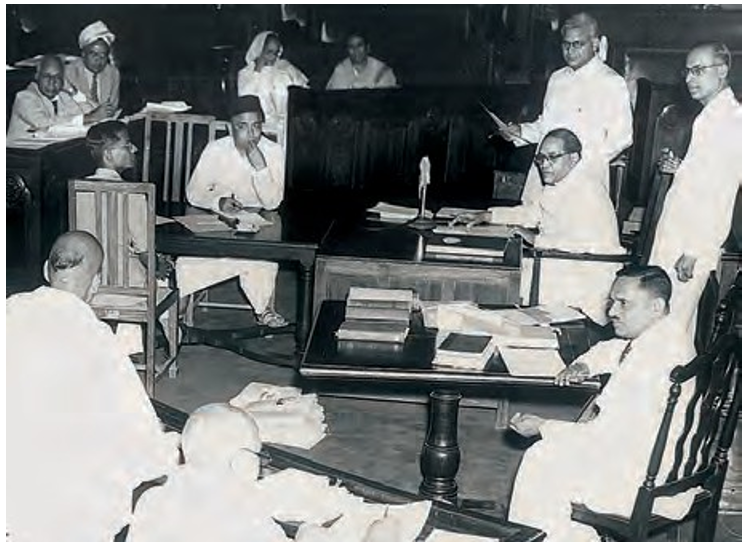
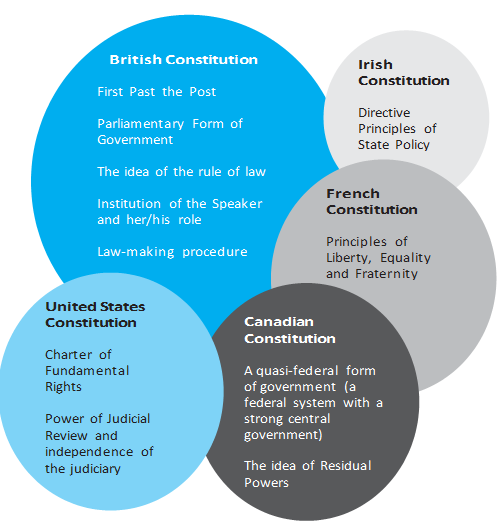
Enduring Significance
Key Dates and Duration
- 1946Jawaharlal Nehru moved the Objective Resolution in the Constituent Assembly.
- 4 November 1948B.R. Ambedkar discussed adapting constitutional provisions to the country’s needs.
- Two years and eleven months; 166 sitting daysThe Constituent Assembly conducted its work over this period.
- 26 November 1949Rajendra Prasad praised the work and devotion of the Drafting Committee and its Chairman, B.R. Ambedkar.
- Public reason
- Reasoned argument based on principles and offered for others to consider.
- Universal suffrage
- The right of all citizens reaching the required age to vote, regardless of identity or social position.
- Objective Resolution
- Nehru’s 1946 resolution defining the Assembly’s aims and the values behind the Constitution.
- Federal arrangement
- A system that distributes governmental powers between the Union and the States.
Why was public reason important to the authority of the Constituent Assembly?
How did the nationalist movement shape the Constitution?
How did the framers use constitutional ideas from other countries?
Quick recap
- The Assembly’s authority came from broad representation, public reason and careful deliberation.
- Members debated most constitutional questions; universal suffrage was adopted with virtually no debate.
- Committees drafted provisions for full-Assembly debate, with consensus, votes and careful written responses to concerns.
- The nationalist movement’s debates and the 1946 Objective Resolution shaped the Constitution’s core values.
- The Constitution established parliamentary and federal arrangements and adapted ideas from other countries to Indian needs.
- Its shared values, institutional balance and capacity to meet people’s aspirations helped it endure and influence other constitutions.
Political Science — ALL CHAPTERS
1
Constitution: Why And How?
2
Rights In The Indian Constitution
3
Election And Representation
4
Executive
5
Legislature
6
Judiciary
7
Federalism
8
Local Governments
9
Constitution as A Living Document
10
The Philosophy Of The Constitution
1
INTRODUCTION TO POLITICAL THEORY
2
FREEDOM OVERVIEW
3
EQUALITY
4
SOCIAL JUSTICE
5
RIGHTS
6
CITIZENSHIP
7
NATIONALISM
8
SECULARISM