Class 11 Humanities . Political Science . India Constitution At Work . Executive
Chapter 4: Executive
Ch 4
Political Science
Class 11 Humanities
What is an Executive ?
Meaning and Functions of the Executive
The Executive in Government
- Executive: The organ of government chiefly responsible for implementing laws and policies and administering public affairs.
- Policy role: The executive may also help frame policies and make important government decisions.
- Administration: It coordinates and supervises routine work needed to put laws and decisions into practice.
- Government organs: The legislature, executive and judiciary perform government functions and are expected to coordinate while maintaining a balance.
- Parliamentary system: The legislature controls the executive; in turn, the executive also controls the legislature.
| Point | Political executive | Permanent executive |
|---|---|---|
| Who it includes | Heads of government and ministers | Civil servants and administrative machinery |
| Main responsibility | Overall government policy and political decisions | Day-to-day administration and implementation |
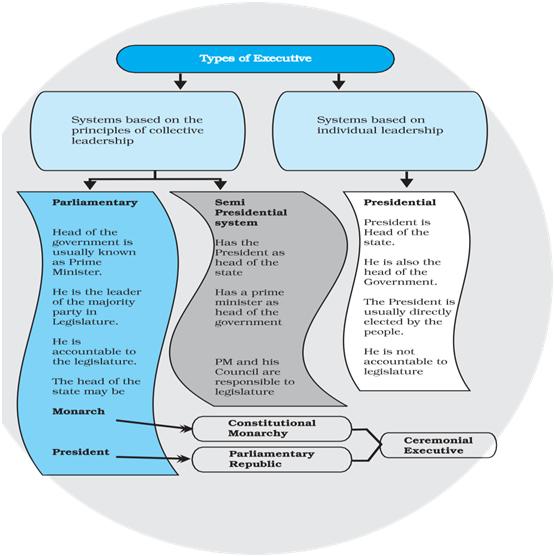
Types of Executive Systems
| Point | Presidential | Parliamentary | Semi-presidential |
|---|---|---|---|
| Head of government | President | Prime Minister | Prime Minister |
| Head of state | President | Usually a ceremonial president or monarch | President |
| Where effective power lies | The President holds strong executive power | The Prime Minister and cabinet wield effective power | The President may possess significant day-to-day powers alongside a Prime Minister |
| Examples in the lecture | United States, Brazil and most Latin American nations | Germany, Italy, Japan, United Kingdom, Portugal | France, Russia, Sri Lanka |
| Country | System | Key arrangement |
|---|---|---|
| United States | Presidential | The President is both head of state and head of government. |
| Canada | Parliamentary constitutional monarchy | The monarch is formal head of state; the Prime Minister heads the government. |
| France | Semi-presidential | The President appoints the Prime Minister and ministers; they are responsible to Parliament and cannot be dismissed by the President. |
| Japan | Parliamentary | The Emperor is head of state; the Prime Minister heads the government. |
| Italy | Parliamentary | The President is formal head of state; the Prime Minister heads the government. |
| Russia | Semi-presidential | The President is head of state; the President appoints the Prime Minister, who heads the government. |
| Germany | Parliamentary | The President is ceremonial head of state; the Chancellor heads the government. |
Do not identify a system by its office titles alone. A country can have both a President and a Prime Minister, and the President may be ceremonial, powerful or share power. The constitutional roles determine the system.
Sri Lanka’s Semi-Presidential System
- 1978Sri Lanka amended its Constitution and introduced the system of Executive Presidency.
Powers and Position of the President
- Election and term: The people directly elect the President for a six-year term.
- Roles: The President is head of state, head of government and Commander-in-Chief of the Armed Forces.
- Prime Minister: The President chooses the Prime Minister from the party holding a majority in Parliament.
- Ministers: Ministers must be members of Parliament; the President can remove the Prime Minister or ministers.
- Party relationship: The President and Prime Minister may belong to the same party or to different parties.
Removal of the Sri Lankan President
- A resolution supported by at least half of all Members of Parliament may be reported by the Speaker to the Supreme Court if the Speaker considers the allegations worthy of inquiry.
- The President can be removed only through a parliamentary resolution passed by at least two-thirds of all Members of Parliament.
- Executive
- The government organ responsible for implementing laws and policies and administering public affairs.
- Political executive
- The heads of government and ministers responsible for overall government policy.
- Permanent executive
- Civil servants responsible for day-to-day administration.
- Head of state
- The formal representative of the state; the role may be ceremonial or carry substantial powers.
- Head of government
- The leader responsible for directing the government’s work.
Why is it incorrect to say that every country with a President has a presidential executive?
What is the difference between the political and permanent executive?
Quick recap
- Executive: Implements laws and policies and administers government; it may also help frame policy.
- Political executive: Ministers and government leaders are responsible for overall policy; the permanent executive handles day-to-day administration.
- Systems: Presidential, parliamentary and semi-presidential systems differ in how executive power is allocated.
- Titles are not enough: A President may be ceremonial, powerful or share executive authority with a Prime Minister.
- Sri Lanka: Since the 1978 constitutional change, its directly elected President has major powers and serves a six-year term.
Parliamentary Execution in India
Why India Adopted the Parliamentary System
- Accountability: Parliamentary government makes the executive answerable to people’s representatives.
- Safeguards: The system combines a strong executive with legislative control, reducing the danger of a personality cult.
Executive at the Union and State Levels
- Union: The President is the formal Head of State, while the Prime Minister and Council of Ministers run the national government.
- States: The Governor is the formal head, while the Chief Minister and Council of Ministers run the State government.
Election and Removal of the President
- Election: The President serves a five-year term and is elected indirectly by elected MPs and MLAs through proportional representation by single transferable vote.
- Removal: Parliament may remove the President by impeachment for violation of the Constitution, following a special-majority procedure.
President’s Powers and Position
How Executive Authority Works in Practice
- The Constitution formally vests Union executive power in the President.
- The Council of Ministers, headed by the Prime Minister, advises the President.
- Article 74(1) makes that advice binding, subject to a request for reconsideration.
- The Council must provide advice again after reconsideration.
- The President must act on the reconsidered advice; the Council supported by the Lok Sabha majority is the real executive.
- Parliamentary executive
- An executive accountable to the legislature and its elected representatives.
- Impeachment
- The parliamentary procedure for removing the President for violation of the Constitution.
- Proportional representation
- The electoral system used for the indirect election of the President.
- Single transferable vote
- The voting method used in the President’s proportional-representation election.
How is the President of India elected and removed?
Explain the President’s position under Article 74(1).
Quick recap
- India adopted the parliamentary executive for Union and State governments to ensure accountability and legislative control.
- At the Union level, the President is the formal Head of State; the Prime Minister and Council of Ministers run the government.
- The President is indirectly elected for five years by elected MPs and MLAs using proportional representation and the single transferable vote.
- Impeachment is Parliament’s method of removing the President for violation of the Constitution and requires a special majority.
- Under Article 74(1), the President must act on ministerial advice, including advice given after reconsideration.
- The Council of Ministers with the Lok Sabha majority is the real executive.
Discretionary Powers of the President
When the President Can Exercise Discretion
- Information: The President may seek information from the Prime Minister on the affairs and decisions of the government.
- Discretion: The President may ask the Council of Ministers to reconsider its advice and, in exceptional political situations, use judgment in appointing a Prime Minister.
Veto and Pocket Veto
- Veto: The President may withhold assent to a non-Money Bill or return it to Parliament for reconsideration.
- Reconsideration: If Parliament passes the Bill again, the President must give assent.
- Pocket veto: Since no time limit is prescribed for assent, the President may keep a Bill pending indefinitely.
Political Circumstances and Government Formation
Why the President’s Role Matters
- The Council of Ministers depends on legislative majority → it may lose office and need replacement.
- A government may need to be formed quickly → a Head of State with a fixed term appoints the Prime Minister.
- No party has a clear majority → the President assesses claims and appoints a Prime Minister likely to command support.
- The President also symbolically represents the whole country.
The Vice President of India
Example of an Acting President
- B. D. Jatti acted as President after Fakhruddin Ali Ahmed’s death, until a new President was elected.
If the Prime Minister advises President’s Rule in a State but the President disagrees, what course is open to the President?
- The President’s discretion is limited, but it grows in importance when there is no clear Lok Sabha majority.
- The President can return a Bill other than a Money Bill once; if Parliament passes it again, assent is required.
- A pocket veto is the informal use of the absence of a time limit to keep a Bill pending.
Quick recap
- The President may seek information and express views, but most executive action follows ministerial advice.
- The President can ask the Council of Ministers to reconsider its advice once; repeated advice is binding.
- The President may return a non-Money Bill once; delaying action without a time limit is called a pocket veto.
- In a hung Lok Sabha, the President assesses who can command majority support and form a government.
- The Vice President serves five years, chairs the Rajya Sabha ex officio, and acts as President during a vacancy until a successor is elected.
Prime Minister and Council of Ministers
The Prime Minister and the Council of Ministers
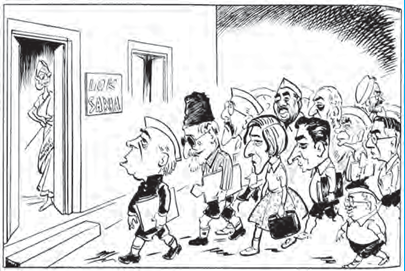
- Central role: The President exercises powers on the advice of the Council of Ministers, which is headed by the Prime Minister.
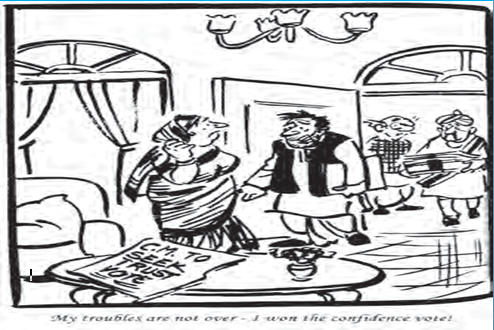
- Majority support: In the parliamentary system, the Prime Minister must have the support of a majority in the Lok Sabha; losing it means losing office.
- Appointment: The President formally appoints the leader who can command majority support.
- Coalition selection: Since 1989, when no party has won a Lok Sabha majority, parties have formed coalitions; their partners choose a leader acceptable to the majority.
Choosing Ministers and Allocating Portfolios
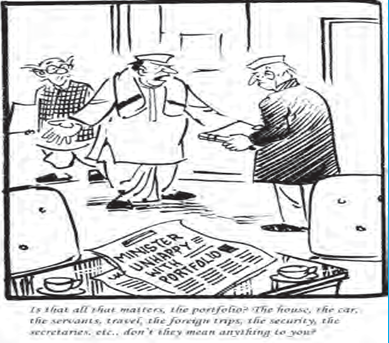
- Selection: The Prime Minister chooses the ministers and allocates their ranks and portfolios.
- Ranks: Ministers may be cabinet ministers, ministers of State or deputy ministers; seniority and political importance are considered.
- MP requirement: The Prime Minister and ministers must be members of Parliament. A non-MP appointed to either office must become an MP within six months.
- State parallel: A Chief Minister similarly chooses ministers from their party or coalition.
An alternative proposal
- Begum Aizaz Rasul: In the Constituent Assembly on 17 July 1947, she supported a Swiss-style system in which the legislature elects the executive for a fixed period.
- Representation: She proposed the single transferable vote to represent different interests and avoid leaving any legislative party unrepresented in the executive.
Size of the Council of Ministers
- Before 2003: There was no limit on the Council’s size, allowing very large ministries and encouraging attempts to win legislators’ support with ministerial positions.
- 91st Amendment Act (2003): The Council must not exceed 15% of the total membership of the Lok Sabha; in a State, the limit is 15% of the Assembly’s total membership.
Collective Responsibility and Legislative Control
Collective responsibility — The Council of Ministers is collectively responsible to the Lok Sabha and must resign if it loses the House’s confidence.
- Cabinet solidarity: A no-confidence vote against even one minister requires the entire Council to resign.
- Cabinet decisions: A minister who disagrees with a cabinet decision must accept it or resign; all ministers must support policies for which the Council is collectively responsible.
- Parliamentary control: In a parliamentary executive, the legislature routinely controls and supervises the executive.
The Prime Minister’s Position and Powers
- Formation: The Council of Ministers comes into existence only after the Prime Minister takes the oath of office.
- Link to President and Parliament: The Prime Minister communicates Council decisions on Union administration and legislative proposals to the President.
- Leadership: The Prime Minister is involved in crucial government decisions and policy-making. Jawaharlal Nehru called the Prime Minister the government’s “linchpin.”
- Sources of influence: These include control over the Council, leadership in the Lok Sabha, command of the bureaucracy, access to media, election-time public profile and representation of India internationally.
| Event | Effect on the Council of Ministers |
|---|---|
| Prime Minister dies or resigns | The entire Council of Ministers is dissolved. |
| A minister dies, is dismissed or resigns | A ministerial vacancy is created; the Council continues. |
Single-Party Majority and Coalition Governments
| Point | Single-party majority | Coalition government |
|---|---|---|
| Prime Minister’s position | The position of the Prime Minister and Council of Ministers is generally unassailable while the party retains its Lok Sabha majority. | Authority is constrained by the need to maintain the support of coalition partners. |
| Decision-making | The Prime Minister has greater authority over ministers, portfolios and government policy. | Ministers, ranks, portfolios and policies are shaped by consultation, negotiation and compromise among partners. |
| Stability | Majority support generally gives the government a stronger position. | Since 1989, several coalition governments have lost majority support, resigned or been removed before the Lok Sabha completed its full term. |
How coalition politics affects the executive
- No party has a Lok Sabha majority → parties form pre-poll or post-poll alliances.
- The Prime Minister must consult partners → choices of ministers, ranks and portfolios are restricted.
- Partners may have different ideologies → government policies require negotiation and compromise.
- Coalition support may be uncertain → the President’s discretionary role in selecting a Prime Minister can grow.
- The Prime Minister must reconcile partners’ positions → the role becomes more that of a negotiator than a sole decision-maker.
The Parliamentary Executive in the States
- Chief Minister: Like the Prime Minister, the Chief Minister leads the majority party or coalition in the Assembly.
- Governor: The President appoints the Governor on the advice of the central government. The Governor has more discretionary powers than the President.
- Principle: The main principles of the parliamentary system also operate at the State level.
What does collective responsibility of the Council of Ministers mean?
What limit did the 91st Amendment Act (2003) set for the size of the Council of Ministers?
How does coalition government affect the Prime Minister’s authority?
Quick recap
- The Prime Minister heads the Council and must retain majority support in the Lok Sabha.
- The Prime Minister selects ministers, assigns portfolios and links the Council with the President and Parliament.
- The 91st Amendment Act (2003) caps the Council at 15% of the relevant House’s total membership.
- Collective responsibility means the Council stands or falls together in the Lok Sabha.
- The Prime Minister’s departure dissolves the Council; a minister’s departure creates only a vacancy.
- A single-party majority strengthens the Prime Minister’s position; coalition politics limits unilateral authority and requires negotiation.
- State governments follow parliamentary principles, with a Governor who has greater discretion.
Permanent Executive : Bureaucracy
The Permanent Executive
- Meaning: The permanent executive is the body of trained civil servants who assist ministers and carry out government administration.
- Continuity: Unlike the political executive, civil servants remain in office as governments change.
Size of the Council of Ministers
Limit on the Council of Ministers
- Before 2003There was no numerical limit, which could lead to very large councils and ministerial positions being offered to gain political support.
- 91st Amendment Act, 2003The Council of Ministers was limited to 15% of the total members of the House of the People or the State Legislative Assembly.
Political Control and Neutrality
- Political control: Elected ministers supervise the administration, and the legislature exercises control over its work.
- Neutrality: Civil servants are expected to avoid political positions and efficiently implement the policies of the government in office.
Structure, Recruitment and Representation
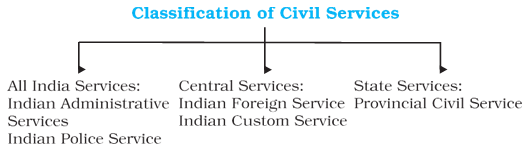
| Component | Examples or role |
|---|---|
| All-India services | Services such as the IAS and IPS |
| Central services | Civil services serving the Union government |
| State services | Officials recruited for State administration |
| Other public administration | Local-government employees and technical and managerial staff in public sector undertakings |
Merit-Based Recruitment and Social Representation
- Recruitment The Union Public Service Commission (UPSC) conducts recruitment for civil servants of the Government of India; States have similar Public Service Commissions.
- Commission safeguards Members serve for a fixed term; their removal or suspension requires a thorough enquiry by a Supreme Court judge.
- Merit and inclusion Recruitment is based on efficiency and merit, while constitutional reservations widen access for under-represented sections.
- Reservations Provisions cover Scheduled Castes and Scheduled Tribes; reservations were subsequently extended to women, Other Backward Classes (OBC) and Economically Weaker Sections (EWS).
- Purpose These measures aim to make the bureaucracy more representative and prevent social inequalities from obstructing entry into civil service.
All-India Services and Centre–State Relations
- Services: IAS and IPS officers form an important part of the higher-level administration in the States.
- Centre–State link: These officers are assigned to States and work under State supervision, but are appointed by the central government, which alone can take disciplinary action against them.
Bureaucracy: Strengths and Concerns
- Strengths: A professional bureaucracy provides continuity, expertise and the administrative machinery needed to implement welfare policies.
- Concerns: Administration can be insensitive to citizens, while excessive political interference can turn civil servants into instruments of politicians.
Democratic Control of the Executive
What does political neutrality of the bureaucracy mean?
How do IAS and IPS officers connect State administration with the Central Government?
Quick recap
- The executive comprises the Prime Minister, ministers and bureaucracy; civil servants permanently assist ministers and implement policies.
- The 91st Amendment Act, 2003 capped the Council of Ministers at 15% of the legislature's membership.
- Civil servants must be politically neutral and work under democratic and legislative control.
- The UPSC and State Public Service Commissions recruit officials; reservations support broader representation.
- IAS and IPS officers serve States but remain under key Central Government appointment and disciplinary powers.
- RTI and democratic supervision can improve responsiveness and accountability while guarding against excessive political interference.
- Because the executive has greater powers than other organs, elections, constitutional limits and parliamentary oversight are essential.
Political Science — ALL CHAPTERS
1
Constitution: Why And How?
2
Rights In The Indian Constitution
3
Election And Representation
4
Executive
5
Legislature
6
Judiciary
7
Federalism
8
Local Governments
9
Constitution as A Living Document
10
The Philosophy Of The Constitution
1
INTRODUCTION TO POLITICAL THEORY
2
FREEDOM OVERVIEW
3
EQUALITY
4
SOCIAL JUSTICE
5
RIGHTS
6
CITIZENSHIP
7
NATIONALISM
8
SECULARISM