Class 11 Humanities . Political Science . Political Theory . Secularism
Chapter 8: SECULARISM
Ch 8
Political Science
Class 11 Humanities
What Is Secularism ?
Why Secularism Matters
- Continuing concern: Religious minorities in many societies face exclusion or discrimination, showing why secularism remains important.
- Examples beyond India: Arab Christian and Muslim minorities in Israel face unequal access to social, political and economic benefits; discrimination against non-Christians also persists in parts of Europe.
- Regional concern: The treatment of religious minorities in Pakistan and Bangladesh has raised concern.
Inter-religious Domination
Inter-religious domination — The targeting or subordination of people because they belong to a particular religious community.
Examples of religiously targeted violence and displacement in India
- Sikhs: More than 2,700 Sikhs were massacred in Delhi and elsewhere in 1984; victims’ families felt the guilty were not punished.
- Kashmiri Pandits: Thousands were forced to leave their homes in the Kashmir Valley and had been unable to return for more than two decades.
- Gujarat: More than 1,000 people were killed in the post-Godhra riots of 2002; many surviving families could not return to their villages.
- Common feature: Members of a religious community were victimised, denying them basic freedoms; such cases can amount to religious persecution.
Examples by Date
- 1984More than 2,700 Sikhs were massacred in Delhi and other parts of India.
- 2002More than 1,000 people were killed during the post-Godhra riots in Gujarat.
- Constitutional ideal: Every Indian citizen is entitled to live with freedom and dignity in any part of the country, though exclusion and discrimination continue in practice.
- Secularism’s first role: It opposes inter-religious domination and the denial of citizens’ freedoms on religious grounds.
Intra-religious Domination
Intra-religious domination — Unequal treatment, control or exclusion of people within the same religion.
Religion and human experience
- Human limits: People cannot fully control or understand life; disease, accidents, separation and loss cannot all be eliminated.
- Responses to suffering: Religion, art and philosophy respond to suffering, including suffering not caused by people.
- Implication: Secularism recognises religion’s place in human life and is therefore not anti-religious.
Forms of domination within religions
- Gender inequality: Religious traditions may fail to treat women and men equally; in some parts of India, Hindu women have been barred from temple entry.
- Caste exclusion: Dalits have faced persistent discrimination, including being barred from Hindu temples.
- Control of institutions: Organised religion can be dominated by conservative factions that reject dissent.
- Fundamentalism and sectarianism: Religious fundamentalism can threaten peace, while divisions into sects may lead to violence and persecution of dissenting minorities.
| Point | Inter-religious domination | Intra-religious domination |
|---|---|---|
| Where it occurs | Between different religious communities | Within the same religion |
| Typical form | Targeting or persecution based on religious identity | Unequal treatment, exclusion or suppression of dissent |
| Secularism opposes | Domination by one religious community over another | Institutionalised domination within a religious community |
Secularism as a Normative Doctrine
Secularism — A normative doctrine that seeks a society free from both inter-religious and intra-religious domination.
What secularism seeks to promote
- Within religions: Freedom for individuals and groups, including freedom from oppressive control and intolerance of dissent.
- Between religions: Equality among different religious communities.
- Within religions: Equality among members of the same religious community.
- Purpose: A secular state must relate to religions and religious communities in ways that support these goals.
- Religious persecution
- Targeting or harming people because of their religious identity.
- Inter-religious domination
- Domination or discrimination between religious communities.
- Intra-religious domination
- Domination or discrimination within a religious community.
- Normative doctrine
- An idea about the kind of society that ought to be realised.
- Secular society
- A society free from inter-religious and intra-religious domination.
What is the difference between inter-religious and intra-religious domination?
Why is secularism not anti-religious?
What kind of society does secularism seek to realise?
Quick recap
- Secularism opposes domination and discrimination based on religion.
- Inter-religious domination operates between religious communities; intra-religious domination operates within a religion.
- Religious persecution can deny citizens basic freedoms and dignity.
- Secularism recognises religion’s role in responding to human suffering; it is not anti-religious.
- A secular society promotes freedom within religions and equality between and within religions.
Secular State
Why the State Matters
Reducing Religious Discrimination
- Community action: Education and examples of mutual help can reduce prejudice and suspicion between religious communities.
- Limits of personal action: Education and individual goodwill alone are unlikely to eliminate religious discrimination.
- Role of the state: The state’s public power and policies can significantly affect religious conflict, harmony and equality.
What Makes a State Secular?
Secular state — A state that is neither theocratic nor formally allied with a religion, and is committed to religious freedom, equality and protection from religious oppression.
Core Requirements
- Theocracy: A state governed directly by the heads or institutions of a religion; such rule can foster hierarchy, oppression and restrictions on other religions.
- Separation: Religious and state institutions must be separated to protect peace, freedom and equality.
- No formal alliance: A secular state must not have a legal alliance with, or establish, any religion.
- Necessary, not sufficient: Separation alone is not enough; the state must pursue secular values, including goals derived at least partly from non-religious sources.
- Key goals: These include religious freedom, freedom from religious oppression, discrimination and exclusion, and equality within and between religions.
- Flexible forms: The nature and extent of separation can vary according to the values a state seeks to promote.
Theocratic and Official-Religion States
- Theocratic examples: Medieval Papal states in Europe and the Taliban-controlled state are examples of government by religious authority.
- Non-theocratic but allied: A state may not be run by priests but can still officially favour a religion.
- Examples: Sixteenth-century England favoured the Anglican Church; Pakistan has Sunni Islam as its official state religion.
- Risk: Official religious favour can leave little scope for internal dissent or religious equality.
The Western Model of Secularism
Western model — A mainstream model, commonly associated with the American approach, that treats religion and the state as separate spheres with independent authority.
Mutual Exclusion and Its Limits
- Mutual exclusion: The state does not intervene in religious affairs, and religion does not interfere in state affairs.
- Public policy: Policy must not rest on an exclusively religious rationale or use religious classification as its basis.
- Religious institutions: The state neither aids religious institutions nor hinders their lawful activities; it cannot financially support religious educational institutions.
- Private sphere: Religion is treated as a private matter, even when internal practices restrict members.
- Examples: The state does not intervene if a religion bars women from priesthood, excommunicates dissenters or restricts entry to a temple sanctum.
Rights and Limits in the Western Model
- Individual focus: Liberty and equality are mainly understood as rights of individuals.
- Limited community rights: Community-based rights and minority rights receive little emphasis.
- Historical context: Many Western societies were religiously homogeneous, apart from the presence of Jews; the focus therefore fell more on domination within religions than equality between religions.
- Religious reform: State-supported religious reform has little place because religion and state are expected to remain separate.
Ataturk’s Secularism
State-Led Secularisation in Turkey
- Approach: Mustafa Kemal Ataturk’s secularism involved active state intervention in, and suppression of, religion rather than principled distance from it.
- Aim: After coming to power following the First World War, he sought to end the Khalifa’s place in public life and modernise Turkey.
- Public life: The Hat Law banned the Fez; Western clothing was encouraged for men and women.
- Institutional changes: The Gregorian calendar replaced the traditional Turkish calendar; a modified Latin alphabet was adopted in 1928.
- Name: Ataturk changed his name from Mustafa Kemal Pasha to Kemal Ataturk; “Ataturk” means “Father of the Turks.”
Ataturk’s Secularising Changes
- After the First World WarAtaturk came to power and pursued the modernisation and secularisation of Turkey.
- 1928Turkey adopted a new alphabet in a modified Latin form.
Nehru on Secularism
Nehru’s view — Secularism means equal protection for all religions without favouring one or adopting a state religion.
Nehru’s Principles
- Not hostility to religion: Nehru did not practise religion or believe in God, but secularism did not mean opposition to religion.
- Social reform: He supported state intervention to abolish caste discrimination, dowry and sati, and to extend legal rights and social freedom to women.
- Against communalism: He firmly opposed communalism of all kinds, especially that of the majority community.
- National unity: He regarded secularism as essential to India’s unity and integrity.
The Indian Model of Secularism
Distinctive Foundations
- Context: Indian secularism developed in a society with deep religious diversity, where ideas of equality were strengthened through interaction with Western modernity.
- Tolerance is limited: Tolerance may permit coexistence while leaving domination intact; it can mean merely putting up with others rather than recognising equal dignity.
- Two kinds of equality: Indian secularism opposes both intra-religious domination (within a community) and inter-religious inequality (between communities).
- Examples: It opposes caste and gender oppression within religions as well as threats by a majority community to minority rights.
Religious Freedom and State Engagement
- Individual freedom: Every person has the right to profess a religion of their choice.
- Minority rights: Religious minorities have the right to exist, maintain their culture and establish educational institutions.
- Reform: The Constitution bans untouchability; laws have abolished child marriage and lifted the taboo on inter-caste marriage.
- Negative engagement: The state may intervene to oppose religious tyranny, as in the ban on untouchability.
- Positive engagement: Minority educational institutions may receive state assistance under the Constitution.
- Flexible separation: The state can disengage from religion or engage with it when needed to advance peace, freedom and equality.
| Point | Western model | Indian model |
|---|---|---|
| Separation | Mutual exclusion between state and religion | Flexible separation; the state may engage when needed |
| Main focus | Individual liberty and equality | Individual and minority-community freedoms; equality within and between religions |
| Religious reform | Little scope for state-supported reform | Allows principled state-supported reform |
| State support | State does not aid religious institutions | Minority educational institutions may receive state assistance |
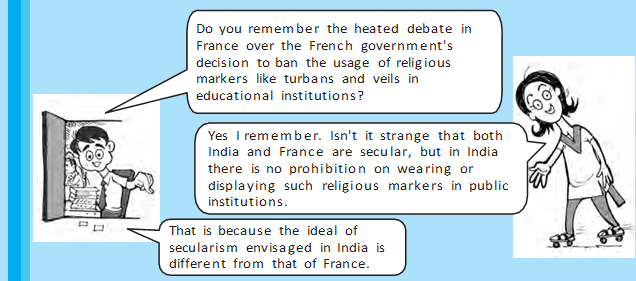
Do not reduce Indian secularism to “equal respect for all religions.” It allows principled intervention against oppression and does not require equal approval of every religious practice; religiously sanctioned caste hierarchies are unacceptable.
- Theocracy
- Government directly controlled by religious authorities.
- Established religion
- A religion formally recognised as the state’s official religion.
- Intra-religious domination
- Domination or inequality within a religious community.
- Inter-religious equality
- Equality between different religious communities.
- Communalism
- A politics of religious-community interests that can threaten equality and national unity.
Why is separation of religion and state necessary but not sufficient for secularism?
How does Indian secularism differ from the mainstream Western model?
Quick recap
- Secular state: It is neither theocratic nor formally allied with a religion, and pursues religious freedom and equality through goals partly grounded in non-religious sources.
- Western model: It emphasises mutual exclusion, individual rights and minimal state intervention in religion.
- Ataturk: His Turkish model pursued secularisation through active state intervention and restrictions on traditional practices.
- Nehru: He supported equal protection, social reform and strong opposition to communalism.
- Indian model: It protects individual and minority rights and permits principled state engagement to oppose religious domination.
- Key distinction: Secularism requires equality and protection, not approval of every religious practice.
Critics of Indian Secularism
Anti-religious
Does secularism oppose religion?
- What it opposes: Institutionalised religious domination—not religion itself.
- Religious identity: Secularism protects religious freedom and equality, so it need not threaten religious identity.
- Limits: It challenges dogmatic, violent, fanatical or exclusivist identities that promote hatred of other religions.
- Key question: Judge whether the practice being challenged is worthy, not simply whether it is being challenged.
Western Import
Is secularism unsuited to India because of its origins?
- Criticism: Secularism is said to be a Western concept and therefore unsuitable for Indian conditions.
- Origins do not decide suitability: Ideas can be adapted to local needs; secularism has both Western and non-Western origins.
- Western experience: Western states became secular by challenging established religious authority's control over social and political life.
- A secular state's own ends: A secular state must pursue purposes of its own; secularism is not simply a product of the Christian world.
- Not one model: Separation between religion and state can be interpreted differently; mutual exclusion is not essential to every secular state.
- Indian approach: India developed a variant shaped especially by peaceful coexistence among religious communities—not merely an implant from the West.
| Point | Western emphasis | Indian emphasis |
|---|---|---|
| Central concern | Church–state separation | Peaceful coexistence among religious communities |
| State's possible role | Separation from established religious authority | Principled distance: non-interference in some matters and intervention to protect rights in others |
| Secularism's origins | A response to religious authority's control over social and political life | A locally developed approach drawing on non-Western as well as Western ideas |
Minoritism
Minoritism — The accusation that secularism gives minorities unjustified special privileges by protecting their rights.
Why minority rights may be necessary
- Majority rule has limits: Voting is unfair when it overrides a person's fundamental or urgent interest.
- Example: A non-smoker with asthma should not be outvoted if cigarette smoke could trigger a life-threatening attack.
- Community rights: The same principle applies to communities; constitutional law must protect minorities' fundamental interests.
- Justification: Minority rights are warranted when they safeguard fundamental interests.
Rights are not necessarily special privileges
- Unequal access: A staircase may be open to everyone but unusable for some older people, people with injuries or people with disabilities.
- Accommodation: A lift or ramp gives them access to the same benefit; it does not create an unfair privilege.
- Core idea: Equal respect may require different arrangements when identical arrangements exclude some people.
Interventionist
Does Indian secularism interfere too much?
- Criticism: State involvement is said to be coercive and to undermine communities' religious freedom.
- Principled distance: Indian secularism rejects compulsory non-interference, but does not require excessive intervention.
- Intervention is not always coercive: The state may support religious reform without imposing change from above.
- Personal laws: Laws on marriage, inheritance and family matters may protect community-specific rights, yet may also treat women unequally.
- Two possible readings: Personal laws may protect freedom from inter-religious domination or perpetuate intra-religious domination.
A balanced approach to reform
- Reform personal laws to uphold both minority rights and equality between women and men.
- Avoid coercion by the state or religious groups; also avoid complete state withdrawal.
- The state should facilitate reform by supporting liberal and democratic voices within every religion.
Equal treatment is not always identical treatment
- Public religion: Equal numbers of holidays for every religion or banning all religious ceremonies are not automatically the only ways to ensure equality.
- Principle: Assess equal treatment by whether rights, dignity and fairness are protected—not by whether arrangements are identical.
| Date | Holiday |
|---|---|
| January 26 | Republic Day |
| March 4 | MahaShivaratri |
| March 21 | Holi |
| April 17 | Mahavir Jayanti |
| April 19 | Good Friday |
| May 18 | Buddha Purnima |
| June 5 | Id-ul-Fitr |
| August 12 | Id-ul-Zuha (Bakrid) |
| August 15 | Independence Day |
| August 24 | Janmashtami |
| September 10 | Muharram |
| October 2 | Mahatma Gandhi's Birthday |
| October 8 | Dussehra |
| October 27 | Diwali (Deepavali) |
| November 10 | Milad-un-Nabi/Id-e-Milad |
| November 12 | Guru Nanak's Birthday |
| December 25 | Christmas Day |
Vote Bank Politics
When does vote-seeking become a problem?
- Democratic politics: Seeking votes from groups, including through policy promises, is not automatically wrong.
- Test: Ask whether a policy serves the group's welfare or only a politician's power, and whether it harms other groups' rights.
- Vote-bank politics: A party mobilises a group as a single voting bloc and presents its diverse members as having one shared interest.
- Electoral distortion: Short-term gains and emotive issues can displace long-term development, governance and genuine community concerns.
- Social effects: Competitive appeals can portray groups as rivals over limited resources and deepen divisions.
- Minority appeasement: Prioritising a minority's interests while disregarding equality for all citizens can further alienate and marginalise that group.
- Reform difficulty: Treating a minority as a single unit hides internal diversity and can obstruct social reform within it.
| Point | Legitimate protection | Vote-bank distortion |
|---|---|---|
| Purpose | Protect a group's fundamental interests | Secure short-term electoral advantage |
| Treatment of the group | Recognises rights and welfare | Portrays diverse members as one bloc |
| Effect | Can advance the secular project | May neglect real needs, harm other groups and increase division |
Impossible Project
Can people with deep religious differences live peacefully?
- Cynical criticism: People with deep religious differences can never live together in peace.
- Response: This is empirically false; Indian civilisation has examples of coexistence, as did the Ottoman Empire.
- Equality challenge: Earlier coexistence could exist within unequal hierarchies; the modern challenge is coexistence alongside equality.
- Global relevance: Migration from former colonies and globalisation have made Europe, America and parts of the Middle East more culturally and religiously diverse.
- Indian experiment: India's attempt to combine diversity, coexistence and equality is watched internationally as a possible model for the future.
Why are minority rights compatible with democracy?
How does Indian secularism respond to the charge that it is interventionist?
What is the main danger of vote-bank politics?
Quick recap
- Secularism opposes institutionalised religious domination, not religion; it protects freedom while challenging hateful or violent identities.
- Indian secularism is not simply imported: secularism has Western and non-Western origins, and India developed an approach shaped by peaceful coexistence.
- Minority rights protect fundamental interests; fair treatment may require different arrangements rather than identical treatment.
- Principled distance permits non-interference or reform-supporting state action; personal laws raise tensions between community rights and gender equality.
- Vote-seeking is normal in democracy, but bloc-based appeals can distort priorities, conceal diversity and deepen division.
- Religious coexistence is possible, and India's experiment is relevant to increasingly diverse societies around the world.
Political Science — ALL CHAPTERS
1
Constitution: Why And How?
2
Rights In The Indian Constitution
3
Election And Representation
4
Executive
5
Legislature
6
Judiciary
7
Federalism
8
Local Governments
9
Constitution as A Living Document
10
The Philosophy Of The Constitution
1
INTRODUCTION TO POLITICAL THEORY
2
FREEDOM OVERVIEW
3
EQUALITY
4
SOCIAL JUSTICE
5
RIGHTS
6
CITIZENSHIP
7
NATIONALISM
8
SECULARISM