Class 11 Humanities . Political Science . Political Theory . Social Justice
Chapter 4: SOCIAL JUSTICE
Ch 4
Political Science
Class 11 Humanities
What Is Social Justice ?
What Justice Means
Justice — Justice means promoting the well-being of all people and ensuring that each person receives what is due to them.
Justice in Ancient Thought
- Ancient Indian societyJustice was associated with dharma; maintaining a just social order was a primary duty of kings.
- Ancient ChinaConfucius argued that kings should punish wrongdoers and reward virtuous people.
- Fourth century B.C.In Athens, Plato explored justice in The Republic through a dialogue involving Socrates, Glaucon and Adeimantus.
Why Be Just?
- The apparent advantage of injustice: People who deceive, evade rules or avoid taxes may seem to benefit if they are not caught.
- Socrates’ response: If everyone manipulated rules for personal gain, nobody would be secure and everyone could be harmed.
- Long-term interest: Following laws and acting justly helps protect the well-being and security of all.
- Not simply partiality: Justice is not merely helping friends, harming enemies or pursuing one’s own interests.
Why Laws and Mutual Agreements Arise
- People experience both doing and suffering injustice.
- They recognise that no one can reliably gain from injustice while avoiding its harms.
- People agree to avoid both doing and suffering injustice.
- Laws and mutual agreements arise to establish what is lawful and just.
Human Dignity and What Is Due
- Changing understanding: What people consider due to each person has changed since Plato’s time.
- Human dignity: Immanuel Kant argued that human beings possess dignity.
- What dignity requires: Each person should have the opportunity to develop their talents and pursue chosen goals.
- Fair consideration: Justice requires giving due and equal consideration to every individual.
- Dharma
- A principle associated with justice and maintaining a just social order in ancient Indian society.
- Human dignity
- The worth possessed by every human being, which calls for respect and fair consideration.
- What is due
- The rights, opportunities or rewards that a person is fairly entitled to receive.
- Proportionality
- Giving rewards in proportion to relevant differences, such as effort, skill or danger.
Equal Treatment for Equals
Equal treatment for equals — People who are alike in relevant ways should receive equal rights and treatment.
| Type of right | Examples or purpose |
|---|---|
| Civil rights | Rights to life, liberty and property. |
| Political rights | The right to vote and participate in political processes. |
| Social rights | The right to enjoy equal opportunities with other members of society. |
Equality and Non-Discrimination
- Equal status: People should not be discriminated against because of class, caste, race or gender.
- Fair assessment: Judge people by their work and actions, not by the group to which they belong.
- Equal work, equal reward: People doing the same kind of work should receive the same reward.
- Examples of injustice: Paying one worker Rs. 100 and another Rs. 75 for the same work because of caste, or paying a male teacher more than a female teacher for equivalent work.
Proportionate Justice
Proportionate justice — Justice may require different rewards when relevant differences in effort, skill, responsibility or danger justify them.
How Proportionality Works
- Equal starting point: Equal rights should form the baseline for justice.
- Different performance: Exam marks should reflect the quality of answers and possibly the effort made, not simply be equal for all students.
- Different work: Work may fairly receive different rewards when it involves different levels of effort, skill or danger.
- Social value and reward: Miners, skilled craftspeople and police officers may not always receive rewards that adequately reflect their work and risks.
| Point | Equal treatment | Proportionate justice |
|---|---|---|
| Core idea | Treat people equally when they are alike in relevant ways. | Adjust rewards when relevant differences justify different outcomes. |
| Example | Same reward for the same work, regardless of caste or gender. | Different rewards for different work based on effort, skill or danger. |
| How they fit | Protects equal rights and prevents discrimination. | Balances equality by recognising relevant differences; it does not remove equal rights. |
Why did Socrates argue that acting justly is in everyone’s long-term interest?
What does equal treatment for equals require?
Why must equal treatment be balanced with proportionality?
Quick recap
- Justice promotes the well-being of all and gives each person what is due.
- Socrates argued that widespread injustice undermines everyone’s security and makes justice a long-term shared interest.
- Kant’s idea of human dignity supports equal consideration and opportunities to develop talents and pursue goals.
- Equal treatment for equals requires equal rights and protection from discrimination.
- Civil, political and social rights protect life and liberty, political participation and equal opportunities.
- Proportionate justice allows different rewards for relevant differences in effort, skill or danger, while keeping equal rights as the baseline.
Recognition of Special Needs
Recognising Special Needs
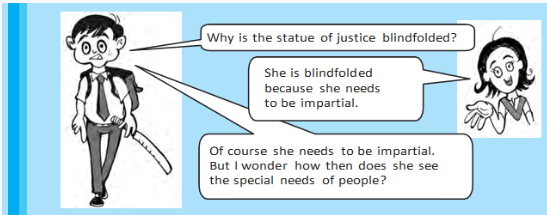
Recognition of special needs — A principle of social justice that considers people’s particular needs when distributing benefits, duties or opportunities.
Why special treatment may be fair
- Equal status, different needs: People have equal basic rights, but may need different support to enjoy fair opportunities.
- Equality extended: Treating equals equally can require different treatment for people unequal in important respects.
- Possible grounds: Physical disability, age, and inadequate access to education or health care may justify special help.
- Unequal starting points: Identical treatment of people with very different resources and opportunities can preserve inequality.
| Situation | Relevant principle or issue |
|---|---|
| A visually impaired student receives extra time in an exam. | Special support can address a disability-related barrier and promote fair opportunity. |
| A student with a limp receives the same extra time. | Consider whether the extra time responds to a relevant need; equal treatment does not always mean identical treatment. |
| A teacher gives grace marks to weaker students to boost their morale. | Raises questions about equal treatment and recognition of achievement; the stated purpose is to encourage morale. |
| Students receive different question papers based on a professor’s assessment of their capabilities. | Raises questions about fair assessment, equal treatment and whether differences in capability justify different arrangements. |
| A proposal reserves 33 per cent of Parliament’s seats for women. | Raises the question of whether special measures are justified to address unequal access or representation. |
Special measures in India
- Caste and deprivation: Lack of access to education, health care and other facilities is often combined with caste-based social discrimination.
- Reservations: The Constitution allows reservations in government jobs and quotas in educational admissions for Scheduled Castes and Scheduled Tribes.
- Purpose: These measures seek to address disadvantage and improve access to opportunities.
Balancing Principles of Justice
| Principle | Main idea |
|---|---|
| Equal treatment for equals | People in relevantly similar situations should be treated equally. |
| Recognition of efforts and skills | Rewards and burdens may reflect differences in people’s efforts and skills. |
| Minimum living standards and equal opportunities | People in need should have access to basic conditions and opportunities. |
Why balancing is difficult
- Equal treatment alone may fail to recognise merit or differences in need.
- Merit alone may disadvantage marginalised people who lacked good nourishment, education or other facilities.
- Government’s role: Governments must reconcile these principles through policies that promote a just society.
Just Distribution
Just distribution — A fair distribution of society’s goods and services among nations, groups and individuals.
What just distribution requires
- Beyond fair laws: Social justice also concerns how resources, goods and services are distributed.
- Level playing field: Serious economic or social inequalities may require redistribution of important resources.
- Basic equality: People need fair life conditions and opportunities to pursue their goals and express themselves.
- Indian examples: The Constitution abolished untouchability, supporting access to temples, jobs and basic needs such as water; states have also used land reforms to distribute land more fairly.
Why resource distribution becomes contentious
- Proposals about distributing resources or expanding access to education and jobs affect people’s perceived future interests.
- People may fear consequences for themselves and their families.
- Disagreement over measures such as reservations can produce strong anger and sometimes violence.
- Political theory examines these policies calmly through principles of justice.
John Rawls’ Theory of Justice
Veil of ignorance — Rawls’ imagined decision-making situation in which people choose society’s rules without knowing what position they themselves will occupy.
How Rawls reaches fair rules
- Problem: People tend to favour rules that give themselves or their children a privileged position.
- Unknown identity: Behind the veil, nobody knows their future family, caste, wealth, social position or opportunities.
- Rational self-interest: Since anyone could turn out to be disadvantaged, each person has reason to protect the worst-off.
- Fair rules: People would support reasonable opportunities and access to resources such as education, health care and shelter.
- Benefit for society: Policies should protect the worst-off while ensuring that society as a whole benefits.
Rawls’ reasoning
- People do not know their future social position.
- Anyone might be born among the worst-off.
- It is in each person’s interest to choose rules that provide protection and reasonable opportunities.
- Fair rules protect the disadvantaged while benefiting society as a whole.
| Point | Rawls’ approach | Self-sacrifice |
|---|---|---|
| Basis | Rational people choose rules in their own interest while ignorant of their future position. | People give up their interests for others. |
| Why it can work | Anyone could be disadvantaged, so protecting the worst-off is prudent. | It depends on exceptional generosity, which cannot be expected of everyone. |
| Outcome | Fairness follows from rational choice, not benevolence or generosity. | Self-sacrifice is treated as heroic rather than a normal expectation. |
Importance of Rawls’ theory
- Impartial judgement: The veil encourages people to consider society from the perspective of the worst-off.
- Rationality, not morality: Rawls argues that fair distribution can follow from rational thinking, without relying on moral rules given in advance.
- Practical value: The theory offers a rational justification for helping society’s least privileged members.
- Special needs
- Needs that may justify different support so people can access fair opportunities.
- Social justice
- Fair treatment and fair access to resources, living conditions and opportunities.
- Just distribution
- Fair sharing of goods and services across society.
- Veil of ignorance
- Rawls’ imagined condition of choosing social rules without knowing one’s future position.
- Worst-off
- People with the least favourable opportunities or social and economic position.
Why can treating everyone identically fail to create an egalitarian society?
What is Rawls’ veil of ignorance, and how does it support fair rules?
How does Rawls’ theory justify helping the least privileged?
Quick recap
- Recognising special needs extends equality by allowing different support when people face important disadvantages.
- Disability, age and unequal access to education or health care can be grounds for special help.
- Justice requires balancing equal treatment, recognition of merit, and minimum standards and opportunities for people in need.
- Just distribution may require fairer access to resources; Indian examples include abolishing untouchability and land reforms.
- Rawls’ veil of ignorance asks people to choose rules without knowing their future social position.
- Rawls argues that rational self-interest can lead people to protect the worst-off and choose rules that benefit society as a whole.
Pursuing Social Justice
What Makes a Society Just?
Social justice — A society is socially just when people can live healthy and secure lives, develop their abilities, and have fair opportunities to pursue their goals.
Inequality and justice
- Not sameness: Justice does not require everyone to have identical lifestyles or living standards.
- Unjust extremes: A society is unjust when wealth and power are deeply divided and deprived people have no real chance to improve their circumstances.
- Fair opportunity: People should have the basic conditions needed to build their abilities and pursue chosen goals.
B. R. Ambedkar's just society — A compassionate society in which an ascending sense of reverence and a descending sense of contempt are dissolved.
Basic Minimum Conditions
What people need
- Minimum needs: Adequate nourishment, housing, clean drinking water, education, and a minimum wage are important basic conditions.
- Assessment: Governments and organisations such as the World Health Organisation use different methods to estimate basic needs.
- Government responsibility: In a democracy, providing basic conditions is considered a responsibility of the state.
- Practical challenge: Ensuring these conditions for everyone can place a heavy burden on governments, especially in countries such as India with many poor people.
Free Markets and State Intervention
The debate over how to pursue justice
- Shared aim: Many agree that disadvantaged people should be helped to enjoy a greater degree of equality.
- Disagreement: Should open competition in free markets help the disadvantaged, or should the state guarantee a basic minimum, including through redistribution of resources?
- Political debate: Different groups debate which policies best support marginalised people, including rural and urban poor communities.
Free market — An economic system in which individuals can own property, make agreements about prices, wages and profits, and compete with limited state interference.
Arguments supporting free markets
- Reward for merit: Supporters argue that competition rewards talent and ability, while those considered less capable receive less.
- Market distribution: They regard the distribution arising from voluntary market transactions as just.
- Neutrality claim: Markets are said to focus on skills and merit rather than caste, religion, or gender.
- Consumer choice: Markets can offer consumers more choices, provided they can afford them.
A limited role for the state
- Some regulation accepted: Many free-market supporters accept that the state may ensure a basic living standard so people can compete on more equal terms.
- Efficiency argument: They may argue that markets and private agencies can provide basic services such as health care and education efficiently, with state policies helping people afford them.
- Special assistance: The state may need to support people, such as the old and sick, who cannot compete.
- Regulatory role: Beyond this, the state should maintain laws that protect competition from coercion and other obstacles.
| Point | Free-market approach | State-intervention approach |
|---|---|---|
| Main idea | Competition and private provision distribute benefits and services. | The state ensures basic facilities are available to everyone. |
| Strength | Can expand consumer choice; private services may be of higher quality or provided efficiently. | Can address needs that private providers do not serve profitably. |
| Concern | Services may be unaffordable or unavailable to disadvantaged groups. | Guaranteeing basic conditions for all can be a heavy public burden. |
Limits of market provision
- Affordability and access: More choice matters only when good-quality goods and services are available at prices people can afford.
- Profit motive: Private providers may avoid unprofitable areas or offer cheap, poor-quality services; remote rural areas may have few good schools.
- Unequal reach: Similar access problems can arise in health care and housing.
- Unequal benefits: Private services may be superior in quality but too expensive for poor people; markets can therefore favour the strong, wealthy, and powerful.
Why markets may fail to provide equal opportunities
- Services in some communities are not profitable
- Private providers may avoid those areas or offer low-quality services
- Poor and disadvantaged people have less access to basic facilities
- Their opportunities may shrink, while advantages remain concentrated among the privileged
Justice through democratic debate
- State action: Because markets may favour people who are already privileged, many argue that the state should ensure basic facilities are available to all.
- Healthy disagreement: Disputes about justice and distribution can help people examine different views and defend their positions rationally.
- Role of politics: Politics involves negotiating disagreements through debate.
- Ongoing task: Reducing social and economic inequalities requires continued discussion of the best ways to pursue justice.
- Basic minimum
- Essential conditions—such as nourishment, housing, clean water, education and a minimum wage—needed for a healthy and secure life.
- Free market
- A system where individuals own property, make agreements and compete with limited state interference.
- State intervention
- Government action to provide or secure basic services and support disadvantaged people.
- Redistribution
- Reallocation of resources to reduce disadvantage and help secure a basic minimum.
Why might free markets fail to ensure social justice?
What basic conditions should a just society aim to provide?
Justice as a moral right (J. S. Mill) — Justice concerns not only what is right to do, but also what an individual can claim from others as a moral right.
Quick recap
- Justice does not require identical lifestyles, but it rejects extreme deprivation and barriers to improving one’s condition.
- A just society secures basic needs and fair opportunities for people to develop their talents and pursue their goals.
- Ambedkar described a just society as compassionate, dissolving an ascending sense of reverence and a descending sense of contempt.
- Free-market supporters value competition, merit, choice and limited state interference; some also argue that market provision can be efficient.
- Markets can leave unprofitable communities underserved and make essential services unaffordable for poor people.
- The state may need to ensure basic facilities and support people unable to compete.
- Democratic debate helps negotiate disagreements about distribution; for J. S. Mill, justice is also a moral right an individual can claim.
Political Science — ALL CHAPTERS
1
Constitution: Why And How?
2
Rights In The Indian Constitution
3
Election And Representation
4
Executive
5
Legislature
6
Judiciary
7
Federalism
8
Local Governments
9
Constitution as A Living Document
10
The Philosophy Of The Constitution
1
INTRODUCTION TO POLITICAL THEORY
2
FREEDOM OVERVIEW
3
EQUALITY
4
SOCIAL JUSTICE
5
RIGHTS
6
CITIZENSHIP
7
NATIONALISM
8
SECULARISM