Class 11 Humanities . Political Science . India Constitution At Work . Judiciary
Chapter 6: Judiciary
Ch 6
Political Science
Class 11 Humanities
Why Do We Need A Judiciary ?
Why a Judiciary Is Needed
- Dispute resolution: An independent judiciary settles disputes between individuals, groups, and governments according to law.
- Rule of law: It ensures that everyone is subject to the same law and upholds the supremacy of law.
- Rights and democracy: It safeguards individual rights and prevents democracy from giving way to the dictatorship of an individual or group.
- Independence: Judges must be able to decide cases without political pressure, fear, or favour.
Appointment of Judges
Why Judicial Appointments Matter
Judicial appointment — The selection of judges is part of the political process and can influence how the Constitution and laws are interpreted.
- Impact: Judges’ political philosophy can shape whether the judiciary is active and assertive or controlled and committed, affecting the fate of legislation.
- Participants: The Council of Ministers, Governors, Chief Ministers and the Chief Justice of India (CJI) influence appointments.
Appointment of the CJI and Other Judges
CJI appointment
- Convention: The senior-most Supreme Court judge was conventionally appointed as the CJI.
- Departures: The convention was broken in 1973, when A. N. Ray was appointed over three senior judges, and in 1975, when M. H. Beg was appointed over Justice H. R. Khanna.
Other Supreme Court and High Court judges
- Formal appointment: The President appoints other Supreme Court and High Court judges after consulting the CJI.
- Earlier effect: The consultation was initially understood as advisory, leaving the final appointment decisions effectively with the Council of Ministers.
- Supreme Court’s changing view: Between 1982 and 1998, the Court moved from treating the CJI’s role as purely consultative, to requiring the President to follow the CJI’s opinion, and then to a collegial recommendation process.
- Collegiality: The CJI recommends names in consultation with the four senior-most Supreme Court judges; the group’s opinion carries greater weight.
- Role in appointments: Both the Supreme Court and the Council of Ministers play an important role.
Key developments in appointments
- 1973A. N. Ray was appointed CJI, superseding three senior judges.
- 1975Justice M. H. Beg was appointed CJI, superseding Justice H. R. Khanna.
- 1982–1998The Supreme Court reconsidered the meaning of consultation and developed the collegial recommendation procedure.
How are recommendations for judicial appointments made under the collegial procedure?
- Collegiality
- Recommendations for judicial appointments are made through consultation among the CJI and senior judges.
- Consultation
- The process in which the President consults the CJI before appointing other Supreme Court and High Court judges.
Removal of Judges
Removal of a judge — A Supreme Court or High Court judge may be removed only for proved misbehaviour or incapacity, through a special-majority motion in both Houses of Parliament.
- Special majority: In each House, the motion must receive a majority of the House’s total membership and at least two-thirds of members present and voting.
- Practical safeguard: Removal is difficult and requires broad parliamentary support.
- Balance of power: The executive plays a crucial role in appointments, while Parliament has the power of removal; this supports judicial independence.
| Point | Appointment | Removal |
|---|---|---|
| Main role | The executive plays a crucial role, alongside the Supreme Court’s collegial recommendations. | Parliament has the power to remove judges. |
| Safeguard | Consultation with senior judges gives their collective view greater weight. | A special-majority requirement makes removal difficult. |
Why is judicial independence important?
Unsuccessful Attempt to Remove Justice V. Ramaswami
- 1991: The first-ever motion to remove a Supreme Court Justice was signed by 108 MPs. Justice V. Ramaswami was accused of misusing funds while Chief Justice of the Punjab and Haryana High Court.
- 1992 inquiry: A high-profile commission of Supreme Court judges found him guilty of wilful and gross misuse of office, moral turpitude, using public funds for private purposes and reckless disregard of statutory rules.
- Vote: The motion received two-thirds of the votes of members present and voting, but did not receive support from a majority of the House’s total strength.
- Outcome: The Congress party abstained, so the motion failed the total-strength requirement and Ramaswami was not removed.
| Requirement | Result |
|---|---|
| Two-thirds of members present and voting | Achieved |
| A majority of the House’s total strength | Not achieved |
| Removal | Motion failed; Ramaswami remained in office |
Ramaswami case
- 1991The first-ever removal motion against a Supreme Court Justice was signed by 108 MPs.
- 1992An inquiry commission found Justice Ramaswami guilty of serious misuse of office; the parliamentary motion nevertheless failed.
Why was Justice V. Ramaswami not removed?
Quick recap
- Judicial appointments are politically significant because judges’ views can influence constitutional interpretation and legislation.
- The senior-most Supreme Court judge convention for appointing the CJI was broken in 1973 and 1975.
- Other Supreme Court and High Court judges are appointed by the President after consulting the CJI; collegial recommendations involve the four senior-most judges.
- Judges can be removed only for proved misbehaviour or incapacity through a special-majority motion in both Houses.
- Ramaswami’s motion met the two-thirds present-and-voting requirement but failed to gain support from a majority of the House’s total strength.
Structure of Judiciary
A Single Integrated Judiciary
- Integrated system: India has one judicial hierarchy, unlike federal systems with separate State court systems.
- Pyramidal structure: The Supreme Court is at the top, High Courts are below it, and district and subordinate courts are at the base.
- Superintendence: Lower courts function under the direct superintendence of higher courts.
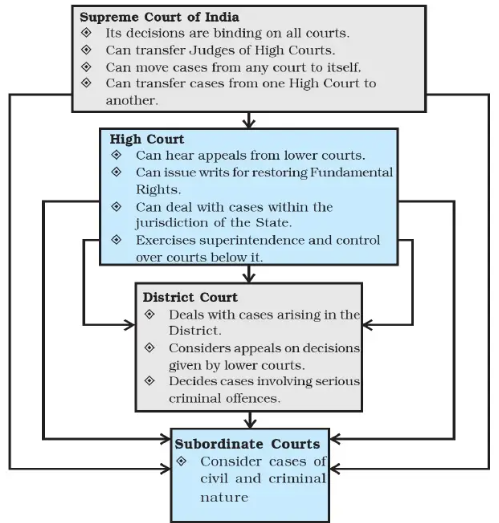
Supreme Court: Jurisdiction and Powers
- Jurisdiction: The scope of cases and powers a court is authorised to deal with.
- Constitutional limits: The Supreme Court is powerful, but its functions and responsibilities are defined by the Constitution.
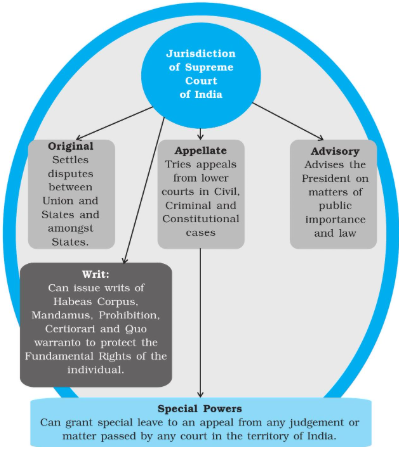
Types of Supreme Court Jurisdiction
| Jurisdiction | Meaning and cases | Key point |
|---|---|---|
| Original | Cases heard first-hand by the Supreme Court, especially disputes involving the Union and one or more States, or disputes among States. | The Supreme Court alone can hear these federal disputes; it acts as an umpire and interprets constitutional powers of the Union and States. |
| Writ | A person whose fundamental right is violated may seek a remedy directly from the Supreme Court. | High Courts can also issue writs; the person may approach either court. Writs can direct the executive to act or refrain from acting. |
| Appellate | The Supreme Court hears appeals against High Court decisions and reconsiders the case and legal issues. | A High Court normally certifies that a case is fit for appeal because it raises a serious question of law or constitutional interpretation. The Supreme Court may also admit appeals in other cases. |
| Advisory | The President may refer a matter of public importance or constitutional interpretation to the Supreme Court for advice. | The Court need not give advice, and the President need not accept it. |
Appellate jurisdiction: important details
- Criminal cases: If a lower court sentences a person to death, an appeal may be made to the High Court or Supreme Court.
- Reinterpretation: If the Supreme Court finds that a law or constitutional provision was interpreted differently by lower courts, it may change the ruling and give a new interpretation.
- High Courts: They also hear appeals against decisions of courts below them.
Why advisory jurisdiction is useful
- Before action: The government can obtain a legal opinion on an important matter, potentially avoiding later litigation.
- Improved decisions: In light of the advice, the government may change its proposed action or legislation.
Review, Authority and Binding Decisions
- Article 137: The Supreme Court may review any judgment it has pronounced or order it has made.
- Article 144: All civil and judicial authorities in India must act in aid of the Supreme Court.
- Binding authority: Supreme Court decisions bind all other courts in India, and its orders are enforceable throughout the country.
- Contempt: The Supreme Court decides cases concerning contempt of itself.
The Supreme Court is not bound by its own earlier decisions in every case: under Article 137, it can review its judgments and orders.
- Jurisdiction
- The scope of a court's authority to hear cases and exercise powers.
- Original jurisdiction
- Authority to hear specified cases directly, without their first being decided by lower courts.
- Writ
- A special court order, including an order directing the executive to act or not to act.
- Advisory jurisdiction
- The Supreme Court's power to advise the President on a referred matter; the advice is not binding.
How does the integrated court structure work in India?
What is original jurisdiction? Give an example.
Are the President and the Supreme Court bound by the Supreme Court's advisory opinion?
Quick recap
- India has one integrated judicial hierarchy: Supreme Court → High Courts → district and subordinate courts.
- Original jurisdiction includes Union–State and inter-State disputes heard directly by the Supreme Court.
- People may approach the Supreme Court or a High Court for writs when fundamental rights are violated.
- The Supreme Court hears appeals, while High Courts hear appeals from courts below them.
- The President may seek non-binding Supreme Court advice on important matters or constitutional interpretation.
- Articles 137 and 144 provide for Supreme Court review and the duty of authorities to act in its aid.
Judicial Activism
Judicial Activism and Public Interest Litigation
Judicial activism — A proactive role in which courts intervene to protect rights and address matters of public concern.
Examples of judicial intervention
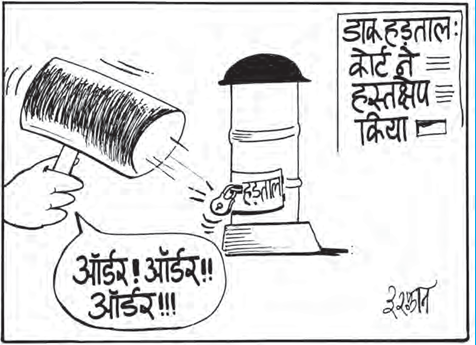
- Public order: Courts have ruled that bandhs and hartals are illegal.
- Wider role: Judicial activism describes the courts’ increasingly proactive role in public issues.
Public Interest Litigation (PIL) / Social Action Litigation (SAL) — A case brought to court by a person or organisation on behalf of people whose rights or interests are affected, or to protect a broader public interest.
| Point | Ordinary litigation | PIL |
|---|---|---|
| Who may approach the court? | Usually, a person personally aggrieved or involved in the dispute. | A public-spirited person, organisation or lawyer may act for affected people. |
| Main concern | The rights or dispute of the parties. | Public interest, including protection of rights and the conditions of disadvantaged groups. |
Emergence and early PILs
- 1979The Supreme Court heard a case filed by someone other than the directly aggrieved people, establishing an important precedent for PIL.
- 1979Hussainara Khatoon vs. State of Bihar: The Court considered reports that undertrial prisoners had been jailed longer than the maximum punishment for their alleged offences.
- 1980Sunil Batra vs. Delhi Administration: The Supreme Court treated a Tihar jail inmate’s letter describing prisoner torture as a petition.
- 1984In Bandhua Mukti Morcha vs. Union of India, Justice Bhagwati emphasised that poor and disadvantaged people need an approach suited to their difficulties in enforcing fundamental rights.
How PIL expanded court access
- Wider access: Courts allowed public-spirited citizens, social organisations and lawyers to petition on behalf of people unable to approach courts easily.
- Broader rights: Courts treated clean air, unpolluted water and decent living conditions as interests and rights of society as a whole.
- Flexible entry: Courts sometimes took up cases based on newspaper reports and letters sent to them.
- Key vehicle: PIL became the most important means through which judicial activism developed in India.
- Scope: PILs addressed protection of existing rights, poverty, poor living conditions, environmental concerns and other public issues.
Impact and concerns
- Democratised access: Individuals and groups gained greater access to the courts, including people who could not easily represent themselves.
- Executive accountability: Court intervention could press government authorities to answer for their actions.
- Electoral transparency: Candidates were required to disclose assets, income and educational qualifications in affidavits so voters could make informed choices.
- Court workload: A large number of PILs can overburden the courts.
- Separation of powers: Intervention in matters such as pollution control, corruption investigations and electoral reform may cross into executive or legislative responsibilities.
- Democratic balance: Each organ of government should respect the powers and jurisdiction of the others; excessive intervention can strain this principle.
To assess whether a PIL serves public interest, weigh the rights and welfare of all affected groups—not only the interests claimed by the petitioners.
Judiciary and Rights
| Remedy | Constitutional basis | Purpose |
|---|---|---|
| Writs | Supreme Court: Article 32; High Courts: Article 226 | Provide a remedy when rights are violated; examples include Habeas Corpus and mandamus. |
| Judicial review | Article 13 and the Constitution’s provisions | Allows courts to examine whether a law is constitutional and declare an unconstitutional law inapplicable. |
Judicial review — The power of the Supreme Court or a High Court to examine a law’s constitutionality and declare it unconstitutional and inapplicable if it conflicts with the Constitution.
Scope and importance of judicial review
- Fundamental rights: Courts can review laws that violate the rights guaranteed by the Constitution.
- Federal division of powers: A law may be reviewed if it violates the distribution of powers between the Union and the States; State laws can also be reviewed.
- Example: If a Union law concerns a subject on the State List, a State may challenge it; the Court can invalidate it if the challenge is upheld.
- Constitutional basis: The Constitution does not expressly use the term “judicial review”; the power follows from the written Constitution and the courts’ authority to invalidate unconstitutional laws.
- Combined protection: Writ powers provide remedies for rights violations, while review powers allow courts to assess laws; together they strengthen the judiciary’s role as protector and interpreter of the Constitution.
PIL and rights in practice
- Right against exploitation: Prohibits forced labour, trafficking in human beings and employing children in hazardous work.
- Access to justice: PIL enabled courts to consider violations affecting people who could not readily approach the courts themselves.
- Examples considered by courts: Blinding of prisoners by police, inhumane conditions in stone quarries and sexual exploitation of children.
- Effect: Judicial activism helped make constitutional rights meaningful for poor and disadvantaged groups.
- International example: South Africa’s Constitution recognises a citizen’s right to bring cases concerning violations of other people’s rights before its Constitutional Court.
When may a court use judicial review?
How does judicial review differ from writ jurisdiction?
What are two major concerns about judicial activism?
Quick recap
- PIL allows public-spirited people and organisations to seek justice for others or for a wider public interest.
- The 1979 PIL trend and early cases widened access to courts, especially for prisoners and disadvantaged groups.
- Courts have ruled bandhs and hartals illegal; activism can improve access, accountability and electoral transparency.
- Judicial activism may overburden courts and strain the separation of powers between government organs.
- Writs under Articles 32 and 226 provide remedies; judicial review examines whether laws comply with the Constitution.
- Judicial review covers violations of fundamental rights and the federal distribution of powers.
- PIL has helped courts address exploitation and make rights more accessible to poor and disadvantaged people.
Judiciary And Parliament
Judicial Activism and Constitutional Checks
Judicial activism
- Meaning: The judiciary actively uses its powers to protect the Constitution and ensure justice, including by directing executive agencies.
- Constitutional review: Courts brought matters such as the powers of the President and Governors within the scope of judicial review.
- Examples: The Supreme Court directed the CBI to investigate politicians and officials in the Hawala case, the Narasimha Rao case and the illegal petrol-pump allotment case.
- Limit: Judicial independence is essential, but courts interpret the Constitution and adjudicate rights; they should not act as a super-legislature or super-executive.
| Organ | Main role |
|---|---|
| Parliament | Makes laws and amends the Constitution, subject to constitutional limits. |
| Executive | Implements laws. |
| Judiciary | Settles disputes and decides whether laws conform to the Constitution. |
Checks and balances
- Principle: India has a limited separation of powers: each organ has its own sphere, while checks and balances prevent misuse of power.
- Tension: Despite this division, conflict between Parliament and the judiciary, and between the executive and judiciary, has repeatedly arisen.
- Balance: Every organ must respect the authority and constitutional limits of the others.
Parliament–Judiciary Conflict
Early dispute over property and fundamental rights
- Parliament sought to restrict the right to property so that land reforms could be carried out.
- The Court held that Parliament could not restrict fundamental rights in this way.
- Parliament attempted constitutional amendments to change the position.
- The Court held that an amendment could not abridge a fundamental right.
Main questions in the dispute
- Property: What is the scope of the right to private property?
- Fundamental rights: How far may Parliament curtail, abridge or abolish these rights?
- Amendment: What are the limits of Parliament’s power to amend the Constitution?
- Directive Principles: Can Parliament pass laws that limit fundamental rights while implementing Directive Principles?
Key developments
- 1967–1973Conflict intensified over land reform, preventive detention, job reservations, property acquisition and compensation.
- 1973The Supreme Court laid down the Basic Structure doctrine in the Kesavananda Bharati case.
- 1979The right to property was removed from the list of Fundamental Rights.
Basic Structure doctrine — Parliament may amend the Constitution, but no amendment can damage or destroy its basic structure.
Kesavananda Bharati case (1973)
- Ruling: The Constitution has a basic structure that Parliament cannot violate, even through an amendment.
- Property: The right to property was not part of the basic structure and could therefore be suitably abridged.
- Judicial role: The Court reserved the authority to decide whether a constitutional feature belongs to the basic structure.
- Significance: The judgment set a constitutional limit on Parliament’s amending power and became a landmark example of judicial interpretation.
How the ruling changed the relationship
- Parliament and the Court disagreed over fundamental rights and amendment powers.
- The 1973 ruling recognised Parliament’s power to amend but placed the basic structure beyond its reach.
- The Court became the authority that determines whether an amendment violates the basic structure.
- Removal of the right to property from Fundamental Rights in 1979 further changed the nature of the conflict.
Continuing Areas of Tension
Legislative privileges and judicial review
- Legislative privilege: Each legislature can regulate its own proceedings and punish a person it finds guilty of breaching its privileges.
- Unresolved issue: It remains contentious whether a person punished for breach of privilege, or a disciplined legislator, can seek protection from the courts.
- Judicial conduct: The Constitution bars discussion of judges’ conduct in Parliament, yet legislatures have criticised the judiciary.
- Judicial directions: Courts have also criticised legislatures or issued directions about legislative business; legislatures may view this as an infringement of parliamentary sovereignty.
| Issue | Why it can cause tension |
|---|---|
| Appointment of judges | Raises questions about influence and the independence of the judiciary. |
| Judges’ salaries and allowances | Concerns the conditions and independence of judicial office. |
| Parliament’s amendment power | The scope of this power is limited by the Basic Structure doctrine. |
| Parliamentary interference in the judiciary | Tests the boundary between legislative authority and judicial independence. |
The Judiciary in Democracy
Role, strengths and challenges
- Role: The judiciary interprets the Constitution, protects citizens’ rights and resolves disputes within its constitutional limits.
- Standing: Its independence and influential judgments have increased its prestige, public hopes and expectations.
- Public concerns: Questions include why some people obtain easy acquittals and why witnesses may change testimony in favour of the wealthy and powerful.
- Democratic requirement: Parliament and the judiciary must maintain a careful balance and respect each other’s constitutional authority.
- Judicial review
- The judiciary’s power to examine whether laws or government actions comply with the Constitution.
- Judicial activism
- Active judicial intervention to uphold rights, justice or constitutional principles.
- Basic Structure doctrine
- The rule that constitutional amendments cannot damage the Constitution’s basic structure.
- Parliamentary privilege
- The legislature’s authority to manage its proceedings and protect its institutional functions.
What was the significance of the Kesavananda Bharati judgment?
Name key issues that have caused conflict between Parliament and the judiciary.
Why must judicial independence be balanced with limits on judicial power?
Quick recap
- India has a limited separation of powers supported by checks and balances.
- Judicial activism includes court directions to executive agencies and constitutional review.
- The Kesavananda Bharati judgment (1973) barred amendments that damage the Constitution’s basic structure.
- The right to property was not part of the basic structure and left the list of Fundamental Rights in 1979.
- Legislative privileges, judicial conduct and the boundaries of institutional authority remain contentious.
- Democracy depends on Parliament and the judiciary respecting each other’s constitutional limits.
Political Science — ALL CHAPTERS
1
Constitution: Why And How?
2
Rights In The Indian Constitution
3
Election And Representation
4
Executive
5
Legislature
6
Judiciary
7
Federalism
8
Local Governments
9
Constitution as A Living Document
10
The Philosophy Of The Constitution
1
INTRODUCTION TO POLITICAL THEORY
2
FREEDOM OVERVIEW
3
EQUALITY
4
SOCIAL JUSTICE
5
RIGHTS
6
CITIZENSHIP
7
NATIONALISM
8
SECULARISM