Class 11 Humanities . Political Science . India Constitution At Work . Legislature
Chapter 5: Legislature
Ch 5
Political Science
Class 11 Humanities
Why do we need a Parliament ?
Why a Legislature Is Essential
- Democratic forum: A legislature is the centre of democratic political processes, not merely a law-making body.
- Representation: It represents the people and helps them hold their elected representatives accountable.
Parliament and the Executive
- Executive accountability: The government must retain legislative support and answer to the legislature.
- Democratic authority: The legislature can choose and dismiss the government, keeping executive power accountable to the people.
Why Have Two Houses?
State Legislatures
- Constitutional choice: A State may have a unicameral or bicameral legislature.
- Bicameral States: Andhra Pradesh, Bihar, Karnataka, Maharashtra, Telangana and Uttar Pradesh.
How Parliament Checks the Executive
- The executive proposes policies and takes decisions.
- Representatives debate and scrutinise those decisions in Parliament.
- Public concerns and opposition can pressure the government to respond or change course.
- The government must retain the support of a majority in the legislature.
- Parliament
- India’s national legislature.
- State legislature
- The legislature of a State.
- Unicameral
- Having one legislative house.
- Bicameral
- Having two legislative houses.
Why is Parliament more than a law-making body?
Give two reasons for having two Houses in Parliament.
Quick recap
- Parliament is a representative forum for debate, law-making and democratic accountability.
- The Cabinet may lead policy-making, but it must retain majority support and answer to Parliament.
- Parliament can choose or dismiss the government and scrutinise executive decisions.
- India’s Parliament has two Houses: the Rajya Sabha and the Lok Sabha.
- Bicameralism supports regional and social representation and gives decisions a second review.
- States may have one or two legislative houses; six States have bicameral legislatures.
Rajya Sabha
Representation in the Rajya Sabha
Rajya Sabha — The Rajya Sabha is the indirectly elected House of Parliament that represents the States of India.
How Rajya Sabha members are elected
- Residents elect members of the State Legislative Assembly.
- The elected members of each State Assembly elect that State's Rajya Sabha members.
| Point | Equal representation | Population-based representation |
|---|---|---|
| Principle | Also called symmetrical representation: each region or State receives the same representation, regardless of size or population. | Representation varies with population; more populous States receive more seats. |
| Example | The USA gives every State equal representation in its Senate. | In India, the Fourth Schedule fixes the number of Rajya Sabha members for each State. |
| Effect | Small and large States have equal representation. | Representation reflects differences in State populations. |
State representation
- India's approach: The Constitution's Fourth Schedule allocates different numbers of Rajya Sabha seats to the States, broadly according to population.
- Reason: Equal seats for every State could create a large mismatch between population and representation.
- Example: The text gives Uttar Pradesh's population as 1,998.12 lakhs and Sikkim's as 6.10 lakhs; Uttar Pradesh has 31 seats, while Sikkim has one.
Membership and Continuity
Term and permanent status
- Term: A Rajya Sabha member serves for six years and may be re-elected.
- Staggered terms: Every two years, one-third of the members complete their terms and elections are held for those seats.
- Permanent House: The Rajya Sabha is never fully dissolved.
- Why continuity matters: It can meet and conduct urgent business even when the Lok Sabha is dissolved and elections are pending.
Nominated members
- Number: The Rajya Sabha has 12 nominated members in addition to elected members.
- Appointment: The President nominates people who have made a mark in literature, science, art or social service.
Lok Sabha: Election and Term
Direct election
- Directly elected: The people elect the Lok Sabha and State Legislative Assemblies.
- Constituencies: The country (or State, for Assembly elections) is divided into territorial constituencies of roughly equal population; each elects one representative.
- Voting: Elections use universal adult suffrage, with each individual's vote having equal value.
- Seats: The text states there are 543 Lok Sabha constituencies, a number unchanged since the 1971 census.
Term and early dissolution
- Maximum term: The Lok Sabha is elected for five years.
- Early dissolution: It may be dissolved before five years if no party or coalition can form a government, or if the Prime Minister advises the President to call fresh elections.
Functions of Parliament
| Function | What Parliament does |
|---|---|
| Legislative | Enacts laws. The Cabinet decides a bill's content and timing; bureaucracy usually drafts it under a minister's supervision. Major bills require Cabinet approval. Non-minister members may introduce bills, but they rarely pass without government support. |
| Executive control and accountability | Checks that the executive stays within its authority and remains accountable to the people. |
| Financial | Controls taxation and government spending. New taxes need Lok Sabha approval; Parliament authorises government resources and scrutinises how money is raised and spent through the budget and annual financial statements. |
| Representation | Brings together different regional, social, economic and religious views from across the country. |
| Debating | Provides a national forum where members can freely discuss matters and analyse issues; debate is central to democratic decision-making. |
| Constituent | Discusses and enacts constitutional changes. Both Houses have similar powers; amendments require a special majority. |
| Electoral | Elects the President and Vice-President of India. |
| Judicial | Considers proposals to remove the President, Vice-President and High Court or Supreme Court judges. |
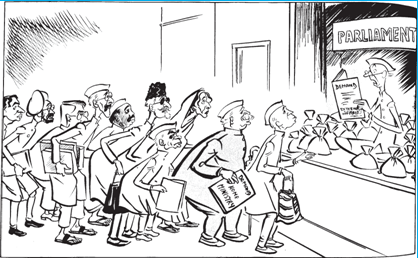
Why is the Rajya Sabha called a permanent House?
How does the Rajya Sabha represent States differently from the US Senate?
Quick recap
- Rajya Sabha members are indirectly elected by elected State Assembly members; State seat allocations are not equal.
- Equal representation is called symmetrical representation; population-based representation gives more seats to more populous States.
- Rajya Sabha members serve six-year terms, with one-third completing their terms every two years; the House is never dissolved.
- The President nominates 12 Rajya Sabha members from fields including literature, science, art and social service.
- The Lok Sabha is directly elected from roughly equal-population constituencies and has a maximum five-year term.
- Parliament makes laws, holds the executive accountable, controls public finance, represents people and provides a forum for debate.
- Parliament also has constituent, electoral and judicial functions.
Powers of Rajya Sabha
Powers of the Two Houses
| Power | Lok Sabha | Rajya Sabha |
|---|---|---|
| Legislation | Makes laws on Union List and Concurrent List matters; can introduce and pass money and non-money bills. | Passes non-money bills; may suggest amendments to money bills. |
| Finance | Approves taxation proposals, budgets and annual financial statements. | Cannot initiate, reject or amend money bills; may suggest amendments. |
| Executive control | Controls the executive through questions, supplementary questions, resolutions, motions and no-confidence motions. | Can ask questions and introduce motions and resolutions, but cannot remove the government. |
| Constitution and emergencies | Amends the Constitution and approves proclamations of emergency. | Approves constitutional amendments. |
| Elections and removal | Participates in the election and removal of the President, Vice President and judges of the Supreme Court and High Courts. | Participates in the election and removal of the President, Vice President and judges of the Supreme Court and High Courts; alone can initiate the procedure for removal of the Vice President. |
| Committees | Establishes committees and commissions and considers their reports. | Establishes committees and considers their reports. |
Rajya Sabha’s Special Power
State List law-making power — The Rajya Sabha can authorise Parliament to make laws on a matter in the State List.
- State representation: The Rajya Sabha is designed to represent States and help protect their powers.
- Transfer of subjects: If Parliament seeks to move a State List matter to the Union List or Concurrent List in the national interest, Rajya Sabha approval is required.
- In practice: Members may represent their political parties more strongly than the States.
Using the Special Power
- A State List matter is proposed for transfer in the national interest.
- The Rajya Sabha considers and approves the proposal.
- Parliament may then make a law on that matter.
Powers Reserved to the Lok Sabha
- Money Bills: The Rajya Sabha cannot initiate, reject or amend a Money Bill; it can only suggest amendments.
- Government accountability: The Council of Ministers is responsible to the Lok Sabha, not the Rajya Sabha.
- Removal of government: The Rajya Sabha may criticise the government but cannot remove it.
Why the Lok Sabha Has These Powers
- The Rajya Sabha is elected by State MLAs, not directly by the people.
- The Lok Sabha is directly elected by the people.
- The Constitution gives the directly elected House decisive powers over government removal and public finances.
Powers Shared Equally
- Non-money bills: Both Houses have equal powers in passing them.
- Constitutional amendments: Both Houses must approve constitutional amendments.
- President and Vice President: Both Houses have equal powers in impeaching the President and removing the Vice President; the Rajya Sabha alone may initiate the Vice President’s removal procedure.
- Bicameral legislature
- A legislature with two Houses.
- State List
- Subjects on which State Legislatures ordinarily make laws.
- Money Bill
- A bill concerning financial matters, over which the Lok Sabha has decisive powers.
What special power does the Rajya Sabha have regarding the State List?
Why can the Rajya Sabha not remove the Council of Ministers?
Name two important powers shared equally by both Houses.
Quick recap
- The Lok Sabha makes laws on Union List and Concurrent List matters and controls finances and the executive.
- The Rajya Sabha represents States and can approve Parliament making laws on State List matters in the national interest.
- The Rajya Sabha can suggest amendments to Money Bills but cannot initiate, reject or amend them.
- The Council of Ministers is accountable to the Lok Sabha, which can remove it.
- Both Houses have equal powers over non-money bills, constitutional amendments and specified removal procedures.
How Does The Parliament Make Laws?
Bills and Their Types
Bill — A bill is a draft of a proposed law.
| Type | Who proposes it? |
|---|---|
| Private member’s Bill | A member of Parliament who is not a minister. |
| Government Bill | A minister proposes it on behalf of the government. |
Political Considerations Before a Bill Is Introduced
How a Bill Reaches the Legislative Agenda
- Pressure for legislation may come from political parties, interest groups, the media or citizens’ forums.
- Electoral aims can influence a party to press for a bill that fulfils election promises or improves its chances of winning.
- Practical considerations include resources needed to implement the law, likely support or opposition, and effects on the ruling party’s electoral prospects.
- Coalition governments must consider whether the proposed bill is acceptable to their coalition partners.
- Cabinet decision follows consideration of these factors; law-making is therefore both a legal procedure and a political process.
Drafting and Introducing a Bill
- Drafting begins once the Cabinet approves the policy behind the proposed legislation; the concerned ministry prepares the bill.
- Example: A proposal to raise the marriageable age of girls from 18 to 21 would involve the Law Ministry; the Ministry of Women and Child Welfare may also contribute.
- Introduction: A member may introduce a bill in either the Lok Sabha or the Rajya Sabha; usually, the minister responsible for the subject introduces a Government Bill.
- Money Bill: It can be introduced only in the Lok Sabha.
Discussion, Voting and Passage
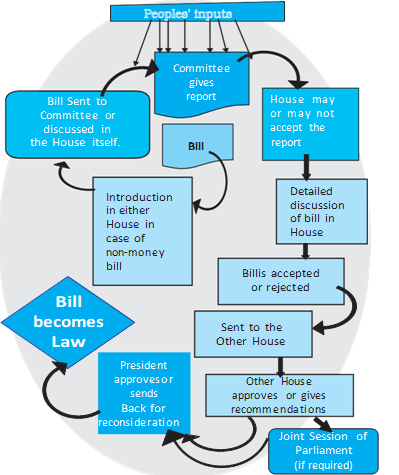
Main Stages of Law-Making
- The Cabinet approves the policy and the concerned ministry drafts the bill.
- A member introduces the bill in one House; a Money Bill must begin in the Lok Sabha.
- The House discusses the bill, often in committees; committee recommendations return to the House.
- The bill is voted upon in the House where it was introduced.
- A non-money bill passed by one House goes to the other House and follows the same procedure.
- After both Houses pass the bill, it is sent to the President for assent; assent makes it law.
Committees and Debate
- Committees handle much of the detailed discussion on bills and send recommendations to the House.
- Miniature legislatures is a name for parliamentary committees because of their important role in examining legislation.
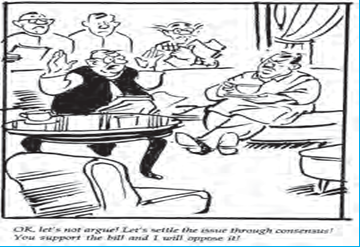
- Debate and consensus are central to legislative consideration.
Money Bills and Disagreement Between the Houses
| Point | Money Bill | Non-Money Bill |
|---|---|---|
| Introduction | Can be introduced only in the Lok Sabha. | May be introduced in either House. |
| Rajya Sabha’s role | May approve it or suggest changes, but cannot reject it. | Must pass it through the same procedure as the first House. |
| Time limit / disagreement | If the Rajya Sabha takes no action within 14 days, it is deemed passed; Lok Sabha may accept or reject its suggested amendments. | If the Houses disagree, a Joint Session may be called to resolve the deadlock. |
Joint Session
- Purpose: A Joint Session may be used to resolve disagreement between the Houses over a non-money bill.
- Outcome noted in the text: In the few Joint Sessions held to resolve deadlocks, the decision went in favour of the Lok Sabha.
Article 109 — The Constitution provides a special procedure for Money Bills; a Money Bill cannot be introduced in the Rajya Sabha (Council of States).
From Bill to Law
Final Enactment
- Both Houses pass the bill.
- The bill is sent to the President for assent.
- The President’s assent turns the bill into law.
Parliamentary Privilege and Executive Oversight
- Executive and majority: In a parliamentary democracy, the executive comes from the party or coalition with a majority in the Lok Sabha.
- Risk: If Parliament is not active and vigilant, majority support may allow the executive to exercise arbitrary power, reducing the House to a follower of the Cabinet.
- Parliamentary privilege: Members cannot be proceeded against for what they say in the legislature; this freedom helps them represent people and check the executive effectively.
- Breach of privilege: The presiding officer has final authority to decide matters concerning breach of privilege.
- Bill
- A draft of a proposed law.
- Private member’s Bill
- A bill proposed by a non-minister member of Parliament.
- Government Bill
- A bill proposed by a minister on behalf of the government.
- Parliamentary privilege
- Protection for legislators’ speech in the legislature, supporting their representative and oversight roles.
Outline the main stages through which a bill becomes law.
What can the Rajya Sabha do when it receives a Money Bill?
Why is parliamentary privilege important?
Quick recap
- A bill is a draft law; it may be a Government Bill or a private member’s Bill.
- Political, electoral, resource and coalition considerations shape whether the Cabinet pursues legislation.
- Bills are drafted by the concerned ministry, discussed and often examined by committees, then voted upon.
- A non-money bill must pass both Houses; a Joint Session may resolve disagreement.
- A Money Bill begins only in the Lok Sabha; the Rajya Sabha has 14 days to act and cannot reject it.
- After passage by both Houses, Presidential assent turns a bill into law.
- Parliamentary privilege protects legislators’ speech and supports Parliament’s scrutiny of the executive.
Instruments of Parliamentary Control
Parliamentary control — The legislature holds the executive accountable while policies are made, laws and policies are implemented, and their effects are reviewed.
Deliberation and Discussion
Discussion as a Check on the Executive
- During lawmaking: Members debate a bill’s policy direction and how the executive proposes to implement it.
- General discussions: Members can scrutinise government policies and actions even outside the direct consideration of bills.
- Question Hour: Held every day during parliamentary sessions; ministers must answer members’ questions. It is a major way to monitor the executive and government administration.
- Public concerns: Questions commonly seek information on issues such as price rise, food-grain availability, atrocities against weaker sections, riots and black-marketing.
- Representation and criticism: Question Hour lets MPs raise constituency problems and criticise government actions.
- Political pressure: Heated exchanges, protests or walkouts can consume legislative time, but may also be tactics to press the government for concessions and accountability.
| Point | Question Hour | Zero Hour |
|---|---|---|
| Purpose | Members seek information and scrutinise government actions. | Members raise matters they consider important. |
| Minister's response | Ministers are required to answer questions. | Ministers are not bound to reply. |
| Timing | Held every day during parliamentary sessions. | A period for raising matters in the House. |
Other Discussion Devices
- Half-an-hour discussion: Allows discussion of matters of public importance.
- Adjournment motion: Another parliamentary device through which members can raise matters and hold the government to account.
Approval or Refusal of Laws
Parliamentary approval — A bill becomes law only after it receives Parliament’s approval; this gives the legislature power to accept or refuse proposed laws.
Examples
- Lok Pal Bill: One example of a bill that failed to become law.
- Prevention of Terrorism Bill (2002): Rejected by the Rajya Sabha.
Examples of Parliamentary Negotiation and Control
- 1977During the Janata Party rule, a government with a Lok Sabha majority but not a Rajya Sabha majority could be compelled to make concessions.
- 2000The same kind of House-divided situation occurred during the NDA rule, requiring concessions to secure approval.
- 2002The Rajya Sabha rejected the Prevention of Terrorism Bill.
Financial Control
Financial control — The legislature controls government finances by examining and approving the resources needed to carry out government programmes.
No-Confidence Motion
No-confidence motion — A motion in the Lok Sabha that tests whether the government still has the House’s support; losing that support can force the government to resign.
Conditions for Effective Parliamentary Control
What Makes Control Effective?
- Adequate time: The House needs enough time to scrutinise government actions.
- Active participation: Members must take interest in debates and participate effectively.
- Willingness to compromise: Government and opposition need to be prepared to negotiate.
- Challenges: Sessions and debate time in the Lok Sabha and State Legislative Assemblies have gradually declined over the last two decades. Absence of quorum and opposition boycotts also weaken scrutiny and control.
- Question Hour
- Daily period during parliamentary sessions when ministers answer members’ questions.
- Zero Hour
- Period when members may raise matters of importance; ministers are not required to reply.
- Quorum
- The minimum number of members required for the House to conduct its business.
- Financial control
- Legislative scrutiny and approval of the government’s funds and budgetary policies.
How does Question Hour help Parliament control the executive?
How does Parliament exercise financial control?
What conditions help Parliament control the executive effectively?
Quick recap
- Parliamentary control holds the executive accountable through discussion, law approval, financial scrutiny and no-confidence motions.
- Question Hour requires ministers to answer members’ questions; ministers are not bound to reply to matters raised in Zero Hour.
- Bills need Parliament’s approval, and negotiations may be needed when the government lacks a majority in either House.
- Financial control gives the legislature a say over the budget, public spending and policies reflected in it.
- No-confidence motion can force a government to resign if it loses Lok Sabha support.
- Effective scrutiny depends on adequate time, active participation and compromise; declining debate time, lack of quorum and boycotts weaken it.
What Do The Committees of Parliament Do ?
Parliamentary Committees
Parliamentary committees — Groups of legislators that study issues and carry out detailed work on Parliament’s behalf.
Why committees are needed
- Limited time: Parliament meets only during sessions, so it cannot give every issue the detailed attention it needs.
- Detailed scrutiny: Committees examine bills, ministry grant demands, departmental spending and possible corruption.
- Standing committees: Since 1983, India has developed a system of over twenty departmentally related standing committees.
- Oversight: Standing committees supervise departments, their budgets and expenditure, and bills concerning their work.
Joint Parliamentary Committee (JPC) — A committee with members from both Houses, formed to examine a particular bill or investigate financial irregularities.
| Point | Standing Committees | Joint Parliamentary Committees |
|---|---|---|
| Purpose | Ongoing oversight of departments, budgets, spending and related bills | Examine a specific bill or investigate financial irregularities |
| Membership | Departmentally related committees | Members selected from both Houses |
Committees and Parliament’s final authority
- Referrals: Many important bills are referred to committees for detailed consideration.
- Reduced workload: Committee scrutiny allows Parliament to focus on work that needs its full consideration.
- Influence: Parliament often approves committee work with only occasional changes and rarely rejects committee recommendations.
- Final approval: A bill cannot become law and a budget cannot be sanctioned without Parliament’s approval.
Legislative sovereignty
- N. V. Gadgil’s view: On 18 November 1949, he argued that restrictions on the legislature concern procedure, not substantive limits on its sovereignty.
How Parliament Regulates Itself
Orderly parliamentary proceedings
- Debate: Parliament performs its important functions through discussion, which needs to be meaningful and orderly.
- Constitutional provisions: The Constitution provides for the smooth conduct of parliamentary business.
- Presiding officer: The presiding officer is the final authority on regulating the House’s business.
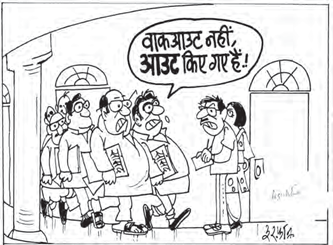
- Walkouts: Opposition members may walk out to protest against the government.
Anti-Defection Law
Defection — A legislator is considered to have defected if they voluntarily leave their party, vote against its instructions, or remain absent when party leadership directs them to attend.
Rules and consequences
- Purpose: The law restricts legislators elected on a party ticket from defecting to another party.
- Constitutional change: The 52nd Amendment Act introduced the anti-defection amendment in 1985; it was later modified by the 91st Amendment.
- Decision-maker: The presiding officer of the House makes the final decision in defection cases.
- Disqualification: A member found to have defected loses House membership and is disqualified from political office, such as ministership.
Impact of the anti-defection amendment
- Effectiveness: Experience over the following twenty years showed that the amendment had not succeeded in curbing defections.
- Shift in power: It gave party leadership and presiding officers additional power over legislators.
Parliament’s Democratic Role
- Representation: Members reflect the country’s varied regions, languages, castes, religions and communities.
- Democratic work: Parliament can control the executive and express the interests of different sections of society.
- Significance: Its diverse membership makes the legislature the most representative organ of government and potentially more responsive to public expectations.
- Responsibility: Parliament holds a high position of power because it represents the people’s wishes.
Key Dates
- 18 November 1949N. V. Gadgil stated that legislative restrictions concern procedure, not substantive sovereignty.
- 1983India developed a system of parliamentary standing committees.
- 1985The 52nd Amendment Act introduced the anti-defection amendment.
- SubsequentlyThe anti-defection amendment was modified by the 91st Amendment.
- Standing committee
- A continuing committee that oversees a department and related work.
- Joint Parliamentary Committee
- A committee drawn from both Houses to examine a specific matter.
- Presiding officer
- The House’s authority for regulating proceedings and deciding defection cases.
- Defection
- Leaving a party or acting against its instructions in the ways defined by the anti-defection law.
Why does Parliament refer work to committees?
What actions count as defection, and what may follow?
How does Parliament contribute to democracy?
Quick recap
- Committees allow detailed legislative and financial scrutiny despite Parliament’s limited session time.
- Many important bills are referred to committees; standing committees oversee departments, while JPCs examine specific bills or investigate irregularities.
- Committee recommendations strongly influence Parliament, but laws and budgets still require Parliament’s approval.
- The presiding officer regulates House business and decides anti-defection cases.
- The anti-defection amendment was introduced by the 52nd Amendment Act in 1985 and later modified by the 91st Amendment.
- A diverse Parliament represents social interests and can hold the executive accountable.
Political Science — ALL CHAPTERS
1
Constitution: Why And How?
2
Rights In The Indian Constitution
3
Election And Representation
4
Executive
5
Legislature
6
Judiciary
7
Federalism
8
Local Governments
9
Constitution as A Living Document
10
The Philosophy Of The Constitution
1
INTRODUCTION TO POLITICAL THEORY
2
FREEDOM OVERVIEW
3
EQUALITY
4
SOCIAL JUSTICE
5
RIGHTS
6
CITIZENSHIP
7
NATIONALISM
8
SECULARISM