Class 11 Humanities . Political Science . India Constitution At Work . Rights in the Indian Constitution
Chapter 2: Rights In The Indian Constitution
Ch 2
Political Science
Class 11 Humanities
Introduction And The Importance Of Rights
The Constitution and Rights
Constitutional rights
- Constitution: It sets out how government is organised, limits government powers and helps ensure that people enjoy rights in a democracy.
- Fundamental Rights: These are listed in Part III of the Indian Constitution, which also specifies limits on the rights.
- Changing scope: Over the decades, the scope of rights has changed and, in some respects, expanded.
Why Rights Matter
Asian Games Construction Workers
- In 1982, contractors hired poor workers from across India to build Asian Games flyovers and stadiums; workers faced poor conditions and were paid below the government-prescribed minimum wage.
- Social scientists petitioned the Supreme Court, arguing that paying less than the minimum wage amounted to begging or forced labour and violated the Fundamental Right against exploitation.
- The Court accepted the plea and directed the government to ensure that thousands of workers received the prescribed wages.
Machal Lalung: Denial of a Fair and Speedy Trial
- Arrest and custody: Machal Lalung, a resident of Chuburi village in Assam’s Morigaon district, was arrested at age 23 on a charge of causing grievous injuries. Considered mentally unfit to stand trial, he was sent to LokPriya Gopinath Bordoloi Mental Hospital in Tezpur for treatment.
- Ignored medical reports: After successful treatment, doctors informed jail authorities in 1967 and 1996 that Machal was fit to stand trial, but no action followed.
- Release: He remained in judicial custody for 54 years without his case coming up for hearing. A National Human Rights Commission-appointed team intervened after inspecting undertrials in the state; Machal was released in July 2005, aged 77.
- Rights lesson: The constitutional right to life and liberty includes the right to a fair and speedy trial. Machal’s case shows that rights are ineffective if they are not available in practice.
Key dates in Machal Lalung’s case
- 1967Doctors reported that Machal was fit to stand trial; the report was ignored.
- 1996Doctors again reported that he was fit to stand trial; no action followed.
- July 2005Machal was released at age 77 after spending 54 years in custody without a hearing.
Bill of Rights — A Bill of Rights is a list of rights mentioned and protected by a constitution; it bars government action against individual rights and provides a remedy when those rights are violated.
Who must be protected—and from whom?
- Democratic duty: A democracy must recognise and protect individuals’ rights.
- Protection in practice: Rights may be threatened by private individuals or organisations, so the government must protect people from such violations.
- Limits on government: Government bodies may themselves violate rights while carrying out their functions.
| Point | Threat from a private person or organisation | Threat from government |
|---|---|---|
| Why protection is needed | An individual may need the government to protect their rights. | Government bodies must be prevented from violating individual rights. |
| Examples | A private person or organisation | The legislature, executive, bureaucracy or judiciary |
Quick recap
- The Constitution limits government power and supports a democratic system in which people enjoy rights.
- Part III lists Fundamental Rights and specifies limits on them; their scope has changed and in some respects expanded.
- In the 1982 Asian Games workers’ case, the Supreme Court treated below-minimum wages as forced labour and required prescribed wages to be paid.
- Machal Lalung’s 54 years in custody without a hearing showed the consequences of denying a fair and speedy trial.
- A Bill of Rights lists and protects constitutional rights, bars government violations and provides a remedy for violations.
- Government must protect people from private threats and must also refrain from violating their rights.
Fundamental Rights In The Indian Constitution
Why Fundamental Rights Are Protected
Origins and purpose
- Freedom struggle: Leaders demanded that British rulers respect people’s rights; the Motilal Nehru Committee called for a bill of rights in 1928.
- Constitutional protection: After independence, rights were included in the Constitution as Fundamental Rights—rights considered so important that they receive special protection.
- Purpose: The Constitution protects these rights against violation by government action.
| Point | Fundamental Rights | Ordinary legal rights |
|---|---|---|
| Source and protection | Guaranteed and protected by the Constitution | Protected and enforced by ordinary laws |
| How they can be changed | Require a constitutional amendment | May be changed through ordinary law-making |
| Government limits | No government organ may violate them; reasonable restrictions may apply | Depend on the laws that establish them |
| Judicial protection | Courts can declare executive or legislative action illegal if it violates them or restricts them unreasonably | Enforced through ordinary legal processes |
Do not assume Fundamental Rights are unlimited: the government may impose reasonable restrictions on their exercise.
South Africa’s Bill of Rights
Purpose and enforcement
- Constitution: South Africa’s Constitution was inaugurated in December 1996, after the dissolution of the Apartheid government and amid the threat of civil war.
- Status: It describes the Bill of Rights as a cornerstone of democracy.
- Enforcement: A special Constitutional Court enforces the rights in the Constitution.
- Anti-discrimination: It forbids discrimination based on race, gender, pregnancy, marital status, ethnic or social origin, colour, age, disability, religion, conscience, belief, culture, language or birth.
| Right or protection | Examples in the Bill of Rights |
|---|---|
| Personal and civic | Dignity; privacy; information |
| Work and living conditions | Fair labour practices; adequate housing; a healthy environment and environmental protection |
| Social and economic | Health care, food, water and social security |
| Children and education | Children’s rights; basic and higher education |
| Community rights | Rights of cultural, religious and linguistic communities |
| Point | India | South Africa |
|---|---|---|
| Information provided here | Six Fundamental Rights: equality, freedom, protection against exploitation, freedom of religion, cultural and educational rights, and constitutional remedies. | The excerpt lists a broad range of rights, including dignity, privacy, fair labour practices, housing, health care, education and information. |
| How to establish common and distinct rights | Consult the relevant list of Indian Fundamental Rights in the wider chapter. | Compare that list with the rights expressly listed for South Africa in this lecture. |
Key dates
- 1928The Motilal Nehru Committee demanded a bill of rights.
- December 1996South Africa inaugurated its Constitution, including its Bill of Rights.
- Fundamental Rights
- Constitutionally guaranteed rights receiving special protection against government violation.
- Ordinary legal rights
- Rights protected by ordinary laws and changeable through ordinary law-making.
- Reasonable restrictions
- Limits the government may place on the exercise of Fundamental Rights.
- Bill of Rights
- A constitutional statement of rights; South Africa’s Constitution calls it a cornerstone of democracy.
How are Fundamental Rights different from ordinary legal rights?
Are Fundamental Rights absolute?
Quick recap
- The freedom movement demanded rights; the Motilal Nehru Committee called for a bill of rights in 1928.
- Fundamental Rights are specially protected by the Constitution and cannot be changed by ordinary law.
- Courts can declare government actions illegal when they violate Fundamental Rights or restrict them unreasonably.
- Fundamental Rights are not unlimited; the government may impose reasonable restrictions.
- South Africa’s 1996 Bill of Rights expressly lists civil, community and socio-economic rights and prohibits discrimination on a wide range of grounds.
- The lecture lists South Africa’s rights but does not enumerate India’s; consult the wider chapter to identify overlaps and differences.
Right To Equality
Fundamental Rights: Overview
- Fundamental Rights: Part III of the Constitution lists rights that are essential to individual freedom and democratic government.
- Protection: The Constitution and the judiciary safeguard these rights, while allowing reasonable restrictions.
Right to Equality
Right to Equality — A Fundamental Right that opposes discrimination and promotes equal dignity, status and opportunity for all citizens.
What it guarantees
- Equality before law: The law should treat people equally; everyone is entitled to equal protection of the laws.
- No discrimination: The State cannot discriminate only on grounds of religion, race, caste, sex or place of birth.
- Public access: People must have equal access to shops, hotels, places of entertainment, wells, bathing ghats, roads and places of worship.
- Public employment: Discrimination on the listed grounds is prohibited in public employment.
- Untouchability and titles: Untouchability is abolished; the State cannot confer titles except for distinction in military or academic fields.
| Point | Equality of Status | Equality of Opportunity |
|---|---|---|
| Meaning | Citizens have equal dignity and standing in society. | People from all sections should have fair chances to progress. |
| Constitutional approach | Discrimination and practices such as untouchability undermine equal status. | Special measures may support children, women and socially and educationally backward classes. |
| Example | Equal access to public places. | Reservations in jobs or admissions for eligible backward classes. |
Reservations and Equality
- Purpose: Special provisions can address existing social inequalities so that equality of opportunity becomes meaningful.
- Article 16(4): Allows the State to make reservations in appointments or posts for a backward class that, in the State’s opinion, is inadequately represented in its services.
- Key principle: Reservation is not treated as a violation of equality; it can help fulfil equality of opportunity.
| Example | Discriminatory basis | Why it violates equality |
|---|---|---|
| A Dalit customer is served tea in an earthen cup while another customer gets a mug. | Caste | Unequal treatment and denial of equal access based on caste. |
| Women newsreaders over 45 are removed, while male newsreaders of the same age continue presenting. | Sex | Different treatment based on gender, despite the same age. |
Does violence against a Dalit community for refusing caste-based customary work violate Fundamental Rights?
Right to Freedom
Liberty — Freedom of thought, expression and action, exercised without denying others their freedom or endangering law and order.
Why Equality and Freedom Go Together
- Interdependence: Equality and liberty are both essential to democracy; each is incomplete without the other.
- Limits: Freedom does not mean doing anything one wishes. Each person’s freedom must be protected alongside the freedom of others and public order.
Right to Life and Personal Liberty
Article 21 — No person may be deprived of life or personal liberty except according to a procedure established by law.
Safeguards on Arrest
- Grounds: An arrested person must be told why they are being arrested.
- Legal defence: The person has the right to defend themselves through a lawyer of their choice.
- Magistrate: Police must bring the arrested person before the nearest magistrate within 24 hours; the magistrate decides whether the arrest is justified.
Wider Meaning of the Right to Life
- Human dignity: Supreme Court judgments have interpreted the right to life as including the right to live with human dignity and without exploitation.
- Livelihood and shelter: The right also includes shelter and livelihood, since people need the means to live.
Preventive Detention
Preventive Detention — Detaining a person in advance because the government believes they may engage in unlawful activity or threaten public order or national security.
| Point | Ordinary Arrest | Preventive Detention |
|---|---|---|
| Basis | Usually follows a suspected offence already committed. | Based on apprehension of possible future unlawful activity or a threat. |
| Procedure | The person is informed of the grounds, may use a lawyer and must be brought before a magistrate within 24 hours. | The usual arrest procedure described above may not be followed before detention. |
| Review | A magistrate considers whether the arrest is justified. | Detention may continue for up to three months before the case is reviewed by an advisory board. |
| Concern | Safeguards protect personal liberty. | It may help address threats, but can be misused; this creates tension with the right to life and personal liberty. |
How can reservations support the Right to Equality?
What safeguards apply to a person who is arrested?
- Equality: Equal dignity and opportunity may require steps to address existing social disadvantage.
- Liberty: Article 21 protects life and personal liberty, with its meaning extended to dignity, shelter and livelihood.
- Preventive detention: It is an exception to ordinary arrest safeguards and requires careful review because it can be misused.
Quick recap
- The Right to Equality protects equal treatment and equal access, and prohibits discrimination on specified grounds.
- Untouchability is abolished, and the State cannot confer titles except for military or academic distinction.
- Special provisions, including reservations under Article 16(4), can advance equality of opportunity.
- Liberty must be exercised without undermining the freedom of others or public order.
- Article 21 protects life and personal liberty; arrest safeguards include notice of grounds, access to a lawyer and a magistrate within 24 hours.
- Preventive detention addresses perceived future threats but may be misused and is reviewed by an advisory board after up to three months.
Other freedoms
Freedoms and Their Restrictions
Restrictions on freedoms — Fundamental freedoms are not absolute; the government may restrict them on specified grounds.
Key points
- Speech and expression may be restricted for concerns such as public order, peace and morality.
- Assembly must be peaceful and without arms. In certain areas, an assembly of five or more people may be declared unlawful.
- Risk of misuse: authorities may deny permission for genuine protests; public awareness and vigilance help guard against this.
- Constituent Assembly concern: Somnath Lahiri criticised rights provisions for granting limited freedoms followed by restrictions.
Constituent Assembly debates
- 29 April 1947Somnath Lahiri objected that fundamental rights were framed with many restrictions that could weaken them.
- 26 May 1949Sardar Hukam Singh stressed that the majority must help minorities feel secure in a secular state.
Rights of Accused Persons
Rights of accused persons — Constitutional protections ensure that accused people receive a fair chance to defend themselves and are not treated as guilty before a court finds them guilty.
| Protection | Meaning |
|---|---|
| No double punishment | A person cannot be punished more than once for the same offence. |
| No retrospective criminal law | An action cannot be made illegal after the action has already occurred. |
| No self-incrimination | A person cannot be compelled to give evidence against themselves. |
Right Against Exploitation
Right against exploitation — This right prohibits forced labour, human trafficking and slavery, and protects children from employment in hazardous work.
Key protections
- Begar is forced labour without payment; it is prohibited, as are buying and selling people and using them as slaves.
- Bonded labour, historically imposed by landlords and moneylenders, still occurs in some forms, including brick-kiln work; it is a crime punishable by law.
- Child labour: employment of children below 14 in dangerous jobs, such as factories and mines, is forbidden.
- Education: making child labour illegal and recognising children's right to education strengthens protection against exploitation.
Right to Freedom of Religion
Freedom of religion — Everyone may choose, follow or reject a religion, subject to limits protecting public order, morality and health.
Freedom of faith and worship
- Freedom of conscience includes choosing a religion or choosing not to follow any religion.
- Religious practice includes the freedom to profess, follow and propagate a religion.
- Limits: government may regulate religious practices to protect public order, morality and health, or to remove social evils.
- Examples of restrictions: practices such as sati, bigamy and human sacrifice have been prohibited.
- Conversion: people may share information about their religion and persuade others, but forcible conversion is not allowed; intimidation or inducement is contested.
Equality of All Religions
Secular state and equal treatment
- No official religion: India does not give official status to any religion, and public office is open regardless of a person's religion.
- No religious discrimination: the government must not favour a religion or discriminate on religious grounds in public employment.
- State institutions: institutions run by the state must not preach or favour a religion or provide religious education.
- Purpose: equal treatment helps sustain secularism; government action on religious practices can nevertheless cause tension.
Cultural and Educational Rights
Minority — A community with a shared language or religion that is outnumbered by another social group in a region or in the country.
Cultural and educational protections
- Diversity: minorities may be religious, linguistic or cultural; minority status is not based only on religion.
- Cultural protection: minority communities may conserve and develop their own culture, language and script.
- Educational institutions: religious and linguistic minorities may establish and manage their own institutions.
- State aid: an institution cannot be denied government aid simply because it is managed by a minority community.
- Majority responsibility: Sardar Hukam Singh argued that the majority should understand minority concerns and help minorities feel secure.
Right to Constitutional Remedies
Right to constitutional remedies — This right allows a person to approach the High Court or Supreme Court to enforce a fundamental right that has been violated.
How remedies protect rights
- Courts: the Supreme Court and High Courts can issue orders and directions to the government to enforce rights.
- Importance: Dr. B. R. Ambedkar described this right as the Constitution's “heart and soul” because it makes rights enforceable.
| Writ | Purpose |
|---|---|
| Habeas Corpus | Orders that an arrested person be brought before the court; the court may release them if the arrest is unlawful or unjustified. |
| Mandamus | Directs a public office-holder to perform a legal duty when failure to do so infringes an individual's right. |
| Prohibition | A higher court stops a lower court from hearing a case beyond its jurisdiction. |
| Quo Warranto | Challenges a person's authority to hold public office and prevents them from acting if they are not entitled to it. |
| Certiorari | Orders a lower court or authority to transfer a pending matter to a higher court or authority. |
Other rights-protection institutions
- Commissions: bodies such as the National Commission on Minorities, National Commission on Women and National Commission on Scheduled Castes protect specific groups.
- National Human Rights Commission: established by law to protect fundamental and other rights.
- Begar
- Forced labour performed without payment.
- Bonded labour
- Labour imposed through debt or other coercion.
- Freedom of conscience
- The freedom to choose a religion or to follow none.
- Secularism
- Equal treatment of religions by the state, without an official religion.
- Writ
- A special court order used to enforce or protect rights.
What three protections does the Constitution provide to accused persons?
Why is the right to constitutional remedies important?
Name the five writs and state what they broadly do.
Quick recap
- Fundamental freedoms are subject to restrictions, and peaceful assembly must be without arms.
- Accused persons have protections against repeat punishment, retrospective criminal laws and compelled self-incrimination.
- The right against exploitation prohibits forced labour, trafficking, slavery and hazardous work for children below 14.
- Freedom of religion includes conscience, practice and propagation, with limits for public order, morality and health.
- Secularism requires equal treatment of religions; minorities can preserve their culture and establish educational institutions.
- Constitutional remedies allow courts to enforce rights through writs, while commissions provide additional protection.
National Human Rights Commission (NHRC)
National Human Rights Commission (NHRC)
Why the NHRC was established
- Implementation matters: The real test of constitutional rights is whether people can actually exercise them, especially poor, illiterate and deprived groups.
- Watchdogs: Independent organisations such as the People’s Union for Civil Liberties (PUCL) and People’s Union for Democratic Rights (PUDR) monitor rights violations.
- Establishment: The government established the NHRC in 1993 to address human-rights concerns.
Establishment
- 1993The government established the National Human Rights Commission.
| Member | Qualification |
|---|---|
| Chairperson | Former Chief Justice of the Supreme Court of India |
| Member | Former judge of the Supreme Court |
| Member | Former Chief Justice of a High Court |
| Two members | Knowledge and practical experience in human-rights matters |
Functions, complaints and powers
- Inquiries: Investigates human-rights violations on its own initiative or following a victim’s petition.
- Jail visits: Visits jails to study inmates’ conditions.
- Research: Undertakes and promotes research on human rights.
- Common complaints: Custodial death or rape, disappearances, police excesses, failure to act and indignity to women.
- Notable interventions: Its work on disappeared youth in Punjab and investigation and trial of Gujarat riot cases proved effective.
- Limited enforcement power: It cannot prosecute; it can recommend action to the government or recommend that courts initiate proceedings based on its inquiry.
Directive Principles of State Policy (DPSP)
Directive Principles of State Policy — Constitutional policy guidelines for governments that are non-justiciable and cannot be enforced by courts.
Purpose and legal status
- Purpose: Guide policy towards equality and the well-being of all citizens while allowing future governments flexibility in their choices.
- Non-justiciable: If a government fails to implement a guideline, a person cannot ask a court to order its implementation.
- Moral and public accountability: The Constitution’s makers expected governments to take the principles seriously and people to hold governments responsible.
- Scope: The principles set social goals, identify rights beyond Fundamental Rights and recommend policies for governments.
- Non-justiciable
- Not enforceable through court proceedings.
- Directive Principles
- Constitutional guidelines that direct government policy.
- Human-rights violation
- An infringement of rights that the NHRC may inquire into.
| Area | Examples |
|---|---|
| Land and industry | Zamindari abolition bills; bank nationalisation; factory laws; promotion of cottage and small industries |
| Workers | Minimum wages and a partial right to work through an employment guarantee programme |
| Social uplift | Reservation provisions for Scheduled Castes and Scheduled Tribes |
| Education and local government | Right to education; panchayati raj institutions; mid-day meal scheme |
What can the NHRC do when it finds evidence of a human-rights violation?
Why are the Directive Principles called non-justiciable?
Quick recap
- The NHRC was established in 1993 to address human-rights violations.
- It investigates complaints, visits jails and promotes human-rights research.
- The NHRC can make recommendations but has no power to prosecute.
- DPSP guide government policy towards equality and citizens’ well-being.
- DPSP are non-justiciable, but governments are expected to act on them and people can hold governments accountable.
- Examples of implementation include wage laws, reservations, education, panchayati raj and employment programmes.
Fundamental Duties of citizens
Fundamental Duties
- Introduction: The 42nd Amendment added ten Fundamental Duties to the Constitution in 1976.
- Examples: Citizens should abide by the Constitution, defend the country, promote harmony and protect the environment.
- Status: The Constitution does not provide for enforcing these duties, and enjoying Fundamental Rights is not conditional on fulfilling them.
Fundamental Rights and Directive Principles
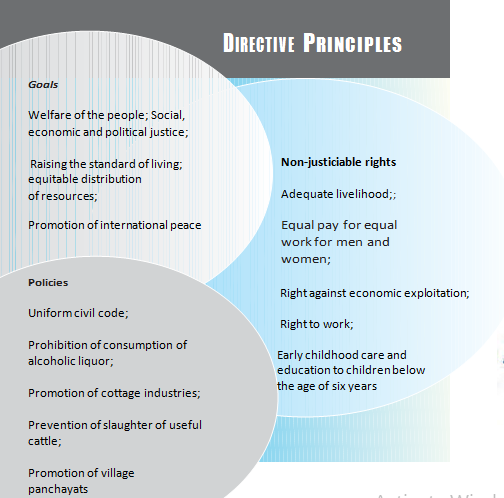
Conflict Over Property and Public Welfare
Zamindari Abolition Dispute
- The government sought to abolish the zamindari system through laws.
- Opponents argued that these laws violated the Fundamental Right to property.
- The government argued that rights could be restricted to implement Directive Principles and advance public welfare.
- The courts and executive took different positions, leading to a long legal dispute.
| Government | Court | |
|---|---|---|
| Position | Fundamental Rights could be abridged to give effect to Directive Principles. | Fundamental Rights were sacred and should not be limited, even to implement Directive Principles. |
| Underlying view | Rights should not obstruct measures for public welfare. | Fundamental Rights require strong protection. |
The Right to Property
- Original provision: The Constitution initially recognised the right to acquire, possess and maintain property as a Fundamental Right.
- Public welfare: The government could take property for public purposes, and property laws became central to disputes over land reform.
- Present status: The 44th Amendment in 1978 removed the right to property from the list of Fundamental Rights; it is now a legal right under Article 300A.
Parliament’s Amendment Power
- Constitutional amendment: Parliament can amend the Constitution, but its power is subject to limits set by the Supreme Court.
- Basic structure: In the 1973 Kesavananda Bharati case, the Court held that Parliament cannot alter the Constitution’s basic features.
Rights and Constitutional Democracy
Key Dates
- 1950The Constitution came into force; the judiciary has since served as an important protector of rights.
- 1973The Supreme Court held that the right to property was not part of the Constitution’s basic structure.
- 1976The 42nd Amendment added ten Fundamental Duties.
- 1978The 44th Amendment removed the right to property from the Fundamental Rights and made it a legal right under Article 300A.
How are Fundamental Rights and Directive Principles different, yet complementary?
What was the significance of the 44th Amendment for the right to property?
What principle did the Supreme Court establish in the Kesavananda Bharati case?
Quick recap
- The 42nd Amendment (1976) added ten Fundamental Duties; duties do not determine whether citizens enjoy Fundamental Rights.
- Fundamental Rights protect individuals, while Directive Principles guide government action for society’s welfare.
- The zamindari abolition dispute raised a conflict between property rights and public welfare policies.
- The 44th Amendment (1978) made property a legal right under Article 300A rather than a Fundamental Right.
- The Kesavananda Bharati case established that Parliament cannot alter the Constitution’s basic structure.
- Rights limit government and support democratic governance; the judiciary helps protect and interpret them.
Political Science — ALL CHAPTERS
1
Constitution: Why And How?
2
Rights In The Indian Constitution
3
Election And Representation
4
Executive
5
Legislature
6
Judiciary
7
Federalism
8
Local Governments
9
Constitution as A Living Document
10
The Philosophy Of The Constitution
1
INTRODUCTION TO POLITICAL THEORY
2
FREEDOM OVERVIEW
3
EQUALITY
4
SOCIAL JUSTICE
5
RIGHTS
6
CITIZENSHIP
7
NATIONALISM
8
SECULARISM