Class 11 PCB . Biology . Biology . Biological Classification
Chapter 2: Biological Classification
Ch 2
Biology
Class 11 PCB
Introduction
Early Attempts at Classification
From practical grouping to scientific criteria
- Early classification was based mainly on organisms’ usefulness for food, shelter and clothing, rather than scientific criteria.
- Aristotle made an early scientific attempt, using simple morphological characters.
- Plants: Aristotle grouped them as trees, shrubs and herbs; animals: he grouped them by whether they had red blood.
Two-Kingdom Classification and Its Limits
Two-kingdom classification — A system used in Linnaeus’ time that classified organisms into Plantae and Animalia.
Why the system was inadequate
- It did not distinguish prokaryotes from eukaryotes, or unicellular from multicellular organisms.
- It grouped unlike organisms: photosynthetic green algae and non-photosynthetic fungi were both included among plants.
- Many organisms fit neither kingdom, despite the system being simple to use.
- Classification needed more criteria: cell structure, cell-wall nature, nutrition, habitat, reproduction and evolutionary relationships.
Whittaker’s Five-Kingdom Classification
Five-kingdom classification — R. H. Whittaker proposed this system in 1969, recognising Monera, Protista, Fungi, Plantae and Animalia.
Criteria used by Whittaker
- Main criteria: cell structure, body organisation, mode of nutrition, reproduction and phylogenetic relationships.
- Phylogenetic classification aims to reflect evolutionary relationships, alongside morphological, physiological and reproductive similarities.
| Feature | Monera | Protista | Fungi | Plantae | Animalia |
|---|---|---|---|---|---|
| Cell type | Prokaryotic | Eukaryotic | Eukaryotic | Eukaryotic | Eukaryotic |
| Cell wall | Non-cellulosic; polysaccharide and amino acid | Present | Present; contains chitin | Present; contains cellulose | Absent |
| Nuclear membrane | Absent | Present | Present | Present | Present |
| Body organisation | Cellular | Cellular | Multicellular or loose tissue | Tissue or organ | Tissue, organ or organ system |
| Mode of nutrition | Autotrophic (chemosynthetic or photosynthetic) and heterotrophic (saprophytic or parasitic) | Autotrophic (photosynthetic) and heterotrophic | Heterotrophic (saprophytic or parasitic) | Autotrophic (photosynthetic) | Heterotrophic (holozoic, saprophytic, etc.) |
How Classification Criteria Changed
Regrouping organisms
- Earlier ‘Plants’ included bacteria, blue-green algae (cyanobacteria), fungi, mosses, ferns, gymnosperms and angiosperms, largely because they had cell walls.
- This grouping mixed distinct organisms: prokaryotes with eukaryotes, and unicellular forms such as Chlamydomonas with multicellular forms such as Spirogyra.
- Fungi separated from plants: fungi are heterotrophic and have chitin cell walls; green plants are autotrophic and have cellulose cell walls.
- Monera groups all prokaryotes; Protista groups unicellular eukaryotes.
- Protista brought together Chlamydomonas and Chlorella (previously placed among plants) with Paramoecium and Amoeba (previously placed among animals). The grouping changed because the classification criteria changed.
Three-domain system — A proposed system that splits Monera into two domains and places the other eukaryotic kingdoms in a third domain, resulting in six kingdoms.
Why was the two-kingdom classification considered inadequate?
Name Whittaker’s five kingdoms and the main criteria he used.
Quick recap
- Early classification was practical; Aristotle used simple morphological features.
- Linnaeus’ two kingdoms were Plantae and Animalia, but the system could not separate important biological differences.
- Whittaker proposed five kingdoms in 1969 using multiple criteria, including phylogeny.
- Monera contains prokaryotes; Protista contains unicellular eukaryotes; fungi differ from plants in nutrition and cell-wall composition.
- Classification changes as knowledge of organismal characteristics and evolutionary relationships improves.
- The three-domain proposal divides Monera into two domains and places the remaining eukaryotic kingdoms in a third.
Kingdom Monera
Bacteria: General Features
Kingdom Monera — Bacteria are the sole members of Kingdom Monera and are among the most abundant microorganisms.
Occurrence and nutrition
- Occurrence: Bacteria live almost everywhere, from soil to extreme habitats such as hot springs, deserts, snow and deep oceans.
- Parasitism: Many live in or on other organisms as parasites.
- Metabolic diversity: Bacteria show extensive metabolic diversity; some are autotrophs and most are heterotrophs.
- Autotrophs: Make food from inorganic substances; they may be photosynthetic or chemosynthetic.
- Heterotrophs: Obtain food from other organisms or dead organic matter.
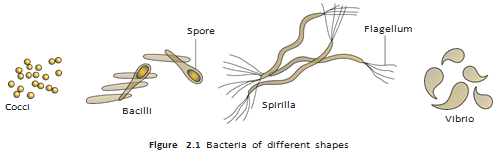
| Shape group | Shape |
|---|---|
| Coccus (plural: cocci) | Spherical |
| Bacillus (plural: bacilli) | Rod-shaped |
| Vibrio (plural: vibrios) | Comma-shaped |
| Spirillum (plural: spirilla) | Spiral |
Archaebacteria
Archaebacteria — Bacteria adapted to extreme habitats, distinguished from other bacteria by a different cell-wall structure.
| Type | Habitat |
|---|---|
| Halophiles | Extremely salty areas |
| Thermoacidophiles | Hot springs |
| Methanogens | Marshy areas; also the gut of ruminants such as cows and buffaloes |
Key significance
- Cell wall: Their distinctive cell-wall structure helps them survive in extreme conditions.
- Methanogens: Produce methane (biogas) from the dung of ruminant animals.
Eubacteria
Eubacteria — The “true bacteria”, generally characterised by a rigid cell wall; motile forms have a flagellum.
Cyanobacteria
Features and importance
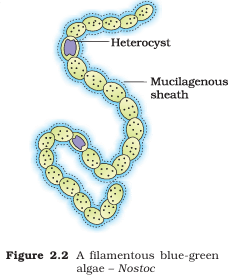
- Other name: Cyanobacteria are also called blue-green algae; they contain chlorophyll and are photosynthetic autotrophs.
- Forms and habitats: They may be unicellular, colonial or filamentous, and live in freshwater, marine or terrestrial habitats.
- Colonies: Colonies are generally surrounded by a gelatinous sheath; cyanobacteria can form blooms in polluted water bodies.
- Nitrogen fixation: Some fix atmospheric nitrogen in specialised cells called heterocysts; examples include *Nostoc* and *Anabaena*.
Other Nutritional Groups and Roles
| Type | How they obtain energy or food | Examples / roles |
|---|---|---|
| Photosynthetic autotrophs | Use light energy to make food | Cyanobacteria |
| Chemosynthetic autotrophs | Oxidise inorganic substances such as nitrates, nitrites and ammonia; use released energy to produce ATP | Recycle nitrogen, phosphorus, iron and sulphur |
| Heterotrophs | Depend on other organisms or dead organic matter | Decomposers; useful in food production and nitrogen fixation, or harmful as pathogens |
Effects of heterotrophic bacteria
- Useful roles: Many are important decomposers; some help make curd, produce antibiotics or fix nitrogen in legume roots.
- Pathogens: Some harm humans, crops, farm animals and pets.
- Diseases: Bacterial diseases include cholera, typhoid, tetanus and citrus canker.
Reproduction in Bacteria
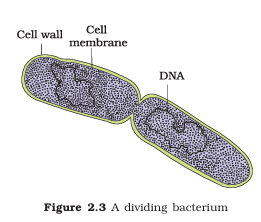
- Main method: Bacteria reproduce mainly by fission.
- Unfavourable conditions: Some bacteria produce spores.
- DNA transfer: Bacteria may also undergo a primitive type of sexual reproduction involving DNA transfer from one bacterium to another.
Mycoplasma
- Cell wall: Mycoplasma completely lack a cell wall.
- Size and survival: They are the smallest known living cells and can survive without oxygen.
- Pathogenic forms: Many cause diseases in animals and plants.
How do archaebacteria differ from other bacteria, and how do methanogens benefit biogas production?
What are heterocysts, and which bacteria have them?
Quick recap
- Bacteria are the sole members of Monera and occur in diverse habitats; common shapes are coccus, bacillus, vibrio and spirillum.
- Archaebacteria have distinctive cell walls and include halophiles, thermoacidophiles and methanogens.
- Eubacteria have rigid cell walls; motile forms possess flagella.
- Cyanobacteria are photosynthetic and some fix nitrogen in heterocysts.
- Bacteria may be autotrophs or heterotrophs; heterotrophs include useful decomposers and harmful pathogens.
- Bacteria reproduce mainly by fission, may form spores, and can transfer DNA; Mycoplasma lack cell walls.
Kingdom Protista
General Features of Protista
- Members: Protista includes all single-celled eukaryotes, such as photosynthetic protists and protozoans.
- Features: They are primarily aquatic, have a well-defined nucleus and membrane-bound organelles, and reproduce asexually or sexually.
Chrysophytes
- Members: Chrysophytes include diatoms and golden algae (desmids); they are microscopic and occur in freshwater and marine environments.
- Diatoms: Their silica-embedded cell walls form two overlapping shells and accumulate as diatomaceous earth, used in polishing and filtration.
Dinoflagellates
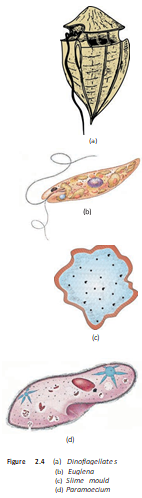
- Habitat and pigments: Dinoflagellates are mostly marine and photosynthetic; their pigments may make them appear yellow, green, brown, blue or red.
- Structure and red tides: Most have cellulose plates and two flagella. Rapid multiplication of red forms such as Gonyaulax can cause red tides and release toxins harmful to marine animals.
Euglenoids
Slime Moulds
- Nutrition and movement: Slime moulds are saprophytic protists that move over decaying matter and engulf organic material.
- Plasmodium and spores: In suitable conditions they form a spreading plasmodium; in unfavourable conditions it forms fruiting bodies bearing resistant spores dispersed by air.
Protozoans
How do diatoms form diatomaceous earth, and what are its uses?
Name the four major groups of protozoans and give examples of disease-causing members.
Quick recap
- Protista includes single-celled eukaryotes, is primarily aquatic and has boundaries that are not sharply defined.
- Diatoms have silica-embedded shells; their deposits accumulated over billions of years to form diatomaceous earth.
- Red dinoflagellate blooms can cause red tides, and their toxins may kill marine animals.
- Euglenoids photosynthesise in sunlight but can feed heterotrophically without it.
- Slime moulds form plasmodia and produce resistant, air-dispersed spores.
- Protozoans are grouped as amoeboid, flagellated, ciliated and sporozoan.
Kingdom Fungi
General Characteristics
Fungi — A diverse kingdom of heterotrophic organisms that absorb nutrients from organic matter.
Structure, habitat and nutrition
- Habitat: Fungi are cosmopolitan, occurring in air, water, soil, and on plants and animals; they commonly thrive in warm, humid places.
- Body: Except for unicellular yeasts, fungi are filamentous; thread-like hyphae form a network called the mycelium.
- Hyphae: Coenocytic hyphae are continuous tubes with multinucleate cytoplasm; other hyphae have cross-walls called septa.
- Cell wall: Fungal cell walls contain chitin and polysaccharides.
- Nutrition: Saprophytes absorb soluble organic matter from dead material; parasites obtain nutrients from living hosts.
- Symbiosis: Fungi form lichens with algae and mycorrhizae with roots of higher plants.
- Examples and effects: Yeast is used in bread and beer; Penicillium is a source of antibiotics; Puccinia causes wheat rust, and Albugo parasitises mustard.
- Food spoilage: Refrigeration helps prevent food spoilage caused by fungal or bacterial infections.
Reproduction and Sexual Cycle
| Mode | Methods or spores |
|---|---|
| Vegetative | Fragmentation, fission, or budding |
| Asexual | Conidia, sporangiospores, or zoospores |
| Sexual | Oospores, ascospores, or basidiospores |
Sexual reproduction
- Spore production: Fungal spores are formed in distinct structures; sexual spores are produced in fruiting bodies.
- Plasmogamy: Protoplasm from two compatible gametes or hyphae fuses.
- Karyogamy: The two nuclei fuse, producing a diploid stage.
- Meiosis: The diploid zygote undergoes meiosis to form haploid spores.
- Dikaryotic stage: In Ascomycetes and Basidiomycetes, plasmogamy may be followed by a stage with two unfused nuclei per cell (), called a dikaryon; this phase is the dikaryophase.
Sexual cycle
- Plasmogamy: cytoplasm fuses.
- Karyogamy: nuclei fuse, forming a diploid stage ().
- Meiosis: the zygote forms haploid spores ().
Fungal classes are distinguished mainly by mycelium structure, spore formation, and fruiting bodies.
Major Classes of Fungi
| Class | Habitat and mycelium | Asexual / vegetative reproduction | Sexual reproduction and fruiting body | Examples and key notes |
|---|---|---|---|---|
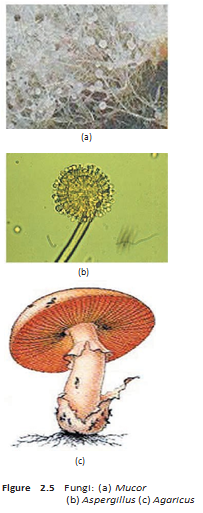
| Phycomycetes | Aquatic; also on damp, decaying wood or as plant parasites. Mycelium is aseptate and coenocytic. | Motile zoospores or non-motile aplanospores form inside sporangia. | Fusion of gametes forms a zygospore. Gametes may be similar (isogamous) or dissimilar (anisogamous or oogamous). | Mucor, Rhizopus (bread mould), Albugo (mustard parasite). |
| Ascomycetes (sac fungi) | Mostly multicellular; branched, septate mycelium. May be saprophytic, decomposing, parasitic, or coprophilous (growing on dung); yeast is unicellular. | Conidia form externally on conidiophores and germinate into mycelium. | Ascospores form internally in sac-like asci; asci are arranged in fruiting bodies called ascocarps. | Penicillium, Aspergillus, Claviceps, Neurospora, and yeast (Saccharomyces). Neurospora is used in biochemical and genetic research; morels and truffles are edible delicacies. |
| Basidiomycetes | Branched, septate mycelium; found in soil, on logs and stumps, or as plant parasites. | Asexual spores are generally absent; vegetative reproduction by fragmentation is common. | Sex organs are absent. Plasmogamy occurs by fusion of vegetative (somatic) cells of different strains or genotypes. The dikaryotic structure forms a basidium; karyogamy and meiosis there produce four basidiospores externally. Basidia form basidiocarps. | Mushrooms, bracket fungi, puffballs; Agaricus, Ustilago (smut), Puccinia (rust). |
| Deuteromycetes (imperfect fungi) | Branched, septate mycelium; many are litter decomposers, while others are saprophytes or parasites. | Reproduce by conidia; only asexual or vegetative stages are known in this group. | Sometimes the asexual/vegetative stage and sexual stage were given separate names and placed in different classes. Once their linkage and sexual stage were discovered, the fungus was reclassified, often into Ascomycetes or Basidiomycetes. | Alternaria, Colletotrichum, Trichoderma. Decomposers help in mineral cycling. |
Do not confuse plasmogamy with karyogamy: cytoplasm fuses first; the nuclei fuse later. In some fungi, the dikaryotic stage separates these events.
What is the dikaryotic condition, and in which fungal classes is it found?
Quick recap
- Fungal hyphae form a mycelium; cell walls contain chitin and polysaccharides.
- Fungi may be saprophytes, parasites, or symbionts and commonly grow in warm, humid habitats.
- Sexual reproduction involves plasmogamy, karyogamy, and meiosis.
- Ascomycetes and Basidiomycetes can have a dikaryotic () phase.
- Phycomycetes have aseptate coenocytic mycelium; Ascomycetes form ascospores in asci.
- Basidiomycetes form basidiospores on basidia; Deuteromycetes are grouped by their known asexual stages.
Kingdom Plantae
General Features of Plantae
Kingdom Plantae — Includes all eukaryotic, chlorophyll-containing organisms commonly called plants.
Plant Features and Groups
- Cell structure: Plant cells are eukaryotic, with prominent chloroplasts and a cell wall mainly made of cellulose.
- Nutrition: Most plants are photosynthetic, but some are partly heterotrophic.
- Insectivorous plants: Bladderwort and Venus flytrap trap insects.
- Parasitic plant: Cuscuta obtains nutrients from its host.
- Major groups: Algae, bryophytes, pteridophytes, gymnosperms and angiosperms.
Alternation of Generations
Alternation of generations — A plant life cycle that alternates between a diploid sporophytic phase and a haploid gametophytic phase.
- Sporophyte: The diploid phase.
- Gametophyte: The haploid phase.
- Variation: The duration of each phase and whether it is free-living or dependent on the other phase differ among plant groups.
What is alternation of generations in plants?
Kingdom Animalia
Kingdom Animalia — Includes heterotrophic, multicellular eukaryotes whose cells lack cell walls.
Animal Characteristics
- Food: Animals depend directly or indirectly on plants; holozoic nutrition involves ingesting food and digesting it internally.
- Storage: Food reserves are stored as glycogen or fat.
- Growth: Animals generally develop into adults with a definite shape and size.
- Movement and sensing: Most can move; higher forms have elaborate sensory and neuromotor mechanisms.
- Reproduction: Sexual reproduction usually involves male–female copulation followed by embryological development.
Viruses, Viroids, Prions and Lichens
Viruses
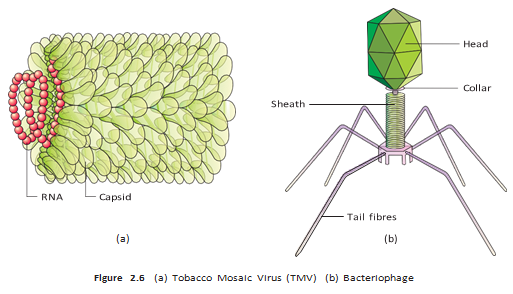
- Nature: Viruses are acellular and are not included in Whittaker’s five kingdoms; outside a host cell they are inert and can form crystals.
- Replication: They are obligate parasites that use a living host cell’s machinery to replicate.
- Structure: A virus has infectious genetic material—either DNA or RNA, never both—inside a protective protein coat called a capsid.
- Capsid: The capsid consists of capsomeres arranged in helical or polyhedral forms.
- Genetic material patterns: Plant viruses generally have single-stranded RNA; animal viruses may have single- or double-stranded RNA, or double-stranded DNA; bacteriophages usually have double-stranded DNA.
- Diseases: Viruses cause mumps, smallpox, herpes, influenza and AIDS. Plant infections can cause mosaic patterns, leaf rolling or curling, yellowing, vein clearing, dwarfing and stunted growth.
Virus Research
- 1892Dmitri Ivanowsky identified the tobacco mosaic disease agent as a microbe smaller than bacteria because it passed through bacteria-proof filters.
- 1898M. W. Beijerinck showed infected tobacco extract could transmit disease and named the pathogen a virus; he called the infectious fluid Contagium vivum fluidum.
- 1935W. M. Stanley showed that viruses could be crystallised and that the crystals consisted largely of proteins.
Viroids
- Definition: Viroids are infectious, low-molecular-weight free RNA without the protein coat found in viruses.
- Discovery: T. O. Diener discovered viroids in 1971 while studying the agent of potato spindle tuber disease.
Prions
- Definition: Prions are infectious agents made of abnormally folded proteins.
- Diseases: Bovine spongiform encephalopathy (BSE), or mad cow disease, affects cattle; the analogous human disease is Creutzfeldt–Jakob disease (CJD).
Lichens
- Definition: Lichens are mutually beneficial associations between algae and fungi; they are not included in Whittaker’s five kingdoms.
- Algal partner: The phycobiont is autotrophic and prepares food.
- Fungal partner: The mycobiont is heterotrophic and provides shelter, water and mineral nutrients.
- Pollution indicator: Lichens do not grow in polluted areas, so their presence indicates relatively unpolluted air.
Five-Kingdom Classification
Classification Background
- Aristotle: Early biological classification used simple morphological characters.
- Linnaeus: Classified living organisms into two kingdoms, Plantae and Animalia.
- R. H. Whittaker: Proposed five kingdoms: Monera, Protista, Fungi, Plantae and Animalia.
- Criteria: Whittaker’s classification considered cell structure, body organisation, nutrition, reproduction and phylogenetic relationships.
- Excluded groups: Viruses, viroids and lichens are not included in the five-kingdom system.
| Kingdom | Key features |
|---|---|
| Monera | Includes bacteria, which are cosmopolitan and show extensive metabolic diversity; they may be autotrophic or heterotrophic. |
| Protista | Includes unicellular eukaryotes with a defined nucleus and other membrane-bound organelles, such as chrysophytes, dinoflagellates, euglenoids, slime moulds and protozoans; they reproduce sexually and asexually. |
| Fungi | Structurally and ecologically diverse; most are saprophytic and reproduce both asexually and sexually. Major groups are Phycomycetes, Ascomycetes, Basidiomycetes and Deuteromycetes. |
| Plantae | Includes algae, bryophytes, pteridophytes, gymnosperms and angiosperms. |
| Animalia | Includes heterotrophic, multicellular eukaryotes without cell walls; nutrition is holozoic. |
Why are viruses not placed in the five-kingdom classification?
Quick recap
- Plantae includes eukaryotic, chlorophyll-containing organisms; plant cells have prominent chloroplasts and cellulose-rich walls.
- Bladderwort and Venus flytrap are insectivorous plants; Cuscuta is parasitic.
- Plants alternate between a diploid sporophyte and a haploid gametophyte; phase duration and independence vary.
- Animalia consists of heterotrophic, multicellular eukaryotes without cell walls and typically uses holozoic nutrition.
- Viruses contain DNA or RNA within a capsid; viroids are free RNA, prions are infectious proteins, and lichens unite algae and fungi.
- Whittaker’s five kingdoms are Monera, Protista, Fungi, Plantae and Animalia; viruses, viroids and lichens are excluded.
Biology — ALL CHAPTERS
1
The Living World
2
Biological Classification
3
Plant Kingdom
4
Animal Kingdom
5
Morphology of Flowering Plants
6
Anatomy Of Flowering Plants
7
Structural Organization In Animals
8
Cell The Unit Of Life
9
Biomolecules
10
Cell Cycle And Cell Division
11
Photosynthesis in Higher Plants
12
Respiration In Plants
13
Plant Growth And Development
14
Breathing And Exchange Of Gases
15
Body Fluids And Circulation
16
Excretory Products And Their Elimination
17
Locomotion And Movement
18
Neural Control And Coordination
19
Chemical Coordination and integration