Class 11 PCB . Biology . Biology . Plant Kingdom
Chapter 3: Plant Kingdom
Ch 3
Biology
Class 11 PCB
Algae
General Characteristics
Algae — Simple, chlorophyll-bearing, thalloid, autotrophic organisms that are mostly aquatic.
Habitats and Forms
- Habitats: Found in fresh water and marine environments, as well as on moist stones, soil and wood.
- Associations: Some live with fungi in lichens; others occur on animals, such as sloth bears.
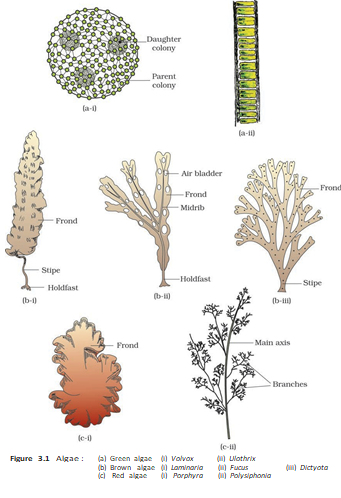
- Body forms: Range from unicellular and colonial forms such as Volvox to filaments such as Ulothrix and Spirogyra.
- Large forms: Some marine algae, including kelps, form massive plant bodies.
Reproduction in Algae
| Mode | How it occurs | Example / key point |
|---|---|---|
| Vegetative | Fragmentation; each fragment develops into a new thallus. | Common in algae |
| Asexual | Spores are produced; the common type is the motile, flagellated zoospore. | Zoospores germinate into new plants. |
| Sexual | Two gametes fuse; gametes may be motile or non-motile. | Classified by the similarity or difference in gamete size and movement. |
| Type | Gametes | Example |
|---|---|---|
| Isogamy | Similar in size; may both be flagellated or both non-flagellated. | Ulothrix (flagellated); Spirogyra (non-flagellated) |
| Anisogamy | Gametes differ in size. | Eudorina |
| Oogamy | Large, non-motile female gamete fuses with a smaller, motile male gamete. | Volvox, Fucus |
Importance and Main Classes
Importance of Algae
- Carbon fixation: Algae carry out at least half of Earth's total carbon dioxide fixation through photosynthesis.
- Oxygen: Photosynthesis increases dissolved oxygen in the surrounding water.
- Food webs: Algae are primary producers and form the base of food cycles for aquatic animals.
- Food: Marine genera used as food include Porphyra, Laminaria and Sargassum.
- Hydrocolloids: Brown algae produce algin; red algae produce carrageen. Both are water-holding substances used commercially.
- Agar: Obtained from Gelidium and Gracilaria; used to grow microbes and to prepare ice-creams and jellies.
- Food supplement: Protein-rich unicellular Chlorella is used as a supplement, including by space travellers.
Three Main Classes
- Chlorophyceae: Green algae.
- Phaeophyceae: Brown algae.
- Rhodophyceae: Red algae.
Chlorophyceae: Green Algae
Structure, Pigments and Reproduction
- Body form: Unicellular, colonial or filamentous; usually grass-green because chlorophyll a and b predominate.
- Chloroplasts: Definite chloroplasts may be discoid, plate-like, reticulate, cup-shaped, spiral or ribbon-shaped.
- Food storage: Pyrenoids in chloroplasts contain protein as well as starch; some species also store food as oil droplets.
- Cell wall: Usually rigid, with an inner cellulose layer and an outer pectose layer.
- Reproduction: Vegetative reproduction occurs by fragmentation or spores; asexual reproduction commonly uses flagellated zoospores formed in zoosporangia.
- Sexual reproduction: May be isogamous, anisogamous or oogamous.
Examples
- Common genera: Chlamydomonas, Volvox, Ulothrix, Spirogyra and Chara.
Phaeophyceae: Brown Algae
Structure, Pigments and Reproduction
- Habitat and size: Primarily marine; forms range from simple branched filaments such as Ectocarpus to kelps that may reach 100 metres.
- Pigments: Chlorophyll a and c, carotenoids and xanthophylls; fucoxanthin gives colours from olive green to brown.
- Stored food: Laminarin and mannitol.
- Cell covering: Cellulose cell wall, usually coated externally with gelatinous algin.
- Body parts: A holdfast anchors the alga; the stipe is the stalk and the frond is the leaf-like photosynthetic part.
- Vegetative and asexual reproduction: Fragmentation; asexual reproduction commonly uses pear-shaped zoospores with two unequal, laterally attached flagella.
- Sexual reproduction: Isogamous, anisogamous or oogamous; gametes are pear-shaped and have two lateral flagella. Fusion occurs in water or, in oogamous forms, inside the oogonium.
Examples
- Common genera: Ectocarpus, Dictyota, Laminaria, Sargassum and Fucus.
Rhodophyceae: Red Algae
Structure, Habitat and Reproduction
- Colour: The red pigment r-phycoerythrin predominates.
- Habitat: Mostly marine, especially in warmer regions; found near the surface and at great ocean depths where little light penetrates.
- Body form: Most have multicellular red thalli; some have complex body organisation.
- Stored food: Floridean starch, structurally similar to amylopectin and glycogen.
- Reproduction: Vegetative reproduction by fragmentation; asexual reproduction by non-motile spores and sexual reproduction by non-motile gametes.
- Sexual reproduction: Oogamous, with complex developments after fertilisation.
Examples
- Common genera: Polysiphonia, Porphyra, Gracilaria and Gelidium.
Class Comparison
| Feature | Chlorophyceae | Phaeophyceae | Rhodophyceae |
|---|---|---|---|
| Common name | Green algae | Brown algae | Red algae |
| Major pigments | Chlorophyll a, b | Chlorophyll a, c; fucoxanthin | Chlorophyll a, d; phycoerythrin |
| Stored food | Starch | Mannitol, laminarin | Floridean starch |
| Cell wall | Cellulose | Cellulose and algin | Cellulose, pectin and sulphate esters |
| Flagella | 2–8; equal, apical | 2; unequal, lateral | Absent |
| Habitat | Fresh, brackish and salt water | Mostly salt water; fresh water is rare | Mostly salt water; some fresh water forms |
Distinguish isogamy, anisogamy and oogamy.
Name the stored food and main pigments of each algal class.
Quick recap
- Algae are mostly aquatic, photosynthetic, thalloid organisms with highly variable forms.
- Reproduction may be vegetative by fragmentation, asexual by spores or sexual by gamete fusion.
- Sexual reproduction is classified as isogamy, anisogamy or oogamy.
- Chlorophyceae are green algae; Phaeophyceae are brown algae; Rhodophyceae are red algae.
- Algal pigments, food stores, cell walls and flagella help distinguish the three classes.
- Algae support aquatic food webs, fix carbon dioxide, release oxygen and provide useful food and commercial products.
Bryophytes
General features and life cycle
Bryophytes — A group of plants that includes mosses and liverworts and depends on water for sexual reproduction.
Structure and habitat
- Habitat: Usually grow in damp, humid, shaded places, including moist areas in hills.
- Plant body: More differentiated than algae; it is thallus-like and may be prostrate or erect.
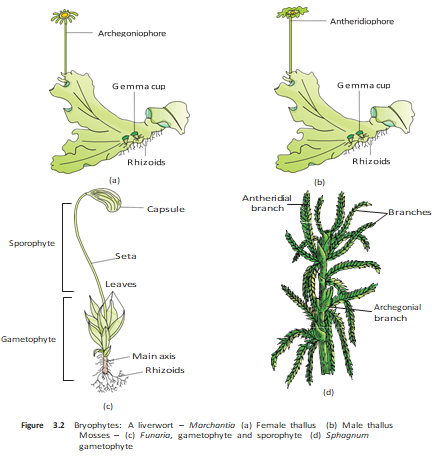
- Attachment: Rhizoids attach the plant to the substratum; true roots, stems and leaves are absent.
- Look-alike structures: Some bryophytes have root-like, stem-like or leaf-like structures.
- Gametophyte: The main plant body is haploid and produces gametes.
Sexual reproduction and life cycle
- Antheridium: The multicellular male sex organ produces biflagellate antherozoids.
- Archegonium: The multicellular, flask-shaped female sex organ produces a single egg.
- Fertilisation: Antherozoids move through water to the archegonium; fusion with the egg forms a zygote.
- Sporophyte: The zygote develops into a multicellular sporophyte, attached to and nourished by the photosynthetic gametophyte.
- Spore formation: Meiosis in some sporophyte cells produces haploid spores, which germinate into gametophytes.
Bryophyte life cycle
- Haploid gametophyte produces antheridia and archegonia
- Antherozoid and egg fuse to form a zygote
- Zygote develops into an attached sporophyte
- Meiosis produces haploid spores
- Spores germinate into new gametophytes
Ecological and economic importance
- Amphibians of the plant kingdom: They grow on soil but depend on water for sexual reproduction.
- Economic importance: Bryophytes are generally of little economic importance; some mosses provide food for herbivorous mammals, birds and other animals.
- Peat and packing: Sphagnum provides peat used as fuel and is used to pack living material because it holds water.
- Rock colonisation: Mosses, along with lichens, are among the first organisms to colonise rocks; they help break down rock and create a substrate for higher plants.
- Soil protection: Dense moss mats reduce the impact of falling rain and help prevent soil erosion.
Liverworts
Structure and reproduction
- Habitat: Moist, shady places such as stream banks, marshes, damp soil, tree bark and deep woods.
- Thallus: Often dorsiventral and closely appressed to the substrate; Marchantia is an example.
- Leafy forms: Have tiny leaf-like appendages arranged in two rows on stem-like structures.
- Asexual reproduction: Occurs by fragmentation of thalli or by gemmae—green, multicellular asexual buds formed in gemma cups.
- Gemmae: Detach from the parent thallus and germinate to form new individuals.
- Sexual reproduction: Sex organs may occur on the same thallus or on separate thalli.
- Sporophyte: Differentiated into foot, seta and capsule; meiosis in the capsule produces spores that germinate into free-living gametophytes.
Mosses
| Stage | Development and features |
|---|---|
| Protonema | Develops directly from a spore; creeping, green, branched and often filamentous. |
| Leafy stage | Develops as a lateral bud from the secondary protonema; upright, slender axes bear spirally arranged leaves and multicellular, branched rhizoids. |
Reproduction and examples
- Dominant stage: The gametophyte is the predominant stage in the moss life cycle.
- Vegetative reproduction: Takes place by fragmentation and budding in the secondary protonema.
- Sexual reproduction: Antheridia and archegonia form at the apex of leafy shoots.
- Sporophyte: After fertilisation, the zygote develops into a foot, seta and capsule; the moss sporophyte is more elaborate than that of liverworts.
- Spores: The capsule contains spores, which are dispersed by an elaborate mechanism.
- Examples: Funaria, Polytrichum and Sphagnum.
Why are bryophytes called the amphibians of the plant kingdom?
Name the two gametophyte stages of mosses and describe how they develop.
Quick recap
- Bryophytes have a dominant haploid gametophyte and lack true roots, stems and leaves.
- Water-dependent fertilisation forms a zygote that develops into a sporophyte dependent on the gametophyte.
- Meiosis in the sporophyte produces haploid spores that germinate into gametophytes.
- Liverworts reproduce asexually by fragmentation or gemmae; their sporophyte has a foot, seta and capsule.
- Moss gametophytes pass through protonema and leafy stages; mosses also reproduce by fragmentation and budding.
- Mosses aid rock colonisation and soil protection; Sphagnum provides peat and water-holding packing material.
Pteridophyte
Key Features and Plant Body
Spore Formation and Life Cycle
Pteridophyte Life Cycle
- Sporophyte bears sporangia on sporophylls → meiosis produces spores.
- Spores germinate → free-living prothalli (gametophytes) develop.
- Antheridia produce antherozoids; archegonia contain eggs.
- Water enables antherozoid transfer → fertilisation forms a zygote.
- Zygote develops into a multicellular, differentiated sporophyte.
Spore Types and Seed Habit
| Point | Homosporous | Heterosporous |
|---|---|---|
| Spore types | One kind of spore | Two kinds: large megaspores and small microspores |
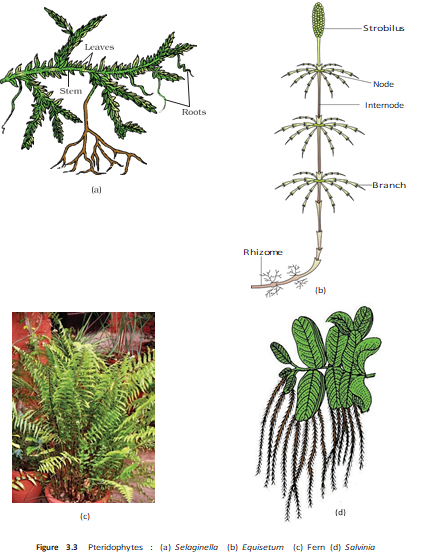
| Examples | Most pteridophytes | *Selaginella* and *Salvinia* |
| Gametophytes | — | Megaspores form female gametophytes; microspores form male gametophytes |
| Development | — | Female gametophytes are retained on the parent sporophyte for a variable period; zygotes develop into young embryos within them |
Habitat Restriction and Evolutionary Significance
- Restricted spread: Gametophytes need cool, damp, shady conditions, while fertilisation also requires water; these needs limit pteridophytes to narrow geographical regions.
- Seed-habit precursor: In heterosporous plants, retention of the female gametophyte and development of the zygote into an embryo within it are important steps towards the seed habit.
Classification
| Class | Examples |
|---|---|
| Psilopsida | *Psilotum* |
| Lycopsida | *Selaginella*, *Lycopodium* |
| Sphenopsida | *Equisetum* |
| Pteropsida | *Dryopteris*, *Pteris*, *Adiantum* |
Why are pteridophytes generally restricted to particular habitats?
Quick recap
- Pteridophytes are seedless vascular plants with a dominant, differentiated sporophyte.
- Their leaves may be microphylls or macrophylls; sporangia are borne on sporophylls, sometimes arranged in strobili.
- Meiosis produces spores that germinate into free-living prothalli.
- Water is required for antherozoids to reach the egg and enable fertilisation.
- Most pteridophytes are homosporous; *Selaginella* and *Salvinia* are heterosporous.
- In heterosporous plants, embryo development within the retained female gametophyte is a precursor to the seed habit.
- The four classes are Psilopsida, Lycopsida, Sphenopsida and Pteropsida.
Gymnosperms
Key Features of Gymnosperms
Gymnosperms — Seed plants whose ovules are not enclosed by an ovary wall; their seeds remain exposed, or naked.
Plant Structure and Adaptations
- Habit: Gymnosperms include medium-sized and tall trees and shrubs; Sequoia is among the tallest tree species.
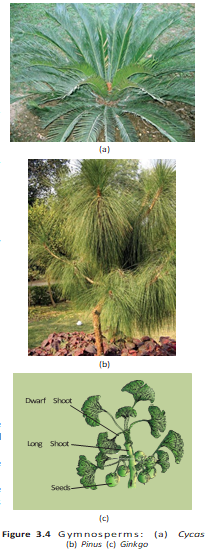
- Roots: Usually tap roots. Pinus may have mycorrhizal roots; Cycas has coralloid roots associated with nitrogen-fixing cyanobacteria.
- Stems: May be unbranched, as in Cycas, or branched, as in Pinus and Cedrus.
- Leaves: Simple or compound; Cycas has pinnate leaves that persist for several years.
- Adaptation: Leaves withstand extremes of temperature, humidity and wind.
- Water conservation: Conifer needle-like leaves have reduced surface area; thick cuticles and sunken stomata also reduce water loss.
Reproduction in Gymnosperms
Spores, Cones and Gametophytes
- Heterospory: Gymnosperms produce haploid microspores and megaspores in microsporangia and megasporangia, respectively.
- Cones: Sporangia occur on sporophylls arranged spirally along an axis, forming lax or compact strobili (cones).
- Male cones: Microsporophylls bear microsporangia; these cones are called microsporangiate or male strobili.
- Pollen grain: Microspores develop inside microsporangia into pollen grains—the highly reduced male gametophyte.
- Female cones: Megasporophylls bear ovules (megasporangia); these form macrosporangiate or female strobili.
- Cone arrangement: Pinus may bear male and female cones on the same tree. In Cycas, male cones and megasporophylls occur on different trees.
- Ovule: The megaspore mother cell forms in the nucellus, which is protected by envelopes; together these structures form the ovule.
- Female gametophyte: The megaspore mother cell undergoes meiosis to form four megaspores. One develops into a multicellular female gametophyte bearing two or more archegonia.
- Retention: The female gametophyte remains inside the megasporangium. Unlike in bryophytes and pteridophytes, gymnosperm gametophytes are not free-living; they remain within sporangia on the sporophyte.
Pollination to Seed Formation
- Pollen grains are released from microsporangia and carried by air to the opening of an ovule.
- The pollen tube grows towards an archegonium and delivers the male gametes near its opening.
- Fertilisation forms a zygote, which develops into an embryo.
- The ovule develops into a naked seed.
Angiosperms
| Point | Gymnosperms | Angiosperms |
|---|---|---|
| Ovules | Not enclosed by an ovary wall | Pollen grains and ovules develop in specialised structures called flowers |
| Seeds | Exposed (naked) | Enclosed in fruits |
Angiosperm Diversity and Classification
- Angiosperms: Flowering plants in which pollen grains and ovules develop in specialised structures called flowers.
- Range: They occur in diverse habitats and range in size from the tiny Wolffia to Eucalyptus trees over 100 metres tall.
- Importance: They provide food, fodder, fuel, medicines and other commercially useful products.
- Classes: Angiosperms are divided into dicotyledons and monocotyledons.
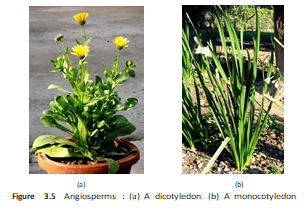
Quick recap
- Gymnosperms: Ovules are not enclosed by an ovary wall, and seeds remain naked.
- Structure: Roots are generally tap roots; stems may be branched or unbranched, and leaves have varied forms.
- Water conservation: Conifer needles, thick cuticles and sunken stomata help limit water loss.
- Reproduction: Microspores form pollen grains; one megaspore develops into a female gametophyte bearing archegonia.
- Fertilisation: Air carries pollen to ovules; the pollen tube delivers male gametes, and the zygote forms an embryo as the ovule becomes a seed.
- Angiosperms: Their seeds are enclosed in fruits, and they are classified as dicotyledons or monocotyledons.
Biology — ALL CHAPTERS
1
The Living World
2
Biological Classification
3
Plant Kingdom
4
Animal Kingdom
5
Morphology of Flowering Plants
6
Anatomy Of Flowering Plants
7
Structural Organization In Animals
8
Cell The Unit Of Life
9
Biomolecules
10
Cell Cycle And Cell Division
11
Photosynthesis in Higher Plants
12
Respiration In Plants
13
Plant Growth And Development
14
Breathing And Exchange Of Gases
15
Body Fluids And Circulation
16
Excretory Products And Their Elimination
17
Locomotion And Movement
18
Neural Control And Coordination
19
Chemical Coordination and integration