Class 11 PCB . Biology . Biology . Morphology of Flowering Plants
Chapter 5: Morphology of Flowering Plants
Ch 5
Biology
Class 11 PCB
The Root
Root and Shoot Systems
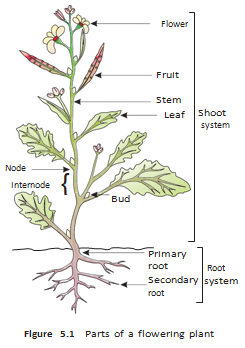
The Root
Root system — The root system is the underground part of a flowering plant, usually developing from the radicle or from other plant parts.
| Type | Formation and features | Example |
|---|---|---|
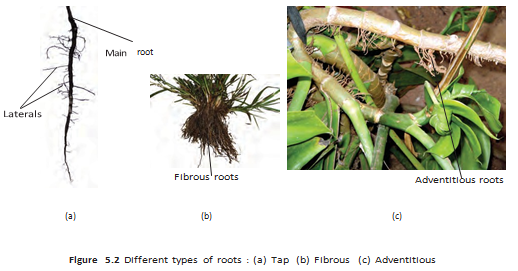
| Tap root system | The radicle elongates into a primary root, which bears lateral roots of successive orders such as secondary and tertiary roots. | Mustard; common in dicots |
| Fibrous root system | The primary root is short-lived and is replaced by many roots arising from the base of the stem. | Wheat; common in monocots |
| Adventitious root system | Roots arise from plant parts other than the radicle. | Grass, Monstera, banyan |
Functions of Roots
- Absorption: Take up water and minerals from the soil.
- Anchorage: Hold the plant firmly in the soil.
- Storage: Store reserve food in some plants.
- Synthesis: Produce plant growth regulators.
Regions of the Root
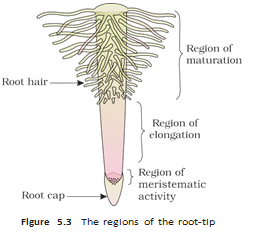
Root Tip Regions: Apex Upwards
- Root cap: Thimble-like covering that protects the tender root apex as it pushes through soil.
- Meristematic region: A short distance above the cap; small, thin-walled cells with dense protoplasm divide repeatedly.
- Region of elongation: Cells enlarge and elongate rapidly, increasing root length.
- Region of maturation: Cells differentiate and mature; some epidermal cells form root hairs that absorb water and minerals.
The Stem
Stem — The stem is the ascending plant axis that develops from the plumule and bears branches, leaves, flowers and fruits.
Stem Features and Functions
- Nodes are the regions where leaves arise; internodes are the portions between two nodes.
- Buds may be terminal or axillary. Young stems are generally green; older stems often become woody and dark brown.
- Main role: Spread branches bearing leaves, flowers and fruits.
- Other roles: Conduct water, minerals and photosynthates; some stems also store food, provide support or protection, and enable vegetative propagation.
The Leaf
Leaf — A leaf is a lateral, generally flattened structure that develops at a stem node and is a major vegetative organ for photosynthesis.
Leaf Origin and Main Parts
- Origin and arrangement: Leaves arise from shoot apical meristems and develop in acropetal order. An axillary bud at the leaf base may later form a branch.
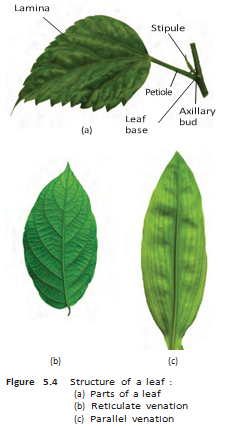
- Three parts: Leaf base, petiole and lamina.
- Leaf base: Attaches the leaf to the stem and may bear two small leaf-like stipules. In monocots it often forms a sheath; in some legumes it swells into a pulvinus.
- Petiole: Holds the blade towards light. Long, flexible petioles let leaves flutter, helping cool them and bring fresh air to their surface.
- Lamina: The expanded green blade; its prominent central vein is the midrib. Veins provide rigidity and transport water, minerals and food materials.
- Variation: Laminae differ in shape, margin, apex, surface and degree of incision.
Venation
Venation — Venation is the arrangement of veins and veinlets in the leaf lamina.
| Type | Vein arrangement | Common association |
|---|---|---|
| Reticulate | Veinlets form a network. | Generally dicots |
| Parallel | Veins run parallel to one another within the lamina. | Most monocots |
Types of Leaves
| Type | Structure | Example or key feature |
|---|---|---|
| Simple | Lamina is entire, or its incisions do not reach the midrib. | A bud occurs in the axil of the petiole. |
| Compound | Incisions reach the midrib, dividing the lamina into leaflets. | A bud occurs at the petiole axil, not in the axils of individual leaflets. |
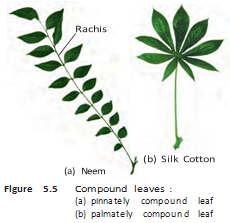
| Pinnately compound | Leaflets are arranged along a common axis called the rachis, which represents the leaf midrib. | Neem |
| Palmately compound | Leaflets arise from a common point at the tip of the petiole. | Silk cotton |
Phyllotaxy
Phyllotaxy — Phyllotaxy is the pattern in which leaves are arranged on a stem or branch.
| Type | Leaves at each node | Example |
|---|---|---|
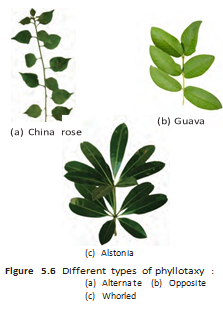
| Alternate | One leaf; successive leaves arise alternately. | China rose, sunflower |
| Opposite | A pair of leaves lie opposite each other. | Calotropis, guava |
| Whorled | More than two leaves form a whorl. | Alstonia |
How do tap, fibrous and adventitious root systems differ?
Distinguish simple and compound leaves.
Quick recap
- The root system lies below ground; the shoot system lies above ground.
- Roots may form tap, fibrous or adventitious systems and absorb, anchor, store and synthesise growth regulators.
- The root tip has a root cap, meristematic region, elongation region and maturation region with root hairs.
- Stems bear nodes, internodes and buds; they support organs, conduct materials and may perform additional functions.
- A typical leaf has a leaf base, petiole and lamina; venation may be reticulate or parallel.
- Leaves may be simple or compound; compound leaves are pinnate or palmate.
- Phyllotaxy is alternate, opposite or whorled.
The Inflorescence
Inflorescence
| Type | Main axis | Flower order |
|---|---|---|
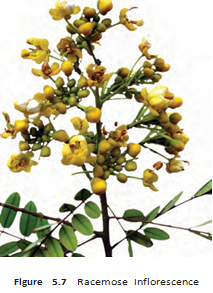
| Racemose | Continues to grow; flowers arise laterally. | Acropetal: older flowers below, younger flowers towards the apex. |
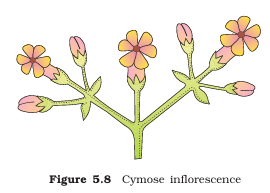
| Cymose | Ends in a flower; growth is limited. | Basipetal: older flowers at the apex, younger flowers towards the base. |
The Flower
| Basis | Type | Meaning or examples |
|---|---|---|
| Whorl appearance | Perianth | In flowers such as lily, calyx and corolla are not distinct. |
| Sex | Bisexual | Both androecium and gynoecium are present. |
| Sex | Unisexual | Only stamens or only carpels are present. |
| Symmetry | Actinomorphic | Divisible into two equal halves in any vertical plane through the centre; mustard, datura, chilli. |
| Symmetry | Zygomorphic | Divisible into two similar halves in only one vertical plane; pea, gulmohur, bean, Cassia. |
| Symmetry | Asymmetric (irregular) | Cannot be divided into two similar halves by any vertical plane; canna. |
| Number of floral parts | Trimerous, tetramerous, pentamerous | Floral appendages are in multiples of 3, 4 or 5, respectively. |
| Bracts | Bracteate / ebracteate | Bracteate flowers have a reduced leaf (bract) at the pedicel base; ebracteate flowers lack it. |
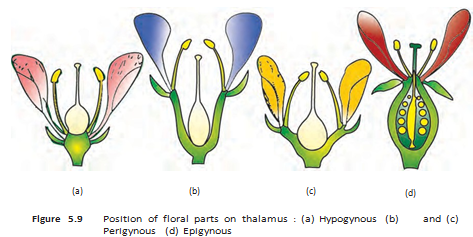
| Point | Hypogynous | Perigynous | Epigynous |
|---|---|---|---|
| Flower-part position | Calyx, corolla and androecium lie below the gynoecium. | Gynoecium is central; other parts arise from the rim of the thalamus at about the same level. | Thalamus grows around and fuses with the ovary; other parts arise above it. |
| Ovary | Superior | Half-inferior | Inferior |
| Examples | Mustard, china rose, brinjal | Plum, rose, peach | Guava, cucumber, sunflower ray florets |
Parts of a Flower
- Flower: The reproductive unit of angiosperms, adapted for sexual reproduction.
- Whorls: A typical flower has four successive whorls—calyx, corolla, androecium and gynoecium.
- Roles: Calyx and corolla are accessory whorls; androecium and gynoecium are the reproductive whorls.
Calyx and Corolla
Corolla — The whorl made up of petals, which are often brightly coloured to attract insects for pollination.
| Structure | Members united | Members free |
|---|---|---|
| Calyx | Gamosepalous | Polysepalous |
| Corolla | Gamopetalous | Polypetalous |
Corolla shapes
- Common forms: Tubular, bell-shaped, funnel-shaped and wheel-shaped.
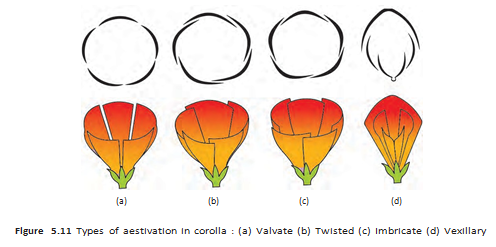
Aestivation — The arrangement of sepals or petals in a floral bud relative to other members of the same whorl.
| Type | Arrangement | Examples |
|---|---|---|
| Valvate | Adjacent margins touch but do not overlap. | Calotropis |
| Twisted | One margin of each member overlaps the next, in a regular direction. | China rose, lady’s finger, cotton |
| Imbricate | Margins overlap, but not in a particular direction. | Cassia, gulmohur |
| Vexillary (papilionaceous) | Largest standard overlaps two wings; wings overlap the two smallest anterior petals (keel). | Pea, bean |
Androecium
| Arrangement | Meaning | Example |
|---|---|---|
| Epipetalous | Stamens attached to petals. | Brinjal |
| Epiphyllous | Stamens attached to the perianth. | Lily |
| Polyandrous | Stamens remain free. | — |
| Monadelphous | Stamens united into one bundle. | China rose |
| Diadelphous | Stamens united into two bundles. | Pea |
| Polyadelphous | Stamens united into more than two bundles. | Citrus |
Filament variation
- Unequal filament lengths: Filaments may vary in length within one flower; examples include Salvia and mustard.
Gynoecium
| Point | Apocarpous | Syncarpous |
|---|---|---|
| Carpels | Free from one another. | Fused together. |
| Examples | Lotus, rose | Mustard, tomato |
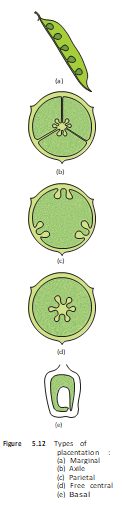
Placentation — The arrangement of ovules within the ovary.
| Type | Ovule/placenta position | Ovary features | Examples |
|---|---|---|---|
| Marginal | Placenta forms a ridge along the ventral suture; ovules occur in two rows. | — | Pea |
| Axile | Ovules attach to the central axis. | Multilocular ovary. | China rose, tomato, lemon |
| Parietal | Ovules develop on the inner wall or peripheral part. | Usually one chamber; a false septum may divide it into two. | Mustard, Argemone |
| Free-central | Ovules are borne on a central axis, with no septa. | Septa absent. | Dianthus, Primrose |
| Basal | Placenta is at the ovary base; a single ovule is attached. | — | Sunflower, marigold |
| Central | Listed as a placentation type in the text; no separate defining structure is described. | — | — |
Differentiate racemose and cymose inflorescences.
What are the three types of ovary position, and which ovary type occurs in each?
Name the main placentation types and give one example of each.
Quick recap
- Racemose axes continue growing with acropetal flowers; cymose axes end in a flower with basipetal flowers.
- A typical flower has four whorls: calyx, corolla, androecium and gynoecium.
- Flower symmetry may be actinomorphic, zygomorphic or asymmetric; floral parts may occur in multiples of 3, 4 or 5.
- Aestivation describes how sepals or petals are arranged in the bud: valvate, twisted, imbricate or vexillary.
- Stamens may be free, bundled, or attached to petals or perianth; carpels may be free (apocarpous) or fused (syncarpous).
- Placentation describes ovule arrangement in the ovary; ovules become seeds and the ovary becomes a fruit after fertilisation.
The Fruit
Fruit
The Seed
- Seed formation: After fertilisation, ovules develop into seeds.
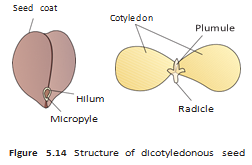
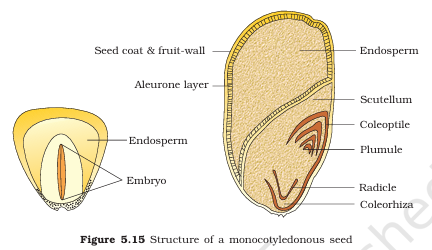
- Structure: A seed consists of a seed coat and an embryo; the embryo has a radicle, an embryonal axis and one or two cotyledons.
- Types: Seeds are classified as monocotyledonous or dicotyledonous according to the number of cotyledons.
Dicotyledonous Seeds
Monocotyledonous Seeds
Semi-technical Description of a Flowering Plant
Solanaceae
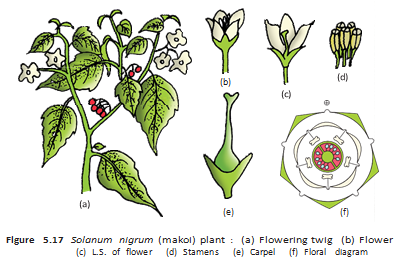
Actinomorphic, bisexual flower; five united sepals, five united petals, five stamens and a fused two-carpel gynoecium with a superior ovary.
| Use | Examples |
|---|---|
| Food | Tomato, brinjal, potato |
| Spice | Chilli |
| Medicine | Belladonna, ashwagandha |
| Fumigatory | Tobacco |
| Ornamental | Petunia |
Quick recap
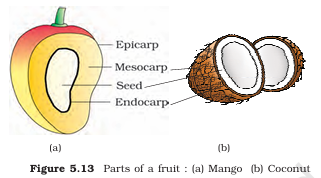
- A fruit is usually the fertilised, mature ovary; a fruit formed without fertilisation is parthenocarpic.
- A fleshy pericarp has epicarp, mesocarp and endocarp; mango and coconut are one-seeded drupes.
- Seeds develop from ovules and contain a seed coat and embryo; dicots have two cotyledons and monocots have one.
- Maize has a large food-storing endosperm, a scutellum and protective coleoptile and coleorhiza.
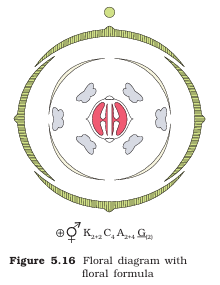
- Plant descriptions follow a fixed sequence and use floral diagrams and formulas to summarise flower structure.
- Solanaceae typically has bisexual, actinomorphic flowers with five united sepals, five united petals and five epipetalous stamens.
Biology — ALL CHAPTERS
1
The Living World
2
Biological Classification
3
Plant Kingdom
4
Animal Kingdom
5
Morphology of Flowering Plants
6
Anatomy Of Flowering Plants
7
Structural Organization In Animals
8
Cell The Unit Of Life
9
Biomolecules
10
Cell Cycle And Cell Division
11
Photosynthesis in Higher Plants
12
Respiration In Plants
13
Plant Growth And Development
14
Breathing And Exchange Of Gases
15
Body Fluids And Circulation
16
Excretory Products And Their Elimination
17
Locomotion And Movement
18
Neural Control And Coordination
19
Chemical Coordination and integration