Class 11 PCB . Biology . Biology . The Living World
Chapter 1: The Living World
Ch 1
Biology
Class 11 PCB
Diversity In The Living World
Diversity and Biodiversity
- Diversity: The living world contains an enormous variety of organisms found in habitats ranging from mountains and forests to oceans and deserts.
- Biodiversity: It refers to the number and variety of organisms on Earth; about 1.7–1.8 million species have been identified and described.
- Discovery: New organisms continue to be identified as scientists explore both new and familiar areas.
Identification and Nomenclature
Binomial nomenclature — The system of naming each organism with two components: a generic name and a specific epithet.
Rules for Scientific Names
- Language Names are generally Latin or Latinised, regardless of their original source.
- First word The generic name indicates the genus and begins with a capital letter.
- Second word The specific epithet begins with a small letter; it identifies the species within the genus.
- Writing Printed names are italicised. When handwritten, the two words are underlined separately.
- Author The describer’s abbreviated name may follow the scientific name; *Mangifera indica* Linn. credits Linnaeus.
| Scientific name | Genus (generic name) | Specific epithet |
|---|---|---|
| *Mangifera indica* | *Mangifera* | *indica* |
Classification, Taxa and Taxonomy
Taxonomy — Taxonomy is the study and practice of characterising, identifying, classifying and naming organisms.
Basis of Modern Taxonomy
- Structure External and internal features of organisms.
- Cells The structure of the cell.
- Development The organism’s developmental processes.
- Ecology Ecological information about the organism.
- Core processes Characterisation → identification → classification → nomenclature.
Systematics
| Point | Taxonomy | Systematics |
|---|---|---|
| Main focus | Characterising, identifying, classifying and naming organisms | Organismal diversity and relationships, including evolutionary relationships |
| Scope | Organising organisms into taxa | Includes identification, nomenclature and classification, with evolutionary relationships |
What is binomial nomenclature? State its main writing rules.
What is the difference between taxonomy and systematics?
Quick recap
- Biodiversity is the number and variety of organisms; about 1.7–1.8 million species are described.
- Identification establishes which organism is being studied; nomenclature gives it a standard scientific name.
- Binomial nomenclature uses a genus name and a specific epithet, with standard capitalisation and formatting rules.
- Classification groups organisms into taxa at different levels.
- Taxonomy uses structural, cellular, developmental and ecological information to characterise, identify, classify and name organisms.
- Systematics includes taxonomy and considers evolutionary relationships.
Taxonomic Categories
Taxonomic Categories and Hierarchy
Taxonomic category — A rank or level in the classification of organisms; each category is a unit of classification called a taxon (plural: taxa).
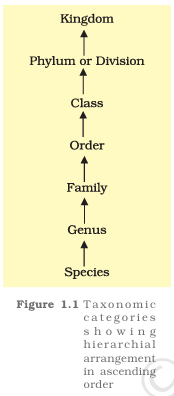
Taxonomic hierarchy — The ordered arrangement of taxonomic categories from species up to kingdom.
How classification works
- Ranks: Classification proceeds through a hierarchy of categories, rather than in one step.
- Basis: Organisms are placed by comparing their characters to identify similarities and differences.
- Biological groups: A taxon is a distinct biological entity, not merely a collection of organisms that look alike.
- Example: Insects are recognisable by features including three pairs of jointed legs.
Main categories
- Ascending order: Species → genus → family → order → class → phylum (animals) or division (plants) → kingdom.
- Lowest category: Species is the lowest category in both the plant and animal kingdoms.
- Higher categories: Taxonomists may use subcategories to place organisms more precisely.
Species
Species — A group of individual organisms with fundamental similarities that can be distinguished from closely related species by distinct morphological differences.
Species names and examples
- Scientific name: In a two-word name, the first word is the genus and the second is the specific epithet.
- Examples: *Mangifera indica*, *Solanum tuberosum* (potato) and *Panthera leo* (lion).
- Same genus, different species: *Panthera* includes *P. leo* (lion) and *P. tigris* (tiger); *Solanum* includes *S. nigrum* and *S. melongena*.
- Human beings: The species is *sapiens*, placed in the genus *Homo*; the scientific name is *Homo sapiens*.
Genus
Genus — A group of closely related species that share more characters with one another than with species of other genera.
Examples
- Solanum: Potato and brinjal are different species within this genus.
- Panthera: Lion (*P. leo*), leopard (*P. pardus*) and tiger (*P. tigris*) are species of this genus.
- Contrast: *Panthera* and *Felis* are separate genera; *Felis* includes cats.
Family
Family — A group of related genera with fewer similarities in common than the species within a genus.
Examples
- Plants: *Solanum*, *Petunia* and *Datura* belong to family Solanaceae; plant families are distinguished using vegetative and reproductive features.
- Animals: *Panthera* and *Felis* belong to family Felidae.
- Different families: Cats and dogs are placed in Felidae and Canidae, respectively.
Order
Order — An assemblage of related families sharing a smaller number of similar characters than genera within a family.
Examples
- Plants: Convolvulaceae and Solanaceae are placed in order Polymoniales, mainly on the basis of floral characters.
- Animals: Order Carnivora includes families Felidae and Canidae.
Class
Class — A category that groups related orders.
Example
- Mammalia: Includes order Primata (monkeys, gorillas and gibbons) and order Carnivora (including tigers, cats and dogs), as well as other orders.
Phylum and Division
Phylum — A higher category grouping related animal classes.
Examples
- Chordata: Fishes, amphibians, reptiles, birds and mammals are placed in this phylum because they share features such as a notochord and a dorsal hollow neural system.
- Plants: The corresponding higher category for plant classes is called a division.
Kingdom
Kingdom — The highest category in this classification hierarchy, grouping organisms from multiple phyla or divisions.
Examples
- Animalia: Includes animals belonging to different phyla.
- Plantae: Includes plants belonging to different divisions.
Changes Across the Hierarchy
| Point | Lower taxa | Higher taxa |
|---|---|---|
| Shared characters | More common characteristics | Fewer common characteristics |
| Relationships | Members are more closely related | Relationships to other taxa at the same rank are harder to determine |
| Classification | Placement is more specific | Classification becomes more complex |
| Organism | Biological name | Genus | Family | Order | Class | Phylum / Division |
|---|---|---|---|---|---|---|
| Man | *Homo sapiens* | *Homo* | Hominidae | Primata | Mammalia | Chordata |
| Housefly | *Musca domestica* | *Musca* | Muscidae | Diptera | Insecta | Arthropoda |
| Mango | *Mangifera indica* | *Mangifera* | Anacardiaceae | Sapindales | Dicotyledonae | Angiospermae |
| Wheat | *Triticum aestivum* | *Triticum* | Poaceae | Poales | Monocotyledonae | Angiospermae |
Taxonomy and its importance
- Taxonomy: The branch of biology concerned with identification, nomenclature and classification of organisms.
- Scientific naming: Organisms are assigned correct biological names using the binomial system, which gives each name two words.
- Common principles: Identification, naming and classification follow internationally developed codes and rules.
- Uses: Taxonomic study supports agriculture, forestry, industry and understanding biodiversity and biological resources.
How do the number of shared characters and difficulty of classification change from species to kingdom?
Differentiate between genus and family, giving one example of each.
Quick recap
- Taxonomic categories are ranks; each unit of classification is a taxon, and their ordered arrangement is the taxonomic hierarchy.
- The hierarchy is species → genus → family → order → class → phylum/division → kingdom.
- Species is the lowest category; a species group shares fundamental similarities and has distinguishing features.
- Each successively higher category groups broader sets of related taxa with fewer shared characters.
- Animals are grouped into phyla and plants into divisions; Animalia and Plantae are kingdoms.
- Taxonomy includes organism identification, nomenclature and classification, guided by internationally developed codes.
Biology — ALL CHAPTERS
1
The Living World
2
Biological Classification
3
Plant Kingdom
4
Animal Kingdom
5
Morphology of Flowering Plants
6
Anatomy Of Flowering Plants
7
Structural Organization In Animals
8
Cell The Unit Of Life
9
Biomolecules
10
Cell Cycle And Cell Division
11
Photosynthesis in Higher Plants
12
Respiration In Plants
13
Plant Growth And Development
14
Breathing And Exchange Of Gases
15
Body Fluids And Circulation
16
Excretory Products And Their Elimination
17
Locomotion And Movement
18
Neural Control And Coordination
19
Chemical Coordination and integration