Class 11 PCB . Biology . Biology . Cell Cycle and Cell Division
Chapter 10: Cell Cycle And Cell Division
Ch 10
Biology
Class 11 PCB
Cell Cycle
Meaning and Importance of the Cell Cycle
Cell cycle — The sequence in which a cell duplicates its genome, makes other cell components, grows and divides into two daughter cells.
- Single-cell origin: All organisms, including the largest, begin life as a single cell.
- Growth and division: Repeated growth and division allow one parental cell to produce a large population of cells.
- Coordination: Cell growth, DNA replication and division must occur in an orderly way so daughter cells receive intact genomes.
- DNA timing: Cytoplasmic growth is continuous, but DNA synthesis occurs during one specific stage.
- Chromosome distribution: Replicated chromosomes are distributed to daughter nuclei through genetically controlled events.
Basic Phases of the Cell Cycle
Duration and phases
- Duration varies: Human cells in culture divide about once every 24 hours; yeast may complete a cycle in about 90 minutes.
- Two phases: The cycle consists of interphase and the M phase.
- Interphase: The interval between successive M phases; the cell grows and prepares for division.
- M phase: The phase of actual cell division. It begins with nuclear division and usually ends with cytoplasmic division.
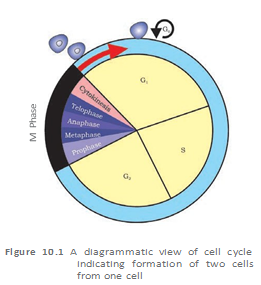
| Point | Interphase | M phase |
|---|---|---|
| Main role | Growth and preparation for division | Actual cell division |
| Time in a typical human cycle | More than 95% of the cycle | About 1 hour of a 24-hour cycle |
| Key events | Cell growth and DNA replication | Karyokinesis, usually followed by cytokinesis |
Karyokinesis — Division of the nucleus, involving separation of daughter chromosomes.
Cytokinesis — Division of the cytoplasm, usually completing the M phase.
Interphase: G₁, S and G₂
| Stage | Main events | DNA and chromosome status |
|---|---|---|
| (Gap 1) | Cell is metabolically active and grows; DNA replication has not started. | DNA amount is . |
| (Synthesis) | DNA is replicated in the nucleus; in animal cells, centrioles also duplicate in the cytoplasm. | DNA amount doubles from to , but chromosome number stays the same (for example, remains ). |
| (Gap 2) | Cell growth continues and proteins are synthesised in preparation for mitosis. | DNA replication is complete; the cell prepares to enter M phase. |
Do not confuse DNA amount with chromosome number: during phase DNA doubles, but the chromosome number does not increase.
Quiescent Stage and Mitotic Division
G₀ and mitosis in different organisms
- G₀ (quiescent stage): Some cells leave and stop proliferating; they remain metabolically active and may divide again when required.
- Examples of limited division: Adult heart cells generally do not divide, while some cells divide occasionally to replace cells lost through injury or cell death.
- Animals: Mitosis is generally seen in diploid somatic cells; male honey bees are an exception, as their haploid cells can divide by mitosis.
- Plants: Mitosis can occur in both haploid and diploid cells.
What happens to DNA amount and chromosome number during the S phase?
What is the stage?
Quick recap
- All organisms, including the largest, begin life as a single cell; repeated cell growth and division build a larger cell population.
- The cell cycle coordinates growth, DNA replication and division to produce daughter cells with intact genomes.
- A typical cell cycle has interphase and M phase; interphase occupies more than 95% of a human cell cycle.
- Interphase proceeds through , and ; DNA is replicated during phase.
- During phase, DNA doubles from to , but chromosome number stays constant.
- M phase involves karyokinesis and usually cytokinesis; cells in remain metabolically active but do not proliferate unless required.
- Mitosis occurs in haploid and diploid plant cells; in animals it is generally seen in diploid somatic cells, with male honey bees as an exception.
M Phase
Overview of M Phase
- M phase: The stage of the cell cycle in which mitosis and cell division occur.
- Sequence: Karyokinesis proceeds through four stages, followed by cytokinesis.
Prophase
Key events
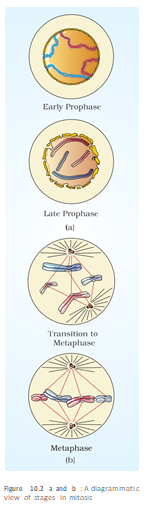
- Beginning: Prophase follows the S and G₂ phases; DNA molecules formed in S phase are initially intertwined.
- Condensation: Chromatin untangles and condenses into compact, visible chromosomes, each consisting of two sister chromatids joined at a centromere.
- Centrosomes: Duplicated centrosomes move towards opposite poles. Each radiates microtubules called asters; asters and spindle fibres form the mitotic apparatus.
- By the end: The nucleolus, Golgi complexes, endoplasmic reticulum and nuclear envelope are no longer visible.
Metaphase
Key events
- Start: The nuclear envelope completely disintegrates, and condensed chromosomes are exposed in the cytoplasm.
- Chromosome structure: Each chromosome has two sister chromatids joined at the centromere; chromosomes are most clearly observed at this stage.
- Kinetochores: Disc-shaped structures on centromeres provide attachment sites for spindle fibres.
- Alignment: Spindle fibres position all chromosomes at the cell equator. Each sister chromatid attaches to fibres from the opposite pole.
- Metaphase plate: The plane along which chromosomes align at the equator.
Anaphase
Key events
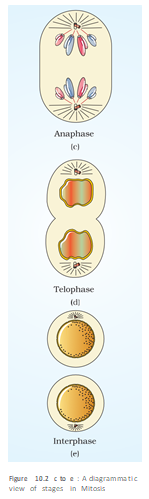
- Separation: Centromeres split simultaneously, separating sister chromatids; each chromatid is now a daughter chromosome.
- Movement: Daughter chromosomes migrate to opposite poles. Each centromere leads, with chromosome arms trailing behind.
Telophase
Key events
- Decondensation: Chromosomes reach opposite poles, decondense and lose their identity as distinct elements; chromatin collects at each pole.
- Nuclear envelopes: A new nuclear envelope forms around each chromosome set, producing two daughter nuclei.
- Organelles: The nucleolus, Golgi complex and endoplasmic reticulum reform.
Cytokinesis
| Point | Animal cell | Plant cell |
|---|---|---|
| Mechanism | A furrow forms in the plasma membrane and deepens until it divides the cytoplasm. | A cell plate forms at the centre and grows outward to meet the existing lateral walls. |
| Reason | The cell can divide by furrowing. | The relatively inextensible cell wall prevents furrowing. |
| Outcome | Two daughter cells form. | The cell plate develops into a new cell wall; it represents the middle lamella between adjacent cells. |
Additional points
- Organelle distribution: Mitochondria and plastids are distributed between the two daughter cells during cytoplasmic division.
- Syncytium: If karyokinesis is not followed by cytokinesis, a multinucleate condition forms; for example, the liquid endosperm of coconut.
Significance of Mitosis
Importance
- Genetic continuity: Mitosis usually produces diploid daughter cells with the same genetic complement as the parent cell.
- Cell types: Mitosis usually occurs in diploid cells, but haploid cells also divide by mitosis in some lower plants and social insects.
- Growth: Mitosis increases cell number and enables growth in multicellular organisms.
- Nucleo-cytoplasmic ratio: As a cell grows, the ratio between its nucleus and cytoplasm is disturbed; cell division helps restore it.
- Repair and replacement: Mitosis replaces cells such as those in the upper epidermis, gut lining and blood.
- Plant growth: Mitosis in apical and lateral cambium meristems supports continuous plant growth throughout life.
Quick recap
- M phase includes karyokinesis followed by cytokinesis; mitosis is usually equational.
- Prophase condenses chromosomes and organizes the mitotic apparatus as centrosomes move to opposite poles.
- At metaphase, chromosomes align at the equator and sister chromatids attach to spindle fibres from opposite poles.
- Anaphase separates sister chromatids into daughter chromosomes that move to opposite poles.
- Telophase forms two daughter nuclei as chromosomes decondense and cell structures reform.
- Animal cells divide by a furrow; plant cells form a cell plate, while failed cytokinesis can produce a syncytium.
- Mitosis supports growth, repair, cell replacement and maintenance of genetic continuity.
Meiosis
Meiosis: Meaning and Key Features
Meiosis — A specialised cell division in diploid cells that halves the chromosome number and produces haploid daughter cells.
Core features
- Role: Meiosis occurs during gamete formation in plants and animals; it produces haploid cells from specialised diploid cells.
- Divisions: It has two successive nuclear and cell divisions—meiosis I and meiosis II—but only one DNA replication cycle.
- Before meiosis I: DNA replicates in the S phase, producing identical sister chromatids in each chromosome.
- Meiosis I: Homologous chromosomes pair and recombination occurs between their non-sister chromatids.
- Outcome: Meiosis II produces four haploid daughter cells.
| Point | Meiosis I | Meiosis II |
|---|---|---|
| Main event | Homologous chromosomes separate; sister chromatids stay together. | Sister chromatids separate. |
| Effect on chromosome number | Reduces chromosome number by half. | Does not halve it further. |
| Similarity | Includes pairing and recombination in prophase I. | Resembles mitosis. |
Meiosis I
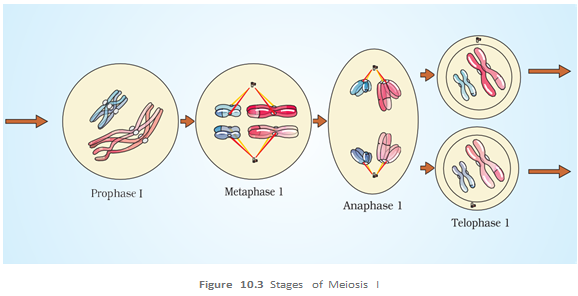
- Stages: Meiosis I comprises prophase I, metaphase I, anaphase I and telophase I.
- Interkinesis: A generally brief interval separates meiosis I and meiosis II; DNA does not replicate during it.
Prophase I
Five stages of Prophase I
- Leptotene: Chromosomes gradually become visible under a light microscope and continue to condense.
- Zygotene: Homologous chromosomes pair by synapsis; a synaptonemal complex forms between them.
- Pachytene: The four chromatids in each paired homologous set become distinct. Crossing over occurs between non-sister chromatids at recombination nodules.
- Diplotene: The synaptonemal complex dissolves; homologues begin separating but remain connected at crossover sites called chiasmata.
- Diakinesis: Chiasmata move towards chromosome ends (terminalisation); chromosomes fully condense, the spindle forms, and the nucleolus and nuclear envelope disappear.
Synapsis — The pairing of homologous chromosomes during zygotene.
Bivalent or tetrad — A pair of synapsed homologous chromosomes, consisting of four chromatids.
Crossing over and chiasmata
- Crossing over: Exchange of genetic material between non-sister chromatids of homologous chromosomes; it is enzyme-mediated by recombinase.
- Result: Crossing over recombines genetic material. Recombination is completed by the end of pachytene, while homologues remain linked at crossover sites.
- Chiasmata: X-shaped crossover connections visible as homologues begin to separate in diplotene.
- Long diplotene: In oocytes of some vertebrates, diplotene may last for months or years.
Stages after Prophase I
- Metaphase I: Bivalents align at the equatorial plate; spindle microtubules from opposite poles attach to the kinetochores of homologous chromosomes.
- Anaphase I: Homologous chromosomes move to opposite poles; sister chromatids remain joined at their centromeres.
- Telophase I: Nuclear membranes and nucleoli reappear, then cytokinesis forms two cells called a dyad. Chromosomes may partly disperse but do not fully extend as in interphase.
- Interkinesis: The usually brief interval between the two divisions; no DNA replication occurs.
Meiosis II
Stages of Meiosis II
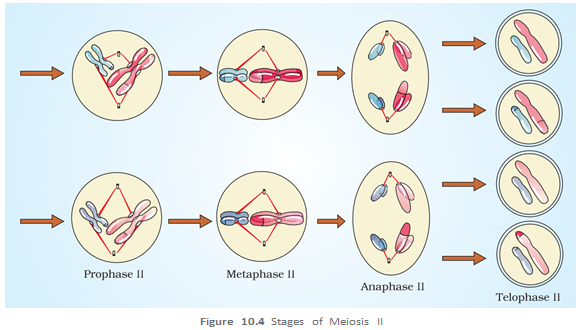
- Prophase II: Begins after cytokinesis, usually before chromosomes fully elongate. Chromosomes condense again and the nuclear membrane disappears.
- Metaphase II: Chromosomes align at the equator; spindle microtubules from opposite poles attach to the kinetochores of sister chromatids.
- Anaphase II: Centromeres split simultaneously, separating sister chromatids. Kinetochore microtubules shorten to move them to opposite poles.
- Telophase II: Each chromosome group is enclosed by a nuclear envelope; cytokinesis produces four haploid daughter cells, called a tetrad of cells.
Significance of Meiosis
Chromosome number across generations
- Meiosis halves the chromosome number to form haploid gametes.
- Fusion of two haploid gametes during fertilisation restores the diploid chromosome number.
- This cycle conserves the species-specific chromosome number across generations.
Genetic variation
- Variation: Recombination during meiosis increases genetic variability in populations from one generation to the next.
- Evolution: Genetic variation is important for the process of evolution.
Do not confuse anaphase I with anaphase II: homologous chromosomes separate in anaphase I, while sister chromatids separate in anaphase II.
What happens during crossing over, and when does it occur?
How do chromosome movements differ in anaphase I and anaphase II?
State two important roles of meiosis.
Quick recap
- Meiosis consists of two cell divisions after one DNA replication cycle and produces four haploid cells.
- Prophase I proceeds through leptotene, zygotene, pachytene, diplotene and diakinesis.
- Synapsis pairs homologous chromosomes; crossing over between non-sister chromatids creates recombination.
- Meiosis I separates homologous chromosomes; meiosis II separates sister chromatids.
- Interkinesis occurs between divisions and has no DNA replication.
- Meiosis and fertilisation together conserve chromosome number across generations; meiosis also creates variation.
Biology — ALL CHAPTERS
1
The Living World
2
Biological Classification
3
Plant Kingdom
4
Animal Kingdom
5
Morphology of Flowering Plants
6
Anatomy Of Flowering Plants
7
Structural Organization In Animals
8
Cell The Unit Of Life
9
Biomolecules
10
Cell Cycle And Cell Division
11
Photosynthesis in Higher Plants
12
Respiration In Plants
13
Plant Growth And Development
14
Breathing And Exchange Of Gases
15
Body Fluids And Circulation
16
Excretory Products And Their Elimination
17
Locomotion And Movement
18
Neural Control And Coordination
19
Chemical Coordination and integration