Class 11 PCB . Biology . Biology . Photosynthesis in Higher Plants
Chapter 11: Photosynthesis in Higher Plants
Ch 11
Biology
Class 11 PCB
Introduction
Photosynthesis and Its Importance
- Photosynthesis: Green plants use light energy to synthesise organic food from simple substances.
- Importance: Photosynthesis is the primary source of food on Earth and releases oxygen into the atmosphere.
Requirements for Photosynthesis
- Autotroph
- An organism that makes its own food.
- Heterotroph
- An organism that depends on other organisms for food.
- Chlorophyll
- The green pigment in leaves involved in photosynthesis.
Quick recap
- Photosynthesis uses light energy to synthesise organic compounds in green plants.
- Green plants are autotrophs; organisms dependent on them for food are heterotrophs.
- Photosynthesis is the primary source of food on Earth and releases oxygen into the atmosphere.
- Chlorophyll, light and CO₂ are required for photosynthesis.
- Starch formation is evidence that photosynthesis has occurred.
Early Experiment
Priestley: Air and Plant Growth
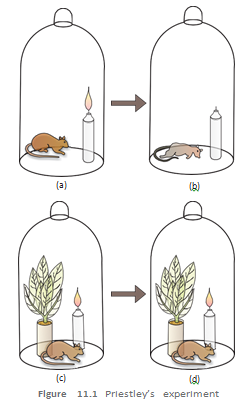
Light, Green Parts and Food Production
- Ingenhousz: Sunlight is essential for plants to purify air; oxygen bubbles form around green parts in bright light.
- Sachs: Green plant parts produce glucose, which is commonly stored as starch.
Engelmann: Light Wavelengths and Photosynthesis
- Engelmann’s experiment: He illuminated the alga Cladophora with separated wavelengths of light in the presence of aerobic bacteria.
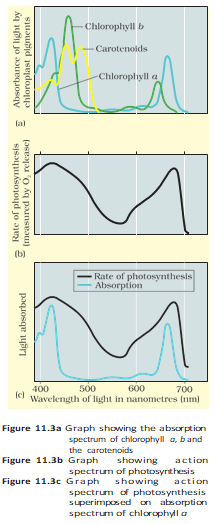
- Observation: Bacteria gathered mainly in the blue and red regions, indicating greater oxygen release and photosynthesis there.
Van Niel: General Photosynthesis Equation
Overall Photosynthesis Equation
- Water’s role: The full equation uses water molecules as substrate and forms ; the net use is water molecules.
- Oxygen source: The released comes from water, as shown by radioisotope evidence.
What did Ingenhousz establish about oxygen release by plants?
How did Van Niel infer that the oxygen released by green plants comes from water?
Quick recap
- Priestley’s bell-jar observations showed that plants restore air altered by burning or breathing.
- Ingenhousz established that sunlight is required for oxygen release and that only green plant parts release oxygen.
- Sachs linked green parts with glucose production and starch storage.
- Engelmann found photosynthesis most active in blue and red light, mapping its first action spectrum.
- Van Niel’s general principle identified the hydrogen donor as the source of the oxidised product.
- In green plants, water supplies the oxygen released during photosynthesis.
Where Does Photosynthesis Take Place?
Sites of Photosynthesis
Where photosynthesis occurs
- Main sites: Photosynthesis occurs in green leaves and other green parts of plants.
- Mesophyll cells: Leaf mesophyll cells contain many chloroplasts.
- Chloroplast position: Chloroplasts align along mesophyll cell walls to receive an optimum amount of incident light.
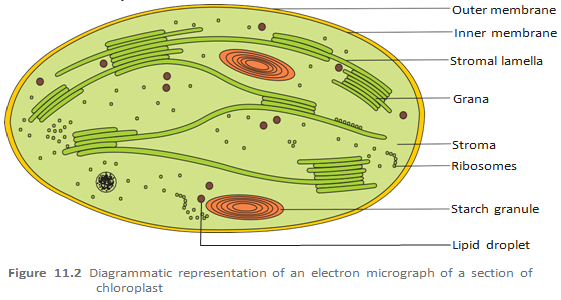
Division of Work Within the Chloroplast
| Region | Main role |
|---|---|
| Membranous system (grana and stroma lamellae) | Traps light energy; produces ATP and NADPH. |
| Stroma | Contains enzymes that synthesise sugars; sugars can be converted to starch. |
| Point | Light reactions | Dark reactions |
|---|---|---|
| Other name | Photochemical reactions | Carbon reactions |
| Location | Chloroplast membrane system | Stroma |
| Dependence | Directly driven by light | Not directly driven by light; depend on ATP and NADPH from light reactions |
| Main outcome | ATP and NADPH are produced | Enzymatic reactions synthesise sugars |
Do not interpret “dark reactions” as reactions that occur only in darkness: they are not directly light-driven, but depend on products of the light reactions.
Photosynthetic Pigments
Pigment — A substance that absorbs light at specific wavelengths.
| Pigment | Colour |
|---|---|
| Chlorophyll a | Bright or blue-green |
| Chlorophyll b | Yellow-green |
| Xanthophylls | Yellow |
| Carotenoids | Yellow to yellow-orange |
Pigments and light absorption
- Chlorophyll a: The chief pigment associated with photosynthesis and the most abundant plant pigment.
- Absorption peaks: Chlorophyll a absorbs most strongly in the blue and red regions of visible light.
- Photosynthesis rate: Photosynthesis is greatest in the blue and red regions, but also occurs at other visible wavelengths.
- Spectra: The absorption spectrum of chlorophyll a and the action spectrum of photosynthesis do not completely overlap.
Accessory Pigments
Functions of accessory pigments
- Accessory pigments: Chlorophyll b, xanthophylls and carotenoids are additional thylakoid pigments.
- Energy transfer: They absorb light and transfer the energy to chlorophyll a.
- Wider light capture: They allow the plant to use a wider range of incoming wavelengths.
- Protection: They protect chlorophyll a from photo-oxidation.
Why are the light reactions and dark reactions named differently?
State two roles of accessory pigments.
Quick recap
- Photosynthesis occurs in green leaves and other green plant parts, especially in chloroplast-rich mesophyll cells.
- The chloroplast membrane system traps light and produces ATP and NADPH; stroma enzymes synthesise sugars.
- Dark reactions are not directly light-driven, but they depend on ATP and NADPH.
- The four main leaf pigments are chlorophyll a, chlorophyll b, xanthophylls and carotenoids.
- Chlorophyll a is the chief photosynthetic pigment, with strong absorption in blue and red light.
- Accessory pigments expand light capture and protect chlorophyll a from photo-oxidation.
What is Light Reaction?
Light Reaction and Photosystems
Light reaction — The photochemical phase of photosynthesis that absorbs light, splits water, releases oxygen and forms ATP and NADPH.
Photosystems and light harvesting
- Photosystems: PS I and PS II are protein complexes containing light-harvesting complexes (LHCs). Their names follow discovery order, not functional order.
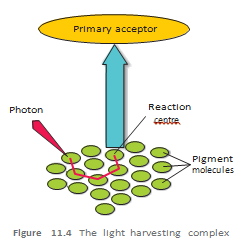
- Antenna: Hundreds of pigment molecules bound to proteins absorb different wavelengths and transfer energy to the reaction centre.
- Reaction centre: One chlorophyll a molecule in each photosystem acts as its reaction centre; the remaining pigments form the antenna.
- PS I: The reaction-centre chlorophyll has an absorption maximum at and is called P700.
- PS II: The reaction-centre chlorophyll has an absorption maximum at and is called P680.
Electron Transport and the Z Scheme
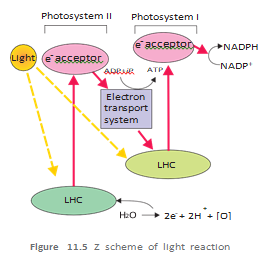
Non-cyclic electron flow
- Light excites an electron in PS II (P680); it moves uphill to a primary electron acceptor.
- The electron moves downhill through the electron transport chain, including cytochromes, and reaches PS I; it is passed on, not used up.
- Light excites an electron in PS I (P700); it moves uphill to another acceptor, which has a greater redox potential, then moves downhill to .
- gains electrons and is reduced to ; water splitting replaces the electrons lost from PS II.
Z scheme — The electron pathway from PS II through the transport chain to PS I and then to ; its characteristic shape appears like a Z when carriers are arranged by redox potential.
Key points
- Energy changes: Light raises electrons to acceptors in uphill steps; their subsequent movement through carriers is downhill on the redox-potential scale.
- Products: Non-cyclic electron flow supports formation of ATP and .
Splitting of Water
Photolysis of water
- Role: Water splitting supplies electrons to replace those removed from PS II and produces oxygen, a net product of photosynthesis.
- Location: The water-splitting complex is associated with PS II on the inner side of the thylakoid membrane.
Photophosphorylation
Phosphorylation — The process by which cells synthesise ATP.
Photophosphorylation — The synthesis of ATP from ADP and inorganic phosphate in the presence of light.
| Point | Non-cyclic | Cyclic |
|---|---|---|
| Photosystems involved | PS II followed by PS I | Only PS I |
| Electron pathway | Electrons flow from water through both photosystems to | Excited electrons return to PS I through an electron transport chain |
| Products | ATP and | ATP only; is not formed |
| Location or condition | Grana membranes contain both photosystems | May occur in stroma lamellae, which lack PS II and NADP reductase; also occurs when only wavelengths beyond are available |
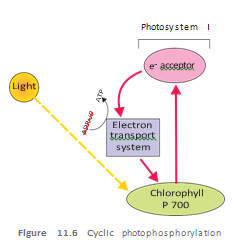
Do not confuse the discovery-based numbering of PS I and PS II with their order in non-cyclic electron flow: PS II functions before PS I.
What is the Z scheme?
How do cyclic and non-cyclic photophosphorylation differ in their products?
Quick recap
- Light reactions absorb light, split water, release oxygen and form ATP and NADPH.
- P680 is the PS II reaction centre; P700 is the PS I reaction centre.
- In non-cyclic flow, light raises electrons uphill to acceptors; electrons then travel downhill through carriers and ultimately reduce .
- Water splitting at the PS II complex supplies replacement electrons and releases oxygen.
- Non-cyclic photophosphorylation uses PS II and PS I and forms ATP and .
- Cyclic photophosphorylation uses PS I alone, returns electrons to P700 and forms ATP only; it can occur when only wavelengths beyond are available.
Chemiosmotic Hypothesis
Chemiosmotic Hypothesis
Chemiosmotic hypothesis — ATP synthesis is driven by the energy released when protons move down their concentration gradient across a membrane.
How the thylakoid proton gradient forms
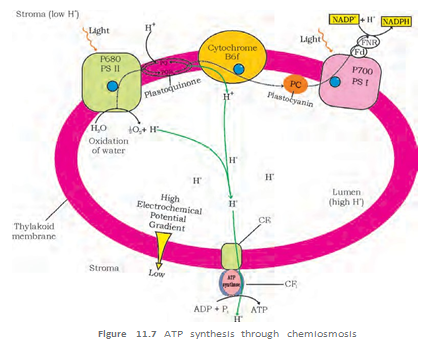
- Water splitting: Photolysis occurs on the lumen side of the thylakoid membrane, so the released protons accumulate in the lumen.
- Electron transport: An electron carrier takes up a proton from the stroma while carrying an electron, then releases the proton into the lumen when it transfers the electron onward.
- NADP⁺ reduction: Stroma-side NADP reductase uses electrons from photosystem I and protons from the stroma to form NADPH; this further lowers the stromal proton concentration.
- Result: Protons build up in the lumen and become depleted in the stroma, creating a gradient and lowering the lumen pH.
ATP Synthesis by ATP Synthase
| Part | Location and role |
|---|---|
| Embedded in the thylakoid membrane; forms the channel through which protons diffuse from lumen to stroma. | |
| Projects towards the stroma; proton flow supplies energy for a conformational change that enables ATP formation. |
Chemiosmosis: gradient to ATP
- Light-driven processes create a high proton concentration in the thylakoid lumen.
- Protons flow down their gradient through the channel into the stroma.
- The flow provides energy for a conformational change in .
- ATP synthase uses this energy to form ATP.
- Requirements: Chemiosmosis needs a membrane, proton pumping, a proton gradient and ATP synthase.
- Direction: In chloroplasts, protons accumulate in the thylakoid lumen and return to the stroma through ATP synthase.
Use of ATP and NADPH
The biosynthetic phase
- Light-reaction products: ATP, NADPH and oxygen are produced; oxygen diffuses out of the chloroplast.
- Use of ATP and NADPH: These products provide energy and reducing power for biosynthesis in the stroma, where carbon is fixed and sugars are formed from and water.
- Light dependence: Biosynthesis does not directly require light, but depends on ATP and NADPH made by the light reactions.
- Evidence: Sugar synthesis continues briefly after light is removed, then stops; it starts again when light returns. Thus, calling it the “dark reaction” can be misleading.
First Products of Carbon Fixation
Carbon fixation and pathway discovery
- Melvin Calvin: Used radioactive in algal photosynthesis studies just after World War II to trace carbon fixation and work out the biosynthetic pathway.
- Calvin cycle: The pathway was named after Calvin; its first identified stable product was 3-phosphoglyceric acid (PGA), a three-carbon acid.
- Other plants: Studies found plants whose first stable carbon-fixation product is oxaloacetic acid (OAA), a four-carbon acid.
| Point | C₃ pathway | C₄ pathway |
|---|---|---|
| First stable product of fixation | PGA, a three-carbon acid | OAA, a four-carbon acid |
| Plant classification | Plants whose first fixation product is a C₃ acid | Plants whose first fixation product is a C₄ acid |
How does the proton gradient drive ATP synthesis in chloroplasts?
What are the first stable products in the C₃ and C₄ pathways?
Quick recap
- Water splitting and electron transport add protons to the thylakoid lumen; NADP⁺ reduction removes protons from the stroma.
- The proton gradient powers proton flow through ATP synthase from lumen to stroma.
- forms the proton channel; stroma-facing catalyses ATP formation.
- ATP and NADPH from the light reactions support carbon fixation and sugar synthesis in the stroma.
- The biosynthetic phase is not directly light-dependent, but it relies on products of the light reactions.
- PGA is the first stable product in C₃ plants; OAA is the first stable product in C₄ plants.
The Primary Acceptor of CO2
Primary Acceptor of CO₂
- Primary CO₂ acceptor: Ribulose bisphosphate (RuBP), a five-carbon ketose sugar, accepts CO₂ in the Calvin pathway.
- Product formation: The fixation of CO₂ with RuBP ultimately produces the three-carbon compound PGA.
The Calvin Cycle
Overview
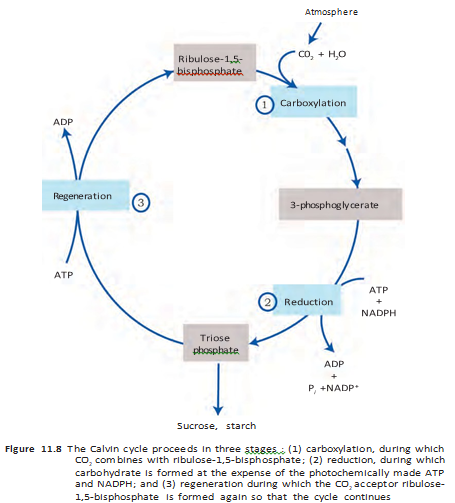
- Cycle: RuBP is regenerated, allowing the pathway to continue.
- Occurrence: The Calvin cycle is the common sugar-forming pathway in all photosynthetic plants, including both C₃ and C₄ plants.
- Stages: Carboxylation → reduction → regeneration.
| Stage | Role | Energy use per CO₂ |
|---|---|---|
| Carboxylation | RuBisCO fixes CO₂ to RuBP; two molecules of 3-PGA form. | No energy amount specified |
| Reduction | A series of reactions leads towards sugar formation. | 2 ATP and 2 NADPH |
| Regeneration | RuBP, the CO₂ acceptor, is regenerated so the cycle can continue. | 1 ATP |
RuBisCO — RuBP carboxylase-oxygenase (RuBisCO) catalyses CO₂ fixation and also has oxygenation activity.
Per CO₂ fixed, the cycle uses 3 ATP and 2 NADPH. One glucose requires six CO₂ and six turns.
The C₄ Pathway
C₄ Plant Features
- First fixation product: C₄ plants initially fix CO₂ into the four-carbon compound oxaloacetic acid (OAA), but use the Calvin cycle as their main biosynthetic pathway.
- Adaptations: C₄ plants tolerate higher temperatures, respond to high light intensities, lack photorespiration and have greater biomass productivity.
- Pathway name: The C₄ pathway is also called the Hatch–Slack pathway.
Kranz anatomy — Kranz anatomy is the arrangement of large bundle-sheath cells around the vascular bundles in C₄ leaves.
Bundle-Sheath Cells
- Structure: They may form several layers around vascular bundles and contain many chloroplasts.
- Walls and spaces: Their thick walls prevent gaseous exchange, and they have no intercellular spaces.
Hatch–Slack Pathway
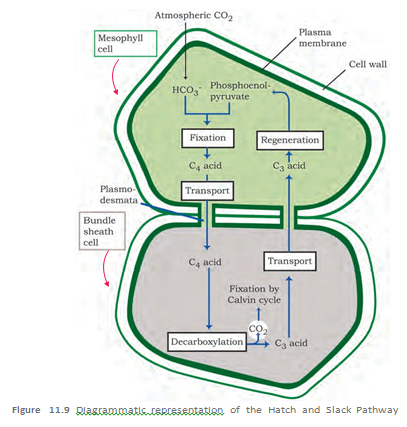
- In mesophyll cells, three-carbon PEP accepts CO₂; PEP carboxylase (PEPcase) catalyses fixation and forms four-carbon OAA.
- OAA is converted into four-carbon malic acid or aspartic acid in the mesophyll.
- The four-carbon acids move to bundle-sheath cells and are broken down, releasing CO₂ and a three-carbon molecule.
- Released CO₂ enters the Calvin cycle in bundle-sheath cells; RuBisCO is present there, but PEPcase is absent.
- The three-carbon molecule returns to the mesophyll and is converted back to PEP, completing the cycle.
| Point | C₃ plants | C₄ plants |
|---|---|---|
| Calvin cycle location | Mesophyll cells | Bundle-sheath cells only |
| RuBisCO in mesophyll | Present | Absent |
| Initial CO₂ acceptor | RuBP | PEP in mesophyll cells |
How many ATP and NADPH molecules are required to form one glucose through the Calvin cycle?
Quick recap
- RuBP is a five-carbon ketose and the Calvin cycle’s primary CO₂ acceptor; fixation produces two 3-PGA molecules.
- The Calvin cycle proceeds through carboxylation, reduction and regeneration.
- Each CO₂ requires 3 ATP and 2 NADPH; one glucose requires six turns, 18 ATP and 12 NADPH.
- C₄ plants first fix CO₂ with PEP in mesophyll cells, forming OAA and other four-carbon acids.
- Bundle-sheath cells release CO₂ for the Calvin cycle and have RuBisCO but lack PEPcase.
- C₄ leaves have Kranz anatomy; the Calvin cycle occurs in bundle-sheath cells, unlike in C₃ mesophyll cells.
Photorespiration
Photorespiration and RuBisCO
Photorespiration — A pathway initiated when RuBisCO binds instead of , reducing carbon fixation and releasing .
RuBisCO and its competing reactions
- Calvin-cycle reaction: RuBisCO catalyses the combination of RuBP and , producing two molecules of 3-PGA.
- Dual binding: RuBisCO’s active site binds either or ; these gases compete, and their relative concentrations affect which binds.
- Affinity: When the ratio is nearly equal, RuBisCO has a much greater affinity for .
- Oxygenation: When RuBP reacts with , it forms one molecule of phosphoglycerate and one molecule of two-carbon phosphoglycolate.
- Effect: Oxygen binding reduces fixation, particularly in plants; RuBisCO is the most abundant enzyme in the world.
RuBisCO catalyses this carboxylation reaction.
This reaction initiates photorespiration.
Consequences of photorespiration
- No carbohydrate gain: Photorespiration does not synthesise sugars.
- Energy cost: It consumes ATP but synthesises neither ATP nor NADPH.
- Carbon loss: It releases , reducing photosynthetic efficiency.
- Biological role: Its biological function is not yet known.
Photorespiration in and plants
plants reduce photorespiration
- concentration: A acid formed in mesophyll cells moves to bundle-sheath cells, where it releases .
- RuBisCO activity: The increased concentration near RuBisCO favours its carboxylase activity over its oxygenase activity.
- Outcome: Photorespiration does not occur in plants; their productivity and yields are generally higher, and they tolerate higher temperatures.
| Characteristic | plants | plants |
|---|---|---|
| Cell type where the Calvin cycle occurs | Mesophyll cells | Bundle-sheath cells |
| Cell type where initial carboxylation occurs | Mesophyll cells | Mesophyll cells |
| Leaf cell types that fix | One: mesophyll | Two: mesophyll and bundle sheath |
| Primary acceptor | RuBP | PEP |
| Carbon atoms in primary acceptor | 5 | 3 |
| Primary product of initial fixation | 3-PGA | OAA |
| Carbon atoms in primary fixation product | 3 | 4 |
| RuBisCO present? | Yes | Yes |
| PEP carboxylase present? | No | Yes |
| Cells containing RuBisCO | Mesophyll | Bundle sheath |
| fixation rate in high light | Lower | Higher |
| Photorespiration at low light intensity | Negligible | Negligible |
| Photorespiration at high light intensity | High | Negligible |
| Photorespiration at low concentration | High | Negligible |
| Photorespiration at high concentration | Negligible | Negligible |
| Temperature optimum | – | – |
| Examples | Wheat, rice | Maize, sugarcane |
Factors Affecting Photosynthesis
Internal and external factors
- Internal factors: Leaf number, size, age and orientation; mesophyll cells and chloroplasts; internal concentration; and chlorophyll content.
- Plant dependence: Internal factors depend on the plant’s genetic make-up and growth.
- External factors: Sunlight, temperature, concentration and water availability.
- Combined effects: Factors act simultaneously, but the factor available at a sub-optimal level often limits the rate.
Blackman’s Law of Limiting Factors — Proposed in 1905: when a process is affected by several factors, its rate is determined by the factor nearest its minimum; changing that factor directly affects the rate.
Applying the law
- Example: A green leaf may not photosynthesise if the temperature is very low, even when light and are optimal.
- Changing the limit: Raising the temperature to its optimum allows photosynthesis to begin.
Why is photorespiration absent in plants?
State Blackman’s Law of Limiting Factors.
Quick recap
- RuBisCO binds both and ; their relative concentrations influence the competing reactions.
- RuBP oxygenation initiates photorespiration, which releases and consumes ATP without making sugars, ATP or NADPH.
- plants concentrate near RuBisCO in bundle-sheath cells, preventing photorespiration.
- plants use RuBP and initially form 3-PGA; plants use PEP and initially form OAA.
- Photosynthesis is affected by internal plant factors and external environmental factors.
- Blackman’s Law of Limiting Factors (1905) states that the factor nearest its minimum controls the process rate.
Light
Light
How light affects photosynthesis
- Light factors: Consider light quality, intensity and duration of exposure; the lecture focuses on intensity.
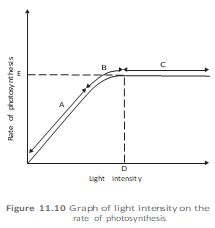
- Low intensity: The rate of CO₂ fixation rises approximately linearly as incident light increases.
- High intensity: Photosynthesis reaches a plateau when other factors become limiting; light saturation occurs at about 10% of full sunlight.
- Excess light: Very intense light can break down chlorophyll and reduce photosynthesis.
- In nature: Light is rarely limiting except for shade plants and plants in dense forests.
Carbon Dioxide Concentration
CO₂ as a limiting factor
- Importance: CO₂ is a major limiting factor for photosynthesis; atmospheric concentration is about –.
- Increase: Raising CO₂ concentration up to about can increase CO₂ fixation; prolonged higher levels may be damaging.
- Light interaction: At low light, neither C₃ nor C₄ plants responds substantially to increased CO₂. At high light, photosynthesis increases in both.
- Greenhouse use: CO₂ enrichment increases photosynthesis and yield in some C₃ crops, including tomatoes and bell peppers.
| Point | C₃ plants | C₄ plants |
|---|---|---|
| CO₂ saturation | Saturation occurs only beyond about . | Saturation occurs at about . |
| Effect of current atmospheric CO₂ | Current CO₂ availability limits photosynthesis. | Photosynthesis reaches saturation at a lower CO₂ concentration. |
Temperature
Temperature effects
- Dark reactions: Enzyme-controlled, so their rates are strongly affected by temperature.
- Light reactions: Also temperature-sensitive, but affected much less than the dark reactions.
- Plant type: C₄ plants generally show higher photosynthetic rates at higher temperatures; C₃ plants have a lower temperature optimum.
- Adaptation: Temperature optimum depends on habitat; tropical plants generally have higher optima than temperate-climate plants.
Water
Water stress
- Direct role: Water is a reactant in the light reaction, but its broader effect on photosynthesis is mainly through its effects on the plant.
- Stomata: Water stress closes stomata, reducing CO₂ entry and therefore photosynthesis.
- Leaves: Water stress causes wilting, reducing leaf surface area and metabolic activity.
Water stress reduces photosynthesis
- Water stress → stomata close → less CO₂ enters the leaf.
- Water stress → leaves wilt → leaf area and metabolic activity decrease.
Photosynthesis Context
Core process and location
- Purpose: Green plants use atmospheric CO₂, taken in through leaf stomata, to make carbohydrates, principally glucose and starch.
- Location: Photosynthesis occurs in green plant parts, mainly leaves. Mesophyll cells contain many chloroplasts, where CO₂ is fixed.
- Chloroplast: Thylakoid membranes host light reactions; the stroma is the site of the carbon-fixing pathway.
- Two stages: Light reactions capture light energy; carbon-fixing reactions use that energy to make carbohydrates.
Light reactions and photosystems
- Antenna pigments: Absorb light and transfer the energy to reaction-centre chlorophyll a molecules.
- Photosystem I (PS I): Has a P700 reaction centre, which absorbs light at 700 nm.
- Photosystem II (PS II): Has a P680 reaction centre, which absorbs light at 680 nm.
- Electron flow: Excited electrons pass through PS II and PS I and ultimately help reduce NADP⁺ to NADPH.
- ATP formation: Electron transport establishes a proton gradient across the thylakoid membrane; proton flow through the F₀ part of ATPase releases energy for ATP synthesis.
- Water splitting: Associated with PS II; it releases O₂ and protons and supplies electrons to PS II.
Carbon fixation and C₄ pathway
- Calvin cycle: RuBisCO adds CO₂ to the five-carbon compound RuBP, forming two molecules of the three-carbon compound PGA.
- Sugar formation: PGA is converted to sugars, and RuBP is regenerated; ATP and NADPH from the light reactions are used.
- Photorespiration: In C₃ plants, RuBisCO can also catalyse oxygenation, a wasteful process called photorespiration.
- C₄ pathway: CO₂ fixation begins in mesophyll cells, producing a four-carbon compound; the Calvin cycle then occurs in bundle sheath cells to make carbohydrates.
Why is light rarely a limiting factor for photosynthesis in nature?
How do C₃ and C₄ plants differ in their response to increasing CO₂ concentration?
Explain how water stress lowers photosynthesis.
Quick recap
- At low light, photosynthesis rises with light intensity; at high light, it plateaus, and excess light can damage chlorophyll.
- Atmospheric CO₂ is low; C₃ plants respond to higher concentrations more than C₄ plants.
- Temperature affects enzyme-controlled dark reactions more strongly than light reactions.
- Water stress reduces CO₂ entry through stomatal closure and also lowers leaf area and metabolism.
- Light reactions produce ATP and NADPH; carbon fixation uses them to form carbohydrates.
- C₄ plants first fix CO₂ into a four-carbon compound in mesophyll cells, then run the Calvin cycle in bundle sheath cells.
Biology — ALL CHAPTERS
1
The Living World
2
Biological Classification
3
Plant Kingdom
4
Animal Kingdom
5
Morphology of Flowering Plants
6
Anatomy Of Flowering Plants
7
Structural Organization In Animals
8
Cell The Unit Of Life
9
Biomolecules
10
Cell Cycle And Cell Division
11
Photosynthesis in Higher Plants
12
Respiration In Plants
13
Plant Growth And Development
14
Breathing And Exchange Of Gases
15
Body Fluids And Circulation
16
Excretory Products And Their Elimination
17
Locomotion And Movement
18
Neural Control And Coordination
19
Chemical Coordination and integration