Class 11 PCB . Biology . Biology . Biomolecules
Chapter 9: Biomolecules
Ch 9
Biology
Class 11 PCB
How To Analyse Chemical Composition?
Elements in Living and Non-Living Matter
Elemental composition
- Elemental analysis identifies the elements in a sample and measures their amount per unit mass.
- Shared elements: Elements in Earth’s crust are also found in living tissue; their relative abundance differs.
- Living tissues contain a higher relative proportion of carbon and hydrogen than Earth’s crust.
| Element | Earth’s crust (%) | Human body (%) |
|---|---|---|
| Hydrogen () | 0.1 | 10.0 |
| Carbon () | 0.03 | 18.5 |
| Oxygen () | 46.6 | 65.0 |
| Nitrogen () | Very little | 3.3 |
| Sulphur () | 0.03 | 0.3 |
| Sodium () | 2.8 | 0.2 |
| Calcium () | 3.6 | 1.5 |
| Magnesium () | 2.1 | 0.1 |
| Silicon () | 27.7 | Negligible |
Analysing Chemical Composition
Biomolecules — Carbon compounds obtained from living tissues are called biomolecules; living organisms also contain inorganic elements and compounds.
Chemical analysis of tissue
- Grind living tissue in trichloroacetic acid, , to form a slurry, then strain it.
- The filtrate is the acid-soluble pool; the retained material is the acid-insoluble fraction.
- Compounds can be separated, isolated and purified; analysis then helps determine their molecular formula and probable structure.
| Stage | Meaning |
|---|---|
| Wet weight | Mass of tissue before drying. |
| Dry weight | Mass remaining after water has evaporated. |
| Ash | Inorganic residue left after dried tissue is fully burnt; carbon compounds are removed as gases, including carbon dioxide and water vapour. |
What the analyses reveal
- Elemental analysis reports elements such as hydrogen, oxygen, chlorine and carbon in tissue.
- Compound analysis identifies organic and inorganic constituents.
- Inorganic constituents include calcium and magnesium in ash, and sulphate and phosphate in the acid-soluble fraction.
| Component | Formula |
|---|---|
| Sodium | |
| Potassium | |
| Calcium | |
| Magnesium | |
| Water | |
| Other compounds and ions | , , , |
Amino Acids
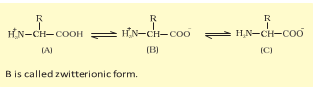
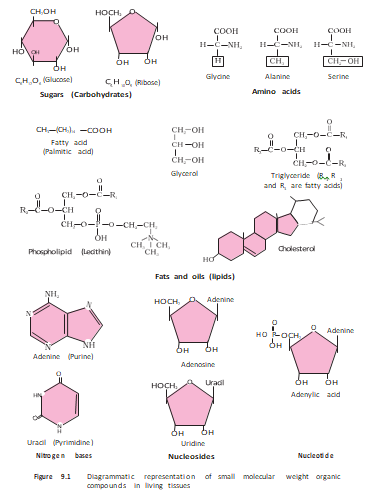
Amino acid — An organic compound with an amino group and a carboxyl group attached to the same carbon, called the -carbon.
Structure, examples and properties
- Four substituents: The -carbon carries hydrogen, an amino group, a carboxyl group and a variable R group; amino acids are substituted methanes.
- R group: Determines the amino acid’s identity. The 20 amino acids found in proteins differ in their R groups.
- Examples: R is hydrogen in glycine, methyl in alanine and hydroxymethyl in serine.
- Properties: Depend mainly on the amino, carboxyl and R groups. The ionisable amino and carboxyl groups change form with solution pH.
| Category | Basis and examples |
|---|---|
| Acidic | Classification depends on the number of amino and carboxyl groups; glutamic acid. |
| Basic | Classification depends on the number of amino and carboxyl groups; lysine. |
| Neutral | Classification depends on the number of amino and carboxyl groups; valine. |
| Aromatic | Contain aromatic groups; tyrosine, phenylalanine and tryptophan. |
Lipids
Lipids — A diverse group of compounds that are generally insoluble in water.
Fatty acids and glycerol-based lipids
- Fatty acid: Has a carboxyl group attached to a variable hydrocarbon R group; the R group may contain 1–19 carbon atoms.
- Saturated fatty acid: Has no carbon–carbon double bond. Unsaturated fatty acid: Has one or more bonds.
- Examples: Palmitic acid has 16 carbon atoms and arachidonic acid has 20, counting the carboxyl carbon.
- Glycerol: Trihydroxy propane. Fatty acids esterified with glycerol form mono-, di- or triglycerides.
| Point | Fats | Oils |
|---|---|---|
| Melting point | Higher | Lower |
| Example or behaviour | A fat is generally solid at cooler temperatures. | Gingelly oil has a low melting point and remains liquid in winter. |
| Type | Key feature | Example or location |
|---|---|---|
| Phospholipids | Contain phosphorus and a phosphorylated organic compound. | Lecithin; found in cell membranes. |
| Complex lipids | Have more complex structures. | Found in neural tissues. |
Nitrogenous Bases and Nucleic Acids
Building blocks of nucleic acids
- Nitrogenous bases: Adenine, guanine, cytosine, uracil and thymine.
- Base + sugar → nucleoside: Examples include adenosine, guanosine, thymidine, uridine and cytidine.
- Nucleoside + phosphate → nucleotide: Examples include adenylic, guanylic, thymidylic, uridylic and cytidylic acids.
- Nucleotides → nucleic acids: DNA and RNA consist of nucleotides and function as genetic material.
How do dry weight and ash help reveal tissue composition?
Distinguish a nucleoside from a nucleotide.
Quick recap
- Living and non-living matter share elements, but living tissues have relatively more carbon and hydrogen.
- Tissue grinding separates acid-soluble and acid-insoluble fractions; purified compounds can be analysed for formula and probable structure.
- Drying gives dry weight; burning dried tissue leaves inorganic ash.
- Amino acids have amino, carboxyl, hydrogen and R groups attached to the -carbon; their ionisable groups respond to pH.
- Lipids are generally water-insoluble; fatty acids may be saturated or unsaturated, and glycerol-based lipids include fats, oils and phospholipids.
- Base + sugar forms a nucleoside; adding phosphate forms a nucleotide, the building block of DNA and RNA.
Primary And Secondary Metabolites
Primary and Secondary Metabolites
Metabolites — Small and large organic compounds found in living organisms; they include compounds such as amino acids and sugars.
| Point | Primary metabolites | Secondary metabolites |
|---|---|---|
| Occurrence | Found in animal tissues and other living cells. | Especially numerous in plants, fungi and microbes. |
| Role | Known functions in normal physiological processes. | Functions in host organisms are not fully understood. |
| Examples | Amino acids and sugars. | Alkaloids, flavonoids, rubber, essential oils, antibiotics, pigments, scents, gums and spices. |
| Importance | Participate in normal life processes. | Many benefit humans; some also have ecological importance. |
| Category | Examples |
|---|---|
| Pigments | Carotenoids, anthocyanins |
| Alkaloids | Morphine, codeine |
| Terpenoids | Monoterpenes, diterpenes |
| Essential oils | Lemongrass oil |
| Toxins | Abrin, ricin |
| Lectins | Concanavalin A |
| Drugs | Vinblastine, curcumin |
| Polymeric substances | Rubber, gums, cellulose |
Biomacromolecules
Micromolecules — Biomolecules with molecular weights below about 1,000 daltons; many occur in the acid-soluble pool.
Macromolecules (biomacromolecules) — Biomolecules found in the acid-insoluble fraction; most have high molecular weights and are polymeric.
Acid-Soluble and Acid-Insoluble Fractions
- Acid-soluble pool: Its compounds generally have molecular weights from about 18 to 800 daltons.
- Acid-insoluble fraction: Contains proteins, nucleic acids, polysaccharides and lipids.
- High molecular weight: Proteins, nucleic acids and polysaccharides are generally 10,000 daltons or more and are polymeric.
- Lipids: Usually have molecular weights no greater than 800 daltons, so they are not strictly macromolecules.
- Why lipids appear in the insoluble fraction: Cell membranes break into water-insoluble vesicles during tissue grinding; these separate with the acid-insoluble pool.
- Together: The acid-soluble pool and macromolecules from the cytoplasm and organelles represent the chemical composition of living tissue.
| Component | Percentage of total cellular mass |
|---|---|
| Water | 70–90% |
| Proteins | 10–15% |
| Carbohydrates | 3% |
| Lipids | 2% |
| Nucleic acids | 5–7% |
| Ions | 1% |
- Water is the most abundant chemical in living organisms.
- Acid-soluble pool roughly represents cytoplasmic composition.
Proteins
Proteins — Polypeptides: linear polymers of amino acids linked by peptide bonds.
Protein Structure and Amino Acids
- Monomers: Proteins are made from 20 types of amino acids, including alanine, cysteine, proline, tryptophan and lysine.
- Heteropolymer: A protein can contain different kinds of amino acids; it is not a homopolymer made of one repeating monomer type.
- Essential amino acids: The body cannot make these, so they must be obtained from food; dietary proteins supply them.
- Non-essential amino acids: The body can make these.
| Protein | Function |
|---|---|
| Collagen | Forms intercellular ground substance |
| Trypsin | Enzyme |
| Insulin | Hormone |
| Antibody | Fights infectious agents |
| Receptor | Sensory reception, including smell, taste and hormone signals |
| GLUT-4 | Enables glucose transport into cells |
- Most abundant protein in animals: Collagen.
- Most abundant protein in the biosphere: RuBisCO (Ribulose bisphosphate Carboxylase-Oxygenase).
Why are lipids found in the acid-insoluble fraction even though they are not strictly macromolecules?
What is the difference between essential and non-essential amino acids?
Quick recap
- Primary metabolites have known roles in normal physiology; secondary metabolites are especially abundant in plants, fungi and microbes.
- Secondary metabolites include pigments, alkaloids, terpenoids, toxins, drugs, essential oils and polymeric substances.
- Micromolecules are generally below 1,000 Da; the acid-insoluble fraction contains proteins, nucleic acids, polysaccharides and lipids.
- Lipids are small molecules but membrane-derived vesicles make them part of the acid-insoluble fraction.
- Water is the most abundant cellular chemical; the acid-soluble pool roughly reflects cytoplasmic composition.
- Proteins are amino-acid heteropolymers linked by peptide bonds; essential amino acids must come from food.
- Collagen is the most abundant animal protein, while RuBisCO is the most abundant protein in the biosphere.
Polysaccharides
Polysaccharides
Polysaccharide — A carbohydrate macromolecule made of long chains of monosaccharide units.
Structure and examples
- Building blocks: Polysaccharides are long chains of sugars and occur in the acid-insoluble fraction of living tissues.
- Homopolymer: A polymer made of one type of monomer; cellulose is made only of glucose.
- Storage: Starch stores energy in plants; glycogen is the main storage polysaccharide in animals.
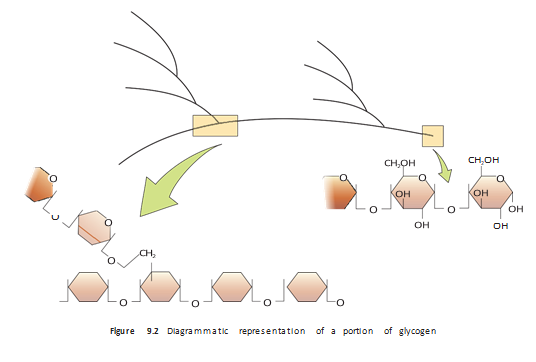
- Other examples: Inulin is a polymer of fructose. Glycogen is branched and has reducing and non-reducing ends.
- Complex polysaccharides: Some contain amino sugars or modified sugars, such as glucosamine and N-acetyl galactosamine; many are homopolymers.
| Polysaccharide | Structure / building block | Role or location |
|---|---|---|
| Cellulose | Glucose homopolymer; does not form complex helices | Plant cell walls; cotton fibre and paper made from plant pulp |
| Starch | Glucose polymer; forms helical secondary structures | Energy storage in plants; its helix holds iodine, producing a blue starch–iodine colour |
| Glycogen | Branched polysaccharide chain | Energy storage in animals |
| Inulin | Fructose polymer | Example of a polysaccharide built from fructose |
| Chitin | Complex polysaccharide | Found in arthropod exoskeletons |
Do not confuse starch with cellulose: starch forms helices that hold iodine and turn blue, whereas cellulose lacks complex helices and cannot hold iodine this way.
Nucleic Acids
Nucleic acid — A polynucleotide macromolecule built from nucleotide units.
Nucleotide structure and types
- Nucleotide components: Each nucleotide contains a nitrogenous heterocyclic base, a monosaccharide and phosphate.
- Bases: The five nitrogenous bases are adenine, guanine, cytosine, thymine and uracil.
- Base classes: Adenine and guanine are purines; cytosine, thymine and uracil are pyrimidines.
- Sugar: The sugar is either ribose, a pentose, or 2′-deoxyribose.
- DNA and RNA: DNA contains deoxyribose; RNA contains ribose. Nucleic acids carry hereditary information.
| Base class | Nitrogenous bases |
|---|---|
| Purines | Adenine and guanine |
| Pyrimidines | Cytosine, thymine and uracil |
Structure of Proteins
Protein — A heteropolymer made of amino acids arranged in one or more polypeptide chains.
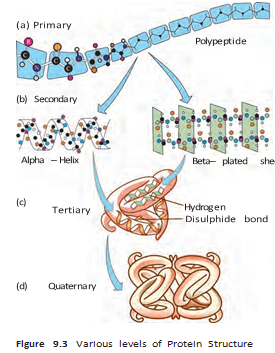
| Level | What it describes | Key detail |
|---|---|---|
| Primary | The amino-acid sequence and its position along the chain | The first amino acid is at the N-terminal end; the last is at the C-terminal end |
| Secondary | Local folding of parts of the polypeptide chain | Some regions form right-handed helices; other regions fold into different forms |
| Tertiary | The overall three-dimensional folding of one long polypeptide chain | Essential for many biological activities of proteins |
| Quaternary | Arrangement of multiple folded polypeptide subunits | Adult human haemoglobin has four subunits: two α and two β |
Enzymes
Enzyme — A biological catalyst that speeds up biochemical reactions; almost all enzymes are proteins.
Key features and activity conditions
- Ribozymes: Some nucleic acids also act as enzymes and are called ribozymes.
- Active site: A pocket or cleft in the enzyme where a substrate binds and the reaction is catalysed.
- Specificity: Enzymes catalyse particular chemical or metabolic reactions.
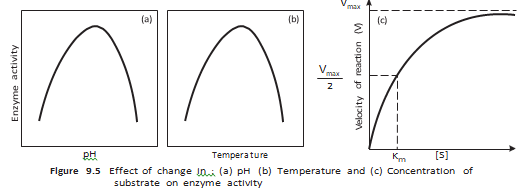
- Temperature and pH: Each enzyme has an optimum temperature and pH for maximum activity; activity declines above or below these values.
- Temperature effects: Low temperature leaves enzymes temporarily inactive; high temperature can denature them. Many enzymes are damaged above about , while enzymes from thermophiles can remain active at –.
- Substrate concentration: Reaction velocity initially rises as substrate concentration increases, then reaches when enzyme active sites are saturated.
- Inhibition: A chemical that binds an enzyme and shuts off or reduces its activity is an inhibitor; this effect is called inhibition.
- Competitive inhibition: A substrate-like inhibitor competes for the substrate-binding site. Malonate resembles succinate and inhibits succinate dehydrogenase; competitive inhibitors can help control bacterial pathogens.
Chemical Reactions and Reaction Rate
| Point | Physical change | Chemical reaction |
|---|---|---|
| What changes | Shape or state changes without breaking bonds | Bonds break and new bonds form |
| Example | Ice melts into water; water becomes vapour | Barium hydroxide reacts with sulfuric acid to form barium sulfate and water |
The amount of product formed per unit time; it is also called velocity when direction is specified.
Rates and catalysis
- Temperature rule of thumb: A process rate often doubles or halves for each change in temperature.
- Catalysts: Catalysed reactions proceed much faster than the same reactions without a catalyst.
- Carbonic anhydrase: Without the enzyme, about 200 carbonic acid molecules form per hour; with it, about 600,000 form per second—an increase of roughly 10 million-fold.
Metabolic pathway — A multistep chemical reaction in which each step is catalysed by the same enzyme complex or by different enzymes.
Glucose pathway example
- Pathway: Glucose becomes two pyruvic acid molecules through ten enzyme-catalysed reactions.
- Different outcomes: The pathway and additional reactions can produce different end products depending on conditions or organism.
| Condition / organism | Product |
|---|---|
| Skeletal muscle under anaerobic conditions | Lactic acid |
| Normal aerobic conditions | Pyruvic acid |
| Yeast fermentation | Ethanol |
How Enzymes Lower the Energy Barrier
Substrate, transition state and activation energy
- Substrate: The chemical that an enzyme converts into product(s).
- Enzyme–substrate complex: The substrate binds transiently at the enzyme's active site before conversion.
- Transition state: The substrate passes through a high-energy, unstable structure during bond breaking and formation.
- Activation energy: The energy difference between the substrate and the transition state.
- Enzyme effect: Enzymes lower the activation-energy barrier, making conversion of substrate to product easier.
- Exothermic reaction: If the product has a lower energy level than the substrate, the reaction releases energy; the transition-state barrier must still be crossed.
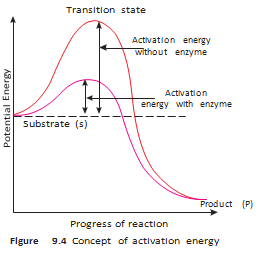
Enzymes lower activation energy; they do not eliminate the transition state or change the reaction's substrate and product.
Nature of Enzyme Action
Enzyme catalytic cycle
- The substrate binds to the enzyme's active site, forming an enzyme–substrate complex.
- Binding induces a change in enzyme shape, allowing it to fit more tightly around the substrate.
- The active site helps break or form bonds, producing an enzyme–product complex.
- The product is released; the free enzyme can bind another substrate molecule and repeat the cycle.

Classification and Nomenclature of Enzymes
Classification system
- Basis: Enzymes are grouped according to the types of reactions they catalyse.
- Numbering: There are six classes, each with 4–13 subclasses; enzymes are named using a four-digit number.
| Class | Reaction catalysed | Key detail / example |
|---|---|---|
| Oxidoreductases (dehydrogenases) | Catalyse oxidation–reduction between two substrates | Transfer reducing and oxidising equivalents between substrates |
| Transferases | Transfer a group other than hydrogen between substrates | A group G moves from one substrate to another |
| Hydrolases | Catalyse hydrolysis of bonds | May act on ester, ether, peptide, glycosidic, C–C, C–halide or P–N bonds |
| Lyases | Remove groups by mechanisms other than hydrolysis | Removal leaves a double bond |
| Isomerases | Interconvert isomers | May involve optical, geometric or positional isomers |
| Ligases | Join two compounds | Catalyse bonds such as C–O, C–S, C–N or P–O |
Cofactors
Cofactor — A non-protein component that binds to an enzyme and is required to make it catalytically active.
Apoenzyme — The protein portion of an enzyme that requires a cofactor for catalytic activity.
| Type | Binding / role | Example |
|---|---|---|
| Prosthetic group | Organic compound tightly bound to the apoenzyme | Haem in catalase and peroxidase; it forms part of the active site |
| Co-enzyme | Organic compound that associates transiently, often during catalysis; may assist different enzymes | NAD and NADP contain niacin, a vitamin |
| Metal ion | Forms coordination bonds with enzyme side chains and may also bond with the substrate | Zinc is a cofactor for the proteolytic enzyme carboxypeptidase |
- Cofactor removal: Removing a required cofactor causes loss of catalytic activity.
- Three types: Prosthetic groups bind tightly; co-enzymes bind transiently; metal ions assist through coordination bonds.
Biological roles and abundance
- Macromolecules: The three major macromolecule classes in living systems are proteins, nucleic acids and polysaccharides; lipids separate with the macromolecular fraction because of their association with membranes.
- Polysaccharides: They form structural components such as plant cell walls and arthropod exoskeletons, and store energy as starch or glycogen.
- Proteins: Their roles include enzymes, antibodies, receptors, hormones and structural components.
- Abundant proteins: Collagen is the most abundant protein in the animal world; RuBisCO is the most abundant protein in the biosphere.
- Nucleic acids: DNA and RNA carry hereditary information, which is passed from parents to progeny.
Describe the four levels of protein structure.
How do enzymes increase the rate of a reaction?
What is competitive inhibition? Give an example.
Quick recap
- Polysaccharides are sugar polymers: cellulose forms plant cell walls, while starch and glycogen store energy.
- Starch forms iodine-binding helices and turns blue; cellulose lacks these complex helices.
- Nucleotides contain a base, a sugar and phosphate; DNA has deoxyribose, while RNA has ribose.
- Proteins are amino-acid heteropolymers with primary, secondary, tertiary and quaternary structures.
- Enzymes bind substrates at active sites, lower activation energy and are affected by conditions such as temperature, pH, substrate concentration and inhibitors.
- The six enzyme classes are oxidoreductases, transferases, hydrolases, lyases, isomerases and ligases; some enzymes require cofactors.
Biology — ALL CHAPTERS
1
The Living World
2
Biological Classification
3
Plant Kingdom
4
Animal Kingdom
5
Morphology of Flowering Plants
6
Anatomy Of Flowering Plants
7
Structural Organization In Animals
8
Cell The Unit Of Life
9
Biomolecules
10
Cell Cycle And Cell Division
11
Photosynthesis in Higher Plants
12
Respiration In Plants
13
Plant Growth And Development
14
Breathing And Exchange Of Gases
15
Body Fluids And Circulation
16
Excretory Products And Their Elimination
17
Locomotion And Movement
18
Neural Control And Coordination
19
Chemical Coordination and integration