Class 11 PCB . Biology . Biology . Respiration in Plants
Chapter 12: Respiration In Plants
Ch 12
Biology
Class 11 PCB
Introduction
Energy and Food in Living Organisms
Where organisms obtain food
- Energy need: Organisms require energy for absorption, transport, movement, reproduction and other life processes.
- Green plants and cyanobacteria: Photosynthesis converts light energy into chemical energy stored in carbohydrates such as glucose, sucrose and starch.
- Plant cells: Only cells containing chloroplasts photosynthesise; food must be transported to non-green parts for oxidation.
- Animals: Herbivores obtain food directly from plants; carnivores obtain it indirectly through other animals.
- Saprophytes: Fungi depend on dead and decaying matter.
- Ultimate source: Food used in respiration ultimately comes from photosynthesis.
Cellular Respiration and ATP
Cellular respiration — The enzyme-controlled breakdown and oxidation of food molecules inside cells, releasing energy that is trapped to synthesise ATP.
Key features
- Sites in eukaryotes: Photosynthesis occurs in chloroplasts; breakdown of complex molecules occurs in the cytoplasm and mitochondria.
- Respiratory substrate: A compound oxidised during respiration; carbohydrates are commonly used, but proteins, fats and organic acids can also serve under certain conditions.
- Stepwise release: Oxidation occurs through a series of enzyme-controlled reactions, so some energy can be captured rather than lost as heat.
- ATP: Energy released in respiration is used to synthesise ATP. ATP is the cell’s energy currency and is broken down wherever energy is needed.
- Other use: Carbon skeletons produced during respiration can act as precursors for biosynthesis of other cellular molecules.
Do Plants Breathe?
Gas exchange in plants — Plants use oxygen for respiration and release carbon dioxide, exchanging gases mainly through stomata and lenticels rather than specialised respiratory organs.
Why plants do not need specialised respiratory organs
- Local exchange: Each plant part largely meets its own gas-exchange needs; gases move very little from one part to another.
- Low demand: Roots, stems and leaves respire at rates far lower than animals, so their gas-exchange requirements are modest.
- Photosynthesis: Photosynthesising cells release oxygen internally, so oxygen availability is not a problem in these cells during photosynthesis.
- Short diffusion distance: Living cells are usually close to the plant surface. In woody stems, living cells occur in thin layers near or beneath the bark, and lenticels provide openings for exchange.
- Air spaces: Loosely packed parenchyma cells form interconnected spaces that allow gases to diffuse through leaves, stems and roots.
- Woody interiors: Many cells deep inside woody stems are dead and mainly provide mechanical support.
How respiration captures energy
- One-step oxidation: If glucose were oxidised in one step, much of its energy would be released as heat.
- Cellular strategy: Glucose is oxidised through small, controlled steps; energy from suitable steps is coupled to ATP synthesis.
- Products: In respiration, oxygen is utilised and carbon dioxide, water and energy are released.
Respiration Without Oxygen
Anaerobic conditions and glycolysis
- Anaerobic conditions: Some environments and organisms have little or no available oxygen; the earliest cells are believed to have lived in an oxygen-free atmosphere.
- Facultative anaerobes: Some organisms adapted to anaerobic conditions are described as facultative anaerobes.
- Obligate anaerobes: Other organisms have an obligate requirement for anaerobic conditions.
- Shared capacity: All living organisms retain the enzymatic machinery to partially oxidise glucose without oxygen.
- Glycolysis: The breakdown of glucose to pyruvic acid; it is a partial oxidation that does not require oxygen.
Why do plants not require specialised respiratory organs?
What is a respiratory substrate?
What is glycolysis?
Quick recap
- Food energy for life processes is released by oxidation of respiratory substrates.
- Food used in respiration ultimately originates from photosynthesis; only chloroplast-containing plant cells photosynthesise.
- Respiration releases energy gradually and captures some of it in ATP for cellular work.
- Plants exchange gases through stomata, lenticels and air spaces without specialised respiratory organs.
- Complete glucose oxidation produces carbon dioxide and water, with much energy released as heat.
- Glycolysis partially oxidises glucose to pyruvic acid without requiring oxygen.
Glycolysis
Glycolysis: Overview
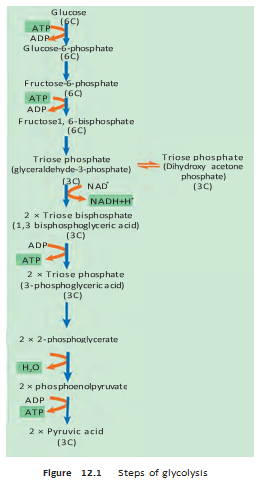
Main Steps and Energy Changes
Two ATP are used and four ATP are directly produced, giving a net gain of two ATP. Two are also formed.
Fates of Pyruvate
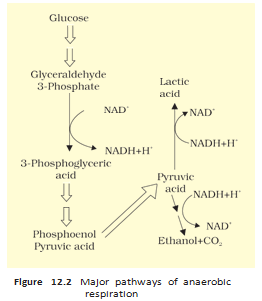
- Pyruvate: The product of glycolysis has different metabolic fates depending on the cell’s needs and oxygen availability.
- Main pathways: Pyruvate may undergo anaerobic pathways or be completely oxidised during aerobic respiration.
Fermentation
Aerobic Respiration
How many ATP molecules are directly produced, and what is the net ATP gain in glycolysis per glucose?
What are the products of alcoholic and lactic acid fermentation?
Why is fermentation’s net ATP yield only two ATP per glucose?
Quick recap
- Glycolysis is a ten-reaction cytoplasmic pathway that converts glucose into two pyruvate molecules.
- Two ATP are invested and four ATP are directly produced, giving a net gain of two ATP; two also form.
- Pyruvate can undergo lactic acid fermentation, alcoholic fermentation or aerobic respiration.
- Fermentation occurs without oxygen, regenerates and yields only the net ATP made during glycolysis.
- Fermentation releases less than of glucose’s energy; yeast is poisoned at an alcohol concentration of about .
- Aerobic respiration requires oxygen and completely oxidises organic substances to and water, releasing much energy.
Aerobic Respirstion
Overview and Pyruvate Oxidation
Aerobic respiration — The complete oxidation of glucose using oxygen, releasing carbon dioxide, water and energy stored as ATP.
Main events
- Pyruvate transport: Pyruvate formed during glycolysis in the cytoplasm enters the mitochondrial matrix.
- Complete oxidation: Pyruvate is broken down stepwise, releasing three molecules of per pyruvate.
- Electron transfer: Electrons removed with hydrogen are passed to molecular oxygen; the energy transfer supports ATP synthesis.
- Locations: Pyruvate oxidation and the TCA cycle occur in the matrix; the electron transport system is on the inner mitochondrial membrane.
Oxidative decarboxylation — The conversion of pyruvate to acetyl-CoA, releasing carbon dioxide and reducing to .
Pyruvate dehydrogenase reaction
- Enzyme and cofactors: Pyruvate dehydrogenase catalyses the reaction, with participation of and coenzyme A; is shown as a condition.
- Yield per glucose: Two pyruvate molecules from one glucose produce two acetyl-CoA molecules and two molecules.
Tricarboxylic Acid Cycle
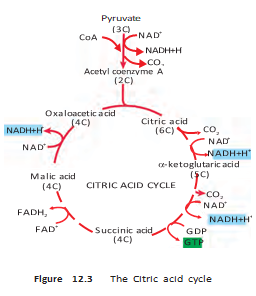
Tricarboxylic acid (TCA) cycle — A cyclic pathway in the mitochondrial matrix that oxidises acetyl-CoA and regenerates oxaloacetic acid (OAA); it is also called the Krebs cycle, after Hans Krebs.
Key stages of the cycle
- Acetyl group combines with OAA and water to form citrate; citrate synthase catalyses the reaction and CoA is released.
- Citrate is isomerised to isocitrate.
- Two successive decarboxylations form α-ketoglutarate and then succinyl-CoA, releasing two per acetyl-CoA overall.
- Succinyl-CoA is converted to succinate, generating GTP by substrate-level phosphorylation; GTP can transfer its phosphate to ADP to make ATP.
- Further reactions oxidise succinate and regenerate OAA, allowing the cycle to continue.
TCA cycle outputs
- Per acetyl-CoA: The cycle releases two and produces three , one and one ATP (via GTP).
- Per glucose: Two acetyl-CoA molecules yield four , six , two and two ATP from the TCA cycle.
- Including pyruvate oxidation: The two pyruvate molecules add two and two ; these stages therefore release six and yield eight per glucose.
- Replenishment: Continued cycling requires OAA and the oxidised carriers and to be available again.
Electron Transport System and Oxidative Phosphorylation
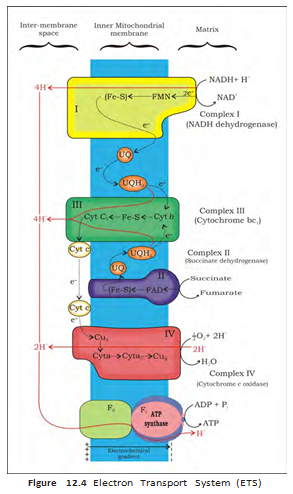
Electron transport system (ETS) — A series of carriers in the inner mitochondrial membrane that pass electrons from and ultimately to oxygen.
Electron flow through ETS
- donates electrons to NADH dehydrogenase (Complex I); donates electrons through Complex II.
- Electrons from Complexes I and II pass to ubiquinone; reduced ubiquinone transfers them to Complex III.
- Complex III (cytochrome complex) passes electrons to cytochrome c, a mobile carrier on the outer surface of the inner membrane.
- Cytochrome c transfers electrons to Complex IV (cytochrome c oxidase), which contains cytochromes and and two copper centres.
- Oxygen accepts electrons at the end of the chain and forms water; electron-transfer energy supports the proton gradient.
Oxidative phosphorylation — ATP formation from ADP and inorganic phosphate using energy released by oxidation-reduction reactions in the ETS.
ATP synthesis and oxygen’s role
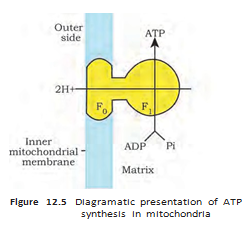
- Energy coupling: Electron transfer is coupled to ATP synthesis by ATP synthase (Complex V). ATP yield depends on the electron donor.
- Textbook yields: Oxidation of one is assigned three ATP; oxidation of one is assigned two ATP.
- Oxygen: It acts as the final hydrogen acceptor and forms water. Although required at the terminal stage, oxygen’s removal of hydrogen enables the overall process to continue.
- Proton gradient: Unlike photophosphorylation, which uses light energy to build the gradient, respiration uses energy from oxidation-reduction reactions.
| Component | Position / structure | Function |
|---|---|---|
| Peripheral headpiece | Contains the catalytic site for ATP synthesis from ADP and inorganic phosphate. | |
| Integral membrane part | Forms the proton channel across the inner mitochondrial membrane. |
Proton-driven ATP synthesis
- Mechanism: Protons move through from the intermembrane space into the matrix down their electrochemical gradient; this drives the catalytic action of .
- Stoichiometry: Passage of four through is coupled to the production of one ATP.
Respiratory Balance Sheet
Theoretical ATP yield
- Calculated net gain: Complete aerobic respiration is assigned a theoretical net yield of 38 ATP molecules per glucose molecule.
- Assumptions: Pathways proceed in sequence; glycolytic enters mitochondria and undergoes oxidative phosphorylation; intermediates are not diverted; glucose is the only substrate.
- Why it is theoretical: In living cells, pathways run simultaneously, intermediates enter or leave as needed, ATP is used continuously, and enzyme rates are regulated.
| Point | Fermentation | Aerobic respiration |
|---|---|---|
| Glucose breakdown | Partial breakdown | Complete breakdown to and |
| ATP per glucose | Net gain of 2 ATP | Many more ATP; theoretical net gain of 38 ATP |
| oxidation | Relatively slow | Vigorous through the ETS |
What is the role of oxygen in aerobic respiration?
How does ATP synthase produce ATP?
Why is the respiratory balance-sheet ATP yield theoretical?
Quick recap
- Pyruvate enters the mitochondrial matrix and is oxidatively decarboxylated to acetyl-CoA.
- The TCA cycle releases two per acetyl-CoA and produces reduced carriers plus ATP via GTP.
- Per glucose, pyruvate oxidation and the TCA cycle together release six and produce eight .
- ETS carriers transfer electrons from and to oxygen, the final hydrogen acceptor.
- Oxidative phosphorylation uses ETS energy to create a proton gradient that drives ATP synthase.
- The theoretical net yield is 38 ATP per glucose, but the calculation’s assumptions do not fully reflect living cells.
- Aerobic respiration completely breaks down glucose; fermentation is partial and yields only 2 ATP per glucose.
Amphibolic Pathway
Respiration as an Amphibolic Pathway
Why Respiration Is Not Only Catabolic
- Catabolism breaks down molecules; anabolism synthesises molecules.
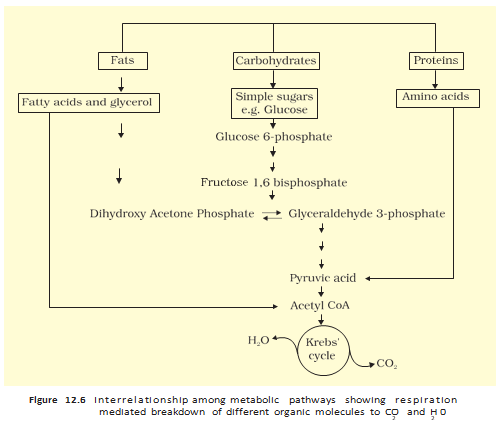
- Breakdown: fatty acids are converted to acetyl-CoA, which enters respiration.
- Synthesis: acetyl-CoA can be withdrawn from respiration to make fatty acids; respiratory intermediates also link respiration with protein synthesis and breakdown.
- Conclusion: respiratory intermediates serve both breakdown and synthesis, so respiration is amphibolic rather than purely catabolic.
Respiratory Quotient
Use the gas volumes released and consumed during respiration.
| Substrate | RQ | Key point |
|---|---|---|
| Carbohydrates | Complete oxidation releases and consumes equal volumes of and . | |
| Fats | Less than ; about for tripalmitin | Fat oxidation consumes more relative to the released. |
| Proteins | About | Protein can act as a respiratory substrate. |
For complete glucose oxidation:
For tripalmitin oxidation:
Interpreting RQ
- Depends on: the type of respiratory substrate being oxidised.
- In living organisms: more than one substrate is often respired at a time; pure fats or pure proteins are never used as respiratory substrates.
Why is the respiratory pathway called amphibolic?
Define respiratory quotient and state its values for carbohydrates, fats, and proteins.
Quick recap
- Glucose is the favoured respiratory substrate; fats and proteins enter respiration at different points.
- Glycerol enters after conversion to PGAL, while fatty acids enter as acetyl-CoA.
- Respiratory intermediates connect respiration with both synthesis and breakdown, making the pathway amphibolic.
- equals the volume of released divided by the volume of consumed.
- is for carbohydrates, below for fats, and about for proteins.
- Living organisms often respire a mixture of substrates; pure fats or pure proteins are never used as respiratory substrates.
Biology — ALL CHAPTERS
1
The Living World
2
Biological Classification
3
Plant Kingdom
4
Animal Kingdom
5
Morphology of Flowering Plants
6
Anatomy Of Flowering Plants
7
Structural Organization In Animals
8
Cell The Unit Of Life
9
Biomolecules
10
Cell Cycle And Cell Division
11
Photosynthesis in Higher Plants
12
Respiration In Plants
13
Plant Growth And Development
14
Breathing And Exchange Of Gases
15
Body Fluids And Circulation
16
Excretory Products And Their Elimination
17
Locomotion And Movement
18
Neural Control And Coordination
19
Chemical Coordination and integration