Class 11 Humanities . Geography . Fundamental Of Physical Geography . Composition and Structure of Atmosphere
Chapter 7: Composition And Structure Of Atmosphere
Ch 7
Geography
Class 11 Humanities
Composition Of The Atmosphere
Atmosphere — The atmosphere is a mixture of gases surrounding the Earth.
Composition and Vertical Variation
Main Components
- Components: The atmosphere contains gases, water vapour and dust particles.
- With altitude: The proportions of gases change in the higher layers.
- Oxygen: Its amount becomes almost negligible at about 120 km altitude.
- Carbon dioxide and water vapour: These are found only up to about 90 km above Earth’s surface.
Important Gases
| Gas | Key properties and role |
|---|---|
| Carbon dioxide | Transparent to incoming solar radiation but opaque to outgoing terrestrial radiation; absorbs some terrestrial heat and sends some back towards Earth, contributing to the greenhouse effect. |
| Ozone | Found about 10–50 km above Earth; absorbs the Sun’s ultraviolet rays and prevents much of this radiation from reaching the surface. |
Rising Carbon Dioxide and Air Temperature
- Burning fossil fuels increases atmospheric carbon dioxide.
- More carbon dioxide absorbs and returns more outgoing terrestrial heat.
- The greenhouse effect strengthens, contributing to a rise in air temperature.
Water Vapour
- Variable gas: Water vapour decreases with altitude and from the equator towards the poles.
- Regional amount: It may form about 4% of air by volume in warm, wet tropical areas, but less than 1% in dry deserts and cold polar regions.
- Heat balance: It absorbs some incoming solar energy and helps retain Earth’s radiated heat, acting like a blanket that moderates temperature.
- Weather: Water vapour contributes to stability and instability in the air.
Dust Particles
- Sources: Atmospheric particles include sea salts, fine soil, smoke and soot, ash, pollen, dust, and fragments of meteors.
- Distribution: Dust is concentrated mainly in lower layers, though convectional currents can carry it to great heights.
- Regional concentration: Subtropical and temperate regions generally have more dust than equatorial and polar regions, partly due to dry winds.
- Cloud formation: Dust and salt particles act as hygroscopic nuclei, around which water vapour condenses to form clouds.
Dust Particles and Cloud Formation
- Dust and salt particles are suspended in the atmosphere.
- They provide hygroscopic nuclei.
- Water vapour condenses around the nuclei, helping clouds form.
- Greenhouse effect
- Warming caused when gases such as carbon dioxide absorb and return part of Earth’s outgoing heat.
- Insolation
- Incoming solar radiation received by Earth.
- Hygroscopic nuclei
- Particles that attract water vapour and provide surfaces for condensation.
- Terrestrial radiation
- Heat energy radiated from Earth’s surface.
Quick recap
- The atmosphere is a life-supporting mixture of gases, water vapour and dust around Earth.
- About 99% of atmospheric mass lies within 32 km of the surface.
- Oxygen becomes almost negligible at 120 km; carbon dioxide and water vapour extend to about 90 km.
- Carbon dioxide contributes to the greenhouse effect, while ozone filters ultraviolet rays at about 10–50 km.
- Water vapour varies by altitude and region and helps regulate heat and atmospheric stability.
- Dust and salt particles act as condensation nuclei and help clouds form.
Structure Of The Atmosphere
Atmospheric Layers
How the atmosphere is divided
- Density: Greatest near Earth’s surface; it decreases as altitude increases.
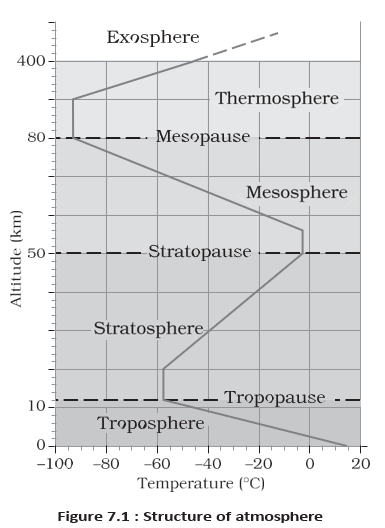
- Layers: The atmosphere is divided by temperature conditions into the troposphere, stratosphere, mesosphere, thermosphere and exosphere.
- Geographers’ focus: The troposphere and stratosphere are especially important to geographers.
| Layer | Approximate extent | Temperature and key features |
|---|---|---|
| Troposphere | Surface to about 13 km on average; about 8 km near the poles and 18 km at the equator | Temperature decreases with height by about 1°C per 165 m. Contains dust and water vapour; weather and climate changes occur here. Most important layer for biological activity. |
| Tropopause | Boundary between the troposphere and stratosphere | Temperature is nearly constant; about −80°C over the equator and −45°C over the poles. |
| Stratosphere | Above the tropopause to about 50 km | Contains the ozone layer, which absorbs harmful ultraviolet radiation and protects life on Earth. |
| Mesosphere | Above the stratosphere to about 80 km | Temperature decreases with height, reaching about −100°C at 80 km. Its upper boundary is the mesopause. |
| Thermosphere (ionosphere region) | About 80–400 km | Contains electrically charged particles called ions. Temperature increases with height; the layer reflects radio waves transmitted from Earth back to Earth. |
| Exosphere | Above the thermosphere | The uppermost layer; its gases are extremely rarefied and it gradually merges into outer space. |
Why the troposphere is thickest at the equator
- Strong heating at the equator
- Strong convectional currents develop
- Heat is carried to greater heights
- The troposphere becomes thicker at the equator than near the poles
Elements of Weather and Climate
Elements of weather and climate — Atmospheric conditions that change and influence human life on Earth.
- Main elements: Temperature, pressure, winds, humidity, clouds and precipitation.
Quick recap
- Atmospheric density decreases with altitude, and temperature conditions distinguish its five main layers.
- The troposphere is thickest at the equator and contains most weather and climate activity.
- The tropopause separates the troposphere from the stratosphere.
- The ozone layer in the stratosphere absorbs harmful ultraviolet radiation.
- Temperature decreases through the mesosphere; the ionosphere contains ions and reflects radio waves.
- The exosphere is the outermost, extremely rarefied layer; weather and climate elements include temperature, pressure, winds, humidity, clouds and precipitation.
Geography — ALL CHAPTERS
1
GEOGRAPHY AS A DISCIPLINE
2
THE ORIGIN AND EVOLUTION OF THE EARTH
3
INTERIOR OF THE EARTH
4
DISTRIBUTION OF OCEANS AND CONTINENTS
5
Geomorphic Processes
6
Landforms And Their Evolution
7
Composition And Structure Of Atmosphere
8
Solar Radiation, Heat Balance And Temperature
9
Atmospheric Circulation And Weather Systems
10
Water In The Atmosphere
11
World Climate And Climate Change
12
Water ( Oceans )
13
Movements Of Ocean Water
14
Biodiversity And Conservation
1
India - Location
2
Structure And Physiography
3
Drainage System
4
Climate
5
Natural Vegetation
6
Natural Hazards And Disasters