Class 11 Humanities . Geography . India Physical Environment . Natural Vegetation
Chapter 5: Natural Vegetation
Ch 5
Geography
Class 11 Humanities
Introduction & Tropical Evergreen And Semi Evergreen Forests
Natural Vegetation and Forest Types
Natural vegetation — A plant community left undisturbed for a long time, allowing its species to adjust to local climate and soil conditions.
- Natural vs planted vegetation: The same plant species may grow wild in a forest or be cultivated under human supervision.
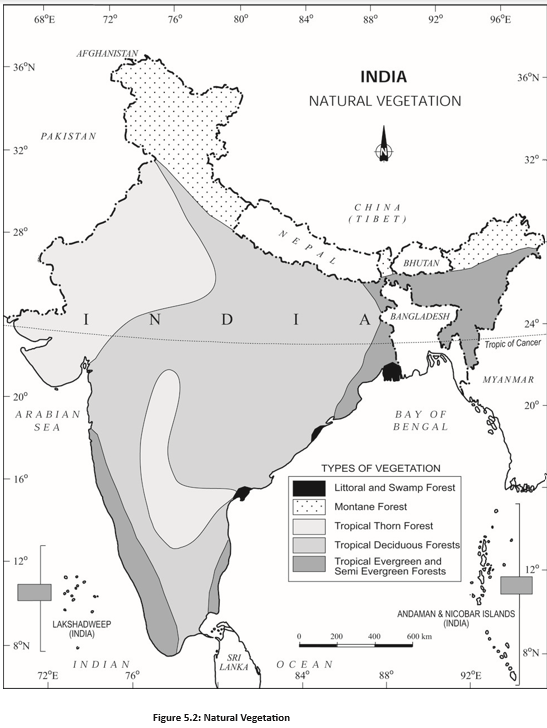
- Regional variation: India's vegetation varies with climate and soil—from Himalayan temperate vegetation to rain forests, mangroves, and desert thorn vegetation.
- Examples by region: The Western Ghats and Andaman and Nicobar Islands have tropical rain forests; deltaic regions have tropical forests and mangroves; Rajasthan has cacti, bushes, and thorny vegetation.
- Basis of grouping: Indian forests are classified using common features, especially predominant vegetation type and climatic regions.
| Forest types |
|---|
| Tropical evergreen and semi-evergreen forests |
| Tropical deciduous forests |
| Tropical thorn forests |
| Montane forests |
| Littoral and swamp forests |
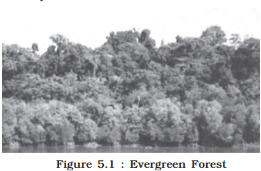
Tropical Evergreen and Semi-Evergreen Forests
| Forest type | Conditions / distribution |
|---|---|
| Tropical evergreen | Warm, humid regions with annual precipitation over and mean annual temperature above ; western slopes of the Western Ghats, northeastern hills, and Andaman and Nicobar Islands. |
| Semi-evergreen | Less rainy parts of these regions. |
Evergreen Forest Structure and Features
- Stratification: Layers range from shrubs and creepers near the ground, through shorter trees, to tall trees.
- Height: Trees may reach or more.
- Year-round greenery: There is no definite season for leaf-shedding, flowering, or fruiting, so the forests remain green throughout the year.
- Examples: Rosewood, mahogany, aini, and ebony.
Semi-Evergreen Forest Features
- Composition: A mixture of evergreen and moist deciduous trees.
- Evergreen character: Undergrowing climbers help give these forests an evergreen character.
- Examples: White cedar, hollock, and kail.
Colonial Exploitation and Changing Forest Use
Shift from Protective to Commercial Use
- The British recognised the economic value of India's forests.
- Large-scale exploitation began, changing forest structure.
- Oak forests in Garhwal and Kumaon were replaced by pine (chir) to supply wood for railway lines.
- Forests were cleared for tea, rubber, and coffee plantations; timber was also used in construction because it acts as a heat insulator.
- Forest use shifted from protection to commercial exploitation.
Quick recap
- Natural vegetation is a plant community left undisturbed long enough to adjust to climate and soil.
- Indian forests are grouped using common features such as predominant vegetation type and climatic regions.
- India has five forest types; vegetation varies regionally with climate and soil.
- Evergreen forests grow in warm, humid regions with over annual precipitation and mean annual temperature above .
- Evergreen forests are stratified, may have trees or taller, and stay green year-round; semi-evergreen forests mix evergreen and moist deciduous trees.
- British commercial exploitation included replacing oak with chir pine for railways and clearing land for plantations.
Tropical Deciduous Forests
Tropical deciduous forests — India’s most widespread forests, also called monsoon forests, found in regions receiving 70–200 cm of rainfall.
Forest Conservation And Social Forestry
Forest Conservation
Aims of the Forest Policy
- Forest cover: Bring 33% of India’s geographical area under forest cover.
- Environmental stability: Maintain stability and restore forests where ecological balance has been disturbed.
- Natural heritage: Conserve biodiversity and the country’s genetic pool.
- Land and water protection: Check soil erosion and the spread of desert lands; reduce floods and droughts.
- Expansion: Increase forest cover through social forestry and afforestation on degraded land.
- Rural needs and productivity: Improve forest productivity to supply timber, fuel, fodder and food to forest-dependent rural people; encourage substitutes for wood.
- People’s participation: Build a large public movement, involving women, to plant trees and prevent felling, reducing pressure on existing forests.
Forests and Tribal Communities
- Forest dependence: For many tribal people, forests are home and a source of food, livelihood and materials for building houses and practising traditional arts.
- Conservation role: Tribal communities’ longstanding knowledge of forests can support their development and conservation; they should be encouraged to grow minor forest produce and participate in protecting forests.
Social Forestry
| Type | Main focus | Examples or purpose |
|---|---|---|
| Urban forestry | Growing and managing trees on public and private land in and around towns and cities. | Green belts, parks, roadside avenues and industrial or commercial green belts. |
| Rural forestry | Promoting agroforestry and community forestry. | Combines tree-raising with agriculture or community needs. |
| Agroforestry | Growing trees and agricultural crops on the same land, including waste patches. | Can produce food, fodder, fuel, timber and fruit together. |
| Community forestry | Growing trees on public or community land. | Village pastures, temple land, roadsides, canal banks, railway strips and school grounds; benefits the community, including landless people. |
Farm Forestry
- Farm forestry: Farmers grow trees on their farmland for commercial or non-commercial purposes.
- Use of land: Trees may be planted along field margins, on grasslands and pastures, and around homes and cattle sheds; state forest departments distribute seedlings to small and medium farmers.
Wildlife and Its Decline
Causes of Wildlife Decline
- Industrial and technological growth → greater exploitation of forest resources.
- Clearing land for agriculture, settlements, roads, mining and reservoirs → loss and disturbance of habitats.
- Lopping for fodder and fuelwood, and removal of small timber → greater pressure on forests.
- Domestic cattle grazing → harm to wildlife and its habitat.
- Hunting as an elite sport, followed by commercial poaching → large numbers of wild animals killed.
- Forest fires → damage to wildlife and habitats.
- Afforestation
- Establishing tree cover on land that was not recently forested.
- Agroforestry
- Growing trees and agricultural crops together on the same land.
- Community forestry
- Raising trees on community or public land for shared benefit.
- Farm forestry
- Growing trees on farmers’ land for commercial or non-commercial purposes.
- Social forestry
- Forest management and tree planting aimed at environmental, social and rural development.
- Sustainable forest management
- Managing forests to conserve and expand them while meeting local people’s needs.
What were the main aims of India’s forest policy?
How do agroforestry and community forestry differ?
State major causes of wildlife decline.
Quick recap
- India adopted a forest policy in 1952 and modified it in 1988 to emphasise sustainable management.
- A key policy target was forest cover over 33% of the country’s geographical area.
- Tribal communities rely on forests and their knowledge and participation can aid conservation.
- Social forestry includes urban, rural and farm forestry; agroforestry and community forestry are parts of rural forestry.
- Farm forestry means farmers grow trees on their own land, with seedlings often supplied by state forest departments.
- Habitat disturbance, resource use, grazing, hunting, poaching and fires contribute to wildlife decline.
Wildlife Conservation In India
Wildlife Conservation: Laws and Protection
Key Wildlife Conservation Milestones
- 1972The Wildlife (Protection) Act was enacted.
- 1973Project Tiger was launched.
- 1991The Wildlife Act was comprehensively amended.
- 1992Project Elephant was launched.
- 2006–2020India’s tiger population rose from 1,411 to 2,967.
Species Conservation Projects
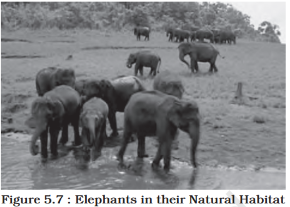
Project Elephant — Launched in 1992 to help states with free-ranging wild elephants and ensure the long-term survival of viable elephant populations in their natural habitats.
Other Species Projects
- Implementation: Project Elephant operates in 16 states.
- Other initiatives: The Government of India has also launched the Crocodile Breeding Project, Project Hangul and Himalayan Musk Deer conservation.
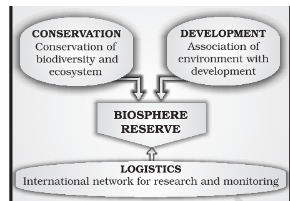
Biosphere Reserves
Objectives of a Biosphere Reserve
- Conservation: Protect biodiversity and ecosystems.
- Development: Support human progress in ways compatible with nature.
- International cooperation: Enable research, monitoring and shared support.
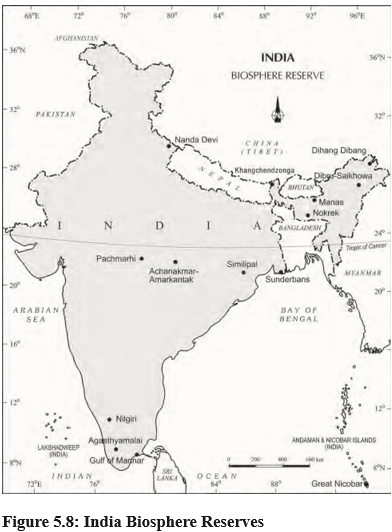
| Biosphere reserve | Area (square kilometres) | Designation date | Location |
|---|---|---|---|
| Nilgiri | 5,520 | 1 August 1986 | Tamil Nadu, Kerala and Karnataka; includes parts of Wynad, Nagahole, Bandipur, Mudumalai, Nilambur, Silent Valley and Siruvani Hills |
| Nanda Devi | 5,860.69 | 18 January 1988 | Parts of Chamoli, Pithoragarh and Almora districts, Uttarakhand |
| Nokrek | 820 | 1 September 1988 | Parts of East, West and South Garo Hill districts, Meghalaya |
| Manas | 2,837 | 14 March 1989 | Parts of Kokrajhar, Bongaigaon, Barpeta, Nalbari, Kamrup and Darang districts, Assam |
| Sunderban | 9,630 | 29 March 1989 | Part of the Ganges–Brahmaputra delta, West Bengal |
| Gulf of Mannar | 10,500 | 18 February 1989 | Indian part of the gulf, from Rameswaram Island to Kanyakumari, Tamil Nadu |
| Great Nicobar | 885 | 6 January 1989 | Southernmost island of the Andaman and Nicobar Islands |
| Similipal | 4,374 | 21 June 1994 | Part of Mayurbhanj district, Odisha |
| Dibru-Saikhowa | 765 | 28 July 1997 | Parts of Dibrugarh and Tinsukia districts, Assam |
| Dehang Debang | 5,111.5 | 2 September 1998 | Parts of Upper Siang, West Siang and Dibang Valley districts, Arunachal Pradesh |
| Pachmarhi | 4,981.72 | 3 March 1999 | Parts of Betul, Hoshangabad and Chhindwara districts, Madhya Pradesh |
| Khangchendzonga | 2,619.92 | 7 February 2000 | Parts of North and West districts, Sikkim |
| Agasthyamalai | 3,500.36 | 12 November 2001 | Parts of Tirunelveli and Kanyakumari districts, Tamil Nadu, and Thiruvananthapuram, Kollam and Pathanamthitta districts, Kerala |
| Achanakmar-Amarkantak | 3,835.51 | 30 March 2005 | Parts of Anuppur and Dindori districts, Madhya Pradesh, and Bilaspur district, Chhattisgarh |
| Kachchh | 12,454 | 29 January 2008 | Parts of Kachchh, Rajkot, Surendranagar and Patan districts, Gujarat |
| Cold Desert | 7,770 | 28 August 2009 | Pin Valley National Park and surrounding areas, including Chandratal, Sarchu and Kibber Wildlife Sanctuary, Himachal Pradesh |
| Seshachalam | 4,755.997 | 20 September 2010 | Seshachalam hill ranges in the Eastern Ghats; part of Chittoor and Kadapa districts, Andhra Pradesh |
| Panna | 2,998.98 | 25 August 2011 | Parts of Panna and Chhattarpur districts, Madhya Pradesh |
What are the two main objectives of the Wildlife (Protection) Act, 1972?
State the purpose of Project Tiger and give one measure of its progress.
Quick recap
- Wildlife Act: The 1972 law protects endangered species and gives legal support to conservation areas; its 1991 amendment strengthened protection and penalties.
- Project Tiger: Launched in 1973; tiger reserves expanded from 9 to 50, while the population rose to 2,967 by 2020.
- Project Elephant: Began in 1992 to support states with free-ranging elephants and protect viable populations in natural habitats.
- Other projects: Crocodile Breeding Project, Project Hangul and Himalayan Musk Deer conservation also support wildlife.
- Biosphere reserves: These are unique, internationally recognised ecosystems that link biodiversity conservation, sustainable development and international cooperation.
- India’s network: The lecture lists 18 biosphere reserves, 11 of which are recognised in UNESCO’s World Network.
Geography — ALL CHAPTERS
1
GEOGRAPHY AS A DISCIPLINE
2
THE ORIGIN AND EVOLUTION OF THE EARTH
3
INTERIOR OF THE EARTH
4
DISTRIBUTION OF OCEANS AND CONTINENTS
5
Geomorphic Processes
6
Landforms And Their Evolution
7
Composition And Structure Of Atmosphere
8
Solar Radiation, Heat Balance And Temperature
9
Atmospheric Circulation And Weather Systems
10
Water In The Atmosphere
11
World Climate And Climate Change
12
Water ( Oceans )
13
Movements Of Ocean Water
14
Biodiversity And Conservation
1
India - Location
2
Structure And Physiography
3
Drainage System
4
Climate
5
Natural Vegetation
6
Natural Hazards And Disasters