Class 11 Humanities . Geography . Fundamental Of Physical Geography . Geomorphic Processes
Chapter 5: Geomorphic Processes
Ch 5
Geography
Class 11 Humanities
Introduction & Geomorphic Processes
Why the Earth's Surface Is Uneven
How Relief Variations Persist
- Endogenic forces uplift or build parts of the crust
- Exogenic forces erode elevations and deposit material in depressions
- The opposing actions continue
- Relief variations remain rather than being completely levelled
Why Understanding the Surface Matters
- Human dependence: People rely on the Earth's surface and its resources for sustenance.
- Long timescales: Many landforms develop over hundreds or thousands of years.
- Human impact: Overuse and misuse of resources can rapidly diminish the surface's capacity to support life.
- Responsible use: Understanding surface processes helps reduce damage and preserve the Earth's potential for future generations.
Geomorphic Processes and Agents
How Agents Move Earth Materials
- Mobility: Agents become mobile when gradients set them in motion.
- Sequence: An agent removes material, transports it over slopes and deposits it at a lower level.
- Usage: In this chapter, “geomorphic processes” and “geomorphic agents” may sometimes be used together when referring to exogenic action.
Gravity and Gradients
Movement of Surface Materials
- Gravity and gradients create the potential for movement
- Materials move from higher to lower levels
- Agents erode and transport materials
- Materials are deposited at lower levels
Endogenic Processes
- Energy source: Energy from within the Earth—mainly radioactivity, rotational and tidal friction, and primordial heat—drives endogenic processes.
- Surface effects: These forces build up and elevate parts of the crust; variations in their strength help create an uneven surface.
Diastrophism
| Point | Orogeny | Epeirogeny |
|---|---|---|
| Main process | Mountain building | Continental building |
| Crustal deformation | Severe folding | Simple uplift or warping |
| Area affected | Long, narrow belts | Large parts of the crust |
Volcanism
- Degradation
- Wearing down of elevated relief by erosion.
- Aggradation
- Filling of basins and depressions through deposition.
- Geomorphic agent
- A mobile natural medium that removes, transports and deposits Earth materials.
- Diastrophism
- Crustal processes that move, elevate or build parts of the Earth's crust.
- Orogeny
- Mountain building involving severe folding, commonly in long, narrow crustal belts.
- Epeirogeny
- Uplift or warping of large parts of the Earth's crust.
What are geomorphic processes and geomorphic agents?
How do orogeny and epeirogeny differ?
Quick recap
- Endogenic forces build or uplift land; exogenic forces erode elevations and fill depressions.
- Degradation wears down relief, aggradation fills basins, and gradation reduces relief variations through erosion.
- Geomorphic processes are forces acting on Earth materials; agents are mobile media that move those materials.
- Gravity and gradients enable the movement needed for erosion, transport and deposition.
- Endogenic energy comes from radioactivity, rotational and tidal friction, and primordial heat.
- Diastrophism includes orogeny, epeirogeny, earthquakes and plate tectonics; volcanism involves magma and volcanic forms.
Exogenic Processes
Exogenic Processes and Denudation
- Energy: Exogenic processes draw energy from the atmosphere, ultimately from the Sun, and from gradients created by tectonic forces.
- Gravity and stress: Gravity moves materials downslope; stresses within rocks can deform and break them, enabling weathering and movement.
- Denudation: This term covers weathering, mass movements, erosion and transportation—the processes that strip and reshape the land.
- Climate: Temperature and precipitation, along with vegetation and local conditions, influence the type and rate of exogenic processes.
- Erosion and transport: Their movement of earth materials is driven by kinetic energy; deposition follows when agents lose velocity and energy.
Quick recap
- Exogenic processes are powered by atmospheric energy from the Sun and by tectonically created gradients.
- Gravity drives movement downslope; stress, especially shear stress, helps break and deform earth materials.
- Denudation includes weathering, mass movement, erosion and transportation.
- Climate, vegetation, topography and rock type and structure cause exogenic processes to vary by place.
- Weathering is mainly in-situ breakdown and is classified as chemical, physical or biological.
- Chemical weathering includes solution, carbonation, hydration, oxidation and reduction; water, air and heat promote reactions.
Physical Weathering Processes
Physical Weathering
Physical weathering — The mechanical breakdown of rocks by applied forces, without requiring chemical change.
Forces and effects
- Gravity: Overburden pressure, load and shearing stress act on earth materials at the surface and below it, helping fracture rocks.
- Expansion: Temperature changes, crystal growth and animal activity exert pressure on materials.
- Water pressure: Wetting and drying cycles create pressure within earth materials.
- Repeated stress: Thermal expansion and pressure release are major causes; repeated contraction and expansion fatigue rocks over time.
- Rate and impact: These processes are often slow and small, but their repetition can cause substantial rock damage.
Biological Activity and Weathering
Biological weathering — The contribution or removal of minerals and ions, and the physical alteration of earth materials through the growth or movement of organisms.
How organisms contribute
- Burrowing and wedging: Earthworms, termites and rodents expose fresh surfaces and help moisture and air penetrate materials, increasing chemical attack.
- Human activity: Disturbing vegetation, ploughing and cultivation mix soil and create new contacts among air, water and minerals.
- Decomposition: Decaying plants and animals produce humic, carbonic and other acids, increasing decay and the solubility of some elements.
- Root pressure: Growing plant roots exert pressure that mechanically breaks earth materials apart.
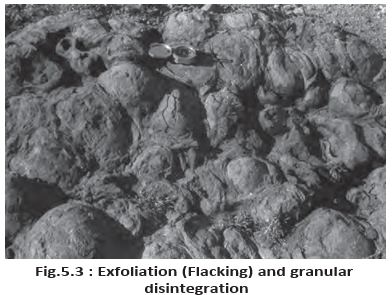
Special Effect: Exfoliation
Exfoliation — The flaking off of curved, shell-like sheets from rock or bedrock, producing smooth and rounded surfaces; it is an effect of weathering, not a process.
Causes and related landforms
- Temperature change: Repeated expansion and contraction can cause exfoliation.
- Unloading: The release of pressure as overlying material is removed can produce exfoliation domes.
- Thermal expansion: It is associated with the formation of tors.
Significance of Weathering
Why weathering matters
- Rock breakdown: It breaks rocks into smaller fragments and helps form regolith and soils.
- Erosion and relief: Weathering prepares rocks for erosion and mass movements; erosion then reduces relief and changes landforms. Erosion is limited where rocks have not been weathered.
- Ecosystems: The depth of weathering mantles supports vegetation and forests, which underpin biomes and biodiversity.
- Soil formation: Weathering is an important process in the formation of soils.
- Ore enrichment: Weathering can concentrate valuable ores such as iron, manganese, aluminium and copper, increasing their economic importance.
Enrichment — The concentration of valuable material left behind when weathering and groundwater leaching remove some other materials, potentially making the deposit economically viable to exploit, process and refine.
Ore enrichment by leaching
- Groundwater physically or chemically leaches some materials
- The valuable materials remain in a smaller amount of material
- Their concentration rises, potentially to an economically usable level
Mass Movements
Mass movement — The downslope transfer of rock debris under gravity, without a geomorphic agent carrying it from place to place.
Key characteristics and types
- Gravity: It acts on bedrock and weathered material alike; debris may carry air, water or ice with it, but these do not transport the debris.
- Speed and depth: Movement ranges from slow to rapid and may affect shallow or deep columns of material.
- Types: Commonly listed types include creep, flow, slide and fall; heave, flow and slide are also identified as forms of movement.
- Weathering link: Weathering aids mass movement and makes it more active on weathered slopes, but it is not a prerequisite.
- Resistance: Slope material yields only when the disturbing force exceeds its shearing resistance.
| Point | Mass movement | Erosion |
|---|---|---|
| Main force or agent | Gravity moves material downslope directly. | A geomorphic agent such as running water, glaciers, wind, waves or currents transports material. |
| Classification | Not classed as erosion, even though material shifts place. | Involves transport by a geomorphic agent. |
| Condition | Examples |
|---|---|
| Weak or unstable materials | Weak unconsolidated materials; thinly bedded rocks; faults; steeply dipping beds. |
| Steep topography | Vertical cliffs and steep slopes. |
| Water and vegetation | Abundant precipitation, torrential rain and sparse vegetation. |
Activating Causes of Mass Movement
- Support removed from below, naturally or artificially → material above loses support.
- Slope gradient or height increased → downslope pull becomes greater.
- Materials added by natural accumulation or filling → slope becomes overloaded.
- Heavy rainfall saturates and lubricates slope materials → resistance may decrease.
- Material or load removed from the original slope surface → the slope becomes unstable.
- Earthquakes, explosions or machinery → vibrations disturb slope materials.
- Excessive seepage, or heavy drawdown of water in lakes, reservoirs or rivers → water drains slowly from beneath slopes or river banks.
- Natural vegetation removed indiscriminately → slope support and stability decline.
Why is mass movement not classified as erosion?
What is enrichment of an ore deposit?
Quick recap
- Physical weathering fractures rocks through gravity, expansion and water-pressure forces; repeated stress can fatigue rocks.
- Organisms and human activities mechanically alter materials, expose fresh surfaces and contribute acids through decomposition.
- Exfoliation is the flaking of curved rock sheets; temperature-driven expansion and contraction can cause it, while unloading forms exfoliation domes and thermal expansion is linked to tors.
- Weathering forms regolith and soil, aids erosion and mass movement, supports ecosystems and can enrich valuable ores through leaching.
- Mass movement is direct gravity-driven downslope movement, not erosion; weathering aids it but is not essential.
- Weak materials, steep slopes, water, slope disturbance, earthquakes and vegetation removal can trigger mass movement.
Landslides
Landslides and Their Types
| Point | Rockslide | Rock fall |
|---|---|---|
| Movement | Slides along bedding, joint or fault surfaces. | Falls freely away from a steep slope. |
| Depth of material | Can affect rock to substantial depth. | Usually involves superficial layers of the rock face. |
Landslides in Indian Hill Regions
| Point | Himalayas | Nilgiris and Western Ghats |
|---|---|---|
| Occurrence | Debris avalanches and landslides occur very frequently. | They also occur, but less frequently. |
| Geology and tectonics | Tectonically active; largely sedimentary rocks and unconsolidated or semi-consolidated deposits. | Relatively tectonically stable and mostly made of very hard rocks. |
| Other conditions | Very steep slopes. | Steep slopes, near-vertical cliffs and escarpments; pronounced mechanical weathering from temperature changes and ranges; heavy rain over short periods causes frequent direct rock falls as well as landslides and debris avalanches. |
Erosion and Deposition
Erosion — The acquisition and transportation of rock debris from one place to another by geomorphic agents.
How Erosion Works
- Agents: Running water, groundwater, glaciers, wind and waves remove and transport material according to their energy and dynamics.
- Abrasion: Rock debris carried by these agents scrapes and wears away surfaces, aiding erosion.
- Relief: Erosion degrades relief by wearing down the landscape; erosion and transportation are controlled by kinetic energy.
- Weathering: It helps break rocks into smaller fragments, but it is not a precondition for erosion.
- Degradation: Weathering, mass-wasting and erosion are degradational processes.
| Agent | Control / state | Key point |
|---|---|---|
| Wind | Climate-controlled; gaseous state | One of the three climatically controlled agents. |
| Running water | Climate-controlled; liquid state | One of the three climatically controlled agents. |
| Glaciers | Climate-controlled; solid state | One of the three climatically controlled agents. |
| Waves | Not controlled by climate | Their work depends on coastal location, at the lithosphere–hydrosphere interface. |
| Groundwater | Not controlled by climate | Its work depends mainly on the region's lithology. Karst topography forms where rocks are permeable and soluble and water is available. |
Deposition — The settling of transported material when an erosional agent loses velocity and energy, often on gentler slopes.
How Deposition Works
- Settling order: Coarser materials are deposited first; finer materials settle later.
- Landform effect: Deposition fills depressions and builds up the surface.
- Agent role: Deposition is not an independent action performed by an agent; it occurs as transported material settles when the agent loses energy.
- Dual role: Running water, glaciers, wind, waves and groundwater can act as both erosional and aggradational (depositional) agents.
| Point | Mass movement | Erosion |
|---|---|---|
| Main process | Rock or soil moves downslope under gravity. | Agents acquire and transport rock debris. |
| Transport | Material shifts from one place to another as a mass. | Material is removed and carried by geomorphic agents; abrasion may also wear down rock. |
Quick recap
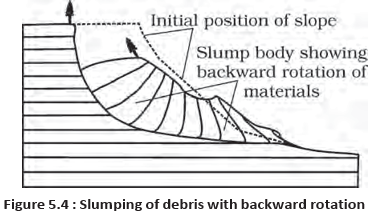
- Slumps rotate backward; debris slides move rapidly without backward rotation.
- Rockslides follow bedding, joints or faults and can affect deep material; rock falls usually involve superficial rock.
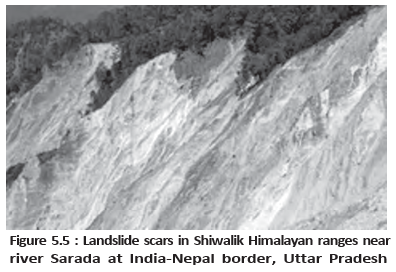
- Himalayan landslides are encouraged by tectonic activity, weak deposits and steep slopes; the Western Ghats and Nilgiris also face risk from steep cliffs, mechanical weathering and intense short-period rainfall.
- Erosion acquires and transports debris, degrades relief, and is aided by abrasion; weathering helps but is not essential.
- Wind, running water and glaciers are climate-controlled agents; waves depend on coastal location and groundwater on lithology and water availability.
- Deposition follows loss of velocity and energy: coarse material settles first, finer material later, and depressions are filled.
Soil Formation
Soil and Pedogenesis
Soil — A dynamic, changing medium where physical, chemical and biological activities continue; it is both a product of decay and a medium for growth.
How soil changes
- Seasonal variation: Soil alternates between conditions such as warm and cold or dry and moist.
- Biological activity: It slows or stops when soil is too cold or too dry.
- Organic matter: It increases as leaves fall and grasses or other plants die.
- Pedogenesis
- The process of soil formation.
- Pedology
- The science of soil.
- Pedologist
- A soil scientist.
- Humus
- Finely divided organic matter in soil, formed from dead plants and organisms.
- Eluviation and illuviation
- Downward removal and transportation of soil components, followed by their deposition lower in the soil.
- Desilication
- Removal of silica from soil.
Process of Soil Formation
From weathered material to mature soil
- Weathering creates a mantle of weathered material, the basic input for soil; transported deposits can also provide the starting material.
- Bacteria, mosses and lichens colonise the material; other organisms also take shelter within it.
- Dead organisms and plants add organic matter, gradually building humus.
- Grasses and ferns grow, followed by bushes and trees from seeds carried by birds and wind.
- Plant roots penetrate the material, while burrowing animals move particles; it becomes porous, retains water and allows air to pass.
- Over time, mature soil forms as a complex mixture of mineral and organic products.
Soil formation depends on more than weathering
- Weathering: It supplies the starting material, but does not alone form soil; organisms, climate, topography and time also shape development.
- Interacting controls: Soil-forming factors act together and influence one another, so soil formation cannot be separated from its controls.
Soil-forming Factors
| Factor | Role |
|---|---|
| Parent material | Provides the material from which soil develops; passive control. |
| Topography | Affects sunlight exposure and surface and subsurface drainage; passive control. |
| Climate | Moisture and temperature influence chemical and biological processes; active control. |
| Biological activity | Organisms add organic matter, aid nitrogen supply and rework soil; active control. |
| Time | Determines how long soil-forming processes operate and how mature the profile becomes; passive control. |
Parent Material
Parent material — The rock debris or transported deposits from which soil develops; it is a passive control factor.
| Material | Soil type |
|---|---|
| Weathered rock debris formed in place (in situ) | Residual soil |
| Material transported and deposited elsewhere | Transported soil |
How parent material affects soil
- Properties: Soil development depends on debris texture (particle size), structure (particle arrangement), and mineral and chemical composition.
- Weathering: Its nature and rate, and the depth of the weathering mantle, are important.
- Bedrock relationship: Similar bedrock can support different soils, and different bedrocks can support similar soils.
- Exceptions: Young, immature soils are strongly linked to their parent rock; soils in some limestone areas also retain a clear parent-rock relationship.
Topography
Topography — The shape and slope of the land, which passively affects soil formation through sunlight exposure and drainage.
Topography and soil development
- Steep slopes: Soils are thin because runoff and erosion remove material.
- Flat uplands: Soils tend to be thick.
- Gentle slopes: Slow erosion and good water percolation favour soil formation.
- Flat areas: Clay and organic matter may accumulate, producing a thick, dark-coloured soil.
Climate
Climate — An active soil-forming factor, chiefly through moisture conditions and temperature variations.
Moisture and temperature effects
- Moisture: Precipitation, evaporation and humidity determine soil moisture, enabling chemical and biological activity.
- Excess water: It carries soil components downward through eluviation and deposits them lower down through illuviation.
- Wet equatorial climates: Heavy rainfall removes calcium, sodium, magnesium, potassium and much silica; silica removal is called desilication.
- Dry climates: High evaporation draws groundwater upward by capillary action; evaporation leaves salts that form soil crusts called hardpans.
- Tropical or intermediate rainfall: Calcium carbonate nodules, called kanker, can form.
- Temperature: Higher temperatures increase chemical activity; cooler conditions reduce it, except for carbonation; freezing conditions stop chemical activity.
- Climate contrast: Warm tropical soils tend to have deeper profiles, while frozen tundra soils contain mainly mechanically broken material.
Effects of Organisms on Soil
Organisms and soil development
- Vegetation and organisms: They add organic matter and moisture and help retain nitrogen in the soil.
- Humification: Dead plants form humus; organic acids produced during this process help decompose minerals in the parent material.
- Cold climates: Slow bacterial growth allows humus to accumulate; undecomposed organic matter can form peat layers in subarctic and tundra regions.
- Humid tropical and equatorial climates: Intense bacterial action rapidly oxidises dead vegetation, leaving little humus.
- Nitrogen fixation: Soil organisms convert gaseous nitrogen from the air into a form plants can use. Rhizobium in legume root nodules fixes nitrogen for the host plant.
- Soil animals: Ants, termites, earthworms and rodents mechanically rework soil, moving material up and down.
- Earthworms: Feeding and processing soil changes the texture and chemistry of the material they excrete.
Time
Time — A passive control factor: the duration of soil-forming processes determines soil maturity and profile development.
Soil maturity
- Mature soil: Forms when soil processes operate long enough to develop a profile.
- Young soils: Recently deposited alluvium or glacial till usually has no horizons or only poorly developed horizons.
- Duration: There is no fixed absolute time required for soil to develop and mature.
Why are time, topography and parent material considered passive soil-forming factors?
Is weathering alone responsible for soil formation?
Quick recap
- Soil is a dynamic medium where physical, chemical and biological processes continue.
- Pedogenesis begins with weathered material or deposits, followed by colonisation, humus formation and profile development.
- Five controls are parent material, topography, climate, biological activity and time; they act together.
- Parent material and topography shape the starting material and drainage; time determines how long soil processes operate.
- Climate influences leaching, salt crusts, kanker formation and soil depth through moisture and temperature.
- Organisms add humus, fix nitrogen and rework soil; climate affects whether humus accumulates or decomposes rapidly.
Geography — ALL CHAPTERS
1
GEOGRAPHY AS A DISCIPLINE
2
THE ORIGIN AND EVOLUTION OF THE EARTH
3
INTERIOR OF THE EARTH
4
DISTRIBUTION OF OCEANS AND CONTINENTS
5
Geomorphic Processes
6
Landforms And Their Evolution
7
Composition And Structure Of Atmosphere
8
Solar Radiation, Heat Balance And Temperature
9
Atmospheric Circulation And Weather Systems
10
Water In The Atmosphere
11
World Climate And Climate Change
12
Water ( Oceans )
13
Movements Of Ocean Water
14
Biodiversity And Conservation
1
India - Location
2
Structure And Physiography
3
Drainage System
4
Climate
5
Natural Vegetation
6
Natural Hazards And Disasters