Class 11 Humanities . Geography . Fundamental Of Physical Geography . Geography As a Discipline
Chapter 1: GEOGRAPHY AS A DISCIPLINE
Ch 1
Geography
Class 11 Humanities
Introduction
Why Study Geography?
Purpose and value
- Human–environment dependence: People rely on surrounding resources for food, shelter, clothing and livelihoods.
- Geographical diversity: Natural resources, technology, social organisation and culture vary from place to place and change over time.
- Geographical inquiry: Geography helps explain the causes of these variations and how places and people differ.
- Practical skills: Maps, GIS and computer cartography help us understand the Earth's surface and support development.
Meaning and Scope of Geography
Geography — The study and description of the Earth, especially as the home of human beings and the setting for human–environment relationships.
Word origin and subject matter
- Word roots: Greek *geo* means “Earth” and *graphos* means “description”; together they mean “description of the Earth.”
- Coined by: Eratosthenes, a Greek scholar; geography was understood as describing the Earth as the abode of human beings.
- Earth's features: Geography studies natural features such as mountains, plains, oceans and deserts, as well as human features such as settlements, roads, railways, ports and markets.
- Related disciplines: It draws on natural sciences such as geology, pedology and meteorology, and social sciences such as economics, history and sociology.
- Distinct but connected: Geography differs from other sciences in its subject matter and methodology, yet remains closely related to them.
- Synthesis: Geography uses data from natural and social sciences and brings them together to understand the Earth.
Eratosthenes
- 276–194 BCLifetime of Eratosthenes, who coined the term geography.
Areal Differentiation and Causal Relationships
Areal differentiation — The study of how geographical phenomena vary from one area to another across the Earth's surface.
How geography explains differences
- Patterns and variation: Some natural and cultural features are similar across places, while others differ.
- Spatial characteristics: Geography studies the distribution, location and concentration of phenomena over space.
- Associations: Geographers connect spatial variations to the other factors linked with them.
- Causal explanation: Geography asks how and why phenomena are related, not just what exists or where it is found.
- Example: Cropping patterns vary with soils, climate, market demand, farmers’ ability to invest and available technology.
- Prediction: Explaining cause and effect helps geographers interpret patterns and anticipate how phenomena may develop.
Nature–Human Interaction
An integrated and changing relationship
- Dynamic phenomena: Physical and human features change over time through interactions between the changing Earth and human societies.
- Mutual influence: Nature shapes food, clothing, shelter and occupations; people adapt to nature and also modify it.
- Technology: Tools and technology help people use resources, reduce the hardship of labour, improve efficiency and expand production and mobility.
- Changing dependence: Earlier societies depended directly on their immediate environment; technological development widened the scale of resource use and human activity.
- Interdependence: Human beings are part of nature, and human activity leaves imprints on the natural environment.
From Environmental Dependence to Wider Possibilities
- Direct dependence on the immediate physical environment
- Adaptation to local conditions and use of natural resources
- Development of technology and modification of the environment
- Wider resource use, increased production and greater mobility
Spatial Organisation and Integration
How places become connected
- Spatial organisation: Human activities and places are arranged across space and linked through transport and communication networks.
- Routes and nodes: Routes are links; settlements of different types and sizes are nodes.
- Spatial integration: Connections between routes and nodes bring places and activities together.
- Geography's focus: As a social science, geography studies both the organisation of space and the integration of places within it.
Geography's Three Key Questions
| Question | Focus | Contribution |
|---|---|---|
| What? | Identify natural and cultural features and their patterns. | Describes which features exist. |
| Where? | Find the distribution and location of features. | Shows where features are found. |
| Why? | Explain causes, processes and relationships between phenomena. | Makes geography explanatory and scientific. |
Key distinction
- What + where: Together, these describe features and their locations, producing an inventory of geographical information; this approach was popular during the colonial period.
- Why: Explains the causes and relationships behind distributions, patterns and processes.
- Areal differentiation
- Geographical variation from one area to another.
- Spatial organisation
- The arrangement of activities and places across space.
- Spatial integration
- The linking of places through routes, settlements, transport and communication.
- Human–environment interaction
- The mutual influence of people and the natural environment.
What makes geography more than a description of locations?
How do people interact with the natural environment?
Quick recap
- Geography studies the Earth as the home of people and other living things.
- Its name combines Greek *geo* (Earth) and *graphos* (description); Eratosthenes coined the term.
- Geography is distinct in its subject matter and methodology, but draws on and synthesises knowledge from natural and social sciences.
- Geographers study spatial variation, distribution, location and concentration, explaining them through relationships between phenomena.
- Human beings adapt to and modify nature, while nature influences human life.
- Routes and settlement nodes connect places, creating spatial organisation and integration.
- Geography asks what features exist, where they are located and why they occur there.
Geography as an Integrating Discipline
Geography's Integrative Perspective
Geography as a discipline of synthesis — Geography combines knowledge about natural and human phenomena to understand their spatial relationships and variations.
| Focus | Geography | History |
|---|---|---|
| Main synthesis | Spatial: relationships and differences between places | Temporal: events and changes through time |
How Geography Integrates Knowledge
- Holistic approach: Geography treats the world as a system of interdependencies and studies connected phenomena together.
- Spatial perspective: It examines differences from place to place and integrates them to understand reality as a whole.
- Interdisciplinary links: Geography connects with natural and social sciences, whose elements often vary over space; all aim to understand reality.
- Global village: Improved transport reduces the effect of distance and increases accessibility.
- Technology: Audio-visual media and information technology expand data; technology also improves monitoring of natural, economic and social phenomena.
- Geographer's role: A geographer needs broad knowledge of related fields to integrate them logically.
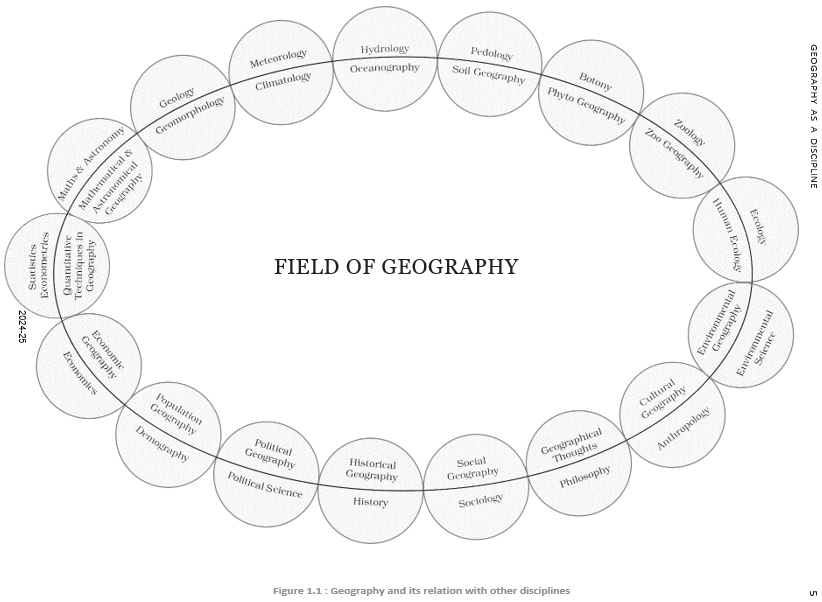
Geography and History
Geographical Influences on History
- Spatial factors: Distance, location, terrain and access can alter the course of historical events.
- Defence and space: Large countries could gain time in warfare by giving up space; ocean expanses helped protect some New World countries from wars on their soil.
- India's barriers and routes: The Himalayas provided protection, while their passes enabled migration and invasions from Central Asia.
- Coastal connections: India's coastline encouraged contact with East and Southeast Asia, Europe and Africa.
- Colonisation: Navigation technology gave European countries ocean access and helped them colonise countries in Asia and Africa, including India.
Geographical Conditions Shaping Historical Events
- Physical features, distance and location shape accessibility and defence.
- Accessibility or protection affects migration, contact, invasion and warfare.
- These interactions modify the course of historical events.
Geography, Change and Time
Time as Geography's Fourth Dimension
- Change through time: Landforms, climate, vegetation, occupations, economic activities and cultures develop through historical processes.
- Human decisions: Some geographical features result from decisions made by institutions at particular times.
- Time–space relationship: Distance can be described in travel time, which varies with the mode of transport.
- Example: Place A is 1,500 km from place B; it may also be two hours away by plane or seventeen hours by fast train.
- Dimensions: Length, width and height are the three spatial dimensions; time is treated as geography's fourth dimension.
Approaches to Studying Geography
| Point | Systematic approach | Regional approach |
|---|---|---|
| Starting point | Study one phenomenon across the world | Divide the world into regions at different hierarchical levels |
| Main focus | Identify and describe types and spatial patterns of that phenomenon | Study all geographical phenomena within a particular region |
| Organisation | Phenomenon-centred | Region-centred and holistic; seeks unity in diversity |
| Example | Classify world vegetation into equatorial rain forests, softwood conical forests and monsoon forests | Study phenomena within a natural, political or designated region as a connected whole |
Development of the Two Approaches
- 1769–1859Alexander von Humboldt, a German geographer, introduced the systematic approach.
- 1779–1859Karl Ritter, Humboldt's German contemporary, developed the regional approach.
Dualism in Geography
| Point | Physical geography | Human geography |
|---|---|---|
| Emphasis | Physical features and processes of the Earth | Human activities and cultural development |
| Basis | An earlier emphasis in geographical study | Recognises humans as part of nature and the Earth's surface |
- Spatial synthesis
- Understanding phenomena through their relationships and variations across places.
- Systematic approach
- Studying one geographical phenomenon worldwide and identifying its types and spatial patterns.
- Regional approach
- Studying geographical phenomena within a region as a connected whole.
- Dualism
- Different emphases in geography, including physical features and human activities.
How do the systematic and regional approaches differ?
How have geographical factors influenced India's history?
Quick recap
- Geography synthesises knowledge spatially and studies the world holistically.
- Transport, media and information technology increase accessibility, data and monitoring capacity.
- Location, terrain, distance and access can shape historical events.
- Time is geography's fourth dimension; the other three are length, width and height.
- Systematic geography studies a phenomenon worldwide; regional geography studies phenomena within a region holistically.
- Geography's dualism includes physical geography and human geography.
Branches of Geography (based on Systematic Approach)
Physical Geography
Physical geography — The study of Earth's physical features, processes and systems.
| Branch | Main focus |
|---|---|
| Geomorphology | Landforms, their evolution and related processes |
| Climatology | Atmospheric structure; weather and climate elements, types and regions |
| Hydrology | Surface water, including oceans, lakes and rivers, and its effects on life and human activities |
| Soil geography | Soil formation, types, fertility, distribution and use |
Human Geography
Human geography — The study of human society, its activities and its spatial organisation.
| Branch | Main focus |
|---|---|
| Social/Cultural geography | Society, its spatial dynamics and the cultural elements it contributes |
| Population geography | Population growth, distribution, density, sex ratio, migration and occupational structure |
| Settlement geography | Characteristics of rural and urban settlements |
| Economic geography | People's economic activities, including agriculture, industry, tourism, trade, transport, infrastructure and services |
| Historical geography | Historical processes that organise space, and changes in geographical features over time |
| Political geography | Political events, boundaries, relations between neighbouring political units, constituency delimitation, elections and political behaviour |
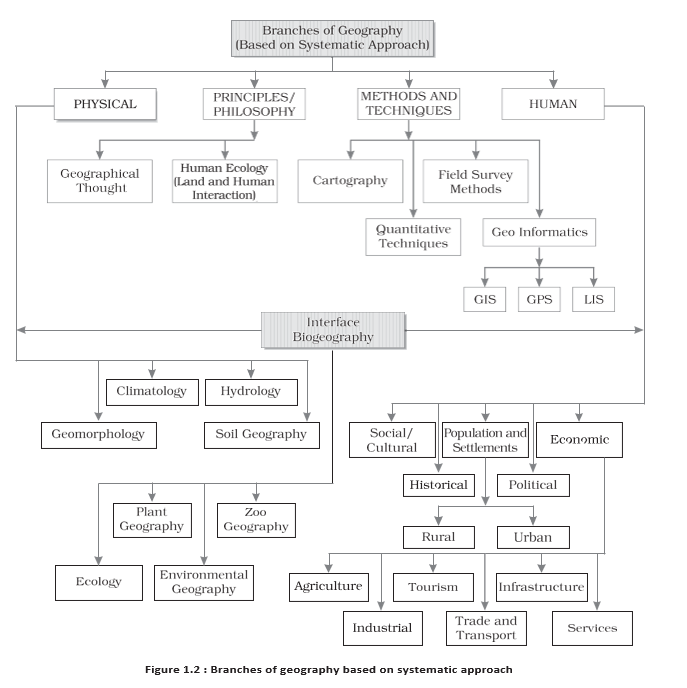
Biogeography
Biogeography — A branch that develops at the interface of physical and human geography and studies living things, habitats and environmental concerns.
| Component | Main focus |
|---|---|
| Plant geography | Spatial patterns of natural vegetation in its habitats |
| Zoo geography | Spatial patterns and geographical characteristics of animals and their habitats |
| Ecology/Ecosystem | Scientific study of the habitats characteristic of species |
| Environmental geography | Environmental problems such as land degradation and pollution, and conservation concerns |
Branches Based on the Regional Approach
| Branch | Types or focus |
|---|---|
| Regional studies/Area studies | Macro-, meso- and micro-regional studies |
| Regional planning | Country/rural and town/urban planning |
| Regional development | Development of regions |
| Regional analysis | Analysis of regions |
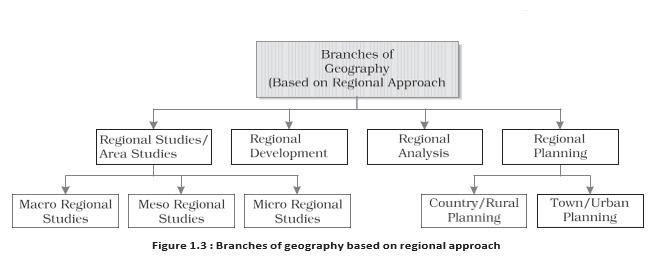
Aspects Common to Every Discipline
| Aspect | Components |
|---|---|
| Philosophy | Geographical thought; land–human interaction (human ecology) |
| Methods and techniques | Cartography, including computer cartography; quantitative/statistical techniques; field survey methods; geo-informatics, including Remote Sensing, GIS and GPS |
A Changing Discipline
Growth in geographical methods and technology
- Changing framework: The classification of geography is comprehensive but not fixed; new ideas, problems, methods and techniques continually develop.
- Cartography: Manual map-making has expanded into computer cartography.
- Data and analysis: Technology helps geographers handle large amounts of data; the internet provides extensive information.
- GIS and GPS: GIS has opened new possibilities for geographical knowledge and analysis; GPS is a practical tool for finding exact locations.
- Synthesis: Technology strengthens the ability to combine information with sound theoretical understanding.
Name the two aspects common to every discipline and give their components in geography.
Quick recap
- Physical geography covers landforms, climate, surface water and soils.
- Human geography studies society, population and settlements, economic activities, historical change and political space.
- Biogeography links physical and human geography through plants, animals, habitats and environmental concerns.
- The regional approach includes regional studies, planning, development and analysis.
- Philosophy and methods and techniques are common aspects across geography's branches.
- Computer cartography, internet resources, GIS and GPS have expanded geographical data handling, analysis and location-finding.
Physical Geography and Its Importance
Scope of Physical Geography
Physical geography — The study of Earth's physical environment, including its land, air, water, life and soils.
| Component | What it includes |
|---|---|
| Lithosphere | Landforms, drainage, relief and physiography. |
| Atmosphere | Composition, structure, weather and climate; temperature, pressure, winds, precipitation and climatic types. |
| Hydrosphere | Oceans, seas, lakes and related features of the water realm. |
| Biosphere | Life forms, including humans and other organisms, and sustaining systems such as food chains and ecological balance. |
| Soils | Soils and their formation, profiles, fertility and role in supporting life and economic activity. |
Soil formation and fertility
- Pedogenesis is the process through which soils form.
- Main factors are parent rocks, climate, biological activity and time.
- Time allows soils to mature and develop distinct soil profiles.
- Fertility is shaped by natural conditions and human cultural practices; soil is a renewable resource and supports the biosphere.
Importance of the Physical Environment to People
| Feature or element | Importance and examples |
|---|---|
| Landforms | Land provides the base for human activity. Plains support agriculture; plateaus provide forests and minerals; mountains offer pastures, forests and tourist sites, and are sources of rivers that supply water to lowlands. |
| Climate | Influences house types, clothing and food habits, as well as vegetation, cropping patterns, livestock farming and some industries. Air conditioners and coolers modify climate elements in limited spaces. |
| Temperature and precipitation | Help determine forest density and grassland quality. In India, monsoon rainfall sets the rhythm of agriculture. |
| Precipitation and groundwater | Rainfall recharges groundwater aquifers, which later supply water for agriculture and domestic use. |
| Oceans | Store resources including fish, other seafood and minerals. India has developed technology to collect manganese nodules from the ocean floor. |
| Soils | Influence economic activities such as agriculture and provide the basis for the biosphere, supporting plants, animals and microorganisms. |
Physical Geography and Sustainable Development
Environment, resources and development
- The physical environment provides natural resources.
- People use resources to support economic and cultural development.
- Modern technology and accelerated resource use can create ecological imbalance.
- Understanding human–environment relationships helps evaluate and manage resources for sustainable development.
Geography: Key Definitions
| Geographer | Definition |
|---|---|
| Richard Hartshorne | Geography describes and explains the areal differentiation of Earth's surface. |
| Hettner | Geography studies how related phenomena differ from place to place across Earth's surface. |
Quick recap
- Physical geography studies the lithosphere, atmosphere, hydrosphere, biosphere and soils.
- Soil formation depends on parent rock, climate, biological activity and time.
- Landforms, climate, water, oceans and soils provide resources and shape human activities.
- Modern resource use can disturb ecological balance; physical geography supports resource management.
- Hartshorne emphasised areal differentiation; Hettner emphasised differences in related phenomena across places.
Geography — ALL CHAPTERS
1
GEOGRAPHY AS A DISCIPLINE
2
THE ORIGIN AND EVOLUTION OF THE EARTH
3
INTERIOR OF THE EARTH
4
DISTRIBUTION OF OCEANS AND CONTINENTS
5
Geomorphic Processes
6
Landforms And Their Evolution
7
Composition And Structure Of Atmosphere
8
Solar Radiation, Heat Balance And Temperature
9
Atmospheric Circulation And Weather Systems
10
Water In The Atmosphere
11
World Climate And Climate Change
12
Water ( Oceans )
13
Movements Of Ocean Water
14
Biodiversity And Conservation
1
India - Location
2
Structure And Physiography
3
Drainage System
4
Climate
5
Natural Vegetation
6
Natural Hazards And Disasters