Class 11 Humanities . Geography . Fundamental Of Physical Geography . The Origin and Evolution of the Earth
Chapter 2: THE ORIGIN AND EVOLUTION OF THE EARTH
Ch 2
Geography
Class 11 Humanities
Introduction & Early Theories / Modern Theories
Early Theories: Origin of the Earth
- Nebular hypothesis: Immanuel Kant proposed that planets formed from material around a slowly rotating young Sun; Laplace revised the idea in 1796.
- Revised hypothesis: In 1950, Otto Schmidt and Carl Weizsäcker suggested that dust and gases in a solar nebula formed planets through accretion.
Modern Theories: Origin of the Universe
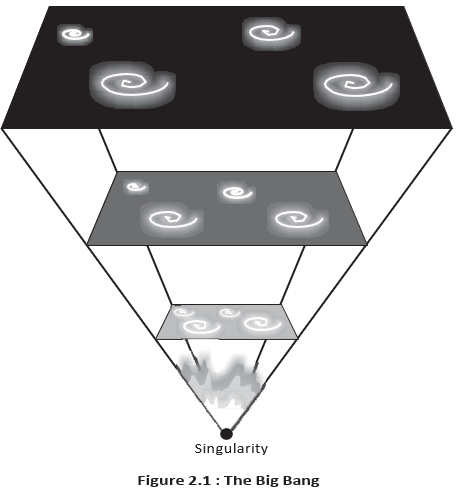
Big Bang: Main Stages
- BeginningAll matter was concentrated in a tiny singularity with unimaginably small volume, infinite temperature and infinite density.
- 13.7 billion years agoThe Big Bang began a violent expansion that continues today; energy was converted into matter as the universe grew.
- Fractions of a second after the Big BangExpansion was especially rapid, then slowed down.
- Within the first three minutesThe first atom began to form.
- Within 300,000 yearsThe temperature fell to ; atomic matter formed and the universe became transparent.
- Solar nebula
- A cloud of gas and dust surrounding the young Sun.
- Accretion
- The gradual growth of planets as particles collide and accumulate.
- Singularity
- The initial state described by the Big Bang theory, with extremely small volume and infinite temperature and density.
- Expanding universe
- A universe in which space between galaxies is increasing.
What is the Nebular Hypothesis, and how were planets thought to form?
State the main stages of the Big Bang theory.
Quick recap
- Nebular Hypothesis: Kant proposed it; Laplace revised it in 1796.
- Planet formation: Schmidt and Weizascar’s 1950 revision described dust-and-gas collisions and accretion.
- Big Bang: The universe began expanding about 13.7 billion years ago, and expansion continues.
- Expansion: Space between galaxies grows; the galaxies themselves are not observed to expand.
- Cooling: Matter formed as the universe cooled; by 300,000 years it was transparent at about .
- Steady state: Hoyle’s alternative held that the universe remained roughly the same over time; expansion is now favoured.
The Star Formation & Formation of Planets
Star Formation
How stars form
- Uneven distribution: Matter and energy were not evenly distributed in the early universe; density differences created differences in gravitational force.
- Galaxy formation: Gravity drew matter together, providing the basis for galaxies, each containing many stars.
- Nebula: A galaxy begins to form as hydrogen gas gathers into a very large cloud called a nebula.
- Star formation: The nebula develops localised gas clumps; these grow denser and eventually form stars.
- Scale: Galaxies extend across vast distances; individual galaxy diameters range from 80,000 to 150,000 light-years.
Light-year — A light-year is a unit of distance: the distance light travels in one year, not a unit of time.
Light-year and distance
- Speed of light: About km per second.
- Distance in one light-year: km.
- Earth–Sun distance: The mean distance is km, equivalent to a light-travel time of 8.311 minutes.
Formation of Planets
Stages in planet formation
- Gas clump and disc: Localised gas lumps within a nebula form a core; a large rotating disc of gas and dust develops around it.
- Planetesimal formation: The cloud condenses and matter around the core forms small rounded objects. Cohesion joins them into planetesimals.
- Growth by collision: Planetesimals collide; gravitational attraction helps their material stick together and form larger bodies.
- Planet formation: Many small planetesimals accrete into a smaller number of large bodies—the planets.
Planetesimals — Small bodies formed when rounded objects in the condensing gas-and-dust cloud join together; they later build larger planetary bodies.
Evolution of the Earth
| Point | Early Earth | Present-day Earth |
|---|---|---|
| Surface condition | Barren, rocky and hot | A planet with abundant water and conditions supportive of life |
| Atmosphere | Thin atmosphere of hydrogen and helium | Atmosphere conducive to life |
Earth’s layered structure
- Uneven materials: Earth’s material is not uniform from the outer atmosphere to the planet’s centre.
- Density pattern: Atmospheric matter has the least density; the interior has different zones containing materials with different characteristics.
- Evolution: Processes over time transformed the early rocky, hot Earth into the present planet with water and a life-supporting atmosphere.
Key time spans
- About 5–6 billion years agoStars are believed to have formed.
- From about 4,600 million years ago to the presentEarth underwent changes that led to its present form and conditions.
- Nebula
- A very large cloud of gas, mainly hydrogen, from which stars develop.
- Cohesion
- The joining or sticking together of smaller objects.
- Accretion
- The gradual joining of smaller bodies into larger ones.
Describe the stages in the formation of planets.
What is a light-year, and what is its value in kilometres?
Quick recap
- Uneven early-universe density created gravitational differences that drew matter together and helped form galaxies.
- Nebulae are vast gas clouds; their growing localised clumps develop into stars.
- A light-year measures distance: km.
- Planetesimals form from smaller joined objects and accrete into planets.
- Early Earth was hot, rocky and barren, with a thin hydrogen-and-helium atmosphere.
- Earth’s materials vary by zone; atmospheric matter is least dense.
Evolution of Lithosphere & Origin of Life
Evolution of the Lithosphere
- Differentiation: As the early Earth heated and grew denser, heavier materials such as iron sank inward while lighter materials moved towards the surface.
- Layered Earth: Cooling and solidification formed the crust; the Earth’s materials became arranged in layers, with density increasing towards the core.
Evolution of the Atmosphere and Hydrosphere
From Earth’s Cooling to Oceans
- Earth cooled → water vapour condensed.
- Carbon dioxide dissolved in rainwater → temperatures decreased further.
- More cooling → more condensation and rainfall.
- Rainwater collected in surface depressions → oceans formed.
Origin and Evolution of Life
Key Events in Earth’s Atmosphere, Oceans and Life
- Within 500 million years of Earth’s formationOceans had formed; they are about 4,000 million years old.
- About 3,800 million years agoLife is thought to have begun evolving.
- About 2,500–3,000 million years agoPhotosynthesis evolved and began contributing oxygen to the oceans.
- About 2,000 million years agoOxygen began to flood the atmosphere after the oceans became saturated.
- Differentiation
- Separation of Earth’s materials into layers according to density.
- Degassing
- Release of gases from Earth’s interior.
- Photosynthesis
- The process through which living organisms contributed oxygen to the oceans and, later, the atmosphere.
- Fossil
- A preserved record of past life found in rocks.
How did Earth’s internal layers form?
How did Earth’s oceans and oxygen-rich atmosphere develop?
Quick recap
- Earth’s materials separated by density, forming crust, mantle, outer core and inner core.
- Solar winds stripped away the primordial hydrogen- and helium-rich atmosphere.
- Degassing and volcanic eruptions supplied gases and water vapour to the developing atmosphere.
- Cooling, condensation and rainfall led to ocean formation.
- Life is thought to have begun in the oceans about 3,800 million years ago.
- Photosynthesis oxygenated the oceans before oxygen began accumulating in the atmosphere.
Geography — ALL CHAPTERS
1
GEOGRAPHY AS A DISCIPLINE
2
THE ORIGIN AND EVOLUTION OF THE EARTH
3
INTERIOR OF THE EARTH
4
DISTRIBUTION OF OCEANS AND CONTINENTS
5
Geomorphic Processes
6
Landforms And Their Evolution
7
Composition And Structure Of Atmosphere
8
Solar Radiation, Heat Balance And Temperature
9
Atmospheric Circulation And Weather Systems
10
Water In The Atmosphere
11
World Climate And Climate Change
12
Water ( Oceans )
13
Movements Of Ocean Water
14
Biodiversity And Conservation
1
India - Location
2
Structure And Physiography
3
Drainage System
4
Climate
5
Natural Vegetation
6
Natural Hazards And Disasters