Class 11 Humanities . Geography . Fundamental Of Physical Geography . Water in the Atmosphere
Chapter 10: Water In The Atmosphere
Ch 10
Geography
Class 11 Humanities
Water In The Atmosphere/ Evaporation And Condensation
Water Vapour and the Water Cycle
Water in the atmosphere
- Water vapour: Forms about 0–4% of the atmosphere by volume and affects weather.
- Forms of water: Water occurs in the atmosphere as gas, liquid and solid.
- Sources of moisture: Water bodies supply moisture through evaporation; plants supply it through transpiration.
Continuous water exchange
- Water from oceans and continents enters the atmosphere through evaporation and transpiration.
- Water vapour condenses and returns to the surface through precipitation.
Humidity and Saturation
Humidity — The water vapour present in the air is called humidity.
| Point | Absolute Humidity | Relative Humidity |
|---|---|---|
| Meaning | Actual mass of water vapour in a unit volume of air | Moisture present compared with the air’s full moisture-holding capacity at that temperature |
| Expression | Grams per cubic metre | Percentage |
| Key influence | Varies from place to place | Changes as temperature alters the air’s moisture-holding capacity |
| Geographical pattern | Varies across Earth’s surface | Generally greater over oceans and least over continents |
Saturation and dew point
- Moisture capacity: The amount of water vapour air can hold depends on its temperature; warmer air can hold more.
- Saturated air: Air holding the maximum water vapour possible at a given temperature; it cannot then hold additional moisture.
- Dew point: The temperature at which a given sample of air becomes saturated.
Evaporation
Evaporation — The change of water from the liquid state to the gaseous state.
Factors affecting evaporation
- Heat: The main cause of evaporation.
- Latent heat of vaporisation: The lecture refers to this as the temperature at which water starts evaporating.
- Air temperature: As temperature rises, air’s capacity to absorb and retain moisture increases.
- Moisture content: Air with low moisture content has greater potential to absorb and retain water vapour.
- Air movement: Wind replaces saturated air near a surface with unsaturated air; stronger movement therefore increases evaporation.
Condensation
Condensation — The change of water vapour into liquid water, generally caused by loss of heat.
How condensation occurs
- Cooling: When moist air cools to the point where it can no longer hold all its water vapour, the excess condenses.
- Condensation nuclei: Tiny particles in free air—especially dust, smoke and ocean salt—provide surfaces that absorb water and support condensation.
- Contact cooling: Condensation can occur when moist air meets a colder object or when its temperature approaches the dew point.
- Controls: The process is influenced by cooling, relative humidity, air volume, temperature and pressure; a fall in air temperature is the most favourable condition.
Conditions that can lead to condensation
- Cooling at constant volume: Air temperature falls to the dew point while its volume remains unchanged.
- Reduced volume and temperature: Condensation may occur when both the air’s volume and temperature decrease.
- Moisture addition: Adding moisture to the air through evaporation is another condition for condensation.
Forms of Condensation
Forms and temperature
- Forms: After condensation, atmospheric moisture may appear as dew, frost, fog or clouds.
- Classification: Forms of condensation can be classified by their temperature and location.
- Freezing point: Condensation takes place when the dew point is either below or above the freezing point.
- Absolute humidity
- Mass of water vapour per unit volume of air, expressed in grams per cubic metre.
- Relative humidity
- Water vapour present as a percentage of the air’s capacity at a given temperature.
- Saturated air
- Air holding the maximum water vapour possible at its current temperature.
- Dew point
- Temperature at which a given air sample becomes saturated.
- Condensation nuclei
- Tiny airborne particles that provide surfaces for water vapour to condense upon.
Quick recap
- Atmospheric water occurs as gas, liquid and solid; evaporation and transpiration add moisture to the air.
- Absolute humidity measures actual water-vapour mass per air volume; relative humidity measures capacity used as a percentage.
- Saturated air cannot hold extra moisture, and the temperature at saturation is the dew point.
- Evaporation changes liquid water to vapour; heat, low moisture content and air movement support it.
- Condensation changes vapour to liquid, commonly when moist air cools to its dew point.
- Dew, frost, fog and clouds are forms of condensation; its most favourable condition is falling air temperature.
Evaporation And Condensation
Dew and Frost
Frost — Frost is moisture deposited as minute ice crystals on cold surfaces when condensation occurs at or below the freezing point (0 °C).
Fog and Mist
- Fog: A cloud near the ground, formed when moist air cools and water vapour condenses on fine particles.
- Mist: Contains more moisture than fog; each particle has a thicker layer of moisture.
- Smog: Fog mixed with smoke, common in urban and industrial areas.
Clouds
| Group | Cloud types |
|---|---|
| High clouds | Cirrus, cirrostratus, cirrocumulus |
| Middle clouds | Altostratus, altocumulus |
| Low clouds | Stratocumulus, nimbostratus |
| Extensive vertical development | Cumulus, cumulonimbus |
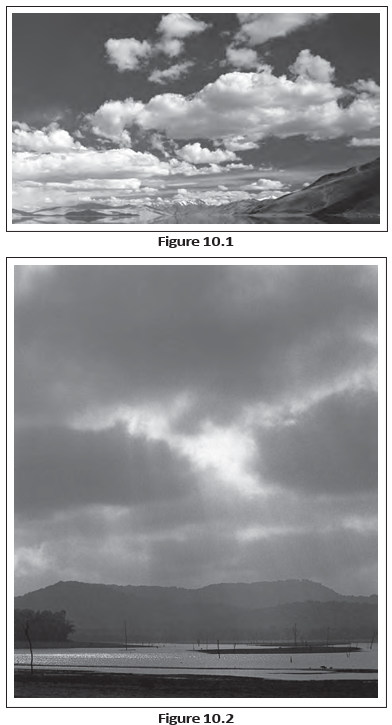
- Dew point
- The temperature at which water vapour condenses.
- Condensation nuclei
- Fine particles, such as dust, smoke or salt, on which water vapour condenses.
- Smog
- A condition in which fog is mixed with smoke.
- Nimbus
- A dense, dark cloud type, often associated with thick cloud cover.
What conditions favour the formation of dew and frost?
Name the four basic cloud types and give one feature of each.
Quick recap
- Dew forms as droplets on cool surfaces when the dew point is above freezing.
- Frost forms as ice crystals when condensation occurs at or below freezing.
- Fog is a cloud at or near the ground; fog mixed with smoke is smog.
- Mist contains more moisture than fog according to the lecture text.
- The four basic cloud types are cirrus, cumulus, stratus and nimbus.
- Cloud combinations are grouped as high, middle, low or vertically developed.
Precipitation/ Types of Rainfall
Precipitation and Its Forms
Sleet formation
- A layer of air above freezing overlies a subfreezing layer near the ground.
- Raindrops fall from the warmer air into the colder layer.
- The drops freeze and reach the ground as small ice pellets.
Types of Rainfall
| Type | How it forms | Main features / locations |
|---|---|---|
| Convectional | Heated air becomes lighter and rises; expansion cools it, causing condensation and cumulus clouds. | Often heavy but short-lived, with thunder and lightning; common in summer or during the hotter part of the day, especially in equatorial regions and continental interiors. |
| Orographic (relief) | Saturated air is forced up a mountain, expands and cools, causing moisture to condense. | Windward slopes receive more rain; descending air warms on the leeward side, creating a dry rain-shadow area. |
| Cyclonic (frontal) | A main origin-based type of rainfall. | Also called frontal rainfall. |
Orographic rainfall and the rain shadow
- Saturated air meets a mountain and is forced upward.
- Rising air expands and cools; moisture condenses and falls on the windward slope.
- Air descends on the leeward slope and warms, increasing its capacity to hold moisture.
- The leeward area receives little rain and is called a rain-shadow area.
World Distribution of Rainfall
Broad distribution patterns
- Latitude: Rainfall generally decreases steadily from the equator towards the poles.
- Coasts and interiors: Coastal areas generally receive more rainfall than continental interiors; oceans receive more rain than land because they are major moisture sources.
- – N and S: Rainfall is heavier on eastern coasts and decreases westward.
- – N and S: Westerlies bring rainfall first to western continental margins; rainfall generally decreases eastward.
- Mountain barriers: Where mountains parallel a coast, rainfall is greater on coastal and windward areas and decreases towards the leeward side.
| Annual precipitation | Main regions |
|---|---|
| Over 200 cm | Equatorial belt; windward mountain slopes along western coasts in the cool temperate zone; coastal areas of monsoon lands. |
| 100–200 cm | Interior continental areas. |
| 50–100 cm | Central parts of tropical lands; eastern and interior parts of temperate lands. |
| Moderate amount; exact range not specified | Coastal areas of continents. |
| Less than 50 cm | Rain-shadow zones in continental interiors and high-latitude areas. |
Seasonal distribution
- Importance: How rainfall is spread through the year helps determine its effectiveness.
- Even rainfall: The equatorial belt and western parts of cool temperate regions receive rainfall relatively evenly throughout the year.
- Precipitation
- Moisture released from the atmosphere to Earth’s surface.
- Sleet
- Frozen raindrops or refrozen melted snow-water, falling as small ice pellets.
- Hailstone
- A rounded, solid piece of ice with several concentric layers.
- Windward slope
- The mountain slope facing the incoming air and receiving more orographic rain.
- Rain-shadow area
- A relatively dry area on the leeward side of a mountain.
How does a rain-shadow area form?
Name the three types of rainfall by origin.
Quick recap
- Precipitation is moisture falling to Earth after condensation; its forms include rain, snow, sleet and hail.
- Sleet may be frozen raindrops or refrozen melted snow-water; hailstones are rounded ice pieces with several concentric layers.
- Rainfall by origin is convectional, orographic (relief), or cyclonic (frontal).
- Convectional rain follows rising, cooling air and is often heavy but brief.
- Orographic rain favours windward slopes and leaves leeward rain-shadow areas dry.
- Rainfall generally decreases towards the poles and from coasts towards continental interiors, with regional variations.
- Annual precipitation varies by region; continental coasts receive a moderate amount, and some regions receive rainfall evenly through the year.
Geography — ALL CHAPTERS
1
GEOGRAPHY AS A DISCIPLINE
2
THE ORIGIN AND EVOLUTION OF THE EARTH
3
INTERIOR OF THE EARTH
4
DISTRIBUTION OF OCEANS AND CONTINENTS
5
Geomorphic Processes
6
Landforms And Their Evolution
7
Composition And Structure Of Atmosphere
8
Solar Radiation, Heat Balance And Temperature
9
Atmospheric Circulation And Weather Systems
10
Water In The Atmosphere
11
World Climate And Climate Change
12
Water ( Oceans )
13
Movements Of Ocean Water
14
Biodiversity And Conservation
1
India - Location
2
Structure And Physiography
3
Drainage System
4
Climate
5
Natural Vegetation
6
Natural Hazards And Disasters