Class 7 . Social Science . Exploring Society India and Beyond Part I . New Beginnings Cities and States
Chapter 4: New Beginnings Cities and States
Ch 4
Social Science
Class 7
Introduction
From the First to the Second Urbanisation
The decline of Harappan cities
- Harappan decline: In the early 2nd millennium BCE, the Indus/Harappan civilisation disintegrated; some cities were abandoned, while some people remained but returned to village life.
- Urban order lost: Large public and private structures, busy streets and markets, specialised occupations, writing, sanitation, administration and a larger state structure disappeared.
- Urban gap: For about a millennium, urban life was largely absent in India, although a few towns may have remained in north India.
The Second Urbanisation
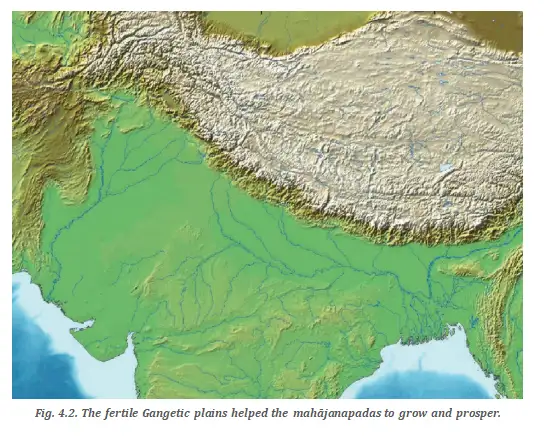
- New urban growth: In the 1st millennium BCE, urbanisation began again in the Ganga plains, parts of the Indus basin and neighbouring regions, then spread across the Subcontinent.
- Evidence: Archaeological excavations reveal ancient urban centres; late Vedic, Buddhist and Jain literature also describes them.
- Continuity: This phase is called the Second Urbanisation and has continued to the present.
Janapadas and Mahājanapadas
Janapada — A territory where a people or clan had settled, usually led by a rājā or ruler.
How janapadas formed and grew
- Clans and territories: Towards the end of the 2nd millennium BCE, people formed groups that probably shared a language and customs; each group became associated with a territory.
- Word meaning: Janapada combines jana (people) and pada (foot/setting foot), referring to where people settled.
- Growth: Expanding trade networks connected janapadas; some merged into larger states called mahājanapadas.
The mahājanapadas
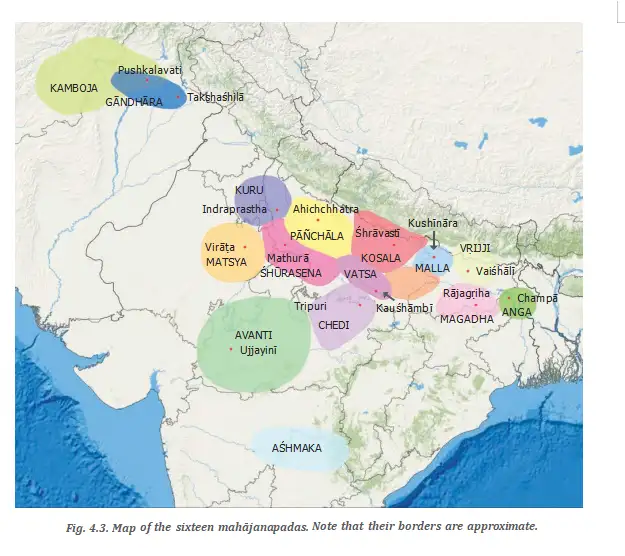
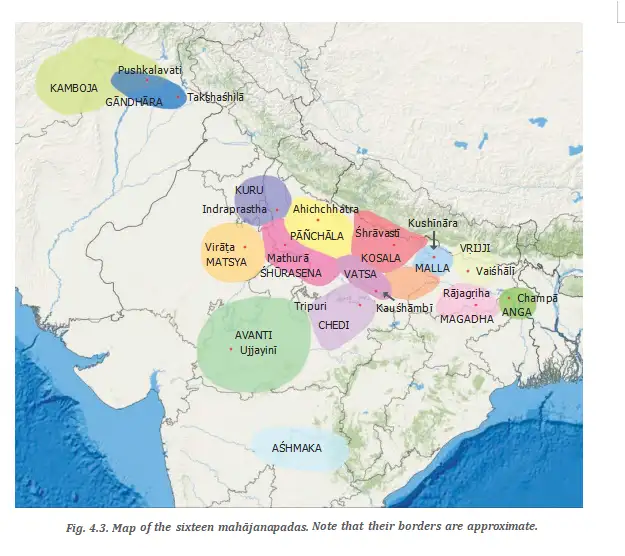
- Formation: By the 8th or 7th centuries BCE, some janapadas had merged into larger states known as mahājanapadas.
- Number and extent: A commonly cited list names sixteen, stretching from Gandhāra in the northwest to Anga in the east and Aśhmaka near the Godavari in central India. Other lists and additional smaller states also existed.
- Powerful states: Magadha, Kosala, Vatsa and Avanti were among the most powerful.
- Ganga plains: Many mahājanapadas were concentrated here, supported by fertile farmland, nearby iron ore and expanding trade networks.
Capitals and city defences
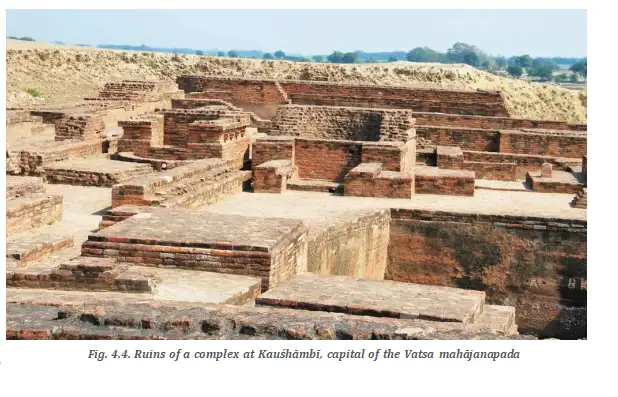
- Capitals: Mahājanapadas had capitals; many of these ancient capitals remain inhabited cities today, some with histories of about 2,500 years.
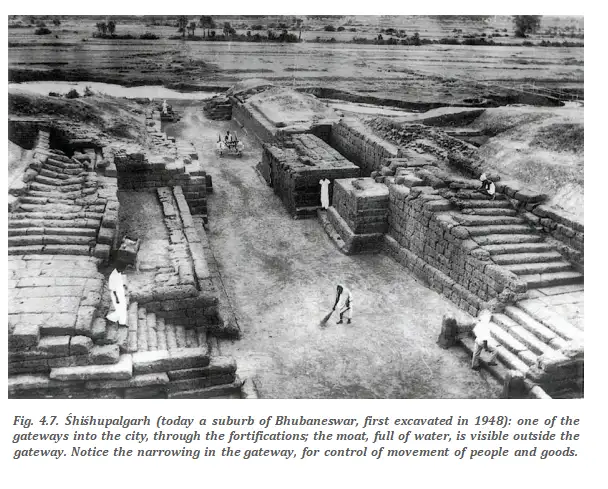
- Fortifications: Many capitals were large, fortified cities, often with a moat outside the defensive walls.
- Controlled access: Narrow gateways through rampart walls helped guards regulate the movement of people and goods.
- Second Urbanisation
- The renewed growth of urban centres beginning in the 1st millennium BCE.
- Mahājanapada
- A large state formed when smaller janapadas merged.
- Moat
- A deep, wide ditch around a fort or fortified city, filled with water.
- Rampart
- A defensive wall built around a fortified city.
Key periods
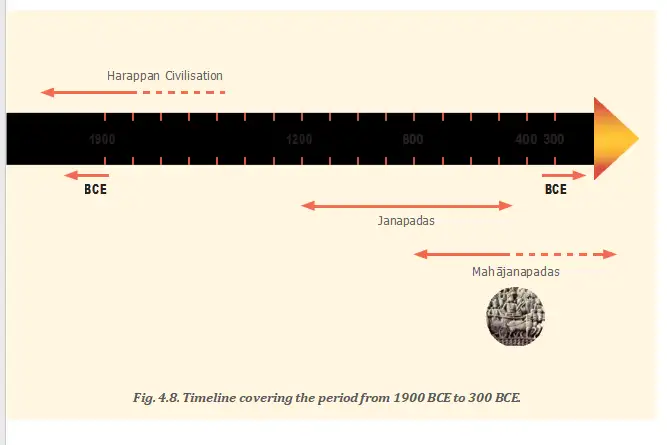
- Early 2nd millennium BCEThe Harappan civilisation disintegrated.
- Towards the end of the 2nd millennium BCERegional groups in north India reorganised into janapadas.
- 8th or 7th centuries BCESome janapadas had merged into mahājanapadas.
- 1st millennium BCEThe Second Urbanisation began in the Ganga plains, parts of the Indus basin and neighbouring regions.
What evidence helps us know about the cities of the Second Urbanisation?
Why were many mahājanapadas concentrated in the Ganga plains?
Quick recap
- The Harappan urban system declined in the early 2nd millennium BCE, followed by a long period with little urban life.
- The Second Urbanisation began in the 1st millennium BCE and is known through archaeology and ancient literature.
- Janapadas were settled territories associated with clans and led by rulers.
- Trade links helped some janapadas merge into mahājanapadas by the 8th or 7th centuries BCE.
- The commonly cited list includes sixteen mahājanapadas; Magadha, Kosala, Vatsa and Avanti were especially powerful.
- Fertile land, iron ore and trade helped the Ganga plains flourish; fortified cities used walls, narrow gates and moats.
Early Democratic Traditions
Assemblies in the Janapadas
Sabha or samiti — An assembly or council in a janapada where matters concerning the clan were discussed.
How the assemblies worked
- Members: Most members were probably elders of the clan.
- Ruler’s role: A rājā was expected to seek advice from assemblies, ministers and administrators rather than rule arbitrarily.
- Possible removal: Some texts say an incompetent ruler could be removed by the assembly, but this is not known to have been an established law.
- Evidence: Information about this distant period is incomplete, so such accounts require caution.
- Origins of the terms: The words sabhā and samiti first appear in the Vedas.
Monarchies among the Mahajanapadas
Mahajanapada political systems — The political systems of the mahajanapadas expanded the basic principles of the janapadas.
Features of monarchies
- Authority: The rājā was the ultimate authority, supported by ministers and an assembly of elders.
- Succession: The position was usually hereditary; a rājā was generally the previous ruler’s son.
- Duties: The king collected revenue, maintained law and order, built fortifications around the capital and maintained an army.
- Army: It defended the territory or was used to wage war with neighbouring states.
- Examples: Magadha (part of present-day Bihar), Kosala (part of present-day Uttar Pradesh) and Avanti (part of present-day Madhya Pradesh) were powerful monarchies.
Ganas and Sanghas: Early Republics
Gana or sangha — A mahajanapada in which the assembly had greater power and made major decisions, rather than the rājā ruling as sole authority.
How these systems worked
- Examples: Vajji (or Vṛijji) and neighbouring Malla had this system.
- Decisions: Assembly members discussed important matters and could vote when needed.
- Selecting the ruler: The assembly also chose the rājā.
- Democratic character: Because assembly members selected the ruler and made major decisions, the system might be called democratic.
- Early republics: Scholars often call these states early republics; they were among the earliest such systems in the world.
| Point | Monarchy | Gana or sangha |
|---|---|---|
| Main authority | Rājā held ultimate authority, with support from ministers and elders. | Assembly held greater power and made major decisions. |
| Ruler’s position | Usually hereditary. | Rājā selected by the assembly. |
| Decision-making | Rājā governed, with the assembly advising. | Assembly discussed decisions and could vote. |
| Examples | Magadha, Kosala and Avanti. | Vajji and Malla. |
What made Vajji and Malla different from monarchies?
Name the main duties of a king in a mahajanapada monarchy.
- Janapada
- A political community whose clan matters were discussed in an assembly or council.
- Sabha or samiti
- An assembly or council for discussing matters concerning the clan.
- Gana or sangha
- A system in which the assembly had greater power and made important decisions.
- Early republic
- A scholarly description for systems such as Vajji and Malla, where assemblies selected rulers and made major decisions.
Quick recap
- Janapada assemblies called sabhā or samiti discussed clan matters; their members were probably elders.
- A rājā was expected to seek advice, though claims that an assembly could remove a ruler are not certain laws.
- Mahajanapada political systems expanded basic janapada principles; monarchs usually inherited their position and managed revenue, order, fortifications and armies.
- Magadha, Kosala and Avanti were powerful monarchies.
- In Vajji and Malla, assemblies discussed and voted on major matters and selected the rājā.
- Their systems might be called democratic and are often described by scholars as among the world’s earliest republics.
More Innovations
New Ideas and Cultural Change
- New schools of thought: Late Vedic, Buddhist and Jain traditions developed, along with their own literature.
- Spread of ideas: Scholars, monks and nuns travelled to share teachings, while pilgrimages helped carry them across India.
- Art: Indian art was renewed during this period and flourished further in the age of empires.
Iron and the Second Urbanisation
Development and Spread of Iron
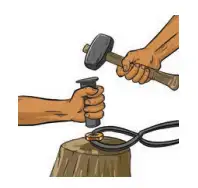
- Early 2nd millennium BCEIron extraction and shaping techniques were perfected in several regions.
- Late 2nd millennium BCEIron tools became widespread and supported agriculture on a larger scale.
| Point | Copper/Bronze | Iron |
|---|---|---|
| Historical use | Mastered by the Harappan civilisation | A major technology of the Second Urbanisation |
| Key uses mentioned | Used in earlier metallurgy | Tools for larger-scale farming and weapons |
| Weapons | Less light and sharp than iron weapons | Lighter and sharper weapons |
Iron, Warfare and State Formation
- Wider use of iron tools → agriculture on a bigger scale.
- Sharper, lighter iron weapons → used in warfare.
- Warfare between neighbouring mahājanapadas, and occasional alliances → new kingdoms and empires.
Warfare Between Mahājanapadas
- Evidence: There is some evidence of warfare between neighbouring mahājanapadas.
- Limit of evidence: Its frequency and intensity cannot be determined.
- Outcomes: Military campaigns—and sometimes alliances—helped form new kingdoms and empires.
The First Coins in India
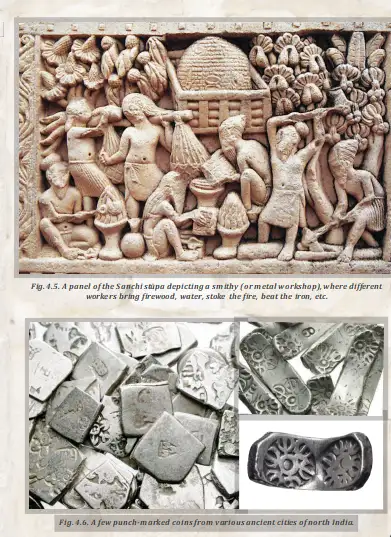
Punch-marked coins — Early Indian silver coins on which symbols were punched into the soft metal.
Coins and Trade
- Why coins emerged: Growing trade created a need for coins.
- Materials: The first Indian coins were silver; later coins were also made of copper, gold and other metals.
- Issuing coins: Generally, each mahājanapada issued its own coins.
- Circulation: Coins were exchanged across regions and with other parts of the world; neighbouring regions’ coins were also used in trade.
- Second Urbanisation
- A phase of urban growth associated in this lecture with iron technology, trade and the mahājanapadas.
- Iron metallurgy
- The extraction and shaping of iron.
- Punch-marked coins
- Early silver coins marked by symbols punched into the metal.
- Mahājanapada
- A large political territory or state of this period.
Quick recap
- Late Vedic, Buddhist and Jain teachings and literature spread through travel and pilgrimage.
- Ironworking techniques were perfected from the early 2nd millennium BCE; iron tools spread widely by the late 2nd millennium BCE.
- Iron tools supported larger-scale agriculture, while iron weapons were lighter and sharper than bronze weapons.
- Warfare and occasional alliances between mahājanapadas contributed to the rise of kingdoms and empires.
- Growing trade led to the first Indian coins: silver punch-marked coins, followed later by coins of other metals.
- Mahājanapadas generally issued their own coins, though coins circulated across regions and in wider trade.
The Varṇa - Jati System
Social Groups and Inequality
Why societies form groups
- Complex societies organise people into groups for activities such as governance, religion, education, trade, farming and crafts.
- Interdependence can help different groups contribute to society and work together.
- Inequality can develop when some groups gain more wealth, power or influence than others; equality has often remained an ideal.
Jāti and Varṇa
Jāti — A community of people whose shared occupation was closely connected to their livelihood.
Features of jāti
- Occupational skills included agriculture, metallurgy, commerce and crafts, and were generally passed from one generation to the next.
- Sub-jātis could develop within a jāti, with their own customs and traditions.
- Community customs might differ in matters such as marriage, rituals and food habits.
Varṇa — A social classification described in Vedic texts, organised into four broad groups.
| Varṇa | Expected roles |
|---|---|
| Brahmins | Preserve and spread knowledge; perform rituals. |
| Kshatriyas | Defend society and the land; fight when necessary. |
| Vaishyas | Build society’s wealth through trade, business or agriculture. |
| Shudras | Work as artisans, craftspeople, workers or servants. |
| Point | Varṇa | Jāti |
|---|---|---|
| Meaning | Four broad categories described in Vedic texts. | Occupational community closely tied to livelihood. |
| Scale | Broad classification. | Numerous communities, sometimes further divided into sub-jātis. |
| Basis and practice | Describes broad expected social roles. | Often linked to inherited skills and distinct community customs. |
Caste, Change and Social Impact
The word “caste”
- Origin: “Caste” comes from the Portuguese word *casta*.
- Use: Portuguese travellers in India in the 16th century CE used the term while trying to understand Indian society.
- Meaning: Scholars differ: it may refer to varṇas, to jātis, or to the whole varṇa–jāti system.
Changing flexibility of the system
- Early periodsHistorical texts and inscriptions show that people and communities could change occupations when circumstances required.
- 16th century CEPortuguese travellers used the word *casta*, from which the English word “caste” comes.
- Over time, particularly during British ruleThe varṇa–jāti system became more rigid; scholars broadly agree it had been more flexible in earlier periods.
Occupational change and effects
- Changing work: A drought or natural disaster could force farming communities to migrate and take up other occupations.
- Changing roles: Some Brahmins also turned to trade or military activities.
- Social organisation: The system organised many social and economic activities and provided a degree of stability.
- Later consequences: Greater rigidity led to inequality and discrimination against lower jātis and communities excluded from the varṇa–jāti system.
- Wider context: The varṇa–jāti system was important, but it was not the only force shaping Indian society.
What is the difference between varṇa and jāti?
How could people change occupations in the early period?
How did the system’s social impact change over time?
Quick recap
- Jāti was an occupational community, often with inherited skills, customs and sub-jātis.
- Varṇa was a four-part classification in Vedic texts: Brahmins, Kshatriyas, Vaishyas and Shudras.
- Caste comes from Portuguese *casta*; its use for varṇa, jāti or the whole system varies among scholars.
- Occupations could change in early periods when circumstances demanded it.
- The system organised social and economic life but became more rigid over time, bringing inequality and discrimination.
- Varṇa–jāti was one important influence on Indian society, not its only organising force.
Developments Elsewhere in India
Routes and Connections
Routes in the first millennium BCE
- Purpose: Important routes supported trade, pilgrimage and military campaigns.
- Main routes: The Uttarapatha and Dakṣiṇapatha were widely used and frequently mentioned in literature.
- Lateral roads: These linked other regions, including important trade ports on both the eastern and western coasts.
| Route | Direction and course |
|---|---|
| Uttarapatha | Connected the northwest with the Ganga plains and continued to eastern India. |
| Dakṣiṇapatha | Started at Kauśhāmbī, near Prayagraj, crossed the Vindhya Range and continued south. |
Eastern Cities and Trade
Shishupalgarh — A major eastern city and capital of the Kalinga region, now called Sisupalgarh and located near Bhubaneswar.
Features of Shishupalgarh
- Plan: It followed a strict square ground plan, with broad streets.
- Defences: Imposing fortifications and a controlled entrance helped regulate access to the city.
- Trade links: Roads connected inland areas with busy ports on both coasts.
Southern Kingdoms, Resources and Trade
Cities and kingdoms in the south
- City growth: Cities began emerging in southern India from about 400 BCE; some recent excavations suggest commercial activity may have begun earlier.
- Three kingdoms: The Cholas, Cheras and Pāṇḍyas emerged around this period.
- Sources: Archaeological remains and ancient Tamil literature provide evidence about the kingdoms and mention several of their kings.
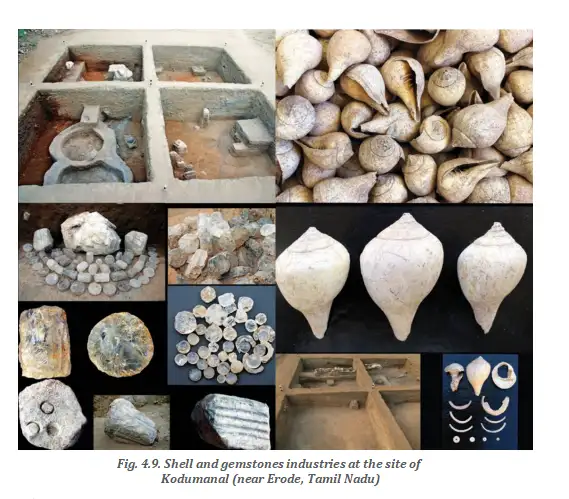
Southern Resources and Trade
- Rich deposits of precious and semiprecious stones, gold and spices
- → Production and exchange of valuable goods
- → Profitable trade with other parts of India and overseas kingdoms and empires
An Interconnected Subcontinent
Changing Connections and States
- First millennium BCEMajor routes supported trade, pilgrimage and military movement across regions.
- About 400 BCECities began emerging in southern India, alongside the rise of the Cholas, Cheras and Pāṇḍyas.
- By 300 or 200 BCENearly the entire Subcontinent, including the Northeast, was interconnected; goods and culture also travelled to Central and Southeast Asia.
- About the same timeThe mahājanapadas ceased to exist, giving way to new developments.
Regional exchange
- By 300 or 200 BCE: Goods and cultural ideas moved across the Subcontinent and beyond it, reaching parts of Central and Southeast Asia.
- Political change: The mahājanapadas ended, making way for developments that would reshape India.
- Uttarapatha
- Route connecting the northwest with the Ganga plains and eastern India.
- Dakṣiṇapatha
- Route from Kauśhāmbī across the Vindhya Range towards the south.
- Mahājanapadas
- The large states that ceased to exist around 300 or 200 BCE.
How did routes help connect different parts of India?
What evidence tells us about southern kingdoms and their trade?
Quick recap
- The Uttarapatha linked the northwest to the Ganga plains and eastern India; the Dakṣiṇapatha ran from Kauśhāmbī across the Vindhyas to the south.
- Lateral roads connected regions to important eastern and western coastal ports.
- Shishupalgarh, capital of Kalinga, had a square plan, broad streets and strong fortifications.
- Southern cities emerged from about 400 BCE; the Cholas, Cheras and Pāṇḍyas rose around this time.
- Southern resources supported profitable trade within India and with overseas kingdoms and empires.
- By 300 or 200 BCE, goods and culture moved across most of the Subcontinent and into parts of Central and Southeast Asia; the mahājanapadas had ceased to exist.
Before we move on
Janapadas and Mahājanapadas
- Janapadas: From the end of the 2nd millennium BCE, smaller states arose in parts of north and central India, usually ruled by a rājā advised by an assembly of elders.
- Mahājanapadas: Sixteen major states emerged in the 1st millennium BCE, accompanying the Second Urbanisation, which spread from the Ganga region across the Subcontinent.
- Change: By about 300 BCE, the mahājanapadas had ceased to exist, giving way to new political developments.
Roads and Connections
What were janapadas, and how were they governed?
What was significant about the 16 mahājanapadas?
Quick recap
- Janapadas arose in north and central India from the end of the 2nd millennium BCE.
- A rājā headed each janapada and consulted an assembly of elders.
- The 16 mahājanapadas were the first organised states of the 1st millennium BCE.
- The Second Urbanisation spread from the Ganga region in all directions, reaching south India.
- By about 300 BCE, the mahājanapadas had ceased to exist.
- Roads connected regions across the Subcontinent, carrying people, goods, ideas and teachings.
Social Science — ALL CHAPTERS
1
Geographical Diversity of India
2
Understanding the Weather
3
Climates of India
4
New Beginnings Cities and States
5
The Rise of Empires
6
The Age of Reorganisation
7
The Gupta Era: An Age of Tireless Creativity
8
How the Land Becomes Sacred
9
From the Rulers to the Ruled: Types of Governments
10
The Constitution of India - An Introduction
11
From Barter to Money
12
Understanding Markets
1
The Story of Indian Farming
2
India and Her Neighbours
3
Empires and Kingdoms: 6th to 10th Centuries
4
Turning Tides: 11th and 12th Centuries
5
India, a Home to Many
6
The State, the Government, and You
7
Infrastructure: Engine of India’s Development
8
Banks and the Magic of Finance