Class 7 . Social Science . Exploring Society India and Beyond Part I . Understanding the Weather
Chapter 2: Understanding the Weather
Ch 2
Social Science
Class 7
Weather and its Element
Weather and the Atmosphere
- Weather: The state of the atmosphere at a particular time and place, described with words such as hot, cold, rainy or cloudy.
- Atmosphere: The layer of gases surrounding Earth, called air.
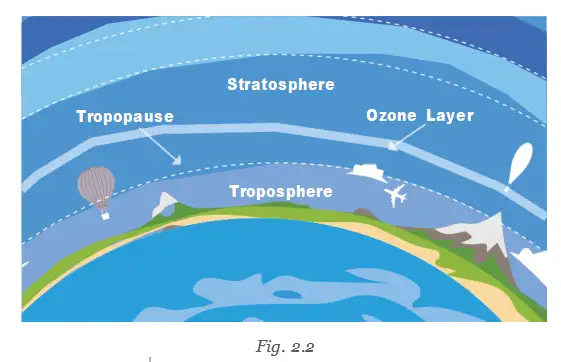
The Troposphere
Elements of Weather
| Element | Meaning |
|---|---|
| Temperature | How hot or cold the atmosphere is. |
| Precipitation | Any form of water that falls from the sky, such as rain, snow, sleet or hail. |
| Atmospheric pressure | The weight of the air above us, felt at Earth's surface. |
| Wind | The movement of air, including its speed and direction. |
| Humidity | The amount of water vapour in the air. |
Why Measure Weather?
- Common standards: Measuring weather precisely makes it possible to compare conditions and communicate them clearly.
- Planning and safety: Weather forecasts help people plan activities and prepare for hazards such as storms and cyclones.
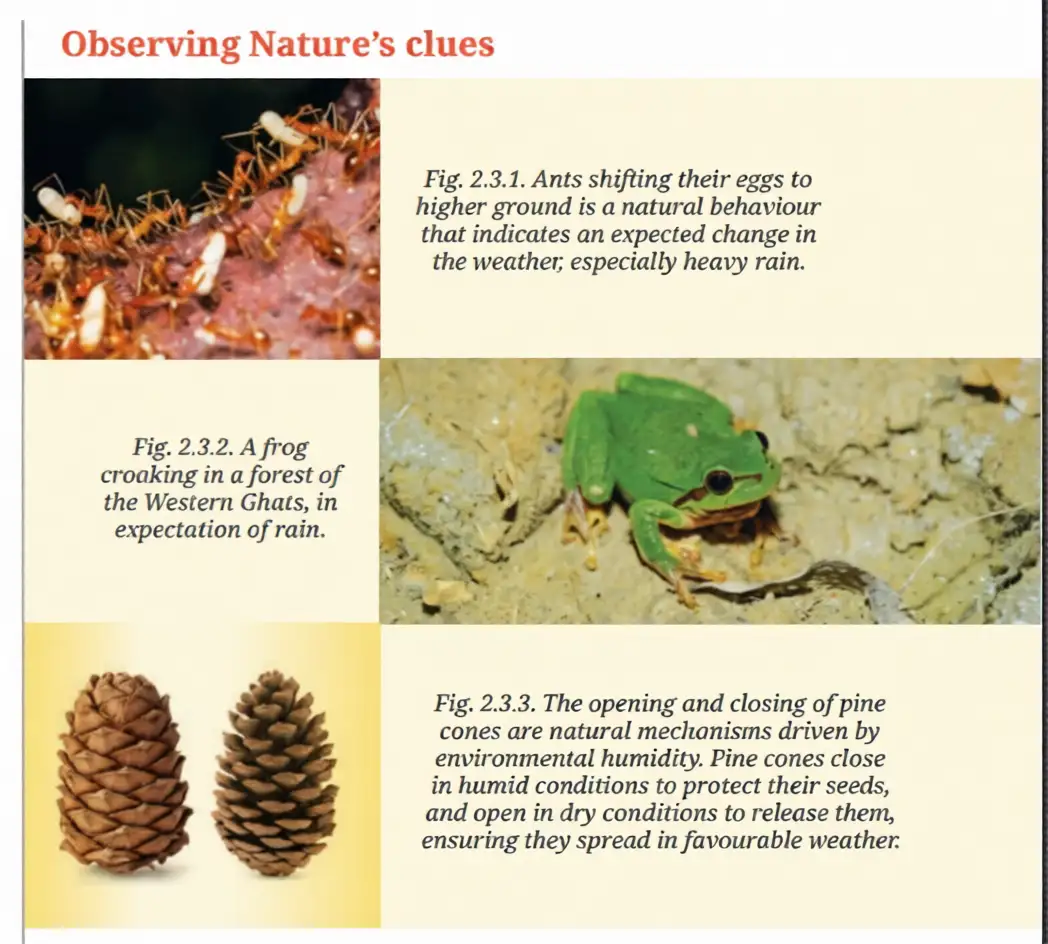
Traditional Weather Signs
Scientific Weather Forecasting
- Atmosphere
- The layer of gases surrounding Earth.
- Troposphere
- The lowest atmospheric layer, where almost all weather occurs.
- Precipitation
- Water that falls from the sky in forms such as rain, snow, sleet or hail.
- Humidity
- The amount of water vapour in the air.
- Meteorologist
- A scientist who studies and forecasts the weather.
Quick recap
- Weather is the state of the atmosphere at a particular time and place.
- Atmosphere is the layer of gases surrounding Earth; the troposphere is its lowest layer.
- Troposphere extends about 6–18 km, contains almost all weather and is thinner at the poles than in the tropics.
- Weather elements are temperature, precipitation, atmospheric pressure, wind and humidity.
- Standard measurements make weather descriptions clear and comparable.
- Forecasts combine measured observations with scientific monitoring; traditional nature signs have also helped predict weather.
Weather Instruments Part-1
Temperature
Temperature — Temperature tells how hot or cold the air is.
Measuring temperature
- Thermometers measure ambient temperature; some record the day's maximum and minimum temperatures.
- Liquid thermometers often contain coloured liquid that expands as temperature rises.
- Digital thermometers are increasingly preferred because they are more precise and can record more data.
- Scales: Temperature may be reported in Celsius or Fahrenheit; equals .
The range is the maximum temperature minus the minimum temperature over a period, usually 24 hours.
The mean daily temperature is the average of the day's maximum and minimum temperatures.
| Statistic | Value |
|---|---|
| Highest maximum temperature | |
| Lowest minimum temperature | |
| Range across the week |
India Meteorological Department
- 1875The India Meteorological Department (IMD) was established.
IMD motto
- Motto: “From the sun arises rain” (ādityāt jāyate vṛṣṭi), from the ancient text Manusmriti.
- Complete saying: Sun → rain → food → living beings.
Precipitation
Rainfall — Rainfall is measured as the depth of rainwater collected over an area, usually in millimetres.
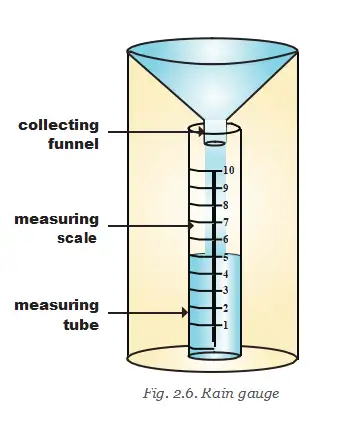
Rain gauge
- Instrument: A rain gauge measures the amount of rainfall.
- How it works: A funnel directs rain into a cylinder; a scale measures the depth of water collected.
- Reading: A water depth of means of rainfall; means the collected water is deep.
Atmospheric pressure
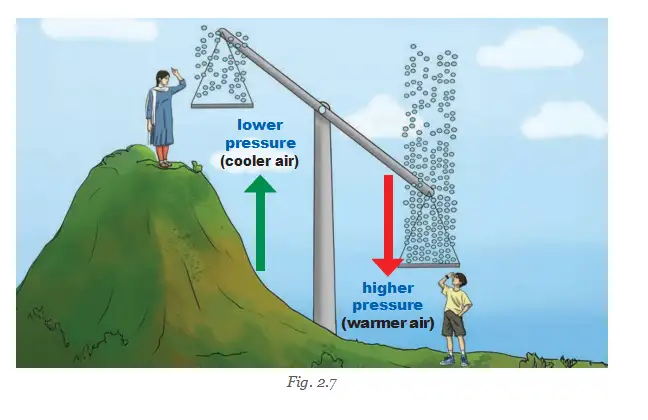
Atmospheric pressure — Atmospheric pressure is the pressure exerted by the weight of the air above and around us.
Pressure, altitude and weather
- Altitude: Pressure is generally higher near sea level and lower higher up in the mountains, where the air is thinner.
- High-altitude effects: Lower pressure means less oxygen is available to the lungs; people may feel breathless, dizzy or tired.
- Low-pressure systems: Pressure can drop sharply, forming a depression that may develop into a storm or cyclone.
Barometer and pressure readings
- Barometer: The instrument used to measure atmospheric pressure.
- Unit: Pressure readings are generally given in millibars ().
- Sea-coast reference: Normal atmospheric pressure is about .
- Depression indicator: Pressure below indicates a depression.
Life at high altitude
- Acclimatisation: Travellers pause on the way to high-altitude places so their bodies can adjust.
- Example: Khardung La in Ladakh is over above sea level; atmospheric pressure there is generally about .
High altitude and the body
- Higher altitude → thinner air and lower atmospheric pressure
- Lower pressure → less oxygen available for the lungs
- Less oxygen enters the blood → the body works harder
- The person may feel breathless, dizzy or tired
- Thermometer
- Instrument for measuring temperature.
- Rain gauge
- Instrument for measuring rainfall depth.
- Barometer
- Instrument for measuring atmospheric pressure.
- Depression
- A low-pressure system that may develop into a storm or cyclone.
- Acclimatisation
- The body's adjustment to conditions such as those at high altitude.
What does a rainfall reading of mean?
What is a barometer, and what pressure reading indicates a depression?
Why can people feel breathless at high altitudes?
Quick recap
- Thermometers measure temperature; some record daily maximum and minimum values.
- Temperature range = maximum − minimum; mean daily temperature = (maximum + minimum) ÷ 2.
- A rain gauge collects rain and measures its depth in millimetres.
- A barometer measures atmospheric pressure, generally in millibars.
- Pressure below indicates a depression that may develop into a storm or cyclone.
- Lower pressure at high altitude means less available oxygen and can cause breathlessness, dizziness or tiredness.
Weather Instruments Part-2
Wind

| Instrument | What it shows or measures | How it works / use |
|---|---|---|
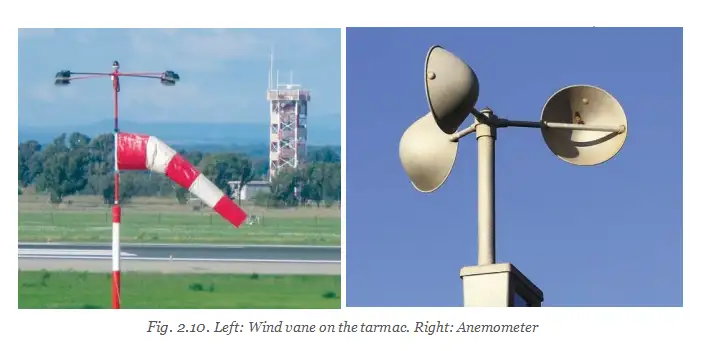
| Wind vane (weather vane) | Wind direction | A rotating arm has a pointer and a tail. Wind pushes the tail, turning the pointer in the wind’s direction; it responds even to a light breeze. |
| Wind sock | Wind direction | A sock-shaped indicator on a tarmac helps pilots during take-off and landing. Similar socks are used in industries releasing ash or gases. |
| Anemometer | Wind speed | Three or four metal cups rotate on a vertical shaft. Stronger wind makes them spin faster; a meter counts rotations over time and calculates speed in km/h. |
Humidity
Relative humidity — Relative humidity expresses the air’s water-vapour content as a percentage, from 0% (no water vapour) to 100% (air saturated with water vapour).
| Weather | Relative humidity |
|---|---|
| Dry | 20%–40% |
| Humid | 60%–80% |
| Point | Lower humidity | Higher humidity |
|---|---|---|
| Evaporation | Faster | Slower |
| Wet clothes | Dry faster | Dry more slowly |
| Sweating | Sweat evaporates more readily | Sweat evaporates less readily, so you are likely to feel sweatier |
Measuring humidity
- Instrument: A hygrometer measures humidity; different types work on different principles.
- Uses: Humidity monitoring is important in industrial processes such as food processing.
- Preservation: Museums monitor humidity to maintain a dry environment and protect exhibits.
- Wind vane
- An instrument that indicates wind direction.
- Anemometer
- An instrument that measures wind speed.
- Humidity
- The amount of water vapour in the air.
- Relative humidity
- The percentage measure of water vapour in air, from 0% to 100%.
- Hygrometer
- An instrument used to measure humidity.
How does an anemometer measure wind speed?
Where would wet clothes dry faster: Delhi at 52% humidity or Kochi at 84% humidity?
Quick recap
- Wind moves from high-pressure areas to low-pressure areas and is described by speed and direction.
- A wind vane indicates wind direction; a wind sock helps pilots judge it.
- An anemometer measures wind speed in km/h by counting cup rotations.
- Humidity is the amount of water vapour in air; relative humidity is expressed from 0% to 100%.
- Higher humidity slows evaporation, so wet clothes dry more slowly and sweat evaporates less readily.
- A hygrometer measures humidity; industries and museums use humidity monitoring.
Weather Stations
Weather stations and automated stations
Weather station — A weather station brings together instruments to measure and track the weather at a particular place and time.
How weather stations work
- Regular readings: Measurements are recorded at intervals, helping map and forecast the weather.
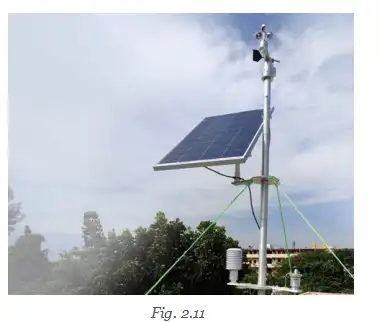
- Automated Weather Station (AWS): A self-operating system that uses sensors to measure and record weather data.
- Measurements: AWS sensors can record temperature, humidity, wind speed and direction, precipitation, and atmospheric pressure.
- Uses: AWSs provide timely weather information for agriculture, aviation, navigation, and environmental monitoring, without requiring human intervention.
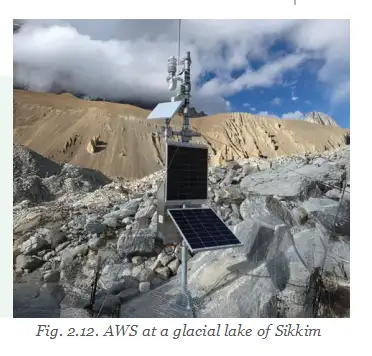
AWS in Sikkim
- 2023The National Disaster Management Authority set up an AWS beside a glacial lake in Sikkim, at an altitude above 4,800 metres, to provide early information about upcoming weather.
Weather prediction and preparedness
From observations to forecasts
- Collect: Meteorologists gather weather readings over long periods.
- Study: They examine the data using scientific methods.
- Predict: They use their findings to forecast weather conditions.
- Prepare: Forecasts help people and local governments get ready for dangerous weather.
Why forecasts matter
- Extreme weather: Climate change is making events such as droughts, floods, and cyclones more frequent.
- Public safety: Accurate forecasts allow people to prepare for hazards.
- Government response: Local governments can mobilise resources and prepare for disasters.
- Examples: Fishermen may be warned not to go to sea during a storm; a coastal area may be evacuated when a cyclone is expected.
Weather warning map
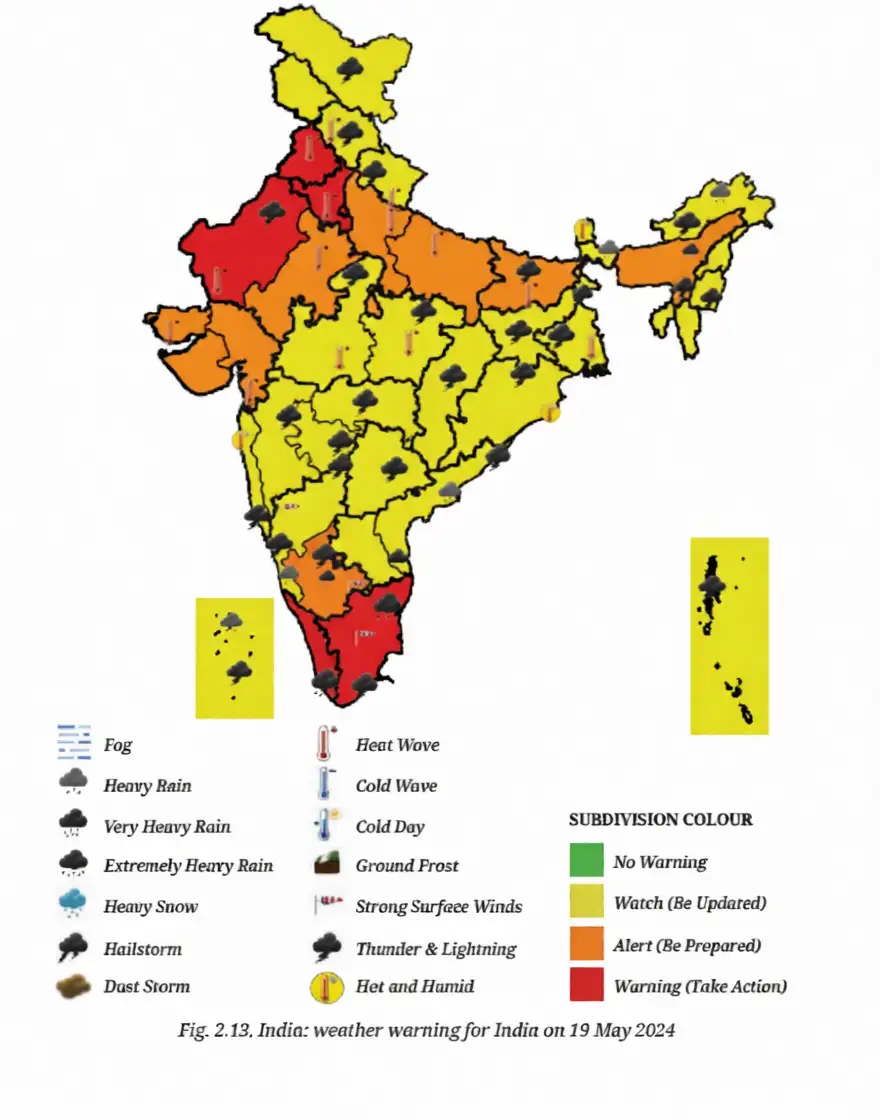
- 19 May 2024The India Meteorological Department issued a map of India showing weather conditions and colour-coded warning levels.
- Weather station
- A place where instruments measure and track weather conditions.
- Automated Weather Station (AWS)
- A self-operating station that uses sensors to record weather data.
- Meteorologist
- A specialist who studies weather data and makes forecasts.
- Forecast
- A prediction of upcoming weather conditions.
How does an AWS help with weather forecasting?
How can weather forecasts help protect people and communities?
Quick recap
- A weather station combines instruments to measure weather at a particular place and time.
- An AWS uses sensors to record weather conditions automatically.
- Regular readings help meteorologists map weather and develop forecasts.
- Climate change is making extreme weather events such as droughts, floods, and cyclones more frequent.
- Forecasts help communities prepare and governments organise responses to weather hazards.
- In 2023, the NDMA set up an AWS at a glacial lake in Sikkim above 4,800 metres.
Before We Move On
Weather and Its Measurement
Weather — The condition of temperature, humidity, precipitation, wind and atmospheric pressure at a particular place.
Measuring Weather
- Instruments: Special instruments measure the elements of weather.
- Data: Measurements help us monitor and predict weather.
Dominant Weather Elements
| Element | Situation |
|---|---|
| Rainfall | July |
| Temperature | May and December |
| Atmospheric pressure | When a cyclone is moving |
| Wind | When loo winds blow or forest fires spread |
Loo — A strong, hot and dusty wind that blows in northern India during summer.
Weather and Climate
- Link: Weather is closely connected to climate.
- Weather
- The condition of key atmospheric elements at a particular place.
- Climate
- A concept closely linked to weather.
- Loo
- A strong, hot, dusty summer wind in northern India.
Quick recap
- Weather is described by temperature, humidity, precipitation, wind and atmospheric pressure.
- Special instruments measure weather elements; their data helps monitor and predict weather.
- The dominant weather element can vary with the time or situation.
- Rainfall is notable in July and temperature in May and December.
- Pressure is important during cyclones; wind is prominent during loo conditions or spreading forest fires.
- Weather is closely linked to climate.
Social Science — ALL CHAPTERS
1
Geographical Diversity of India
2
Understanding the Weather
3
Climates of India
4
New Beginnings Cities and States
5
The Rise of Empires
6
The Age of Reorganisation
7
The Gupta Era: An Age of Tireless Creativity
8
How the Land Becomes Sacred
9
From the Rulers to the Ruled: Types of Governments
10
The Constitution of India - An Introduction
11
From Barter to Money
12
Understanding Markets
1
The Story of Indian Farming
2
India and Her Neighbours
3
Empires and Kingdoms: 6th to 10th Centuries
4
Turning Tides: 11th and 12th Centuries
5
India, a Home to Many
6
The State, the Government, and You
7
Infrastructure: Engine of India’s Development
8
Banks and the Magic of Finance