Class 7 . Social Science . Exploring Society India and Beyond Part I . The Rise of Empires
Chapter 5: The Rise of Empires
Ch 5
Social Science
Class 7
Introduction
Pataliputra: The Imperial Capital
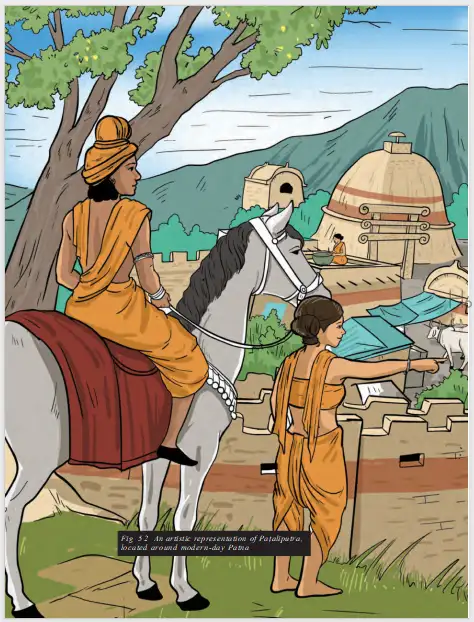
City and its surroundings
- Pataliputra was a great city and the setting for this introduction to the chapter.
- Defences included wooden ramparts, watch towers and a drawbridge over a moat.
- Drawbridge could be lifted during danger, making it harder for attackers to reach the city’s fortifications.
- Nearby hills and forests supplied timber, herbs and other resources; elephants were captured there and trained for the army.
- Cave carving was being carried out for a community of monks.
The Army and Defence
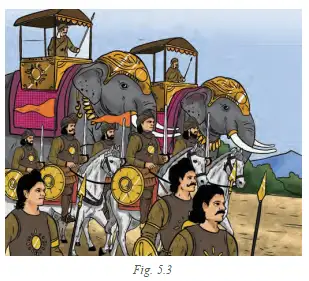
Army and royal protection
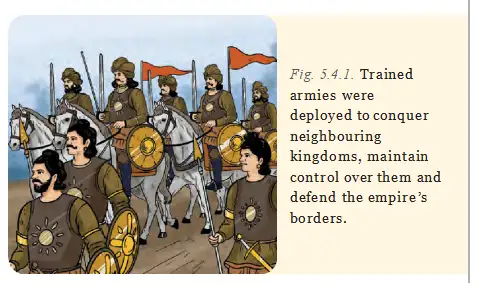
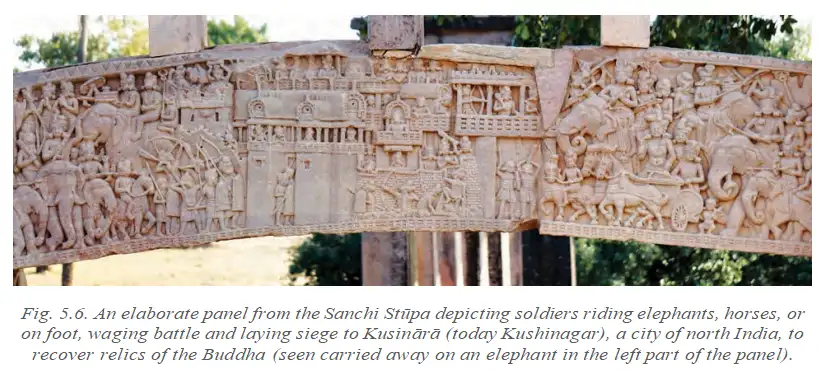
- Army included soldiers on foot, horsemen and elephants; army chiefs rode on elephants.
- Weapons such as swords were forged by skilled craftspeople, including ironsmiths.
- King’s role included protecting the people when necessary; the king avoided war when possible.
- Military action could be taken against neighbouring kingdoms that threatened the realm.
Trade and City Life
Markets and entertainment
- Market attracted traders from distant lands and regions.
- Goods included silk from China, spices and gems from the south, and fine clothes from different regions.
- Street performers entertained people with human pyramids, songs, dances and short plays; they sometimes performed before the king.
- City life also included palaces, other grand buildings and lively streets.
What Is an Empire?
Empire — A vast territory ruled by one king, whose authority extends over many villages, towns and kingdoms.
Scale of imperial rule
- Territory of the king extended far beyond Pataliputra and included many settlements and kingdoms.
- Distance from the capital to the borders was so great that the journey on horseback took close to two months.
- Empire
- A vast realm under one ruler, extending across many villages, towns and kingdoms.
- Moat
- A deep ditch around a fortification that makes it harder to approach.
- Drawbridge
- A bridge that can be lifted to help defend a city or fort.
- Rampart
- A defensive wall or raised barrier around a city.
- Ironsmith
- A craftsperson who works with iron, including making weapons such as swords.
Quick recap
- Pataliputra, near modern-day Patna, was a great city and the setting of this chapter introduction.
- Ramparts, watch towers, a moat and a liftable drawbridge helped defend the city.
- Forests and hills supplied resources, including timber, herbs and elephants for the army.
- The army included foot soldiers, horsemen and elephants; the king protected the people and avoided war when possible.
- Pataliputra’s busy market connected it with distant regions and traded goods such as Chinese silk and southern spices and gems.
- An empire is a vast territory ruled by one king, extending across many settlements and kingdoms.
What is an Empire?
Meaning and structure of an empire
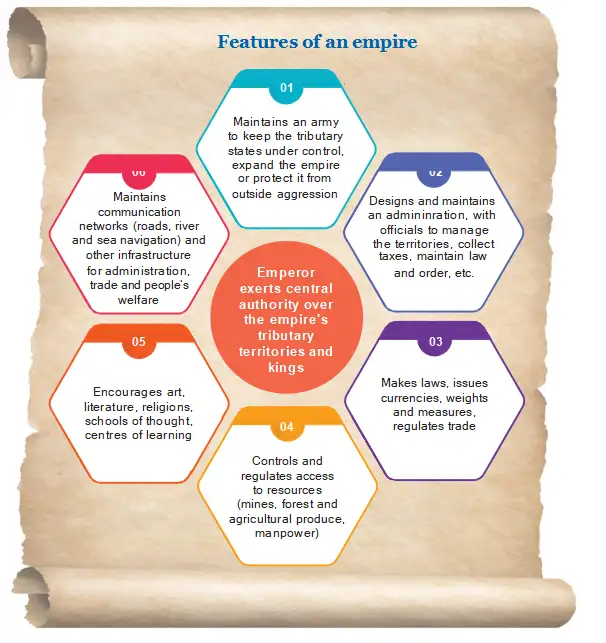
Empires in Indian history
- Indian empires: Empires rose, expanded, lasted for a time, and eventually declined and disappeared.
- Impact: They shaped India’s political, economic, social, and cultural development.
Tributary kingdoms and imperial rule
- Tributaries: Smaller rulers or states accepted an emperor’s overlordship and paid tribute, such as money, grain, livestock, or valuable goods.
- Local rule: In return for tribute and loyalty, emperors generally allowed regional kings and chiefs to continue governing their areas.
Why rulers expanded their kingdoms
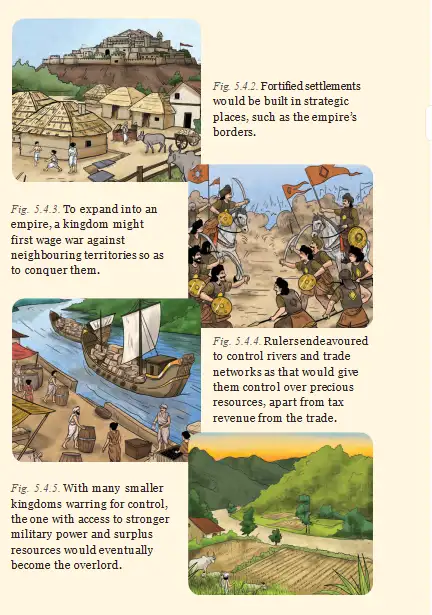
What is a tributary, and what could it give to an emperor?
Give three reasons a ruler might want to expand a kingdom into an empire.
Quick recap
- An empire is a collection of territories under an emperor’s supreme authority.
- Smaller kingdoms could retain local rulers while accepting imperial overlordship.
- Tributaries paid goods or money as tribute; emperors generally let regional rulers continue governing.
- Empires rose, expanded, declined and disappeared, shaping India in several ways.
- Rulers sought expansion for ambition, wealth, resources and greater economic and military strength.
- Warfare, fortifications, trade control and access to resources could help kingdoms expand.
Trade, Trade Routes and Guilds
Trade and the Strength of Empires
Why Trade Mattered
- Military costs: Armies required food, clothing, weapons and wages; horses and elephants needed care. Roads and ships also had to be built.
- Economic strength: Maintaining an empire required economic power, control of the workforce and access to resources.
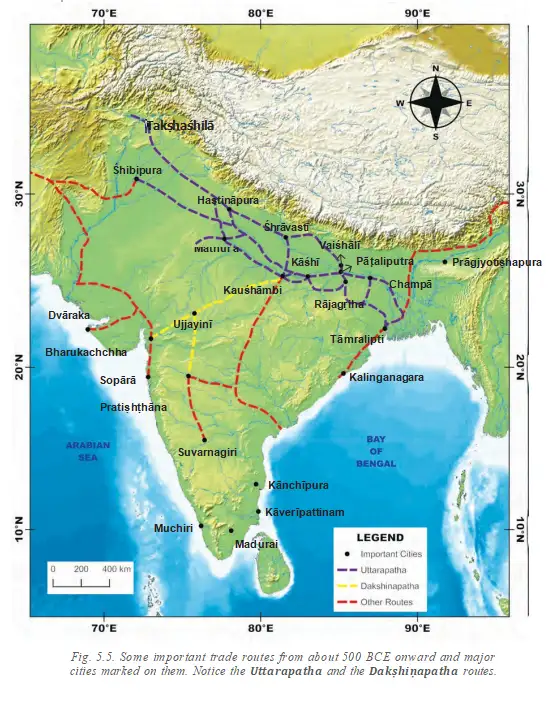
- Trade routes: Controlling routes within and beyond an empire helped goods move in greater quantity and variety.
- Benefits: More trade increased producers’ income and the ruler’s tax collections, supporting the empire and people’s welfare.
How Trade Routes Supported Empires
- Trade routes connect producers and markets.
- More goods move along the routes, increasing the quantity and variety of trade.
- Trade growth raises producers’ income and the ruler’s tax collections.
- Greater income and access to resources help maintain the empire and support people’s welfare.
Goods and the Reach of Trade
Trade in Ancient India
- Goods traded: Textiles, spices, agricultural produce, gems and other luxury items, handicrafts, and animals.
- Evidence: Literature and archaeological excavations provide evidence of these traded goods.
- Distant trade: Indian goods travelled to faraway countries by land and sea.
Guilds (Śhrenīs)
Guild (śhrenī) — An organised association of traders, craftsmen, moneylenders or agriculturists.
How Guilds Worked
- Leadership: A guild usually had a head, often elected, and executive officers expected to have ethical qualities.
- Cooperation: Members became collaborators rather than competitors, sharing resources and information.
- Shared knowledge: Members exchanged information about markets, supply and demand, and the workforce.
- Autonomy: Guilds could make internal rules for their occupational groups; the king was not expected to interfere when trade flourished.
- Guild (śhrenī)
- An occupational association that organised shared activities and made internal rules.
- Autonomy
- The ability to manage one’s affairs and make internal rules independently.
- Supply and demand
- The availability of goods and the need or desire for them in a market.
Guilds and Self-Organisation
- Spread and duration: Guilds existed across large parts of India and endured for centuries.
- Continuing influence: Even after guilds ceased to exist formally, their spirit continued to influence Indian trade and business, sometimes to the present day.
- Other local institutions: Village committees and councils also show how communities organised themselves.
- Role of the ruler: An enlightened ruler allowed local institutions to manage their affairs when they worked satisfactorily.
How did trade routes benefit producers and rulers?
What made guilds important?
Quick recap
- Empires needed economic power, workers and resources to maintain armies and support people’s welfare.
- Trade routes increased the quantity and variety of goods, producers’ income and rulers’ tax collections.
- Ancient Indian trade included textiles, spices, agricultural produce, luxury items, handicrafts and animals.
- Indian goods travelled to distant countries by land and sea.
- Guilds organised occupational groups through cooperation, shared information and internal rules.
- Guilds and village institutions illustrate the self-organising abilities of Indian society.
The Rise of Magadha
Magadha’s Rise
Mahajanapada — One of the sixteen large kingdoms of north and central India, which had an assembly system; Magadha was one of them.
Magadha’s Importance and Advantages
- Location: Magadha lay in the resource-rich Ganga plains, in present-day south Bihar and adjoining areas.
- Historical importance: Magadha’s rise set the stage for kingdoms to unite into India’s first empire.
- Natural resources: Fertile land supported farming; forests provided timber, and elephants were among the region’s resources.
- Iron: Nearby hills had iron ore and other minerals; iron ploughs increased crop production, while lighter, sharper weapons strengthened the army.
How Trade Supported Magadha
- Fertile land and iron ploughs → more food production and surplus grain.
- Surplus food → more people could work in arts and crafts.
- Ganga and Son rivers → easier transportation and trade.
- Trade in goods → increased income and helped Magadha grow stronger.
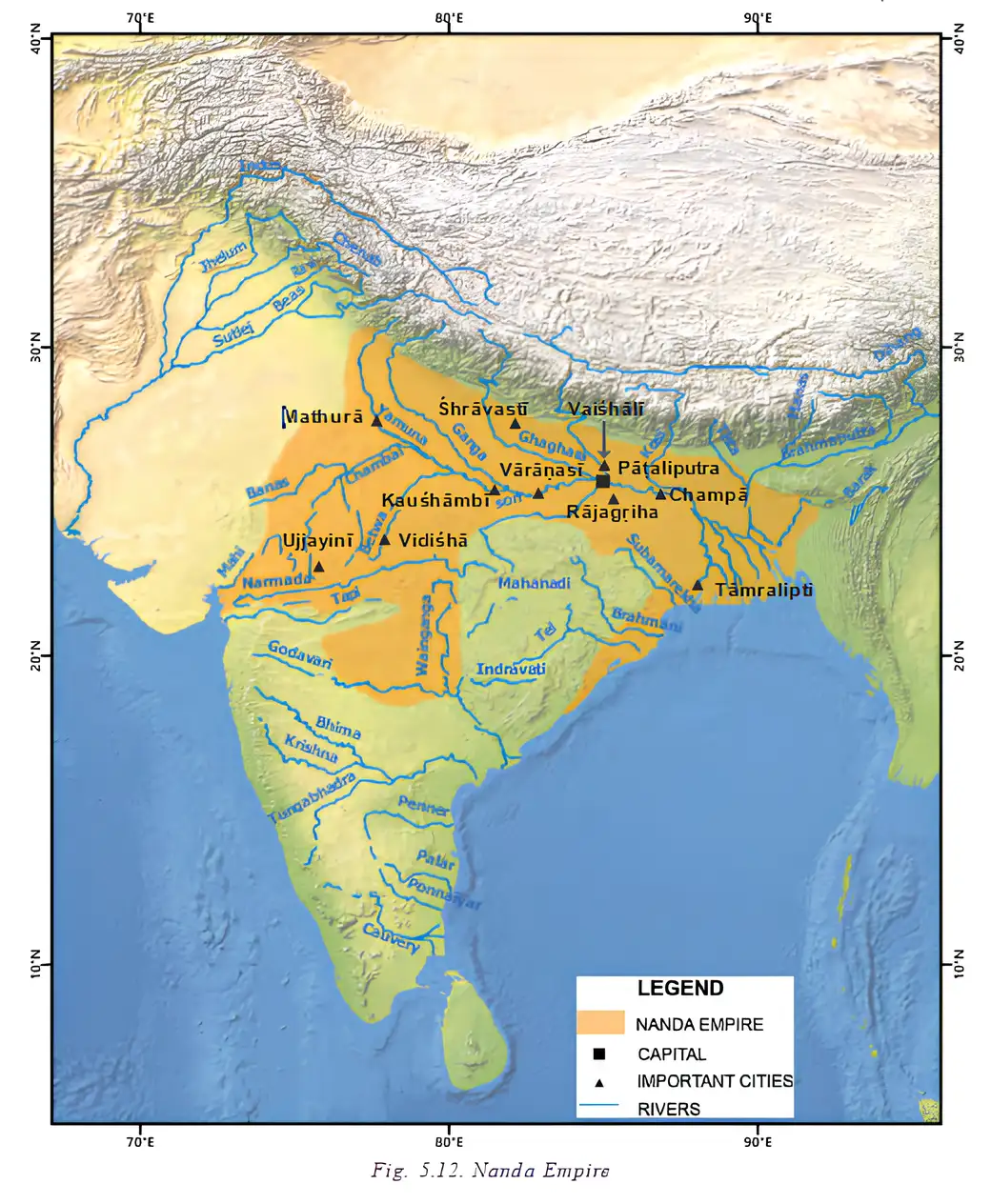
The Nanda Dynasty
Key Periods and People
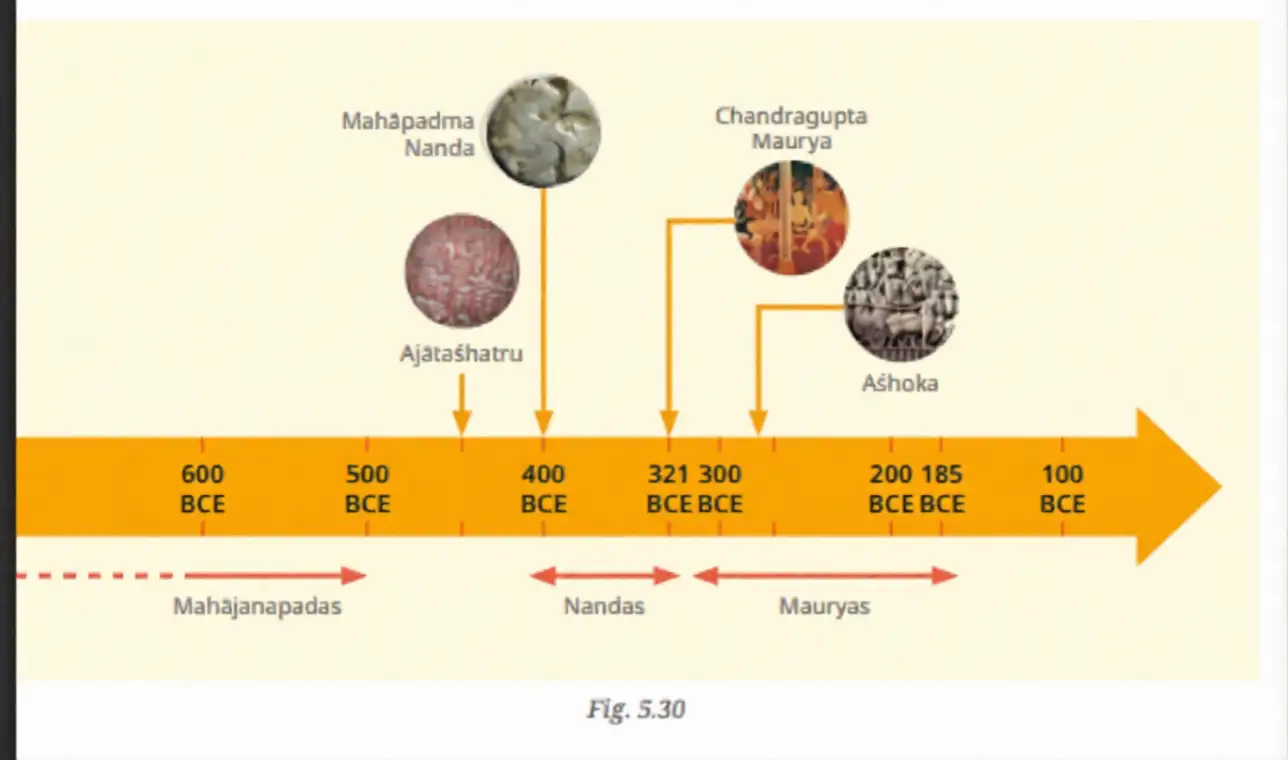
- 6th–4th century BCEMajor changes took place in north India; Magadha rose among the mahajanapadas.
- Around the 5th century BCEMahapadma Nanda rose to prominence and founded the Nanda dynasty; the grammarian Panini also lived around this time.
Nanda Rule and the Mauryas
- Mahapadma Nanda: Unified many smaller kingdoms and extended his rule across parts of eastern and northern India.
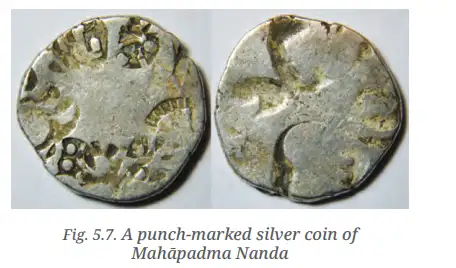
- Wealth and army: As the economy thrived, he began issuing coins; Greek accounts describe the Nanda army as large.
- Dhana Nanda: The last Nanda ruler was wealthy but became unpopular for oppressing and exploiting people.
- Change of power: Dhana Nanda’s unpopularity paved the way for the Nanda Empire to be conquered and absorbed into the Maurya Empire.
Important Contemporaries
- Ajatashatru: A powerful early king who helped establish Magadha as a major centre of power.
- Buddha and Mahavira: Siddhartha Gautama, later known as the Buddha, and Vardhamana, known as Mahavira, lived during Ajatashatru’s time.
- Panini: A Sanskrit grammarian associated with the Nanda period; his Ashtadhyayi presents Sanskrit grammar in 3,996 concise sutras.
- Surplus
- Food produced beyond what people immediately need, allowing others to take up crafts and trade.
- Sutra
- A concise, carefully formed phrase used to preserve and transmit knowledge.
How did Magadha’s resources and location help it rise?
What were the main achievements and outcome of Nanda rule?
Quick recap
- Magadha was one of the sixteen mahajanapadas, large kingdoms with an assembly system.
- Its fertile location and nearby iron resources supported agriculture and military strength.
- Surplus food, crafts, and river transport supported trade and increased income.
- Magadha’s rise helped set the stage for the unification of kingdoms into India’s first empire.
- Mahapadma Nanda unified smaller kingdoms, expanded Nanda rule, and began issuing coins.
- Dhana Nanda’s oppression contributed to the fall of the Nandas and the rise of the Mauryas.
The Arrival of the Greeks
The Northwestern Kingdoms
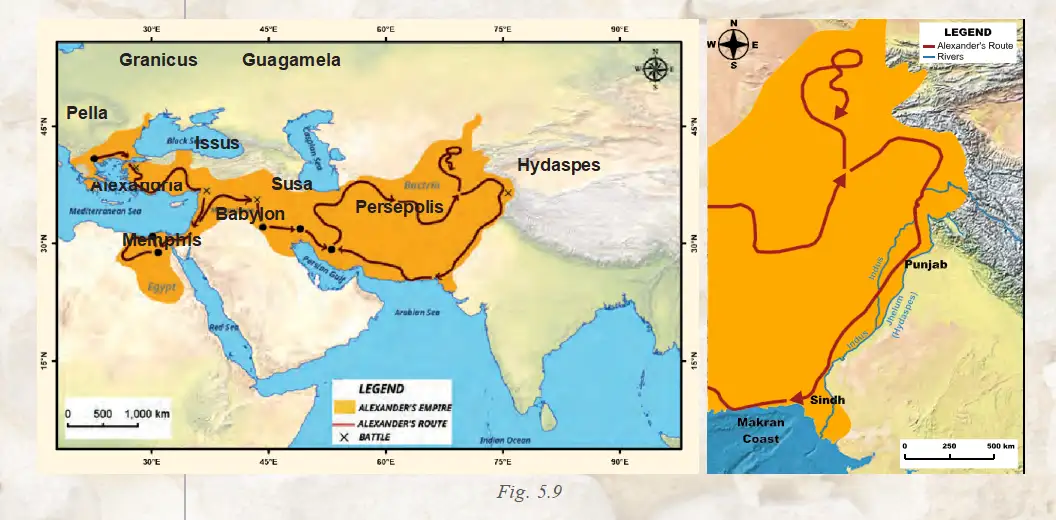
Alexander’s Campaign and the Satraps
Alexander’s Campaign
- 334–331 BCEAlexander of Macedonia campaigned against and conquered the Persian Empire.
Alexander’s Expansion
- Alexander: A young and powerful Greek king from Macedonia.
- Motive: He campaigned against Persia to avenge earlier Persian invasions of Greece.
- Result: He conquered the Persian Empire, and Greek cultural influence spread.
- Extent: His empire reached across three continents and was among the largest in world history.
Satrap — A governor appointed to administer a province of the Persian or Greek empire, often in a far-off territory.
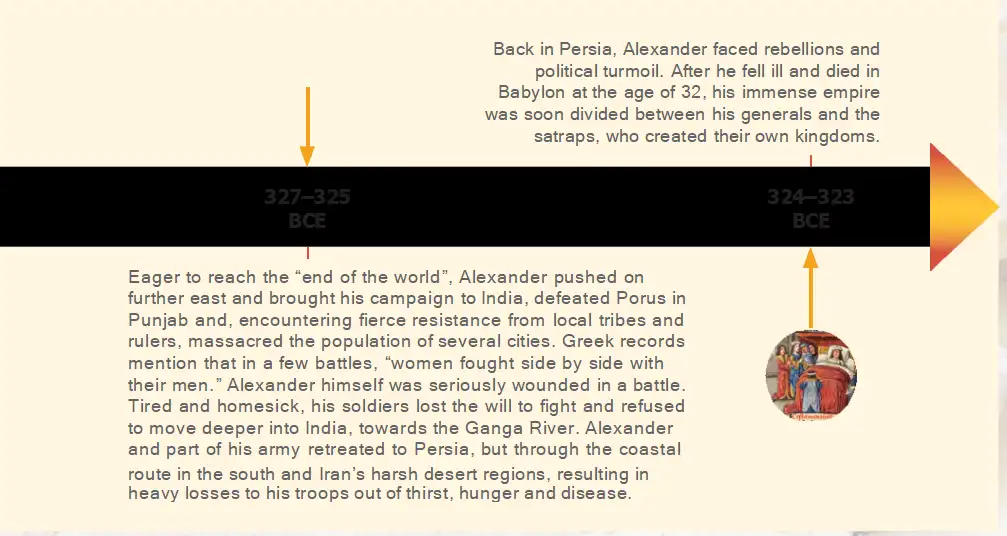
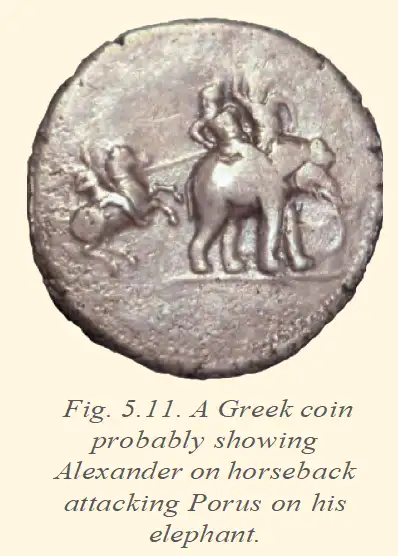
Alexander and Porus
Porus after the Battle
- After the battle, Alexander asked Porus how he wished to be treated.
- Porus answered, “Like a King.”
- Alexander left Porus in charge of his kingdom as a satrap.
Alexander and the Gymnosophists
Gymnosophists — Indian sages whom the Greeks called “naked philosophers,” probably because they wore very little clothing.
| Alexander’s question | Sage’s reply |
|---|---|
| Which is stronger, life or death? | Life, because it endures while death does not. |
| How can a man be most loved? | By being powerful without inspiring fear. |
The Mighty Mauryas
The Rise of the Maurya Empire
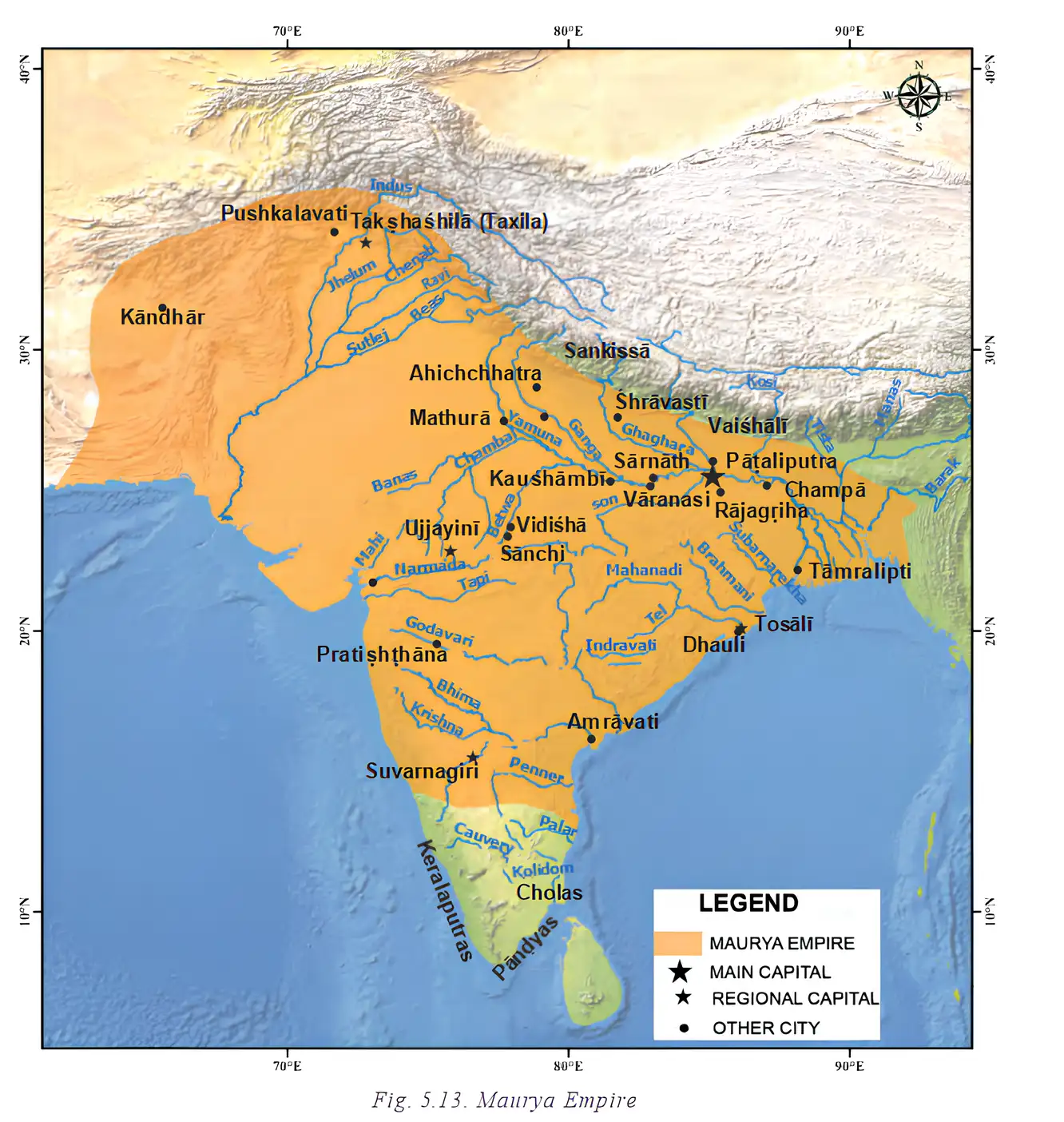
- Around 321 BCEChandragupta Maurya founded a new dynasty and empire in Magadha, a few years after Alexander left India with his army.
How the Maurya Empire Expanded
- Chandragupta Maurya founded the Maurya dynasty.
- With help from his mentor Kautilya, he built a powerful empire.
- The Maurya Empire absorbed the territories of the Nanda Empire.
- It continued expanding beyond those territories.
Chandragupta Maurya and Kautilya
- Chandragupta Maurya: Founder of the Maurya Empire, which became one of the greatest empires in Indian history.
- Kautilya: Chandragupta’s able mentor, known for his knowledge of politics, governance and economics.
- Pauravas
- A northwestern kingdom ruled by Porus, according to Greek accounts.
- Satrap
- A provincial governor in the Persian or Greek empire.
- Gymnosophists
- Indian sages known to the Greeks as “naked philosophers.”
- Maurya Empire
- The empire founded by Chandragupta Maurya around 321 BCE.
- Kautilya
- Chandragupta Maurya’s mentor, skilled in politics, governance and economics.
Who were satraps, and how much authority did they have?
How did the Maurya Empire rise and expand?
Quick recap
- The northwest had smaller kingdoms, including the Pauravas ruled by Porus.
- Alexander conquered the Persian Empire during his campaign of 334–331 BCE.
- Satraps governed imperial provinces and could hold substantial local power.
- After the battle, Alexander kept Porus in charge of his kingdom as a satrap.
- The Gymnosophists’ encounter with Alexander is viewed as a meeting of Greek and Indian philosophies.
- Around 321 BCE, Chandragupta Maurya founded an empire that absorbed Nanda territories and expanded with Kautilya’s help.
The Story of Kauṭilya
Kautilya and the Nandas
Kautilya’s role and vow
- Identity: Buddhist texts describe Kautilya as a teacher at the renowned university of Takshashila (modern Taxila); he was also known as Chanakya or Vishnugupta.
- Warning: Kautilya advised King Dhana Nanda to change his ways or risk the collapse of his empire.
- Vow: Dhana Nanda insulted Kautilya and expelled him from court; Kautilya then vowed to end Nanda rule.
The Rise of Chandragupta Maurya
Chandragupta Maurya — The ruler who overthrew the Nandas, took control of Magadha and established the Mauryan Empire, with Pataliputra as his capital.
How Chandragupta expanded his empire
- Magadha’s favourable geography, established economy and flourishing trade provided a strong base.
- Kautilya’s strategic advice helped Chandragupta build on these advantages.
- Chandragupta overthrew the Nandas and took control of Magadha.
- He defeated the Greek satraps left in the northwest after Alexander’s campaigns.
- The conquered northwestern region became part of an empire stretching from the northern plains to the Deccan plateau.
Relations with the Greeks and Megasthenes
Megasthenes and Indika
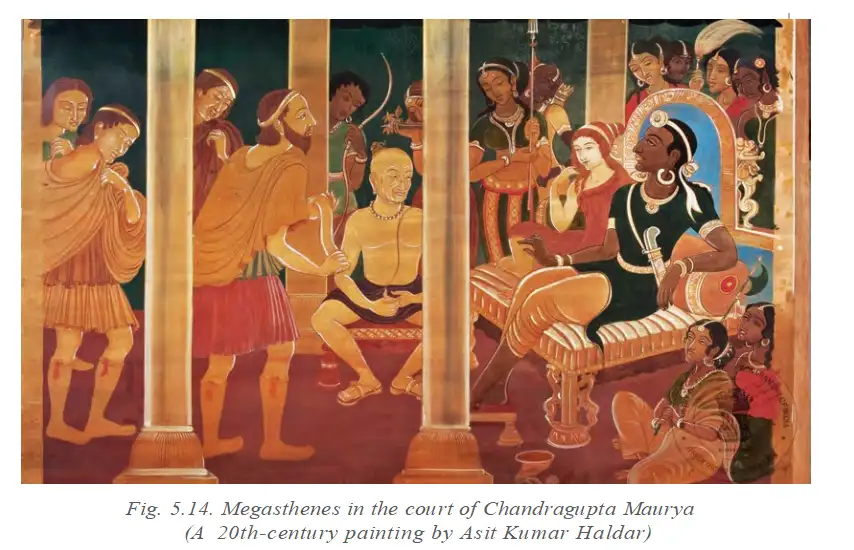
- Diplomacy: After defeating the Greek satraps, Chandragupta maintained diplomatic relations with the Greeks.
- Megasthenes: Chandragupta hosted this Greek historian and diplomat at his court.
- Indika: Megasthenes wrote this account of his travels in India; it was the first such written account, but survives only in excerpts quoted by later Greek scholars.
- Kautilya
- Strategist and teacher, also known as Chanakya or Vishnugupta.
- Magadha
- The kingdom Chandragupta took from the Nandas and used as the base of his rule.
- Greek satraps
- Greek provincial rulers left in the northwest after Alexander’s campaigns.
- Indika
- Megasthenes’ account of his travels in India, known today through later quotations.
What helped Chandragupta Maurya expand his empire?
Who was Megasthenes, and what was Indika?
Quick recap
- Kautilya, also called Chanakya or Vishnugupta, taught at Takshashila.
- After Dhana Nanda expelled and insulted him, Kautilya vowed to end Nanda rule.
- Chandragupta overthrew the Nandas and made Pataliputra his capital.
- Magadha’s advantages and Kautilya’s advice supported the empire’s growth.
- Chandragupta defeated the Greek satraps in the northwest and expanded his empire.
- Megasthenes’ Indika is an early written account of India, preserved only in later quotations.
Kauṭilya’s Concept of a Kingdom
Kautilya and the Arthaśāstra
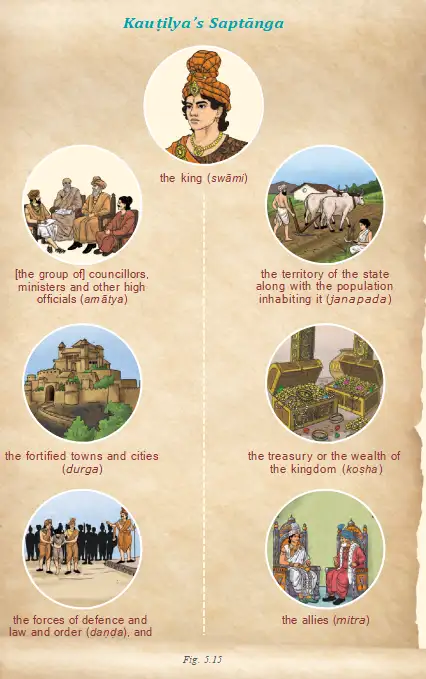
- Kautilya described how a kingdom, or *rajya*, should be established, managed and strengthened.
- Arthaśāstra means “the science of governance and economics”; it gives directives on defence, economics, administration, justice, urban planning, agriculture and people’s welfare.
The Saptānga: Seven Parts of a Kingdom
Saptānga — Kautilya’s concept of the seven parts that constitute a kingdom.
A Well-Governed Kingdom
- Aim: The seven parts together should help create a settled, well-protected and prosperous kingdom.
- Security and peace: A kingdom may be maintained through warfare or through alliances for peace, depending on the circumstances.
- Administration: Maintaining law and order requires a strong administration.
- Justice: Kautilya detailed laws against corruption and punishments for actions that harm people’s wellbeing.
People’s Welfare and the Countryside
Why the Countryside Matters
- The countryside is the source of all economic activity.
- Economic activity supports the king’s power.
- Therefore, the king should promote rural welfare and favour work that benefits people, such as building embankments and road bridges, improving villages and helping protect them.
Kautilya’s principle of kingship — A king’s happiness and welfare lie in the happiness and welfare of the subjects; their interests should come before the king’s personal preferences.
- Rajya
- A kingdom.
- Arthaśāstra
- Kautilya’s work on governance and economics.
- Saptānga
- The seven parts that constitute a kingdom.
Why did Kautilya consider the countryside important to a kingdom?
Quick recap
- Kautilya’s Arthaśāstra gives guidance on governance, economics, defence, justice and welfare.
- Saptānga refers to the seven parts that constitute a kingdom.
- A kingdom should be settled, protected and prosperous, maintained through warfare or alliances as circumstances require.
- Kautilya stressed strong administration, law and order, and punishment for corruption and harm to people’s wellbeing.
- The countryside is the source of all economic activity and therefore supports the king’s power.
- A ruler should put the welfare of subjects before personal interests.
The King Who Chose Peace Part-1
Ashoka and the Mauryan Empire
Ashoka’s Reign
- 268–232 BCEAshoka ruled as a Mauryan king.
The Kalinga War and Ashoka’s Change
From Conquest to Peace
- Ashoka marched on Kalinga, in present-day Odisha, and fought a fierce war.
- He witnessed extensive death and destruction on the battlefield.
- The experience changed his path: he gave up violence as far as possible.
- He chose to follow the Buddha’s teachings of peace and non-violence.
Edict — An official declaration issued by an authority; in this context, a declaration made by a king.
Why might Ashoka have recorded the destructive Kalinga War in his edicts?
Buddhist Teachings and Emissaries
Spreading the Buddha’s Message
- Buddhist teachings: Ashoka embraced the Buddha’s message after the Kalinga War.
- Emissaries: He sent special mission envoys to Sri Lanka, Thailand, Central Asia and other regions to spread the Buddha’s message.
Emissary — A person sent on a special mission, often a diplomatic one.
Ashoka’s Edicts and Communication
Messages Across the Empire
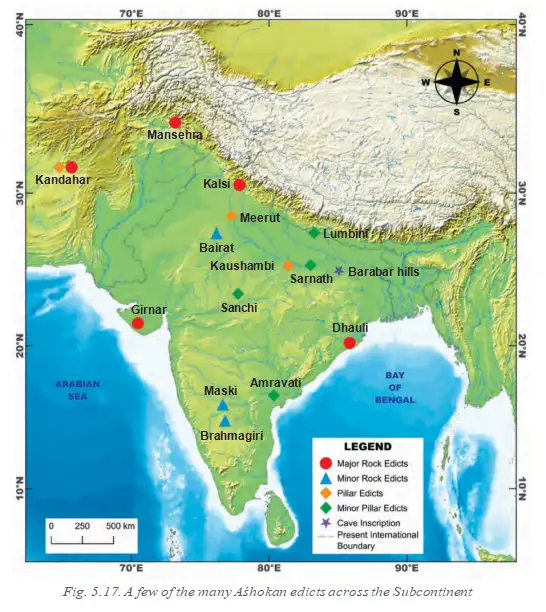
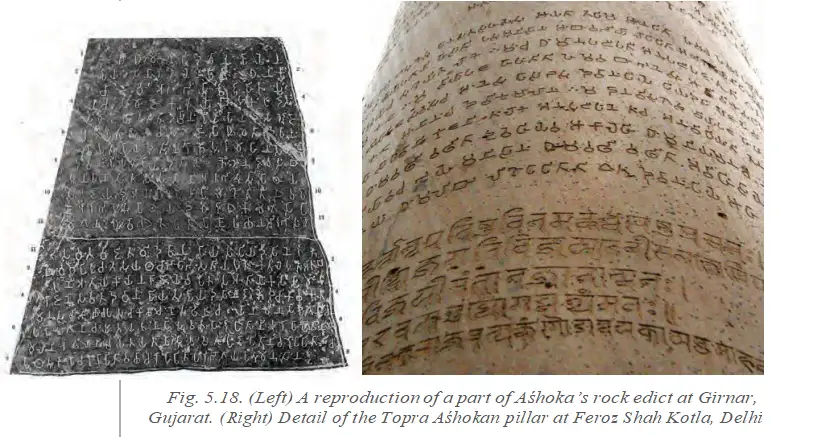
- Edicts: Ashoka had messages engraved on rocks and pillars in many parts of his empire.
- Purpose: The messages communicated with the people and encouraged them to follow dharma.
- Importance: Historians have called Ashoka a “great communicator” because he used these inscriptions to share his ideas widely.
| Point | Language | Script |
|---|---|---|
| Meaning | A system of spoken communication | The writing system used to write a language |
| Ashoka’s edicts | Mostly written in Prakrit, a popular language in many parts of India | Written in the Brahmi script |
Prakrit and Brahmi
- Prakrit: The language used in most Ashokan edicts.
- Brahmi: The script used to write those edicts; it is described as the mother of India’s regional scripts.
- Edict
- An official declaration issued by a king or other authority.
- Emissary
- A person sent on a special, often diplomatic, mission.
- Dharma
- The principle or path Ashoka’s edicts encouraged people to follow.
- Brahmi
- The script in which most Ashokan edicts were written.
Quick recap
- Ashoka, Chandragupta’s grandson, ruled from 268 to 232 BCE and expanded the Mauryan Empire.
- The destruction he witnessed in the Kalinga War led him to give up violence as far as possible.
- Ashoka embraced Buddhist teachings and sent emissaries abroad to spread the Buddha’s message.
- His edicts were engraved on rocks and pillars to communicate with people and encourage dharma.
- Most edicts used Prakrit as the language and Brahmi as the script.
The King Who Chose Peace Part-2
Aśhoka’s Image and Welfare Policies
Dharma and Dhamma
- Dharma: It includes moral duty, righteous conduct, truth, and living in harmony with the order of the universe.
- Aśhoka’s dhamma: Aśhoka encouraged people to follow dharma and urged different sects to respect one another and learn from one another’s teachings.
Fairness in the Administration
- Fair administration: Aśhoka instructed officials to act impartially, remain even-tempered, and avoid rash decisions.
- Protection of people: He ordered that people should not be imprisoned or tortured without good reason and sent officers on regular tours to check that instructions were followed.
The Mauryan Empire After Aśhoka
The Empire’s Break-up
- Aśhoka dies
- Successors are unable to hold the empire together
- Smaller kingdoms break away
- The kingdoms become independent
After Aśhoka
- About half a century after Aśhoka’s deathThe Mauryan Empire continued, but its successors could not maintain its unity.
- Around 185 BCEIndia began another phase of its history.
What measures did Aśhoka say he took for people, animals and travellers?
How did Aśhoka seek to make officials administer justice fairly?
Quick recap
- Devanampiya Piyadasi means “Beloved of the Gods” and “one who regards others with kindness.”
- Aśhoka’s edicts describe welfare measures for people and animals, public facilities, and respect among sects.
- Dharma includes duty, truth, righteous conduct and harmony with the cosmic order, or ṛitam.
- Officials were expected to act impartially; an officer was to inspect their conduct every five years.
- After Aśhoka’s death, his successors failed to keep the empire united and smaller kingdoms became independent.
- Around 185 BCE, India entered another phase of its history.
Life in the Mauryan Period Part-1
Cities, Government and Trade
Urban life
- City centres: Pataliputra was a major centre of governance and commerce, with palaces, public buildings and well-planned streets.
- Economy: An organised taxation system and brisk trade strengthened the treasury and supported the empire’s growth.
- People: Officials, merchants and artisans played important roles in city life.
The Sohagaura Inscription and Food Security
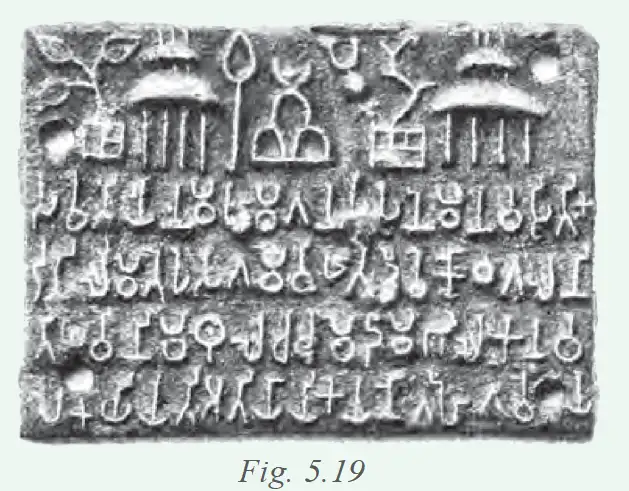
Sohagaura copper plate
- Date and importance: Dating to the 4th–3rd century BCE, it is one of India’s earliest known administrative records.
- Origin and writing: Found in Sohagaura, Uttar Pradesh, it is written in Prakrit using the Brahmi script.
- Mauryan connection: It is believed to have been issued during Chandragupta Maurya’s reign.
- Food security: It records the establishment of a granary to store grain as protection against famine.
Agriculture and Everyday City Life
Society and livelihoods
- Agriculture: A substantial part of the population farmed; agriculture was an important source of imperial revenue.
- Two crops: Summer and winter rains allowed two crops to be sown each year, helping provide ample food and making famine rare.
- Granaries and security: Grain was stored for emergencies, and farmers were protected from nearby warfare so cultivation could continue.
- Crafts and communication: Blacksmiths, potters, carpenters, jewellers and other artisans lived in cities; couriers carried messages between places.
- City provisions: Streets had signage, and water vessels were kept at regular intervals to help fight fires.
Homes and clothing
- Houses: Homes were made of wood and could be up to two storeys tall.
- Dress: Later accounts describe a lower cotton garment reaching below the knee, about halfway to the ankles, and an upper garment draped over the shoulders.
- Footwear: Some people wore decorated leather shoes with thick soles that made them appear taller.
Mauryan Art: The Sarnath Pillar Capital
Meaning and setting
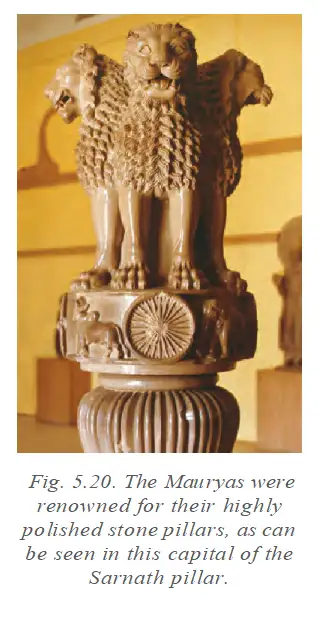
- Capital: Here, “capital” means the top portion or head of a pillar.
- Location: Ashoka had the pillar erected at Sarnath, near Varanasi, where the Buddha gave his first teaching.
- Symbols: The four lions represent royal power. The ring below shows an elephant, bull, horse and lion, along with the dharmachakra (wheel of dharma).
- Dharmachakra: The wheel symbolises the Buddha’s teachings.
Quick recap
- Pataliputra was a centre of governance and commerce; taxation and trade strengthened the treasury.
- The Sohagaura copper plate is an early administrative record from the 4th–3rd century BCE, written in Prakrit using Brahmi.
- The Sohagaura inscription records a granary intended to protect people against famine.
- Summer and winter rains supported two crops a year, while stored grain and protection of farmers helped safeguard food supplies.
- Mauryan city life included skilled artisans, couriers, planned streets, wooden homes and fire-prevention water vessels.
- At Sarnath, Ashoka’s pillar capital joined symbols of royal power with Buddhist imagery: the lions and animal ring, including the dharmachakra, which represents the Buddha’s teachings.
Life in the Mauryan Period Part-2
Art and Material Culture
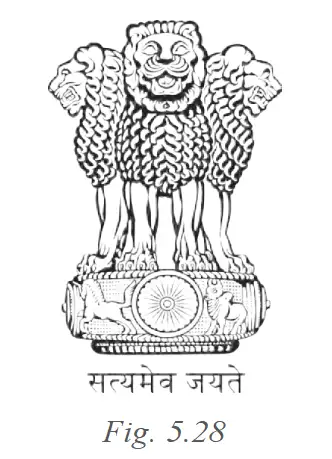
The Lion Capital and National Symbols
Ashoka’s Lion Capital
- National emblem: The Lion Capital of Ashoka was chosen as India’s national emblem.
- Motto: “Satyameva Jayate” means “Truth alone triumphs”; the full phrase is “Satyameva Jayate Nanritam” — truth alone triumphs, not falsehood.
- Source: The motto comes from the Mundaka Upanishad.
- National flag: The Dharmachakra is depicted at the centre of India’s national flag.
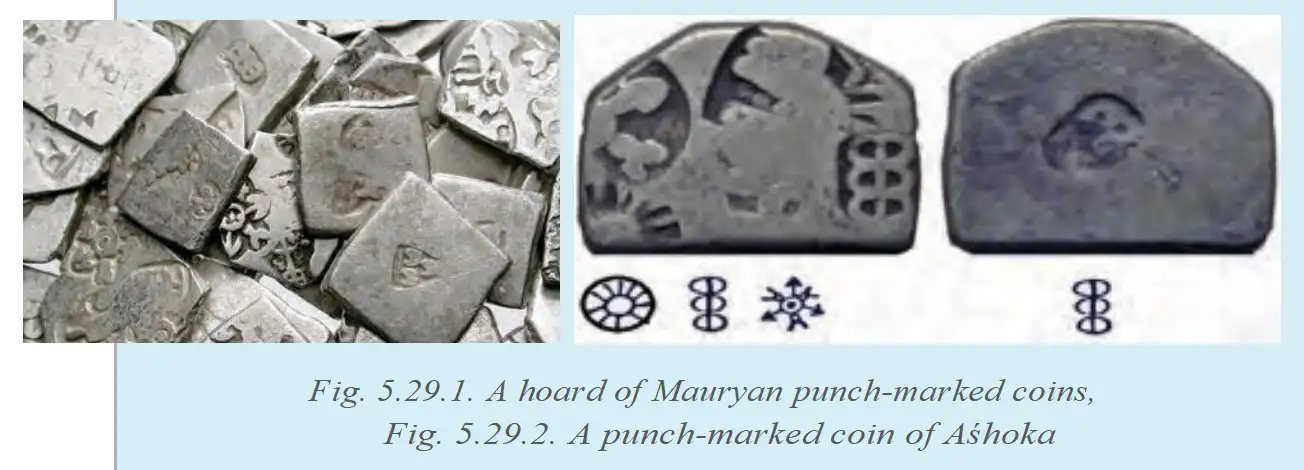
Punch-Marked Coins
- Coins: Mauryan punch-marked coins carried different symbols; the symbols shown can be examined as evidence of coin design in this period.
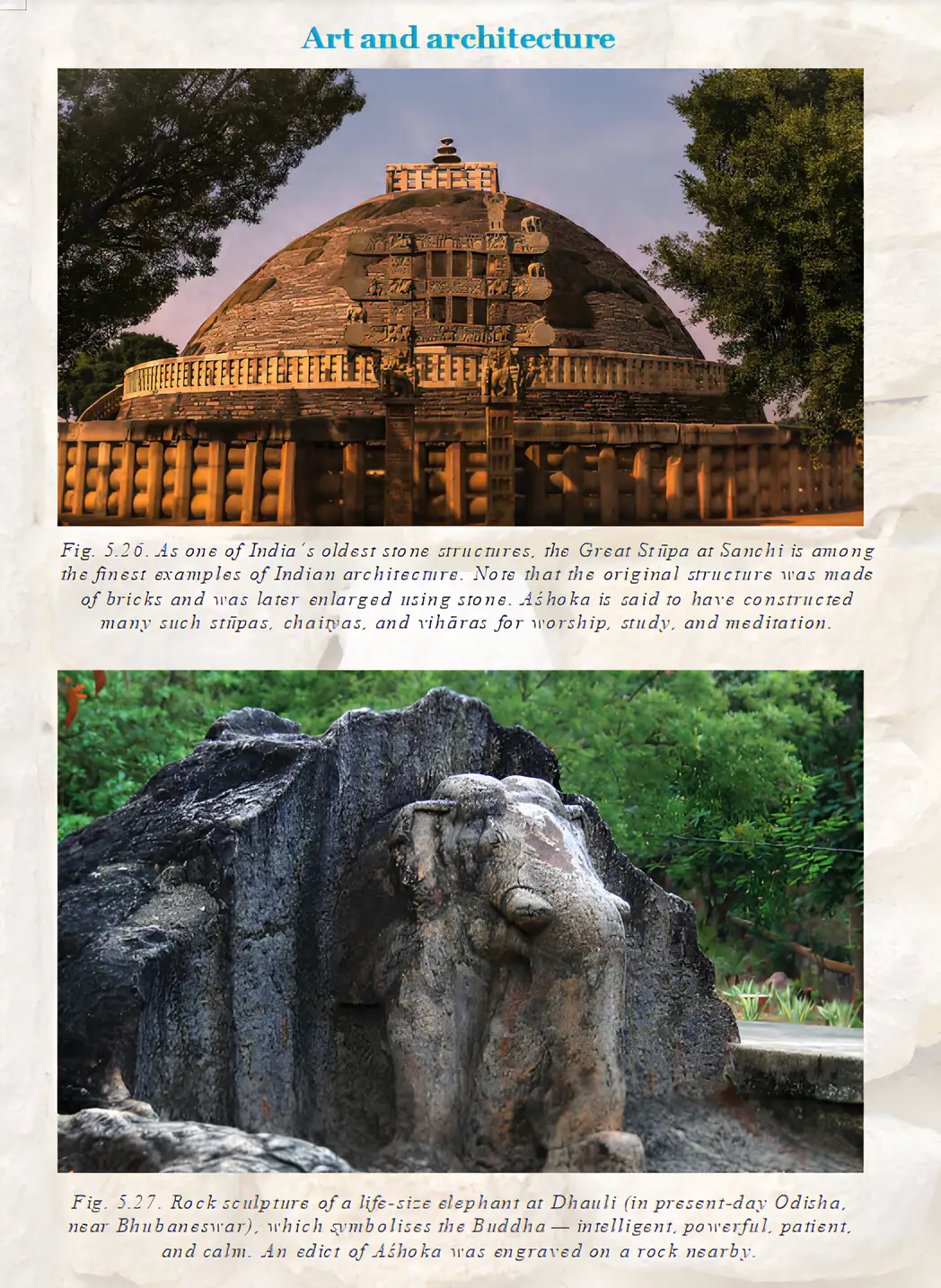
The Stupa and Worship
Anda — The large, round hemispherical structure at the centre of a stupa; it represents the universe and often houses sacred relics.
Pradakshina — The ritual of walking in a circle around the anda as an act of worship.
Stupa Worship
- Sacred relics may be housed in the anda → worshippers walk around it in a circle → this ritual is called pradakshina.
Quick recap
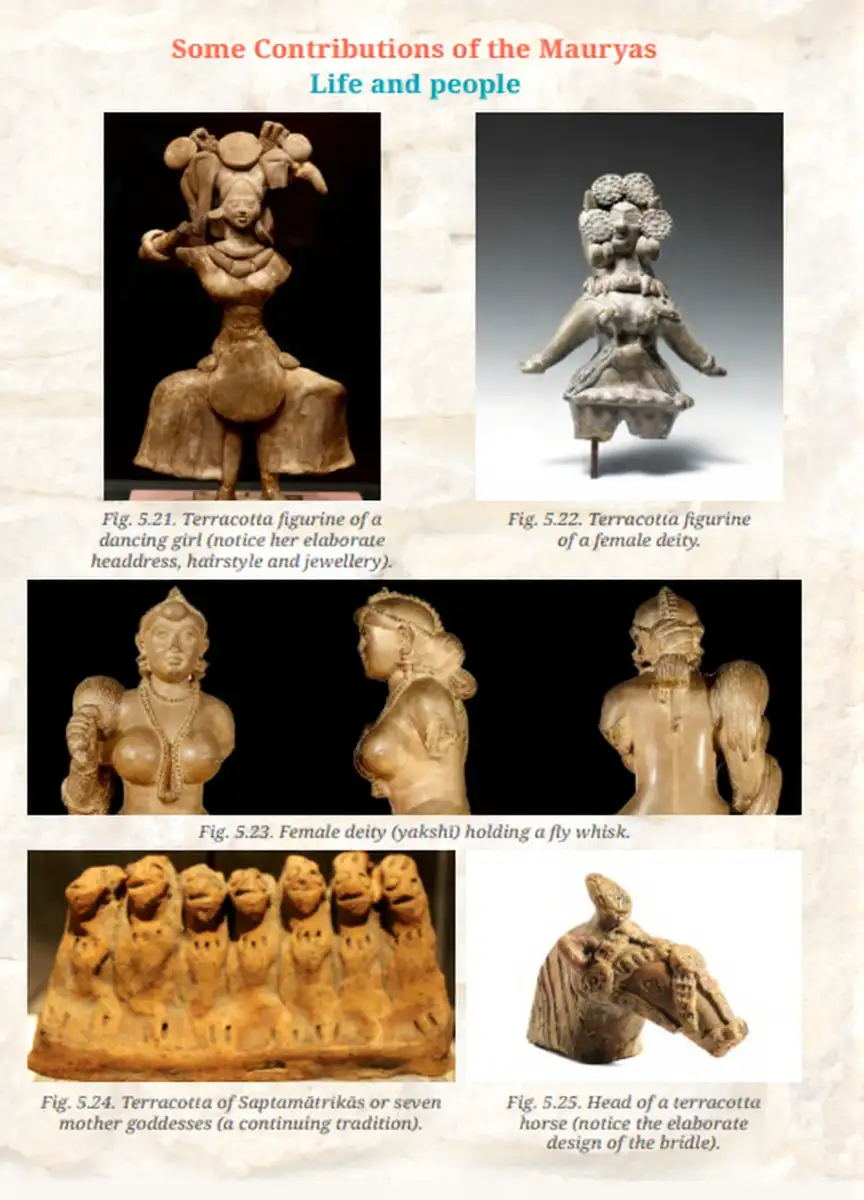
- Mauryan terracotta figurines and sculptures provide evidence of life, beliefs and artistic traditions.
- The Great Stupa at Sanchi and the elephant sculpture at Dhauli illustrate Ashokan art and architecture.
- The Lion Capital of Ashoka was adopted as India’s national emblem.
- “Satyameva Jayate,” from the Mundaka Upanishad, means “Truth alone triumphs.”
- The Dharmachakra appears at the centre of India’s national flag.
- The stupa’s anda represents the universe and may contain sacred relics; walking around it is pradakshina.
The Fragile Nature of Empires
Why Empires Decline or Break Apart
Examples and historical debate
- Examples: The Roman, Persian, Ottoman, Spanish, Russian and British empires are all long gone; historians continue to debate why empires decline.
- Breakaway risk: Regions may seek independence, especially when the central ruler’s demands or control weaken.
Pressures that can weaken an empire
- Long military campaigns or droughts increase the emperor’s need for resources.
- Local rulers face heavier tribute demands → resentment grows.
- A ruler perceived as weak succeeds a powerful emperor → local kings or chieftains may stop paying tribute.
- A very large empire is difficult to control—as Alexander experienced → distant territories may be first to break away.
- Droughts or floods cause economic crises → the empire’s structure is shaken.
The Paradox of Empires
| Point | Benefits of empire | Fragility of empire |
|---|---|---|
| Political order | Can unite many regions; the Mauryan Empire brought unity to almost the entire Subcontinent. | Often established through war and maintained by force and repression. |
| Warfare and prosperity | Can reduce or end warfare among smaller kingdoms; a well-managed empire may bring greater prosperity. | Force and repression make an empire unstable over time. |
| Overall nature | Can create unity and prosperity. | This strength exists alongside an underlying vulnerability. |
- Tribute
- Payment or resources demanded from local rulers by an emperor.
- Political unity
- The joining of many regions under one political authority.
- Repression
- The use of force to control opposition or maintain power.
- Empire
- A large territory or group of regions ruled by one central power.
Why might local rulers stop paying tribute?
Explain the paradox of empires.
Quick recap
- Empires can decline when regions seek independence or central control weakens.
- Military campaigns and natural calamities can increase resource demands and economic strain.
- Heavy tribute demands may create resentment among local rulers.
- Large empires are difficult to hold together; Alexander’s experience illustrates this, and distant territories may break away first.
- Empires can bring political unity and prosperity, yet force and repression make them fragile.
Before we move on
Empires and Their Growth
Empire — A large territory made up of many smaller kingdoms or territories.
Why Emperors Expanded
- Aims: Emperors sought fame, greater power—including military power—and control over resources and economic life.
Where the First Indian Empires Emerged
Natural Advantages and Empire-Building
- Abundant natural resources supported production and wealth.
- Rivers provided water for irrigation and routes for transport.
- A variety of goods were produced for trade.
- These advantages helped the first Indian empires emerge in such regions.
Alexander’s Campaign in Northwest India
| Aspect | Impact |
|---|---|
| Political | The campaign had limited political impact. |
| Cultural | It opened the way for Indo-Greek cultural contacts. |
The Mauryan Empire and Its Legacy
Mauryan Contributions
- Vast empire: The Mauryas built a large empire whose legacy lasted for centuries.
- Trade and economy: They strengthened trade routes and economic systems; coins were used extensively in trade.
- Cities: They developed well-designed urban settlements.
- Administration: They established an elaborate system of administration.
- Art and architecture: The Mauryas promoted art and architecture.
Aśhoka and Dharma
Aśhoka’s Public Image
- Publicising achievements: Aśhoka was keen to advertise his achievements.
- Benevolent ruler: He projected the image of a benevolent ruler.
- Dharma: He encouraged his subjects to follow dharma; its meaning is not defined in this lecture.
Why did emperors expand their kingdoms?
What were the political and cultural effects of Alexander’s campaign in northwest India?
Name important features of the Mauryan legacy.
Quick recap
- An empire is a large territory containing many smaller kingdoms or territories.
- Emperors expanded to gain fame, power, and control over resources and economic life.
- Natural resources, rivers, irrigation, transport, and trade supported the emergence of the first Indian empires.
- Alexander’s campaign had limited political impact but opened the way for Indo-Greek cultural contacts.
- The Mauryan legacy included trade, coins, urban settlements, administration, art, and architecture.
- Aśhoka advertised his achievements, projected a benevolent image, and encouraged subjects to follow dharma.
Social Science — ALL CHAPTERS
1
Geographical Diversity of India
2
Understanding the Weather
3
Climates of India
4
New Beginnings Cities and States
5
The Rise of Empires
6
The Age of Reorganisation
7
The Gupta Era: An Age of Tireless Creativity
8
How the Land Becomes Sacred
9
From the Rulers to the Ruled: Types of Governments
10
The Constitution of India - An Introduction
11
From Barter to Money
12
Understanding Markets
1
The Story of Indian Farming
2
India and Her Neighbours
3
Empires and Kingdoms: 6th to 10th Centuries
4
Turning Tides: 11th and 12th Centuries
5
India, a Home to Many
6
The State, the Government, and You
7
Infrastructure: Engine of India’s Development
8
Banks and the Magic of Finance