Class 7 . Social Science . Exploring Society India and Beyond Part I . The Constitution of India an Introduction
Chapter 10: The Constitution of India - An Introduction
Ch 10
Social Science
Class 7
Introduction
Why a Constitution Matters
Making democracy work
- Constitutional goals: Achieving them requires hard physical and mental labour and, above all, great moral regeneration.
- Democratic institutions: Work well when people respect others’ viewpoints and are willing to compromise and accommodate differences.
- Dr. Rajendra Prasad: India’s first President stressed these responsibilities for the successful working of democracy.
Republic Day and the Constitution
- 26 January 1950The Constitution of India came into effect; this is marked each year by Republic Day.
Constitution — A document that lays down the basic principles and laws of a nation.
Pledges to uphold the Constitution
- President: Takes an oath to preserve, protect and defend the Constitution.
- Prime Minister and Council of Ministers: Promise to follow its provisions.
- Judges: Promise to follow its provisions.
- Constitution
- The document stating a nation’s basic principles and laws.
- Republic Day
- The annual observance of the Constitution coming into effect on 26 January 1950.
- Oath
- A formal promise to uphold or follow the Constitution.
Quick recap
- A constitution sets out a nation’s basic principles and laws.
- India’s Constitution came into effect on 26 January 1950, celebrated as Republic Day.
- Realising constitutional goals requires physical and mental labour and, above all, moral regeneration.
- Democracy needs respect for different viewpoints, compromise and accommodation.
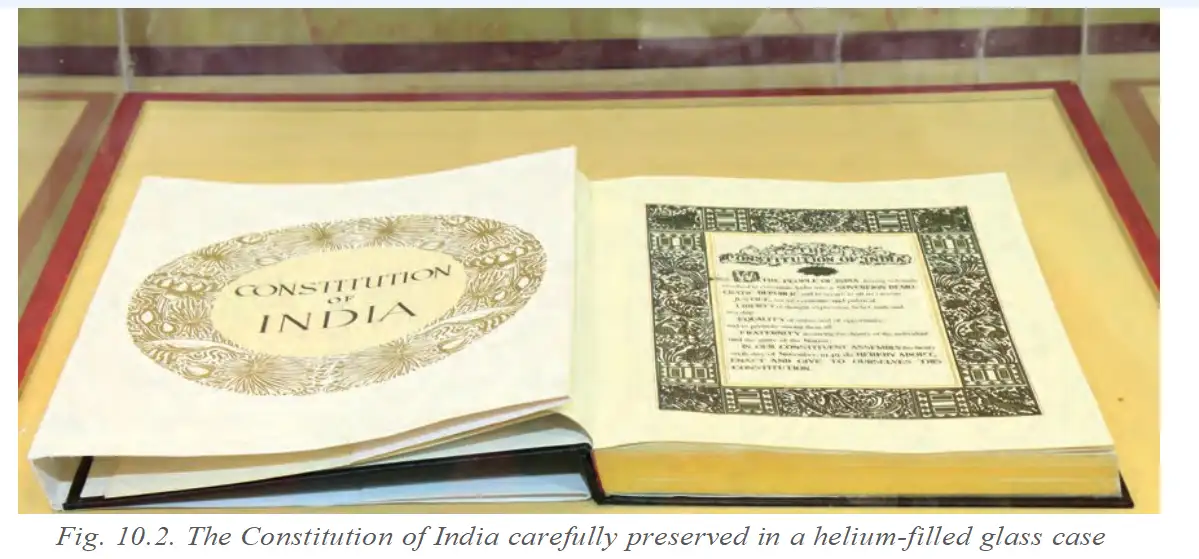
- The Constitution is preserved in a helium-filled glass case because helium does not react with paper or ink.
- The President, Prime Minister, Council of Ministers and judges pledge to uphold or follow the Constitution.
What is a Constitution?
Meaning and Main Features
- Constitution: A document that lays down a nation’s basic principles and laws.
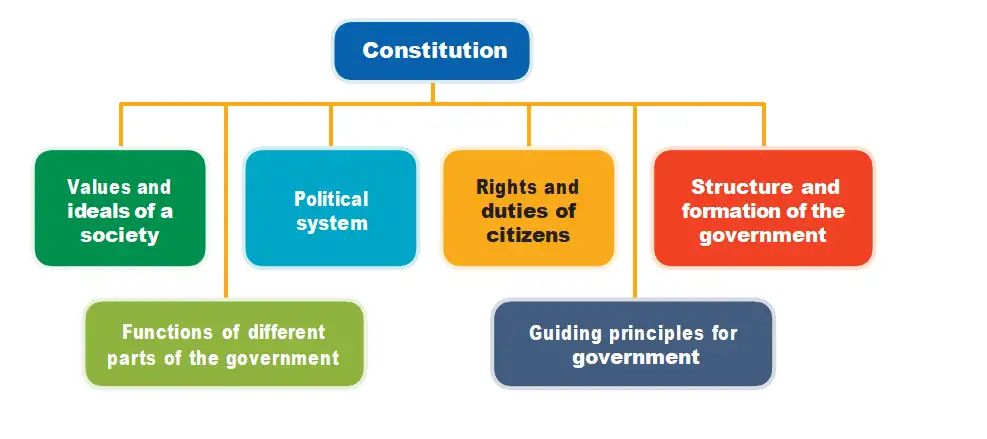
- Main features: It sets out how government is organised and describes citizens’ rights and duties.
Why a Constitution Is Needed
- Common rules: A constitution gives a country an agreed rulebook to guide how it is governed.
- Fairness: It helps settle disputes and ensures that those in authority follow established rules.
What a Constitution Explains
- Government: A constitution explains the structure, roles and responsibilities of the legislature, executive and judiciary.
- Citizens: It sets out their rights and duties, as well as the nation’s long-term goals and ideals.
The Constitution of India
Parts and Schedules of the Constitution
- 1950, when it came into effectThe Constitution had 22 Parts and 8 Schedules.
- TodayIt has 25 Parts and 12 Schedules.
- Legislature
- The organ of government responsible for making laws.
- Executive
- The organ of government responsible for carrying out laws and governing.
- Judiciary
- The organ of government responsible for interpreting laws and administering justice.
- Checks and balances
- Arrangements that limit and oversee the powers of government organs.
What is a constitution?
Name three things a constitution explains about government and law.
Quick recap
- A constitution is a country’s basic document of principles and laws.
- It sets out the roles and responsibilities of the legislature, executive and judiciary.
- Checks and balances support fairness, responsibility and accountability.
- It explains how laws are made and implemented, who elects the executive, and how the judiciary is formed.
- It describes citizens’ rights and duties and the nation’s long-term aims.
- India’s Constitution expresses ideals such as equality, justice, fraternity, pluralism and freedom.
Writing the Constitution of India
Why India needed a Constitution
Planning for self-government
- Need: During the struggle for independence, India had to plan how it would govern itself.
- Key questions: What kind of government and guiding principles should India have? Who could vote, and how should disputes be settled?
- Challenge: The rules needed to serve a large, culturally diverse and complex country.
From independence planning to a Constitution
- India’s struggle for independence
- Need to decide how the country would govern itself
- Need for shared rules and principles
- A Constituent Assembly was formed to write the Constitution
The Constituent Assembly and its work
Assembly and drafting
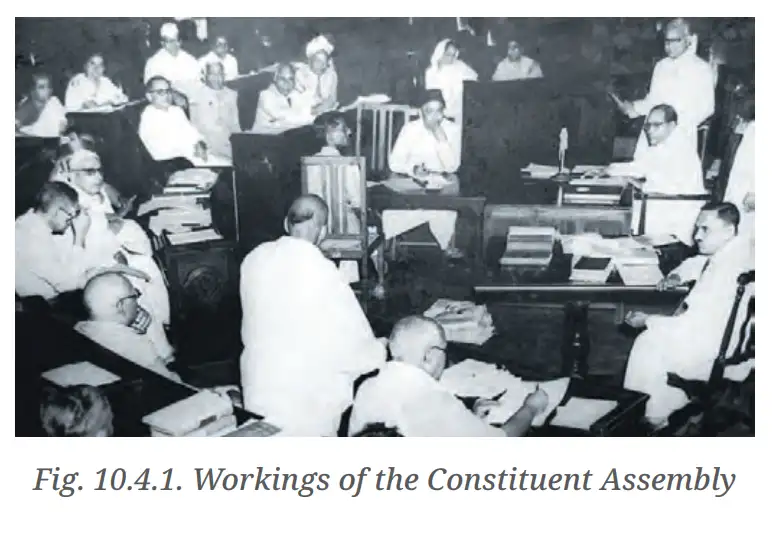
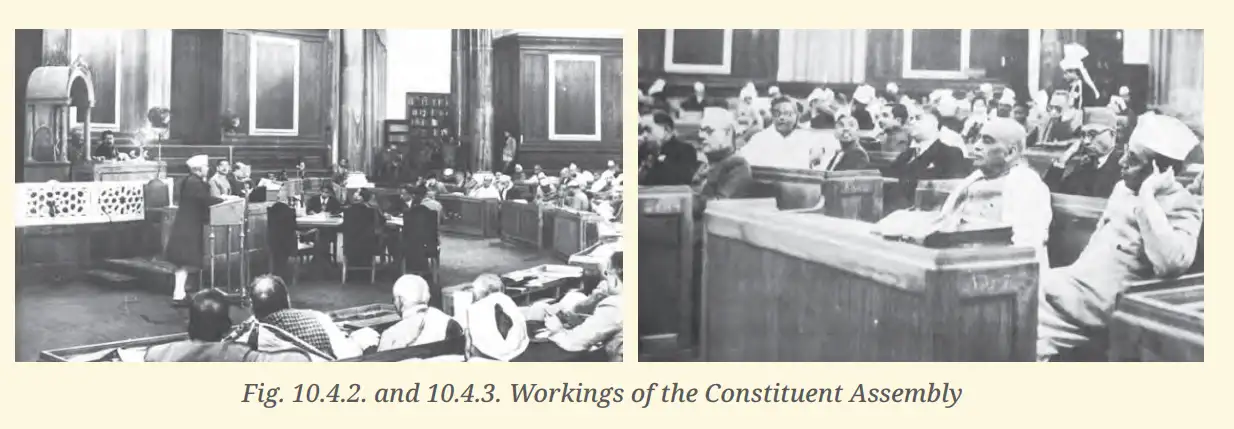
- Duration: The Constitution was developed and written by the Constituent Assembly over almost three years.
- Membership: The Constituent Assembly began with 389 members; after Partition, its membership was reduced to 299.
- Representation: Its members included 15 women and represented India’s regions, professions and social groups.
- Selection: Provincial legislative assemblies elected the members; those assemblies had themselves been elected by the people.
- Chairperson: Dr. Rajendra Prasad was Chairman of the Constituent Assembly.
- Drafting: A Drafting Committee prepared the initial text, chaired by Dr. B.R. Ambedkar, a social reformer and independent India’s first Law and Justice Minister.
Key dates
- 9 December 1946The Constituent Assembly was formed.
- 26 November 1949The Assembly completed its work on the Constitution.
- 26 January 1950The Constitution was adopted; India celebrates this date annually as Republic Day.
- Constituent Assembly
- The representative body formed to write India’s Constitution.
- Drafting Committee
- The committee that prepared the Constitution’s initial text.
- Republic Day
- The annual observance on 26 January, marking the adoption of the Constitution.
Who chaired the Constituent Assembly and its Drafting Committee?
Quick recap
- The Constituent Assembly was formed to decide how independent India would be governed.
- It first had 389 members, later reduced to 299 after Partition, including 15 women.
- Provincial legislative assemblies elected its members.
- The Constitution was written over almost three years; Dr. Rajendra Prasad chaired the Assembly and Dr. B.R. Ambedkar chaired the Drafting Committee.
- The Assembly completed its work on 26 November 1949, and the Constitution was adopted on 26 January 1950.
- 26 January is celebrated annually as Republic Day.
What Shaped and Influenced the Indian Constitution?
Sources of Influence
- Civilisational heritage: India’s culture and history, including its emphasis on learning, unity and duties, helped shape the Constitution.
- Global ideas: Constitution makers studied democratic constitutions from other countries and considered useful ideas for India.
Influence of the Indian Freedom Movement
| Question | Constitutional concern |
|---|---|
| How can every adult citizen vote? | Voting rights for adult citizens |
| How can executive, legislature and judiciary powers be kept separate? | Separation of powers |
| How can every individual’s fundamental rights be respected? | Protection of fundamental rights |
| How should the Constitution be changed? | A process for amending the Constitution |
| How should Central and State governments relate to each other? | Centre–State relationship |
India’s Civilisational Heritage and History
Earlier Governance Ideas
- Governance traditions: India’s past included janapadas, sanghas, rulers and their councils, Kautilya’s idea of *saptanga*, and *rajadharma*.
- People’s role: These traditions placed strong emphasis on people’s duties and their role in governance.
- Constitutional link: The heritage of duties is reflected in the Constitution through Fundamental Duties.
- Fraternity
- A sense of shared brotherhood and unity among people.
- Vasudhaiva kutumbakam
- The idea that the world is one family.
- Sarve bhavantu sukhinah
- An invocation for the well-being of all creatures.
- Janapadas
- An earlier form of political and territorial organisation in India.
- Sanghas
- Earlier governing or political groupings in India.
- Fundamental Duties
- Duties of citizens included in the Constitution.
Name the main influences on the Indian Constitution.
How did India’s civilisational heritage influence the Constitution?
Quick recap
- The Constitution drew on the freedom struggle, Indian heritage and useful ideas from other constitutions.
- Freedom movement leaders carried their experience into the Constituent Assembly.
- Equality, justice, freedom, fraternity and cultural preservation were important constitutional ideals.
- The Constitution addresses voting rights, separation of powers, fundamental rights, amendments and Centre–State relations.
- India’s cultural traditions and earlier governance ideas, including the emphasis on duties, influenced the Constitution.
Learnings from across the world
Learning from Other Constitutions
Ideas from the World
- Approach: Constitution makers studied democratic constitutions from other countries and considered which ideas would suit India.
- Countries studied: France, the USA, the UK, Ireland, Australia and other countries.
- Guiding idea: The Indian tradition of “Let noble thoughts come to me from every side” encouraged openness to ideas from across the world.
| Source | Influence on India’s Constitution |
|---|---|
| France | The ideals of liberty, equality and fraternity. |
| Ireland | The idea of the Directive Principles of State Policy. |
| United States of America | The concept of an independent judiciary. |
A Key Date
- 1789France’s Constitution enshrined the ideals of liberty, equality and fraternity associated with the French Revolution.
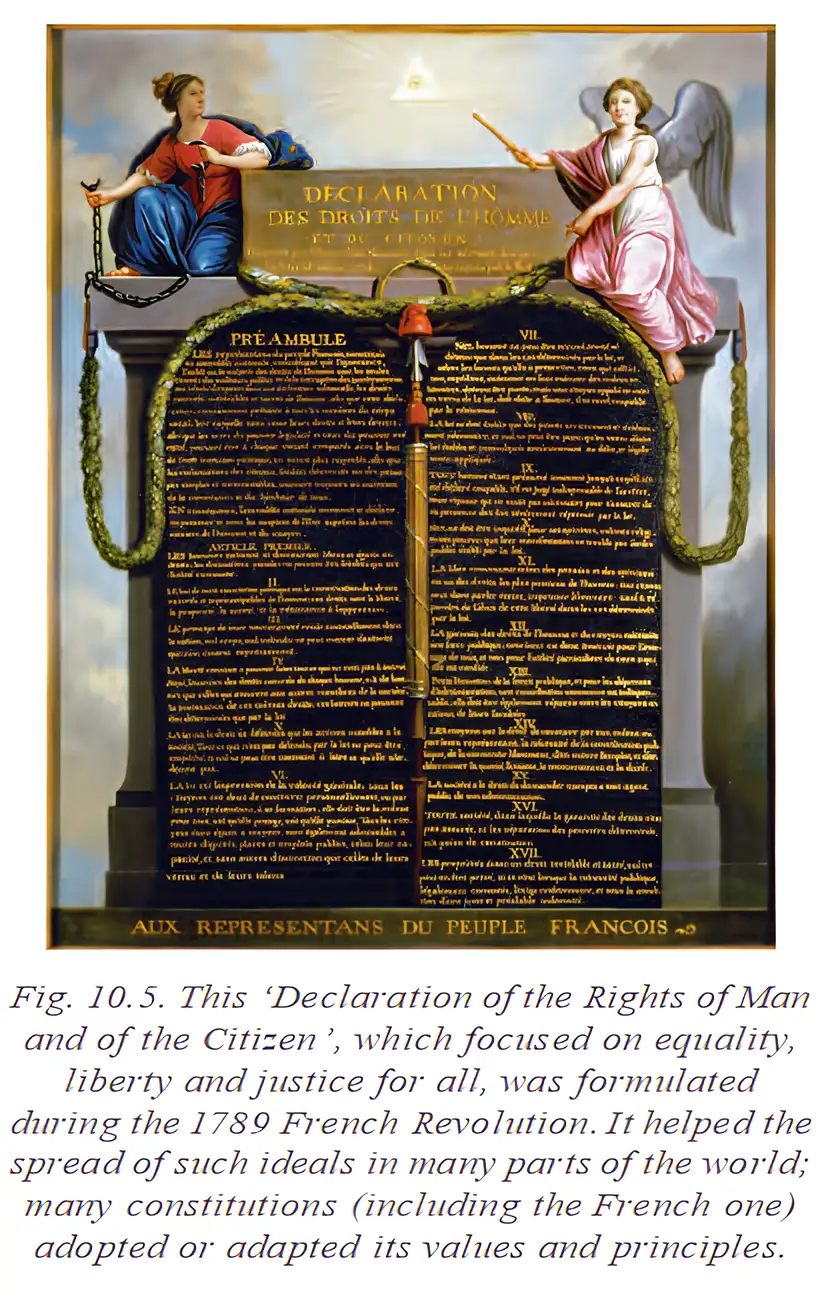
Ideas from Abroad, an Indian Constitution
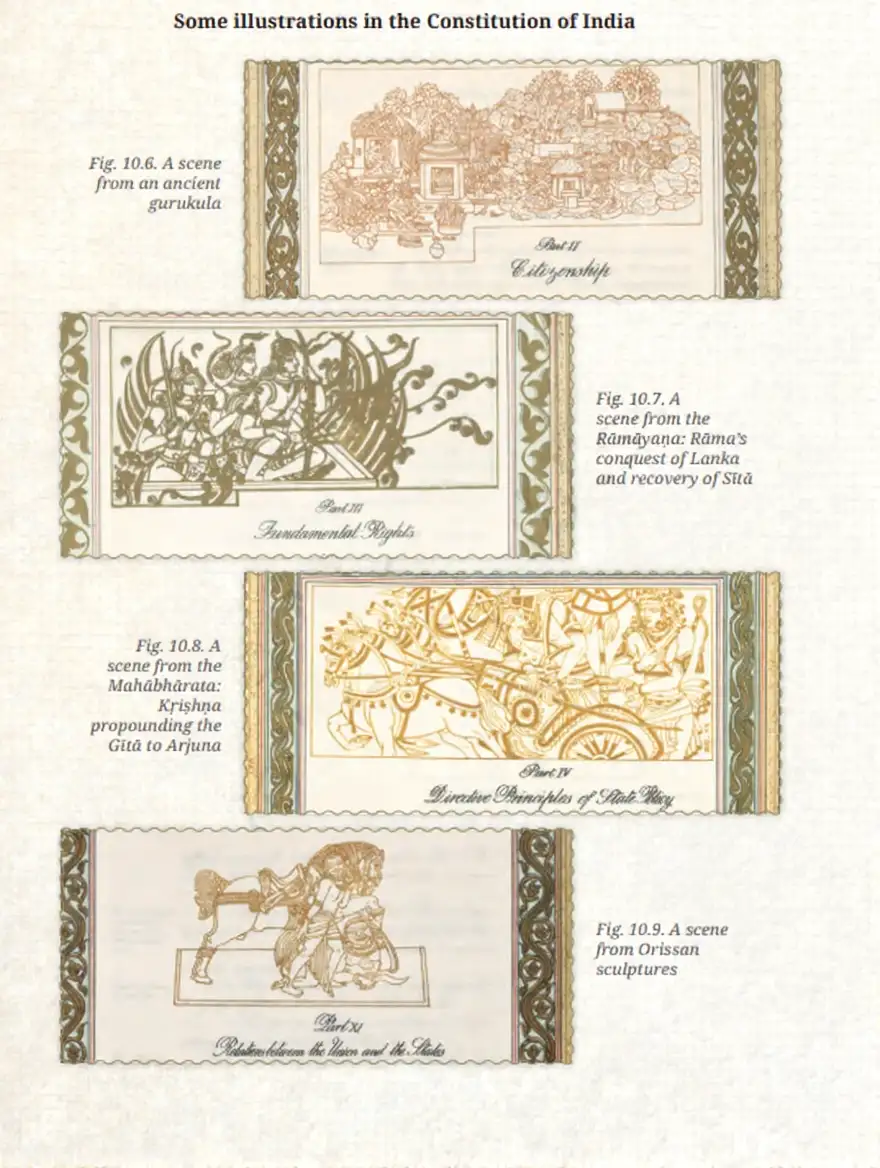
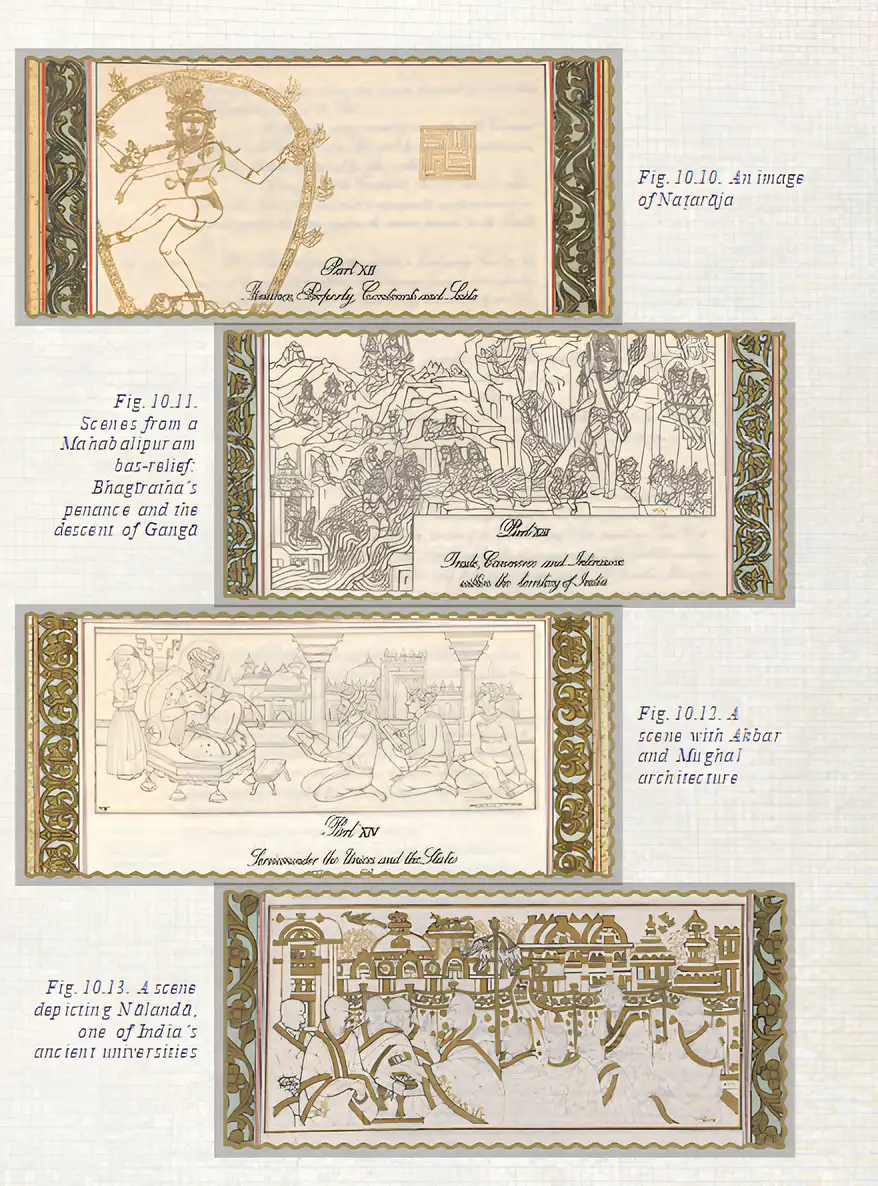
- Indian heritage: Illustrations in the original Constitution show scenes from India’s history, culture and epics alongside its constitutional sections.
Name three ideas adopted or inspired by other constitutions and their sources.
Quick recap
- Constitution makers studied democratic constitutions from France, the USA, the UK, Ireland, Australia and other countries.
- They explored how ideas from other countries could be useful in the Indian context.
- The ideals of liberty, equality and fraternity came from France’s Constitution, which enshrined ideals associated with the French Revolution of 1789.
- The Directive Principles of State Policy were inspired by Ireland’s Constitution.
- The American Constitution helped shape the idea of an independent judiciary.
- Illustrations in the original Indian Constitution reflect India’s history, culture and epics.
Key Features of the Constitution of India
Government Structure and the Constitution
Three organs and levels of government
- Separation of powers: Government has three organs with distinct roles, supporting effective working.
- Legislature: Makes laws.
- Executive: Implements laws; at the Union level, it is headed by the Prime Minister.
- Judiciary: Ensures laws accord with the Constitution, decides whether laws have been broken and determines appropriate punishment.
- Three tiers: Central, state and local government, including the Panchayati Raj system.
- Division of responsibilities: Some functions belong to the central government and others to state governments.
How the Constitution guides government
- Roles and accountability: Defines the roles, functions and responsibilities of government organs and provides accountability measures.
- Elections: Lays down an electoral system so every eligible citizen can vote.
Fundamental Rights, Fundamental Duties and DPSP
Fundamental Rights — Constitutional promises that protect people and can be claimed through courts when violated.
| Right | Article or protection |
|---|---|
| Right to Equality | Article 14: equality before law |
| Right to Freedom | Article 21: protection of life and personal liberty |
| Right against Exploitation | Protection against exploitation |
| Right to Education | Article 21-A |
Fundamental Duties — Responsibilities associated with citizens and society; the lecture lists the following examples under this heading.
| Article | Example listed |
|---|---|
| 41 | Welfare government |
| 44 | Uniform Civil Code |
| 38 | Social, political and economic justice |
| 48-A | Environment and wildlife protection |
| 49 | Protection of monuments, places and objects of national importance |
| 47 | Nutrition, standard of living and public health |
Directive Principles of State Policy (DPSP) — Guidelines expressing the social and economic goals that governments should work towards for the welfare of all; they include the aim of ensuring a good standard of living for everyone.
Examples listed under DPSP
- Respect: Abide by the Constitution and respect its ideals and institutions, the National Flag and the National Anthem.
- National service: Defend the country and serve when called upon.
- Heritage: Value and preserve India’s composite culture.
- Environment: Protect and improve forests, lakes, rivers and wildlife, and show compassion for living creatures.
- Excellence: Strive for excellence in individual and collective activities.
- Education: Parents or guardians should provide education opportunities to children aged 6–14.
| Point | Fundamental Rights | DPSP |
|---|---|---|
| Purpose | Protect people through constitutional guarantees. | Guide government towards social and economic goals, including a good standard of living for all. |
| Court enforcement | A person can approach a court when a right is violated. | Not directly enforceable in court; a person cannot complain to a judge simply because a goal has not been achieved. |
| Role | Promises that must be upheld. | Guidelines for governance; goals may take time to achieve. |
Equality in the Constitution
- 22 November 1949During Constituent Assembly debates, Begum Aizaz Rasul said the Constitution affirmed women’s equality with men and assured respect for women’s legal rights.
- Separation of powers
- Division of government roles among the legislature, executive and judiciary.
- Fundamental Rights
- Constitutional protections that can be claimed through courts.
- DPSP
- Guidelines for government to pursue social and economic welfare.
- Fundamental Duties
- Responsibilities associated with citizens and society.
How do Fundamental Rights differ from the Directive Principles of State Policy?
Quick recap
- The legislature makes laws, the executive implements them and the judiciary ensures laws accord with the Constitution.
- Government works at central, state and local levels, with responsibilities divided among them.
- The Constitution defines government roles and accountability and provides for eligible citizens to vote.
- Fundamental Rights protect people and can be claimed through courts when violated.
- DPSP guide government towards social and economic welfare, including a good standard of living, but are not directly enforceable in court.
- The lecture lists Articles 41, 44, 38, 48-A, 49 and 47 under Fundamental Duties, and citizen responsibilities a–f under DPSP.
The Constitution is a Living Document
A Constitution That Can Change
Living document — A Constitution that can adapt to changing needs through amendments and legal decisions while continuing to guide the country.
How the Constitution responds to change
- Amendments are changes made to the Constitution to meet new needs.
- Debate and approval Amendments are rigorously debated in Parliament; some also need debate in State Legislative Assemblies.
- Public participation The government may seek public feedback on proposed laws or rule changes; popular movements can also initiate change.
- Example Fundamental Duties were added as Part IV-A in 1976.
| Example | What changed |
|---|---|
| Panchayati Raj | It was incorporated into the Constitution through the 73rd Constitutional Amendment Act in 1992. |
| Flying the national flag | In 2004, after a citizen challenged the rule in court, the Supreme Court recognised flying the flag as part of the Fundamental Right to Freedom of Expression. The flag must never be dishonoured. |
Key dates
- 1976Part IV-A, Fundamental Duties, was added; the words “Socialist” and “Secular” were added to the Preamble through the 42nd Amendment.
- 1992The 73rd Constitutional Amendment Act integrated Panchayati Raj into the Constitution.
- 2004The Supreme Court recognised flying the national flag as part of Freedom of Expression.
- 20 April–20 May 2020The government invited public comments on draft amendments to the Aadhaar Authentication for Good Governance Rules, 2020. The proposal would enable entities beyond Central and State Government departments to use Aadhaar authentication for prescribed purposes.
The Constitution as a Work of Art
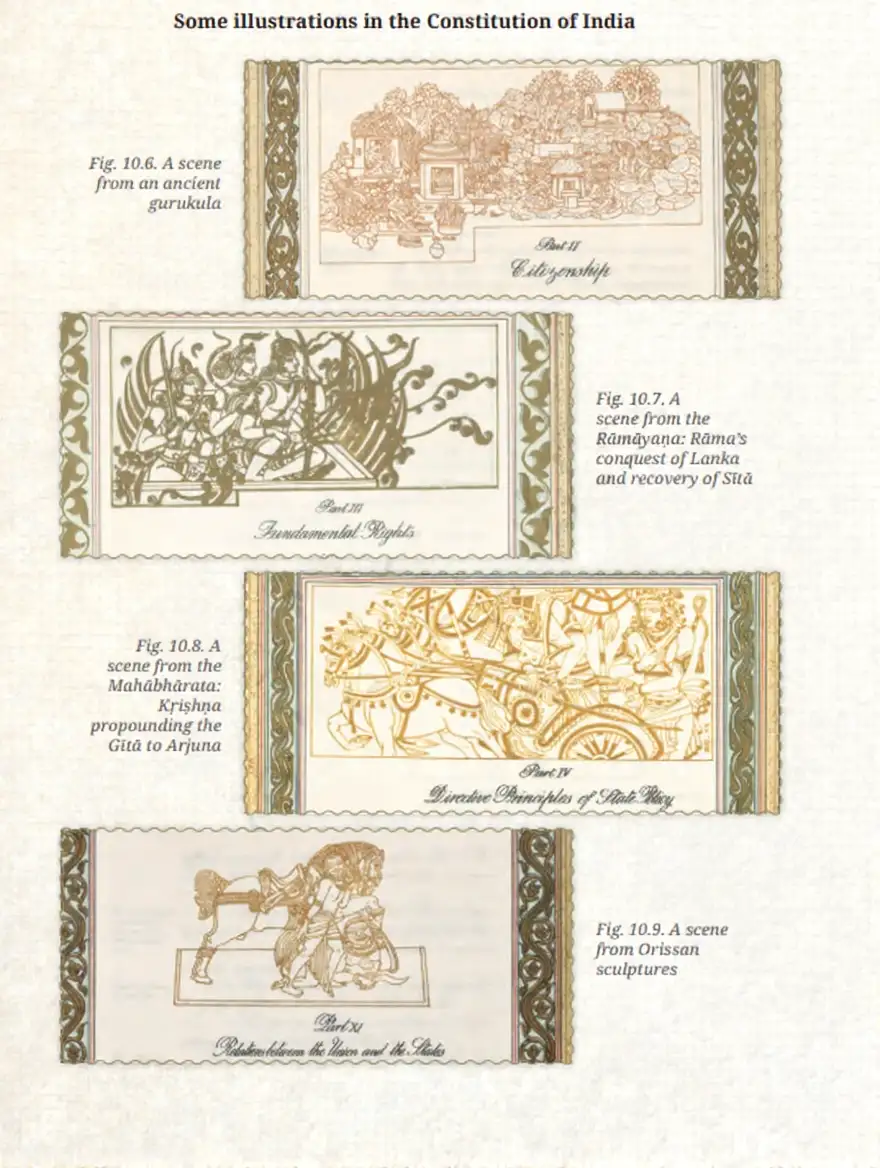
- Handwritten text Calligrapher Prem Behari Narain Raizada wrote the Constitution by hand.
- Illustrations Nandalal Bose and his team illustrated its pages with scenes from Indian history, from Mohenjo-daro to the freedom movement.
The Preamble: Guiding Values
Preamble — The Constitution’s opening statement, expressing its core values and the goals that should guide government decisions and citizens’ conduct.
Who gives the Constitution its authority?
- “We, the people of India” means the Constitution was made and adopted by the people through their representatives—not handed down by a king or an outside power.
- Adoption The Constituent Assembly adopted, enacted and gave the Constitution to the people on 26 November 1949.
| Value | Meaning | Everyday application |
|---|---|---|
| Sovereign | India has supreme authority over its internal and external decisions; no outside power dictates its government. | The country makes its own laws and decisions. |
| Socialist | Wealth is produced socially and should benefit society; government should reduce socio-economic inequalities by regulating land and industry ownership. | Public policies can support disadvantaged groups and reduce unequal access to resources. |
| Secular | There is no official religion; citizens may follow any religion and the government respects all beliefs and practices equally. | People can practise their religion without interfering with others’ daily lives. |
| Democratic | People have equal political rights, elect their rulers and hold them accountable; government follows basic rules. | Citizens vote and can question their elected representatives. |
| Republic | The head of state is elected, not a hereditary ruler. | The position of head of state is not inherited within a family. |
| Justice | Citizens should not face discrimination based on caste, religion or gender. Social inequalities should be reduced, and government should work for everyone’s welfare, especially less advantaged groups. | Jobs should offer equal opportunity regardless of gender, caste or religion. |
| Liberty | Freedom of thought, expression, belief, faith and worship, without unreasonable restrictions. | People can express their views and choose their beliefs within the law. |
| Equality | Everyone is equal before the law; social inequalities have to be ended, and the government should ensure equal opportunities for all. | Rules and opportunities should apply fairly to all. |
| Fraternity | A sense of shared community that protects each person’s dignity and the nation’s unity. | Treat every fellow citizen as an equal member of the community. |
- Amendment
- A formally approved change to the Constitution.
- Preamble
- The Constitution’s opening statement of values and goals.
- Sovereign
- Having supreme authority to make decisions without outside control.
- Secular
- Having no official religion and treating all religions equally.
- Republic
- A state whose head is elected rather than hereditary.
- Fraternity
- A shared sense of community that upholds dignity and unity.
Why is the Indian Constitution called a living document?
What does “We, the people of India” mean in the Preamble?
Quick recap
- The Constitution adapts to new needs through amendments and legal decisions.
- Amendments are debated in Parliament; some also involve State Legislative Assemblies, public feedback or popular movements.
- The 73rd Amendment integrated Panchayati Raj into the Constitution in 1992.
- The government’s 2020 Aadhaar draft proposed allowing entities beyond government departments to use authentication for prescribed purposes.
- The Preamble states the Constitution’s guiding values and was adopted on 26 November 1949.
- The Preamble’s ideals include sovereignty, socialism, secularism, democracy, republican government, justice, liberty, equality and fraternity.
- The words “Socialist” and “Secular” were added to the Preamble in 1976 through the 42nd Amendment.
Before we move on
The Constitution as a Guiding Rulebook
Constitution of India — The Constitution is the guiding rulebook that protects citizens’ rights and sets out their fundamental duties.
Foundations and Role
- Foundations: India’s civilizational heritage, the freedom struggle and good practices from other countries’ constitutions shaped the Constitution.
- Structure: Its key features define India’s social, economic and political structure, including its parliamentary form of government.
- Living document: It can be improved to meet the changing needs of the country.
- Fundamental duties
- Responsibilities that citizens are expected to follow under the Constitution.
- Parliamentary form of government
- A key feature of the system of government defined by the Constitution.
- Living document
- A document that can be improved as the country’s needs change.
Quick recap
- The Constitution is India’s guiding rulebook and protects citizens’ rights.
- Citizens are expected to follow their fundamental duties.
- India’s heritage, freedom struggle and constitutional practices from other countries helped shape it.
- It defines the country’s social, economic and political structure, including parliamentary government.
- As a living document, it can be improved to meet the country’s needs.
Social Science — ALL CHAPTERS
1
Geographical Diversity of India
2
Understanding the Weather
3
Climates of India
4
New Beginnings Cities and States
5
The Rise of Empires
6
The Age of Reorganisation
7
The Gupta Era: An Age of Tireless Creativity
8
How the Land Becomes Sacred
9
From the Rulers to the Ruled: Types of Governments
10
The Constitution of India - An Introduction
11
From Barter to Money
12
Understanding Markets
1
The Story of Indian Farming
2
India and Her Neighbours
3
Empires and Kingdoms: 6th to 10th Centuries
4
Turning Tides: 11th and 12th Centuries
5
India, a Home to Many
6
The State, the Government, and You
7
Infrastructure: Engine of India’s Development
8
Banks and the Magic of Finance