Class 7 . Social Science . Exploring Society India and Beyond Part I . The Age of Reorganisation
Chapter 6: The Age of Reorganisation
Ch 6
Social Science
Class 7
Introduction
The End of the Maurya Empire
From one empire to many kingdoms
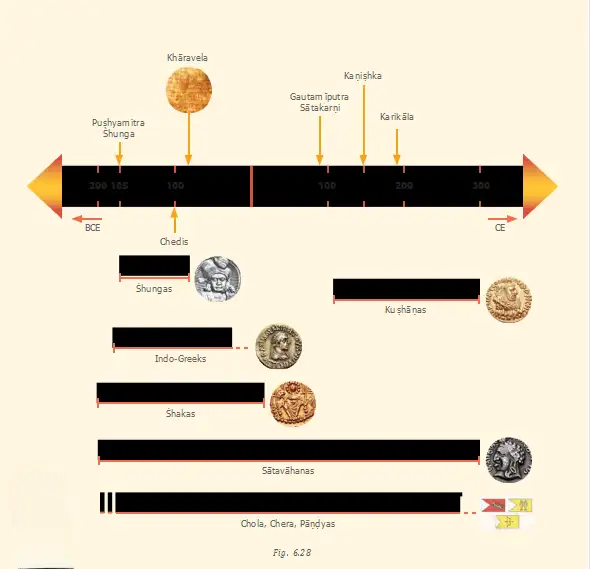
- Around 185 BCE: It is generally accepted that the last Maurya emperor was assassinated by his commander-in-chief, Pushyamitra Shunga.
- Timing: The assassination and breakup came hardly half a century after Ashoka.
- After the Mauryas: The empire broke up, and many new kingdoms emerged across the subcontinent.
- Former tributaries: Many new kingdoms had earlier been tributary kingdoms under Maurya overlordship.
- Northwest: The region weakened, making it more exposed to invasions from outside the subcontinent.
Break-up and its effects
- It is generally accepted that the last Maurya emperor was assassinated around 185 BCE, hardly half a century after Ashoka
- The Maurya Empire broke up
- New kingdoms emerged, including former tributary kingdoms
- Kingdoms competed for territory; the weakened northwest became vulnerable to invasions
Why It Is Called the Age of Reorganisation
Age of Reorganisation — A period when existing regions were reorganised into new kingdoms that competed to become powerful.
A changing subcontinent
- Political change: The map of India changed significantly as new kingdoms arose and competed for control.
- Long period: The chapter covers 200 BCE to 300 CE—500 years when counted inclusively.
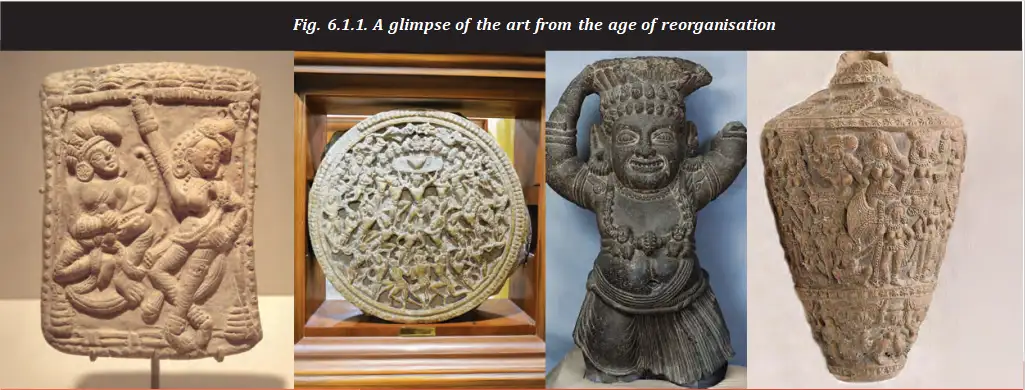
- Cultural change: Art, architecture and literature flourished, alongside enriching cultural exchanges.
Competition and Alliances
How kingdoms sought control
- Territorial competition: New kingdoms struggled to control land, especially border areas important for protection from attacks.
- Peaceful means: Neighbouring kingdoms could form matrimonial alliances.
- Warfare: Kingdoms also used force to gain territory and power.
Matrimonial alliance — An alliance between kingdoms arranged through a marriage, usually between members of royal families.
- Tributary kingdom
- A kingdom that paid tribute to a more powerful ruler or empire.
- Overlordship
- The authority or control exercised by a more powerful ruler over another kingdom.
- Matrimonial alliance
- A political alliance formed through a marriage between royal families.
- Age of Reorganisation
- The period in which regions were reorganised into competing kingdoms.
Period Covered
- 200 BCEBeginning of the period covered: the first year of the 2nd century BCE.
- Around 185 BCEIt is generally accepted that the last Maurya emperor was assassinated by Pushyamitra Shunga; this was hardly half a century after Ashoka, and the empire broke up.
- 300 CEEnd of the period covered: the last year of the 3rd century CE.
Why is this period called the Age of Reorganisation?
What methods did kingdoms use to gain control?
Quick recap
- It is generally accepted that the last Maurya emperor was assassinated around 185 BCE by Pushyamitra Shunga, hardly half a century after Ashoka.
- The Maurya Empire broke up, and many new kingdoms arose, including former tributary kingdoms.
- The weakened northwest became more vulnerable to invasions from outside the subcontinent.
- New kingdoms competed for land, using alliances and warfare; border control was important for security.
- Art, architecture, literature and cultural exchange flourished during this period.
- The period covered runs from 200 BCE to 300 CE, or 500 years counted inclusively.
Surge of the Śhungas
Puṣhyamitra Shunga and the Dynasty
- Founder: Puṣhyamitra Śhunga founded the Śhunga dynasty after assassinating the last Maurya emperor around 185 BCE.
- Kingdom: The Śhungas ruled parts of north and central India; their empire was smaller than the Maurya Empire and lasted about a century.
Ashvamedha Yajña
Beliefs, Language and Learning
- Vedic traditions: Vedic rituals and practices revived under the Śhungas, while other schools of thought continued to flourish.
- Sanskrit: It became a preferred language for philosophical and literary works.
- Learning: Patañjali compiled the Yoga Sūtras during this period.
Shunga Patronage and the Bharhut Stūpa
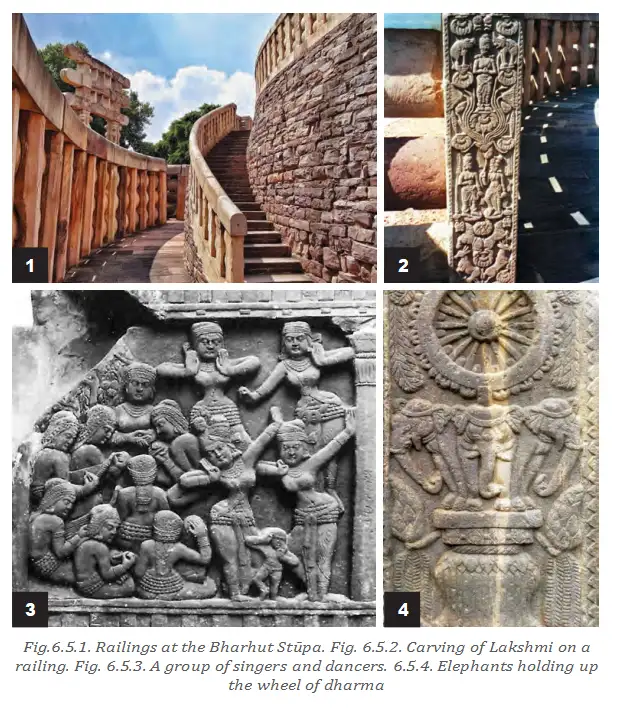
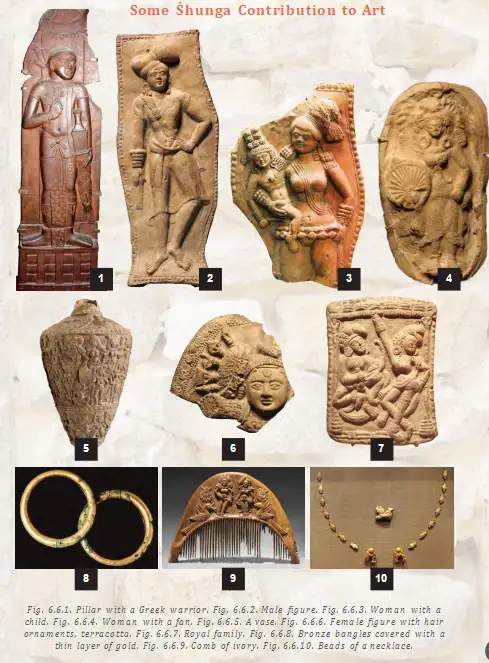
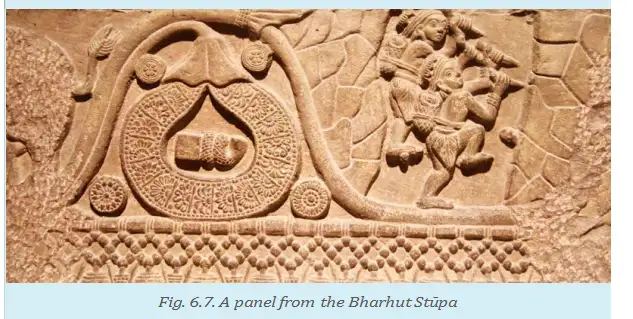
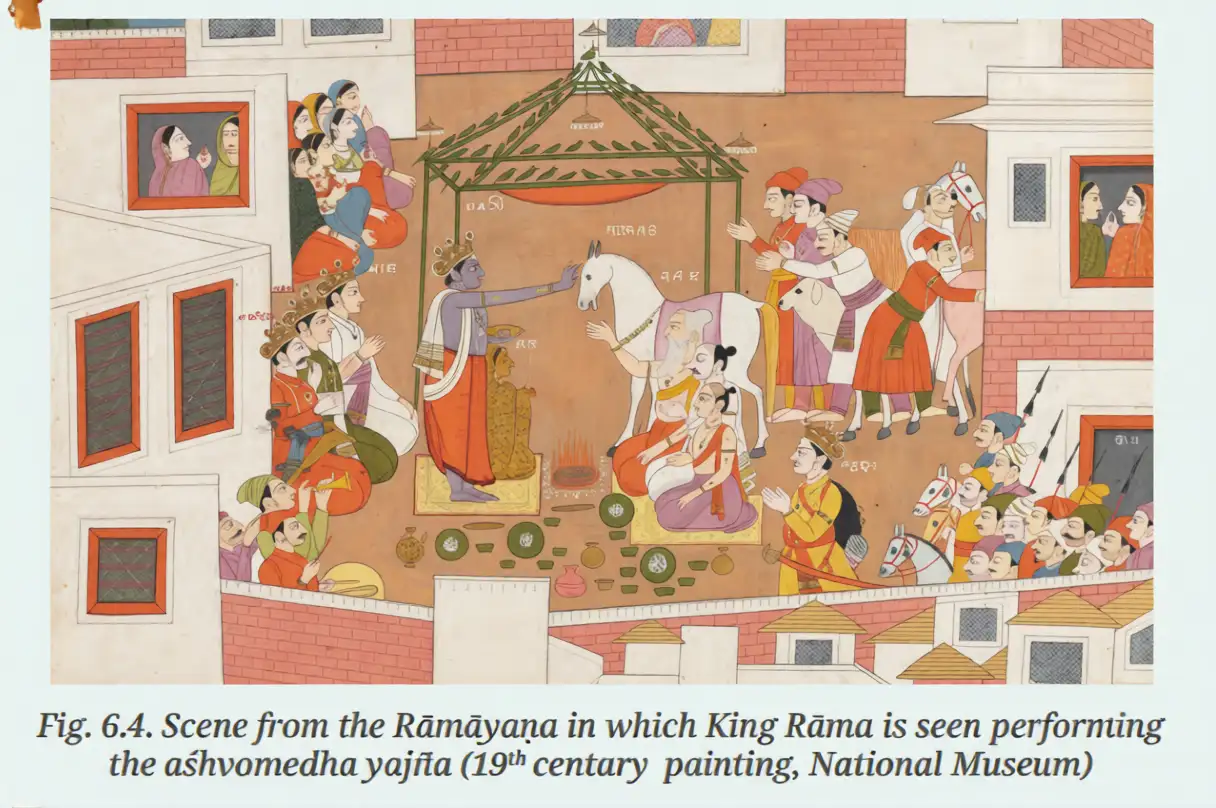
- Ashvamedha yajña
- A Vedic horse ritual through which a ruler declared royal power and could claim unchallenged territories.
- Relief
- A sculpted design that projects from a flat background.
- Bharhut Stūpa
- A stūpa in present-day Madhya Pradesh featuring important early Buddhist carvings.
How did the ashvamedha yajña work?
What was the significance of the Shunga additions to the Bharhut Stūpa?
Quick recap
- Puṣhyamitra Shunga founded a smaller empire in parts of north and central India.
- He performed the ashvamedha yajña to assert his power as king.
- The Shungas protected their territory and later maintained friendly relations with the Greeks.
- Vedic practices revived, while other schools of thought continued to flourish.
- Sanskrit gained importance, and Patañjali compiled the Yoga Sūtras.
- Shunga additions to Bharhut include carved railings and early Buddhist reliefs, with subjects such as Lakshmi, performers and elephants holding the wheel of dharma.
The Sātavāhanas
The Sātavāhana Kingdom
Period
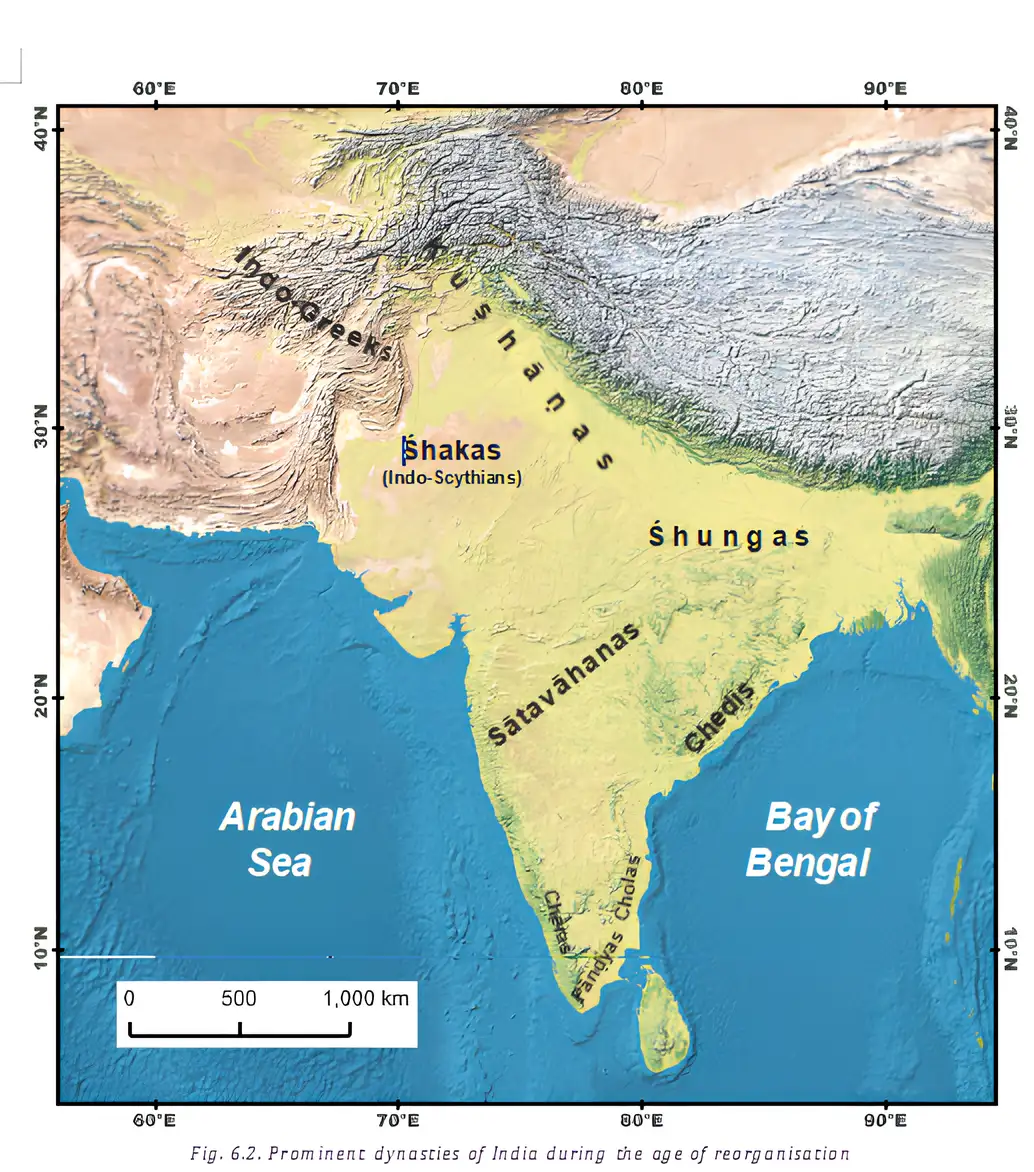
- From the 2nd century BCE onwardThe Sātavāhanas ruled large parts of the Deccan, south of the Śhunga Empire.
Rule and territory
- Other name: The Sātavāhanas were sometimes called the Andhras.
- Territory: Their kingdom largely covered present-day Andhra Pradesh, Telangana and Maharashtra.
- Capitals: Amarāvatī and Pratiṣṭhāna (Paithan) were among their best-known capitals; capitals changed over time.
- Neighbours: The Śhungas may have fought wars with neighbouring regions, possibly including the Sātavāhanas.
- Deccan
- The broad plateau region of south-central India where the Sātavāhanas ruled large territories.
- Pratiṣṭhāna (Paithan)
- One of the Sātavāhanas’ best-known capitals.
- Tolls
- Charges collected from traders using routes or trade facilities.
Trade and Economic Life
Trade, coins and agriculture
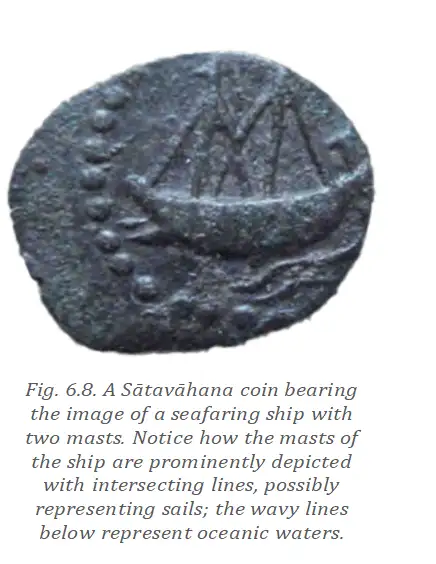
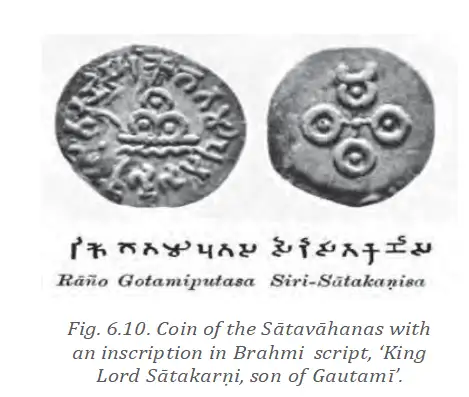
- Coins: Sātavāhana coins have been found across regions from Gujarat to Andhra Pradesh, along India’s western and eastern coasts.
- Maritime trade: Many coins show ships, indicating the importance of sea trade; ship designs suggest advanced shipbuilding and navigation.
- Agriculture: Farming flourished in the Krishna–Godavari river system, supporting the kingdom’s economic stability.
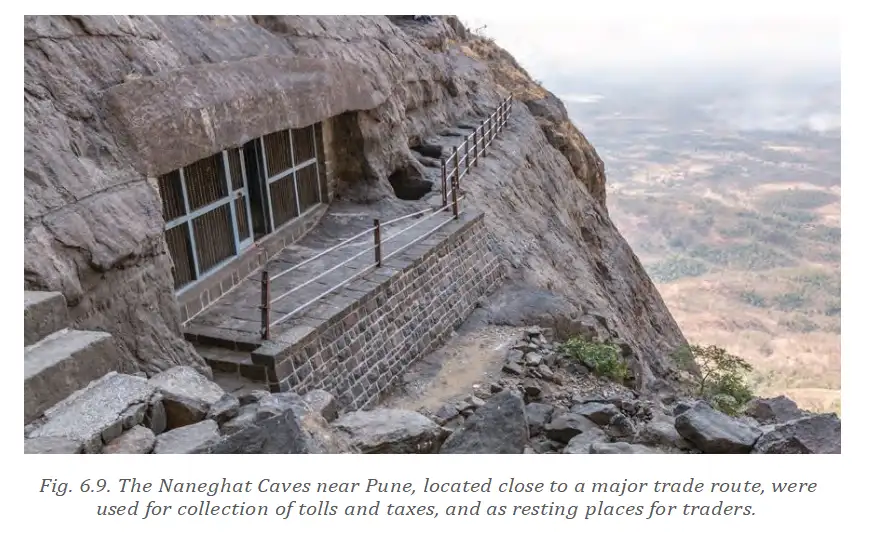
- Trade links: Networks extended as far as the Roman Empire.
- Goods exchanged: Spices, textiles, sandalwood, gold-plated pearls and ivory were among the goods exchanged.
- Imports: Glass and perfumed ointments were brought in.
- Revenue: Tolls and taxes on trade added income to the kingdom.
Literature, Art and Culture
Conditions supporting cultural development
- Trade and agriculture supported economic prosperity.
- Economic prosperity and a relatively peaceful political period created favourable conditions.
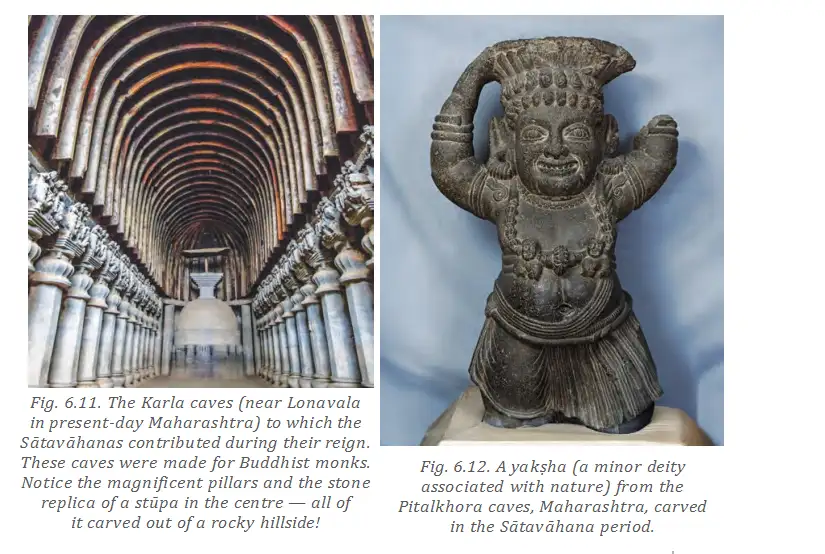
- Literature, art and culture developed, with significant contributions from the Sātavāhanas.
What evidence points to the importance of maritime trade under the Sātavāhanas?
Name important goods exchanged and sources of trade revenue under the Sātavāhanas.
Quick recap
- The Sātavāhanas, also known as the Andhras, ruled much of the Deccan from the 2nd century BCE onward.
- Their territory largely included present-day Andhra Pradesh, Telangana and Maharashtra; Amarāvatī and Pratiṣṭhāna were important capitals.
- Coins found from Gujarat to Andhra Pradesh often depict ships, pointing to significant maritime trade.
- Agriculture in the Krishna–Godavari river system strengthened the kingdom’s economy.
- Sātavāhana trade extended to the Roman Empire and generated revenue through tolls and taxes.
- Economic prosperity and relative political peace supported the growth of literature, art and culture.
Life Under the Sātavāhanas
Queens, Names and Inscriptions
- Maternal names: Sātavāhana princes were often named after their mothers. Gautamīputra Sātakarṇi was named after his mother, Gautamī Balaśhrī.
- Gautamī Balaśhrī: She was a powerful queen who donated land to Buddhist monks and had an important inscription carved at Nāśhik.
- Naneghat inscriptions: Inscriptions in caves near Pune record a Sātavāhana widow queen who performed Vedic rituals, including the aśhvamedha yajña.
- Rituals and deities: The inscriptions mention Vedic gods including Indra, Chandra and Sūrya.
- Donations: The queen gave land, cows, horses, elephants, silver coins and other items to priests, guests, workers, scholars and monks.
Brahmi Script and Numerals
- Script: The inscriptions were written in Brahmi and included symbols for numbers.
- Numerals: Some ancient numeral forms resemble modern numerals, while others look different.
- Origin: These inscriptions are evidence that modern numerals ultimately originated in India.

Religious Patronage and Skilled Craftspeople
- Belief and patronage: The Sātavāhanas were devoted to Vāsudeva, another name for Kṛṣṇa, and also supported other schools of thought.
- Land grants: Kings often granted tax-free agricultural land to Vedic scholars and Jaina and Buddhist monks, supporting their studies and religious practices.
- Craft skills: A Pitalkhora yakṣha sculpture bears an inscription saying it was made by Kanahadasa, a goldsmith. This shows that skilled craftspeople could make objects in materials beyond their usual trade.
- Brahmi
- The script used in the Sātavāhana inscriptions described here.
- Aśhvamedha yajña
- A Vedic ritual performed by the widow queen recorded in the Naneghat inscriptions.
- Dāna
- A gift or donation; the inscriptions list gifts made to different groups.
- Tax-free land grant
- Agricultural land granted without taxes, including to scholars and religious communities.
Fragmentation of the Empire
- 3rd century CEThe Sātavāhana Empire fragmented into smaller independent kingdoms.
Why the Empire Fragmented
- Weak central control and gradual economic decline
- The empire's control weakened
- The empire fragmented into smaller independent kingdoms
- Regional powers asserted or reasserted their dominance and established new kingdoms
What do the Naneghat inscriptions reveal about the Sātavāhana widow queen?
How did the Sātavāhanas support different religious and scholarly communities?
What were the main causes and consequences of the Sātavāhana Empire's fragmentation?
Quick recap
- Sātavāhana princes were often named after their mothers; Gautamī Balaśhrī was an influential queen.
- Naneghat inscriptions record a widow queen's Vedic rituals and extensive donations.
- Brahmi inscriptions and numerals provide evidence for the Indian origins of modern numerals.
- The Sātavāhanas supported Vāsudeva worship and patronised other schools of thought.
- Tax-free land grants supported scholars and Jaina and Buddhist monks; inscriptions also reveal skilled craftspeople.
- In the 3rd century CE, weak central control and economic decline contributed to fragmentation and the rise of regional kingdoms.
Coming of the Chedi
The Chedi Dynasty and Kharavela
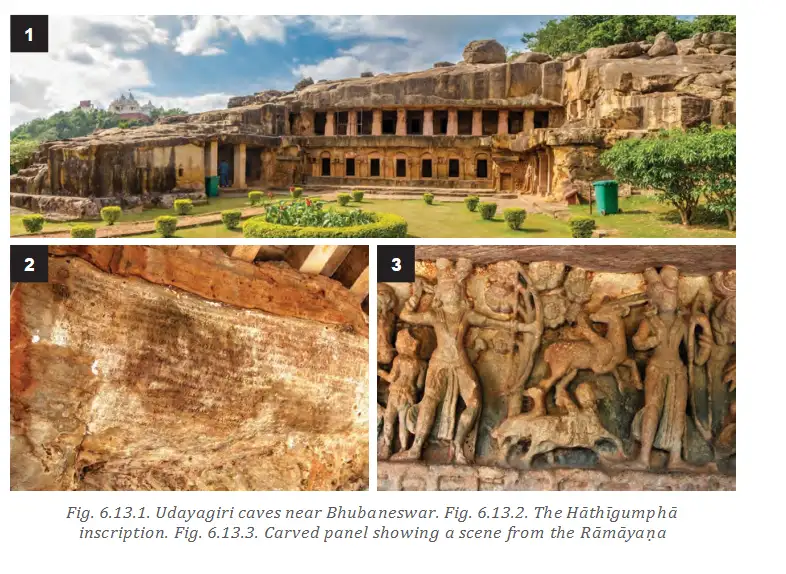
Hathigumpha inscription — A Brahmi-script inscription in a Udayagiri cave that records Kharavela’s achievements year by year.
What the inscription records
- Achievements: It describes Kharavela’s victorious military campaigns and works for the welfare of his people.
- Religious respect: Kharavela claimed to have formed a council of ascetics and sages from a hundred regions.
- Protection of faiths: He described himself as respectful of every sect and as a repairer of every temple.
- Significance: The ruler’s support for different schools of thought reflects a tradition of religious respect.
Kingdoms and Life in the South
Period of the Southern Kingdoms
- 2nd or 3rd century BCE to 3rd century CEThe Chera, Chola and Pandya kingdoms rose to prominence in southern India.
| Kingdoms | Relations and significance |
|---|---|
| Cheras, Cholas and Pandyas | They often competed for control of the South and contributed to the growth of trade and culture. |
Independence and Kharavela’s Campaign
- Mauryan independence: Ashoka’s edicts mention the southern kingdoms beyond the limits of his empire, suggesting they remained independent even at the height of Mauryan power.
- Kharavela’s claim: He said he defeated an alliance of southern kings that threatened his territory.
- Limits of the evidence: The battle’s location is unknown, and Kharavela does not appear to have invaded the southern region.
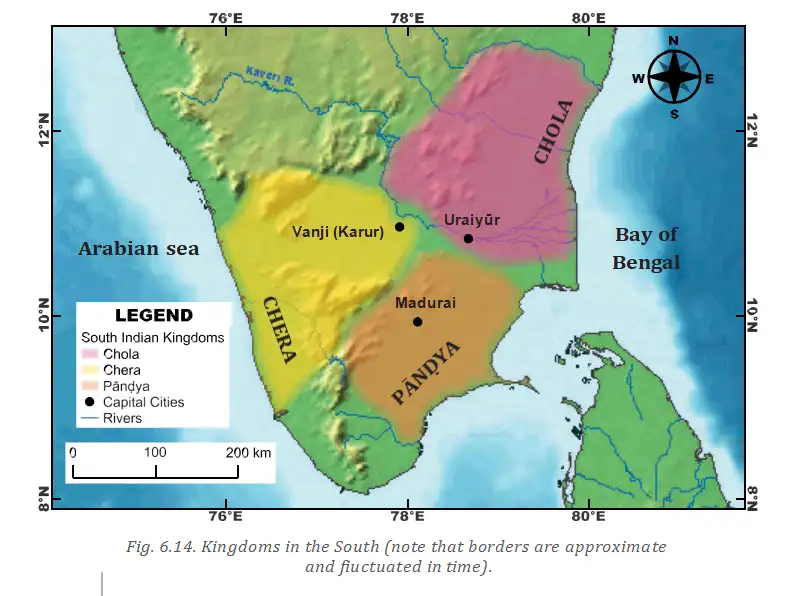
Sangam literature — Collections of poems from ancient South India that express personal emotions and social values.
The Sangam Age
- Name: *Sangam* comes from Sanskrit *sangha*, meaning an association or coming together; here it refers to an assembly of poets.
- Importance: Sangam literature, the oldest literature of South India, consists of several collections or anthologies of poems.
- Historical source: Historians use these poems to investigate the society and culture of the time.
- Themes: Poems describe personal emotions such as love and social values such as heroism and generosity.
- Rock-cut architecture
- Architecture formed by carving structures directly into rock.
- Hathigumpha inscription
- A Brahmi inscription recording Kharavela’s achievements.
- Sangam
- An assembly or coming together; in this context, an assembly of poets.
- Sangam Age
- The era associated with the poetry and literary collections called Sangam literature.
What does the Hathigumpha inscription tell us about Kharavela?
Why were the southern kingdoms considered independent during Mauryan rule?
What is the significance of Sangam literature?
Quick recap
- Kalinga became a major power under the Chedi dynasty after the decline of the Maurya Empire.
- Kharavela followed Jain teachings while respecting different sects and supporting temples.
- The Hathigumpha inscription records Kharavela’s campaigns, public works and religious outlook.
- The Cheras, Cholas and Pandyas competed in South India and fostered trade and culture.
- Ashoka’s edicts suggest these southern kingdoms remained outside the Mauryan Empire.
- Sangam literature preserves poems that help historians study ancient South Indian society and culture.
The Cholas
The Sangam Kingdoms and the Cholas
- Three crowned kings: The Cholas, Cheras and Pāṇḍyas were the major kingdoms of south India during the Sangam Age.
- Cholas: They ruled parts of south India from the 3rd century BCE to the 13th century CE.
- Karikāla: The Chola king is said to have defeated a combined force of the Cheras and Pāṇḍyas.
Silappadikaram: The Tale of the Anklet
- Story: In the epic, Kovalan is falsely accused of theft and executed in Madurai; Kaṇṇagi proves his innocence with her anklet.
- Justice: The Pāṇḍya king dies of shock after realising his mistake, and Kaṇṇagi’s curse brings destruction to Madurai.
- Theme: The poem highlights justice and a ruler’s duty to protect it.
Karikala and the Kallanai
- Public works: Karikāla undertook projects to benefit his people, including the Kallaṇai, or Grand Anicut.
- Irrigation: The water-diversion system directed Kāveri water into the delta, expanding cultivation and supporting the region known as the “rice bowl of the South.”
The Cheras
- Kingdom: The Cheras, also called Keralaputras, ruled western Tamil Nadu and Kerala, with their capital at Vanji, identified with present-day Karur.
- Culture: They encouraged Tamil literature and patronised Sangam poets.
- Trade: Chera trade with the Roman Empire and West Asia included spices, timber, ivory and pearls.
The Pandyas
- Kingdom: The Pāṇḍyas ruled parts of Tamil Nadu from their capital at present-day Madurai.
- Trade and power: They traded with distant powers, including the Greeks and Romans, and were an important naval power.
- Prosperity: Their kingdom was known for pearls, and Pāṇḍya kings promoted public welfare and supported different schools of thought.
Invasions of the Indo-Greeks
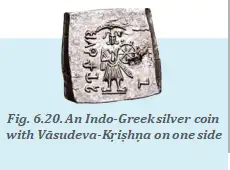
The Śhakas and the Śhaka Samvat
Key periods and dates
- 3rd century BCE–13th century CEThe Cholas ruled parts of south India.
- Several centuries BCEPandya rule in parts of Tamil Nadu and surrounding regions was already established.
- Latter part of the 2nd century BCE–5th century CEThe Śhakas ruled in the northwest after the Indo-Greeks.
- 1957The Śhaka Samvat was adopted as the Indian National Calendar.
- Keralaputras
- ‘Sons of Kerala’; another name for the Cheras.
- Satraps
- Regional rulers left behind by Alexander; they later established independent domains and became known as Indo-Greeks.
- Heliodorus pillar
- A pillar near Vidisha bearing an inscription by the Indo-Greek ambassador Heliodorus.
- Śhaka Samvat
- A calendar developed during Śhaka rule and adopted as India’s National Calendar in 1957.
What does Silappadikaram teach about justice and a ruler’s duty?
What evidence shows interaction between Indo-Greek and Indian cultures?
Quick recap
- The Cholas, Cheras and Pandyas were the three Sangam ‘crowned kings’.
- Silappadikaram links Kaṇṇagi’s story with justice and a ruler’s duty to protect it.
- Karikala’s Kallanai diverted Kāveri water and supported cultivation in the delta.
- The Cheras supported Tamil literature and traded with Rome and West Asia.
- The Pandyas traded internally and with Greeks and Romans, and were known for pearls and naval power.
- Indo-Greek coins and the Heliodorus pillar show cultural interaction; Indo-Greek rule extended into northwestern, northern and central regions.
- The Śhaka Samvat was adopted as the Indian National Calendar in 1957.
The Emergence of the Kuṣhāṇas Part-1
The Kushana Empire
Kushana Arrival
- Probably 2nd century CEThe Kushanas entered India from Central Asia.
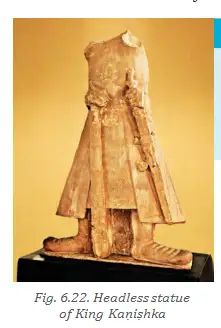
Kanishka
Kanishka as Ruler and Patron
- Power: Kanishka was probably the most powerful ruler of the Kushana dynasty.
- Patronage: Beyond military campaigns, he encouraged art and culture, supporting the growth of new artistic styles.
- Inscription: A Brahmi inscription on his 1.85-metre statue calls him “great king, king of kings, son of God.”
Coins and Religious Symbols
| Coin | One side | Other side |
|---|---|---|
| First coin | Kanishka holding a spear, titled “King of Kings” | Buddha, with the Greek-script inscription BOΔΔO |
| Second coin | An emperor | Shiva with the bull Nandi |
What the Coins Show
- Religious imagery: Buddha and Shiva appear alongside the ruler on Kushana coins.
- Significance: The coins reflect the presence of different religious traditions during Kushana rule.
Trade and the Silk Route
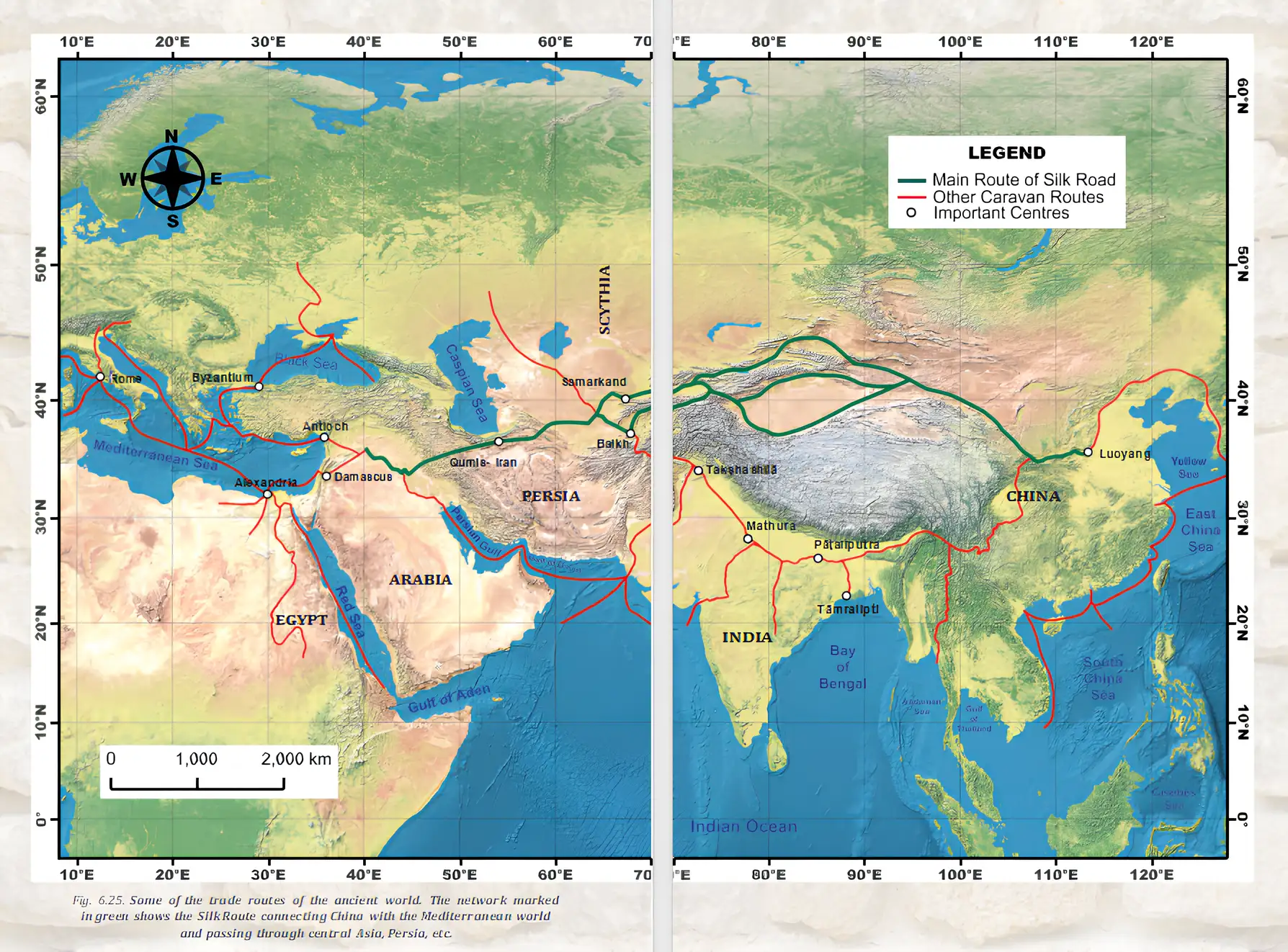
Kushana Control and Trade
- The Kushanas controlled important sections of the Silk Route.
- Control of these routes helped trade grow during their reign.
- Trade connected India with other parts of Asia and the West.
Kushana Art and Architecture
Artistic Developments
- Influences: Continuing a trend from Indo-Greek rule, Kushana art blended Indian and Greek styles.
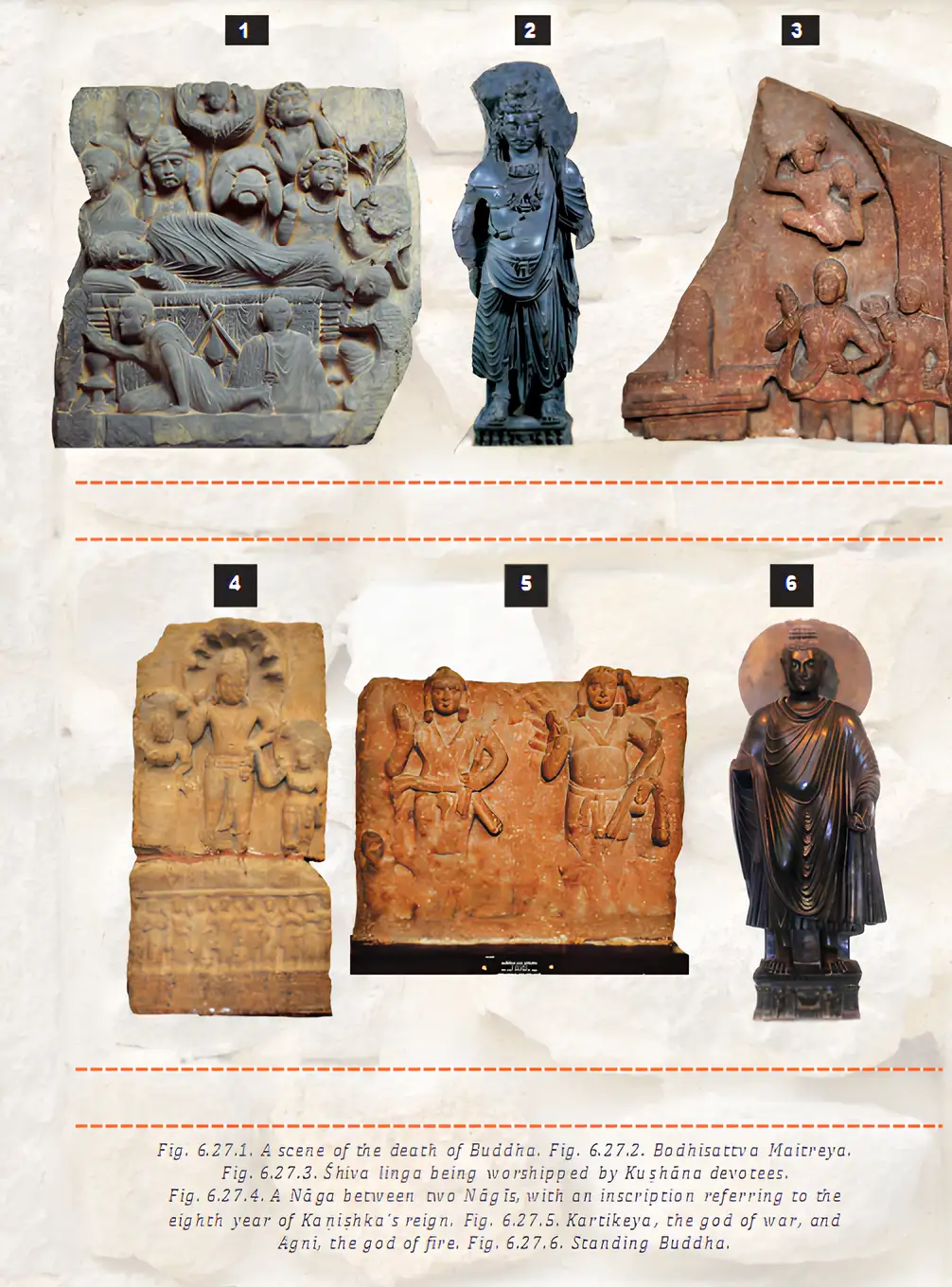
- Schools: Gandhara and Mathura became celebrated centres of art and architecture.
- Religious art: Sculptures depicted a range of deities, reflecting the peaceful coexistence of different schools of thought.
- Deity images: More human-like representations, including Surya, the sun god, became common.
- Legacy: The growth of religious art helped lay the foundations for later temple architecture in the subcontinent.
| Point | Gandhara | Mathura |
|---|---|---|
| Known for | A fusion of Greco-Roman elements and Indian features | A celebrated Kushana-era school; the text gives no further style details |
| Region / material | Western regions of Punjab; often grey-black schist | Not specified in this lecture |
| Notable works | Detailed Buddha images with realistic anatomy and flowing robes | Not specified in this lecture |
- Kushanas
- A Central Asian dynasty that ruled a large empire extending into northern India.
- Silk Route
- A network of trade routes linking regions including China, Central Asia, Persia and the Mediterranean.
- Gandhara school
- An artistic tradition blending Greco-Roman elements with Indian features.
- Mathura school
- One of the celebrated art schools of the Kushana period.
What does the appearance of Buddha and Shiva on Kushana coins indicate?
State two features of the Gandhara school of art.
Quick recap
- The Kushanas came from Central Asia and probably entered India in the 2nd century CE.
- Kanishka was a powerful ruler who encouraged art and culture.
- Kushana coins depicted rulers as well as deities such as Buddha and Shiva.
- Control of Silk Route sections supported trade between India, Asia and the West.
- Gandhara and Mathura were celebrated art schools; Gandhara blended Greco-Roman and Indian styles.
The Emergence of the Kuṣhāṇas Part-2
The Mathura School of Art
Mathura style — An Indian art style that developed in the Mathura region of present-day Uttar Pradesh.
- Material: Sculptures primarily used red sandstone.
- Appearance: Figures were generally fuller, with smooth modelling.
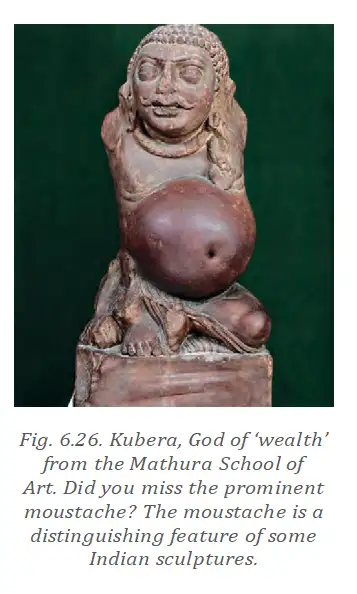
- Themes: Sculptures depicted Indian deities and figures, including Kubera, Lakshmi, Shiva, Buddha, yakshas and yakshinis.
- Distinctive character: The style reflects Indian aesthetics and has less Greco-Roman influence than the Gandhara style.
Cultural Exchange and Literature
- Cultural exchange: Despite political conflicts and power struggles, the period saw interaction and assimilation among cultures.
- Art and architecture: Styles interacted, while Indian themes—especially Hindu and Buddhist themes—remained prominent.
- Sanskrit literature: Sanskrit literature flourished; major Indian texts composed in this broader period included the *Mahabharata* and the *Ramayana*.
- Shared heritage: The past is best understood as a dynamic process shaped by interaction and assimilation over time, not as the achievement of one kingdom or ruler.
Quick recap
- The Mathura style developed in the Mathura region of present-day Uttar Pradesh.
- Mathura sculptures primarily used red sandstone and generally showed fuller figures with smooth modelling.
- Its themes included Indian deities and figures such as Kubera, Lakshmi, Shiva, Buddha, yakshas and yakshinis.
- The Mathura style was distinctly Indian, with less Greco-Roman influence than the Gandhara style; its Kubera sculpture is noted for a prominent moustache.
- The period saw cultural exchange and assimilation, with Indian Hindu and Buddhist themes prominent in art and architecture.
- Sanskrit literature flourished, including the composition of the Mahabharata and the Ramayana.
Before we move on
Political Reorganisation
Political and Cultural Changes
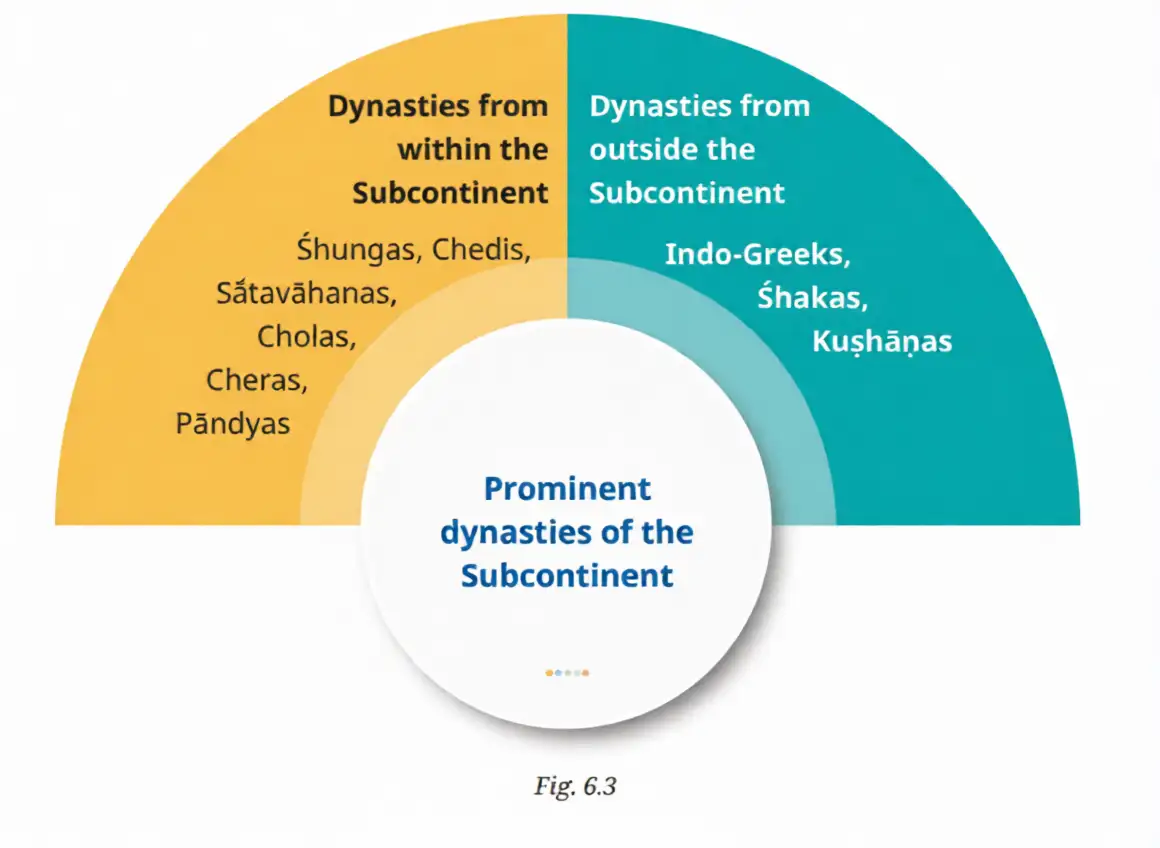
- Kingdoms: After the Maurya Empire disintegrated, many large and small kingdoms emerged across the Subcontinent.
- Conflicts and invasions: Internal conflicts and foreign invasions contributed to a reorganisation of political powers.
- Cultural exchange: Different cultures influenced one another, creating new styles of art, architecture and coinage; Indian themes eventually became dominant.
- Literature: Sanskrit literature flourished during this period.
- Trade: Trade developed remarkably, both within the Subcontinent and with regions beyond it.
Changes after the Maurya Empire
- Disintegration of the Maurya Empire
- Many kingdoms emerge across the Subcontinent
- Internal conflicts combine with foreign invasions
- Political powers reorganise
- Political reorganisation
- A reshaping of political powers and kingdoms.
- Cultural dialogue
- Cultures influencing and absorbing elements from one another.
- Internal and external trade
- Trade conducted within the Subcontinent and with other regions.
Quick recap
- After the Maurya Empire disintegrated, many kingdoms arose across the Subcontinent.
- Internal conflicts and foreign invasions contributed to political reorganisation.
- Cultural exchange shaped new art, architecture and coinage.
- Indian themes became dominant, and Sanskrit literature flourished.
- Both internal and external trade developed remarkably.
Social Science — ALL CHAPTERS
1
Geographical Diversity of India
2
Understanding the Weather
3
Climates of India
4
New Beginnings Cities and States
5
The Rise of Empires
6
The Age of Reorganisation
7
The Gupta Era: An Age of Tireless Creativity
8
How the Land Becomes Sacred
9
From the Rulers to the Ruled: Types of Governments
10
The Constitution of India - An Introduction
11
From Barter to Money
12
Understanding Markets
1
The Story of Indian Farming
2
India and Her Neighbours
3
Empires and Kingdoms: 6th to 10th Centuries
4
Turning Tides: 11th and 12th Centuries
5
India, a Home to Many
6
The State, the Government, and You
7
Infrastructure: Engine of India’s Development
8
Banks and the Magic of Finance