Class 10 . Social Science . Contemporary India II . Agriculture
Chapter 4: AGRICULTURE
Ch 4
Social Science
Class 10
Types ,intensive and Primitive Subsistence and Commercial Farming
Agriculture and Farming Systems
- Agriculture: A primary activity that produces food and raw materials for industries.
- Farming systems: Practices vary with the physical environment, technology and socio-cultural conditions, from subsistence to commercial farming.
Primitive Subsistence Farming
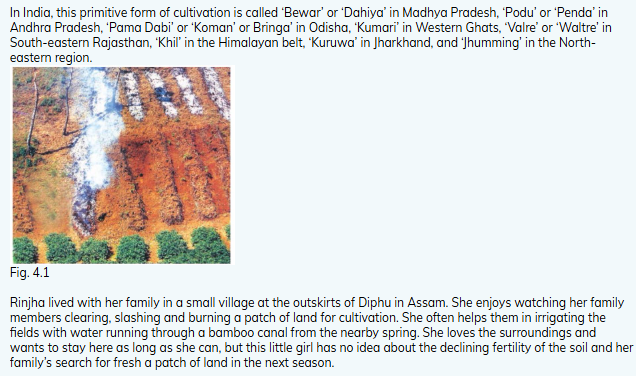
Slash-and-burn cultivation
- Farmers clear and burn a patch of land.
- They grow cereals and other food crops to support their family.
- As soil fertility declines, they shift to a fresh patch.
- The abandoned land can regain fertility through natural processes.
Intensive Subsistence Farming
- Intensive subsistence farming: Practised where population pressure on land is high, using intensive labour, irrigation and biochemical inputs to raise production.
- Small holdings: Inheritance divides land into uneconomical plots, so farmers seek maximum output from limited land, often with few alternative livelihoods.
Commercial Farming
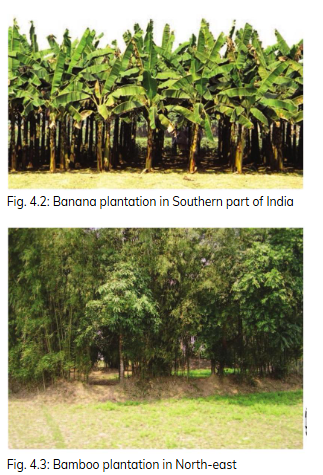
Plantation farming — A type of commercial farming in which a single crop is grown over a large area, usually for processing and sale.
| Crop | Important Indian growing region(s) given |
|---|---|
| Tea | Assam and North Bengal |
| Coffee | Karnataka |
| Rubber | — |
| Sugarcane | — |
| Banana | — |
- Subsistence farming
- Farming mainly to meet the food needs of the farmer’s household.
- Shifting cultivation
- Cultivation in which farmers move to a new patch when the soil on the current plot loses fertility.
- HYV seeds
- High-yielding variety seeds used as a modern farming input.
- Plantation
- Large-scale cultivation of a single crop, generally linked to processing and markets.
Why is primitive subsistence farming called slash-and-burn agriculture?
Why is intensive subsistence farming common where population pressure on land is high?
What makes plantation farming commercial, and why are transport links important?
Quick recap
- Agriculture provides food and industrial raw materials, and supports about two-thirds of India’s population.
- Primitive subsistence farming uses basic tools and follows a slash-and-burn, shifting pattern.
- Primitive subsistence cultivation has different local names, including jhumming, pamlou and dipa.
- Intensive subsistence farming uses labour, irrigation and biochemical inputs to raise output from limited land.
- Commercial farming uses modern inputs, while a crop’s commercial or subsistence role varies by region.
- Plantations grow one crop over a large area and depend on industry, transport and market connections.
Cropping Pattern and Major Crops
Cropping Pattern
Cropping pattern — The cropping pattern is the seasonal arrangement and choice of crops grown in a region, shaped by physical conditions and farming practices.
India's crop seasons
- Crop variety: India grows food and fibre crops, vegetables, fruits, spices and condiments.
- Rabi: Sown in winter, October–December, and harvested in summer, April–June; important crops include wheat, barley, peas, gram and mustard.
- Kharif: Grown with the onset of the monsoon and harvested in September–October; crops include paddy, maize, jowar, bajra, tur, moong, urad, cotton, jute, groundnut and soyabean.
- Zaid: A short summer season between rabi and kharif; crops include watermelon, muskmelon, cucumber, vegetables and fodder crops.
- Sugarcane: Takes almost a year to grow.
Seasonal features
- Rabi regions: Punjab, Haryana, Himachal Pradesh, Jammu and Kashmir, Uttarakhand and Uttar Pradesh are important producers of wheat and other rabi crops.
- Rabi conditions: Winter precipitation from western temperate cyclones supports these crops. The Green Revolution also boosted production in Punjab, Haryana, western Uttar Pradesh and parts of Rajasthan.
- Paddy crops: Assam, West Bengal and Odisha grow three paddy crops in a year: Aus, Aman and Boro.
Major Crops
Crop diversity
- Crop choice: Soil, climate and cultivation practices influence which crops are grown in different parts of India.
- Major crops: Rice, wheat, millets, pulses, tea, coffee, sugarcane, oilseeds, cotton and jute.
Rice
Rice — Rice is a kharif cereal and the staple food crop for a majority of India's people.
Rice: conditions and distribution
- World rank: India is the world's second-largest rice producer after China.
- Climate: Needs high temperature above 25°C, high humidity and annual rainfall above 100 cm.
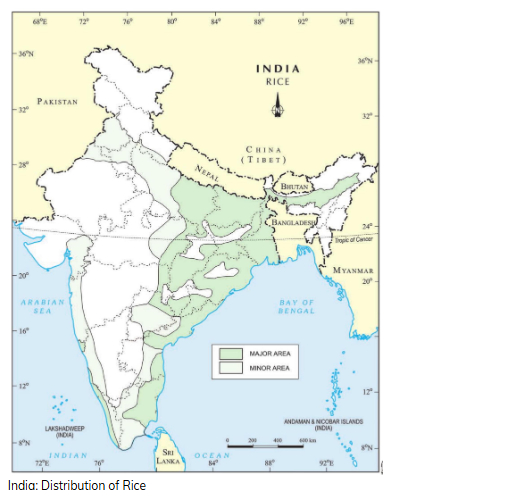
- Distribution: Grown in the northern and north-eastern plains, coastal areas and deltaic regions.
- Major regions: Assam, West Bengal, coastal Odisha, Andhra Pradesh, Telangana, Tamil Nadu, Kerala, Maharashtra (especially the Konkan coast), Uttar Pradesh and Bihar; paddy has recently become important in Punjab and Haryana.
- Irrigation: Canal networks and tubewells allow rice cultivation in lower-rainfall areas, including Punjab, Haryana, western Uttar Pradesh and parts of Rajasthan.
Wheat
Wheat — Wheat is India's second most important cereal and a main food crop in the north and north-west.
Wheat: conditions and distribution
- Season and conditions: A rabi crop requiring a cool growing season and bright sunshine at ripening.
- Rainfall: Requires about 50–75 cm of annual rainfall, evenly distributed over the growing season.
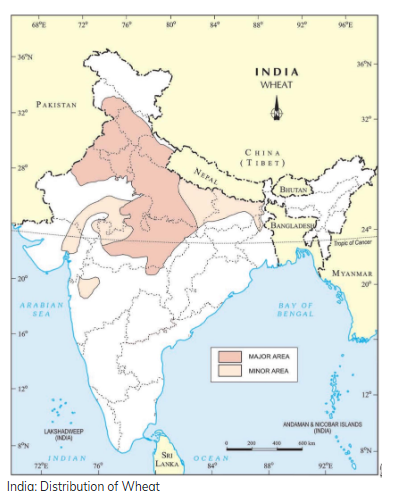
- Growing zones: The Ganga-Satluj plains in the north-west and the black-soil region of the Deccan.
- Major states: Punjab, Haryana, Uttar Pradesh, Madhya Pradesh, Bihar and Rajasthan.
Millets
Millets — Jowar, bajra and ragi are millet crops; although called coarse grains, they have high nutritional value.
Millet types
- Ragi nutrition: Rich in iron, calcium, other micronutrients and roughage.
Maize
Maize — Maize is a crop used as both food and fodder.
Maize: conditions and distribution
- Season and climate: Mainly a kharif crop; requires temperatures of 21–27°C and grows well in old alluvial soil.
- Seasonal variation: In states such as Bihar, maize is also grown in the rabi season.
- Production growth: HYV seeds, fertilisers and irrigation have helped increase production.
- Major states: Karnataka, Madhya Pradesh, Uttar Pradesh, Bihar, Andhra Pradesh and Telangana.
Pulses
Pulses — Pulses are a major source of protein in vegetarian diets.
Pulses: types and importance
- World position: India is the world's largest producer and consumer of pulses.
- Types: Major pulses include tur (arhar), urad, moong, masur, peas and gram.
- Growing conditions: Pulses need little moisture and can survive in dry conditions.
- Soil fertility: Pulses are leguminous crops; all those listed except arhar help restore soil fertility by fixing nitrogen from the air.
- Crop rotation: Pulses are mostly grown in rotation with other crops.
- Major states: Madhya Pradesh, Rajasthan, Maharashtra, Uttar Pradesh and Karnataka.
- Rabi
- Winter-sown crops, generally harvested from April to June.
- Kharif
- Monsoon-season crops, generally harvested in September–October.
- Zaid
- The short summer cropping season between rabi and kharif.
- Leguminous crop
- A crop that can help restore soil fertility by fixing nitrogen from the air.
What conditions does rice need, and how is it grown in areas of low rainfall?
How do pulses contribute to soil fertility?
Quick recap
- India's cropping seasons are rabi, kharif and zaid.
- Rabi crops are winter-sown; kharif crops grow with the monsoon; zaid is a short summer season.
- Rice needs warmth, humidity and abundant rainfall, but irrigation supports it in drier regions.
- Wheat is a cool-season rabi crop grown widely in the north and north-west and in the Deccan black-soil region.
- Jowar, bajra and ragi are nutritious millets suited to different soils and conditions.
- Maize serves as food and fodder; pulses provide protein, need little moisture and mostly help restore soil fertility.
Food Crop Other Than Grains
Sugarcane
Sugarcane — A tropical and subtropical crop that is the main source of sugar and several related products.
- Climate: Grows in hot, humid conditions at 21°C–27°C, with 75–100 cm of annual rainfall.
- Water: Irrigation is needed in regions with low rainfall.
- Soil and labour: Grows in a variety of soils and needs manual labour from sowing to harvesting.
- Uses: Main source of sugar, gur (jaggery), khandsari and molasses.
- Production: India is the world’s second-largest sugarcane producer, after Brazil.
| States |
|---|
| Uttar Pradesh, Maharashtra, Karnataka, Tamil Nadu, Andhra Pradesh, Telangana, Bihar, Punjab and Haryana |
Oilseeds
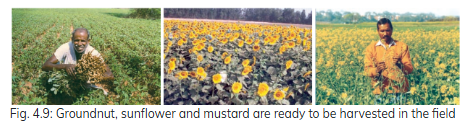
- Area: Different oilseeds are grown on about 12% of India’s total cropped area.
- Main oilseeds: Groundnut, mustard, coconut, sesamum (til), soyabean, castor seeds, cotton seeds, linseed and sunflower.
- Uses: Most oilseeds are edible and used as cooking oils; some are raw materials for soap, cosmetics and ointments.
- Groundnut: A kharif crop that accounts for about half of the major oilseeds produced in India.
| Crop | Season |
|---|---|
| Groundnut | Kharif |
| Linseed and mustard | Rabi |
| Sesamum | Kharif in north India; rabi in south India |
| Castor seed | Both kharif and rabi |
Oilseed production facts
- 2018India was the world’s second-largest groundnut producer after China, and third-largest rapeseed producer after Canada and China.
- 2019–20Gujarat was the largest groundnut producer, followed by Rajasthan and Tamil Nadu.
Tea
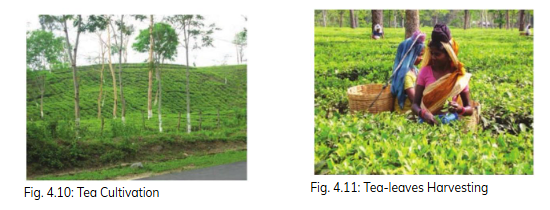
Tea cultivation — An example of plantation agriculture and an important beverage crop introduced to India initially by the British.
- Ownership: Most tea plantations are now owned by Indians.
- Climate and soil: Tea needs a warm, moist, frost-free climate throughout the year, and deep, fertile, well-drained soil rich in humus and organic matter.
- Rainfall: Frequent showers evenly distributed through the year support continuous growth of tender leaves.
- Labour and processing: Tea cultivation is labour-intensive and requires abundant, cheap, skilled labour; leaves are processed in the tea garden to retain freshness.
- Production: In 2018, India was the world’s second-largest tea producer after China.
| Major regions | Other producing states |
|---|---|
| Assam; Darjeeling and Jalpaiguri districts of West Bengal; Tamil Nadu; Kerala | Himachal Pradesh, Uttarakhand, Meghalaya, Andhra Pradesh and Tripura |
Coffee
- Quality and variety: Indian coffee is known for good quality; the Arabica variety, first brought from Yemen, is in great demand worldwide.
- Origin in India: Coffee cultivation was first introduced on the Baba Budan Hills.
- Growing regions: Cultivation is concentrated in Karnataka, Kerala and Tamil Nadu, including the Nilgiri region.
Horticulture Crops
- Production: In 2018, India was the world’s second-largest producer of fruits and vegetables after China.
- Fruit range: India produces both tropical and temperate fruits.
- Important fruits: Mango, orange, banana, lichi, guava, pineapple, grapes, apples, pears, apricots and walnuts are among the fruits grown.
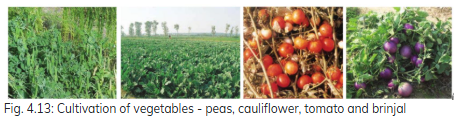
- Important vegetables: Pea, cauliflower, onion, cabbage, tomato, brinjal and potato are important Indian crops.
| Fruit | Important producing regions |
|---|---|
| Mango | Maharashtra, Andhra Pradesh, Telangana, Uttar Pradesh and West Bengal |
| Orange | Nagpur and Cherrapunjee (Meghalaya) |
| Banana | Kerala, Mizoram, Maharashtra and Tamil Nadu |
| Lichi and guava | Uttar Pradesh and Bihar |
| Pineapple | Meghalaya |
| Grapes | Andhra Pradesh, Telangana and Maharashtra |
| Apples, pears, apricots and walnuts | Jammu and Kashmir and Himachal Pradesh |
Quick recap
- Sugarcane grows in hot, humid conditions, needs manual labour and supplies sugar, gur, khandsari and molasses.
- Oilseeds cover about 12% of India’s cropped area; crop seasons vary by oilseed and region.
- Groundnut is a kharif crop and makes up about half of major oilseed production.
- Tea is a labour-intensive plantation crop requiring warm, moist, frost-free conditions.
- India grows Arabica coffee, first brought from Yemen, mainly in Karnataka, Kerala and Tamil Nadu.
- India produces tropical and temperate fruits and a wide range of vegetables.
Non-food Crops , Technological and Institutional Reforms
Non-Food Crops
- Purpose: Non-food crops provide raw materials for industries and other uses rather than being grown mainly as food.
- Examples: Rubber and fibre crops are important non-food crops grown in India.
Fibre Crops
Sericulture — The rearing of silkworms to produce silk fibre is called sericulture.
Cotton
Jute
- Golden fibre: Jute grows in hot conditions on fertile, well-drained soils of flood plains, which are renewed each year.
- Major states: West Bengal, Bihar, Assam, Odisha and Meghalaya are leading jute-producing states.
- Uses: Jute is made into gunny bags, mats, ropes, yarn, carpets and other artefacts.
Technological and Institutional Reforms
Institutional reforms and agricultural programmes
- After Independence: Priorities included collectivisation, consolidation of landholdings, cooperation and abolition of zamindari.
- First Five Year Plan: Land reform was a major focus.
- Implementation gap: Land-reform laws were enacted, but implementation was often weak or lukewarm.
- 1960s–1970s: The Green Revolution, using package technology, and the White Revolution (Operation Flood) were introduced to improve agriculture.
- Uneven gains: Development under these approaches became concentrated in a few selected areas.
Key reform phases
- After IndependenceLand reforms were prioritised, including consolidation, cooperation and abolition of zamindari.
- First Five Year PlanLand reform was made a central focus.
- 1960s–1970sGreen Revolution and White Revolution (Operation Flood) strategies were introduced.
- 1980s–1990sA comprehensive land-development programme combined institutional and technical reforms.
Land-development measures and farmer support
- Risk protection: Crop insurance covered losses from drought, flood, cyclone, fire and disease.
- Credit access: Grameen banks, cooperative societies and banks offered farmers loans at lower interest rates.
- Other schemes: The Government introduced the Kisan Credit Card (KCC) and Personal Accident Insurance Scheme (PAIS).
- Information: Special weather bulletins and agricultural programmes were broadcast on radio and television.
- Price support: Minimum support, remunerative and procurement prices for important crops aim to protect farmers from exploitation by speculators and middlemen.
Bhoodan–Gramdan Movement
- Consolidation of holdings
- Combining fragmented plots into larger, more manageable holdings.
- Green Revolution
- An agricultural improvement strategy based on package technology.
- White Revolution
- Operation Flood, a strategy introduced to improve agriculture.
- Bhoodan
- Voluntary donation of land for distribution among the landless.
- Gramdan
- Donation of a village for distribution among landless people.
What were the main agricultural reforms introduced after Independence?
Distinguish between Bhoodan and Gramdan.
Quick recap
- Rubber needs a hot, moist climate and is an important industrial raw material.
- India's main fibre crops include cotton, jute, hemp and natural silk; silkworm rearing is sericulture.
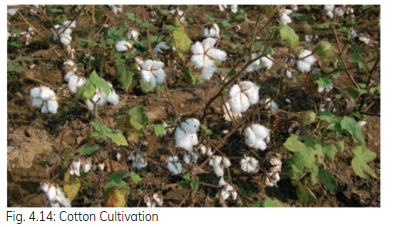
- Cotton is a kharif crop needing warmth, sunshine and a long frost-free period; jute grows in fertile flood plains.
- Land fragmentation, monsoon dependence and weak implementation of reforms hindered agricultural development.
- Post-Independence reforms included land reform, the Green and White Revolutions, insurance, credit and price support.
- Vinoba Bhave's Bhoodan–Gramdan movement promoted voluntary land donations to the landless.
Social Science — ALL CHAPTERS
1
RESOURCES AND DEVELOPMENT
2
FOREST AND WILDLIFE RESOURCES
3
WATER RESOURCES
4
AGRICULTURE
5
MINERALS AND ENERGY RESOURCES
6
MANUFACTURING INDUSTRIES
7
LIFELINES OF NATIONAL ECONOMY
1
POWER SHARING
2
FEDERALISM
3
GENDER, RELIGION AND CASTE
4
POLITICAL PARTIES
5
OUTCOMES OF DEMOCRACY
1
THE RISE OF NATIONALISM IN EUROPE
2
NATIONALISM IN INDIA
3
THE MAKING OF A GLOBAL WORLD
4
THE AGE OF INDUSTRIALISATION
5
PRINT CULTURE AND THE MODERN WORLD
1
DEVELOPMENT
2
SECTORS OF THE INDIAN ECONOMY
3
MONEY AND CREDIT
4
GLOBALISATION AND THE INDIAN ECONOMY
5
CONSUMER RIGHTS