Class 10 . Social Science . Contemporary India II . Forest and Wildlife Resources
Chapter 2: FOREST AND WILDLIFE RESOURCES
Ch 2
Social Science
Class 10
Conservation of Forest and Wildlife in India
Biodiversity and Ecological Interdependence
Biodiversity — The variety of living organisms, diverse in form and function, connected through networks of interdependence.
Why biodiversity matters
- Interdependence: Humans and other organisms are parts of an ecological system and depend on it for survival.
- Life-support systems: Plants, animals and microorganisms help maintain the air, water and soil essential to life.
- Forests: As primary producers, forests support the food webs on which other living beings depend.
Flora and Fauna in India
India's biological richness
- Rich diversity: India is among the world's richest countries in biological diversity; its known diversity may be two or three times the number of species still to be discovered.
- Daily importance: Diverse plants and animals are closely integrated into human life, although people often take these resources for granted.
- Pressure: Insensitivity towards the environment has placed flora and fauna under great stress.
Why Forest and Wildlife Conservation Is Essential
Conservation — The protection and careful management of forests, wildlife and biodiversity.
Main reasons for conservation
- Ecological balance: Conservation maintains ecological diversity and protects life-support systems—water, air and soil.
- Genetic diversity: Protecting plant and animal varieties supports species growth and breeding.
- Agriculture: Farming still depends on traditional crop varieties.
- Fisheries: Fisheries depend heavily on maintaining aquatic biodiversity.
Wildlife Protection in India
Key conservation measures
- 1960s–1970sConservationists called for a national wildlife protection programme.
- 1972The Indian Wildlife (Protection) Act was implemented, and an all-India list of protected species was published.
- 1973Project Tiger was launched.
- 1980 and 1986Wildlife Act notifications added hundreds of butterflies, moths and beetles, and one dragonfly, to protected species lists.
- 1991Plants were added to the protected list for the first time, beginning with six species.
Provisions and protected species
- Protection measures: The programme aimed to protect endangered species by banning hunting, legally protecting habitats and restricting wildlife trade.
- Protected areas: The Central and state governments established national parks and wildlife sanctuaries.
- Targeted animals: Projects focused on the tiger, one-horned rhinoceros, Kashmir stag (hangul), freshwater crocodile, saltwater crocodile, gharial and Asiatic lion, among others.
- Further protection: The Indian elephant, black buck (chinkara), great Indian bustard (godawan) and snow leopard received full or partial legal protection against hunting and trade across India.
Project Tiger
Decline and purpose
- Population decline: In 1973, the tiger population was reported at 1,827, down from an estimated 55,000 at the turn of the century.
- Importance: Tigers are a key species in the faunal web; protecting them also helps preserve sizeable biotypes.
- International context: India and Nepal provide habitat for about two-thirds of the world's surviving tiger population.
Threats to tigers
- Poaching for trade, tiger skins and bones used in traditional medicines
- Shrinking habitats and depletion of prey species
- Growing human population increases pressure on habitats
- These threats reduce tiger numbers and push the species towards extinction
Examples of tiger reserves
- Uttarakhand: Corbett National Park
- West Bengal: Sunderbans National Park
- Madhya Pradesh: Bandhavgarh National Park
- Rajasthan: Sariska Wildlife Sanctuary
- Assam: Manas Tiger Reserve
- Kerala: Periyar Tiger Reserve
Broadening the Scope of Conservation
From selected species to biodiversity
- Changing focus: Conservation increasingly considers biodiversity as a whole rather than only a few selected species.
- Wider inclusion: Insects and plants have also been included in conservation planning and protected-species lists.
- Examples: The 1980 and 1986 notifications protected many butterflies, moths and beetles, and one dragonfly; six plant species were first listed in 1991.
- Flora
- The plant life of a region.
- Fauna
- The animal life of a region.
Why is conservation of forests and wildlife necessary?
What were the main aims and methods of India's wildlife protection programme?
Quick recap
- Biodiversity links varied living organisms through networks of interdependence, with forests acting as primary producers.
- India's known biological diversity may be two or three times the number of species still to be discovered.
- Conservation safeguards ecological diversity, life-support systems, genetic diversity, agriculture and fisheries.
- The Indian Wildlife (Protection) Act was implemented in 1972; Project Tiger began in 1973.
- Tiger threats include poaching, habitat loss, depletion of prey and pressure from a growing human population.
- Conservation has broadened from selected animals to biodiversity, including insects and plants.
Types and Distribution of Forest and Wildlife Resources
Forest Resource Categories
Permanent forest estates — Reserved and protected forests, maintained to produce timber and other forest produce and for protective purposes.
Distribution Across States
- Madhya Pradesh: It has the largest area under permanent forests, making up 75% of its total forest area.
- Forest categories: Many northeastern states and parts of Gujarat have a high share of unclassed forests, managed by local communities.
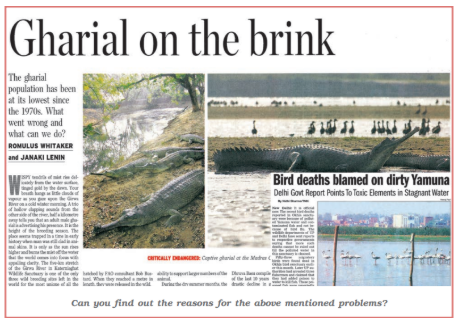
Wildlife Threat: Gharials
- Reserved forests
- Forests given the greatest conservation value; they cover more than half of India’s total forest land.
- Protected forests
- Forests protected from further depletion; they cover almost one-third of India’s total forest area.
- Unclassed forests
- Other forests and wastelands belonging to the government, private individuals or communities.
- Permanent forest estates
- Reserved and protected forests maintained for forest produce and protective purposes.
Quick recap
- India’s forests are classified as reserved, protected and unclassed.
- Reserved forests cover more than half of India’s forest land; protected forests cover almost one-third of its forest area.
- Reserved and protected forests together are called permanent forest estates.
- Madhya Pradesh has the largest area under permanent forests, equal to 75% of its total forest area.
- Several states have large shares of reserved forests, while Bihar, Haryana, Punjab, Himachal Pradesh, Odisha and Rajasthan have a bulk of their forests protected.
- North-Eastern states and parts of Gujarat have high percentages of locally managed unclassed forests.
- The lecture highlights gharials as being on the brink and reports gharial and bird deaths in the Yamuna linked to pollution.
Community and Conservation
Community-Led Conservation
- Local action: Communities have protected habitats and opposed threats such as mining and deforestation.
- Examples: Villagers in Alwar protect the Bhairodev Dakav ‘Sonchuri’, while the Chipko movement resisted deforestation in the Himalayas.
Joint Forest Management (JFM)
How Community Involvement Supports Forests
- Local institutions take responsibility for protecting degraded forest land.
- Protection and restoration improve forest habitats.
- Communities receive benefits such as non-timber forest produce and a share of harvested timber.
People at the Centre of Conservation
- Community initiatives: Chipko showed the value of community afforestation with indigenous species; Beej Bachao Andolan and Navdanya promote diverse, chemical-free farming.
- Shared decisions: Local communities should have a central role in natural-resource management, and development should be people-centred, environment-friendly and economically rewarding.
Sacred Groves and Traditional Beliefs
How does Joint Forest Management involve local communities?
What are sacred groves, and how do they help conserve nature?
Quick recap
- Local communities protect forests and wildlife through both cooperation with government and their own rules.
- Sariska, Bhairodev Dakav ‘Sonchuri’ and Chipko are examples of community-led conservation.
- Beej Bachao Andolan and Navdanya promoted diversified farming without synthetic chemicals.
- JFM began formally in 1988 after Odisha passed the first resolution; communities protect degraded forests in return for benefits.
- Sacred groves and beliefs about sacred species help preserve habitats and wildlife.
- Conservation and development should be people-centred, environment-friendly and economically rewarding.
Social Science — ALL CHAPTERS
1
RESOURCES AND DEVELOPMENT
2
FOREST AND WILDLIFE RESOURCES
3
WATER RESOURCES
4
AGRICULTURE
5
MINERALS AND ENERGY RESOURCES
6
MANUFACTURING INDUSTRIES
7
LIFELINES OF NATIONAL ECONOMY
1
POWER SHARING
2
FEDERALISM
3
GENDER, RELIGION AND CASTE
4
POLITICAL PARTIES
5
OUTCOMES OF DEMOCRACY
1
THE RISE OF NATIONALISM IN EUROPE
2
NATIONALISM IN INDIA
3
THE MAKING OF A GLOBAL WORLD
4
THE AGE OF INDUSTRIALISATION
5
PRINT CULTURE AND THE MODERN WORLD
1
DEVELOPMENT
2
SECTORS OF THE INDIAN ECONOMY
3
MONEY AND CREDIT
4
GLOBALISATION AND THE INDIAN ECONOMY
5
CONSUMER RIGHTS