Class 10 . Social Science . India And Contemporary World II . Print Culture and the Modern World
Chapter 5: PRINT CULTURE AND THE MODERN WORLD
Ch 5
Social Science
Class 10
Introduction & the First Printed Books
Print and the World Before Printing
Why print matters
- Print culture includes books, newspapers, images, advertisements, posters and other printed material that shape access to information and public debate.
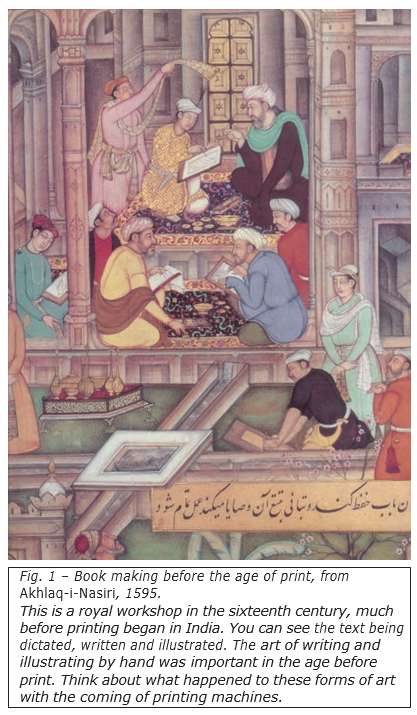
- Before printing books and images were produced by hand; writing and illustration were skilled crafts.
The First Printed Books in East Asia
Woodblock printing — A hand-printing method in which paper is rubbed against an inked, carved wooden block.
Printing in China
- Method: From AD 594, books were printed by rubbing paper—also invented in China—against inked woodblocks.
- Book form: Thin, porous paper could not be printed on both sides, so books were folded and stitched into accordion form.
- Craft: Skilled printers reproduced calligraphy, the art of beautiful, stylised writing, with great accuracy.
- State support: The imperial government printed large numbers of textbooks for civil-service examinations.
- Growing demand: More examination candidates from the sixteenth century increased the volume of printed material.
- Practical use: By the seventeenth century, merchants used print to collect trade information.
- New readership: Urban growth made reading a leisure activity; readers sought fiction, poetry, autobiographies, literary collections and romantic plays.
- Women readers and writers: Rich women read; wives of scholar-officials published their works, and courtesans wrote about their lives.
- Mechanical printing: Western techniques and presses arrived in the late nineteenth century; Shanghai became a centre serving Western-style schools.
Growth of Chinese print culture
- Imperial examinations create demand for textbooks
- More candidates increase the volume of print
- Urban culture brings merchants, trade information and leisure reading into print culture
- Western mechanical presses arrive in the late nineteenth century; Shanghai becomes a print hub
China
- From AD 594Woodblock printing of books is practised in China.
- Sixteenth centuryMore examination candidates increase demand for print.
- Seventeenth centuryUrban growth broadens print use beyond scholar-officials.
- Late nineteenth centuryWestern mechanical presses arrive; Shanghai becomes a print hub.
Print in Japan and Korea
Japan
- Arrival: Buddhist missionaries from China introduced hand-printing to Japan around AD 768–770.
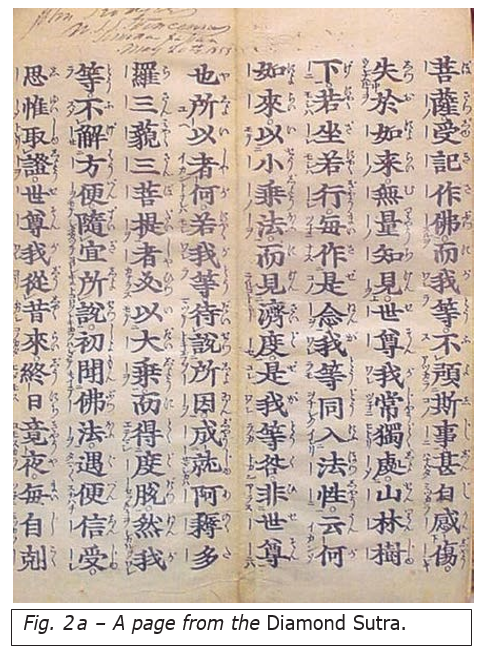
- Early book: The Buddhist *Diamond Sutra* is identified as the oldest Japanese printed book; it has six sheets of text and woodcut illustrations.
- Everyday printing: Pictures appeared on textiles, playing cards and paper money; books became cheap and abundant.
Korea
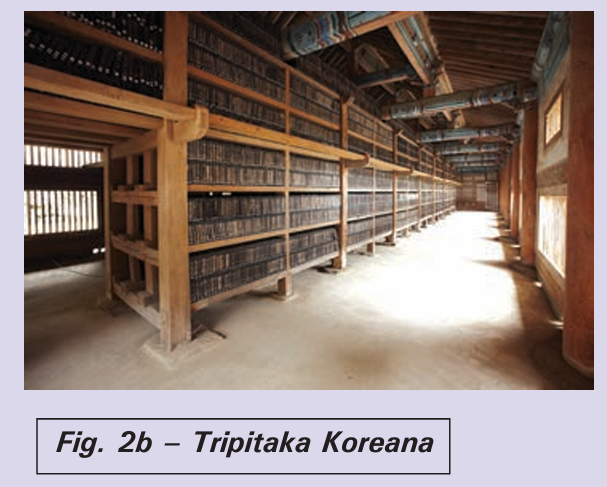
- Tripitaka Koreana: A collection of Buddhist scriptures from the mid-thirteenth century, engraved on about 80,000 woodblocks.
- Recognition: The Tripitaka Koreana woodblocks were inscribed on UNESCO’s Memory of the World Register in 2007.
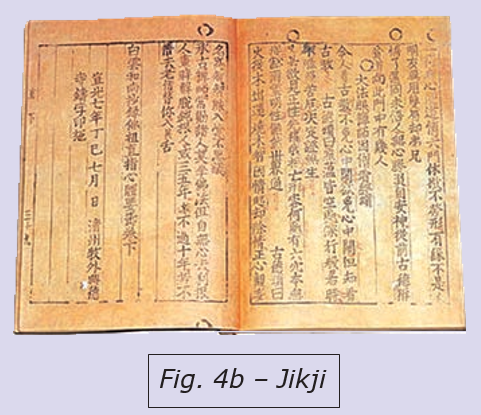
- Jikji: Printed in the late fourteenth century, it is among the oldest existing books printed with movable metal type and contains Zen Buddhist teachings.
- Contents and survival: *Jikji* mentions about 150 monks from India, China and Korea; its first volume is unavailable, while the second is held by the National Library of France.
- Recognition: *Jikji* was inscribed on UNESCO’s Memory of the World Register in 2001.
Edo publishing and ukiyo prints
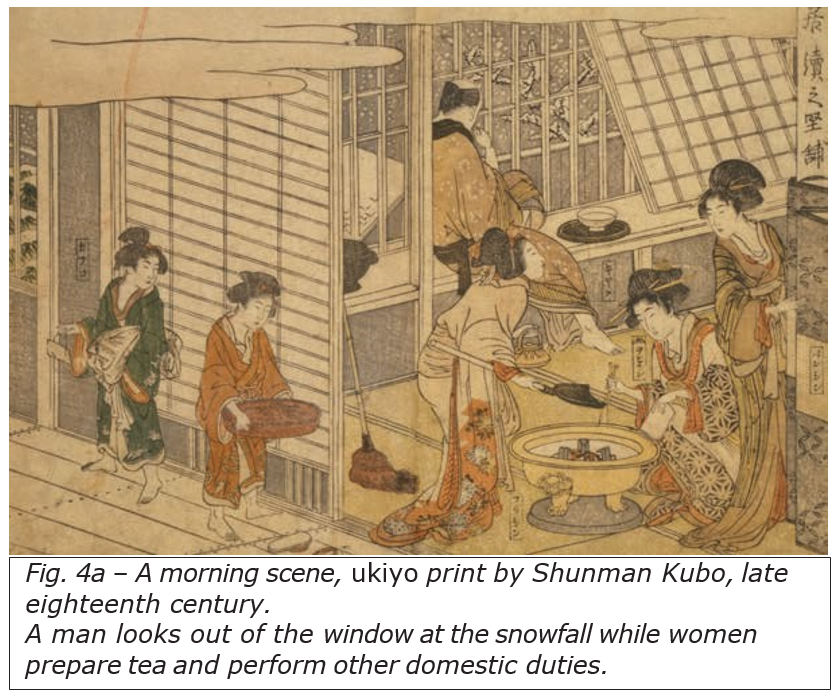
- Edo culture: In the late eighteenth century, illustrated collections depicted an elegant urban life of artists, courtesans and teahouse gatherings.
- Wide range: Libraries and bookstores offered hand-printed books about women, music, calculations, tea ceremony, flower arranging, etiquette, cooking and famous places.
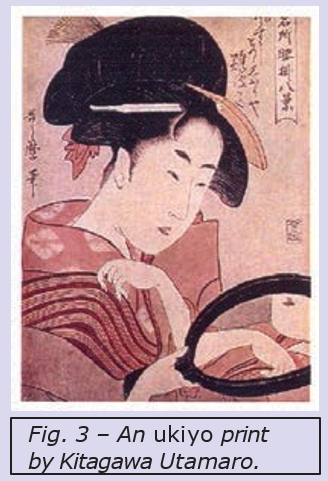
- Ukiyo: Meaning “pictures of the floating world,” it depicted ordinary human experiences, especially urban life.
- Kitagawa Utamaro: Born in Edo in 1753, he became known for ukiyo prints; his work influenced Manet, Monet and Van Gogh.
- Production: Publishers such as Tsutaya Juzaburo chose subjects and commissioned artists to draw outlines; woodblock carvers then cut the designs.
- Key feature: The drawing was pasted onto the block and destroyed during carving, so only the prints survived.
Japan and Korea
- Around AD 768–770Chinese Buddhist missionaries introduce hand-printing to Japan.
- Mid-thirteenth centuryThe Tripitaka Koreana is engraved on about 80,000 woodblocks.
- Late fourteenth centuryKorea prints *Jikji* using movable metal type.
- 1753Kitagawa Utamaro is born in Edo.
- Late eighteenth centuryIllustrated print culture flourishes in Edo.
- 2001 / 2007*Jikji* / the Tripitaka Koreana woodblocks are inscribed on UNESCO’s Memory of the World Register.
Print Comes to Europe
How printing reached Europe
- Silk and spices travel from China to Europe along the Silk Route
- Chinese paper reaches Europe through the same route in the eleventh century
- Marco Polo returns to Italy in 1295 after exploring China, bringing knowledge of Chinese woodblock printing
- Italians begin printing books with woodblocks; the technique spreads across Europe
| Point | Handwritten manuscripts | Printed books |
|---|---|---|
| Cost and production | Expensive, slow and labour-intensive to copy | Cheaper copies could be produced more quickly |
| Use and readers | Luxury vellum editions served aristocrats and wealthy monastic libraries | Merchants and university students bought cheaper printed copies |
| Elite attitude | Luxury manuscripts retained prestige | Some aristocrats and wealthy monasteries dismissed printed books as “cheap vulgarities” |
| Handling and circulation | Fragile, awkward to handle and difficult to carry; circulation remained limited | Printing helped meet rising demand and widen circulation |
Growing demand and the printing press
- Book trade: Booksellers exported books and organised book fairs; they also hired scribes to meet demand.
- Scribes: More than 50 scribes could work for a single bookseller.
- Woodblock printing: By the early fifteenth century, European woodblocks printed textiles, playing cards and religious pictures with short texts.
- Need for change: Manuscript copying was expensive and time-consuming, and fragile books were awkward to carry; this limited circulation.
- Breakthrough: In the 1430s, Johann Gutenberg developed the first-known printing press at Strasbourg, Germany.
Print in Europe
- Eleventh centuryChinese paper reaches Europe via the Silk Route.
- 1295Marco Polo returns to Italy after travelling in China.
- Early fifteenth centuryWoodblocks are widely used in Europe for textiles, playing cards and religious images.
- 1430sJohann Gutenberg develops the first-known printing press at Strasbourg.
- Calligraphy
- The art of beautiful, stylised writing.
- Vellum
- Parchment made from animal skin.
- Woodblock printing
- Printing by rubbing paper against an inked, carved wooden block.
- Movable metal type
- Separate metal characters arranged to print text; used for Korea’s *Jikji*.
- Ukiyo
- “Pictures of the floating world”; prints depicting ordinary experiences, especially urban life.
How did Chinese print culture expand beyond government textbooks?
Why did handwritten manuscripts fail to satisfy Europe’s growing demand for books?
What is the importance of *Jikji* in print history?
Quick recap
- East Asia developed early hand-printing; China used woodblock printing from AD 594.
- Chinese print served examinations, merchants gathering trade information, leisure readers and women writers.
- Japanese printing included the *Diamond Sutra* and ukiyo depictions of urban life; Korea produced the Tripitaka Koreana and movable-type *Jikji*.
- Paper and woodblock printing reached Europe; manuscripts remained costly and difficult to circulate, and some elites scorned printed books.
- Growing European demand helped lead to Gutenberg’s first-known printing press in the 1430s.
Gutenberg and the Printing Press & the Print Revolution and Its Impact
Gutenberg and the Printing Press
Early printed books
- Appearance: Early printed books often resembled manuscripts in layout and style; metal letters imitated handwritten lettering.
- Hand decoration: Artists added painted illustrations and illuminated borders. For wealthy buyers, blank spaces could be left for chosen decorations.
- Gutenberg’s Bible: The text was printed in black, while colour and decoration were added by hand; copies therefore differed.
- Why uniqueness mattered: Elites valued the individual differences between copies.

Spread of printing in Europe
- Expansion: Between 1450 and 1550, presses were established in most European countries; German printers helped set up presses elsewhere.
- Scale: In the second half of the fifteenth century, about 20 million printed books reached European markets.
- Growth: In the sixteenth century, the number rose to about 200 million.
- Print revolution: The shift from hand copying to mechanical printing transformed book production.
Early printing
- By 1448Gutenberg had perfected his printing system.
- 1450–1550Printing presses spread across most European countries.
- Second half of the fifteenth centuryAbout 20 million printed books entered European markets.
- Sixteenth centuryPrinted book production rose to about 200 million copies.
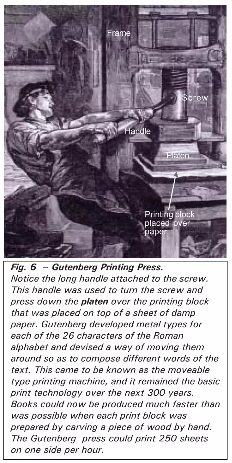
- Platen
- The board or plate pressed onto paper to transfer the impression from the type.
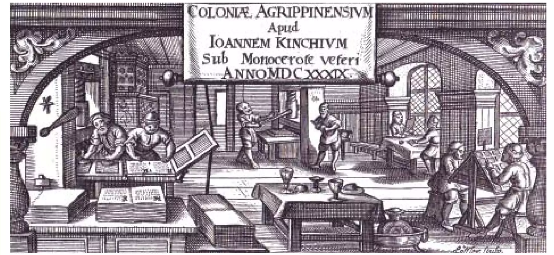
- Compositor
- A person who arranges type to form the text for printing.
- Galley
- A metal frame in which type is arranged and the text composed.
The Print Revolution and Its Impact
- Transformation: Mechanical printing changed not only how books were produced but also people’s lives and their relationship with knowledge and authority.
- New ideas: Print influenced popular perceptions and opened new ways of thinking and discussing public issues.
A New Reading Public
From hearing public to reading public
- Cheaper books: Printing reduced the labour, time and cost needed to produce books, allowing many copies to be made.
- Before print: Reading was mainly limited to elites; many people encountered stories and sacred texts through listening and performances.
- New readers: Printed books reached wider groups, helping a reading public emerge.
- Literacy limits: Many people remained unable to read, so publishers also aimed their works at listeners.
| Point | Hearing public | Reading public |
|---|---|---|
| Access to stories | Stories were heard through readings, recitations and performances. | People could access printed books and read them. |
| How knowledge spread | Mainly through oral transmission. | Through printed texts, as well as oral sharing. |
How print reached non-readers
- Printers published popular ballads and folk tales, often with many illustrations.
- People sang or recited these works at village gatherings and in town taverns.
- Oral culture entered print, and printed material was shared orally.
- The reading public and hearing public became intermingled.
- Ballad
- A folk tale or historical account in verse, usually sung or recited.
- Tavern
- A place where people met, ate, drank and exchanged news.
Religious Debates and the Fear of Print
Debate, influence and anxiety
- Wider circulation: Print allowed people who opposed established authorities to spread ideas and persuade others.
- Fear of uncontrolled reading: Religious authorities, monarchs, writers and artists worried that rebellious or irreligious ideas could spread.
- Perceived threat: Critics feared that uncontrolled print would undermine accepted religious and literary authority.

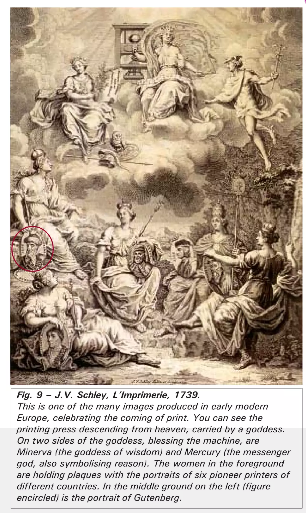
Martin Luther and the Protestant Reformation
- 1517: Martin Luther wrote the Ninety-Five Theses, criticising practices and rituals of the Roman Catholic Church.
- Challenge: A printed copy was posted on a church door in Wittenberg, inviting debate about Luther’s ideas.
- Rapid spread: His writings were reproduced widely. His New Testament translation sold 5,000 copies within a few weeks; a second edition appeared within three months.
- Impact: The debate contributed to a division in the Church and the beginning of the Protestant Reformation.
- Importance of print: Print helped circulate new ideas and created a new intellectual atmosphere that supported the Reformation.
Print and religious change
- 1517Luther’s Ninety-Five Theses challenged practices of the Roman Catholic Church.
- 1739J. V. Schley produced an engraving celebrating the spread of printing.
- Protestant Reformation
- A sixteenth-century movement to reform the Roman Catholic Church; several anti-Catholic Christian traditions developed from it.
How did printing help create a new reading public?
How did print contribute to the Protestant Reformation?
Quick recap
- Gutenberg adapted the olive press and metal moulds to develop a reusable-type printing system.
- Early printed books often combined mechanically printed text with hand-painted decoration.
- Printing spread across Europe and greatly increased the number of books produced.
- Cheaper books helped create a reading public, while printed stories also reached listeners through oral performance.
- The wide circulation of print encouraged debate and caused concern about uncontrolled ideas.
- Print helped spread Martin Luther’s criticisms and contributed to the Protestant Reformation.
Print and Dissent & the Reading Mania
Print and Dissent
Print challenged religious authority
- Individual interpretations: Popular religious books enabled even people with little formal education to interpret faith for themselves.
- Menocchio: This sixteenth-century Italian miller read local books and formed his own views of the Bible, God and Creation.
- Church response: The Roman Catholic Church treated challenges to its teachings as heresy; Menocchio was tried twice and eventually executed.
- Censorship: The Church imposed controls over publishers and booksellers and began its Index of Prohibited Books in 1558.
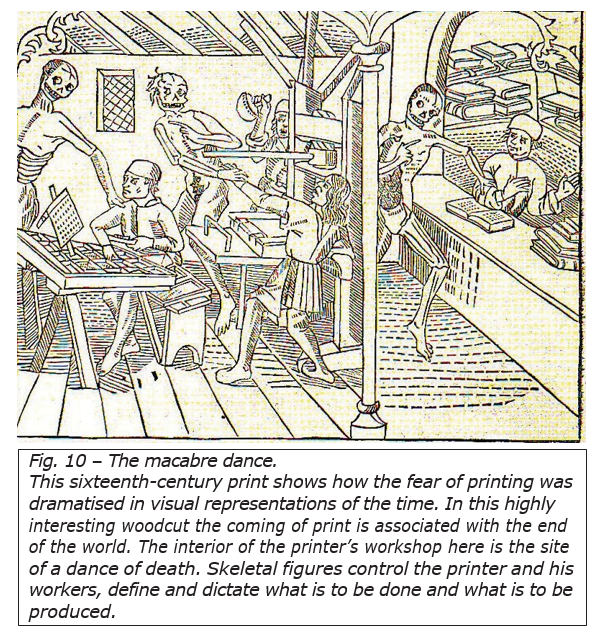
Anxiety about the spread of books
- Erasmus: The Latin scholar and Catholic reformer criticised excesses of Catholicism but kept his distance from Luther.
- Warning: In *Adages* (1508), Erasmus argued that too many books could overwhelm scholarship; worthless and scandalous works might also reduce the perceived value of worthwhile books.
- Why print was feared: Books could circulate ideas that challenged religious or political authority, including beliefs considered heretical or seditious.
The Reading Mania
More readers and wider access
- Literacy: Rates rose across much of Europe during the seventeenth and eighteenth centuries, helped by village schools established by different religious denominations.
- By the late eighteenth century: Literacy reached 60–80% in some parts of Europe.
- Reading mania: More literate people wanted books, so printers produced them in growing numbers and booksellers used travelling pedlars to sell them in villages.
| Type or example | Description |
|---|---|
| Almanacs | Annual publications with calendars and practical information, including astronomical events and tides. |
| Ballads and folktales | Popular stories and songs sold by travelling booksellers. |
| Penny chapbooks | Small, inexpensive English books sold for a penny by travelling pedlars called chapmen, making them affordable to poor readers. |
| Bibliothèque Bleue | Low-priced French books, usually small and printed on poor-quality paper with cheap blue covers. |
| Romances and histories | Romances were often only four to six pages; histories told stories about the past. |
| Periodical press | From the early eighteenth century, newspapers and journals combined current affairs—such as wars and trade—with entertainment. |
Science, philosophy and everyday reading
- Scientific knowledge: Printed editions of older scientific texts, maps and diagrams made learning accessible to more readers.
- Wider audiences: Isaac Newton’s published discoveries reached a larger circle of scientifically interested people.
- Enlightenment writers: Works by Thomas Paine, Voltaire and Jean-Jacques Rousseau spread ideas about science, reason and rationality.
- Rural readers: In 1791, publisher James Lackington described poorer farmers and country people listening to children read tales and romances, and asking them to bring home particular books.
Print as a Force for Progress
Books, enlightenment and public opinion
- Common belief by the mid-eighteenth century: Books could spread progress and enlightenment, free society from tyranny and allow reason to guide public life.
- Louise-Sébastien Mercier: The French novelist saw the printing press as a powerful force for progress and public opinion as a force against despotism.
- Reading and change: In Mercier’s novels, characters are transformed by reading and become enlightened through books.
Print Culture and the French Revolution
| Argument | How print contributed |
|---|---|
| Enlightenment ideas | Writings by thinkers such as Voltaire and Rousseau criticised tradition, superstition, Church authority and despotism, and promoted reason. |
| Dialogue and debate | Print helped create a public culture in which values, institutions and beliefs could be discussed and reconsidered; this encouraged new ideas of social revolution. |
| Criticism of monarchy | In the 1780s, literature mocked royalty and attacked its morality. Cartoons and caricatures contrasted royal pleasure with ordinary people’s hardship; underground circulation helped foster hostility toward the monarchy. |
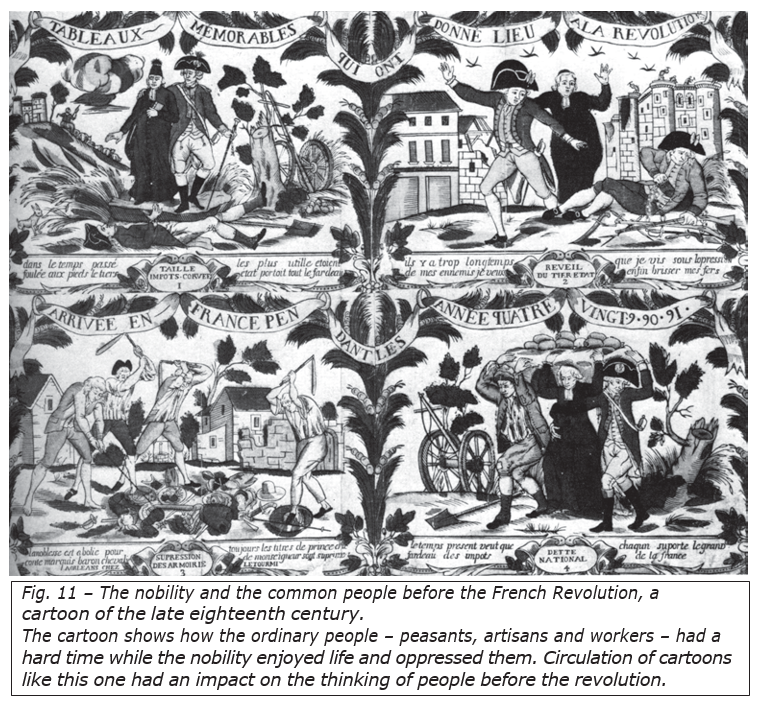
How to assess print’s influence
- Print’s role: It helped spread ideas and made alternative ways of thinking possible, but did not automatically cause the Revolution or control readers’ beliefs.
- Readers’ choices: People encountered different kinds of writing, including Church and monarchical propaganda; they interpreted what they read and accepted some ideas while rejecting others.
- Inquisition
- A former Roman Catholic court that identified and punished people considered heretics.
- Heretical
- Beliefs that do not follow the accepted teachings of the Church.
- Satiety
- The state of being fulfilled far beyond the point of satisfaction.
- Seditious
- Action, speech or writing seen as opposing the government.
- Chapbook
- A small, inexpensive book sold by travelling pedlars called chapmen.
- Despotism
- A system in which an individual exercises absolute power without legal or constitutional checks.
How did print contribute to dissent and challenges to authority?
What were the three main arguments linking print culture with the French Revolution?
Key dates and periods
- 1508Erasmus expressed concern about the glut of books in *Adages*.
- Sixteenth centuryMenocchio’s independent reading and interpretations challenged Church authority.
- 1558The Roman Catholic Church began maintaining its Index of Prohibited Books.
- Seventeenth and eighteenth centuriesLiteracy rose in much of Europe, expanding demand for books.
- Early eighteenth centuryThe periodical press developed, combining current affairs with entertainment.
- Mid-eighteenth centuryMany believed books could spread enlightenment and help defeat tyranny.
- 1780sLiterature mocking the monarchy circulated, including underground.
- 1791James Lackington described the growing demand for books among poorer rural people.
- Late eighteenth centuryLiteracy reached 60–80% in some parts of Europe.
Quick recap
- Dissent: Print enabled ordinary readers to question religious teachings; the Church responded with censorship, including its Index of Prohibited Books from 1558.
- Fear of print: A sixteenth-century woodcut presents the printer’s workshop as a dance of death and associates print with the end of the world.
- Erasmus: He warned that a glut of books could harm scholarship and devalue worthwhile works.
- Reading mania: Rising literacy in the seventeenth and eighteenth centuries expanded demand for books and popular reading.
- Popular print: Penny chapbooks, the Bibliothèque Bleue, almanacs and periodicals brought varied material to broad audiences.
- French Revolution: Print encouraged critical ideas and debate, but readers interpreted material rather than being shaped by it automatically.
The Nineteenth Century & India and the World of Print
New Readers in the Nineteenth Century
Children, Women and Workers
- Literacy: Mass literacy expanded across Europe, creating new readers among children, women and workers.
- Children: Compulsory primary education from the late nineteenth century increased demand for school textbooks.
- Children’s press: A French press devoted to children’s literature was established in 1857; it published both new works and traditional tales.
- Grimm Brothers: They collected folk tales from German peasants and published an edited collection in 1812. Tales considered unsuitable were removed, so print both preserved and changed folklore.
- Women readers: Penny magazines and manuals on behaviour and housekeeping targeted women; novels also made women an important reading audience.
- Women writers: Jane Austen, the Brontë sisters and George Eliot helped shape the image of a woman with will, determination and independent thought.
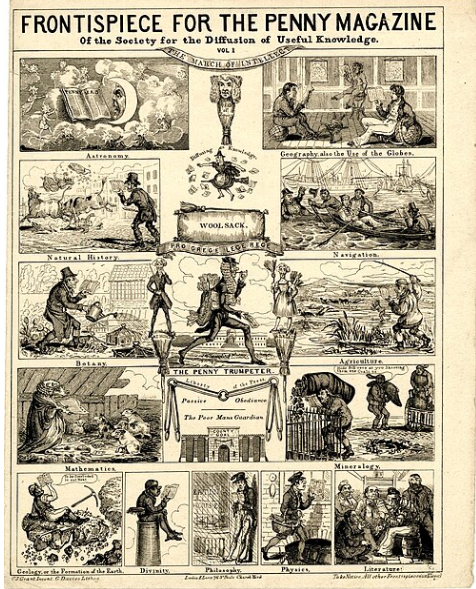
Workers as Readers and Writers
- Penny Magazine: Published in England from 1832 to 1835 by the Society for the Diffusion of Useful Knowledge; it was aimed mainly at working-class readers.
- Lending libraries: Present from the seventeenth century, they became a means of education for white-collar workers, artisans and lower-middle-class people in nineteenth-century England.
- More leisure: The gradual shortening of the working day from the mid-nineteenth century gave workers more time for self-improvement and expression.
- Working-class writing: Some self-educated workers wrote political tracts and autobiographies. Yorkshire mechanic Thomas Wood rented newspapers and read them by firelight because he could not afford candles.
- Autobiography: Maxim Gorky’s *My Childhood* and *My University* describe the obstacles poor people faced in learning to read.
Key Developments in the Nineteenth Century
- 1812The Grimm Brothers published an edited collection of German folk tales.
- 1832–1835The working-class-oriented Penny Magazine was published in England.
- 1857A children’s press was established in France.
- Late nineteenth centuryCompulsory primary education expanded the number of child readers.
Further Innovations in Printing
Printing Technology
- Late eighteenth centuryPrinting presses began to be made of metal.
- Mid-nineteenth centuryRichard M. Hoe perfected a power-driven cylindrical press in New York; it printed up to 8,000 sheets per hour and was especially useful for newspapers.
- Late nineteenth centuryThe offset press was developed, capable of printing up to six colours at once.
- Turn of the twentieth centuryElectric presses accelerated printing; improved paper feeding, plates, automatic reels and photoelectric colour-register controls also improved print quality.
Selling Printed Material
- Serial novels: Nineteenth-century periodicals published novels in instalments, influencing how novels were written.
- Shilling Series: Cheap popular books sold in England in the 1920s.
- Book jacket: The dust cover or jacket became a twentieth-century innovation.
- Cheap paperbacks: During the Great Depression of the 1930s, publishers issued inexpensive paperback editions to encourage book buying.
- Advertisements: Printed notices and advertisements appeared on street walls, railway platforms and public buildings.

India and the World of Print
- Growth of print: Printing spread across India through presses, newspapers and publications in many languages.
- Public debate: Print helped circulate religious, social and political ideas, connecting readers and communities across regions.
- Social impact: New publications reached women and poorer readers, while colonial authorities also tried to control the press.
Manuscripts Before the Age of Print
Manuscript — A text written by hand rather than produced by a printing press.
Manuscript Culture in India
- Languages: India had a long manuscript tradition in Sanskrit, Arabic, Persian and many vernacular languages.
- Materials and form: Texts were copied onto palm leaves or handmade paper, sometimes illustrated, and preserved between wooden covers or by sewing pages together.
- Continued use: Manuscripts continued to be produced well after printing arrived, up to the late nineteenth century; some finely made manuscripts were produced for the rich even after letterpress printing began.
- Limitations: Manuscripts were expensive and fragile, needed careful handling, and were difficult to use widely because scripts varied.
- Learning in Bengal: In pre-colonial village schools, students often learned to write by copying dictated passages from memory without reading the texts themselves.
- Examples: Eighteenth-century pages from Jayadeva’s *Gita Govinda* and pages from the *Rigveda* are shown. An eighteenth-century manuscript in Malayalam script is another example.
- Hafiz: The *Diwan* is the collected works of fourteenth-century poet Hafiz; an illustrated copy shown in the text dates to 1824.
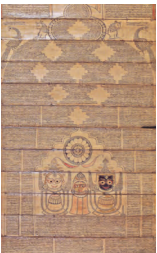
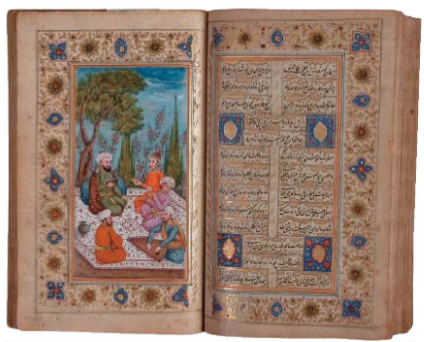
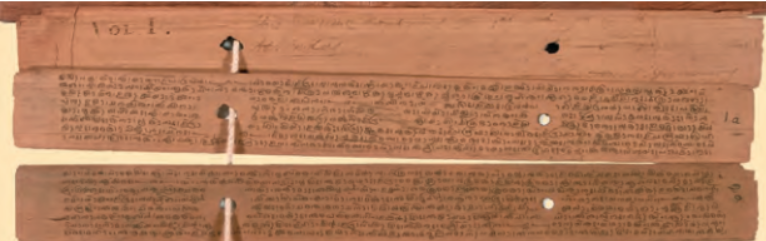
| Point | Manuscripts | Printed books |
|---|---|---|
| Production | Copied by hand | Produced using a printing press |
| Cost and access | Expensive, fragile and not widely used in everyday life | Printing made it possible to produce texts in larger numbers |
| Use in India | Continued alongside print, including for wealthy patrons | Introduced new ways to circulate texts |
Print Comes to India
Early Printing in India
- Mid-sixteenth centuryPortuguese missionaries brought the first printing press to Goa; Jesuits learnt Konkani and printed tracts.
- 1579Catholic priests printed the first Tamil book at Cochin.
- By 1674About 50 books had been printed in Konkani and Kanara languages.
- Late seventeenth centuryThe English East India Company began importing printing presses, although an English-language press developed only much later.
- By 1710Dutch Protestant missionaries had printed 32 Tamil texts, many translated from older works.
- 1713Catholic priests printed the first Malayalam book.
- 1768William Bolts posted a notice in Calcutta highlighting the disadvantage of having no printing press; he soon left for England, and the proposal came to nothing.
- 1780James Augustus Hickey began editing the *Bengal Gazette*, a weekly newspaper.
- By the close of the eighteenth centurySeveral newspapers and journals had appeared, including Indian publications.
Newspapers and Colonial Control
- Hickey’s *Bengal Gazette*: Described as “a commercial paper open to all, but influenced by none”; it represented private English enterprise and claimed independence from colonial influence.
- Content: Hickey published advertisements, including notices about the import and sale of enslaved people, as well as gossip about senior Company officials.
- Colonial response: Governor-General Warren Hastings persecuted Hickey and encouraged officially sanctioned newspapers to counter information damaging to the colonial government’s image.
- Indian newspapers: The first Indian weekly newspaper was the *Bengal Gazette*, brought out by Gangadhar Bhattacharya, who was close to Rammohun Roy.
Print and Colonial Power
- Hickey published gossip about Company officials and material critical of their interests.
- The publications threatened the colonial government’s public image.
- Warren Hastings persecuted Hickey.
- The government encouraged officially approved newspapers to counter damaging information.
- Lending library
- A library that lends books to readers; in nineteenth-century England, it supported education among workers and lower-middle-class groups.
- Serialisation
- Publishing a novel in instalments, often in a periodical.
- Offset press
- A printing press developed in the late nineteenth century that could print up to six colours at once.
- Manuscript
- A text copied or written by hand.
- Letterpress
- A printing method using a press and type; manuscript production continued even after it arrived.
How did print affect the collection of folk tales?
Name two major printing innovations of the nineteenth century and state their importance.
How did printing begin and develop in India?
Quick recap
- Mass literacy created new readers among children, women and workers, and encouraged new forms of writing and publishing.
- Print preserved folk tales but could also alter them through editing.
- Mechanical innovations increased printing speed, colour capacity and quality; publishers used serials and cheaper editions to attract buyers.
- Indian manuscripts were often elaborate but expensive and fragile; examples include Jayadeva’s *Gita Govinda*, the *Rigveda* pages and Hafiz’s *Diwan*.
- Missionaries introduced printing in India, first in Goa and then through publications in several Indian languages.
- Newspapers became a space for both public information and conflict with colonial authorities.
Religious Reform and Public Debates & New Forms of Publication
Religious Reform and Public Debates
Print and religious debate
- From the early nineteenth century, reformers and religious orthodox groups debated beliefs and practices as colonial society changed.
- Reformers criticised existing practices and campaigned for change; orthodox groups challenged their arguments.
- Print’s role: tracts and newspapers spread ideas, shaped debates and let a wider public express opinions.
- Debated issues in Bengal included widow immolation, monotheism, Brahmanical priesthood and idolatry.
- Language: publications increasingly used everyday spoken languages to reach more readers.
Bengal and early newspapers
- 1821Rammohun Roy began publishing the Bengali newspaper Sambad Kaumudi.
- 1822Hindu orthodoxy commissioned Samachar Chandrika to oppose Roy’s views; Persian newspapers Jam-i-Jahan Nama and Shamsul Akhbar, and Gujarati newspaper Bombay Samachar, also appeared.
Religious Print Across Communities
Muslim scholars and print
- Ulama’s concerns: they feared the decline of Muslim dynasties, colonial encouragement of conversion and changes to Muslim personal laws.
- Response: cheap lithographic presses printed Persian and Urdu translations of scriptures, religious newspapers and tracts.
- Deoband Seminary, founded in 1867, issued many fatwas explaining Islamic doctrines and guiding everyday conduct.
- Many interpretations: Muslim sects and seminaries promoted different understandings of faith and used Urdu print to gain followers and challenge rivals.
- Ulama
- Scholars of Islam and Islamic law (sharia).
- Fatwa
- A legal pronouncement on Islamic law, usually given by a mufti to clarify an uncertain issue.
- Vernacular
- The everyday language spoken by ordinary people in a region.
Printed Hindu religious texts
- 1810The first printed edition of Tulsidas’s Ramcharitmanas was published in Calcutta.
- Mid-nineteenth centuryCheap lithographic editions of religious texts became widely available in north Indian markets.
- 1880sNaval Kishore Press in Lucknow and Shri Venkateshwar Press in Bombay published many religious texts in vernacular languages.
How religious texts reached wider audiences
- Portable printed texts could be read at any time and place by people who could read.
- Shared reading: texts could also be read aloud to groups, including people who were illiterate.
- Result: religious texts reached wider circles and encouraged discussion, debate and controversy within and between religions.
Newspapers and Public Life
Why newspapers mattered
- Local knowledge: a 1849 proposal for a Marathi newspaper in Poona sought to share useful information and encourage discussion on local and general topics, including science, history and geography.
- Public scrutiny: Native Opinion (1870) argued that newspapers and political associations should examine government policies, propose improvements and press for their implementation.
- Wider connection: newspapers carried news between places, linking communities and helping create pan-Indian identities.
Newspaper arguments
- 6 January 1849The Bombay Telegraph and Courier printed a proposal for a Marathi newspaper in Poona.
- 3 April 1870Native Opinion compared newspapers and political associations to an Opposition scrutinising government policy in the English Parliament.
New Forms of Publication
New literary forms
- Growing readership: as more people could read, they wanted writing that reflected their lives, experiences, emotions and relationships.
- The novel, developed in Europe, met this interest and acquired distinctively Indian forms and styles.
- Other forms: lyrics, short stories and essays on social and political matters also became popular.
- Impact: these forms explored human lives and intimate feelings, as well as the social and political rules shaping them.
Mass visual culture
- Reproduction: increasing numbers of presses made it possible to print visual images in many copies.
- Artists and workers: Raja Ravi Varma created images for mass circulation; wood engravers made blocks and worked near letterpresses and print shops.
- Cheap prints and calendars were sold in bazaars and bought even by poorer people to decorate homes and workplaces.
- Influence: printed images shaped popular ideas about modernity and tradition, religion and politics, and society and culture.
Caricatures and cartoons
- From the 1870s, journals and newspapers published cartoons and caricatures about social and political issues.
- Social criticism: some mocked educated Indians’ attraction to Western tastes and clothing; others expressed fears about social change.
- Political criticism: imperial caricatures ridiculed nationalists, while nationalist cartoons criticised imperial rule.
- Ravi Varma’s mythological paintings were also printed in large numbers at the Ravi Varma Press.
How did print change religious debates in nineteenth-century India?
How did newspapers contribute to public life and a pan-Indian identity?
Quick recap
- Print turned religious reform and orthodoxy into public debates involving wider audiences.
- Bengal newspapers circulated competing arguments in languages accessible to readers.
- Muslim and Hindu religious texts reached more people through print, vernacular editions and shared reading.
- Newspapers shared information, scrutinised government policy and connected people across India.
- Novels and other literary forms reflected human experiences, emotions and social rules.
- Cheap visual prints, calendars and cartoons influenced popular ideas and commented on social and political change.
Women and Print & Print and Censorship
Women and Print
Women and print — Print widened women’s access to reading and gave them a platform to describe their lives and debate education and social conditions.
Education, reading and women’s writing
- Growing readership: Women’s reading increased in middle-class homes. From the mid-nineteenth century, liberal fathers and husbands educated women at home or sent them to new schools.
- Journals: Many periodicals supported women’s education and supplied syllabuses and suitable reading for home schooling.
- Conservative opposition: Some Hindus feared that literate girls would become widows; some Muslims feared education would expose women to Urdu romances.
- Secret learning: A girl in a conservative Muslim family in north India secretly learnt Urdu because she wanted to read her own language, not only the Arabic Quran, which she did not understand.
- Rashsundari Debi: In early nineteenth-century East Bengal, she secretly learnt to read in her kitchen. Her *Amar Jiban*, published in 1876, was the first full-length Bengali autobiography.
- Kailashbashini Debi: From the 1860s, she wrote about women’s confinement at home, lack of education, hard domestic labour and unjust treatment.
- Tarabai Shinde and Pandita Ramabai: In the 1880s, they wrote passionately about the hardships of upper-caste Hindu women, especially widows.
Women’s print and changing social roles
- Print languages: Urdu, Tamil, Bengali and Marathi print cultures developed early; serious Hindi printing began only from the 1870s, with much material devoted to women’s education.
- Women’s journals: In the early twentieth century, journals written for—and sometimes edited by—women discussed education, widowhood, remarriage and nationalism, alongside household advice, fashion and entertainment.
- Prescriptive writing: Ram Chaddha’s popular *Istri Dharm Vichar* and cheap Khalsa Tract Society booklets promoted the obedient wife, often through dialogues about a ‘good woman’.
- Battala: This central Calcutta publishing area sold cheap religious books and controversial literature. By the late nineteenth century, books often included woodcuts and coloured lithographs; pedlars brought them to homes.
- Indian Charivari: This late-nineteenth-century journal of caricature and satire showed an authoritative British figure instructing submissive Indians to make versions modelled on the British journal *Punch*.
- Ghor Kali print: The image depicts a wife perched on her husband’s shoulder and dominating him, while he cruelly drags his mother by a noose. It represents anxiety about the breakdown of proper family relations.
- Indian couple print: The man plays the veena while the woman smokes a hookah. The artist presents Western cultural influence and women’s changing roles as turning the traditional family upside down.
- European couple print: The Sahib holds a liquor bottle while the Memsahib plays the violin; the image suggests familiar gender roles in a European household.
- Social anxiety in prints: Such images reveal artists’ fears about women’s education and changing family roles; they are commentaries, not neutral records of family life.
- Begum Rokeya Sakhawat Hossein: At the Bengal Women’s Education Conference in 1926, she condemned men who denied women education in religion’s name and argued that women had an equal right to learn.

Print and Poor People
Access to print and social criticism
- Cheap books: Small, inexpensive books were sold at markets and crossroads in nineteenth-century Madras, giving poor people access to reading.
- Libraries: From the early twentieth century, public libraries—mainly in towns and cities, and sometimes prosperous villages—widened access. Local patrons could gain prestige by establishing them.
- Caste criticism: From the late nineteenth century, printed tracts and essays increasingly challenged caste discrimination.
- Jyotiba Phule: In *Gulamgiri* (1871), he exposed injustices of the caste system.
- Later anti-caste writing: In the twentieth century, B.R. Ambedkar and E.V. Ramaswamy Naicker (Periyar) wrote powerfully on caste; their work was read across India.
- Protest publications: Local movements and sects published journals and tracts criticising ancient scriptures and imagining a more just future.
Workers and print
- Barriers: Factory workers were overworked and often lacked the education to write about their experiences.
- Kashibaba: A Kanpur millworker, he published *Chhote Aur Bade Ka Sawal* in 1938, showing links between caste and class exploitation.
- Sudarshan Chakr: Poems written by another Kanpur millworker between 1935 and 1955 were collected in *Sacchi Kavitayan*.
- Worker libraries: By the 1930s, Bangalore cotton millworkers had set up libraries, following Bombay workers’ example. Reformers supported literacy, discouraged excessive drinking and sometimes spread nationalism.
Print and Censorship
Censorship — Censorship is government control over published material, including restricting or punishing criticism in print.
Colonial press controls
- Before 1798The East India Company showed limited concern about censorship, but early controls targeted English critics of Company misrule whose criticism could threaten its trade monopoly.
- 1820sThe Calcutta Supreme Court introduced press regulations; the Company encouraged newspapers that praised British rule.
- 1835After petitions by English and vernacular newspaper editors, Governor-General Bentinck revised press laws; Thomas Macaulay formulated rules restoring earlier freedoms.
- After the revolt of 1857English demands for a clampdown grew as vernacular newspapers became more assertively nationalist.
- 1878The Vernacular Press Act, modelled on Irish Press Laws, gave the government extensive powers to censor vernacular reports and editorials.
- 1907After Punjab revolutionaries were deported, Bal Gangadhar Tilak wrote sympathetically about them in *Kesari*.
- 1908Tilak was imprisoned, provoking widespread protests across India.
- During the First World WarUnder the Defence of India Rules, 22 newspapers had to furnish securities; 18 shut down rather than comply.
- 1919The Sedition Committee Report under Rowlatt strengthened controls and led to penalties on newspapers.
- 1922Gandhi defended freedom of speech, the press and association as essential to public opinion and the struggle for Swaraj.
- At the outbreak of the Second World WarThe Defence of India Act allowed censorship of war-related reports and reports about the Quit India movement.
- August 1942About 90 newspapers were suppressed.
Censorship, resistance and press freedom
- Vernacular Press Act: The government tracked vernacular newspapers. If a report was judged seditious, it could issue a warning; ignoring it could lead to seizure of the press and confiscation of printing machinery.
- Nationalist press: Despite repression, nationalist newspapers multiplied, reported colonial misrule and encouraged nationalist activity.
- Cycle of conflict: Attempts to silence criticism provoked protest, followed by renewed persecution and further protests.
- Loyalist papers: The government sometimes struggled to find editors for loyalist newspapers. The *Friend of India* refused a subsidy, fearing it would have to obey government commands.
- Freedom defended: In 1922, Gandhi argued that freedom of speech, press and association were essential to public opinion and the fight for Swaraj and Khilafat.
Nationalist criticism and colonial repression
- Vernacular newspapers criticise colonial rule and support nationalist activity
- The government monitors and restricts publications
- Warnings, penalties and seizures attempt to silence criticism
- Repression provokes protest and strengthens resistance
- Vernacular press
- Newspapers and publications printed in Indian languages.
- Seditious
- Considered by the colonial government to encourage opposition to its authority.
- Battala
- A central Calcutta area known for cheap popular books, from religious works to controversial literature.
- Censorship
- Government regulation or suppression of printed material.
How did print support women’s education and expression?
What were the main provisions of the Vernacular Press Act of 1878?
How did print reach poor readers and factory workers?
Quick recap
- Print expanded women’s reading and enabled women writers to challenge restrictions and describe their own lives.
- Women’s journals, cheap books and Battala publications carried education, advice, entertainment and debate.
- Prints such as *Ghor Kali* and the European-couple image expressed anxieties about changing family roles and Western influence.
- Cheap books, libraries and workers’ writing widened access and circulated criticism of caste and class inequality.
- Colonial press policy shifted from limited early controls to stronger restrictions as nationalist criticism grew.
- The 1878 Vernacular Press Act allowed censorship, warnings and seizure of presses; repression also provoked protest.
Social Science — ALL CHAPTERS
1
RESOURCES AND DEVELOPMENT
2
FOREST AND WILDLIFE RESOURCES
3
WATER RESOURCES
4
AGRICULTURE
5
MINERALS AND ENERGY RESOURCES
6
MANUFACTURING INDUSTRIES
7
LIFELINES OF NATIONAL ECONOMY
1
POWER SHARING
2
FEDERALISM
3
GENDER, RELIGION AND CASTE
4
POLITICAL PARTIES
5
OUTCOMES OF DEMOCRACY
1
THE RISE OF NATIONALISM IN EUROPE
2
NATIONALISM IN INDIA
3
THE MAKING OF A GLOBAL WORLD
4
THE AGE OF INDUSTRIALISATION
5
PRINT CULTURE AND THE MODERN WORLD
1
DEVELOPMENT
2
SECTORS OF THE INDIAN ECONOMY
3
MONEY AND CREDIT
4
GLOBALISATION AND THE INDIAN ECONOMY
5
CONSUMER RIGHTS