Class 10 . Social Science . Contemporary India II . Manufacturing Industries
Chapter 6: MANUFACTURING INDUSTRIES
Ch 6
Social Science
Class 10
Importance of Manufacturing
Manufacturing and Economic Sectors
Manufacturing in the Economy
- Secondary activities: Workers transform materials from primary activities into finished goods.
- Examples: Steel factories, car plants, breweries, textile industries and bakeries belong to the secondary sector.
- Tertiary activities: These provide services rather than manufacturing goods.
- Economic strength: A country's economic strength is measured by the development of its manufacturing industries.
- Manufacturing
- Processing raw materials into more valuable finished goods, often in large quantities.
- Secondary sector
- Economic activities that convert materials into finished goods.
- Agro-industry
- An industry that uses agricultural products as raw materials or supplies goods to farmers.
- Foreign exchange
- Money earned from trade with other countries.
Why Manufacturing Is Important
- Employment: Manufacturing creates jobs in the secondary and tertiary sectors and helps reduce dependence on agricultural income.
- Development: Industrial growth helps tackle unemployment, poverty and regional disparities.
- Trade: Exporting manufactured goods expands trade and earns foreign exchange; producing higher-value goods supports national prosperity.
Agriculture and Industry: Interdependence
How Agro-industries Support Agriculture
- Farmers provide raw materials to agro-industries.
- Industries produce pumps, fertilisers, pipes, machines and other farm inputs.
- Farmers use these inputs to improve productivity and efficiency.
- Higher agricultural production supports the growth of agro-industries.
Manufacturing in a Globalised World
Explain why manufacturing is considered the backbone of economic development.
How are agriculture and industry interdependent?
Quick recap
- Manufacturing processes raw materials into more valuable finished goods.
- Manufacturing belongs mainly to the secondary sector and is a measure of a country's economic strength.
- Industries create jobs, support agriculture, reduce regional disparities and contribute to poverty reduction.
- Exports of manufactured goods expand trade and earn foreign exchange.
- Agriculture supplies industrial raw materials, while industry supplies tools and inputs to farmers.
- Global competition requires efficient industries and goods of internationally competitive quality.
Classification of Industries
Ways to Classify Industries
| Basis | Type | Meaning / examples |
|---|---|---|
| Source of raw material | Agro-based | Uses agricultural materials: cotton, wool, jute, silk, rubber, sugar, tea, coffee and edible oil. |
| Source of raw material | Mineral-based | Examples include iron and steel, cement, aluminium, machine tools and petrochemicals. |
| Main role | Basic or key | Supplies products used as raw materials by other industries; examples include iron and steel, copper smelting and aluminium smelting. |
| Main role | Consumer | Produces goods for direct consumer use, such as sugar, toothpaste, paper, sewing machines and fans. |
Small-scale industry — An industry classified by the maximum investment allowed in a unit’s assets; the stated current limit is Rs. one crore.
| Type | Ownership and operation | Examples |
|---|---|---|
| Public sector | Owned and operated by government agencies. | BHEL, SAIL |
| Private sector | Owned and operated by an individual or a group of individuals. | TISCO, Bajaj Auto Ltd., Dabur Industries |
| Joint sector | Run jointly by the state and private individuals or groups. | Oil India Ltd. (OIL) |
| Cooperative sector | Owned and operated by producers, raw-material suppliers, workers, or both; members pool resources and share profits or losses proportionately. | Sugar industry in Maharashtra; coir industry in Kerala |
| Point | Heavy industries | Light industries |
|---|---|---|
| Materials and products | Associated with bulky, heavy raw materials or finished goods. | Use light raw materials and produce light goods. |
| Examples | Iron and steel. | Electrical goods. |
Agro-based Industries
Agro-based industries — Industries that use agricultural raw materials, including cotton, jute, silk, wool, sugar cane and oilseeds.
Textile Industry
Importance and Value Chain
- Economic contribution: Textiles contribute significantly to industrial production, employment generation and foreign-exchange earnings.
- Complete value chain: It is the only industry in India described as self-reliant and complete across the value chain, from raw material to the highest value-added products.
- Industry links: Textile production supports agriculture and related industries such as chemicals, dyes, packaging materials and engineering works.
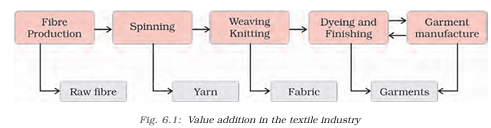
Cotton Textiles
Development and Location
- Early production: Cotton cloth was made by hand spinning and handloom weaving; power-looms came into use after the 18th century.
- Colonial impact: Traditional textile industries suffered because they could not compete with mill-made cloth from England.
- First successful mill: Established in Mumbai in 1854.
- War-time demand: The two world wars, fought in Europe while India was a British colony, increased demand for cloth in the United Kingdom and boosted the Indian cotton textile industry.
- Early concentration: The industry initially concentrated in the cotton-growing belt of Maharashtra and Gujarat.
Why Cotton Mills First Concentrated in Maharashtra and Gujarat
- Nearby cotton-growing areas supplied raw cotton.
- Markets, transport links and accessible ports supported trade.
- Labour and a moist climate were available.
- These advantages encouraged mills to locate in the region.
| Point | Spinning | Weaving |
|---|---|---|
| Organisation | Continues to be concentrated in Maharashtra, Gujarat and Tamil Nadu. | Highly decentralised, allowing traditional weaving skills and designs to be incorporated. |
| Production | India has world-class production in spinning. | Done by handloom, powerloom and mills; weaving supplies lower-quality fabric because it cannot use much of the high-quality yarn produced. |
Employment and Traditional Skills
- Cotton-linked work: The industry supports farmers and cotton-boll pluckers, plus workers in ginning, spinning, weaving, dyeing, designing, packaging, tailoring and sewing.
- Traditional weaving: Decentralised weaving provides scope for traditional skills and designs in cotton, silk, zari and embroidery.
- Khadi: Handspun khadi provides large-scale employment to weavers in their homes as a cottage industry.
Cotton Textile Milestones
- After the 18th centuryPower-looms came into use in cotton textile production.
- 1854The first successful cotton textile mill was established in Mumbai.
Jute Textiles
Production and Distribution
- World position: India is the largest producer of raw jute and jute goods, and the second-largest exporter after Bangladesh.
- Concentration: Most mills are in West Bengal, mainly in a narrow belt along the Hugli River.
- First mill: Set up at Rishra near Kolkata in 1855.
- Partition: In 1947, the jute mills remained in India, while three-fourths of the jute-producing area went to Bangladesh, then East Pakistan.
Why Jute Mills Cluster in the Hugli Basin
- Nearby jute-growing areas provide raw material.
- Water transport and good rail and road networks move raw jute to mills.
- Abundant water supports processing, and cheap labour is available from West Bengal and neighbouring states.
- Kolkata provides banking, insurance and port facilities, including for exports.
- Together, these advantages encouraged mills to cluster along the Hugli.
Jute Industry Milestones
- 1855The first jute mill was established at Rishra near Kolkata.
- 1947Partition separated most jute-growing areas from the mills that remained in India.
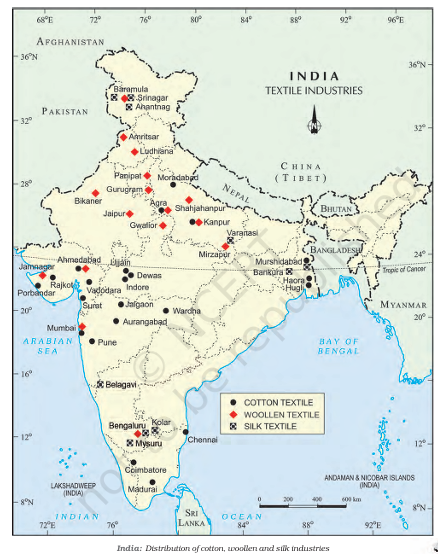
Sugar Industry
Production, Location and Seasonality
- World position: India ranks second in sugar production and first in the production of gur and khandsari.
- Raw-material constraint: Sugar cane is bulky, and its sucrose content falls during transport; mills are therefore located near cane-growing areas.
- Distribution: Mills are found in Uttar Pradesh, Bihar, Maharashtra, Karnataka, Tamil Nadu, Andhra Pradesh, Gujarat, Punjab, Haryana and Madhya Pradesh.
- Concentration: Uttar Pradesh and Bihar together contain 60% of the mills.
- Seasonal nature: The industry is seasonal and is ideally suited to the cooperative sector.
Shift Towards Southern and Western States
- Recent trend: Sugar mills have increasingly shifted and concentrated in southern and western states, especially Maharashtra.
- Reasons: Cane there has higher sucrose content, the cooler climate allows a longer crushing season, and cooperatives are more successful.
- Agro-based industry
- An industry that uses agricultural raw materials.
- Basic industry
- An industry that supplies materials for producing other goods.
- Consumer industry
- An industry that makes goods for direct use by consumers.
- Cooperative industry
- An industry owned and operated by producers, suppliers or workers who pool resources and share profits or losses.
- Khadi
- Handspun cloth produced as a cottage industry, providing home-based employment to weavers.
Why are many jute mills located along the Hugli River?
Why is the sugar industry ideally suited to the cooperative sector?
Quick recap
- Classification: Industries are grouped by raw material, role, investment, ownership, and the bulk and weight of materials or goods.
- Textiles: The textile industry contributes to production, employment and foreign exchange, and is India’s only industry described as self-reliant across its complete value chain.
- Cotton: Mills first concentrated in Maharashtra and Gujarat because of cotton supply, markets, transport, ports, labour and climate.
- Jute: Hugli-basin mills benefit from nearby raw material, transport, water, labour and Kolkata’s services.
- Sugar: Cane is bulky and loses sucrose during transport, so mills locate near cane-growing areas.
- Sugar trend: Higher sucrose content, a longer crushing season and successful cooperatives have encouraged a shift towards southern and western states.
Mineral- Based Industries Part 1
Mineral-Based Industries
Mineral-based industries — Industries that use minerals and metals as raw materials.
Example
- Iron and steel is a major mineral-based industry.
Iron and Steel Industry
Basic industry — An industry on which other industries depend for their machinery.
Importance and Uses of Steel
- Basic role: Heavy, medium and light industries depend on iron and steel for machinery.
- Uses: Steel is used in engineering goods, construction materials, defence, medical, telephonic and scientific equipment, and consumer goods.
- Development indicator: A country's steel production and consumption are often regarded as an index of its development.
Heavy industry — An industry whose raw materials and finished products are heavy and bulky, resulting in high transportation costs.
Raw Materials and Location
- Main inputs: Iron ore, coking coal and limestone are required in the approximate ratio .
- Hardening: Small quantities of manganese are also required to harden steel.
- Location needs: Proximity to raw materials helps limit transport costs; efficient transport is also needed to distribute finished goods to markets and consumers.
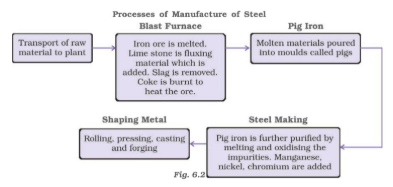
Location of Iron and Steel Industries
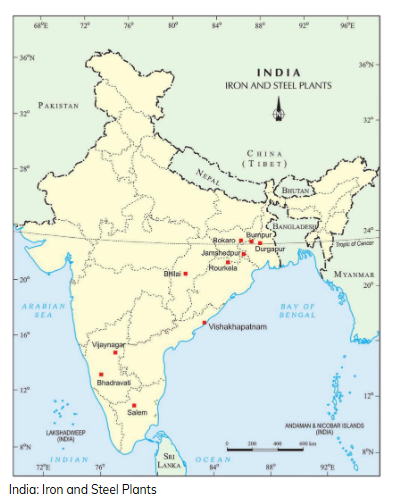
Chhotanagpur Plateau
- Concentration: The Chhotanagpur Plateau region has the greatest concentration of iron and steel industries.
- Advantages: Low-cost iron ore, nearby high-grade raw materials, cheap labour and strong growth potential in the home market favour the region.
- Mineral-based industry
- An industry that uses minerals and metals as raw materials.
- Basic industry
- An industry that supplies machinery on which other industries depend.
- Heavy industry
- An industry handling heavy, bulky raw materials and finished goods.
Quick recap
- Mineral-based industries use minerals and metals as raw materials.
- Iron and steel is a basic industry because many industries depend on it for machinery.
- Steel is used in many sectors, and its production and consumption are indicators of a country's development.
- Iron ore, coking coal and limestone are required in the approximate ratio ; manganese helps harden steel.
- The Chhotanagpur Plateau has the greatest concentration of iron and steel industries because of its raw materials, labour and home-market potential.
Mineral- Based Industries Part 2
Aluminium Smelting
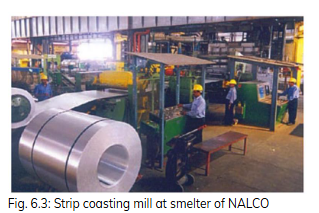
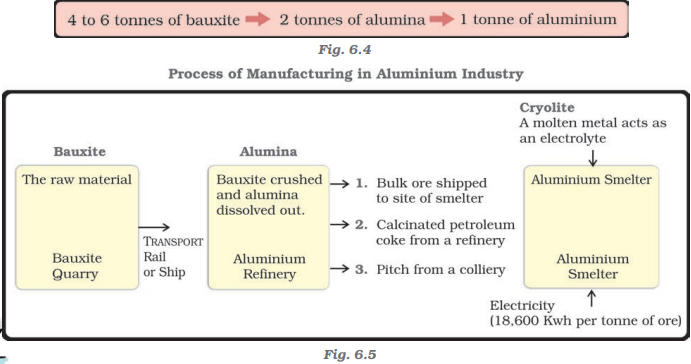
Aluminium smelting — The process of producing aluminium from bauxite; it is India’s second most important metallurgical industry.
Properties, uses and location
- Properties: Aluminium is light, corrosion-resistant, malleable and a good conductor of heat; mixing it with other metals makes it strong.
- Uses: It is used in aircraft, utensils and wires, and replaces steel, copper, zinc and lead in some industries.
- Raw material: Bauxite is a bulky, dark reddish-coloured rock.
- Location factors: Smelters need a regular electricity supply and an assured supply of raw material at minimum cost.
- Indian locations: Plants are in Odisha, West Bengal, Kerala, Uttar Pradesh, Chhattisgarh, Maharashtra and Tamil Nadu.
Chemical Industries
Growth, types and products
- Growth: India’s chemical industry is rapidly growing and diversifying, with both large- and small-scale units; rapid growth has occurred in both inorganic and organic sectors.
- Inorganic chemicals: Include sulphuric acid, nitric acid, alkalies, soda ash and caustic soda; these industries are widely spread across the country.
- Sulphuric acid: Used to manufacture fertilizers, synthetic fibres, plastics, adhesives, paints and dyes.
- Soda ash: Used to make glass, soaps, detergents and paper.
- Organic chemicals: Include petrochemicals, used to make synthetic fibres, synthetic rubber, plastics, dyes, drugs and pharmaceuticals.
- Location: Organic chemical plants are generally located near oil refineries or petrochemical plants.
- Interdependence: The chemical industry is its own largest consumer; basic chemicals are processed into products for industry, agriculture and consumer markets.
Fertilizer Industry
Products and production centres
- Main products: Nitrogenous fertilizers (mainly urea), phosphatic fertilizers, ammonium phosphate (DAP) and complex fertilizers.
- Complex fertilizers: Combine nitrogen, phosphate and potash.
- Potash: India imports it entirely because it has no reserves of commercially usable potash or potassium compounds.
- Major contributors: Gujarat, Tamil Nadu, Uttar Pradesh, Punjab and Kerala together account for about half of fertilizer production.
- Other producers: Andhra Pradesh, Odisha, Rajasthan, Bihar, Maharashtra, Assam, West Bengal, Goa, Delhi, Madhya Pradesh and Karnataka.
- Expansion: Fertilizer production spread to several other parts of the country after the Green Revolution.
Cement Industry
Importance and requirements
- Uses: Cement is essential for houses, factories, bridges, roads, airports, dams and other commercial establishments.
- Raw materials: The industry uses bulky, heavy limestone, silica and gypsum.
- Other requirements: Coal, electric power and rail transport are also needed.
- Location: Gujarat’s plants have suitable access to markets in Gulf countries.
- Development: India’s first cement plant was set up in Chennai in 1904; the industry expanded after Independence.
Automobile Industry
Products, growth and locations
- Role: Automobiles provide quick transport for goods, services and passengers.
- Products: Trucks, buses, cars, motorcycles, scooters, three-wheelers and multi-utility vehicles are made in India.
- Growth after liberalisation: New and contemporary models stimulated demand, supporting growth in passenger cars and two- and three-wheelers.
- Centres: Delhi, Gurugram, Mumbai, Pune, Chennai, Kolkata, Lucknow, Indore, Hyderabad, Jamshedpur and Bengaluru.
Key developments
- 1904India’s first cement plant was set up in Chennai.
- After IndependenceThe cement industry expanded.
- After the Green RevolutionFertilizer production expanded to several other parts of India.
- After liberalisationNew automobile models stimulated demand and industry growth.
What are the two prime location factors for aluminium smelters?
Why does India import potash for fertilizer production?
Name the main raw materials and other requirements of the cement industry.
Quick recap
- Aluminium smelting depends on affordable bauxite and a steady electricity supply.
- Both inorganic and organic chemical sectors have grown rapidly; chemical products serve industry, agriculture and consumers.
- Fertilizer production includes urea, phosphatic, DAP and complex fertilizers; India imports potash.
- Cement needs bulky minerals, energy and rail transport; India’s first plant was set up in Chennai in 1904.
- After liberalisation, new automobile models stimulated demand and industry growth.
Industrial Pollution and Environmental Degradation
Information Technology and Electronics Industry
Electronics and IT
- Products include transistor sets, televisions, telephones, cellular telecom equipment, telephone exchanges, radars and computers.
- Bengaluru is known as India’s electronic capital.
- Other centres include Mumbai, Delhi, Hyderabad, Pune, Chennai, Kolkata, Lucknow and Coimbatore.
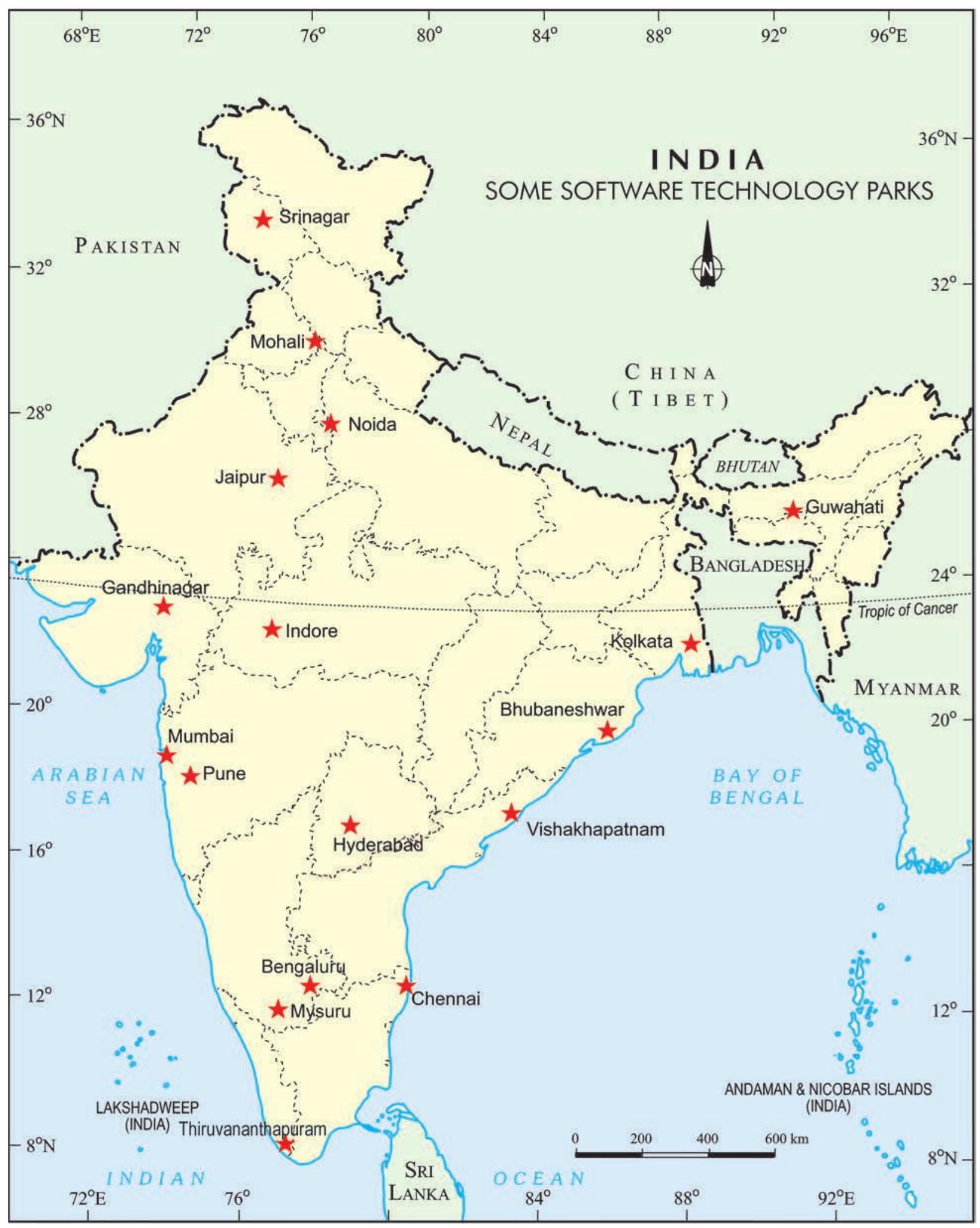
- Major industry concentrations are Bengaluru, Noida, Mumbai, Chennai, Hyderabad and Pune.
- Importance: The industry generates employment; continued growth in hardware and software supports the success of India’s IT industry.
Types and Effects of Industrial Pollution
Industrial pollution — Pollution caused by industrial activities; industries and thermal power plants contribute to air, water, land and noise pollution.
| Type | Main causes and examples | Effects |
|---|---|---|
| Air | Undesirable gases such as sulphur dioxide and carbon monoxide; dust, sprays, mist and smoke from factories and fossil-fuel burning. | Harms human health, animals, plants, buildings and the atmosphere; toxic gas leaks may have long-term effects. |
| Water | Industrial organic and inorganic wastes and effluents; hot water from factories or thermal plants. | Contaminates water bodies and causes thermal pollution, which harms aquatic life. |
| Land | Dumping glass, harmful chemicals, industrial effluents, packaging, salts and garbage. | Makes soil unfit for use and can contaminate groundwater. |
| Noise | Industrial and construction activities, machinery, generators, saws and pneumatic or electric drills. | Causes irritation, anger, stress, hearing impairment, increased heart rate and high blood pressure. |
Pollutants and Their Impacts
- Air pollution: Smoke comes from chemical and paper factories, brick kilns, refineries, smelting plants and factories that burn fossil fuels while ignoring pollution norms.
- Toxic gas leaks can cause serious hazards with long-term effects; the Bhopal Gas tragedy is a notable example.
- Water pollutants: Paper, pulp, chemical, textile and dyeing industries, petroleum refineries, tanneries and electroplating industries discharge dyes, detergents, acids, salts, lead, mercury, pesticides, fertilisers, synthetic chemicals, plastics and rubber.
- Solid industrial wastes in India include fly ash, phospho-gypsum and iron-and-steel slags.
- Nuclear waste from power plants and nuclear or weapon-production facilities can cause cancers, birth defects and miscarriages.
- Noise pollution is unwanted sound that irritates and causes stress, as well as possible hearing and other physiological effects.
How Industrial Waste Contaminates Groundwater
- Industrial waste is dumped on land.
- Rainwater percolates through the polluted soil.
- Pollutants are carried down into the ground.
- Groundwater becomes contaminated.
Controlling Environmental Degradation
Reducing Water Pollution
- Freshwater impact: Every litre of industrial wastewater can pollute eight times that quantity of freshwater.
- Use less water by reusing and recycling it through two or more successive processing stages.
- Harvest rainwater to meet industrial water requirements.
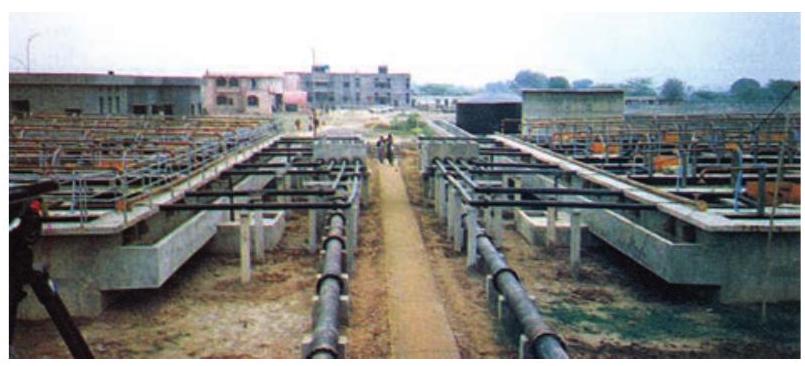
- Treat hot water and effluents before releasing them into rivers and ponds.
- Protect groundwater by legally regulating industrial overuse where groundwater resources are threatened.
| Phase | Process | Main operations |
|---|---|---|
| Primary | Mechanical | Screening, grinding, flocculation and sedimentation. |
| Secondary | Biological | Treatment through biological processes. |
| Tertiary | Biological, chemical and physical | Includes wastewater recycling. |
| Pollution | Control measures |
|---|---|
| Air | Fit factory smokestacks with electrostatic precipitators, fabric filters, scrubbers or inertial separators to reduce particulate matter; use oil or gas instead of coal to reduce smoke. |
| Noise | Use efficient machinery and fit generators with silencers; redesign machinery to save energy and reduce noise; use noise-absorbing materials and earplugs or earphones. |
Sustainable development — Development that integrates economic progress with environmental concerns.
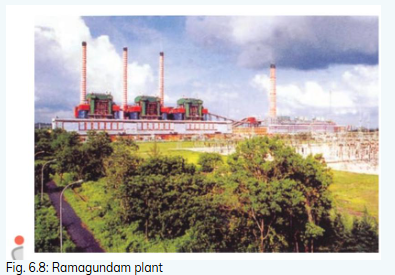
NTPC and Environmental Management
NTPC’s Environmental Measures
- NTPC is a major power-providing corporation in India and holds ISO 14001 certification for its Environment Management System (EMS).
- Resource conservation: It seeks to preserve water, oil, gas and fuels where it establishes power plants.
- Equipment and waste: It optimises equipment use, adopts the latest techniques and upgrades existing equipment; it minimises waste by maximising ash utilisation.
- Ecological measures: It provides green belts and supports afforestation to nurture ecological balance.
- Pollution management: It manages ash ponds, recycles ash water and manages liquid waste.
- Monitoring: It conducts ecological monitoring and reviews, and maintains an online database for its power stations.
- Effluent
- Liquid waste discharged from an industrial process.
- Particulate matter
- Fine solid or liquid particles suspended in air, such as dust, mist and smoke.
- Thermal pollution
- Pollution caused when hot water is released into rivers or ponds before cooling.
- EMS
- Environment Management System; NTPC’s system has ISO 14001 certification.
What are the four types of industrial pollution, and what are some of their effects?
What are the three phases of industrial effluent treatment?
How does NTPC work to reduce its environmental impact?
Quick recap
- Industries and thermal power plants contribute to air, water, land and noise pollution.
- Industrial smoke, toxic gases and airborne particles harm people, other living things, buildings and the atmosphere.
- Industrial effluents and hot water pollute water bodies; dumped wastes can contaminate soil and groundwater.
- Reduce water pollution through reuse, recycling, rainwater harvesting and three-phase effluent treatment.
- Control air pollution with particle-removal equipment and cleaner fuels; reduce noise with silencers and sound-absorbing measures.
- Sustainable development integrates economic growth with environmental care; NTPC demonstrates resource conservation and pollution management.
Social Science — ALL CHAPTERS
1
RESOURCES AND DEVELOPMENT
2
FOREST AND WILDLIFE RESOURCES
3
WATER RESOURCES
4
AGRICULTURE
5
MINERALS AND ENERGY RESOURCES
6
MANUFACTURING INDUSTRIES
7
LIFELINES OF NATIONAL ECONOMY
1
POWER SHARING
2
FEDERALISM
3
GENDER, RELIGION AND CASTE
4
POLITICAL PARTIES
5
OUTCOMES OF DEMOCRACY
1
THE RISE OF NATIONALISM IN EUROPE
2
NATIONALISM IN INDIA
3
THE MAKING OF A GLOBAL WORLD
4
THE AGE OF INDUSTRIALISATION
5
PRINT CULTURE AND THE MODERN WORLD
1
DEVELOPMENT
2
SECTORS OF THE INDIAN ECONOMY
3
MONEY AND CREDIT
4
GLOBALISATION AND THE INDIAN ECONOMY
5
CONSUMER RIGHTS