Class 10 . Social Science . Democratic Politics II . Federalism
Chapter 2: FEDERALISM
Ch 2
Social Science
Class 10
Introduction
Federalism as Power-Sharing
Federalism — A form of power-sharing in which power is divided vertically among different levels of government.
Key Idea
- Vertical division means sharing power among different levels of government.
- Modern democracies commonly use this arrangement as a form of power-sharing.
Focus of the Chapter
- General idea — the chapter begins by describing federalism in general terms.
- India — it explores the theory and practice of federalism in India.
- Constitution and practice — it examines federal constitutional provisions and the policies and politics that have strengthened federalism.
- Local government — the chapter concludes with local government as the new, third tier of Indian federalism.
Quick recap
- Federalism is a form of power-sharing.
- It divides power vertically among different levels of government.
- The chapter examines federalism in general and its theory and practice in India.
- It considers constitutional provisions and the policies and politics that strengthen federalism.
- Local government is presented as the third tier of Indian federalism.
What Is Federalism?
Belgium and Sri Lanka
- Belgium: In 1993, regional governments received constitutional powers that the central government could no longer withdraw; Belgium shifted from a unitary to a federal system.
- Sri Lanka: It remains practically unitary, with power concentrated in the national government; Tamil leaders have sought a federal system.
Meaning of Federalism
Federalism — A system of government in which power is divided between a central authority and the constituent units of a country.
How federal systems work
- Levels: Usually, one government serves the whole country while state or provincial governments manage many day-to-day matters.
- National role: The central government usually handles subjects of common national interest.
- Independent powers: Each level has powers of its own and is separately answerable to the people.
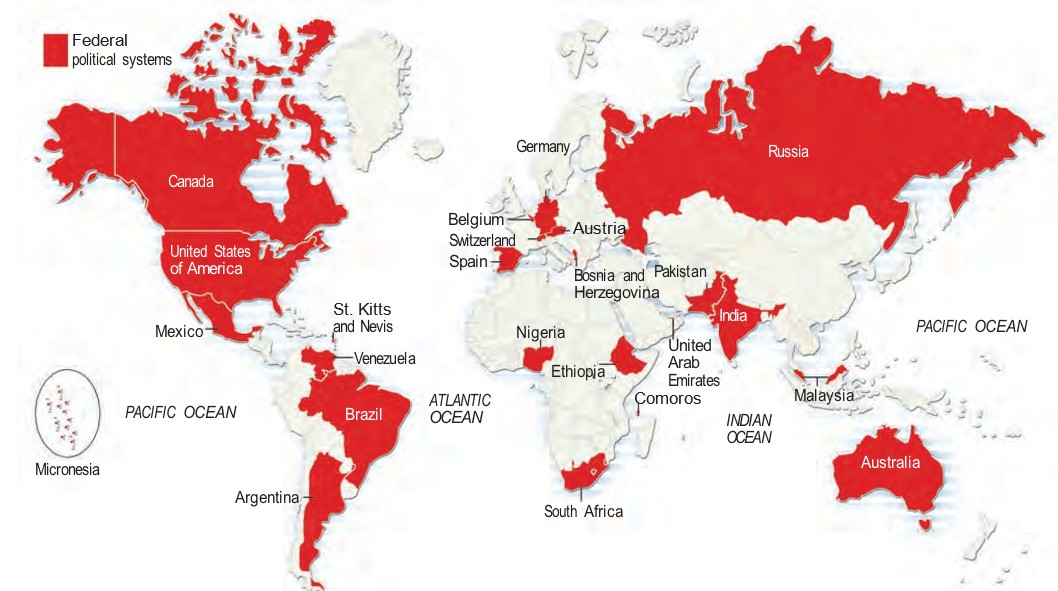
- Global presence: 25 of the world’s 193 countries are federations; their citizens make up 40 per cent of the world’s population.
- Large countries: Most of the large countries of the world are federations.
| Point | Federal | Unitary |
|---|---|---|
| Power structure | Power is divided between national and constituent-unit governments. | There is one level of government, or sub-units remain subordinate to the central government. |
| State/provincial authority | States have powers of their own; the central government cannot simply order them. | The central government can pass orders to provincial or local governments. |
| Accountability | Each level is separately answerable to the people. | Sub-units are subordinate to the central government. |
Key Features of Federalism
- Multiple tiers: There are two or more levels of government.
- Jurisdiction: Each tier governs the same citizens but has defined powers over legislation, taxation and administration.
- Constitutional protection: The Constitution specifies each level’s jurisdiction and guarantees its authority.
- Shared constitutional change: Fundamental provisions cannot be changed unilaterally by one level; changes require the consent of both levels.
- Courts: Courts interpret the Constitution and the powers of each level; the highest court acts as umpire in disputes.
- Financial autonomy: The sources of revenue for each level are clearly specified.
- Dual objective: Federalism safeguards national unity while accommodating regional diversity.
- Trust and agreement: Federalism requires agreement on power-sharing rules, mutual trust and willingness to live together.
- Jurisdiction
- The area or subject over which a government or authority has legal power.
- Constituent units
- The states, provinces or other units that make up a federation.
- Financial autonomy
- The ability of each level of government to rely on its clearly specified sources of revenue.
How Federations Are Formed
- Balance of power: The balance between central and state governments varies across federations and depends mainly on the historical context in which each federation formed.
| Point | Coming together | Holding together |
|---|---|---|
| How formed | Independent states voluntarily join to create a larger unit. | A large country divides power between the national government and constituent states. |
| Purpose or context | States pool sovereignty for greater security while retaining their identity. | Power is shared within an existing large country. |
| Relative power | Constituent states usually have equal power and are strong relative to the federal government. | The central government tends to be stronger; constituent units may have unequal powers, and some may receive special powers. |
| Examples | USA, Switzerland and Australia. | India, Spain and Belgium. |
What is federalism?
State any four key features of federalism.
Distinguish between coming together and holding together federations.
Quick recap
- Federalism divides power between a central government and constituent units.
- Federal levels have their own powers and are separately answerable to the people.
- The Constitution defines jurisdictions, shared amendment rules, revenue powers and the courts’ role.
- Federalism aims to protect national unity while accommodating regional diversity through agreement and mutual trust.
- The balance of power varies among federations and depends mainly on their historical context.
- Coming together federations unite independent states; holding together federations divide power within a large country.
- Belgium became federal in 1993; Sri Lanka remains practically unitary.
What Makes India a Federal Country?
India’s Federal Structure
India as a Union of States
- Constitutional description: The Constitution calls India a Union of States; although it does not use the word “federation,” India is based on federal principles.
- Origins: India became independent after Partition, and several princely states later joined the country.
- Tiers of government: The Constitution first established the Union and State governments; Panchayats and Municipalities were later added as a third tier.
- Federal principle: Each tier has its own jurisdiction, with powers divided by the Constitution.
Division of Legislative Powers
| List | Subjects and examples | Who makes laws? | Key rule |
|---|---|---|---|
| Union List | National matters: defence, foreign affairs, banking, communications and currency. | Union Government alone. | A uniform national policy is needed. |
| State List | State and local matters: police, trade, commerce, agriculture and irrigation. | State Governments alone. | Each State can make laws for its subjects. |
| Concurrent List | Shared-interest matters: education, forests, trade unions, marriage, adoption and succession. | Both Union and State Governments. | If their laws conflict, the Union law prevails. |
Residuary subjects — Subjects not included in any of the three lists, including new subjects such as computer software, on which the Union Government can legislate.
Unequal Powers within the Union
Special Provisions and Union Territories
- Unequal powers: In a “holding together” federation, constituent units may not all have identical powers.
- Special provisions: Assam, Nagaland, Arunachal Pradesh and Mizoram have certain special powers under Article 371 because of their social and historical circumstances.
- Purpose: These provisions protect matters such as indigenous peoples’ land rights and culture, and may provide preference in government employment; some rules restrict land purchases by non-permanent residents.
- Union Territories: Areas such as Chandigarh, Lakshadweep and Delhi are not States and have fewer powers; the Central Government has special powers in administering them.
Safeguards for the Federal Power-Sharing Arrangement
Changing the Division of Powers
- A proposed change must pass both Houses of Parliament with at least a two-thirds majority.
- It must then be ratified by the legislatures of at least half of all the States.
Courts and Financial Powers
- Judiciary: High Courts and the Supreme Court oversee constitutional provisions and decide disputes over the division of powers.
- Revenue: Union and State Governments can raise resources by levying taxes to carry out their assigned responsibilities.
Applying the Division of Powers
Could Rajasthan prevent the Union Government from conducting nuclear tests in Pokharan?
Does Sikkim need Union permission to introduce new school textbooks?
Can the Prime Minister order all States to adopt one police policy toward Naxalites?
- Union of States
- The constitutional description of India, whose government is organised on federal principles.
- Concurrent List
- Subjects on which both Union and State Governments can make laws; Union law prevails in a conflict.
- Residuary subjects
- Subjects outside the Union, State and Concurrent Lists; the Union Government legislates on them.
- Union Territory
- A unit with fewer powers than a State and special administration by the Central Government.
Quick recap
- India is a Union of States based on federal principles, with Union, State and local tiers.
- The Constitution divides law-making powers among the Union, State and Concurrent Lists.
- The Union legislates on residuary subjects; its law prevails when Union and State laws conflict on a Concurrent List subject.
- Some States have special constitutional provisions, while Union Territories have fewer powers than States.
- Changing the federal division of powers needs a special parliamentary majority and ratification by at least half the States.
- Courts resolve power disputes, and Union and State Governments can levy taxes for their responsibilities.
How Is Federalism Practised?
Federalism in practice — Federalism succeeds not only through constitutional rules, but also through democratic politics that respects diversity and encourages people to live together.
Linguistic States
Why States were reorganised
- Linguistic reorganisation: Many State boundaries were changed so that people speaking the same language could live in the same State.
- Other bases: Some States were created to recognise cultural, ethnic or geographical differences; examples include Nagaland, Uttarakhand and Jharkhand.
- Initial concern: Some national leaders feared linguistic States would break up India, so the Central Government resisted them at first.
- Outcome: Linguistic States strengthened national unity and made administration easier; people could identify with both their State and India.
Changes in State organisation
- 1947India became independent; many State boundaries were later reorganised, including on linguistic lines.
- November 1, 1956The States Reorganisation Commission’s report was implemented.
- 2019India’s political map showed the many changes in State boundaries, names and territories since 1947.
| Point | Fear | Outcome |
|---|---|---|
| National unity | Linguistic States might lead to the country’s disintegration. | They helped strengthen unity while allowing regional identities to flourish. |
| Administration | Reorganisation was seen as a possible source of division. | Sharing a State language made administration easier. |
Language Policy
Official languages and safeguards
- No national language: The Constitution did not grant any one language the status of India’s national language.
- Hindi: Hindi was identified as an official language, although it was the mother tongue of only about 40% of Indians in the language-policy discussion.
- Scheduled Languages: The Constitution recognises 22 Scheduled Languages—Hindi and 21 others. Candidates for Central Government positions may take examinations in any of them.
- State languages: States can have their own official languages, and much State government work is conducted in the relevant State’s official language.
Use of Hindi and English
- 1965The Constitution had envisaged ending the use of English for official purposes.
- After demands from non-Hindi-speaking StatesThe Central Government agreed to continue English alongside Hindi for official purposes; the Tamil movement had taken a violent form.
Balancing language interests
- Flexibility: Continuing English alongside Hindi helped accommodate non-Hindi-speaking States and avoid a serious language conflict.
- Hindi promotion: The Union promotes Hindi, but this does not mean it can impose Hindi on States where people speak other languages.
- Criticism: Some critics argue that continuing English benefits the English-speaking elite.
- Contrast: India adopted a more cautious approach to promoting Hindi than Sri Lanka’s leaders did to spreading their language.
Centre–State Relations
From central dominance to greater power sharing
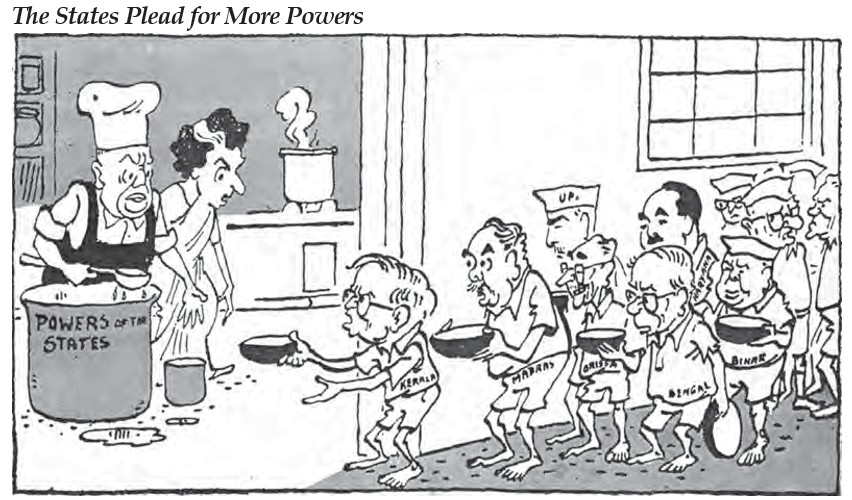
- Early practice: For a long time, the same party ruled at the Centre and in most States, limiting the autonomy exercised by State Governments.
- Misuse of power: When rival parties governed States, the Centre sometimes used the Constitution to dismiss those State Governments, weakening federalism.
- Change after 1990: Regional parties grew in strength, and coalition governments became common at the Centre because no single party had a clear Lok Sabha majority.
- New political culture: National parties formed alliances with regional parties, encouraging power sharing and respect for State autonomy.
- Judicial safeguard: A major Supreme Court judgment made arbitrary dismissal of State Governments more difficult.
Coalition government — A government formed when at least two political parties join together, usually through an alliance and a common programme.
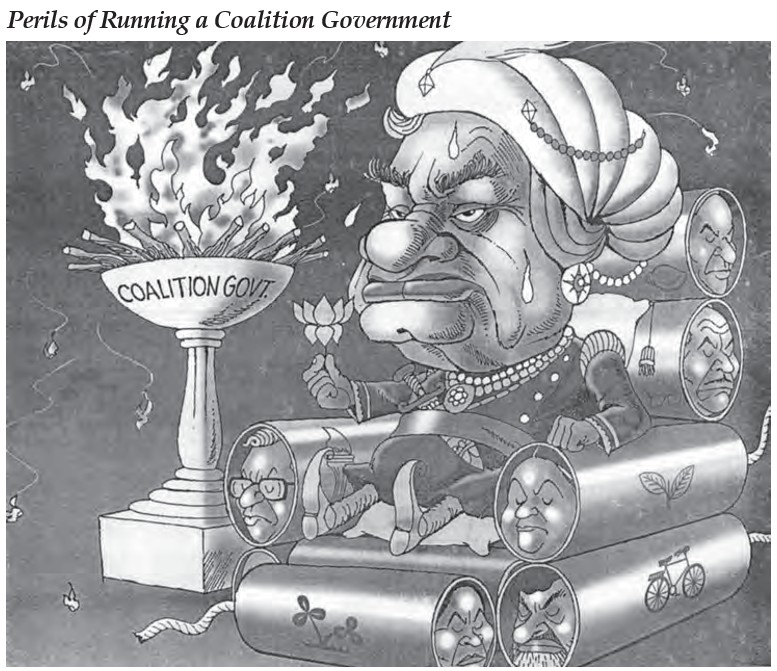
How coalition politics strengthened federalism
- No single party wins a clear majority in the Lok Sabha.
- National parties form alliances with regional parties.
- Coalition partners share power and State autonomy receives greater respect.
- Along with the Supreme Court safeguard, federal power sharing becomes more effective.
Linguistic Diversity of India
Language counts in the 2011 Census
- Mother tongues recorded: People reported more than 1,300 distinct mother tongues; many were grouped under larger language labels.
- Major languages: After grouping, the Census counted 121 major languages. For example, Bhojpuri, Magadhi, Bundelkhandi, Chhattisgarhi and Rajasthani were grouped under Hindi.
- Scheduled Languages: Of the 121 major languages, 22 are in the Constitution’s Eighth Schedule; the others are non-Scheduled Languages.
- Hindi: It was the largest mother-tongue language, spoken by about 44% of Indians. Even including second- and third-language speakers, the total remained below 50%.
- English: About 0.02% recorded English as their mother tongue; another 11% knew it as a second or third language.
- Diversity: No single language is the mother tongue of a majority of India’s population.
| Evidence | Interpretation | |
|---|---|---|
| Linguistic States | The States Reorganisation Commission’s report was implemented on November 1, 1956; linguistic States sometimes have disputes with one another. | Historian Ramachandra Guha argued that linguistic States strengthened Indian unity and allowed regional and national identities to coexist. |
| Possible alternative | India has many languages and a highly diverse population. | Guha argued that ignoring linguistic identities could have led to a more serious breakup into multiple nations. |
Related dates
- November 1, 2006Ramachandra Guha’s article in The Times of India discussed the impact of linguistic States.
- 2011The Census recorded more than 1,300 distinct mother tongues and 121 major languages.
How did linguistic States strengthen India?
How did India’s language policy accommodate linguistic diversity?
How did Centre–State relations change after 1990?
Quick recap
- Federalism depends on democratic practices that respect diversity, as well as on constitutional provisions.
- Linguistic reorganisation strengthened unity and made administration easier; some States were formed for cultural, ethnic or geographical reasons.
- Hindi is an official language, not India’s national language; English and State official languages help accommodate diversity.
- Regional parties, coalition governments and a Supreme Court safeguard strengthened Centre–State power sharing after 1990.
- The 2011 Census recorded more than 1,300 mother tongues, grouped into 121 major languages, including 22 Scheduled Languages.
Decentralisation in India
Why Decentralisation Is Needed
- Local needs: Local people understand their area’s problems and can decide how resources should be used effectively.
- Democratic participation: Local self-government lets people participate directly in decision-making and brings government closer to them.
Constitutional Changes in 1992
- 1992 amendment: The Constitution was amended to strengthen local government and make the third tier more effective.
- Key provisions: Regular elections became mandatory; seats were reserved for disadvantaged groups and at least one-third of positions for women.
- State support: State Election Commissions were established, and State governments were required to share some powers and revenue with local bodies.
Rural Local Government: Panchayati Raj
- Panchayati raj: Rural local government operates at village, block and district levels.
- Gram panchayat: Elected ward members and a sarpanch make decisions for the village under the supervision of the gram sabha, which includes all village voters.
- Higher levels: Gram panchayats are grouped into panchayat samitis or mandals, and these together form the district’s zilla parishad.
Urban Local Government
- Urban bodies: Municipalities govern towns, while municipal corporations serve larger cities.
- Elected representatives: Both bodies are controlled by elected representatives; a municipal chairperson leads a municipality, and a mayor leads a municipal corporation.
Participatory Democracy and Its Impact
- Decentralisation
- Transfer of powers from higher levels of government to local government.
- Gram sabha
- The assembly of all voters in a village.
- Panchayati raj
- Rural local government in India.
- State Election Commission
- Independent State institution that conducts panchayat and municipal elections.
What were the main decentralisation measures introduced by the 1992 constitutional amendment?
How is rural local government organised from village to district?
What are the main achievements and limitations of decentralisation in India?
Quick recap
- Decentralisation transfers power to local governments so local issues can be decided closer to the people.
- The 1992 constitutional amendment strengthened local bodies and required regular elections.
- Seats are reserved for SCs, STs and OBCs, and at least one-third of positions for women.
- Rural local government is organised through gram panchayats, panchayat samitis and zilla parishads.
- Towns have municipalities; large cities have municipal corporations.
- Local participation can improve accountability, but many local bodies still lack adequate powers and resources.
Social Science — ALL CHAPTERS
1
RESOURCES AND DEVELOPMENT
2
FOREST AND WILDLIFE RESOURCES
3
WATER RESOURCES
4
AGRICULTURE
5
MINERALS AND ENERGY RESOURCES
6
MANUFACTURING INDUSTRIES
7
LIFELINES OF NATIONAL ECONOMY
1
POWER SHARING
2
FEDERALISM
3
GENDER, RELIGION AND CASTE
4
POLITICAL PARTIES
5
OUTCOMES OF DEMOCRACY
1
THE RISE OF NATIONALISM IN EUROPE
2
NATIONALISM IN INDIA
3
THE MAKING OF A GLOBAL WORLD
4
THE AGE OF INDUSTRIALISATION
5
PRINT CULTURE AND THE MODERN WORLD
1
DEVELOPMENT
2
SECTORS OF THE INDIAN ECONOMY
3
MONEY AND CREDIT
4
GLOBALISATION AND THE INDIAN ECONOMY
5
CONSUMER RIGHTS