Class 10 . Social Science . India And Contemporary World II . The Rise of Nationalism in Europe
Chapter 1: THE RISE OF NATIONALISM IN EUROPE
Ch 1
Social Science
Class 10
Introduction & the French Revolution and the Idea of the Nation
Sorrieu’s Vision of Democratic Nations

Reading the vision
- Artist and date: In 1848, French artist Frédéric Sorrieu created a series of four prints imagining a world of democratic and social republics.
- Liberty: Peoples of Europe and America march past a female statue of Liberty, carrying the torch of Enlightenment and the Charter of the Rights of Man.
- Nations: Flags and national costumes identify distinct peoples; the United States and Switzerland lead as existing nation-states.
- Unification hopes: France is followed by German peoples carrying black, red and gold—a symbol of hopes to unite German-speaking principalities under a democratic constitution.
- Fraternity: Christ, saints and angels look down from above, suggesting brotherhood among nations.
- Utopian vision: The print imagines an ideal democratic world that did not yet exist.
- Absolutist
- A system of rule in which a monarch’s power has no restraints; historically, it was centralised, militarised and repressive.
- Utopian
- An ideal vision of society that is unlikely to exist in reality.
The French Revolution and the Idea of the Nation
Nationalism — The idea that a people sharing a collective identity should form a nation and shape its own political destiny.
The French Revolution’s national idea
- 1789: The French Revolution gave the first clear expression of nationalism.
- Sovereignty: France was a territorial state under an absolute monarch; the Revolution transferred sovereignty from the monarchy to the body of French citizens.
- The nation: The people were declared the nation, with the right to shape its destiny.
- Collective identity: The ideas of *la patrie* (fatherland) and *le citoyen* (citizen) promoted a united community of equal citizens under a constitution.

Revolutionary symbols and reforms
- Rebmann: A journalist in Mainz and a member of a German Jacobin group; his illustration carried the slogan, “The people must seize their own freedom!”
- Flag: The tricolour replaced the royal standard.
- Institutions: The Estates General, elected by active citizens, was renamed the National Assembly.
- Shared national culture: New hymns, oaths and commemorations of martyrs were created in the nation’s name.
- Uniform administration: A centralised system introduced uniform laws; internal customs duties were abolished and common weights and measures adopted.
- Common language: Regional dialects were discouraged and Parisian French promoted as the nation’s common language.
The Revolution’s mission beyond France
- French revolutionaries claimed it was France’s mission to free European peoples from despotism.
- News of the Revolution encouraged students and educated middle-class people in European cities to form Jacobin clubs.
- In the 1790s, French armies moved into Holland, Belgium, Switzerland and much of Italy.
- The armies carried nationalist ideas abroad, alongside French military power.
Napoleon’s reforms
- Political limit: Napoleon restored monarchy and ended democracy in France, but retained several revolutionary administrative principles.
- Napoleonic Code (1804): The Civil Code ended privileges based on birth, established equality before the law and secured the right to property.
- Across conquered territories: In the Dutch Republic, Switzerland, Italy and Germany, Napoleon simplified administration, abolished feudalism and ended serfdom and manorial dues.
- Economic and social changes: Guild restrictions were removed and transport and communication improved.
- Benefits to commerce: Uniform laws, standard weights and measures, and a common national currency helped businesses move and exchange goods and capital across regions.

| Point | Initial response and reforms | Reasons for growing hostility |
|---|---|---|
| Political promise | French armies were initially welcomed in places such as Holland, Switzerland, Brussels, Mainz, Milan and Warsaw as bringers of liberty. | New administrative arrangements did not bring political freedom. |
| Everyday changes | Feudalism, serfdom and some old restrictions were removed; laws and administration were made more uniform. | Higher taxes, censorship and forced conscription burdened local people. |
| Meaning of the Liberty Tree | A symbol associated with liberty and equality. | In the Zweibrücken print, French soldiers are shown seizing a peasant’s cart and mistreating local people; the inscription sarcastically challenges their claim to be liberators. |

Napoleon’s declining control
- Leipzig, 1813: The cartoon represents Napoleon returning to France after losing the battle and losing control of the territories named on the letters.
Key dates
- 1789The French Revolution begins; popular sovereignty and the idea of the nation receive their first clear expression.
- 1790sFrench armies carry revolutionary and nationalist ideas into parts of Europe.
- 1798Andreas Rebmann’s almanac illustration calls on people to seize their freedom.
- 1804The Napoleonic Code establishes equality before the law and the right to property, while ending birth-based privileges.
- 1813Napoleon loses the battle of Leipzig and territories represented in the political cartoon.
- 1848Frédéric Sorrieu creates prints imagining a world of democratic and social republics.
How did the French Revolution create a sense of collective identity?
What were the main features of the Napoleonic Code?
Why did enthusiasm for French rule turn into hostility?
Quick recap
- The French Revolution of 1789 transferred sovereignty from the monarch to the people and gave nationalism a clear political expression.
- Shared symbols, laws, administration and language helped create a collective French identity.
- French revolutionary armies spread nationalist ideas and also occupied territories across Europe.
- Napoleon’s 1804 Code promoted legal equality and property rights while ending birth-based privilege.
- French rule brought reforms but also taxation, censorship and conscription, leading many people to oppose it.
- Sorrieu’s 1848 prints imagined a united world of democratic nations.
The Making of Nationalism in Europe
Europe Before Nation-States
A politically fragmented continent
- Mid-eighteenth-century Europe had no nation-states in the modern sense. Areas now known as Germany, Italy and Switzerland were divided into kingdoms, duchies and cantons.
- Central and Eastern Europe contained autocratic monarchies ruling over people with different languages, ethnic identities and cultures.
- Habsburg Empire was a patchwork of regions and peoples; its diverse population was linked mainly by allegiance to the emperor.
- Regional diversity: Bohemia’s aristocracy was mainly German-speaking; Lombardy and Venetia were Italian-speaking; Hungary included Magyar speakers and people speaking other dialects.
- Other Habsburg peoples: Galicia’s aristocracy spoke Polish; Bohemians and Slovaks lived to the north, Slovenes in Carniola, Croats to the south, and Roumans in Transylvania.
Key Dates
- 1797Napoleon invaded Italy; the Napoleonic Wars began.
- 1814–1815Napoleon fell, followed by the Vienna Peace Settlement.
- 1821The Greek struggle for independence began.
- 1848Revolutions spread across Europe: artisans, industrial workers and peasants rebelled against economic hardship; middle classes demanded constitutions and representative government; Italians, Germans, Magyars, Poles, Czechs and others demanded nation-states.
- 1859–1870Italy was unified.
- 1866–1871Germany was unified.
- 1905Slav nationalism gained strength in the Habsburg and Ottoman Empires.
The Aristocracy and the New Middle Class
Social groups and changing society
- Landed aristocracy was socially and politically dominant, though small in number. Its members owned country estates and townhouses, spoke French in diplomacy and high society, and were often connected through marriage.
- Peasantry formed the majority of the population.
- Landholding: In the West, most land was farmed by tenants and small owners; in Central and Eastern Europe, vast estates were cultivated by serfs.
- Industrialisation began in England in the second half of the eighteenth century; it reached France and parts of the German states during the nineteenth century.
- New social groups grew with industrial production, trade and towns: industrial workers, industrialists, businessmen and professionals. These groups remained smaller in Central and Eastern Europe until late in the nineteenth century.
- National unity gained support among educated, liberal middle classes, who linked it to ending aristocratic privileges.
What Did Liberal Nationalism Stand For?
Liberalism — An ideology rooted in individual freedom and equality before the law; in nineteenth-century Europe it also supported government by consent and national unity.
Political meaning of liberalism
- Origin: Liberalism comes from the Latin word *liber*, meaning “free.”
- Political principles: Individual freedom, equality before the law, government by consent, a constitution and representative government through parliament.
- Opposition: Liberals favoured ending autocracy and clerical privileges; they also defended the inviolability of private property.
- Suffrage means the right to vote. Equality before the law did not automatically mean that everyone had the right to vote.
| Group or period | Political rights |
|---|---|
| Property-owning men | Could vote and stand for election. |
| Men without property and women | Were excluded from political rights. |
| Brief Jacobin period | All adult men had the right to vote. |
| Under the Napoleonic Code | Suffrage was restricted again; women were treated as minors under the authority of fathers or husbands. |
| Nineteenth and early twentieth centuries | Women and non-propertied men organised movements demanding equal political rights. |
Economic meaning of liberalism
- Economic freedom meant free markets and removing state restrictions on the movement of goods and capital.
- German-speaking regions: Napoleon’s administrative measures brought countless small principalities together in a confederation of 39 states, each with its own currency and system of weights and measures.
- Trade barriers: In 1833, a merchant travelling from Hamburg to Nuremberg crossed 11 customs barriers and paid about 5% duty at each one.
- Different measures: The length of an elle varied by region: 54.7 cm in Frankfurt, 55.1 cm in Mainz, 65.6 cm in Nuremberg and 53.5 cm in Freiburg.
- Commercial classes viewed customs duties and inconsistent measures as obstacles to trade and growth; they wanted a unified economic area for the free movement of goods, people and capital.
Economic Integration and Nationalism
- Separate currencies, weights and measures, and customs barriers fragmented trade among German states.
- Prussia initiated the Zollverein in 1834, and most German states joined.
- The customs union abolished tariff barriers and reduced the number of currencies from over thirty to two.
- Railway expansion increased mobility and connected economic interests across the states.
- Economic cooperation strengthened wider nationalist feeling and support for national unification.
- Suffrage
- The right to vote.
- Zollverein
- The customs union formed in 1834 under Prussian initiative, removing tariff barriers among most German states.
- Liberal nationalism
- The connection between national unity and liberal ideas such as individual freedom, equality before the law and representative government.
What did liberalism mean politically and economically for the new middle classes?
How did the Zollverein encourage German national unity?
Quick recap
- Mid-eighteenth-century Europe was divided into territories and empires, not modern nation-states.
- The Habsburg Empire’s diverse peoples shared allegiance to the emperor more than a common culture or identity.
- Educated liberal middle classes linked national unity to the removal of aristocratic privileges.
- Liberalism promoted individual freedom, equality before the law, representative government and free markets.
- Political equality did not initially include universal suffrage; women and men without property were excluded.
- Napoleon’s measures created a confederation of 39 German states; the 1834 Zollverein and railway growth helped connect them and strengthen nationalism.
A New Conservatism After 1815 & the Revolutionaries
A New Conservatism after 1815
Conservatism — A political philosophy that values tradition and established institutions, and favours gradual change over sudden transformation.
Conservative ideas
- Institutions to preserve: Monarchy, the Church, social hierarchies, property and the family.
- Not a complete return: Conservatives did not generally seek to restore society exactly as it was before the French Revolution.
- Modernisation: A modern army, efficient bureaucracy and dynamic economy could strengthen the state and monarchy.
- Reforms: Ending feudalism and serfdom could also make autocratic monarchies more effective.
The Congress of Vienna and its Settlement
The 1815 settlement
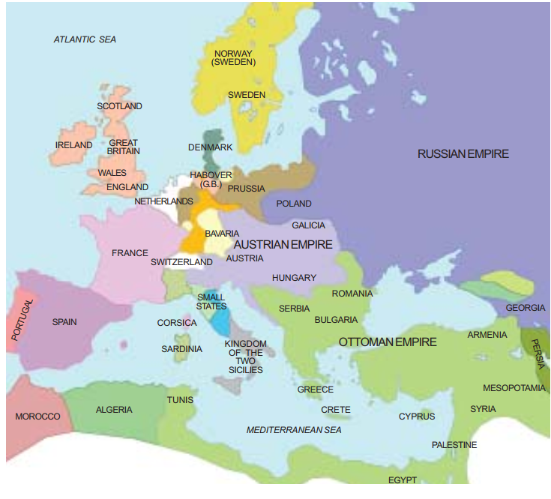
- Participants: Britain, Russia, Prussia and Austria met in Vienna after defeating Napoleon; Austrian Chancellor Duke Metternich hosted the Congress.
- Aim: The Treaty of Vienna sought to reverse many changes made during the Napoleonic Wars and restore monarchies overthrown by Napoleon.
- France: The Bourbon dynasty was restored, and France lost the territories it had annexed under Napoleon.
- Containment of France: The Kingdom of the Netherlands, including Belgium, was created to France’s north; Genoa was added to Piedmont in the south.
- Territorial changes: Prussia gained territories on its western frontier and a portion of Saxony; Austria controlled northern Italy; Russia received part of Poland.
- German lands: The German Confederation of 39 states established by Napoleon was left intact.
Conservative order after Vienna
- Napoleon’s defeat in 1815 → European powers sought to restore traditional monarchies.
- Restored monarchies → conservative and autocratic governments were established.
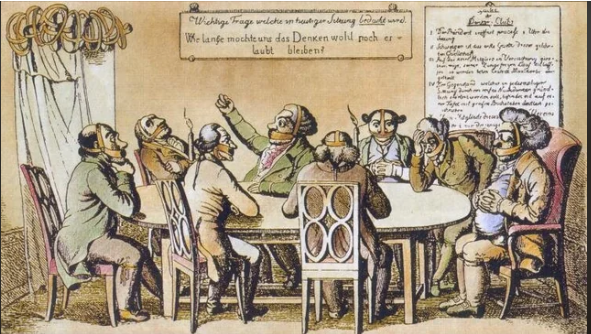
- Fear of challenges to autocratic rule → criticism and dissent were restricted.
- Censorship laws → newspapers, books, plays and songs expressing liberty or freedom could be controlled.
Liberal-nationalist opposition
- French Revolution’s legacy: Its ideas continued to inspire liberals despite the conservative settlement.
- Key demand: Liberal-nationalists criticised the new order, especially its restrictions on freedom of the press.
The Revolutionaries
Revolutionary — After 1815, a revolutionary opposed the monarchies restored by the Congress of Vienna and struggled for liberty, freedom and nation-states.
Secret societies
- Why they formed: Repression drove many liberal-nationalists underground after 1815.
- Purpose: Secret societies trained revolutionaries and spread ideas opposing restored monarchies.
- National goal: Many revolutionaries saw the creation of nation-states as necessary for freedom.
Giuseppe Mazzini
- Early life: Born in Genoa in 1807; he joined the secret society of the Carbonari.
- Exile: At the age of 24, he was exiled in 1831 after attempting a revolution in Liguria.
- Organisations: He founded Young Italy in Marseilles and later Young Europe in Berne; Young Europe included members from Poland, France, Italy and the German states.
- Belief: Mazzini believed God intended nations to be the natural units of mankind.
- Vision for Italy: Italy should not remain divided into small states and kingdoms; it should become a single, unified republic within an alliance of nations.
- Impact: His model inspired secret societies in Germany, France, Switzerland and Poland.
- Conservative response: His opposition to monarchy and support for democratic republics alarmed conservatives; Metternich called him ‘the most dangerous enemy of our social order’.

Economic Unity and National Feeling
Friedrich List and the Zollverein
- Friedrich List: Professor of Economics at the University of Tübingen; he wrote about the Zollverein in 1834.
- Economic purpose: The Zollverein aimed to bind Germans together economically and strengthen the nation by protecting its interests externally and encouraging internal productivity.
- Political purpose: Combining individual and provincial interests could awaken national sentiment and help forge a united nation.
- List’s argument: He believed a free economic system was the means to generate national feeling.
Key dates
- 1815The Congress of Vienna established a conservative settlement after Napoleon’s defeat.
- 1807Giuseppe Mazzini was born in Genoa.
- 1831Mazzini was exiled for attempting a revolution in Liguria.
- 1833Young Europe was founded in Berne.
- 1834Friedrich List wrote about the Zollverein’s role in uniting Germans economically.
- Autocratic
- A system of government in which rulers hold extensive power and restrict opposition.
- Censorship
- Government control over what may be published or expressed.
- Carbonari
- The secret society that Mazzini joined as a young man.
- Zollverein
- The economic union List viewed as a way to unite Germans and promote national feeling.
What political aims did Friedrich List hope to achieve through economic measures?
What was Mazzini’s vision for Italy?
Quick recap
- Conservatives valued traditional institutions but also accepted modernisation that strengthened the state.
- The Congress of Vienna restored monarchies and redrew borders to contain France and create a conservative European order.
- Autocratic governments used censorship to suppress criticism and ideas of liberty.
- Secret societies trained revolutionaries who opposed restored monarchies and supported nation-states.
- Mazzini promoted a unified Italian republic and inspired revolutionary groups across Europe.
- Friedrich List argued that economic unity through the Zollverein could foster German national feeling.
The Age of Revolutions: 1830-1848
Liberal and Nationalist Revolutions
- Movement: Liberalism and nationalism became increasingly linked with revolution across Europe, challenging conservative rule.
- Leadership: Educated middle-class liberals and nationalists, including professionals and commercial groups, led many of these movements.
- July Revolution, 1830: French revolutionaries overthrew the Bourbon kings and established a constitutional monarchy under Louis Philippe; the uprising inspired Belgium to break away from the Netherlands.
Greek War of Independence
- Beginning: Greece, under Ottoman rule since the fifteenth century, began its struggle for independence in 1821.
- Support: Greek exiles and Western Europeans who admired ancient Greek culture supported the struggle; poet Lord Byron raised funds and joined the fight, dying of fever in 1824.
- Independence: The Treaty of Constantinople recognised Greece as an independent nation in 1832.
Romanticism and National Feeling

Art as a Nationalist Force
- The Massacre at Chios: Eugène Delacroix’s 1824 painting depicted the suffering of Greeks on Chios; around 20,000 Greeks were said to have been killed there.
- Emotional appeal: By focusing on women and children and using vivid colours, Delacroix sought to move viewers and build sympathy for the Greek struggle.
Folk Culture, Language and Nation-Building
Poland: Keeping National Feeling Alive
- Partition: Poland was divided among Russia, Prussia and Austria at the end of the eighteenth century, so it no longer existed as an independent territory.
- Resistance: National feeling survived through music and language despite the loss of an independent state.
- Rebellion: An armed revolt against Russian rule in 1831 was crushed.
- Clergy: Many priests and bishops used Polish for church gatherings and teaching; Russian authorities jailed or exiled some to Siberia.
The Grimm Brothers and German Identity
- Jacob and Wilhelm Grimm: They collected and published German folktales, regarding them as expressions of an authentic German spirit.
- Nation-building: Their folklore and language projects helped oppose French cultural domination and strengthen German national identity.
Hunger, Hardship and Popular Revolt
- Economic hardship: Rapid population growth in the first half of the nineteenth century left many people without jobs and drove rural migrants into overcrowded cities.
- Work and poverty: Small producers faced competition from cheap, machine-made English goods, while peasants in regions with powerful aristocracies bore feudal dues.
- Food crisis: Rising food prices and poor harvests increased poverty in both towns and the countryside.
Revolts in 1848

The Silesian Weavers’ Revolt
How did culture help create national identity?
What caused the Silesian weavers’ revolt?
What changes followed the 1848 revolt in France?
Quick recap
- Liberal-nationalist revolutions challenged conservative regimes; France’s 1830 revolution helped lead to Belgium’s separation.
- The Greek struggle began in 1821 and Greece became independent in 1832.
- Romantic culture and folk traditions helped create a shared national heritage.
- Polish music and language preserved national feeling despite partition and Russian rule.
- Population growth, unemployment, competition, feudal burdens and food crises produced widespread hardship.
- The 1848 Paris revolt established a republic with male suffrage above 21 and a right to work.
- The Silesian weavers revolted in 1845 against reduced payments and severe economic exploitation.
1848: the Revolution of the Liberals & the Making of Germany and Italy
The 1848 Revolution of the Liberals
Liberal-Nationalist Demands
- Context: In 1848, educated middle classes pursued political change alongside revolts by poor, unemployed and starving workers and peasants.
- France: February events led to the monarch’s abdication and the proclamation of a republic based on universal male suffrage.
- National unity: In Germany, Italy, Poland and the Austro-Hungarian Empire, liberals linked national unification with constitutional government.
- Aims: They demanded nation-states based on a constitution, parliamentary principles, freedom of the press and freedom of association.
The Frankfurt Parliament and Women’s Rights
The Frankfurt Parliament
- Assembly: German political associations elected an all-German National Assembly, which met at St Paul’s Church in Frankfurt.
- 18 May 1848: 831 elected representatives entered the parliament in a festive procession.
- Constitution: Deputies proposed a united German nation under a monarchy limited by a parliament.
- Rejection: Friedrich Wilhelm IV of Prussia refused the crown offered on these terms and joined other monarchs against the assembly.
- Collapse: Middle-class deputies resisted workers’ and artisans’ demands, losing their support; troops eventually forced the parliament to disband.

Women and Political Rights
- Participation: Women formed political associations, founded newspapers and took part in meetings and demonstrations.
- Exclusion: Women were denied the vote in the Assembly elections and could attend parliament only as observers in the visitors’ gallery.
- Feminist: Awareness of women’s rights based on the belief in social, economic and political equality between genders.
| Writer | Position |
|---|---|
| Carl Welcker | Claimed that men and women had different natural roles; women belonged in the home, and equality would threaten family harmony. |
| Louise Otto-Peters | Argued that liberty is indivisible: men cannot claim freedom for all while excluding women from it. |
| Anonymous reader | Condemned denying political rights to women who owned property and contributed to the state, while men could vote simply because they were men. |
Ideology — A system of ideas reflecting a particular social and political vision.
Effects of the 1848 Revolutions
- Suppression: Conservatives defeated liberal movements but could not fully restore the old order.
- Concessions: Monarchs introduced reforms to reduce recurring cycles of revolution and repression.
- Abolition: Serfdom and bonded labour were abolished in the Habsburg dominions and Russia.
- 1867: Habsburg rulers granted greater autonomy to the Hungarians.
The Making of Germany
Prussian Leadership and Unification
- Shift after 1848: Nationalism increasingly served conservative state power and political dominance, rather than democracy and revolution.
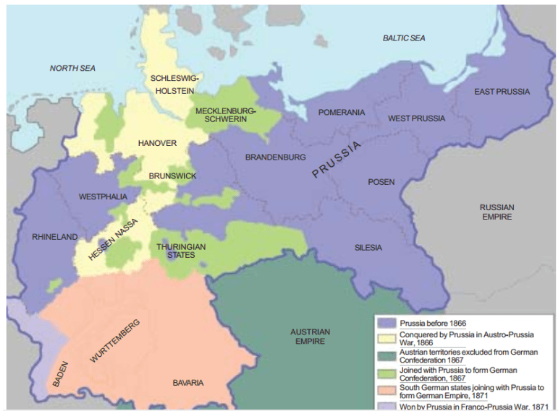
- Failed liberal effort: In 1848, German middle classes tried to unite the German Confederation through an elected parliament; monarchy and military, supported by Prussian landowners, repressed the movement.
- Junkers: The large landowners of Prussia who supported the monarchy and military.
- Bismarck: Prussia’s chief minister, Otto von Bismarck, led unification with the help of the army and bureaucracy.
- Wars: Prussia defeated Denmark, Austria and France in three wars over seven years, completing unification.
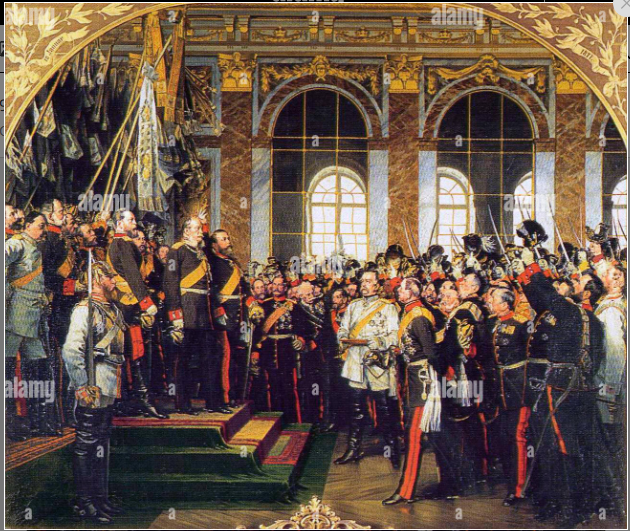
- 18 January 1871: William I of Prussia was proclaimed German Emperor at Versailles.
German Unification
- The liberal parliamentary attempt of 1848 is defeated
- Prussia takes leadership under Bismarck
- Prussian army wins wars against Denmark, Austria and France
- William I is proclaimed German Emperor at Versailles in 1871
The New German State
- Prussian dominance: Unification demonstrated the strength of Prussian state power.
- Modernisation: The new state modernised currency, banking, legal and judicial systems.
- Influence: Prussian measures and practices often became models for the rest of Germany.

The Unification of Italy
Italy Before Unification
- Fragmentation: In the mid-nineteenth century, Italy was divided into seven states; only Sardinia-Piedmont was ruled by an Italian princely house.
- Different rulers: Austria controlled the north, the Pope ruled the centre and Bourbon kings ruled the south; parts of Italy also belonged to the Habsburg Empire.
- Language: Italian had no single common form and retained regional and local variations.
- Mazzini: In the 1830s, Giuseppe Mazzini promoted a unitary Italian republic and founded the secret society Young Italy to spread his aims.
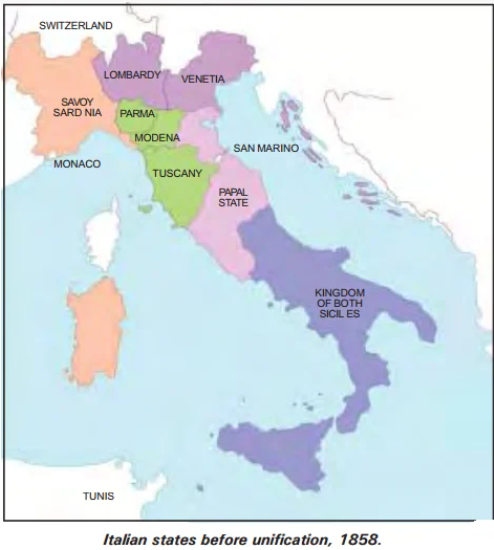
The Unification Process
- Leadership: After failed uprisings in 1831 and 1848, the task of unification passed to Sardinia-Piedmont under King Victor Emmanuel II.
- Cavour: Chief Minister Cavour was neither a revolutionary nor a democrat; he arranged a diplomatic alliance with France.
- 1859: With French support, Sardinia-Piedmont defeated Austrian forces.
- Garibaldi: In 1860, armed volunteers led by Giuseppe Garibaldi entered South Italy and the Kingdom of the Two Sicilies; they gained peasant support to drive out Spanish rulers.
- 1861: Victor Emmanuel II was proclaimed king of united Italy.
Italian Unification
- Mazzini’s republican vision and earlier uprisings fail
- Sardinia-Piedmont and Cavour lead unification through diplomacy and war
- Garibaldi’s volunteers help unite the south in 1860
- Victor Emmanuel II becomes king of united Italy in 1861
- Venetia joins in 1866 and Rome in 1870
Limits of Popular Nationalism
- Elite aims: Ruling elites in Sardinia-Piedmont saw unity as a path to economic development and political dominance.
- Popular awareness: Many Italians, especially peasants in the south, had little knowledge of liberal-nationalist ideas; some Garibaldi supporters had never heard of Italia and thought “La Talia” was Victor Emmanuel’s wife.
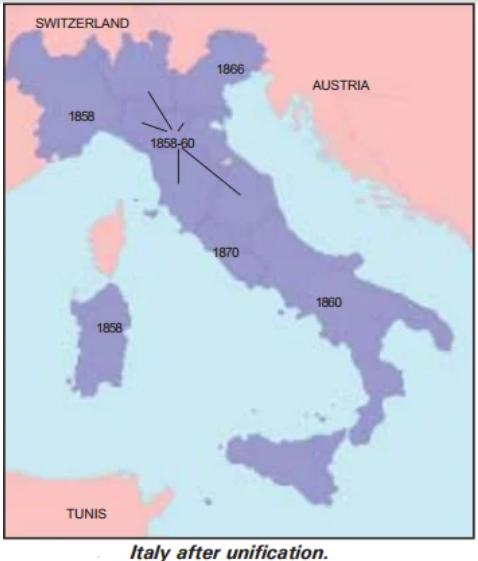
Key Dates
- 1830sMazzini promoted a unitary Italian republic and founded Young Italy.
- 1831 and 1848Italian revolutionary uprisings failed.
- February 1848The French monarch abdicated and a republic based on universal male suffrage was proclaimed.
- 18 May 1848The Frankfurt National Assembly convened with 831 elected representatives.
- 21 April 1849Louise Otto-Peters’s newspaper published an editorial arguing that liberty must include women.
- 25 June 1850An anonymous reader wrote against denying women political rights.
- 1859Sardinia-Piedmont defeated Austria with French support.
- 1860Garibaldi’s volunteers helped unite southern Italy.
- 1861Victor Emmanuel II was proclaimed king of united Italy.
- 1866Venetia joined unified Italy.
- 1867Habsburg rulers granted the Hungarians greater autonomy.
- 1870Rome joined unified Italy.
- 18 January 1871William I was proclaimed German Emperor at Versailles.
- Feminist
- A person or viewpoint supporting women’s social, economic and political equality.
- Ideology
- A system of ideas reflecting a social and political vision.
- Junkers
- Large landowners in Prussia who supported the monarchy and military.
- Young Italy
- Mazzini’s secret society, formed to spread his programme for a united Italian republic.
Why did the Frankfurt Parliament fail?
How did Germany become unified under Prussia?
What do the three writers’ views on women’s rights reveal about liberal ideology?
Quick recap
- The liberal revolutions of 1848 sought constitutions, parliamentary government and national unity.
- The Frankfurt Parliament failed amid royal and military opposition and the loss of popular support.
- Women participated in liberal movements but were denied suffrage and parliamentary membership.
- Prussia and Bismarck unified Germany through military victories; William I became emperor in 1871.
- Cavour, Sardinia-Piedmont and Garibaldi led Italian unification; Victor Emmanuel II became king in 1861.
- National unity did not mean that all ordinary people understood or shared nationalist ideology.
The Strange Case of Britain & Visualising the Nation
The Strange Case of Britain
Ethnic identity — A shared sense of identity based on common cultural, tribal or racial origins.
How Britain became a nation-state
- Gradual formation: Britain became a nation-state through a long process, not a sudden upheaval or revolution.
- Before the 18th century: There was no single British nation; people identified mainly as English, Welsh, Scottish or Irish, each with distinct cultural and political traditions.
- English influence: England’s growing wealth, importance and power allowed it to extend its influence across the British Isles.
- Parliament: After taking power from the monarchy in 1688, the English Parliament became the instrument for creating a nation-state centred on England.
| Region | Process of incorporation | Effects |
|---|---|---|
| Scotland | The 1707 Act of Union joined England and Scotland as the United Kingdom of Great Britain. | The British Parliament was dominated by English members. Scottish culture and political institutions were suppressed. Catholic clans in the Highlands faced severe repression when asserting independence; Highlanders were forbidden to speak Gaelic or wear national dress, and many were forcibly displaced. |
| Ireland | A largely Catholic country was divided between Catholics and Protestants. England supported Protestant dominance; after the failed 1798 revolt led by Wolfe Tone and the United Irishmen, Ireland was forcibly incorporated into the United Kingdom in 1801. | Catholic revolts were suppressed, and Ireland became a subordinate partner in a union shaped by English dominance. |
Creating a British identity
- Dominant culture: A British identity was promoted through the spread of English culture.
- National symbols: The Union Jack, the anthem “God Save Our Noble King” and the English language were actively promoted.
- Unequal union: Older nations survived within the union, but as subordinate partners.
Key dates
- 1688The English Parliament took power from the monarchy.
- 1707The Act of Union joined England and Scotland as the United Kingdom of Great Britain.
- 1798The revolt led by Wolfe Tone and the United Irishmen failed.
- 1801Ireland was forcibly incorporated into the United Kingdom.
Visualising the Nation
Allegory — A person or object used to express an abstract idea through a literal image with a symbolic meaning.
Personifying nations
- Personification: In the 18th and 19th centuries, artists represented nations as people, often as female figures.
- Purpose: The female figure was not a particular real woman; it gave the abstract idea of a nation a visible, concrete form.
- French Revolution: Female allegories represented Liberty, Justice and the Republic. Liberty could be shown with a red cap or broken chain; Justice with a blindfold and scales.
| Point | Marianne | Germania |
|---|---|---|
| Nation represented | France and the French Republic | Germany and the German nation |
| Name and meaning | Marianne was a popular Christian name chosen to underline the idea of a people’s nation. | Germania personified the German nation. |
| Key attributes | Red cap, tricolour and cockade; her characteristics drew on Liberty and the Republic. | Crown of oak leaves; the German oak stood for heroism. |
| Public role | Statues in public squares encouraged unity and identification with the national symbol; her image also appeared on coins and stamps. | Her image gave a symbolic form to German national identity. |

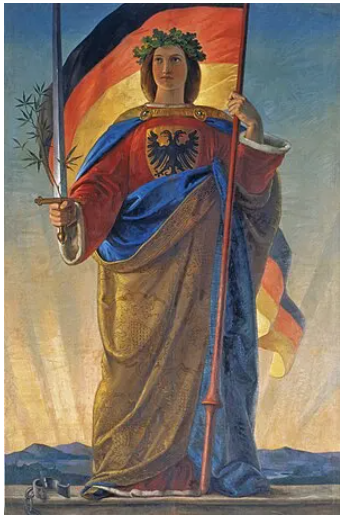
| Attribute | Significance |
|---|---|
| Broken chains | Being freed |
| Breastplate with an eagle | German empire and strength |
| Crown of oak leaves | Heroism |
| Sword | Readiness to fight |
| Olive branch around the sword | Willingness to make peace |
| Black, red and gold tricolour | Flag of the liberal-nationalists in 1848; banned by the dukes of the German states |
| Rays of the rising sun | The beginning of a new era |
Germania in later imagery
- Fallen Germania: Julius Hübner’s 1850 allegorical image presents Germania fallen, evoking the troubled hopes for German national unity after the 1848 movement.
- Germania guarding the Rhine: Lorenz Clasen’s 1860 painting portrays Germany as a warrior woman protecting the Rhine.
- Symbolic change: In Veit’s earlier 1836 rendering, a Kaiser’s crown appeared where the broken chain was later placed. The change shifts emphasis from imperial authority to freedom from bondage.
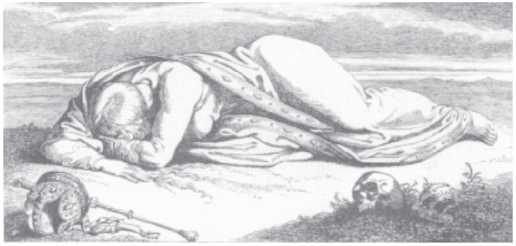
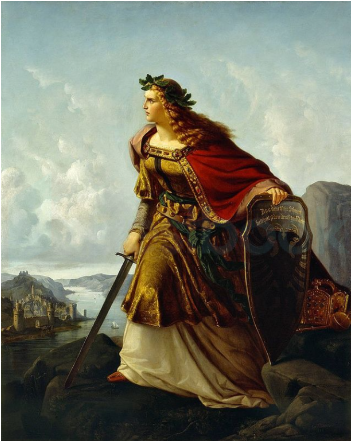
German national allegory
- 1836Veit’s earlier allegorical rendering placed the Kaiser’s crown where the broken chain appeared later.
- March 1848The Frankfurt Parliament met at the Church of St Paul, where Veit’s Germania banner was displayed.
- 1850Hübner painted the fallen Germania; Marianne also appeared on French postage stamps.
- 1860Lorenz Clasen painted Germania guarding the Rhine.
How did England shape the formation of the British nation-state?
What did Marianne and Germania represent, and what were their key attributes?
Quick recap
- Britain formed gradually, with English power and Parliament at its centre.
- The 1707 Union subordinated Scotland; Highland Catholic clans faced repression, language and dress restrictions, and displacement.
- Ireland was incorporated in 1801 after the failed 1798 revolt; English culture and symbols shaped the union.
- Female allegories gave abstract national identities a visible human form.
- Marianne represented France and the idea of a people’s nation; Germania represented Germany, with oak leaves symbolising heroism.
- Veit’s Germania banner displayed national symbols at the Frankfurt Parliament in March 1848.
Nationalism and Imperialism
Nationalism Becomes Narrower
Nationalism and Imperialist Aims
- Earlier and later nationalism: By the last quarter of the nineteenth century, nationalism had shifted from the liberal-democratic ideals of the century’s first half to a narrower, more exclusive creed.
- Growing intolerance: Nationalist groups increasingly opposed one another and were willing to go to war.
- Imperialist use: European powers exploited the national aspirations of subject peoples to advance their own imperialist aims.
Key Periods
- First half of the nineteenth centuryNationalism was associated with liberal-democratic ideals.
- After 1871The Balkans became Europe’s most serious source of nationalist tension.
- Last quarter of the nineteenth centuryNationalism increasingly became narrow and intolerant.
The Balkans: A Region of Tension
Balkans — A diverse region of south-eastern Europe that included modern-day Romania, Bulgaria, Albania, Greece, Macedonia, Croatia, Bosnia-Herzegovina, Slovenia, Serbia and Montenegro.
Causes of Balkan Nationalist Tension
- Ottoman control: Much of the Balkans was ruled by the Ottoman Empire; its attempts to strengthen itself through modernisation and internal reforms had little success.
- Breakaway movements: European subject nationalities left Ottoman control one by one and declared independence.
- National claims: Balkan peoples based demands for independence or political rights on nationality and accounts of past independence followed by foreign subjugation.
- Romantic nationalism: Its spread, together with the weakening and disintegration of the Ottoman Empire, made the region increasingly unstable.
From Ottoman Decline to Balkan Conflict
- Ottoman Empire weakens despite reforms
- Subject nationalities seek independence, using nationality and history to justify their claims
- Slavic groups struggle to define their identities and political independence
- Balkan states compete for territory and European powers compete for influence
- Regional wars contribute to the outbreak of the First World War
National Rivalries and the First World War
Why Balkan Tensions Intensified
- Inter-state competition: Balkan states were jealous of one another and hoped to gain territory at their neighbours’ expense.
- Great-power rivalry: Russia, Germany, England and Austro-Hungary competed over trade, colonies, naval power and military strength.
- Imperial ambition: Each power sought to limit the influence of its rivals and extend its own control in the Balkans.
- Outcome: Local nationalist and territorial disputes combined with great-power rivalry, leading to a series of wars and ultimately the First World War.
- Romantic nationalism
- A form of nationalism that encouraged peoples to value a shared national identity and seek political self-rule.
- Imperialism
- A policy of extending a state’s power and control over other territories or peoples.
- Slavs
- The broad name used for the peoples of the Balkans in the account.
- Subject nationality
- A national group living under the rule of an empire or foreign power.

Why did the Balkans become a centre of nationalist tension after 1871?
How did Balkan peoples support their claims to independence?
How did Balkan rivalries contribute to the First World War?
Quick recap
- By the late nineteenth century, nationalism had become narrower and increasingly intolerant.
- The Balkans were diverse and much of the region had been under Ottoman rule.
- Ottoman decline and romantic nationalism encouraged independence movements.
- Balkan peoples used nationality and history to support claims to self-rule.
- Territorial competition and great-power rivalry intensified conflict in the region.
- Balkan wars and rivalries ultimately led to the First World War.
Social Science — ALL CHAPTERS
1
RESOURCES AND DEVELOPMENT
2
FOREST AND WILDLIFE RESOURCES
3
WATER RESOURCES
4
AGRICULTURE
5
MINERALS AND ENERGY RESOURCES
6
MANUFACTURING INDUSTRIES
7
LIFELINES OF NATIONAL ECONOMY
1
POWER SHARING
2
FEDERALISM
3
GENDER, RELIGION AND CASTE
4
POLITICAL PARTIES
5
OUTCOMES OF DEMOCRACY
1
THE RISE OF NATIONALISM IN EUROPE
2
NATIONALISM IN INDIA
3
THE MAKING OF A GLOBAL WORLD
4
THE AGE OF INDUSTRIALISATION
5
PRINT CULTURE AND THE MODERN WORLD
1
DEVELOPMENT
2
SECTORS OF THE INDIAN ECONOMY
3
MONEY AND CREDIT
4
GLOBALISATION AND THE INDIAN ECONOMY
5
CONSUMER RIGHTS