Class 10 . Social Science . Understanding Economic Development . Money and Credit
Chapter 3: MONEY AND CREDIT
Ch 3
Social Science
Class 10
Money as a Medium of Exchange
Money as a Medium of Exchange
Double coincidence of wants — A situation in barter where each person wants to buy exactly what the other person wants to sell.
Modern Forms of Money
- Forms of money: Modern money includes currency and bank deposits, both widely accepted for making payments.
- Role of banks: Banks keep people’s deposits safe and use a major part of them to provide loans.
Currency
- Currency: Modern currency consists of paper notes and coins and is not made of precious metals.
- Authority: In India, the Reserve Bank of India issues currency notes on behalf of the central government.
- Legal acceptance: The rupee is authorised as a medium of payment and cannot legally be refused in settling transactions in India.
Deposits with Banks
- Barter
- Direct exchange of goods without using money.
- Double coincidence of wants
- When each trader wants what the other trader is offering.
- Medium of exchange
- Something accepted to make the exchange of goods and services easier.
- Currency
- Paper notes and coins used as money.
- Demand deposits
- Bank deposits that can be withdrawn on demand.
How does money make the exchange of goods easier?
Why are demand deposits considered money?
How can an account holder use a cheque to withdraw cash?
Quick recap
- Money is a medium of exchange that makes buying and selling easier.
- Barter requires double coincidence of wants; using money removes this requirement.
- Money has included grains, cattle and metallic coins; modern forms are currency and bank deposits.
- In India, currency is government-authorised, and the RBI issues notes on behalf of the central government.
- Demand deposits are withdrawable on demand and earn interest.
- Cheques allow payments directly from bank deposits, so demand deposits function as money.
Loan Activities of Banks
How Banks Use Deposits
Banks’ use of deposits
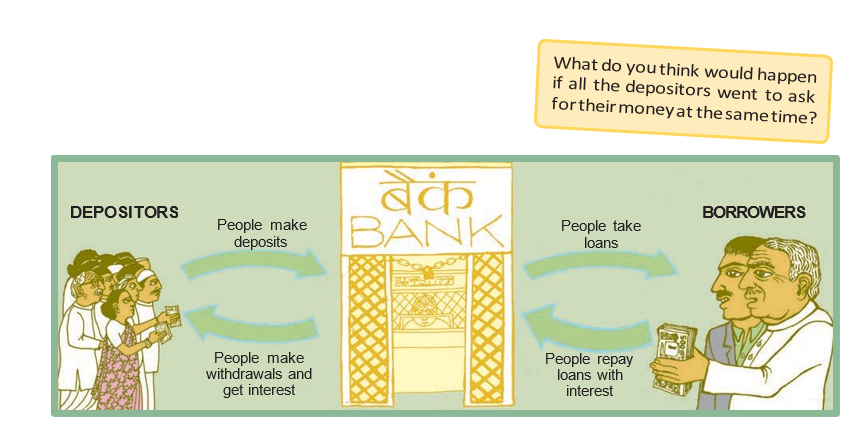
- Cash reserve: Banks keep a small share of deposits as cash to pay depositors who withdraw money; the text gives about 15% for banks in India.
- Loans: Banks lend the major portion of their deposits to people who need funds for economic activities.
- Intermediaries: Banks connect depositors with surplus funds to borrowers who need funds.
- Income: Banks’ main income comes from charging borrowers a higher interest rate than the interest paid to depositors.
Credit and Its Effects
Credit (loan) — An agreement in which a lender provides money, goods or services to a borrower in return for a promise of future payment.
Two Different Credit Situations
Salim: credit supports production
- Need: Salim, a shoe manufacturer, needed funds to hire extra workers and buy raw materials to fulfil an order for 3,000 pairs.
- Sources of credit: He received leather from a supplier on the promise of later payment and cash in advance from the trader for 1,000 pairs.
- Outcome: He completed the order, earned a good profit and repaid what he had borrowed.
- Effect: Credit covered working-capital expenses, helped production finish on time and increased Salim’s earnings.
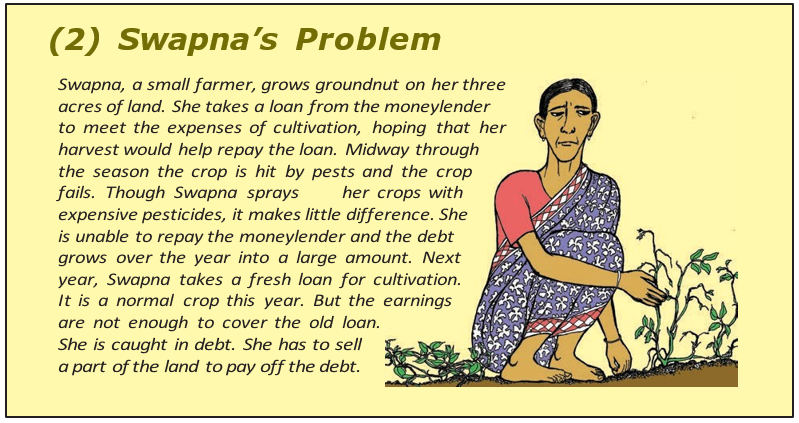
Farm credit and Swapna’s debt trap
- Crop expenses: Farmers need credit for seeds, fertilisers, pesticides, water, electricity and equipment repairs.
- Repayment cycle: Farmers usually borrow at the start of the season and repay after harvest; about three to four months pass between buying inputs and selling the crop.
- Risk: Repayment depends heavily on farming income, so crop failure can make repayment impossible.
- Swapna’s outcome: After her crop failed, Swapna could not repay the moneylender and had to sell part of her land to repay the loan.
- Debt trap: Credit becomes a debt trap when repayment leaves a borrower worse off and recovery is very difficult.
| Point | Salim | Swapna |
|---|---|---|
| Why credit was needed | To hire workers, buy raw materials and complete a shoe order. | To meet crop-production expenses. |
| Main risk | The ability to complete the order and earn enough to repay. | Crop failure could remove the income needed for repayment. |
| Outcome | Completed the order, made a profit and repaid the loans. | Could not repay after crop failure and sold part of her land. |
| Effect of credit | Improved earnings. | Led to a painful debt trap. |
When credit helps or harms
- Credit for production or farming expenses
- Successful production and sufficient income
- Loan repayment and improved earnings
- But if a major loss, such as crop failure, occurs, income may be insufficient
- Repayment difficulty can push the borrower into a debt trap
- Whether credit helps depends on the risks involved and whether support is available if a loss occurs.
- Credit can raise earnings when it enables successful production, but can worsen a borrower’s position when repayment depends on income that fails to arrive.
How do banks earn their main income from deposits and loans?
Why can credit have a positive effect for one borrower and a harmful effect for another?
Quick recap
- Banks keep a small cash reserve and lend most deposits to borrowers.
- Banks connect depositors and borrowers and earn mainly from the interest-rate difference.
- Credit is an agreement for money, goods or services now in return for future payment.
- Salim used credit for production, completed his order and earned enough to repay.
- Farmers often borrow at the start of a crop season and repay after harvest.
- Crop failure prevented Swapna from repaying and pushed her into a debt trap.
- Credit’s effect depends on risk and the support available if a loss occurs.
Terms of Credit
What Makes Up the Terms of Credit?
Principal — The original amount borrowed, which the borrower must repay.
Core Loan Terms
- Interest is paid to the lender in addition to repayment of the principal.
- Collateral is an asset owned by the borrower and pledged as security until the loan is repaid.
- Default may allow the lender to sell the collateral to recover the loan.
- Common collateral includes land or house papers, bank deposits, vehicles and livestock.
- Terms of credit include the interest rate, collateral and documentation requirements, and mode of repayment; they vary between arrangements.
| Detail | Loan terms |
|---|---|
| Loan amount | Rs 5 lakhs |
| Duration | 10 years |
| Documents required | Employment records and salary details |
| Interest rate | 12% per annum |
| Mode of repayment | Monthly instalments |
| Collateral | Papers of the new house, returned after full repayment with interest |
Easy Terms and Borrowing Capacity
- Easy terms mean a low interest rate, manageable repayment conditions, and fewer collateral and documentation requirements.
- Limited borrowing capacity: people with low or irregular incomes may not have acceptable collateral or required documents.
- Result: people unable to access formal loans may depend on informal lenders with costly or restrictive terms.
Credit Arrangements in Sonpur
Village Credit Survey
- 15 November 2019Rohit and Ranjan recorded examples of credit arrangements in Sonpur.
| Point | Shyamlal: small farmer | Arun: medium farmer | Rama: landless agricultural worker |
|---|---|---|---|
| Credit source | Agricultural trader; previously a village moneylender | Bank | Employer, a medium landowner |
| Loan purpose | Cultivation on 1.5 acres | Cultivation on 7 acres | Daily expenses during workless months, illness and family functions |
| Interest and repayment | Trader charges 3% per month; farm inputs are supplied at the start of the season and repaid at harvest. Previously, the moneylender charged 5% per month (60% per annum). | 8.5% per annum; repayment can be made at any time within three years. | 5% per month; repays by working for the landowner. |
| Other conditions | Must promise to sell the crop to the trader, often at the low post-harvest price. | Plans to sell part of the crop after harvest and store the rest; can seek a fresh bank loan against the cold-storage receipt. | Often takes a new loan before the old one is repaid; currently owes Rs 5,000 and depends on the employer for credit. |
How the Trader Benefits from Shyamlal’s Loan
- The trader supplies farm inputs on credit at the start of the season.
- Shyamlal agrees to sell the crop to the trader at harvest.
- Harvest-time prices are low, so the trader buys the crop cheaply.
- The trader sells it later when prices rise, earning a profit.
Why Rama’s Debt Can Grow
- Rama has periods without work and borrows for daily and unexpected expenses.
- Her employer charges 5% interest per month, and repayment is made through labour.
- Rama often needs another loan before the previous one is cleared.
- Repeated borrowing can increase her debt and keep her dependent on the employer for credit.
Why Arun May Earn More from Cultivation
- Larger holding: Arun cultivates 7 acres, compared with Shyamlal’s 1.5 acres.
- Cheaper credit: Arun’s bank loan charges 8.5% per annum, below the trader’s 3% per month charged to Shyamlal.
- Better timing: Arun can store potatoes and may borrow against the cold-storage receipt instead of selling the entire crop when harvest prices are low.
| Source of credit | Examples of uses |
|---|---|
| Village moneylender | Cultivation |
| Agricultural trader | Farm inputs and cultivation |
| Bank | Crop loans and loans against cold-storage receipts |
| Landowner-employer | Daily expenses, illness and family functions |
| Cooperative | Farm implements, cultivation, agricultural trade, fishery, house construction and other expenses |
Cooperative Credit
How Cooperatives Lend
- Cooperatives are member-based societies that pool resources for shared needs; examples include farmers’, weavers’ and industrial workers’ cooperatives.
- Krishak Cooperative has 2,300 farmer members and accepts deposits from them.
- Lending cycle: member deposits are used as collateral for a large bank loan; the cooperative lends these funds to members, and repayments make another round of lending possible.
- Rural importance: cooperatives are another major source of relatively cheap credit in rural areas, alongside banks.
- Principal
- The original amount borrowed.
- Interest
- The amount paid to the lender in addition to the principal.
- Collateral
- An asset pledged as a guarantee for repayment.
- Terms of credit
- The interest rate, collateral and documentation requirements, and repayment method.
- Cooperative
- A member-run society that pools resources and provides loans to members.
Why do lenders ask for collateral?
What are easy terms of credit for a borrower?
Can everyone in Sonpur get credit at a cheap rate? Who is more likely to access it?
Quick recap
- Terms of credit include interest, collateral and documentation requirements, and the mode of repayment.
- Collateral protects the lender; on default, the lender may sell the pledged asset.
- Shyamlal borrows from a trader and must sell his crop at harvest; Arun has a lower-rate bank loan and can store part of his crop.
- Rama’s high monthly interest and repeated borrowing can deepen her debt and dependence on her employer.
- Cooperatives pool member resources; member deposits serve as collateral for bank loans, which are lent to members.
- Easy credit terms mean low interest, manageable repayment and fewer collateral and documentation requirements.
Formal Sector Credit in India
Sources of Credit
Formal sector credit — Loans provided by banks and cooperative societies, whose credit activities are supervised by the Reserve Bank of India (RBI).
Informal sector credit — Loans from moneylenders, traders, employers, relatives and friends, which are not supervised by an organisation.
| Point | Formal credit | Informal credit |
|---|---|---|
| Sources | Banks and cooperative societies | Moneylenders, traders, employers, relatives and friends |
| Supervision | RBI supervises lending and monitors banks | No organisation supervises lenders |
| Interest and recovery | Generally cheaper; lending is regulated | Lenders can choose interest rates and may use unfair recovery methods |
How the RBI Supervises Banks
- Cash reserves: The RBI checks that banks maintain the required minimum cash balance from their deposits.
- Inclusive lending: It monitors whether banks lend beyond profitable businesses—to small cultivators, small-scale industries and other small borrowers.
- Reporting: Banks periodically report how much they lend, to whom and at what interest rate.
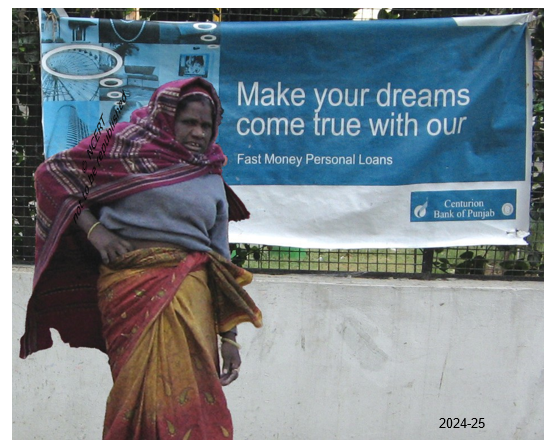
Why Affordable Credit Matters
Effects of High-Cost Informal Loans
- High interest increases the cost of borrowing.
- A larger share of the borrower’s earnings goes towards repayment.
- Less income remains for the borrower; in severe cases, repayment can exceed income.
- Debt may keep increasing, trapping the borrower and discouraging them from starting an enterprise.
Debt trap — A situation in which high repayments and growing debt make it difficult for a borrower to repay and escape further borrowing.
Why Credit at Reasonable Rates Is Important
- More bank and cooperative lending
- → greater access to affordable loans
- → people can grow crops, run businesses and set up small-scale industries
- → higher incomes and support for the country’s development
- Affordable credit helps borrowers invest and earn; expensive credit can deepen debt.
- Banks and cooperatives need to lend more, especially in rural areas, to reduce dependence on informal lenders.
Who Gets Formal and Informal Credit?
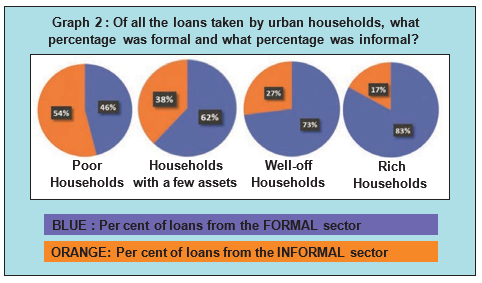
| Household group | Informal loans | Formal loans |
|---|---|---|
| Poor urban households | 85% | 15% |
| Rich urban households | 10% | 90% |
Unequal Access and the Credit Gap
- Income pattern: Rich households use more formal, cheaper credit; poor households depend more on costly informal sources. A similar pattern exists in rural areas.
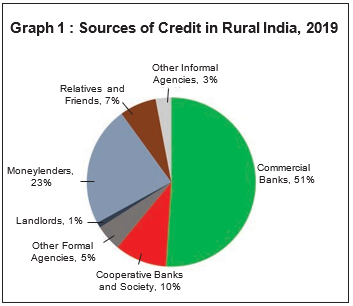
- Rural credit gap: The formal sector meets only about half of rural people’s total credit needs; informal sources provide the rest.
- Need: Expand formal lending, particularly in rural areas, and distribute formal credit more equally so poorer households can benefit.
- Formal sector credit
- Credit from banks and cooperative societies under RBI supervision.
- Informal sector credit
- Credit from lenders outside formal institutional supervision.
- Debt trap
- A cycle of growing debt that becomes difficult to repay.
Why should credit at reasonable rates be available to everyone?
Why is the share of formal credit higher among richer households?
Why would supervising informal lenders be difficult?
Quick recap
- Formal credit comes from banks and cooperatives; informal credit comes from unregulated lenders and individuals.
- The RBI supervises banks’ cash balances, lending and reporting.
- Informal loans often cost more and can reduce borrowers’ income or lead to a debt trap.
- Affordable credit supports farming, businesses, small industries and national development.
- Poor urban households get 85% of their loans informally, while rich urban households get 90% formally.
- Formal lenders meet only about half of rural credit needs; wider and more equal access is needed.
Self-help Groups for the Poor
Why Poor Households Depend on Informal Credit
Informal credit — Loans from sources such as moneylenders, outside the formal banking system.
Barriers to Bank Credit
- Limited access: Banks are not present everywhere in rural India, and bank loans can be harder to obtain than informal loans.
- Documents and collateral: Banks require proper documents and collateral; poor households may not have assets to pledge.
- Moneylender access: Moneylenders may lend without collateral because they know borrowers personally, and borrowers may sometimes borrow again before repaying earlier loans.
- Risks of informal credit: Moneylenders may charge very high interest, keep no transaction records and harass borrowers.
| Point | Bank loans | Informal moneylenders |
|---|---|---|
| Access | May be difficult; banks may be unavailable locally and require documents and collateral. | Often easier to obtain; a moneylender may lend without collateral. |
| Terms and risks stated in the text | Collateral and proper documents are required. | Interest may be very high; transaction records may not be kept, and borrowers may be harassed. |
Self-Help Groups: Structure and Working
Self-Help Group (SHG) — A small group, usually of people from one neighbourhood, that pools members’ savings and provides loans to its members.
How an SHG Works
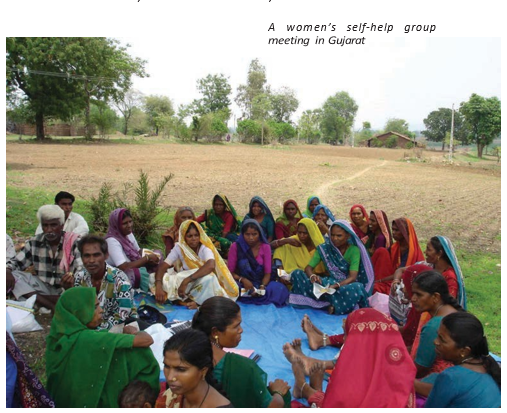
- Members: SHGs organise rural poor people, particularly women; members usually belong to the same neighbourhood and meet regularly.
- Savings: Members save regularly according to their ability; a typical contribution is Rs. 25 to Rs. 100 or more per member.
- Loans within the group: Members can borrow small amounts for their needs; the group charges interest, usually less than moneylenders charge.
- Bank loan eligibility: After a year or two of regular savings, the group may become eligible for a bank loan sanctioned in the group’s name.
- Purpose of bank loans: These loans are intended to create self-employment opportunities for members.
| Need | Examples |
|---|---|
| Land | Release mortgaged land. |
| Working capital | Buy seeds, fertilisers or raw materials such as bamboo and cloth. |
| Housing | Buy housing materials. |
| Income-generating assets | Acquire sewing machines, handlooms or cattle. |
Group Decisions and Benefits
Why SHGs Improve Access to Credit
- Member decisions: Members decide which loans to grant, their purpose and amount, the interest charged and the repayment schedule.
- Collective responsibility: The group is responsible for repaying its bank loan and follows up seriously if a member does not repay.
- No individual collateral: Group responsibility helps banks lend to poor women organised in SHGs even when they have no collateral.
- Affordable, timely credit: SHGs help members obtain loans for varied needs at reasonable interest rates.
- Rural organisation: SHGs are building blocks for organising the rural poor and can support women’s financial self-reliance.
- Social platform: Regular meetings provide a place to discuss and act on issues such as health, nutrition and domestic violence.
Grameen Bank of Bangladesh
A Successful Example of Credit for the Poor
- Purpose: Grameen Bank is a major example of reaching poor people with credit at reasonable rates.
- Borrowers: Almost all its borrowers are women from the poorest sections of society.
- Impact: Borrowers have shown that poor women can be reliable borrowers and successfully run small income-generating activities.
Grameen Bank: Key Dates
- 1970sGrameen Bank began in Bangladesh as a small project.
- 2006Founder Muhammad Yunus received the Nobel Prize for Peace.
- 2018The bank had over 9 million members in about 81,600 villages across Bangladesh.
Credit and Development
Formal and Informal Credit
- Sources: Formal credit comes from institutions such as banks and cooperative societies; informal credit includes sources such as moneylenders.
- Unequal access: Richer households receive more credit from formal sources, while poor households often depend on informal sources.
- Credit’s effects: Credit can benefit borrowers, but in some situations it can make a borrower worse off.
- Development need: Total formal-sector credit must increase, and poor households must receive a greater share of formal loans.
- SHG contribution: SHGs help poor borrowers, especially women, access bank loans despite lacking collateral.
- Collateral
- An asset pledged as security for a loan.
- Working capital
- Money used for production needs such as seeds, fertilisers or raw materials.
- Formal credit
- Credit from institutions such as banks and cooperative societies.
- Self-Help Group (SHG)
- A group that pools members’ savings and provides loans, often helping rural women access credit.
How do SHGs help poor women obtain bank loans without collateral?
State two economic and two social benefits of SHGs.
Quick recap
- Poor households may rely on informal credit because banks are not always accessible and bank loans require documents and collateral.
- SHGs pool regular savings and lend to members at interest rates below those charged by moneylenders.
- After a year or two of regular saving, an SHG may qualify for a bank loan in the group’s name.
- Collective decisions and repayment responsibility help banks lend to SHG members without collateral.
- SHGs support women’s self-employment, financial self-reliance and action on social issues; they are building blocks for organising the rural poor.
- Credit can help borrowers or make them worse off; expanding formal credit and increasing the poor’s share are important for development.
Social Science — ALL CHAPTERS
1
RESOURCES AND DEVELOPMENT
2
FOREST AND WILDLIFE RESOURCES
3
WATER RESOURCES
4
AGRICULTURE
5
MINERALS AND ENERGY RESOURCES
6
MANUFACTURING INDUSTRIES
7
LIFELINES OF NATIONAL ECONOMY
1
POWER SHARING
2
FEDERALISM
3
GENDER, RELIGION AND CASTE
4
POLITICAL PARTIES
5
OUTCOMES OF DEMOCRACY
1
THE RISE OF NATIONALISM IN EUROPE
2
NATIONALISM IN INDIA
3
THE MAKING OF A GLOBAL WORLD
4
THE AGE OF INDUSTRIALISATION
5
PRINT CULTURE AND THE MODERN WORLD
1
DEVELOPMENT
2
SECTORS OF THE INDIAN ECONOMY
3
MONEY AND CREDIT
4
GLOBALISATION AND THE INDIAN ECONOMY
5
CONSUMER RIGHTS