Class 10 . Social Science . Understanding Economic Development . Globalisation and the Indian Economy
Chapter 4: GLOBALISATION AND THE INDIAN ECONOMY
Ch 4
Social Science
Class 10
Introduction & Production Across Countries
Changing Markets and Consumer Choice
Markets in India
- Greater choice: Indian consumers can now choose from many global brands and models of goods such as cars, phones, televisions, clothing and processed fruit juices.
- Recent change: This wide variety was not commonly available in Indian markets even a few decades ago; markets have changed rapidly.
- Example: Indian roads now have cars from many leading global companies, unlike the earlier dominance of Ambassador and Fiat.
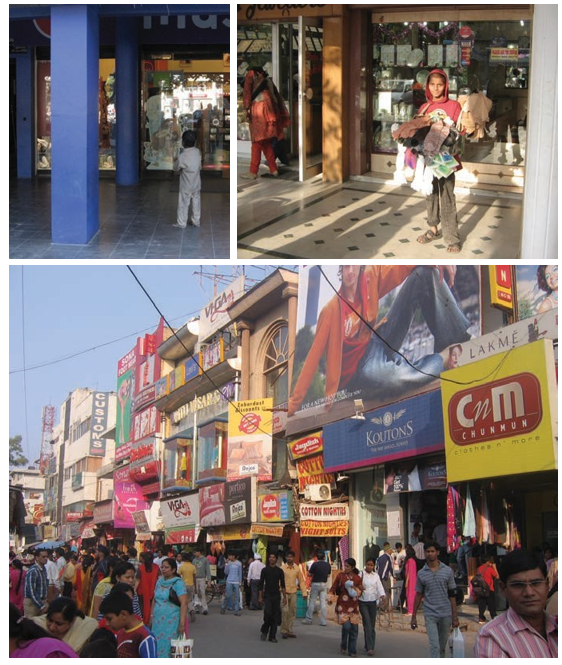
Changing Production and Markets
- Until the middle of the 20th centuryProduction was mainly organised within countries; trade connected countries through raw materials, food and finished goods.
- Recent decadesIndian markets have gained a much wider range of goods and global brands.
Production Across Countries
| Point | Earlier pattern | Global production pattern |
|---|---|---|
| Organisation | Production was largely organised within individual countries. | A production process can be divided into parts and carried out across several countries. |
| Connection between countries | Trade was the main channel; raw materials, food and finished products crossed borders. | Countries are connected through different stages of production as well as trade. |
| Colonial trade example | Colonies such as India exported raw materials and food and imported finished goods. | MNCs organise production across countries to use different locations' advantages. |
Multinational corporation (MNC) — A company that owns or controls production in more than one nation.
Why MNCs Locate Production in Different Countries
- Location choice: MNCs set up offices and factories where labour and other resources are relatively cheap or otherwise advantageous.
- Main purpose: Lower production costs can help MNCs earn greater profits.
- Global organisation: An MNC may sell products globally while also producing goods and services across several countries.
How MNCs Spread Production
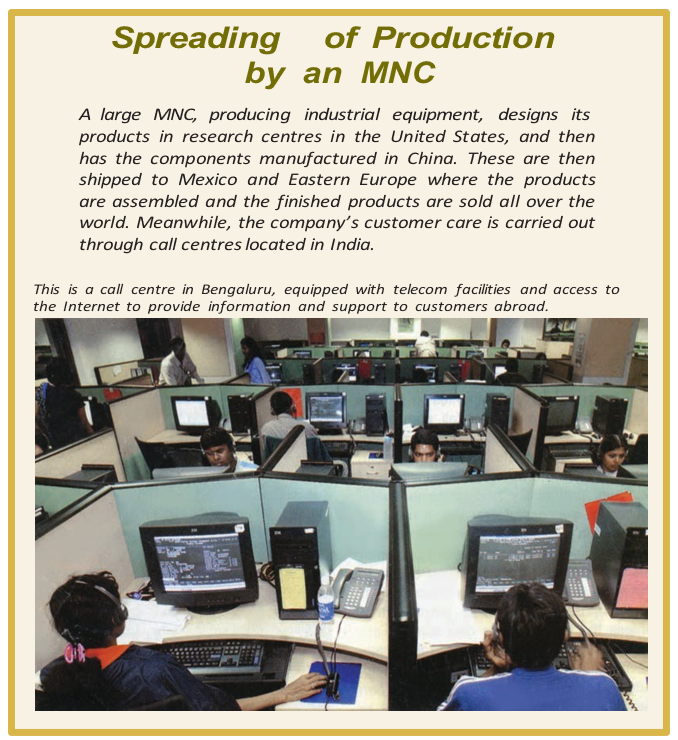
- An MNC identifies the resources, skills or market access needed at each production stage.
- It divides the production process into smaller parts.
- It places each part in a country that offers a suitable advantage.
- Production becomes spread across countries, potentially lowering costs and increasing profits.
| Location | Advantage for production |
|---|---|
| China | Low-cost manufacturing |
| Mexico and Eastern Europe | Closeness to the US and European markets |
| India | Skilled engineers for technical work, and educated English-speaking youth for customer care |
Global Services and Cost Savings
- Example: Call-centre staff in Bengaluru can provide customer support to an MNC’s customers abroad.
- Potential saving: Combining advantages from different countries may reduce an MNC’s costs by about 50–60 per cent.
- Key idea: Global production is more than selling finished products internationally; production itself is organised internationally.
Garment Production Example
- Brand label: A garment labelled “Made in Thailand” need not use only Thai materials or represent a wholly Thai production process.
- Global sourcing: A company can examine each manufacturing step and choose the country best suited to it.
- Example given: Cotton fibre for garments may be obtained from Korea.
- Multinational corporation (MNC)
- A company that owns or controls production in more than one nation.
- Global production
- Production organised across countries, with different stages carried out in different locations.
- Trade
- The exchange of goods across countries; it was the main channel connecting countries before global production networks became widespread.
What is an MNC, and why does it spread production across countries?
How is production across countries different from trade alone?
Quick recap
- Indian markets now offer a much wider choice of goods and global brands than a few decades ago.
- Before the middle of the 20th century, production was mainly organised within countries and trade connected them.
- An MNC owns or controls production in more than one nation.
- MNCs locate production where labour, resources, skills or market access offer an advantage.
- Global production divides a process into stages carried out in different countries.
- China, Mexico, Eastern Europe and India offer different production advantages in the example; combining them may save 50–60 per cent in costs.
Interlinking Production Across Countries
How MNCs Spread Production
Multinational corporation (MNC) — A company that owns or controls production in more than one country.
Where MNCs locate production
- Markets: MNCs prefer locations close to the markets where their products will be sold.
- Costs and resources: They seek skilled or unskilled labour at low cost and reliable access to other factors of production.
- Government policies: They may favour countries whose policies protect or support their interests.
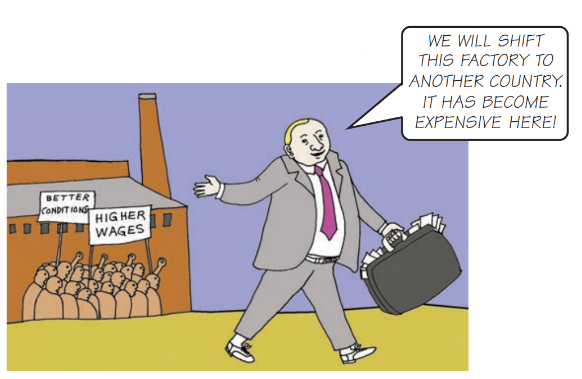
- Relocation: If production becomes too expensive, an MNC may move its factory abroad.
Investment — Money spent to buy assets such as land, buildings, machines and equipment, with the expectation of earning profits.
Foreign investment — Investment made by an MNC in another country.
| Method | How it works | Effect |
|---|---|---|
| Joint production | An MNC works with a local company. | The local company may receive investment for new machines and access to newer technology. |
| Buying local companies | An MNC takes over a local company and may expand its production. | The MNC gains the company’s facilities, products and existing market network. |
| Orders to small producers | An MNC places production orders with small producers, then sells the goods under its own brand. | The MNC can influence price, quality, delivery and labour conditions. |
| Competition or supply links | MNCs compete with local companies or use them as suppliers. | Local production becomes connected to the MNC’s wider production network. |
Example: Cargill and Parakh Foods
- Takeover: The American MNC Cargill Foods bought the Indian company Parakh Foods.
- What Cargill gained: Parakh had a well-known brand, a wide marketing network and four oil refineries.
- Result: Cargill became India’s largest edible-oil producer, with capacity to make 5 million pouches daily.
- Influence: The wealth of some MNCs exceeds the budgets of developing-country governments, giving them considerable economic power.
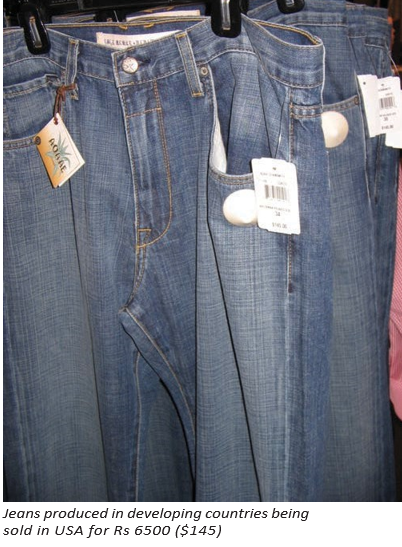
Interlinked production
- MNCs establish partnerships, buy local companies, place orders with suppliers or compete with local producers.
- Goods and production decisions link businesses in different countries.
- Production in widely separated locations becomes interconnected.
Foreign Trade and Integration of Markets
Foreign trade — The buying and selling of goods between countries.
What foreign trade does
- Producers: They can sell beyond their domestic market and compete in markets abroad.
- Buyers: Imports widen the choice of goods beyond those produced within their own country.
- Connection: Foreign trade has long connected countries; now production networks as well as trade link economies across borders.
| Point | Foreign trade | Foreign investment |
|---|---|---|
| Meaning | Exchange of goods between countries. | Money invested by an MNC in another country. |
| Main link | Goods move between markets. | Capital is used to acquire or establish productive assets. |
| Example | Chinese toys exported to India. | An MNC buys a company or invests in its factories abroad. |
Example: Chinese Toys in India
How imports changed the toy market
- Chinese manufacturers saw an opportunity to sell toys in India, where prices were high.
- They exported plastic toys, often offering lower prices and new designs.
- Indian buyers gained more choice; within a year, Chinese toys replaced Indian toys in 70–80% of toy shops.
- Toy prices fell, Chinese producers gained business, and Indian toy makers faced reduced sales and losses.
Integration of markets — The process by which trade connects markets in different countries, bringing them into closer competition and affecting choices and prices.
Effects of foreign trade on markets
- Choice: Buyers can choose from goods produced in different countries.
- Prices: Prices of similar goods in the two markets tend to move towards each other.
- Competition: Producers in different countries compete despite being far apart.
- Winners and losers: Trade can expand opportunities for some producers while reducing sales for others.
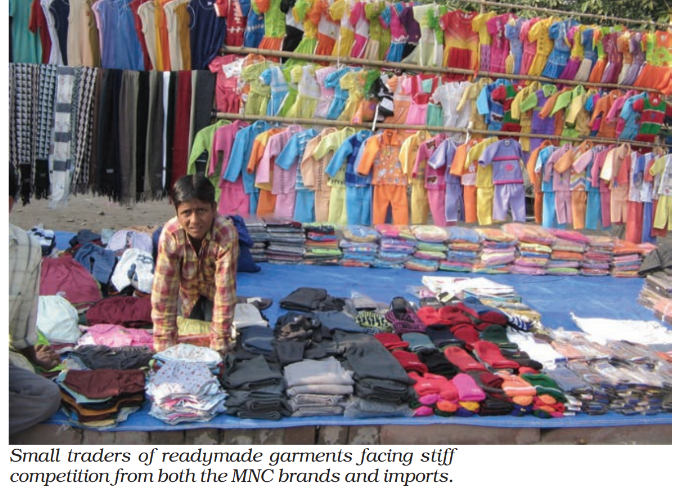
- Domestic market
- The market within a country.
- Foreign investment
- Investment made by an MNC in another country.
- Foreign trade
- Trade in goods between countries.
- Integration of markets
- Markets becoming connected through trade and competition.
How does foreign trade integrate the markets of two countries?
How could China’s import of steel from India affect steel producers and steel-using industries?
Quick recap
- MNCs choose production sites based on markets, costs, resources and government policies.
- MNCs spread production through partnerships, takeovers, suppliers and competition.
- Joint production can bring local firms investment and access to newer technology.
- Foreign trade widens markets for producers and choices for buyers.
- Imports increase competition and can benefit some producers while hurting others.
- Trade connects markets; prices of similar goods tend to move closer together.
What Is Globalisation?
Globalisation
Globalisation — The rapid integration or interconnection of production and markets across countries.
How countries become interconnected
- Drivers: Rising foreign investment and foreign trade have increased the integration of production and markets.
- Movements: Goods, services, investments and technology move between countries; people also move in search of better income, jobs or education.
- MNCs: Multinational corporations play a major role; much foreign trade is also controlled by them.
- Example: Ford’s Indian plant produces cars for India and exports cars and components to other countries and Ford factories.
- People: Unlike trade and investment, the movement of people has not increased much in recent decades because of restrictions.
What is the role of MNCs in globalisation?
What are the main ways countries are linked?
What effect does globalisation have on competition among producers?
Factors That Have Enabled Globalisation
- Key factors: Improvements in technology and the liberalisation of foreign trade and investment have enabled globalisation.
- Effect: These changes have made it easier for goods, services and investment to move across countries.
Technology
How technological change supports globalisation
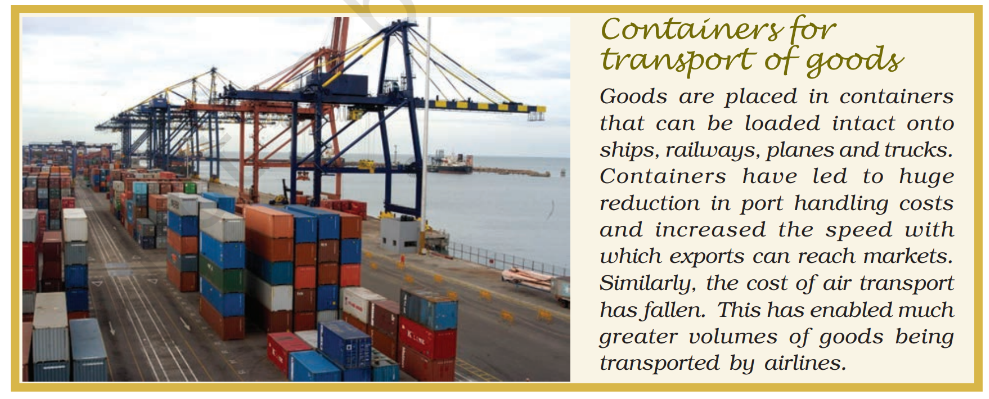
- Transport: Improvements over the past fifty years have made long-distance delivery faster and cheaper.
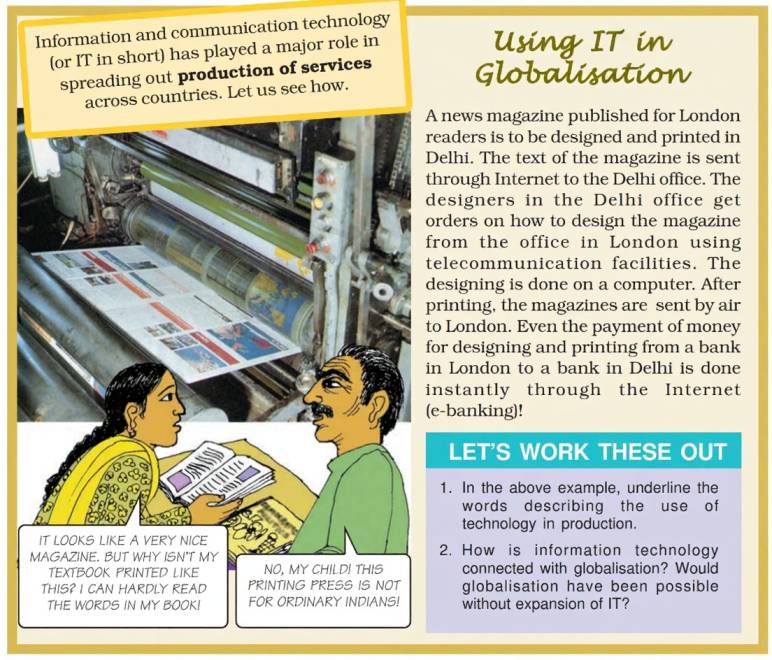
- Telecommunications: Telegraphs, phones, mobile phones and fax connect people worldwide and provide quick access to information, including from remote places.
- Satellite communication: Satellite devices help make long-distance communication possible.
- Computers and the Internet: These are used across many fields; the Internet enables information sharing, instant e-mail and voice-mail at negligible cost.
Liberalisation of Foreign Trade and Investment
Trade barrier — A government restriction on foreign trade, used to regulate what goods and how much of them enter a country.
Import tax: Chinese toy example
- Tax is placed on imported Chinese toys.
- Importers pay the tax, so the toys become more expensive for buyers.
- Chinese toys are less cheap in Indian markets and imports fall.
- Indian toy-makers face less foreign competition and may prosper.
| Barrier | How it works | Effect |
|---|---|---|
| Import tax | Raises the price of imported goods. | Can reduce imports and protect domestic producers. |
| Quota | Sets a limit on the quantity of a good that may be imported. | Restricts the amount of foreign competition in the market. |
India’s Trade Policy: Protection to Liberalisation
- After Independence: India restricted foreign trade and investment to protect domestic producers from foreign competition.
- Reason: Industries were developing in the 1950s and 1960s; strong import competition could have prevented them from growing.
- Essential imports: India permitted imports mainly of essential items such as machinery, fertilisers and petroleum.
- Wider pattern: Developed countries also protected domestic producers during their early stages of development.
- Around 1991: India decided domestic producers should compete globally, expecting competition to improve their performance and product quality; powerful international organisations supported the policy change.
- Policy change: Many trade and investment barriers were removed, making importing, exporting and setting up foreign factories or offices in India easier.
Liberalisation — The removal or reduction of government restrictions, allowing businesses greater freedom to make import and export decisions.
India’s Trade Policy
- After Independence; especially the 1950s–1960sIndia used trade barriers to protect developing domestic industries and allowed imports mainly of essential goods.
- Around 1991India began removing many foreign trade and investment restrictions to encourage global competition.
| Point | Protection | Liberalisation |
|---|---|---|
| Government restrictions | Many barriers limit foreign trade and investment. | Barriers are reduced or removed. |
| Main purpose or effect | Protect domestic producers, especially developing industries. | Allow easier trade and investment and increase competition. |
| Business decisions | Imports and foreign investment are more restricted. | Businesses have greater freedom to decide what to import or export. |
- Globalisation
- Rapid integration or interconnection of production and markets across countries.
- MNC
- A multinational corporation operating and investing in more than one country.
- Trade barrier
- A restriction, such as an import tax or quota, used to regulate foreign trade.
- Liberalisation
- Reducing or removing government restrictions on trade and investment.
Quick recap
- Globalisation is the rapid integration of production and markets across countries.
- MNCs connect countries through investment, production and trade in goods and services.
- Countries are linked by movements of goods, services, investment, technology and people.
- Better transport and information and communication technology have accelerated globalisation.
- Trade barriers such as import taxes and quotas restrict foreign trade and can protect domestic producers.
- India protected domestic industries after Independence and began removing many restrictions around 1991.
World Trade Organisation
World Trade Organisation (WTO)
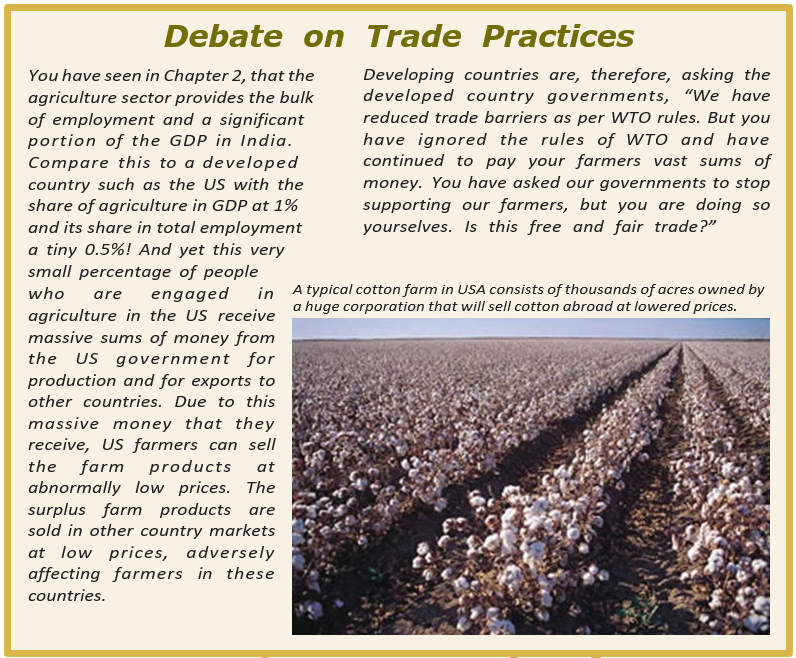
Impact of Globalisation in India

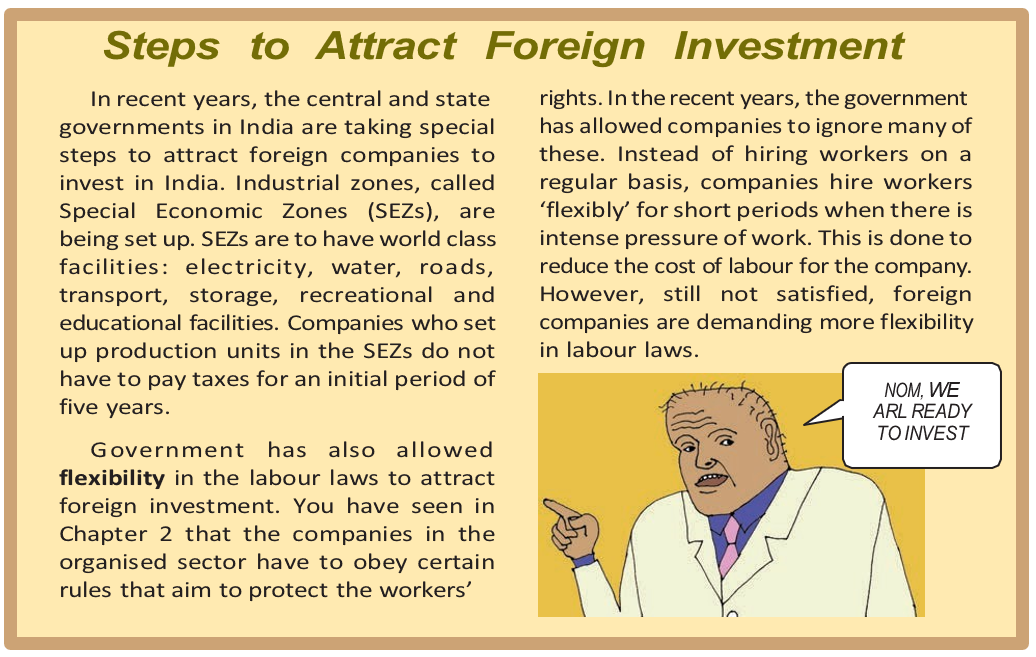
How Globalisation Creates Opportunities
- Greater competition and access to markets → some Indian firms modernise and improve production.
- Foreign investment → new jobs in selected industries and services.
- Demand from MNCs → growth for some local suppliers and Indian service exporters.
- Expansion and collaboration → some Indian companies become multinationals.
Small Producers: Compete or Perish
Ravi’s Business
- 1992Ravi borrowed money to start a capacitor-making company.
- Within three yearsProduction expanded and the company employed 20 workers.
- 2001Import restrictions on capacitors were removed, intensifying competition.
- Liberalisation
- Removing or reducing government restrictions on trade and investment.
- MNC
- A company that owns or controls production in more than one country.
- Foreign investment
- Investment made by a company or individual in another country.
- Trade barrier
- A restriction that limits imports or trade between countries.
Competition and Uncertain Employment
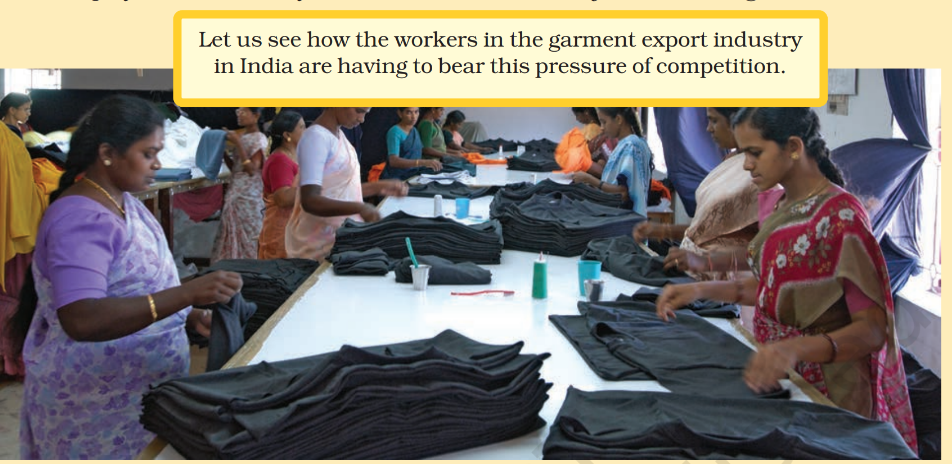
| Point | Permanent employment | Temporary employment |
|---|---|---|
| Job security | More secure and ongoing | Less secure; work may depend on orders |
| Benefits | May include health insurance, provident fund and double-rate overtime | Often lacks these benefits |
| Pay and time off | Greater protection under employment terms | A day off may mean no wages; overtime and long hours may be common |
Sushila’s Experience
- Earlier job: Sushila was a permanent garment worker with health insurance, provident fund and double-rate overtime.
- After the factory closed: In the late 1990s, she searched for work for six months before finding another job.
- Current conditions: She is temporary, earns less than half her earlier wage and has none of her former benefits.
- Working week: She leaves at 7:30 a.m. and returns at 10 p.m., works seven days a week, and receives no wages for a day off.
Competition and Workers’ Conditions
- MNCs seek the cheapest products → Indian exporters face pressure to win orders.
- Exporters try to cut costs → labour costs become a target.
- Permanent jobs are replaced by temporary work → workers lose security and benefits.
- Low wages and long hours → workers may struggle to earn enough despite increased production.
| Point | Employers | Workers |
|---|---|---|
| View of flexibility | Temporary hiring helps adjust to changing orders and reduce labour costs. | Temporary hiring weakens job security and makes income uncertain. |
| Main concern | Competing in the market and controlling production costs. | Fair wages, regular work, reasonable hours and employment benefits. |
Why is trade under the WTO not always fair to developing countries?
How has globalisation affected different groups in India?
How has competition affected workers in the garment-export industry?
Quick recap
- The WTO promotes liberalised trade, but trade rules and protections have not affected developed and developing countries equally.
- Globalisation has benefited many consumers and some Indian companies, service providers and workers.
- Small producers may lose business when cheaper imports and MNC competition reduce demand for their products.
- MNC orders can expand exports, but pressure to reduce costs often falls on workers.
- Temporary employment can mean insecure work, low wages, long hours and fewer benefits.
- The gains of globalisation are unevenly shared among consumers, businesses and workers.
The Struggle for a Fair Globalisation
Unequal Benefits of Globalisation
Who gains and who loses?
- Greater gains: People with education, skills and wealth are best placed to use new opportunities.
- Unequal outcomes: Many workers and small producers have not shared in the benefits and face stronger competition.
| Group | Typical outcome |
|---|---|
| Well-off consumers and producers with skill, education and wealth | Often benefit from greater opportunities. |
| Small producers and workers | May suffer from rising competition and miss out on benefits. |
Making Globalisation Fair
Fair globalisation — Globalisation that creates opportunities for everyone and ensures its benefits are shared more equally.
Role of the government
- Protect everyone: Policies should safeguard the interests of all people, not only the rich and powerful.
- Enforce labour laws: Ensure workers' rights are properly implemented.
- Support small producers: Help them improve until they are strong enough to compete.
- Use policy measures: Where necessary, use trade and investment barriers.
- Negotiate for fairer rules: Seek fairer WTO rules and work with developing countries that share similar interests.
- Counter domination: Developing countries can act together to resist the domination of developed countries in the WTO.
People's Role in the Struggle
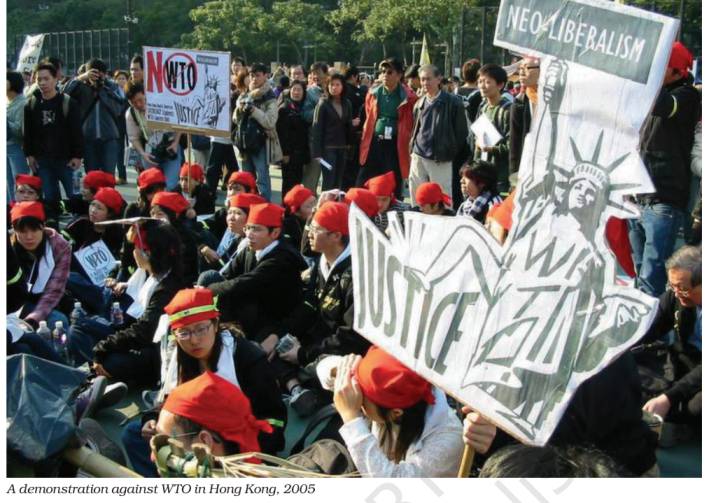
- Public action matters: Campaigns and representation by people's organisations have influenced WTO decisions on trade and investment.
- Shared effort: Governments and citizens can both contribute to making globalisation fairer.
Chapter Overview
How globalisation is organised
- Greater foreign trade and investment rapidly integrate countries.
- MNCs seek low-cost production locations around the world.
- Production becomes organised across countries in complex ways.
- Information technology helps coordinate this production.
- Liberalisation removes trade and investment barriers, while the WTO has pressured developing countries to liberalise.
What can the government do to make globalisation fairer?
How have people's organisations contributed to fair globalisation?
- Globalisation
- Rapid integration of countries, driven by greater foreign trade and investment.
- MNC
- A multinational corporation that organises production and business across countries.
- Liberalisation
- Removal of barriers to trade and investment.
- WTO
- The international organisation involved in setting trade rules and promoting trade liberalisation.
Quick recap
- Globalisation creates opportunities, but its gains are not shared equally.
- People with education, skills and wealth often benefit most; small producers and workers may lose out.
- Fair globalisation means opportunities for all and a better sharing of benefits.
- Government action can protect workers and help small producers compete.
- Governments can seek fairer WTO rules and work with developing countries to counter developed-country domination.
- Campaigns by people's organisations can influence trade and investment decisions.
Social Science — ALL CHAPTERS
1
RESOURCES AND DEVELOPMENT
2
FOREST AND WILDLIFE RESOURCES
3
WATER RESOURCES
4
AGRICULTURE
5
MINERALS AND ENERGY RESOURCES
6
MANUFACTURING INDUSTRIES
7
LIFELINES OF NATIONAL ECONOMY
1
POWER SHARING
2
FEDERALISM
3
GENDER, RELIGION AND CASTE
4
POLITICAL PARTIES
5
OUTCOMES OF DEMOCRACY
1
THE RISE OF NATIONALISM IN EUROPE
2
NATIONALISM IN INDIA
3
THE MAKING OF A GLOBAL WORLD
4
THE AGE OF INDUSTRIALISATION
5
PRINT CULTURE AND THE MODERN WORLD
1
DEVELOPMENT
2
SECTORS OF THE INDIAN ECONOMY
3
MONEY AND CREDIT
4
GLOBALISATION AND THE INDIAN ECONOMY
5
CONSUMER RIGHTS