Class 10 . Social Science . Democratic Politics II . Gender Religion and Caste
Chapter 3: GENDER, RELIGION AND CASTE
Ch 3
Social Science
Class 10
Introduction
Social Diversity and Democracy
- Democracy: Social diversity does not threaten democracy; democratic politics can give expression to social differences.
- Constructive expression: People can raise different needs and interests through politics, helping democracy respond to society.
Social Divisions in This Chapter
- Social division
- A division in society that can develop from social differences and inequalities.
- Political expression
- The expression of social differences through political life and participation.
Quick recap
- Social diversity does not automatically endanger democracy.
- Democracy allows social differences to be expressed politically.
- Political expression of social differences can be desirable.
- The chapter focuses on gender, religion and caste in India.
- It examines how these differences appear in politics and whether their expression is healthy for democracy.
Gender and Politics
A visual message
- Example: A poster from Bengal affirms women’s strength, challenging ideas that limit women to narrow social roles.
Gender Division
Gender division — A hierarchical social division based mainly on social expectations and stereotypes, not on biology.
Key idea
- Socially learned: Gender roles are often treated as natural and unchangeable, although they are shaped by society.
- Political significance: Gender division is widespread, but has often received less attention in the study of politics.
The Public–Private Division of Labour
Sexual division of labour — A system in which women do, or organise through domestic helpers, most work inside the home.
| Area | Common expectation or pattern |
|---|---|
| Home | Women are expected to cook, clean, wash clothes, sew and care for children. |
| Outside the home | Men are commonly expected to do paid work outside the home. |
| Women’s work beyond the home | Women also fetch water and fuel, work in fields, take domestic jobs and work in offices. |
| Recognition and pay | Much domestic work is unpaid and invisible; women’s paid and unpaid work is often undervalued. |
Why the division is unequal
- Not ability: Men can do housework, but it is often treated as women’s responsibility; men may take up similar work when it is paid.
- Double burden: Most women do some paid work as well as domestic labour, but much of their total work is not recognised.
- Political consequence: Although women make up half of humanity, their role in public life—especially politics—is minimal in most societies.
Women’s Political Mobilisation
From exclusion to greater participation
- Women were historically excluded from public affairs, voting and contesting public office.
- Women organised and campaigned for equal rights, including the right to vote.
- Movements demanded stronger political and legal status, and better education and career opportunities.
- More radical movements also sought equality in personal and family life.
- Political mobilisation helped increase women’s participation in public life.
Feminist — A woman or man who believes in equal rights and opportunities for women and men.
Feminist movement — A movement seeking equal rights and opportunities for women; more radical movements also challenge inequality in personal and family life.
Changing roles
- Work and public life: Women now work in fields such as science, medicine, engineering, law, management and teaching.
- Example: Women’s participation in public life is particularly high in Scandinavian countries such as Sweden, Norway and Finland.
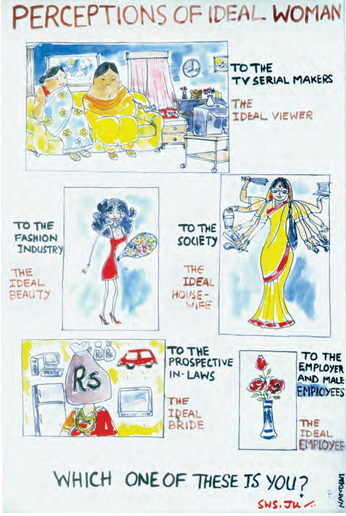
Stereotypes of an “ideal woman”
- Different expectations: Media, the fashion industry, society, prospective in-laws and employers may each impose a different ideal on women.
- Core message: These stereotypes restrict women to narrow roles and overlook their individuality and abilities.
Gender Inequality in India
Patriarchy — Literally “rule by father”; a system that values men more and gives them power over women.
Forms of disadvantage and discrimination
- Education: Women’s literacy rate is 54%, compared with 76% for men. Girls may perform as well as or better than boys at school, yet fewer continue to higher studies.
- Family investment: Some parents prioritise sons’ education, causing girls to drop out.
- Employment: Women remain under-represented in highly paid and valued jobs.
- Unpaid work: Indian women work about one hour more per day on average than men, but much of their work is unpaid and undervalued.
| Activity | Men | Women |
|---|---|---|
| Income-generating work | 6:00 | 2:40 |
| Household and related work | 0:30 | 5:00 |
| Talking and gossip | 1:25 | 1:20 |
| No work / leisure | 3:40 | 3:50 |
| Sleep, self-care, reading, etc. | 12:25 | 11:10 |
Unequal wages and sex-selective practices
- Equal Remuneration Act, 1976: Provides for equal wages for equal work, yet women are often paid less than men doing the same work.
- Sex-selective abortion: Preference for sons has led to the abortion of some female foetuses and a decline in the child sex ratio.
- Child sex ratio: The number of girl children per 1,000 boys; the figure given in the text is 919 nationally, with some states below 850 or even 800.
Child sex ratio — The number of girl children for every 1,000 boys.
Violence and safety
- Harassment and exploitation: Women face harassment, exploitation and other forms of violence.
- Domestic violence: Women may face beating and harassment even within their own homes.
- Public safety: Urban areas have become particularly unsafe for women.
Dates and data references
- 1976The Equal Remuneration Act provided for equal wages for equal work.
- 1998–99The Government of India Time Use Survey reported daily time-use data from six states.
- 2011The child sex ratio map referenced in the lecture presents data for children aged 0–6.
What is the sexual division of labour, and what is one effect of it?
What were the main demands of women’s movements?
How does the child sex ratio reflect gender discrimination?
Quick recap
- Gender roles are socially shaped, not fixed by biology.
- Women commonly carry out most household work alongside paid work; much of it is unpaid and unrecognised.
- The sexual division of labour also contributes to women’s limited role in public life, especially politics.
- Feminist movements campaigned for women’s political, legal, educational and career equality.
- Patriarchy—literally “rule by father”—sustains discrimination in education, work, wages and safety.
- The Equal Remuneration Act, 1976 provides for equal pay for equal work, though unequal pay continues.
- Son preference and sex-selective abortion contribute to a low child sex ratio.
Women’s Political Representation & Religion, Communalism and Politics
Women’s Political Representation
- Under-representation: Women held 14.36% of Lok Sabha seats in 2019, while their share in State Assemblies was less than 5%.
- Local bodies: One-third of seats in panchayats and municipalities are reserved for women; more than 10 lakh women have been elected.
- Further representation: Women’s organisations have demanded at least one-third reservation in the Lok Sabha and State Assemblies, but the proposal has lacked political consensus.
- Importance: Greater representation can help ensure that women’s concerns receive adequate attention in decision-making.
Caste and Politics
Caste Inequalities and Social Change
Caste system — An extreme, ritual-sanctioned form of hereditary occupational division, organised into social groups with shared rules.
Traditional caste rules and inequality
- India-specific division: Unlike gender and religion, caste division is specific to India; although occupations pass between generations in many societies, caste made this division hereditary and ritual-sanctioned.
- Group rules: Members were expected to practise similar occupations, marry within their caste and avoid eating with members of other castes.
- Exclusion: The system discriminated against outcaste groups, who faced the inhuman practice of untouchability.
- Reformers: Jotiba Phule, Gandhiji, B.R. Ambedkar and Periyar Ramaswami Naicker worked to establish a society without caste inequalities.
- Changes: Economic development, urbanisation, literacy and education, occupational mobility, and weakening landlord power have eroded old caste hierarchies.
- Urbanisation
- Shift of population from rural areas to urban areas.
- Occupational mobility
- Shift from one occupation to another, including when a new generation takes up different work from its ancestors.
- Caste hierarchy
- A ladder-like arrangement ranking caste groups from ‘highest’ to ‘lowest’.
Social and Religious Diversity of India
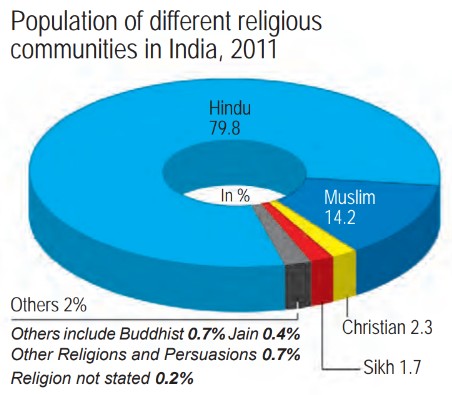
Religious population data
- Census: The Census of India records each person’s religion every ten years, as described by the person; it also records answers such as “no religion” or “atheist.”
- Population shares: Since Independence, the total population of each major religious community has grown substantially, while their proportions have changed little.
- Since 1961: Hindu, Jain and Christian population shares declined marginally; Muslim, Sikh and Buddhist shares increased slightly.
- Projection: Sachar Committee estimates suggested that the Muslim share might rise by about 3–4 percentage points over the next 50 years—not overtake other communities. Overall religious population balance was not expected to change greatly.
Caste groups and population shares
- Scheduled groups: The Census counts Scheduled Castes (SCs) and Scheduled Tribes (STs), whose communities are listed in official Schedules.
- SCs: Commonly called Dalits, they include groups historically treated as outcastes and subjected to exclusion and untouchability.
- STs: Often called Adivasis, they include communities that traditionally lived relatively secluded lives, often in hills and forests.
- 2011: SCs formed 16.6% and STs 8.6% of India’s population.
- OBCs: The Census did not count Other Backward Classes; the National Sample Survey estimated them at about 41% in 2004–05. SCs, STs and OBCs together comprised about two-thirds of India’s population and three-fourths of its Hindu population.
Key population and poverty data
- 1961 onwardReligious population shares changed only slightly: Hindu, Jain and Christian shares declined marginally; Muslim, Sikh and Buddhist shares increased slightly.
- 1999–2000NSSO poverty estimates showed differences in poverty levels among caste and community groups.
- 2004–05The National Sample Survey estimated the OBC population at about 41%.
- 2011SCs were 16.6% and STs 8.6% of India’s population.
Caste in Modern India
Change and persistence
- Constitution: Caste-based discrimination is prohibited, and constitutional policies aim to reverse historical injustices.
- Change: Urban life has weakened some traditional caste boundaries; caste identity may matter little in everyday interactions such as walking along a street or eating in a restaurant.
- Persistence: Most people still marry within their caste or tribe, and untouchability has not ended completely despite its prohibition.
- Unequal legacy: Groups historically denied education continue to lag behind; upper castes are disproportionately represented among urban middle classes.
- Continuing link: Caste remains closely connected to economic status, even though rich and poor people can be found in every caste.
Caste and Economic Inequality
How caste shapes economic status
- Historical restrictions: So-called untouchable castes were denied land ownership, while education was traditionally limited to so-called twice-born castes.
- Continuing effects: Formal caste-based inequalities are outlawed, but centuries of accumulated advantages and disadvantages still affect people.
- Changed pattern: Rich and poor people now exist in every caste; wealth among the lowest castes was very rare in the past.
- Average status: Upper castes are best off on average, Dalits and Adivasis worst off, and backward classes fall in between.
- Poverty and wealth: Extreme poverty is more common among lower castes; upper castes are over-represented among the rich.
| Caste/community group | Rural | Urban |
|---|---|---|
| Scheduled Tribes | 45.8 | 35.6 |
| Scheduled Castes | 35.9 | 38.3 |
| Other Backward Classes | 27.0 | 29.5 |
| Muslim Upper Castes | 26.8 | 34.2 |
| Hindu Upper Castes | 11.7 | 9.9 |
| Christian Upper Castes | 9.6 | 5.4 |
| Sikh Upper Castes | 0.0 | 4.9 |
| Other Upper Castes | 16.0 | 2.7 |
| All groups | 27.0 | 23.4 |
How to read the poverty data
- Poverty line: Below the poverty line meant spending Rs. 327 or less per person per month in rural areas and Rs. 454 or less in urban areas.
- Upper caste: In this table, it means groups that are not SC, ST or OBC.
- Source: National Sample Survey Organisation (NSSO), Government of India, 55th Round, 1999–2000.
Caste in Politics
Casteism — The belief that caste is the sole basis of social community and that people of the same caste share interests unlike those of other castes.
Caste is one part of social experience
- Not the only basis: Caste is one aspect of people’s experience, but it is not the only relevant or necessarily the most important one.
- Shared interests vary: The idea that everyone in one caste forms a natural community with identical interests is not supported by experience; people also differ by economic condition and other circumstances.
How caste enters electoral politics
- Candidate selection: Parties consider the caste composition of the electorate and nominate candidates from different castes to build support.
- Government formation: Parties usually try to include representatives of different castes and tribes in government.
- Caste appeals: Parties and candidates may appeal to caste sentiment; some parties are seen as favouring or representing particular castes.
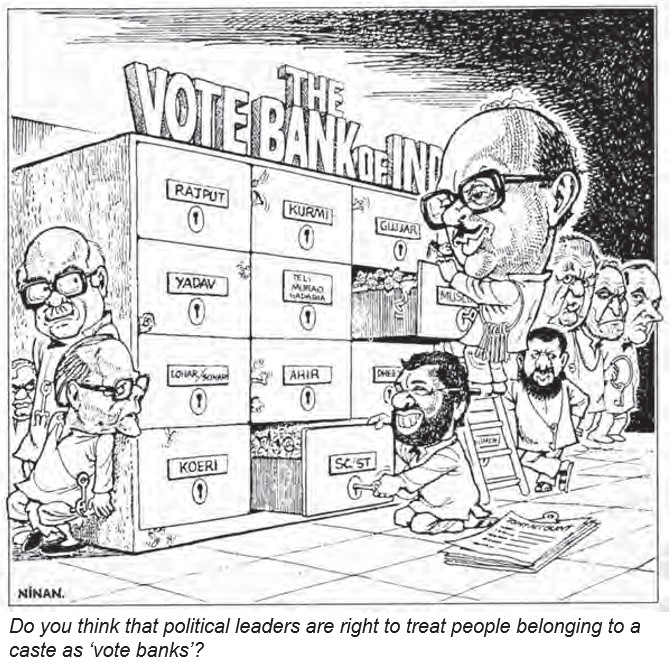
Why elections are not decided by caste alone
- No single-caste majority: No parliamentary constituency has a clear majority of one caste, so parties need support from multiple castes and communities.
- Vote banks: Calling a caste a party’s vote bank usually means a large proportion—not all—of its voters support that party.
- Candidate choices: Several parties may nominate candidates from the same caste; some voters have several same-caste candidates, while others have none.
- Changing preferences: Ruling parties and sitting MPs or MLAs frequently lose elections, showing that voting preferences are not fixed by caste.
- Other influences: Party attachment, differing economic interests within a caste, government performance and leaders’ popularity can be decisive.
Politics in Caste
How politics reshapes caste identities
- Two-way relationship: Politics influences caste too; it is more accurate to say caste gets politicised than that politics simply becomes caste-ridden.
- Larger groups: Caste groups may grow by incorporating neighbouring castes or sub-castes previously excluded from them.
- Coalitions: Caste groups form alliances with other castes and communities, involving dialogue and negotiation.
- New categories: Wider political groupings such as “backward” and “forward” caste groups have emerged.
| Aspect | Positive effects | Negative effects |
|---|---|---|
| Representation | Gives disadvantaged communities space to demand power; caste politics has helped Dalits and OBCs gain access to decision-making. | An exclusive focus on caste identity can weaken attention to wider democratic concerns. |
| Public demands | Organisations seek an end to discrimination, greater dignity, and access to land, resources and opportunities. | Caste politics can divert attention from poverty, development and corruption. |
| Social relations | Groups can organise and negotiate for their interests. | Caste divisions can cause tensions, conflict and even violence. |
How does caste influence elections, and why does it not determine results by itself?
How does politics influence caste identities?
Quick recap
- Caste is a hereditary, ritual-sanctioned social division associated with occupational rules, endogamy and historical exclusion.
- Urbanisation, education, occupational mobility and constitutional protections have weakened caste hierarchy, but discrimination and its effects persist.
- Religious population proportions have changed little; the Sachar Committee projected only a modest rise in the Muslim share over the next 50 years.
- In 2011, SCs were 16.6% and STs 8.6% of India’s population; OBCs were estimated at about 41% in 2004–05.
- Caste remains linked to economic status: lower castes face higher poverty on average, while upper castes are over-represented among the rich.
- Parties consider caste in elections, but caste alone does not determine votes or outcomes; voters weigh many interests and factors.
- Caste politics can improve representation and demands for equality, but exclusive caste focus may distract from wider issues and fuel conflict.
Social Science — ALL CHAPTERS
1
RESOURCES AND DEVELOPMENT
2
FOREST AND WILDLIFE RESOURCES
3
WATER RESOURCES
4
AGRICULTURE
5
MINERALS AND ENERGY RESOURCES
6
MANUFACTURING INDUSTRIES
7
LIFELINES OF NATIONAL ECONOMY
1
POWER SHARING
2
FEDERALISM
3
GENDER, RELIGION AND CASTE
4
POLITICAL PARTIES
5
OUTCOMES OF DEMOCRACY
1
THE RISE OF NATIONALISM IN EUROPE
2
NATIONALISM IN INDIA
3
THE MAKING OF A GLOBAL WORLD
4
THE AGE OF INDUSTRIALISATION
5
PRINT CULTURE AND THE MODERN WORLD
1
DEVELOPMENT
2
SECTORS OF THE INDIAN ECONOMY
3
MONEY AND CREDIT
4
GLOBALISATION AND THE INDIAN ECONOMY
5
CONSUMER RIGHTS