Class 10 . Social Science . Contemporary India II . Water Resources
Chapter 3: WATER RESOURCES
Ch 3
Social Science
Class 10
Water Scarcity , Need Water Conservation and Management
Water: Importance and Availability
Freshwater and the Hydrological Cycle
- Availability: About three-fourths of Earth’s surface is covered with water, but only a small proportion is usable freshwater.
- Sources: Usable freshwater is obtained mainly from precipitation, surface run-off and groundwater.
- Renewal: The hydrological cycle continually renews and recharges freshwater, making water a renewable resource.
- Key idea: Renewability does not guarantee that enough safe, accessible water is available to everyone.
Water Scarcity and Its Causes
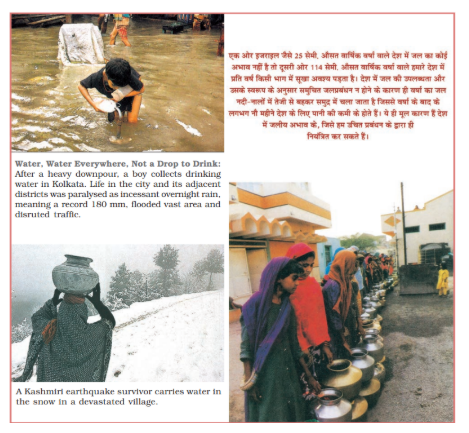
Population Growth and Irrigation
- Growing population → greater domestic water demand and greater demand for food.
- Higher food demand → expansion of irrigated areas, including dry-season agriculture.
- Irrigated agriculture, the largest consumer of water → greater pressure on freshwater resources.
- More farm wells and tube-wells for irrigation → falling groundwater levels → threats to water availability and food security.
Managing Agricultural Water Use
- Need: Reduce pressure caused by excessive irrigation and groundwater extraction.
- Approaches: Develop drought-resistant crops and use dry-farming techniques.
Industrialisation and Urbanisation
- Post-independence industrialisation and urbanisation → more industries and expanding urban centres.
- Industries → heavy water use and greater energy demand; much of the energy comes from hydroelectric power.
- Growing cities and urban lifestyles → higher water and energy requirements.
- Groundwater-pumping devices in housing societies and colonies → over-exploitation and depletion of fragile urban water resources.
- Hydroelectric power: It contributes approximately 22% of the total electricity produced in India.
- Key idea: A region can have ample water resources and still face scarcity because demand is high or access is unequal.
| Point | Quantitative scarcity | Water-quality scarcity |
|---|---|---|
| Meaning | Not enough water is available to meet needs. | Water may be present, but it is unsafe or unsuitable for use. |
| Causes | Low or variable precipitation, overuse, population growth and unequal access. | Pollution from domestic and industrial waste, chemicals, pesticides and fertilisers. |
| Result | Shortages for households, farming and economic activity. | Health hazards and less usable freshwater. |
Water Conservation and Management
Government Initiatives
- Jal Jeevan Mission (JJM): Aims to provide every rural household with a regular, assured supply of potable piped water.
- JJM service level: The target is 55 litres per capita per day, with tap connections functioning reliably over the long term.
- Atal Bhujal Yojana (Atal Jal): Implemented in 8,220 water-stressed Gram Panchayats across 229 administrative blocks/talukas in 80 districts of seven states.
- Atal Jal states: Gujarat, Haryana, Karnataka, Madhya Pradesh, Maharashtra, Rajasthan and Uttar Pradesh.
- Coverage: These selected states account for about 37% of India’s water-stressed blocks.
- Atal Jal focus: Encourage community behaviour to shift from consumption towards conservation and smart water management.
- Surface run-off
- Water flowing over the land surface after precipitation.
- Groundwater
- Water stored below Earth’s surface and recharged partly through the hydrological cycle.
- Potable water
- Water that is safe for drinking.
- Hydroelectric power
- Electricity generated using the energy of flowing or falling water.
Why can water scarcity occur even in a region with ample water resources?
How can excessive irrigation threaten water availability and food security?
State the rural household water-service goal of the Jal Jeevan Mission.
Quick recap
- Only a small share of Earth’s water is usable freshwater, renewed through the hydrological cycle.
- Scarcity results from uneven availability, excessive use, over-exploitation, unequal access and pollution.
- Population growth and irrigation increase demand and can deplete groundwater.
- Industrialisation and urbanisation raise water and energy use, adding pressure on freshwater resources.
- Water conservation supports health, food security, livelihoods and healthy ecosystems.
- JJM targets regular rural piped drinking water at 55 litres per person per day; Atal Jal promotes community-led conservation.
Multi-purpose River Projects and Integrated Water Resources Management
Water Management: Ancient and Modern
Ancient hydraulic structures — Structures built to collect, store and channel water included stone-rubble dams, reservoirs or lakes, embankments and irrigation canals.
Historical Examples
- First century B.C.: Sringaverapura, near Allahabad, had a system for channelling Ganga floodwater.
- Chandragupta Maurya’s time: Dams, lakes and irrigation systems were built extensively.
- Irrigation works: Evidence has been found at Kalinga (Odisha), Nagarjunakonda (Andhra Pradesh), Bennur (Karnataka) and Kolhapur (Maharashtra).
- Later examples: Bhopal Lake was a major artificial lake; Iltutmish built the Hauz Khas tank in Delhi to supply the Siri Fort area.
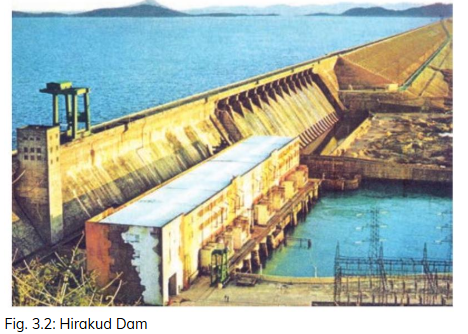
Dams and Multipurpose Projects
Dam — A barrier across flowing water that obstructs, directs or slows its flow, often creating a reservoir; in the source’s terminology, “dam” also refers to the reservoir rather than only the structure.
Uses and Classification
- Traditional use: Dams impounded river or rainwater for later use, especially irrigation.
- Modern uses: Irrigation, hydel power, domestic and industrial water supply, flood control, recreation, inland navigation and fish breeding.
- Multipurpose project: Integrates several uses of impounded water.
- Spillway or weir: A dam section through or over which water may flow intermittently or continuously.
| Basis | Classification or examples |
|---|---|
| Structure and materials | Timber, embankment and masonry dams, each with subtypes. |
| Intended purpose | Dams are also classified according to their intended purpose. |
| Height | Large and major dams; alternatively, low, medium-height and high dams. |
Examples of Multipurpose Projects
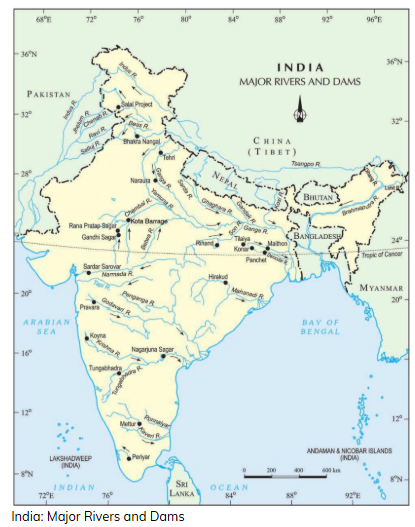
- Bhakra Nangal: In the Sutluj-Beas basin, water is used for both hydel power production and irrigation.
- Hirakud: In the Mahanadi basin, water conservation is integrated with flood control.
Why Multipurpose Projects Were Promoted
- After Independence: These projects were promoted as a route to national development and progress after colonial rule.
- Jawaharlal Nehru called dams the “temples of modern India”.
- Development aim: Dams were expected to connect agricultural and village development with industrialisation and urban economic growth.
Impacts and Criticism of Large Dams
Environmental and Social Effects
- River regulation → disrupted natural flow and sediment movement → reservoir sedimentation and rockier stream beds → poorer aquatic habitats.
- River fragmentation → aquatic fauna, especially spawning fish, find migration more difficult.
- Reservoir formation → floodplain vegetation and soil are submerged → they decompose over time.
- Irrigation expansion → shifts to water-intensive and commercial crops → greater risk of soil salinisation.
- Reservoir sedimentation and extreme rainfall → dams may fail to control floods or may trigger flooding → loss of life and property, soil erosion and land degradation.
Further Consequences
- Floodplain silt: Reservoirs can trap silt that would naturally fertilise floodplains; its loss adds to land degradation.
- Other reported effects: Multipurpose projects may induce earthquakes and contribute to water-borne diseases, pests and pollution associated with excessive water use.
- Damodar example: Flooding of the Damodar—often called the “river of sorrow”—has caused hardship for people in its valley.
Sardar Sarovar Project
- Location and reach: Built on the Narmada River in Gujarat; the project covers Gujarat, Madhya Pradesh, Maharashtra and Rajasthan.
- Purpose: Intended to meet water needs in drought-prone and desert areas.
- Gujarat: Provides for irrigation of 18.45 lakh hectares across 3,112 villages in 15 districts; about 75% of the command area is drought-prone.
- Rajasthan: Provides for irrigation of 2,46,000 hectares in Barmer and Jalore; the entire command area is drought-prone.
- Maharashtra: Provides for irrigation of 37,500 hectares in a tribal hilly area through lift irrigation.
- Expected outcome: Assured water supply is expected to help make these areas drought-proof.
Irrigation Policy and River Disputes
- Pradhan Mantri Krishi Sinchaee Yojana: Aims to ensure every agricultural farm has access to some means of protective irrigation, supporting rural prosperity.
- Krishna-Godavari dispute: Karnataka and Andhra Pradesh objected to Maharashtra diverting more water at Koyna for a multipurpose project.
- Downstream concern: Reduced river flow in Karnataka and Andhra Pradesh could adversely affect agriculture and industry.
- Multipurpose project
- A project that integrates several uses of impounded water.
- Reservoir
- Stored water, often collected behind a dam.
- Command area
- Area intended to receive irrigation from a project.
- Salinisation
- Build-up of salts in soil, which can result from irrigation.
- Protective irrigation
- Irrigation that provides crops with water when needed.
Why are modern dams called multipurpose projects? Give two examples.
Describe three environmental or social problems associated with large dams.
What is the Krishna-Godavari water dispute described in the lecture?
Quick recap
- India has a long history of dams, reservoirs, lakes, embankments and irrigation canals.
- Dams impound water and may be classified by structure, intended purpose or height.
- Multipurpose projects integrate uses such as irrigation, hydel power, water supply and flood control.
- Large dams can disrupt rivers, submerge land, increase salinisation risks and fail to prevent floods.
- Sardar Sarovar is a four-state Narmada project intended to supply water to drought-prone areas.
- Water diversion can create interstate disputes when downstream flows and livelihoods are affected.
Rainwater Harvesting
Rainwater Harvesting as a Local Alternative
Rainwater harvesting — Collecting and storing rainwater, or directing it underground to recharge groundwater, for later use.
- Viable alternative: Water harvesting was considered a socio-economically and environmentally suitable alternative amid the disadvantages and resistance associated with multipurpose projects.
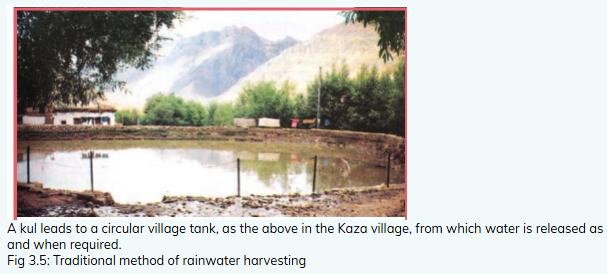
- Local knowledge: Traditional systems reflected knowledge of rainfall patterns, soil types, local ecology and community water needs.
- Water sources: Communities harvested rainwater, groundwater, river water and floodwater.
| Local setting | Method | Example and purpose |
|---|---|---|
| Hill and mountain regions | Diversion channels | Guls or kuls in the Western Himalayas carried water for agriculture. |
| Rajasthan | Rooftop rainwater harvesting | Rainwater was stored for drinking. |
| Flood plains of Bengal | Inundation channels | Floodwater was channelled to irrigate fields. |
| Arid and semi-arid regions | Fields used as rain-fed storage structures | Khadins in Jaisalmer and johads elsewhere in Rajasthan held water and moistened the soil. |
Traditional Tankas in Rajasthan
Tanka — An underground tank used in arid and semi-arid Rajasthan to store rooftop rainwater, especially for drinking.
- Where used: Tankas were traditionally common in Bikaner, Phalodi and Barmer, often built inside the house or courtyard.
- Collection: A pipe connected the sloping roof to the underground tank, carrying rooftop rainwater into storage.
- First spell: The first rain was usually discarded to clean the roof and pipes; later showers were collected.
- Storage and use: Tankas could hold water until the next rainfall and provide drinking water in summer when other sources dried up.
- Palar pani: Rainwater was considered the purest natural water in these regions.
- Cooling: Underground rooms adjoining tankas helped keep homes cool in the summer.
| Feature | Detail |
|---|---|
| Capacity | Some tankas were as large as a big room. |
| Phalodi example | One household had a tanka 6.1 metres deep, 4.27 metres long and 2.44 metres wide. |
Rooftop Harvesting and Groundwater Recharge
A modern rooftop harvesting system
- Collection: A PVC pipe carries rainwater from the roof.
- Filtration: Sand and brick filter the water before it enters a sump.
- Use and recharge: Sump water is used immediately; excess water goes to a well and recharges groundwater.
- Later supply: Water can later be drawn from the recharged well.
Collection, use and recharge
- Roof runoff → PVC pipe → sand-and-brick filter → sump for immediate use
- Excess sump water → well → groundwater recharge → water drawn later
Benefits and examples
- Reliable supply: Stored rooftop rainwater can last until the next rainfall and remain useful when other sources dry up.
- Shillong, Meghalaya: Rooftop harvesting is common despite acute water shortages in the city.
- Nearby high-rainfall areas: Cherrapunji and Mawsynram, about 55 km from Shillong, receive the highest rainfall in the world.
- Household contribution: Rooftop harvesting provides about 15–25% of a Shillong household’s total water requirement.
Changing Practices and Gendathur
- Western Rajasthan: Rooftop harvesting has declined where the perennial Indira Gandhi Canal provides water, although some households retain tankas because they prefer the taste of rainwater.
- Gendathur, Karnataka: Nearly 200 households in this remote village have installed rooftop harvesting systems to meet their water needs.
- Annual rainfall: Gendathur receives about 1,000 mm of precipitation.
- Reported collection: With 80% collection efficiency and about 10 fillings, each house can collect about 50,000 litres annually.
The source also reports a total of 1,00,000 litres harvested annually by 200 Gendathur houses, which conflicts with its stated collection of about 50,000 litres per house. Treat these as separately reported figures.
Bamboo Drip Irrigation in Meghalaya
Bamboo drip irrigation — A traditional Meghalaya system that uses bamboo pipes and gravity to carry spring or stream water to crops.
- Traditional system: The method has been used for more than 200 years in Meghalaya.
- Gravity flow: Bamboo channels divert water from springs or streams on higher ground to farms below, without external power.
- Controlled delivery: About 18–20 litres enter the system and travel hundreds of metres before the flow is reduced to 20–80 drops per minute at the plants.
- Water conservation: Small bamboo branches direct water to plant roots in a controlled, slow flow.
Rainwater Harvesting Policy
- Tamil Nadu: It was the first Indian state to make rooftop rainwater-harvesting structures compulsory in all houses.
- Enforcement: Legal provisions allow punishment of those who do not comply.
How do traditional tankas collect and store rainwater?
How can rooftop harvesting recharge groundwater?
Describe bamboo drip irrigation in Meghalaya.
Quick recap
- Rainwater harvesting uses locally adapted methods to store water or recharge groundwater.
- Traditional methods include Himalayan guls or kuls, Bengal inundation channels, Rajasthan khadins and johads, and rooftop tankas.
- Tankas stored rooftop rainwater underground; the first spell was usually discarded to clean the roof and pipes.
- Rooftop systems can filter and store water for immediate use, then direct excess water to wells for groundwater recharge.
- Shillong harvests rooftop rain despite nearby Cherrapunji and Mawsynram receiving the highest rainfall in the world; Gendathur is another household-level example.
- Meghalaya’s bamboo drip system uses gravity to deliver spring or stream water slowly to crops; Tamil Nadu made rooftop harvesting compulsory in all houses.
Social Science — ALL CHAPTERS
1
RESOURCES AND DEVELOPMENT
2
FOREST AND WILDLIFE RESOURCES
3
WATER RESOURCES
4
AGRICULTURE
5
MINERALS AND ENERGY RESOURCES
6
MANUFACTURING INDUSTRIES
7
LIFELINES OF NATIONAL ECONOMY
1
POWER SHARING
2
FEDERALISM
3
GENDER, RELIGION AND CASTE
4
POLITICAL PARTIES
5
OUTCOMES OF DEMOCRACY
1
THE RISE OF NATIONALISM IN EUROPE
2
NATIONALISM IN INDIA
3
THE MAKING OF A GLOBAL WORLD
4
THE AGE OF INDUSTRIALISATION
5
PRINT CULTURE AND THE MODERN WORLD
1
DEVELOPMENT
2
SECTORS OF THE INDIAN ECONOMY
3
MONEY AND CREDIT
4
GLOBALISATION AND THE INDIAN ECONOMY
5
CONSUMER RIGHTS