Class 10 . Social Science . Understanding Economic Development . Sectors of the Indian Economy
Chapter 2: SECTORS OF THE INDIAN ECONOMY
Ch 2
Social Science
Class 10
Sectors of Economic Activities
Economic Activities and Their Classification
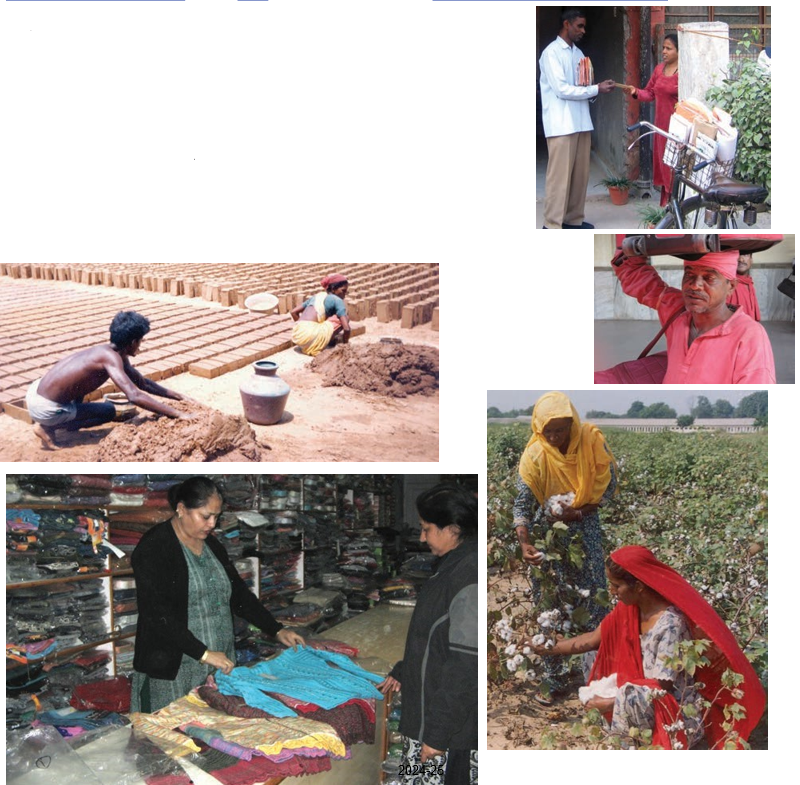
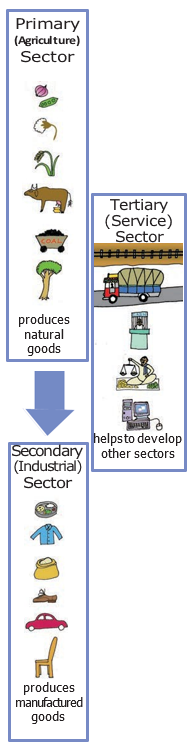
Primary, Secondary and Tertiary Sectors
| Sector | What it does | Examples | Also called |
|---|---|---|---|
| Primary | Uses natural resources to produce natural goods; it forms the base for other products. | Agriculture, dairy, fishing, forestry, mining | Agriculture and related sector |
| Secondary | Changes natural products into other forms through manufacturing, using raw materials. | Cotton fibre → yarn and cloth; sugarcane → sugar or gur; earth → bricks | Industrial sector |
| Tertiary | Provides services that support production and trade, or meet other needs; it does not directly produce goods. | Transport, storage, communication, banking, trade; teaching, healthcare, personal services, administration, accounting | Service sector |
Understanding the Sectors
- Primary sector depends mainly, though not entirely, on natural conditions such as rainfall, sunshine, climate, animal biology and fodder.
- Secondary sector follows primary production; manufacturing may take place in a factory, workshop or at home.
- Tertiary sector includes services such as transport, storage, communication, banking and trade that enable production and selling.
- Other services include teachers, doctors, washermen, barbers, cobblers, lawyers and administrative or accounting workers.
- Newer services based on information technology include internet cafes, ATMs, call centres and software companies.
Interdependence of Sectors
- Interdependence means sectors rely on one another for raw materials, manufactured inputs, services and markets; disruption in one sector can affect the others.
Examples of Sector Interdependence
- Farmers stop supplying sugarcane → a sugar mill lacks raw material → secondary-sector production may stop.
- Companies import all the cotton they need → demand for Indian cotton falls → prices and cultivation profits fall; farmers may face bankruptcy if they cannot switch crops.
- Prices of fertilisers or pumpsets rise → cultivation costs increase → farmers’ profits fall.
- Transporters stop moving food from rural areas → urban food becomes scarce → farmers cannot sell their produce.
- Primary produces from nature; secondary manufactures; tertiary provides services.
- The sectors have different main activities but are closely connected in the economy.
Quick recap
- Economic activities produce goods or provide services and can be grouped into sectors.
- The primary sector uses natural resources and is also called the agriculture and related sector.
- The secondary sector manufactures goods from raw materials and is also called the industrial sector.
- The tertiary sector provides services and is also called the service sector.
- Sectors depend on one another for inputs, production, transport, trade and markets.
- Disruption or rising costs in one sector can affect production and livelihoods in others.
Comparing the Three Sectors
Measuring Production in the Sectors
Measuring production
- Use monetary values: Different goods and services cannot be added by their physical quantities, so their values are added instead.
- Example: 5,000 coconuts at Rs. 15 each have a total value of Rs. 75,000.
- Compare sectors: Production and employment figures show which sectors are dominant and which are relatively small.
Final Goods, Intermediate Goods and Double Counting
Final goods and services — Goods and services that reach consumers; their value is counted in total production.
Intermediate goods — Goods used up to produce final goods and services; their value is already included in the final product.
| Point | Final goods | Intermediate goods |
|---|---|---|
| Use | Reach consumers | Used to produce other goods or services |
| Counting | Counted in total production | Not counted separately if included in a final product's value |
| Example | Biscuits sold to consumers | Wheat and flour used to make biscuits |
Why only final goods are counted
- Example chain: A farmer sells wheat to a mill; the mill sells flour to a biscuit company; the company sells biscuits to consumers.
- Final product: Biscuits worth Rs. 80 are sold to consumers; their value already includes the flour worth Rs. 25 and other inputs.
- Avoid double counting: Counting wheat, flour and biscuits separately would count the value of the same inputs more than once.
Gross Domestic Product (GDP)
Gross Domestic Product (GDP) — The value of all final goods and services produced within a country during a particular year.
GDP and its measurement
- Sector production: The value of final goods and services produced in a sector during a year gives that sector's total production.
- Total GDP: Add the production of the primary, secondary and tertiary sectors.
- What GDP shows: It indicates how large an economy is.
- In India: A central government ministry estimates GDP using information about production volumes and prices, collected with help from government departments in states and union territories.
Historical Shifts Between Sectors
Sectoral shift — A change over time in which sectors are most important for production and employment.
General Pattern in Developed Countries
- Initial stages of developmentThe primary sector was generally the most important in countries that are now developed.
- Over more than 100 yearsManufacturing methods and factories expanded; the secondary sector became important in production and employment.
- Past 100 yearsMany developed countries shifted from secondary to tertiary activities; services became most important in production and employment.
Why the sectors shifted
- Agricultural growth: Improved farming produced more food, allowing more people to take up crafts, trade, transport, administration and other activities.
- Early development: Despite these new activities, most production and employment initially remained in the primary sector.
- Industrialisation: New manufacturing methods led to expanding factories; many people who had worked on farms began working in factories.
- Later development: The tertiary sector grew to lead production and employment in many developed countries.
Production in India: 1973–74 and 2013–14
Reading the comparison
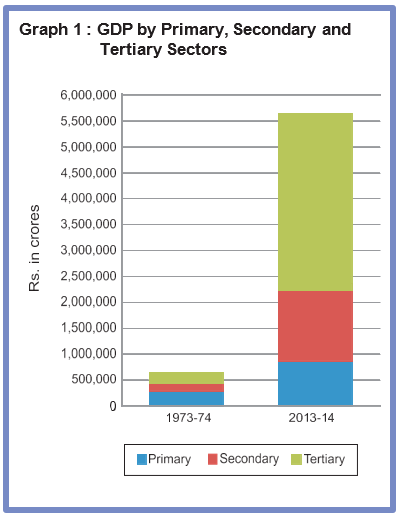
- Years shown: The graph compares production in the three sectors in 1973–74 and 2013–14, a period of forty years.
- Data: These years are used because the data are comparable and authentic.
- Use the graph: Compare the sectors' production in each year, identify the largest sector, and see which sector grew most. The comparison also shows the overall growth in production.
- Production value
- The monetary value of goods and services produced.
- Final goods and services
- Goods and services that reach consumers.
- Intermediate goods
- Inputs used up in producing final goods and services.
- GDP
- The value of all final goods and services produced within a country during a particular year.
Why are only final goods and services counted when calculating GDP?
What general shift between sectors has occurred as many countries developed?
Quick recap
- Measure production by adding monetary values, not physical quantities.
- Count final goods and services; intermediate goods already contribute to the final product's value.
- GDP is the value of final goods and services produced within a country during a particular year.
- India's central government ministry estimates GDP using production-volume and price information gathered with help from state and union territory departments.
- The general development pattern is a shift from primary to secondary and then tertiary-sector importance.
- The graph compares India's sector production in 1973–74 and 2013–14.
Rising Importance of the Tertiary Sector in Production
Why the Tertiary Sector Is Growing
Rising importance
- Growth: Between 1973–74 and 2013–14, production increased in all three sectors, but grew most in the tertiary sector.
- Change in position: By 2013–14, the tertiary sector had become India’s largest producing sector, replacing the primary sector.
- Basic services: Governments provide essential services such as health, education, police, courts, administration, defence, transport, banking and communication.
- Support to production: Growth in agriculture and industry increases demand for transport, trade, storage and other services.
- Rising incomes: Higher incomes increase demand for services such as eating out, tourism, shopping, private healthcare, private education and professional training.
- New services: Information and communication technology-based services have become increasingly important and have grown rapidly.
| Reason | How it increases services |
|---|---|
| Basic needs | Government and society require essential services. |
| Growth of agriculture and industry | More production creates demand for transport, trade and storage. |
| Rising incomes | People demand more private and consumer services. |
| Technology | ICT-based services have expanded rapidly. |
Growth is uneven within the service sector
- Skilled services: A limited number of jobs employ highly educated and skilled workers.
- Low-paid work: Many people work as small shopkeepers, repair workers or transport workers, often earning just enough to live.
- Limited opportunities: Some people take up such work because they have no better employment options; therefore, not every part of the service sector is growing equally.
Production and Employment: Different Shifts
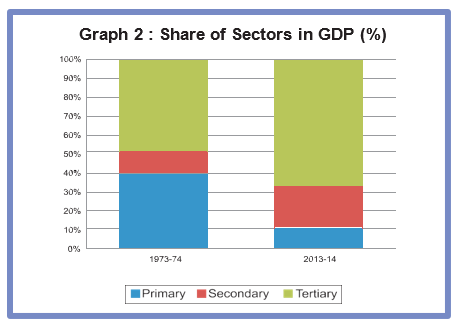
Employment did not shift in the same way
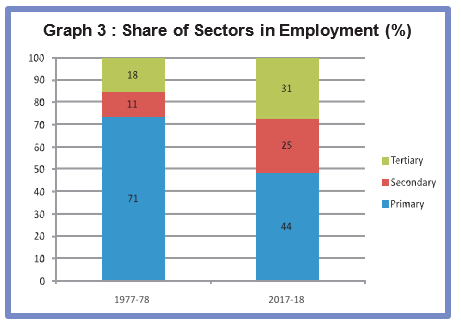
- Primary sector: It remained the largest employer, even as its share of GDP fell.
- Employment pattern: Unlike the change in GDP shares, employment did not shift away from the primary sector on a similar scale.
- Uneven growth: More than half of workers were in the primary sector, producing about one-sixth of GDP; the secondary and tertiary sectors produced the rest while employing less than half of workers.
| Sector | Production growth | Employment growth |
|---|---|---|
| Secondary (industry) | More than nine times | Around three times |
| Tertiary (services) | Fourteen times | Around five times |
Why employment remained concentrated in the primary sector
- Production in industry and services increased rapidly.
- Employment in these sectors increased much more slowly than production.
- Not enough jobs were created in the secondary and tertiary sectors.
- Many workers therefore continued to depend on agriculture.
Underemployment and Disguised Unemployment
Underemployment — A situation in which people are working but are employed below their capacity or potential.
Disguised unemployment — Hidden underemployment in which more people are working than necessary, so some can leave without reducing output.
Agricultural example
- Laxmi’s farm: All five members of her family work on a small, rain-fed plot of about two hectares, growing crops such as jowar and arhar.
- Hidden unemployment: Everyone appears busy, but the work is divided among too many people; each person works below their full potential.
- Test for disguised unemployment: If one or two family members leave for other jobs, farm production can remain unchanged.
- Benefit of other work: Those who move into wage work can increase their family’s income without reducing the farm’s output.
- Scale: If workers from many similar farms find productive jobs elsewhere, agricultural production need not fall while workers’ incomes can rise.
Underemployment beyond agriculture
- Casual service work: Painters, plumbers and repair workers may search for daily jobs but fail to find work every day.
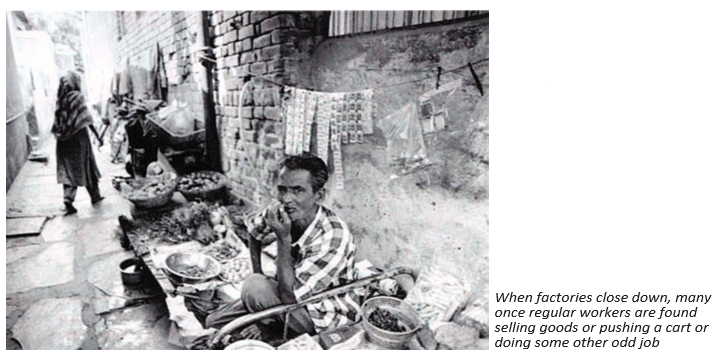
- Low-earning work: Some people spend the day pushing carts or selling goods yet earn very little because better opportunities are unavailable.
- Tertiary sector
- The sector that provides services, including transport, trade, banking and education.
- Underemployment
- Working below one’s ability or potential.
- Disguised unemployment
- Hidden underemployment where some workers can leave without affecting output.
Periods shown in the sector comparisons
- 1973–74 to 2013–14Production increased in all sectors; the tertiary sector grew most and became the largest producing sector.
- 1977–78 to 2017–18Employment shares changed less dramatically; the primary sector remained the largest employer.
Why did employment not shift out of the primary sector as much as production shifted?
What is underemployment? How can it be hidden in agriculture?
Why is underemployment a concern?
Quick recap
- The tertiary sector grew fastest and became India’s largest producing sector by 2013–14.
- Basic needs, growing production, higher incomes and ICT-based services drive service-sector growth.
- Employment did not shift out of agriculture as much as GDP shares shifted, because too few jobs were created elsewhere.
- Agriculture employed more than half of workers but produced about one-sixth of GDP.
- Underemployment means working below one’s potential; its hidden form is called disguised unemployment.
- Moving surplus workers into productive jobs can increase incomes without lowering farm output.
How to Create More Employment?
Employment Through Irrigation and Rural Infrastructure
Underemployment — A situation in which people have work but are not fully or productively employed.
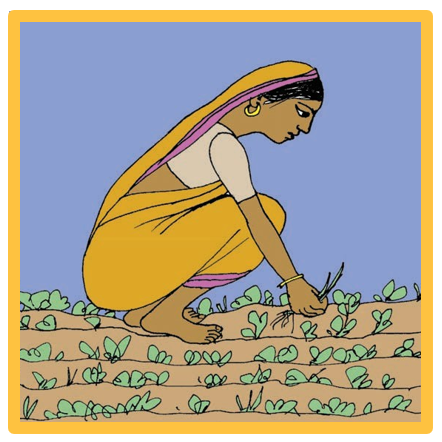
- Agriculture: Underemployment remains widespread, and some people have no work at all.
- Irrigation: A well could let Laxmi grow a second crop of wheat in the rabi season on her unirrigated two-hectare plot.
- Employment example: One hectare of wheat can provide work for two people for 50 days, including sowing, watering, fertilising and harvesting.
- Family employment: Growing the additional crop could employ two more members of Laxmi’s family on her own farm.
- Larger projects: Dams and canals can irrigate many farms, create agricultural jobs and reduce underemployment.
How Irrigation Creates Employment
- Investment in wells, dams and canals → more farms receive water.
- Reliable irrigation → farmers can grow an additional crop.
- More cultivation and harvesting → more farm work and lower underemployment.
Transport, Storage and Agricultural Credit
- Marketing access: Rural roads and mini-trucks help farmers transport crops to nearby towns and markets.
- Storage: Investment in crop storage helps farmers preserve produce for sale.
- Wider employment: Transport and trade create productive work beyond farming.
- Credit: Farmers need affordable loans to buy seeds, fertilisers, equipment and pumpsets on time.
- Reasonable interest: Bank credit can reduce dependence on moneylenders who charge high interest.
Supporting Farmers and Expanding Employment
- Affordable credit and investment in irrigation, roads and storage → farmers can produce more.
- Higher production → more crops need transport, processing and marketing.
- Growth in farming and related services → more employment and income.
Industries and Services in Semi-Rural Areas
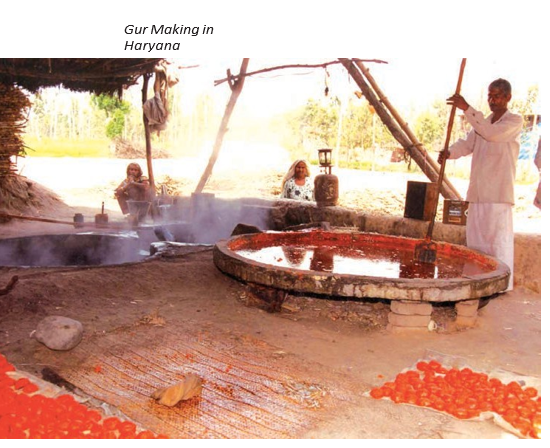
- Approach: Locate industries and services in semi-rural areas where they can employ many local people.
- Dal mills: Procure and process pulses such as arhar and chickpea for sale in cities.
- Cold storage: Let farmers store potatoes and onions and sell them when prices are favourable.
- Other examples: Honey collection centres near forests and processing industries for vegetables, grains and fruits.
- Result: Processing agricultural produce locally creates jobs outside large urban centres.
Employment in Education and Health
- Education access: About 60% of India's population was aged 5–29; only about 51% of this age group attended educational institutions.
- Children outside school: Others, especially those under 18, may be at home or working as child labourers.
- Education jobs: More schools require buildings, teachers and other staff; an estimate suggested nearly 20 lakh jobs could be created in education.
- Health jobs: Improving health services requires more doctors, nurses and health workers, particularly in rural areas.
- Development link: These jobs also improve access to education and healthcare.
Regional Potential and New Opportunities
- Local strengths: Regions can build employment around their potential, such as tourism, regional crafts or IT services.
- Support needed: Some opportunities require proper planning and government support.
- Tourism estimate: Improving tourism was estimated to provide additional employment to more than 35 lakh people each year.
MGNREGA 2005: A Right to Work
MGNREGA 2005 — The Mahatma Gandhi National Rural Employment Guarantee Act is a law guaranteeing 100 days of employment in a year to people in rural areas who are able to work and need work.
- Coverage: The Act was implemented in about 625 districts of India.
- Guarantee: Rural people who are able to work and need work are guaranteed 100 days of employment in a year.
- Unemployment allowance: If the government fails to provide employment, it must pay an unemployment allowance.
- Work priority: The Act gives preference to work that can increase production from land.
- 2005The Mahatma Gandhi National Rural Employment Guarantee Act (MGNREGA) was enacted.
Why is MGNREGA 2005 called a Right to Work?
How do irrigation and marketing facilities increase farmers’ income and employment?
In what ways can employment be increased in urban areas?
Quick recap
- Irrigation enables additional crops and creates more agricultural work, including jobs for two more members of Laxmi’s family in the example.
- Roads, transport, storage and affordable credit help farmers produce and sell more.
- Semi-rural processing and services create jobs close to villages.
- Education and healthcare can create jobs while improving essential services.
- Regional opportunities include tourism, crafts and IT, with planning and support where needed.
- MGNREGA 2005 guarantees 100 days of rural employment per year to people able to work who need work.
Division of Sectors as Organised and Unorganised
Organised and Unorganised Sectors: Work Conditions and Employment
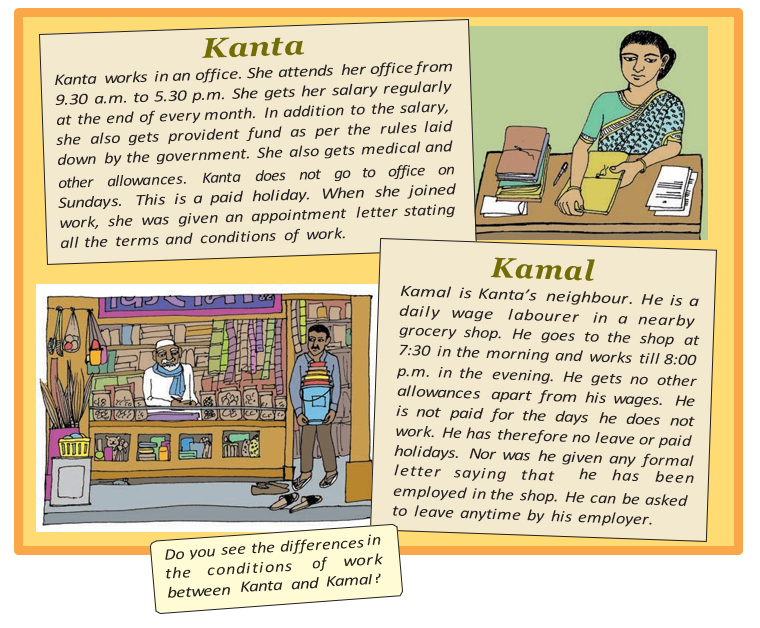
Organised sector — Enterprises or workplaces with regular employment terms that are registered with the government and follow relevant laws.
Unorganised sector — Small, scattered workplaces largely outside government control, where rules may exist but are often not followed and employment is commonly insecure.
| Point | Organised sector | Unorganised sector |
|---|---|---|
| Registration and rules | Registered; formal employment procedures and laws apply. | Often outside government control; rules may exist but are not followed. |
| Work and security | Regular terms and greater security of employment. | Jobs are often irregular; workers may be dismissed without reason or when work is low. |
| Hours and pay | Fixed hours; overtime should be paid for extra work. | Generally low-paid; overtime is usually not provided. |
| Benefits | May include paid leave, paid holidays, provident fund, gratuity, medical benefits and pension. | Usually no paid leave, holiday pay, sick leave or other employment benefits. |
| Examples | A salaried school teacher, hospital doctor or worker in a registered factory. | Headload worker, daily-wage labourer, street vendor, home-based weaver or small farmer working independently. |
Important Features and Examples
- Legal protection: Laws such as the Factories Act, Minimum Wages Act, Payment of Gratuity Act, and Shops and Establishments Act regulate organised workplaces.
- Working conditions: Organised-sector employers should provide facilities such as drinking water and a safe working environment.
- Self-employment: People working for themselves may also belong to the organised sector if they register and follow government rules; many small self-employed workers are in the unorganised sector.
- Unorganised work: Farmers may work independently and hire labourers only when needed; small repair and street-selling jobs are common examples.
| Sector | Organised | Unorganised | Total |
|---|---|---|---|
| Primary | 1 | 231 | 232 |
| Secondary | 41 | 74 | 115 |
| Tertiary | 40 | 88 | 128 |
| Total | 82 | 393 | 475 |
| Percentage | 17.3% | 82.7% | 100% |
What the Employment Figures Show
- Agriculture: 231 of 232 primary-sector workers are in the unorganised sector—about 99.6%, or nearly all.
- Overall employment: About 83% of workers are in the unorganised sector; only about 17% are in the organised sector.
- Conclusion: Agriculture is largely unorganised because most agricultural workers, including many farmers and labourers, lack regular formal employment and protections.
Protecting Workers in the Unorganised Sector
Why Workers Need Protection
- Organised-sector jobs expand slowly, while some enterprises avoid taxes and labour laws by operating informally.
- Workers consequently enter unorganised jobs with low, irregular wages and few or no benefits.
- Since the 1990s, some organised-sector workers have also lost their jobs and been forced into insecure, low-earning work.
- Therefore, workers need both more employment opportunities and protection and support in unorganised work.
- Since the 1990sMany workers have lost organised-sector jobs and had to take up lower-earning work in the unorganised sector.
| Area / group | Who is vulnerable? | Support or protection needed |
|---|---|---|
| Rural areas | Landless agricultural labourers, small and marginal farmers, sharecroppers and artisans such as weavers, blacksmiths, carpenters and goldsmiths. | Small and marginal farmers need timely seeds and other inputs, credit, storage and marketing facilities. |
| Urban areas | Small-scale industry workers; casual workers in construction, trade and transport; street vendors, headload workers, garment makers and rag pickers. | Small industries need support with raw materials and marketing; casual workers need protection. |
| Socially disadvantaged communities | Many workers from Scheduled Castes, Scheduled Tribes and backward communities work in the unorganised sector and also face discrimination. | Protection should address both poor work conditions and social discrimination. |
Rural Households
- Small and marginal farmers: Nearly 80% of rural households in India belong to this category.
- Why support matters: Timely inputs, credit, storage and access to markets help protect their livelihoods and improve their working conditions.
Using Classification to Understand the Economy
- Classification: Economic activities can be grouped using different criteria, depending on what we want to analyse.
- Nature of activity: The primary, secondary and tertiary classification helps analyse patterns of production and employment.
- Employment conditions: The organised and unorganised classification focuses on registration, regulation and workers’ conditions of employment.
- Organised sector
- Registered workplaces with regular employment terms and formal rules.
- Unorganised sector
- Small, scattered workplaces where employment is often irregular and protections are weak.
- Sharecropper
- A farmer who cultivates land belonging to someone else and shares the produce with the landowner.
- Casual worker
- A worker employed temporarily or as needed, commonly without secure employment benefits.
How do organised and unorganised sectors differ?
Why do workers in the unorganised sector need protection?
What proportion of workers is in the unorganised sector in India, and what does the agriculture figure show?
Quick recap
- The organised sector is registered and provides regular employment governed by formal rules and protections.
- The unorganised sector usually has insecure, low-paid work with few benefits or reliable protections.
- About 83% of workers are in the unorganised sector; agriculture is almost entirely unorganised.
- Rural and urban vulnerable workers need support, including access to inputs, credit, raw materials and markets.
- Workers from disadvantaged communities may face both poor employment conditions and social discrimination.
- Classifications by activity type and by employment conditions help analyse different features of the economy.
Sectors in Terms of Ownership: Public and Private Sectors
Classifying Sectors by Ownership
Public sector — An economic sector where the government owns most assets and is responsible for providing services.
Private sector — An economic sector where private individuals or companies own assets and deliver services.
| Point | Public sector | Private sector |
|---|---|---|
| Ownership and services | Government owns most assets and provides services. | Private individuals or companies own assets and deliver services. |
| Main purpose | Provides services and meets public needs; earning profit is not its only purpose. | Activities are generally guided by the motive to earn profits. |
| Funding or payment | Government uses taxes and other sources of revenue to meet expenses. | Users generally pay individuals or companies for services. |
| Examples | Railways and the post office. | Tata Iron and Steel Company Limited (TISCO) and Reliance Industries Limited (RIL). |
Why the Government Provides or Supports Services
Reasons for Public Provision
- Large investment: Roads, bridges, railways, harbours, electricity generation and dams require heavy spending that may exceed private capacity.
- Affordable access: Collecting money from thousands of users can be difficult; private providers may charge high rates.
- Public responsibility: The government undertakes major projects and works to make essential facilities available to everyone.
Why Government Takes on Large Projects
- Essential facility requires very large investment
- Private sector may lack the capacity or charge users too much
- Some people may be unable to access the facility
- Government funds or provides it to widen access
Supporting Producers and Consumers
Examples of Government Support
- Affordable electricity: Selling electricity at its full generation cost can raise production costs and may force some industries, especially small-scale units, to close.
- Industry support: Government may supply electricity at rates industries can afford and bear part of the cost.
- Food support: Government buys wheat and rice from farmers at a fair price, stores the grain, and sells it to consumers at lower prices through ration shops.
- Shared support: These measures support industries, farmers and consumers; the government bears part of the cost.
Government Support for Farmers and Consumers
- Government buys wheat and rice from farmers at a fair price
- It stores the grain in government godowns
- It sells the grain to consumers at a lower price through ration shops
- Government bears part of the cost, supporting both farmers and consumers
Services the Government Must Provide
Public Responsibilities
- Health and education: Providing these facilities for all is a primary government responsibility.
- Schools: The government must run proper schools and provide quality education, particularly elementary education.
- Human development: Public spending should support safe drinking water, housing for the poor, food and nutrition.
- Regional equity: The government should direct greater spending to the poorest and most neglected regions.
Social Needs Highlighted
- Education: India has one of the world's largest illiterate populations, strengthening the need for public education.
- Nutrition and health: Nearly half of India's children are malnourished, and about a quarter are critically ill.
- Infant mortality: The lecture cites rates of 40 in Odisha and 48 in Madhya Pradesh, higher than in some of the world's poorest regions.
- Public sector
- Economic activities where the government owns most assets and is responsible for services.
- Private sector
- Economic activities owned and run by private individuals or companies.
- Ration shop
- A shop through which the government sells essential goods, such as food grains, at lower prices.
- Infant mortality rate
- A measure of infant deaths used as an indicator of health conditions.
Why does the government undertake projects such as roads, railways and dams?
How does the government support both farmers and consumers?
Quick recap
- Ownership distinguishes the public sector, run by government, from the private sector, run by individuals or companies.
- Private-sector motive is generally profit; public-sector spending also serves social needs and is funded through taxes and other revenue.
- Public provision can make large infrastructure and essential services accessible and affordable.
- Government support includes affordable electricity for industries and food grains purchased at fair prices and sold to consumers at lower prices.
- Public duties include health, education, nutrition, safe water, housing support and attention to neglected regions.
- Sector classification also includes primary, secondary and tertiary sectors; the tertiary sector contributes most to GDP, while employment remains concentrated in the primary sector.
- Employment and protection: Most people work in the unorganised sector, so protection for workers there is necessary.
Social Science — ALL CHAPTERS
1
RESOURCES AND DEVELOPMENT
2
FOREST AND WILDLIFE RESOURCES
3
WATER RESOURCES
4
AGRICULTURE
5
MINERALS AND ENERGY RESOURCES
6
MANUFACTURING INDUSTRIES
7
LIFELINES OF NATIONAL ECONOMY
1
POWER SHARING
2
FEDERALISM
3
GENDER, RELIGION AND CASTE
4
POLITICAL PARTIES
5
OUTCOMES OF DEMOCRACY
1
THE RISE OF NATIONALISM IN EUROPE
2
NATIONALISM IN INDIA
3
THE MAKING OF A GLOBAL WORLD
4
THE AGE OF INDUSTRIALISATION
5
PRINT CULTURE AND THE MODERN WORLD
1
DEVELOPMENT
2
SECTORS OF THE INDIAN ECONOMY
3
MONEY AND CREDIT
4
GLOBALISATION AND THE INDIAN ECONOMY
5
CONSUMER RIGHTS