Class 10 . Social Science . India And Contemporary World II . The Age of Industrialisation
Chapter 4: THE AGE OF INDUSTRIALISATION
Ch 4
Social Science
Class 10
Introduction & Before the Industrial Revolution
Industrialisation and the Idea of Progress
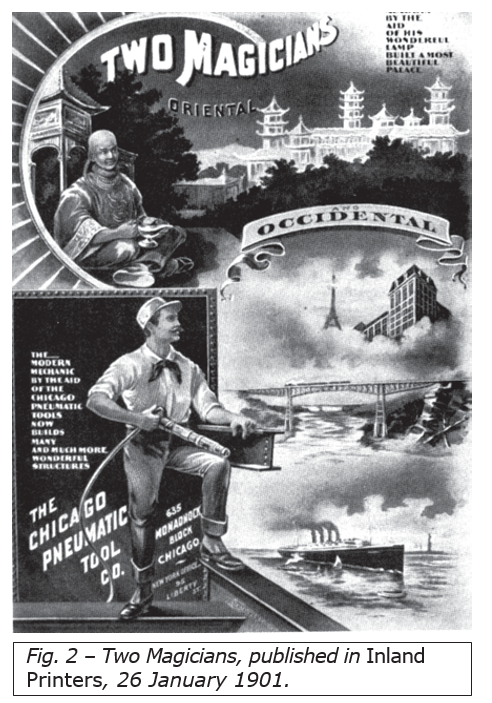
How industrialisation was represented
- 1900 music-book cover: E.T. Paull’s *Dawn of the Century* presented progress through railways, cameras, machines, printing presses and factories.
- 1901 advertisement: It contrasted Aladdin, representing the East and the past, with a modern mechanic representing the West and modernity.
- Popular image: Industrialisation was often portrayed as a triumphant story of technology, factories and rapid change.
- Critical question: Industrialisation brought change, but its effects on people’s lives—and whether mechanisation always means progress—must also be examined.
- Chapter focus: The chapter studies Britain as the first industrial nation, then India, where colonial rule shaped industrial change.
Before the Industrial Revolution
Proto-industrialisation — Large-scale production for an international market before factories became widespread, carried out mainly by households in the countryside.
Why merchants turned to the countryside
- Growing demand: World trade and the acquisition of colonies increased demand for goods.
- Guild restrictions: Urban craft and trade guilds controlled training, production, competition and prices; rulers granted them monopoly rights over particular trades.
- Limited access: Guild controls made it difficult for new merchants to establish production in towns, so merchants sought rural producers.
- Merchant support: Merchants supplied money or advances to peasants and artisans and organised production for international markets.
Why rural households accepted merchant work
- Enclosure reduced access to common lands and their resources.
- Poor peasants and cottagers needed other income; tiny plots could not provide work for every family member.
- Merchants offered advances for producing goods.
- Households earned supplementary income while staying in the countryside and continuing to cultivate their plots.
Town–countryside production network
- A wool stapler sorted and supplied wool to the merchant clothier.
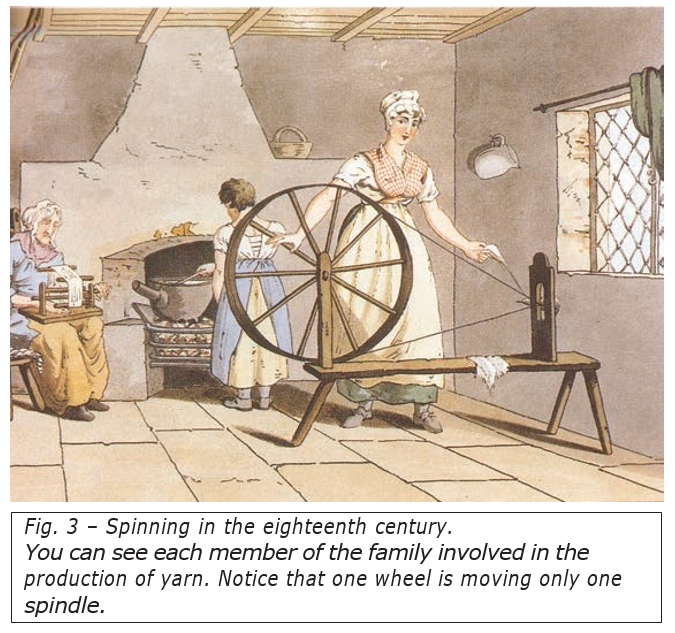
- The clothier sent wool to spinners, who made yarn.
- The yarn went to weavers, then to fullers and dyers.
- Cloth was finished in London and sold abroad by export merchants.
Features of proto-industrial production
- Control: Town-based merchants organised production, while most work took place in rural households and family farms.
- Scale: Each production stage could involve 20–25 workers per merchant; a clothier might therefore control hundreds of workers.
- London: It became an important finishing centre for cloth before export.
- Key distinction: Large-scale production existed before factories; industrial production was not always factory production.
| Point | Proto-industrial production | Factory production |
|---|---|---|
| Workplace | Mostly rural households and family farms | Factory or mill |
| Organisation | Merchants coordinated separate stages of work | Processes gathered under one roof and management |
| Production control | Work and workers were spread across the countryside | Closer supervision of production, quality and labour |
The Coming Up of the Factory
Factories and cotton
- Early factories: The earliest factories in England appeared in the 1730s; their numbers multiplied in the late eighteenth century.
- Cotton: Cotton became a major symbol of the new industrial era, with production booming in the late nineteenth century.
- Import growth: Britain imported 2.5 million pounds of raw cotton in 1760 and 22 million pounds by 1787.
- Reason for growth: Inventions improved carding, twisting, spinning and rolling, increasing output per worker and enabling stronger thread and yarn.
Richard Arkwright and the cotton mill
- Innovation: Richard Arkwright created the cotton mill, bringing processes previously spread across village households into one place.
- Machinery: Mills could purchase, install and maintain costly new machines.
- Management: Production under one roof enabled closer supervision, quality control and regulation of labour.
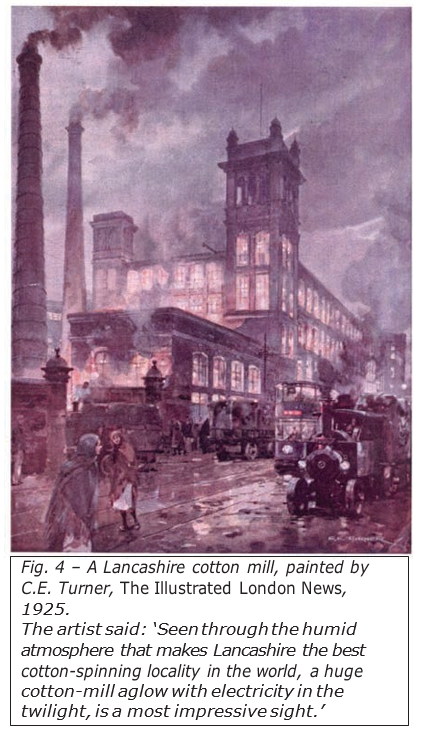
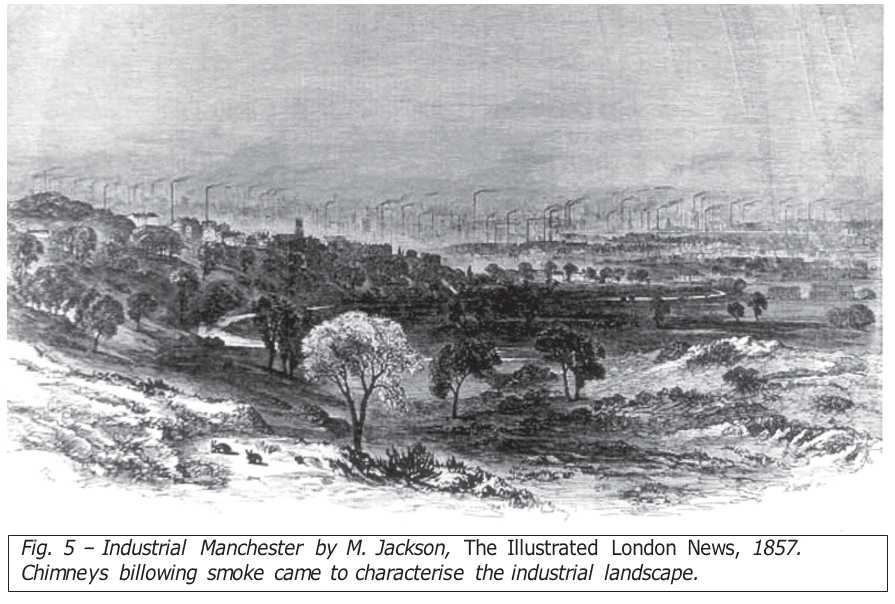
Factories in the landscape
- Early nineteenth century: Factories became an increasingly visible part of the English landscape.
- Public attention: Imposing mills and new technology dazzled contemporaries, drawing attention away from workshops and bylanes where production continued.
- Historical perspective: What people notice about industrialisation can shape which parts of its history are remembered.
- Guild
- An association of producers that regulated training, production, competition and prices in a trade.
- Orient
- Countries east of the Mediterranean; a Western viewpoint often portrayed the region as premodern, traditional and mysterious.
- Stapler
- A person who sorts wool according to its fibre.
- Carding
- Preparing fibres such as cotton or wool before spinning.
- Fuller
- A worker who gathers and pleats cloth during finishing.
- Finishing centre
- A place where cloth receives its final processing before sale or export; London served this role.
Key dates and periods
- Seventeenth and eighteenth centuriesEuropean merchants expanded rural production for international markets.
- 1730sThe earliest factories appeared in England.
- 1760Britain imported 2.5 million pounds of raw cotton.
- 1787Britain’s raw cotton imports had risen to 22 million pounds.
- Late eighteenth centuryThe number of factories multiplied.
- Early nineteenth centuryFactories became a prominent feature of the English landscape.
- 1857An image of industrial Manchester shows factory smoke across the city’s landscape.
- 1900E.T. Paull produced the music book *Dawn of the Century*.
- 1901A trade advertisement contrasted Aladdin’s magic with the modern mechanic’s industrial achievements.
What was proto-industrialisation, and why did it develop in the countryside?
How did the cotton mill change production?
Why is it inaccurate to equate industrialisation only with factories?
Quick recap
- Industrialisation was often celebrated as technological progress, but its effects on people also need examination.
- Proto-industrialisation was large-scale rural production for international markets before factories spread.
- Guild restrictions and rising trade encouraged merchants to organise production in the countryside.
- Rural household income supplemented cultivation, and merchants linked many producers through successive stages of work.
- Factories gathered processes under one roof, improving supervision and control of production and labour.
- Britain’s raw cotton imports rose from 2.5 million pounds in 1760 to 22 million pounds in 1787.
The Pace of Industrial Change & Hand Labour and Steam Power
The Pace of Industrial Change
| Sector | Period | Role |
|---|---|---|
| Cotton | First phase, up to the 1840s | Britain's leading industrial sector |
| Iron and steel | After the 1840s | Expanded with railway construction; by 1873, exports were worth about twice the value of cotton exports |
Industrialisation Was Uneven
- Railways increased demand for iron and steel in England from the 1840s and in the colonies from the 1860s.
- Traditional industries were not quickly displaced: even at the end of the nineteenth century, fewer than 20% of workers were in technologically advanced industrial sectors.
- Textiles grew rapidly, but much textile output was still made in domestic units rather than factories.
- Small innovations also supported growth in non-mechanised sectors such as food processing, building, pottery, glass, tanning, furniture and tool-making.
Why New Technology Spread Slowly
- High cost made new machines a major investment, so merchants and industrialists were cautious.
- Unreliability was a problem: machines could break down, and repairs were expensive.
- Limited performance meant machines were not always as effective as their makers claimed.
- Gradual adoption meant even powerful technology did not immediately transform every industry.
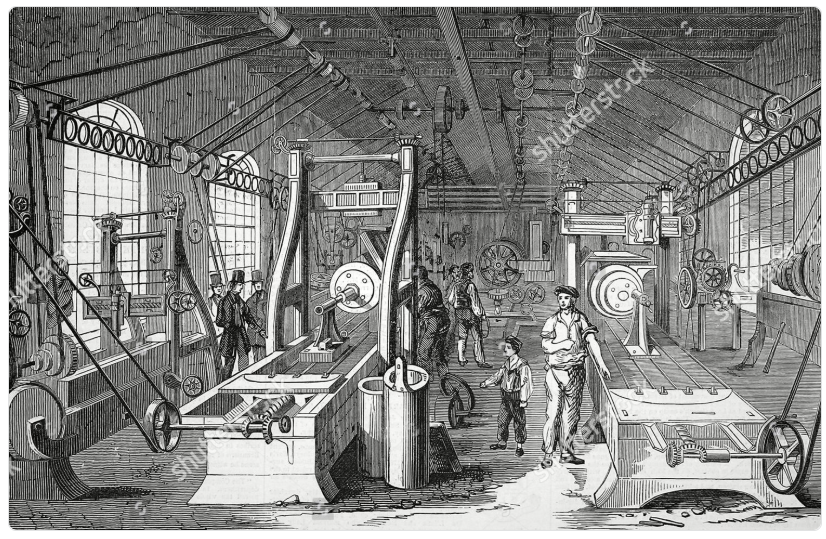
Steam Power: A Slow Start
- James Watt improved Newcomen's steam engine and patented his improved design in 1781; his industrialist partner Matthew Boulton manufactured it.
- Few early buyers adopted the engine: at the beginning of the nineteenth century, England had only 321 steam engines.
- Where they were used: 80 engines were in cotton industries, 9 in wool industries, and the rest in mining, canal works and ironworks.
- Limited reach: steam engines were not used in other industries until much later in the nineteenth century.
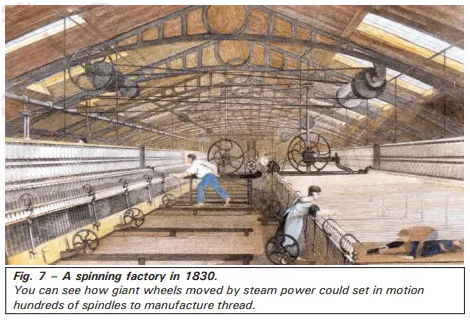
- The typical mid-nineteenth-century worker was a craftsperson or labourer, not a machine operator.
Hand Labour and Steam Power
Why British Industrialists Often Preferred Hand Labour
- Many poor peasants and vagrants moved to cities seeking work.
- A large supply of workers kept wages low.
- Industrialists faced little pressure to replace workers with costly machines.
- Machines required capital investment and could be unreliable or costly to repair.
Seasonal and Mobile Labour
- Seasonal demand led industries such as gas works and breweries to hire extra workers in winter.
- Other peak periods: printers and bookbinders needed extra hands before Christmas; ships were repaired at the waterfront in winter.
- Flexible hiring: employers often preferred to hire workers only for busy seasons rather than invest in machines.
- Job-seekers travelled in search of temporary work, sometimes moving from place to place to sell small goods.
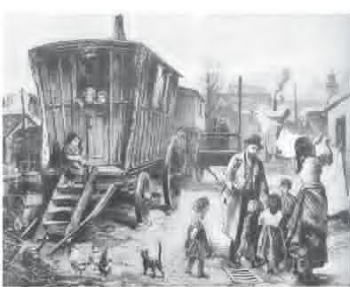
Will Thorne: An Example of Job-Seeking
- In November 1881, Will Thorne and two companions walked to London hoping to find work.
- Hardship: they ran out of money, slept outdoors and in an empty building, then eventually reached the Old Kent Gas Works.
- Outcome: with help from a contact, Thorne obtained a job at the gas works.
Why Skilled Hand Labour Remained Important
- Variety and detail: machines were suited to standardised goods for mass markets, while many buyers wanted intricate designs and specific shapes.
- Examples: British makers produced 500 varieties of hammers and 45 kinds of axes in the mid-nineteenth century; skilled workers made such varied goods.
- Upper-class preference: aristocrats and the bourgeoisie valued handmade goods for their finish, individual design and association with refinement.
- Machine-made goods were often produced for export to the colonies.
| Point | Britain | America |
|---|---|---|
| Labour supply | Abundant human labour | Labour shortage |
| Industrialists' preference | Often retained hand labour | More keen to use mechanical power to reduce labour needs |
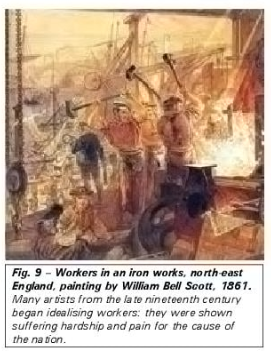
Images of Industrial Workers
- Late nineteenth-century art sometimes idealised workers, portraying their hardship and suffering as service to the nation.
Key Dates
- 1781James Watt patented his improved steam engine.
- Beginning of the nineteenth centuryEngland had 321 steam engines, mostly in cotton, wool, mining, canal and iron industries.
- 1840sRailway expansion in England increased demand for iron and steel; cotton remained the leading sector up to this decade.
- 1860sRailway expansion in the colonies further increased demand for iron and steel.
- 1861William Bell Scott painted workers in an ironworks in north-east England.
- 1873British iron and steel exports were worth about twice the value of cotton exports.
- November 1881Will Thorne walked to London with companions seeking work and obtained a job at the Old Kent Gas Works.
Why did industrialisation not immediately replace hand labour in Britain?
- Industrialisation
- The growth of industry and the use of new production methods; it did not mean that factory production immediately replaced traditional work.
- Seasonal labour
- Workers hired temporarily when production or demand rose during a particular season.
- Mechanisation
- The use of machines to carry out work previously done by people.
Quick recap
- Cotton led Britain's early industrial growth; iron and steel became more important with railway expansion.
- Traditional and domestic production continued alongside factory industries.
- New machines spread slowly because they were expensive, unreliable and costly to repair.
- Abundant, low-wage labour in Britain made hand labour an economical choice.
- Seasonal demand and varied product designs preserved the need for skilled workers.
- Handmade goods were valued by the upper classes, while America’s labour shortage encouraged mechanisation.
Life of the Workers & Industrialisation in the Colonies
Life of the Workers
Finding work and shelter
- Job-seeking: News of possible work drew many people from the countryside to cities, but getting a job often depended on friends or relatives already employed in a factory.
- Waiting for work: Without such connections, jobseekers might wait for weeks and sleep under bridges or in shelters.
- Shelters: Private individuals ran Night Refuges; Poor Law authorities maintained Casual Wards and supervised workhouses.
- Workhouse conditions: Applicants faced medical examinations, bodily cleansing and purification of their clothes, followed by hard labour; the experience was humiliating.
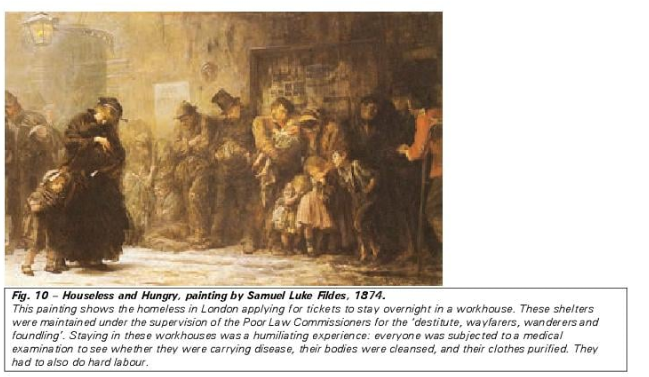
Seasonal employment, wages and poverty
- Seasonal work: When a busy season ended, workers could face long periods without employment; some returned to rural areas when agricultural work became available.
- Odd jobs: Until the mid-nineteenth century, odd jobs were difficult to find.
- Wages and welfare: Wages rose somewhat in the early nineteenth century, but average wage figures hide differences between trades and fluctuations from year to year.
- Real wages: During the prolonged Napoleonic War, sharp price rises meant wages bought fewer goods, reducing workers’ real earnings.
- Days employed: Income depended not only on the wage rate but also on the number of days worked.
- Poverty and unemployment: Even in better periods up to the mid-nineteenth century, about 10% of the urban population was extremely poor. During slumps such as the 1830s, unemployment reached 35–75% in different regions.
Workers and New Technology
Spinning Jenny — A machine devised by James Hargreaves in 1764 that let one worker spin several threads at once by turning a single wheel.
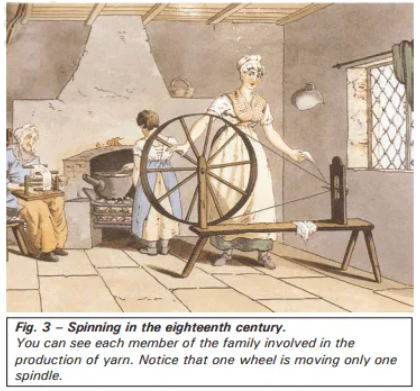
Why workers opposed the Spinning Jenny
- Industry and impact: When the Spinning Jenny was introduced in the woollen industry, it threatened the work of women who earned their living through hand-spinning.
- Fear of unemployment: Because the machine could spin several threads at once, workers feared it would reduce demand for manual labour.
- Resistance: Women attacked the new machines, and conflict over the Jenny continued for a long time.
- 1790 report: A magistrate described workers and their wives threatening to destroy a machine; the wives had lost work to spinning engines.
Construction and New Employment
Growth of construction work
- After the 1840s: Building activity intensified in cities and created more employment.
- Projects: Workers widened roads, built railway stations and lines, dug tunnels, laid drains and sewers, and embanked rivers.
- Railways: From the 1850s, stations spread across London, creating demand for workers to dig tunnels and do timber, brick and iron work.
- Mobile jobseekers: Workers often moved from one construction site to another.
- Transport employment: The number of workers in transport doubled in the 1840s and doubled again over the following 30 years.
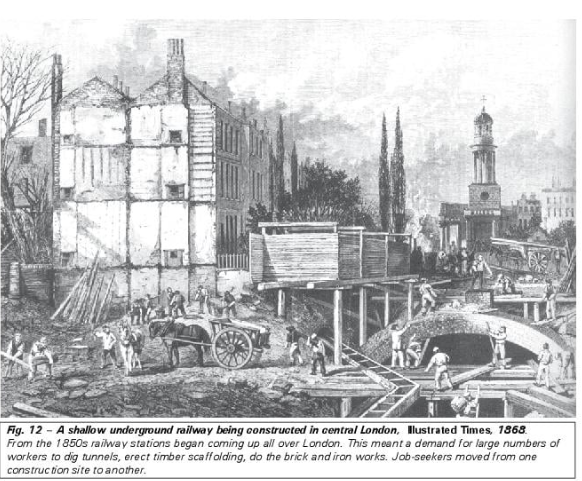
Industrialisation in the Colonies: Indian Textiles
India’s pre-colonial textile trade
- Textile exports: Before machine industries, Indian cotton and silk goods were prominent in international markets; India was especially known for fine textiles.
- Land routes: Armenian and Persian merchants carried textiles from Punjab towards Afghanistan, eastern Persia and Central Asia, across mountain passes and deserts.
- Sea routes: Surat connected India with Gulf and Red Sea ports; Masulipatam and Hoogly traded with Southeast Asian ports.
- Indian trade network: Merchants and bankers financed production and exports. Supply merchants advanced money to weavers, collected cloth in inland villages and transported it to ports.
- Port sales: Brokers for large shippers and export merchants negotiated prices and bought cloth from supply merchants.
Changing Trade and the Rise of Colonial Ports
Decline of the old trading network
- European companies: They first gained concessions from local rulers and later secured monopoly rights over trade.
- Old ports: As Surat and Hoogly declined, exports fell, trade credit dried up and local bankers went bankrupt.
- Surat’s trade: Its gross trade value fell from Rs. 16 million in the last years of the seventeenth century to Rs. 3 million by the 1740s.
- New ports: Bombay and Calcutta grew as Surat and Hoogly declined. European companies controlled trade through the new ports and carried it in European ships.
- Indian traders: Many old trading houses collapsed; those that survived had to work within networks shaped by European companies.
East India Company Control over Weavers
Competition before Company monopoly
- Continuing demand: The consolidation of East India Company power did not initially reduce Indian textile exports. British cotton industries had not yet expanded, and Indian fine textiles remained in demand in Europe.
- Earlier competition: Before gaining political power in Bengal and the Carnatic in the 1760s and 1770s, the Company competed with French, Dutch, Portuguese and local traders for cloth.
- Weavers’ bargaining power: Weavers and supply merchants could choose buyers and bargain over prices; Company officials complained of irregular supplies and high prices.
Gomastha — A paid Company agent appointed to supervise weavers, collect supplies and examine cloth quality.
How the Company controlled textile production
- The Company gained political power and asserted a monopoly over trade.
- It appointed gomasthas and tried to remove existing traders and brokers from the cloth trade.
- The Company gave weavers advances (loans) to buy raw materials.
- Weavers who took advances had to hand over their cloth to the gomastha and could not sell it to other buyers.
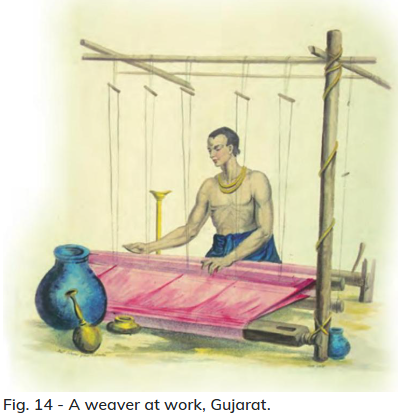
Effects on weavers and their families
- More time in weaving: As demand and advances increased, many weavers leased out small plots they had cultivated and devoted more time to weaving.
- Family labour: Weaving involved the whole family, including women and children, in different stages of production.
- Loss of choice: Advances tied weavers to Company orders, while Company prices were often miserably low.
- Local relations: Earlier supply merchants often lived in weaving villages and supported weavers in times of need; gomasthas were outsiders without these long-term ties.
Conflict and resistance
- Gomastha conduct: Gomasthas could arrive with sepoys and peons, act arrogantly and punish late deliveries, including by beating or flogging weavers.
- Migration and revolt: In parts of Bengal and the Carnatic, weavers deserted villages and moved elsewhere; others joined village traders in revolts against Company officials.
- Leaving weaving: Some weavers refused loans, closed their workshops and turned to agricultural labour.
- Sepoy: An Indian soldier serving the British; the word comes from sipahi.
New difficulties for cotton weavers
- By the turn of the nineteenth century: Cotton weavers faced a new set of problems.
Key dates and periods
- Last years of the seventeenth centurySurat’s trade was valued at Rs. 16 million.
- 1740sSurat’s trade had fallen to Rs. 3 million.
- By the 1750sThe Indian merchant-controlled export network was breaking down.
- 1764James Hargreaves devised the Spinning Jenny.
- 1760s and 1770sThe East India Company established political power in Bengal and the Carnatic.
- 1790A magistrate reported workers’ opposition to a spinning machine.
- Early nineteenth centuryWages rose somewhat, but this did not by itself ensure better welfare.
- 1830sDuring economic slumps, unemployment reached 35–75% in different regions.
- 1840sUrban building activity grew, and transport employment doubled.
- After the 1840sBuilding activity intensified in cities.
- From the 1850sRailway stations began appearing across London.
- 1868An illustration depicted shallow underground railway construction in central London.
- 1874Samuel Luke Fildes painted Houseless and Hungry, showing people seeking workhouse shelter.
- Turn of the nineteenth centuryCotton weavers faced a new set of problems.
- Casual Ward
- A shelter maintained by Poor Law authorities for people without accommodation.
- Spinning Jenny
- A machine that enabled one worker to spin several threads at once.
- Gomastha
- A paid Company agent who supervised weavers and collected cloth.
- Advance
- A loan for raw materials that tied a weaver to Company orders.
- Sepoy
- An Indian soldier serving the British.
Why did workers oppose the Spinning Jenny?
How did the East India Company control Indian weavers?
What happened to India’s older textile trade network as European companies gained power?
Quick recap
- Workers’ lives: Jobs were uncertain and often depended on personal connections; seasonal work also brought periods without employment.
- Wages and hardship: Average wages conceal differences between trades and year-to-year changes; rising prices and fewer workdays weakened real income.
- Technology: Workers, especially women hand-spinners, resisted the Spinning Jenny because it threatened their livelihoods.
- Indian trade: Indian merchants once connected inland weavers to international markets through land and sea routes.
- Colonial trade: European companies gained monopolies, undermined older trading networks and shifted trade towards ports they controlled.
- Weavers’ conditions: Gomasthas and Company advances restricted weavers’ choices, prompting migration, revolt and withdrawal from weaving.
Manchester Comes to India & Factories Come Up
Manchester Goods and the Decline of Indian Weaving
Decline of Indian textile exports
- Earlier confidence: In 1772, Company official Henry Patullo argued that demand for Indian textiles could not fall because their quality was unmatched.
- Export decline: Piece-goods fell from 33% of India’s exports in 1811–12 to just 3% later in the nineteenth century.
- British protection: English industrialists pressed the British government to impose import duties on foreign cotton textiles, protecting Manchester goods from competition.
- Indian market opened: Industrialists also persuaded the East India Company to sell British manufactures in India.
How Manchester imports weakened Indian weavers
- Machine production in Britain lowered the cost of cotton goods.
- Cheap British cotton goods entered India in increasing quantities.
- Indian weavers lost export markets and faced competition in their home market.
- Many weaving regions experienced decline and hardship by the 1850s.
Imports and evidence of decline
- Imports: Cotton piece-goods were virtually absent from Indian imports in the late eighteenth century; they made up over 31% of import value by 1850 and over 50% by the 1870s.
- Jahanabad and Behar: A Patna commissioner reported that cloth manufacture had ceased in Jahanabad and was very limited in Behar because Manchester goods were cheap and durable.
- Koshti weavers: The 1872 Central Provinces Census Report said many Koshti weavers could not compete with Manchester goods; many migrated to Berar to work as day labourers.
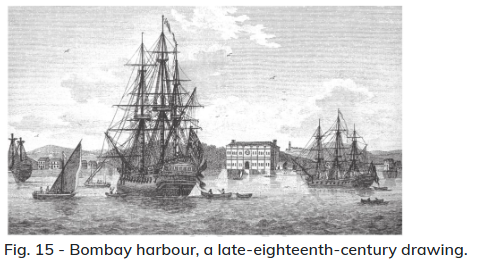
New pressures on weavers
- Trading ports: Bombay and Calcutta grew as trading ports from the 1780s, marking the decline of the old trading order and the expansion of the colonial economy.
- Raw cotton shortage: From the 1860s, the American Civil War disrupted US cotton supplies, so Britain bought more raw cotton from India.
- Higher prices: Increased Indian cotton exports raised raw-cotton prices; weavers faced shortages and had to pay exorbitant prices, making weaving unprofitable.
- Factory competition: By the end of the nineteenth century, Indian factories also flooded markets with machine-made goods, adding to the pressure on craftspeople.
Factories Come Up
| Place / industry | Date and development |
|---|---|
| Bombay cotton | First mill established in 1854; production began in 1856. By 1862, four mills had 94,000 spindles and 2,150 looms. |
| Bengal jute | First mill established in 1855; a second followed in 1862. |
| Kanpur | Elgin Mill began in the 1860s. |
| Ahmedabad cotton | First cotton mill established a year after Elgin Mill began. |
| Madras | First spinning and weaving mill began production in 1874. |
The Early Entrepreneurs
Trade wealth invested in industry
- China trade: From the late eighteenth century, Britain exported Indian opium to China and carried Chinese tea to England; Indian traders helped finance, supply and ship these goods.
- Dwarkanath Tagore: After making money in China trade, he invested in industry and established six joint-stock companies in the 1830s and 1840s. His ventures collapsed during the business crises of the 1840s.
- Industrial vision: Tagore believed westernisation and industrialisation would develop India; he invested in shipping, shipbuilding, mining, banking, plantations and insurance.
- Bombay Parsis: Dinshaw Petit and Jamsetjee Nusserwanjee Tata built major industrial enterprises using wealth gained partly from China exports and raw-cotton shipments to England.
- Other traders: Seth Hukumchand, who established Calcutta’s first Indian jute mill in 1917, traded with China; G.D. Birla’s father and grandfather also had China-trade links.
Other sources of capital and business
- Regional trade: Some Madras merchants traded with Burma; others had links with the Middle East and East Africa.
- Internal networks: Indian commercial groups transported goods within India, banked money, transferred funds between cities and financed traders.
- Industrial investment: When opportunities arose, many merchants from these networks invested in factories.
- Jamsetjee Jeejeebhoy: The son of a Parsi weaver, he gained wealth through China trade and shipping and owned a large fleet. Competition from English and American shippers forced him to sell his ships by the 1850s.
Colonial restrictions on Indian business
- Colonial control over trade tightened.
- Indian merchants were barred from trading manufactured goods with Europe.
- They were pushed towards exporting raw materials and food grains needed by Britain, including raw cotton, opium, wheat and indigo.
- Indian merchants were gradually edged out of shipping.
European Managing Agencies
- Control: Until the First World War, European Managing Agencies controlled a large part of Indian industry.
- Major agencies: Bird Heiglers & Co., Andrew Yule, and Jardine Skinner & Co.
- Role: Agencies raised capital, formed joint-stock companies and managed them.
- Unequal power: Indian financiers often supplied the capital, but European agencies made investment and business decisions; Indian businessmen were excluded from European chambers of commerce.
Iron and steel
- Tata steel works: In 1912, J.N. Tata established India’s first iron and steel works at Jamshedpur.
- Late development: Iron and steel industries began later than textile industries.
- Imported machinery: Industrial machinery, railways and locomotives were mostly imported in colonial India.
- Limited capital goods: Because these goods were imported, capital-goods industries could not develop significantly before Independence.
Key dates and developments
- 1772Henry Patullo said demand for Indian textiles would remain strong.
- From the 1780sBombay and Calcutta grew as trading ports.
- 1811–12Piece-goods formed 33% of India’s exports.
- 1830s–1840sDwarkanath Tagore set up six joint-stock companies.
- 1840sBusiness crises caused Tagore’s enterprises and others to collapse.
- 1854–1856Bombay’s first cotton mill was established and then began production.
- 1855Bengal’s first jute mill was established.
- By 1862Bombay had four cotton mills; Bengal had its second jute mill.
- By 1874Madras’s first spinning and weaving mill began production.
- 1912J.N. Tata established India’s first iron and steel works at Jamshedpur.
- 1917Seth Hukumchand established Calcutta’s first Indian jute mill.
- Piece-goods
- Cloth sold in pieces, an important Indian textile export.
- Joint-stock company
- A company whose capital is raised from shareholders.
- Managing Agency
- A firm that organised investment and managed industrial companies.
- Capital goods
- Goods such as machinery used to produce other goods.
What two major problems did Indian weavers face from British cotton goods?
How did the American Civil War affect Indian weavers?
Who controlled much of Indian industry until the First World War, and how did this limit Indian businessmen?
Quick recap
- Manchester imports were cheap machine-made goods that damaged Indian textile exports and local weaving.
- Weavers also faced raw-cotton shortages and rising prices from the 1860s, followed by competition from Indian factory goods.
- Factories spread from Bombay cotton and Bengal jute mills to mills in north India and Madras.
- Indian entrepreneurs often used wealth from overseas and internal trade to invest in industry.
- Colonial restrictions and European Managing Agencies limited Indian control over trade and industrial decisions.
- Tata’s 1912 steel works marked an important industrial development, but capital-goods industries remained limited before Independence.
Where Did the Workers Come From? & the Peculiarities of Industrial Growth
Where Did the Workers Come From?
Sources and movement of mill workers
- Rising demand: Factory workers increased from 584,000 in 1901 to over 2,436,000 in 1946.
- Nearby districts: Many workers were peasants and artisans who could not find enough work in their villages.
- Examples: In 1911, over half of Bombay cotton-mill workers came from neighbouring Ratnagiri; Kanpur mills recruited mainly from villages in the district.
- Seasonal movement: Workers often returned to their villages for harvests, sowing and festivals; mills commonly granted leave for agricultural work.
- Long-distance migration: Workers from the United Provinces travelled to Bombay’s textile mills and Calcutta’s jute mills.
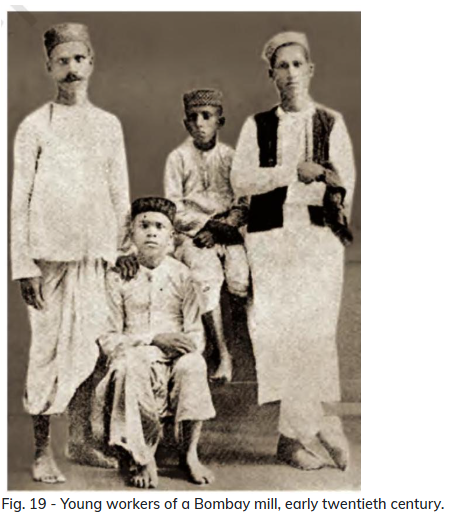
Recruitment and Working Conditions
Jobber — A trusted worker appointed by an industrialist to recruit new workers for a mill.
The jobber’s role and power
- Help offered: Jobbers recruited people, often from their own villages, helped them find work and settle in the city, and lent money during crises.
- Growing authority: Because jobs were scarce and mill entry was restricted, jobbers gained influence over workers.
- Abuse of influence: Some jobbers demanded money or gifts for securing jobs and controlled workers’ lives.
- Family ties: Workers remained connected to their villages and might pay jobbers to secure mill jobs for their sons.
Workers’ lives
- Long shifts: A worker recalled shifts of 10 hours in the 1930s and 1940s.
- Health costs: After 35 years of mill work, one worker’s father developed an asthma-like illness and had to return to his village.
- Small share: Although factory employment grew, factory workers remained only a small part of India’s total industrial workforce.
The Peculiarities of Industrial Growth
| Point | European Managing Agencies | Indian industrialists |
|---|---|---|
| Main interests | Tea and coffee plantations, mining, indigo and jute | Initially, cotton spinning and coarse yarn |
| Investment and markets | Acquired plantation land cheaply from the colonial government; most products were for export, not Indian consumers | Yarn supplied Indian handloom weavers or was exported to China |
| Competition | Invested in products suited to overseas trade | Initially avoided direct competition with Manchester cloth in India |
Early Indian cotton mills
- Coarse yarn: Early mills made coarse cotton yarn rather than cloth because yarn was not a major British import into India.
- Uses: Indian yarn supplied handloom weavers or was exported to China; imported yarn was usually of a superior variety.
- Industrial associations: From the late nineteenth century, merchants formed Chambers of Commerce to coordinate business concerns.
Changes in Indian cotton production
- Swadeshi movement gained momentum → nationalists urged people to boycott foreign cloth.
- Industrialists organised to defend shared interests → they pressed the government for tariff protection and concessions.
- From 1906, produce from Chinese and Japanese mills flooded the Chinese market → demand for Indian yarn exports to China declined.
- Indian mills shifted from yarn to cloth production → Indian cotton piecegoods output doubled between 1900 and 1912.
The First World War and industrial expansion
- War needs occupied British mills → Manchester imports into India declined.
- Imports fell → Indian mills gained a larger home market.
- War created demand for jute bags, uniforms, tents, leather boots and saddles → Indian factories received military orders.
- Factories opened, old factories ran multiple shifts, and working hours lengthened → industrial production boomed during the war.
Key changes in industrial growth
- Late nineteenth centuryIndian business groups began setting up industries; merchants also formed Chambers of Commerce.
- First decade of the twentieth centurySwadeshi, organised industrial pressure and changes in export markets reshaped industrial production.
- 1906Indian yarn exports to China began to decline as produce from Chinese and Japanese mills flooded that market.
- 1900–1912Cotton piecegoods production in India doubled.
- First World WarDeclining imports and war orders led to a boom in Indian industrial production.
- After the warManchester failed to regain its earlier position in India; local industries strengthened and captured more of the home market.
Industrial position after the war
- British decline: Britain struggled to modernise and compete with the United States, Germany and Japan; its cotton production and cloth exports fell.
- Indian gains: Local industrialists gradually replaced foreign manufactures and consolidated their hold on the Indian home market.
Small-scale Industries Predominate
Scale and location of industry
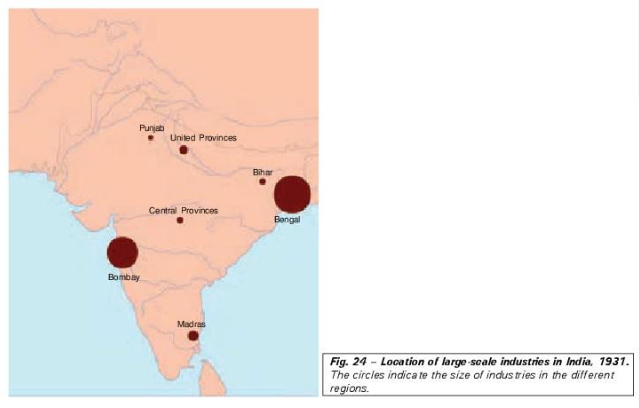
- Large factories: Factory industries grew after the war, but large industries remained a small part of the economy.
- Concentration: In 1911, about 67% of large industries were located in Bengal and Bombay.
- Most workers outside factories: Registered factories employed only 5% of the total industrial labour force in 1911 and 10% in 1931.
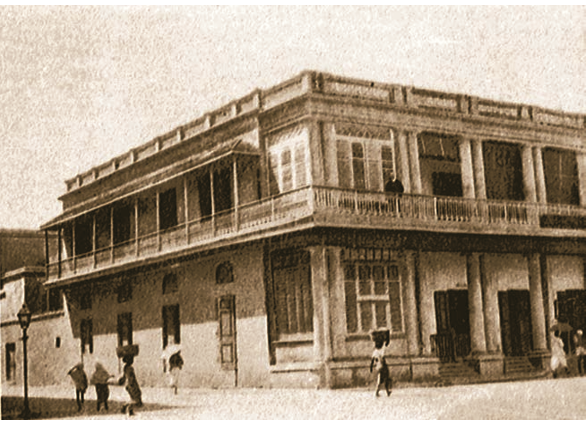
- Small-scale work: The rest worked in small workshops and household units, often in alleys and lanes.
The growth and adaptation of handlooms
- Handloom expansion: Handloom cloth production nearly trebled between 1900 and 1940, even though cheap machine-made thread had damaged spinning in the nineteenth century.
- Fly shuttle: This rope-and-pulley device carries the weft through the warp, helping weavers operate larger looms and weave wider cloth.
- Higher productivity: By the second decade of the twentieth century, weavers adopted fly-shuttle looms and other small improvements; the shuttle increased productivity, sped up production and reduced labour demand.
- Use by 1941: More than 35% of Indian handlooms had fly shuttles; the share was 70–80% in Travancore, Madras, Mysore, Cochin and Bengal.
| Point | Coarse cloth | Fine handloom cloth |
|---|---|---|
| Main buyers | Poorer consumers | Well-to-do consumers |
| Demand | Varied sharply with harvests, famines and rural incomes | More stable, even during famines |
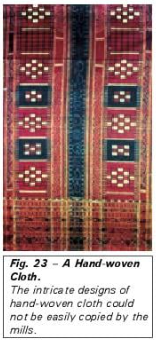
| Competition | More vulnerable to changes in consumers’ purchasing power | Specialised designs and weaves were difficult for mills to imitate |
| Examples | Coarse varieties | Banarasi and Baluchari saris; Madras lungis and handkerchiefs |
Weavers’ work and livelihoods
- Unequal survival: Weavers producing specialised, finer cloth were often better placed to withstand mill competition.
- Hard conditions: Increased production did not necessarily mean prosperity; weavers and craftspeople often worked long hours.
- Household labour: Entire families, including women and children, commonly worked at different stages of production.
- Industrial importance: Handloom workers were not merely remnants of the past; their labour remained part of industrialisation.
- Jobber
- A mill worker who recruited new workers and often helped them settle in the city.
- Fly shuttle
- A rope-and-pulley weaving device that carries the weft through the warp.
- Piecegoods
- Cotton cloth produced and sold in lengths or pieces.
- Chamber of Commerce
- An organisation through which merchants coordinated business concerns.
How did workers reach Indian mills, and what role did jobbers play?
Why did Indian industrial production expand during the First World War?
Why did handloom production continue to grow despite mill competition?
Quick recap
- Mill workers came from nearby districts and distant regions, while often retaining strong village connections.
- Jobbers recruited workers and provided support, but their influence could become exploitative.
- Swadeshi, declining Indian yarn exports to China and wartime demand changed the direction and pace of industrial growth.
- After the war, Indian industries strengthened as British exports and Manchester’s market position declined.
- Small workshops and household units employed most industrial workers; large factories were concentrated mainly in Bengal and Bombay.
- Handloom production expanded through new technology and specialised cloth that mills struggled to reproduce.
Market for Goods
Advertising and the Creation of Consumers
Advertising — Advertising promotes goods by making them appear desirable and necessary, helping create new consumers and a new consumer culture.
Why manufacturers advertised
- Purpose: New products needed to be made familiar and appealing so people would want to use them.
- Reach: Advertisements appeared in newspapers, magazines, hoardings and on street walls; historically, they helped expand markets from the early industrial age.
Labels and Cultural Imagery
Manchester cloth labels
- Origin and brand: Labels named the place of manufacture and the company, making them familiar to buyers.
- Quality signal: “MADE IN MANCHESTER” was intended to inspire confidence in the cloth.
- Appeal: Labels used images as well as words to attract buyers and make imported products seem familiar.
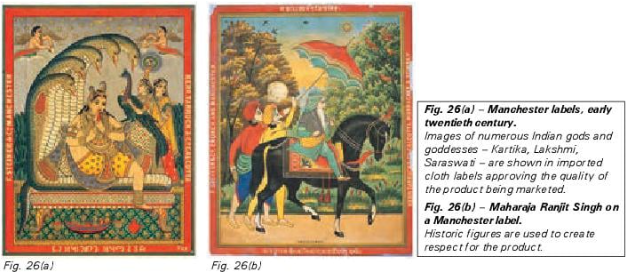
What the images communicated
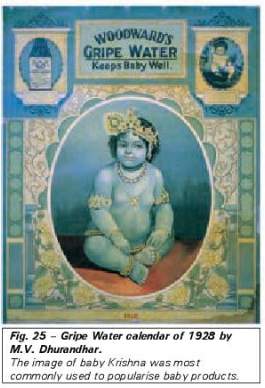
- Religious figures: Images of Indian gods and goddesses suggested divine approval and made foreign-made goods feel more familiar to Indian buyers.
- Royal figures: Emperors and nawabs linked products with respect and authority; the message implied that royal use or approval guaranteed quality.
Calendars as Advertisements
Why calendars reached many people
- Broad audience: Unlike newspapers and magazines, calendars could reach people who could not read.
- Everyday visibility: Hung in tea shops, poor people’s homes, offices and middle-class apartments, calendars displayed advertisements day after day throughout the year.
- Imagery: Calendars also used gods and respected figures to promote new products.
Advertising examples in the lecture
- Late nineteenth centuryManufacturers began printing calendars to popularise their products.
- 1928Woodward’s Gripe Water calendar featured baby Krishna.
- 1934A Sunlight Soap calendar showed Vishnu bringing sunlight across the skies.
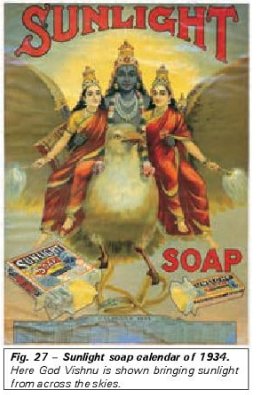
Indian Manufacturers and Swadeshi
Swadeshi — A nationalist appeal to support and buy goods produced in India.
Promoting Indian-made goods
- Nationalist message: Indian manufacturers urged people to show care for the nation by buying goods made in India.
- Advertising’s role: Advertisements became a vehicle for communicating the swadeshi message.
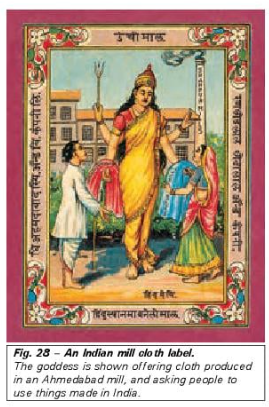
How advertising shaped demand
- New products enter the market
- Labels, images and calendars make products familiar and desirable
- Repeated exposure and cultural or nationalist appeals build trust and interest
- More people are encouraged to buy the goods
Industrialisation and Production
A changing but mixed industrial landscape
- Industrial age: It brought major technological changes, factory growth and a new industrial labour force.
- Continuity: Hand technology and small-scale production remained important alongside factories.
- Consumer culture
- A culture in which advertising encourages people to desire and buy products.
- Product label
- A tag or printed design identifying a product’s maker or origin and signalling its quality.
- Swadeshi
- The nationalist promotion of goods produced in India.
How did labels help Manchester manufacturers sell cloth in India?
Why were calendars effective advertising tools?
How did Indian manufacturers use advertising to promote nationalism?
Quick recap
- Advertising made products attractive and familiar, helping create consumers and expand markets.
- Manchester labels identified origin and company and used place of manufacture as a quality signal.
- Religious and royal images linked goods with familiarity, divine approval or respected authority.
- Calendars reached people who could not read and kept advertisements visible throughout the year.
- Indian manufacturers used advertising to promote swadeshi and the purchase of Indian-made goods.
- Factories and new technology grew, but hand production and small-scale work remained important.
Social Science — ALL CHAPTERS
1
RESOURCES AND DEVELOPMENT
2
FOREST AND WILDLIFE RESOURCES
3
WATER RESOURCES
4
AGRICULTURE
5
MINERALS AND ENERGY RESOURCES
6
MANUFACTURING INDUSTRIES
7
LIFELINES OF NATIONAL ECONOMY
1
POWER SHARING
2
FEDERALISM
3
GENDER, RELIGION AND CASTE
4
POLITICAL PARTIES
5
OUTCOMES OF DEMOCRACY
1
THE RISE OF NATIONALISM IN EUROPE
2
NATIONALISM IN INDIA
3
THE MAKING OF A GLOBAL WORLD
4
THE AGE OF INDUSTRIALISATION
5
PRINT CULTURE AND THE MODERN WORLD
1
DEVELOPMENT
2
SECTORS OF THE INDIAN ECONOMY
3
MONEY AND CREDIT
4
GLOBALISATION AND THE INDIAN ECONOMY
5
CONSUMER RIGHTS