Class 10 . Social Science . Contemporary India II . Minerals and Energy Resources
Chapter 5: MINERALS AND ENERGY RESOURCES
Ch 5
Social Science
Class 10
What Is a Mineral and Its Need
Why Minerals Matter
- Everyday use: Minerals are used in products ranging from household items and machinery to buildings, transport and roads.
- Life and society: Minerals are essential for life processes and have supported human livelihoods, decoration, festivities and religious practices.
Minerals, Rocks and Metals
| Mineral or source | Use |
|---|---|
| Silica, limestone, aluminium oxide and phosphate minerals | Abrasives that help clean teeth |
| Fluorite | Source of fluoride, which helps reduce cavities |
| Rutile, ilmenite and anatase | Sources of titanium oxide, used to make most toothpaste white |
| Mica | Adds sparkle to some toothpastes |
| Petroleum | Source of plastics used to make toothbrushes and toothpaste tubes |
What Is a Mineral?
Mineral — A naturally occurring, homogeneous substance with a definable internal structure.
Mineral Variety and Properties
- Range: Minerals vary from the hardest, diamond, to the softest, talc.
- Occurrence: Over 2,000 minerals have been identified, but only a few are abundantly found in most rocks.
- Formation: The elements combined and the physical and chemical conditions during formation determine which mineral forms.
- Properties: Minerals differ in colour, hardness, crystal form, lustre and density; geologists use these properties to classify them.
How Mineral Properties Vary
- Element combinations and physical and chemical formation conditions
- Different minerals form
- Minerals show different colours, hardness, crystal forms, lustre and density
- Geologists use these properties to classify minerals
| Point | Geographers | Geologists |
|---|---|---|
| Main interest | Minerals as part of the Earth’s crust and their role in understanding landforms | How minerals form, their age, and their physical and chemical composition |
| Resources and people | Distribution of mineral resources and associated economic activities | Minerals themselves and their formation |
- Mineral
- A naturally occurring, homogeneous substance with a definable internal structure.
- Rock
- A combination of one or more minerals.
- Refinement
- Processing through which metals are obtained from minerals.
- Lustre
- A mineral property describing its appearance in reflected light.
Define a mineral.
What determines a mineral’s properties?
Quick recap
- Minerals are essential in everyday objects, transport, food and many human activities.
- Buses and trains use minerals such as iron and aluminium, and run on power resources derived from the Earth.
- The Earth’s crust contains minerals embedded in rocks; metals are extracted from minerals through refinement.
- Rocks may contain one mineral or several minerals in varying proportions.
- Mineral formation conditions determine properties such as colour, hardness, crystal form, lustre and density.
- Geographers study mineral distribution and related economic activities; geologists study mineral formation, age and composition.
Mode of Occurrence of Minerals
Ore — An accumulation of a mineral mixed with other elements, with enough mineral concentration for commercially viable extraction.
Mineral Classification
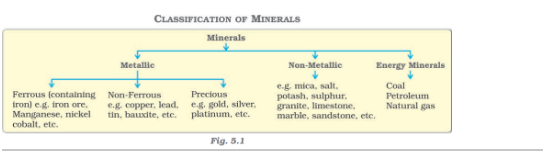
Mining and Ownership in India
- Ownership: Most minerals in India are nationalised; extraction requires government permission. In many tribal areas of north-east India, minerals are owned by individuals or communities.
- Rat-hole mining: In Meghalaya, family members mine coal through long, narrow tunnels. The National Green Tribunal declared this mining illegal and recommended that it stop.
Distribution of Minerals in India
| Region / rock system | Main mineral resources |
|---|---|
| Peninsular rocks | Most coal, metallic minerals, mica and many non-metallic minerals. |
| Sedimentary rocks on the peninsula’s western and eastern flanks, including Gujarat and Assam | Most petroleum deposits. |
| Rajasthan | Many non-ferrous minerals, associated with rock systems of the peninsula. |
| Alluvial plains of north India | Almost devoid of economic minerals. |
Why mineral distribution is uneven
- Differences in geological structure, processes and the time involved in mineral formation
- Different mineral deposits form in different parts of the country
- Mineral resources are distributed unevenly across India
From Mineral Deposit to Mine
- Economic viability depends on: Mineral concentration in the ore, ease of extraction and closeness to markets.
- Choosing a source: To meet demand, these factors are compared across possible deposits or reserves; a selected deposit or reserve is developed into a mine.
- Ore
- Mineral mixed with other elements in a concentration that can make extraction commercially viable.
- Vein
- A smaller mineral occurrence in cracks or cavities of igneous or metamorphic rocks.
- Lode
- A larger mineral occurrence in cracks or cavities of igneous or metamorphic rocks.
- Placer deposit
- An alluvial mineral deposit in valley-floor sands or at the base of hills.
- Rat-hole mining
- Coal mining through long, narrow tunnels, practised in parts of Meghalaya.
Describe the main ways minerals occur.
Why are minerals unevenly distributed in India?
What factors determine whether a mineral deposit can be developed into a mine?
Quick recap
- Ores need sufficient mineral concentration for commercially viable extraction.
- Minerals occur in veins and lodes, sedimentary beds, residual deposits, placer deposits and ocean waters or beds.
- India’s mineral resources are unevenly distributed because geological conditions and formation histories differ.
- Peninsular rocks hold many coal and metallic resources; Gujarat and Assam have petroleum deposits; north India’s alluvial plains have few economic minerals.
- Ore concentration, extraction ease and market proximity determine whether a deposit is developed into a mine.
Ferrous Minerals and Non- Ferrous Minerals
Ferrous Minerals
Ferrous minerals — Metallic minerals containing iron; they account for about three-fourths of the total value of metallic mineral production.
Importance
- Industrial base: Ferrous minerals provide a strong foundation for the development of metallurgical industries.
- Trade: India exports substantial quantities of ferrous minerals after meeting domestic demand.
Iron Ore
Importance and Types
- Importance: Iron ore is a basic mineral and the backbone of industrial development; India has abundant resources of good-quality ore.
- Magnetite: The finest iron ore, with up to 70% iron; its excellent magnetic qualities make it valuable in the electrical industry.
- Hematite: The most important industrial iron ore by quantity used, with a lower iron content of 50–60%.
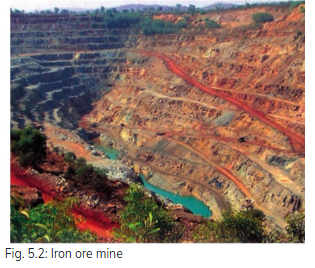
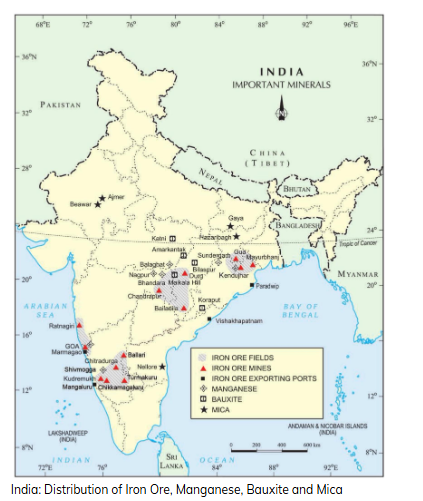
Major Iron Ore Belts of India
| Belt | Location and key facts |
|---|---|
| Odisha–Jharkhand | High-grade hematite occurs at Badampahar in Mayurbhanj and Kendujhar districts of Odisha; in Jharkhand, it is mined at Gua and Noamundi in Singhbhum. |
| Durg–Bastar–Chandrapur | Covers Chhattisgarh and Maharashtra. Bailadila in Bastar, Chhattisgarh, has 14 deposits of super-high-grade hematite with excellent steel-making properties; ore is exported to Japan and South Korea through Visakhapatnam port. |
| Ballari–Chitradurga–Chikkamagaluru–Tumakuru | Located in Karnataka and rich in iron ore. Kudremukh mines in the Western Ghats are a 100% export unit; ore is sent as slurry by pipeline to a port near Mangaluru. |
| Maharashtra–Goa | Includes Goa and Ratnagiri district of Maharashtra. Ore is not very high quality but is efficiently exploited and exported through Marmagao port. |
Manganese
- Steel production: Manganese is mainly used to make steel and ferro-manganese alloy; nearly 10 kg is needed to manufacture one tonne of steel.
- Other uses: It is also used to manufacture bleaching powder, insecticides and paints.
Non-Ferrous Minerals
Overview
- Definition: Non-ferrous minerals do not contain iron as their main metallic component.
- Examples: Copper, bauxite, lead, zinc and gold.
- Importance: India’s reserves and production are not very satisfactory, but these minerals are vital to metallurgical, engineering and electrical industries.
Copper
- Availability: India is critically deficient in copper reserves and production.
- Properties and uses: Copper is malleable, ductile and a good conductor; it is used mainly in electrical cables, electronics and chemical industries.
- Leading producers: Balaghat mines in Madhya Pradesh, Khetri mines in Rajasthan and Singhbhum district of Jharkhand.
Bauxite
Formation and Processing
- Aluminium-silicate-rich rocks decompose → bauxite deposits form.
- Bauxite, a clay-like ore → alumina is obtained → aluminium is produced.
Properties and Distribution
- Aluminium: Combines the strength of metals such as iron with extreme lightness, good conductivity and great malleability.
- Major deposits: Amarkantak plateau, Maikal hills and the plateau region of Bilaspur–Katni.
Production Data
- 2018–19About 97% of India’s iron ore production came from Odisha, Chhattisgarh, Karnataka and Jharkhand; the remaining 3% came from other states.
- Magnetite
- The finest iron ore, containing up to 70% iron.
- Hematite
- The most widely used industrial iron ore, containing 50–60% iron.
- Malleable
- Able to be hammered or shaped into sheets.
- Ductile
- Able to be drawn into wires.
- Bauxite
- A clay-like ore from which alumina and then aluminium are obtained.
Compare magnetite and hematite.
Name the major iron ore belts of India and one key fact about each.
State the uses and major production locations of copper in India.
Quick recap
- Ferrous minerals provide the base for metallurgical industries; iron ore is vital to industrial development.
- Magnetite has up to 70% iron; hematite has 50–60% iron and is most important by quantity used.
- India’s four major iron ore belts span Odisha–Jharkhand, central India, Karnataka and Goa–Maharashtra.
- Manganese is essential for steel and ferro-manganese alloy, and also has chemical and paint uses.
- Non-ferrous minerals include copper, bauxite, lead, zinc and gold; they support several major industries.
- Copper is used in electrical, electronic and chemical industries; bauxite is the chief source of aluminium.
Non -metallic Minerals and Conservation of Minerals
Non-Metallic Minerals: Mica
Mica — A mineral that splits easily into thin sheets or plates.
Properties, uses and distribution
- Properties: Mica sheets can be extremely thin; mica occurs in colours such as clear, black, green, red, yellow and brown.
- Electrical uses: Its high dielectric strength, low power-loss factor, insulating properties and resistance to high voltage make it important in electrical and electronic industries.
- Jharkhand: Deposits occur along the northern edge of the Chota Nagpur Plateau; the Koderma–Gaya–Hazaribagh belt is the leading producing area.
- Other producing areas: Ajmer in Rajasthan and the Nellore mica belt in Andhra Pradesh are also important.
Rock Mineral: Limestone
Limestone — A rock mineral commonly found in sedimentary rocks, associated with calcium carbonate or calcium and magnesium carbonates.
Uses and production
- Cement: Limestone is the basic raw material for the cement industry.
- Iron smelting: It is essential in blast furnaces for smelting iron ore.
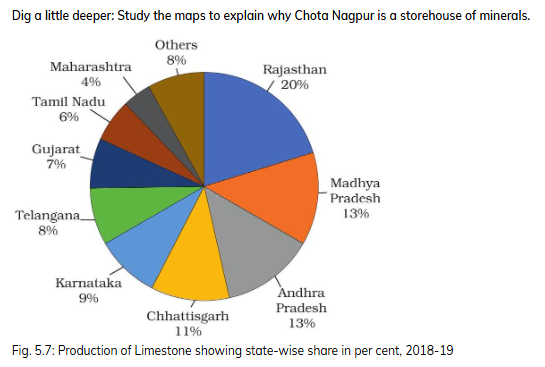
| State/area | Share |
|---|---|
| Rajasthan | 22% |
| Andhra Pradesh | 13% |
| Madhya Pradesh | 13% |
| Chhattisgarh | 11% |
| Karnataka | 10% |
| Telangana | 7% |
| Gujarat | 6% |
| Tamil Nadu | 5% |
| Maharashtra | 4% |
| Other areas | 9% |
Hazards of Mining
Mining hazards: causes and effects
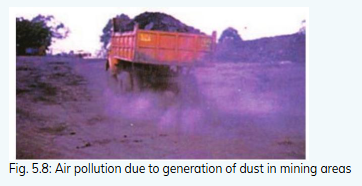
- Dust and noxious fumes inhaled by miners → increased risk of pulmonary diseases.
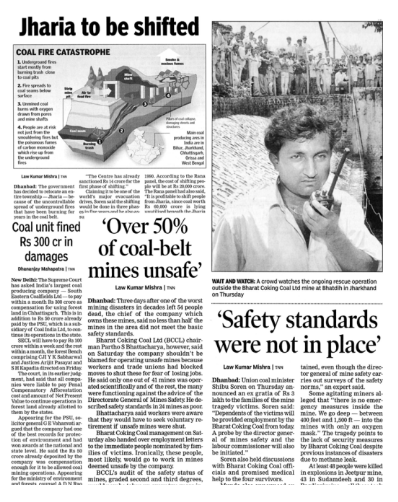
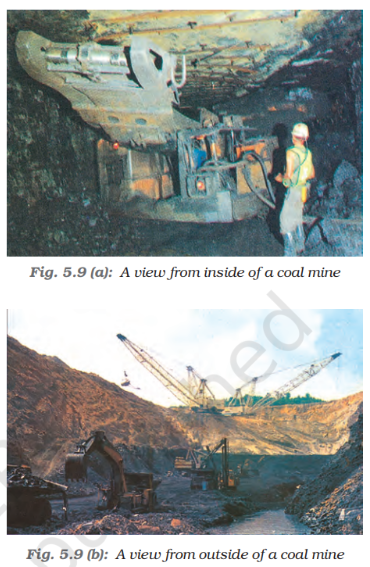
- Unstable roofs, inundation and fires in coal mines → serious threats to miners' lives.
- Mining activity → contamination of local water sources.
- Dumping waste and slurry → degraded land and soil, and increased pollution in streams and rivers.
Preventing mining hazards
- Prevention: Stricter mine-safety regulations and effective implementation of environmental laws are essential to prevent mining from becoming a 'killer industry'.
Conservation of Minerals
Mineral conservation — Planned and sustainable use of mineral resources to ensure they remain available for the future.
Why minerals need conservation
- Limited workable deposits: Only about 1% of the Earth's crust consists of workable mineral deposits.
- Non-renewable: Minerals take millions of years to form, so their replenishment is extremely slow compared with current consumption.
- Finite resources: Rapid use is depleting mineral resources, which are valuable but short-lived possessions.
- Rising extraction costs: Continued mining requires ores to be taken from greater depths, while ore quality decreases.
| Feature | Mineral resources |
|---|---|
| Formation | Geological processes take millions of years. |
| Replenishment | Extremely slow compared with present consumption. |
| Availability | Finite; workable deposits form only a small fraction of the Earth's crust. |
Ways to conserve mineral resources
- Plan mineral use sustainably.
- Develop improved technologies to use low-grade ores at lower costs.
- Recycle metals and use scrap metals.
- Use suitable substitutes to reduce demand for minerals.
Why are mineral resources considered finite and non-renewable?
State two ways to conserve mineral resources.
Quick recap
- Mica splits into thin sheets and is valuable for its electrical insulating properties.
- Important mica-producing areas include Jharkhand's Koderma–Gaya–Hazaribagh belt, Ajmer and Nellore.
- Limestone is essential for cement production and iron smelting; Rajasthan has the largest listed state share.
- Mining can harm miners' health and cause mine accidents, water contamination, land degradation and pollution.
- Minerals are finite and non-renewable because formation and replenishment are extremely slow.
- Sustainable use, improved low-grade ore processing, recycling and substitutes help conserve minerals.
Conventional Energy Resources
Energy Resources
- Uses: Energy is needed for cooking, lighting, heating, transport and running machinery in industries.
- Sources: Energy resources include fuel minerals and electricity; they are classified as conventional and non-conventional sources.
- Rural use: Firewood and cattle-dung cakes meet much of the energy needs of rural households, though their continued use has drawbacks.
Coal
Geological ages of Indian coal-bearing rock series
- A little over 200 million years oldCoal occurs in Gondwana rock series; major resources, including metallurgical coal, are in the Damodar Valley.
- About 55 million years oldCoal also occurs in Tertiary rock series, especially in northeastern India.
Coal distribution and location
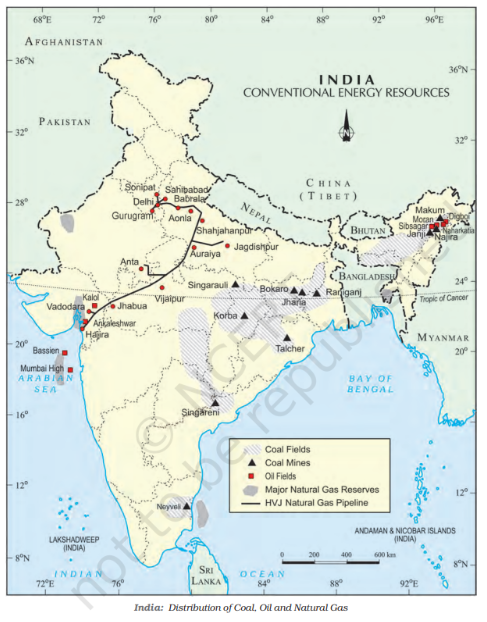
- Gondwana coal: Major deposits occur in the Damodar Valley across West Bengal and Jharkhand.
- Important coalfields: Jharia, Raniganj and Bokaro are important coalfields.
- Other deposits: Coal also occurs in the Godavari, Mahanadi, Son and Wardha valleys.
- Tertiary coal: Found in Meghalaya, Assam, Arunachal Pradesh and Nagaland.
- Industry location: Coal is bulky and loses weight as it burns to ash, so heavy industries and thermal power stations are often located on or near coalfields.
Petroleum
Petroleum-producing areas in India
- Major areas: Mumbai High, Gujarat and Assam are major petroleum-producing regions.
- Gujarat: Ankleshwar is the state’s most important oil field.
- Assam: India’s oldest oil-producing state; important fields include Digboi, Naharkatiya and Moran-Hugrijan.
Natural Gas
- Occurrence: Natural gas is often found with petroleum and is released when crude oil is brought to the surface.
- Uses: It serves as fuel for homes, transport, power generation and industries, and as a raw material for chemical, petrochemical and fertiliser industries.
- Reserves and pipelines: Major reserves occur in Mumbai High and the Krishna-Godavari basin; the Hazira–Vijaipur–Jagdishpur pipeline helped connect gas fields with industrial and power centres.
Electricity
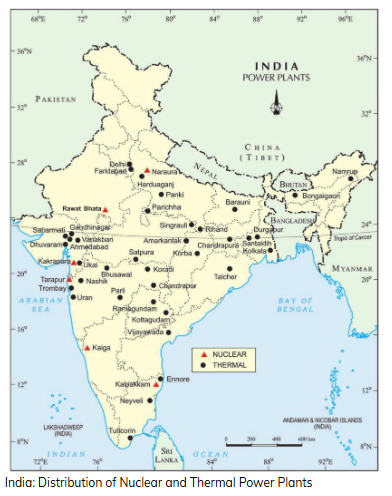
- Fossil fuel
- Fuel formed from the remains of ancient plants or other organisms over geological time.
- Anticline
- An upward fold in rock layers where petroleum may collect near the crest.
- Fault trap
- A petroleum trap formed where a fault brings porous and non-porous rocks together.
- CNG
- Compressed natural gas, used as a transport fuel.
- PNG
- Piped natural gas, supplied to homes for cooking.
Why are many heavy industries and thermal power stations located near coalfields?
How do hydel and thermal electricity generation differ?
Quick recap
- Conventional sources include firewood, dung cakes, coal, petroleum, natural gas and hydel and thermal electricity.
- Firewood and dung cakes are the most common rural energy sources and meet over 70% of rural household needs in one estimate.
- Coal types range from peat and lignite to bituminous coal and anthracite; Indian coal occurs in Gondwana and Tertiary rock series.
- Coal-based industries often locate near coalfields because coal is bulky and loses weight when burned.
- Petroleum accumulates in anticline and fault traps; major producing areas include Mumbai High, Gujarat and Assam.
- Natural gas serves power, industry, transport and cooking; pipelines connect its sources with consumers.
- Hydel power uses renewable flowing water, while thermal power uses non-renewable fossil fuels.
Non-conventional Sources and Conservation of Energy Resources
Non-Conventional Sources of Energy
Non-conventional energy sources — Alternative energy sources, especially renewable sources such as solar, wind, tidal, biomass and energy from waste.
Why alternative energy is needed
- Rising energy use → greater dependence on coal, oil and gas.
- High prices and possible shortages → uncertainty about future energy supply.
- Supply uncertainty → risks to national economic growth.
- More fossil-fuel use → serious environmental problems.
- Therefore, India needs to conserve energy and expand renewable sources.
India’s potential
- Resources: India has abundant sunlight, water, wind and biomass.
- Development: India has one of the world’s largest programmes for developing renewable energy resources.
Nuclear or Atomic Energy
Nuclear energy — Energy released as heat when the structure of atoms is altered; the heat is used to generate electricity.
- Nuclear fuels: Uranium and thorium are used to generate atomic power.
- Locations: These minerals occur in Jharkhand and the Aravalli ranges of Rajasthan.
- Thorium: The monazite sands of Kerala are rich in thorium.
Solar Energy
Photovoltaic technology — Technology that converts sunlight directly into electricity.
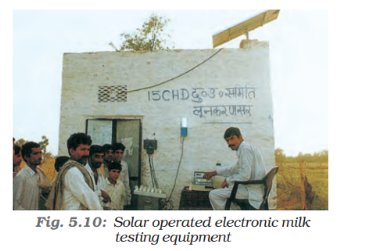
- Potential: As a tropical country, India has great scope for harnessing solar energy.
- Use: Solar power is increasingly useful in rural and remote areas.
- Benefits: Solar plants can reduce rural households’ dependence on firewood and dung cakes, helping conserve the environment and preserving manure for agriculture.
Wind Power
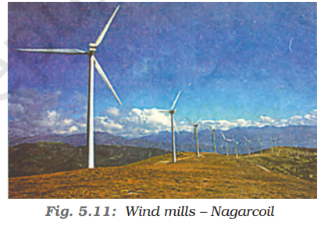
- Potential: India has considerable potential for generating wind power.
- Largest cluster: The largest wind-farm cluster extends from Nagarcoil to Madurai in Tamil Nadu.
- Other locations: Important wind farms are found in Andhra Pradesh, Karnataka, Gujarat, Kerala, Maharashtra and Lakshadweep.
- Well-known sites: Nagarcoil and Jaisalmer are known for effective use of wind energy.
Biogas
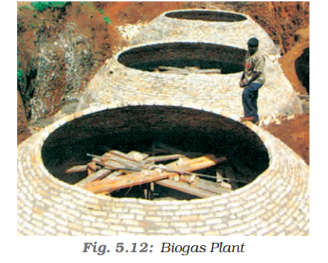
Biogas — Fuel gas produced when organic matter decomposes; it is used mainly for domestic consumption in rural areas.
- Materials: Shrubs, farm waste, animal waste and human waste can be used to produce biogas.
- Efficiency: Biogas has higher thermal efficiency than kerosene, dung cakes and charcoal.
- Plant scale: Biogas plants may be municipal, cooperative or individually owned.
- Gobar gas: Plants using cattle dung are commonly called Gobar gas plants in rural India.
- Benefits: They provide energy and improve manure quality; using dung as biogas also helps prevent the loss of trees and manure through burning fuel wood and dung cakes.
Tidal Energy
Tidal energy — Electricity generated by using the movement of ocean tides.
How tidal power is generated
- Build a floodgate dam across an inlet.
- At high tide, water enters the inlet and is trapped when the gate closes.
- As the outside tide falls, trapped water flows back to the sea through a pipe.
- The flowing water turns a turbine to generate electricity.
Suitable areas in India
- Gujarat: Gulf of Khambhat and Gulf of Kuchchh on the western coast.
- West Bengal: The Gangetic delta in the Sunderban region.
Geothermal Energy
Geothermal energy — Heat and electricity obtained by using heat from the Earth’s interior.
How geothermal electricity is produced
- The Earth becomes hotter with increasing depth.
- In areas with a high geothermal gradient, hot rocks occur at relatively shallow depths.
- Groundwater absorbs heat from the rocks and may become steam as it rises to the surface.
- The steam drives turbines to generate electricity.
Projects in India
- Potential: India has several hundred hot springs that could be used to generate electricity.
- Experimental projects: One is in the Parvati valley near Manikarn, Himachal Pradesh; the other is in Puga Valley, Ladakh.
Conservation of Energy Resources
Sustainable energy development — Meeting energy needs while conserving limited resources and increasing the use of renewable energy.
Why energy conservation matters
- Basic need: Energy is essential for economic development.
- Sectors using energy: Agriculture, industry, transport, commerce and households all need energy inputs.
- Rising demand: Development plans since Independence required increasing energy supplies, so energy consumption has steadily risen across India.
- Energy efficiency: India is described as one of the world’s least energy-efficient countries; limited resources therefore need to be used judiciously.
- Twin approach: Sustainable energy development rests on energy conservation and greater use of renewable sources.
Actions individuals can take
- Transport: Use public transport instead of individual vehicles.
- Electricity: Switch off lights and appliances when they are not in use.
- Efficiency: Use power-saving devices.
- Energy choices: Use non-conventional energy sources where possible.
- Energy saved is energy produced.
- Conservation and renewable-energy use are the two key supports of sustainable energy development.
- Photovoltaic technology
- Converts sunlight directly into electricity.
- Gobar gas plant
- A biogas plant that uses cattle dung.
- Tidal energy
- Electricity generated from ocean tides.
- Geothermal gradient
- The increase in the Earth’s temperature with depth.
- Energy conservation
- Judicious use of energy and avoidance of waste.
How do biogas plants benefit rural households and farmers?
Name the regions in India with favourable conditions for tidal energy.
What are the two main supports of sustainable energy development?
Quick recap
- Growing fossil-fuel use brings supply, price and environmental concerns, making renewable energy important.
- Nuclear power uses heat released by altering atomic structure; uranium and thorium are key fuels.
- Solar and wind resources have major potential in India, including rural and remote areas.
- Biogas uses organic waste and provides both energy and improved manure.
- Tidal power uses trapped tidal water to drive turbines; geothermal power uses heat from inside the Earth.
- Sustainable energy depends on conserving energy and expanding renewable sources.
Social Science — ALL CHAPTERS
1
RESOURCES AND DEVELOPMENT
2
FOREST AND WILDLIFE RESOURCES
3
WATER RESOURCES
4
AGRICULTURE
5
MINERALS AND ENERGY RESOURCES
6
MANUFACTURING INDUSTRIES
7
LIFELINES OF NATIONAL ECONOMY
1
POWER SHARING
2
FEDERALISM
3
GENDER, RELIGION AND CASTE
4
POLITICAL PARTIES
5
OUTCOMES OF DEMOCRACY
1
THE RISE OF NATIONALISM IN EUROPE
2
NATIONALISM IN INDIA
3
THE MAKING OF A GLOBAL WORLD
4
THE AGE OF INDUSTRIALISATION
5
PRINT CULTURE AND THE MODERN WORLD
1
DEVELOPMENT
2
SECTORS OF THE INDIAN ECONOMY
3
MONEY AND CREDIT
4
GLOBALISATION AND THE INDIAN ECONOMY
5
CONSUMER RIGHTS