NEET UG . NEET Chemistry . Chemistry . Alcohols Phenols and Ethers
Chapter 16: Alcohols, Phenols and Ethers
Ch 16
NEET Chemistry
NEET UG
Classification
Functional-group definitions
Alcohol — An alcohol has one or more hydroxyl groups, , directly attached to carbon atoms of an aliphatic system.
Phenol — A phenol has a hydroxyl group, , directly attached to an aromatic ring; simple phenol, , is also called carbolic acid.
Ether — An ether has an oxygen atom between two alkyl or aryl groups, represented as ; its general formula is , where .
How the compounds form
- Alcohols form when a hydrogen atom in an aliphatic hydrocarbon is replaced by .
- Phenols form when a hydrogen atom in an aromatic hydrocarbon is replaced by .
- Ethers form when a hydrocarbon hydrogen is replaced by an alkoxy or aryloxy group, or .
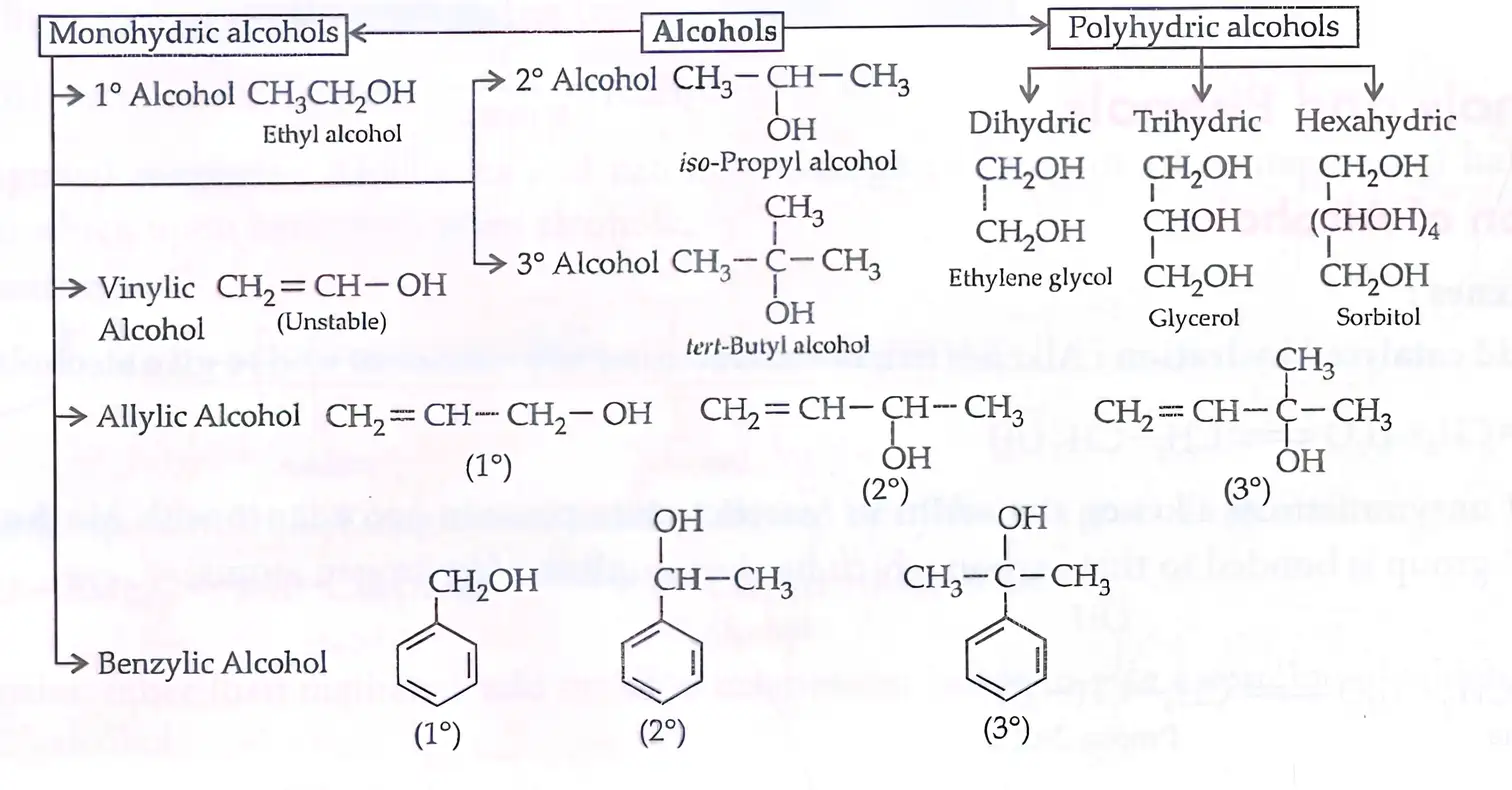
Classification by hydroxyl groups and structure
| Type | Number of groups | Example |
|---|---|---|
| Monohydric | One | Ethanol, |
| Dihydric | Two | Ethylene glycol, |
| Trihydric | Three | Glycerol, |
| Polyhydric | Two or more | Includes dihydric and trihydric alcohols |
| Type | Structure of the carbon bearing | Example |
|---|---|---|
| Primary | Attached to one other carbon | Ethanol, |
| Secondary | Attached to two other carbons | Propan-2-ol, |
| Tertiary | Attached to three other carbons | 2-Methylpropan-2-ol, |
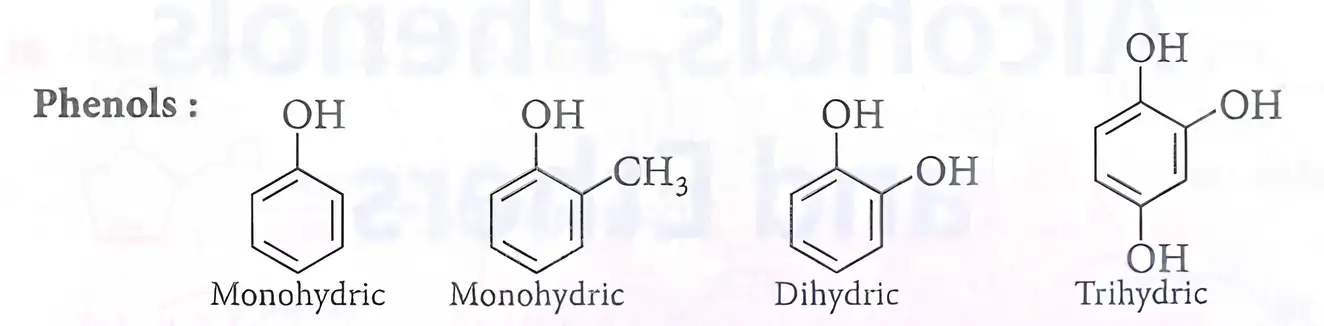
| Type | Number of groups | Description |
|---|---|---|
| Monohydric phenol | One | Phenol, |
| Dihydric phenol | Two | A benzene ring bearing two groups |
| Trihydric phenol | Three | A benzene ring bearing three groups |
Classification of ethers
| Type | Groups attached to oxygen | Example |
|---|---|---|
| Simple or symmetrical | Same groups: | Diethyl ether, |
| Mixed or unsymmetrical | Different groups: | Ethyl methyl ether, ; ethyl phenyl ether, |
Classify an ether by comparing the two groups bonded to oxygen: diethyl ether is symmetrical, while is unsymmetrical.
Quick recap
- Alcohols have attached to an aliphatic carbon; phenols have it directly attached to an aromatic ring.
- Monohydric alcohols have the general formula .
- Alcohols are monohydric or polyhydric according to hydroxyl-group count, and primary, secondary or tertiary by the carbon bearing .
- Phenols are mono-, di- or trihydric according to the number of hydroxyl groups on the aromatic ring.
- Ethers have the structure and formula for .
- Ethers with identical groups attached to oxygen are symmetrical; ethers with different groups are unsymmetrical.
Nomenclature
Alcohols
- Common names: Name alcohols as an alkyl group followed by “alcohol”.
- IUPAC names: Replace the terminal “e” of the parent alkane with “-ol”; in cyclic alcohols, the carbon bearing —OH is C-1.
Phenols
- Phenol: The simplest hydroxy derivative of benzene; “phenol” is both its common and accepted IUPAC name.
- Substituted phenols: Common names use ortho, meta and para for 1,2-, 1,3- and 1,4-substitution, respectively.
- Dihydroxybenzenes: Named as 1,2-, 1,3- or 1,4-benzenediol.
Ethers
How are cyclic alcohols named in the IUPAC system?
What do ortho, meta and para indicate in substituted benzene compounds?
Quick recap
- Alcohol common names use alkyl + alcohol; IUPAC names replace alkane “e” with “-ol”.
- In cyclic alcohols, the carbon bearing is numbered 1.
- Phenol is both a common name and an accepted IUPAC name.
- Ortho, meta and para correspond to 1,2-, 1,3- and 1,4-disubstitution.
- Dihydroxybenzene names specify the positions: 1,2-, 1,3- or 1,4-benzenediol.
- Ether common names list groups alphabetically; identical groups take the prefix “di-”.
- For IUPAC ether names, the larger alkyl group is the parent hydrocarbon.
Structures of Functional Groups
Alcohols
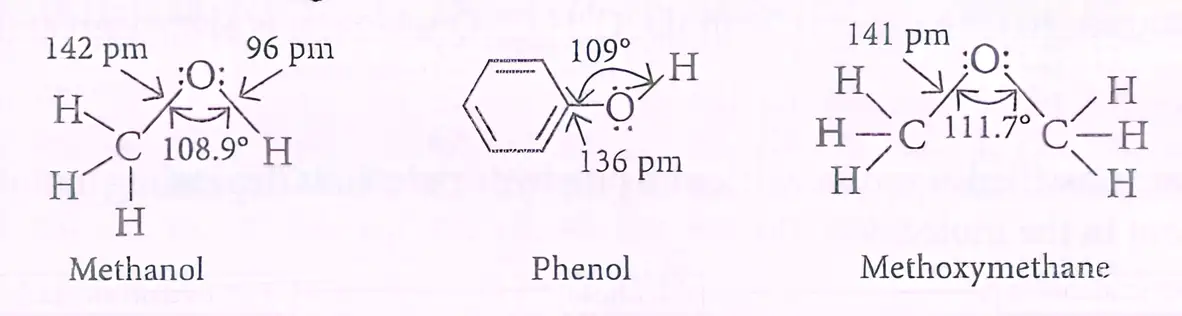
- Structure: Alcohols have the form .
- C–O bond: The oxygen is attached to carbon by a sigma () bond formed by overlap of the carbon and oxygen hybrid orbitals.
- Example: Methanol.
Phenols
Phenol — In phenols, the group is attached to an -hybridised carbon atom of an aromatic ring.
- Example: Phenol.
Ethers
- Electron-pair arrangement: The oxygen atom has four electron pairs—two bond pairs and two lone pairs—arranged approximately tetrahedrally.
- Example: Methoxymethane.
Quick recap
- Alcohols have the form ; their C–O sigma bond forms through overlap of orbitals on carbon and oxygen.
- In phenols, the group is attached to an -hybridised carbon of an aromatic ring.
- Ether oxygen has two bond pairs and two lone pairs arranged approximately tetrahedrally.
- Methanol, phenol and methoxymethane are the examples shown.
Alcohols and Phenols
Preparation of Alcohols
- Main routes: Alcohols are prepared from alkenes, carbonyl compounds, carboxylic acids or esters, and Grignard reagents.
- Reduction: Aldehydes give primary alcohols and ketones give secondary alcohols; carboxylic acids and esters can be reduced to primary alcohols.
- Grignard reagents: Reaction with methanal gives a primary alcohol, while reaction with other aldehydes or ketones gives secondary or tertiary alcohols, respectively, after hydrolysis.
Alcohols from Alkenes
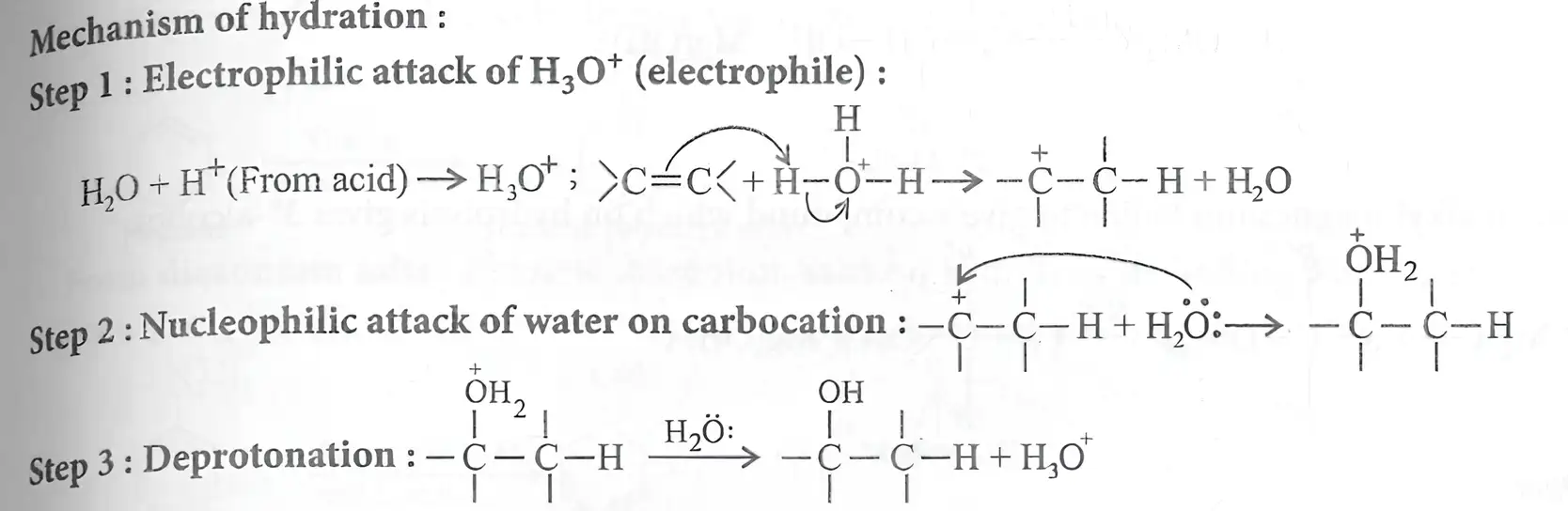
Alkene hydration
- Acid-catalysed hydration: Adding water to an alkene in the presence of acid forms an alcohol.
- Unsymmetrical alkenes: Hydration follows Markovnikov’s rule; the group attaches to the carbon bearing fewer hydrogen atoms.
- Hydroboration–oxidation: Diborane adds across the double bond; oxidation with in alkali produces an alcohol.
- Regioselectivity: Hydroboration–oxidation gives the anti-Markovnikov alcohol, often in excellent yield.
Alcohols from Carbonyl Compounds
| Starting compound | Product | Common reagents |
|---|---|---|
| Aldehyde | Primary alcohol | with , or ; or / |
| Ketone | Secondary alcohol | with , or ; or / |
Reduction of carboxylic acids and esters
- Carboxylic acids: Strong reduction with followed by water gives primary alcohols.
- Esters: Catalytic hydrogenation gives a primary alcohol from the acyl portion and an alcohol from the alkoxy portion.
- Commercial route: Convert the acid to an ester first, then reduce it by catalytic hydrogenation.
Alcohols from Grignard Reagents
Grignard addition
- Reaction sequence: A Grignard reagent adds to a carbonyl compound to form an alkoxide adduct; hydrolysis converts it to an alcohol.
- Methanal: Addition of followed by hydrolysis gives a primary alcohol.
- Other aldehydes: Addition followed by hydrolysis gives a secondary alcohol.
- Ketones: Addition followed by hydrolysis gives a tertiary alcohol.
| Carbonyl compound | Alcohol after hydrolysis |
|---|---|
| Methanal | Primary alcohol |
| Aldehyde other than methanal | Secondary alcohol |
| Ketone | Tertiary alcohol |
Selectivity of Reducing Agents
| Point | LiAlH4 / NaBH4 | Catalytic hydrogenation |
|---|---|---|
| Unsaturated carbonyl compounds | Usually reduce the carbonyl group without reducing the bond | Can reduce both the carbonyl group and the bond |
| Example: crotonaldehyde | gives crotonyl alcohol, | gives butyl alcohol, |
| Exception | For a -phenyl-substituted -unsaturated carbonyl compound, the double bond can also be reduced | Both unsaturations may be reduced |
Reagent selectivity
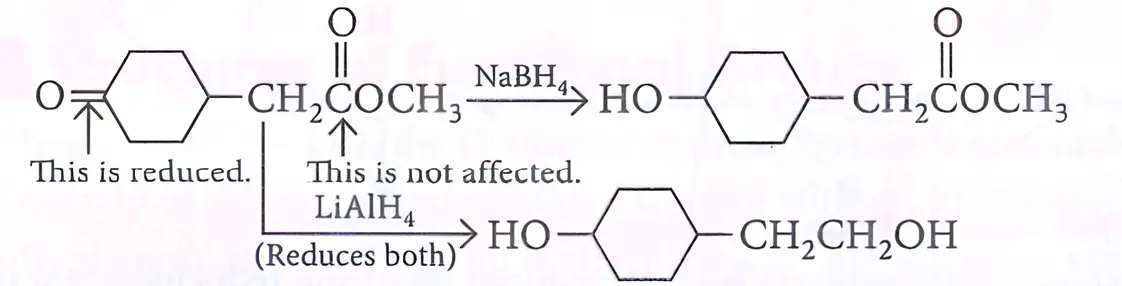
- NaBH4: Selectively reduces more reactive carbonyl groups; in the illustrated case it reduces the ring carbonyl but not the ester carbonyl.
- LiAlH4: Stronger reducing agent; in the illustrated case it reduces both carbonyl groups.
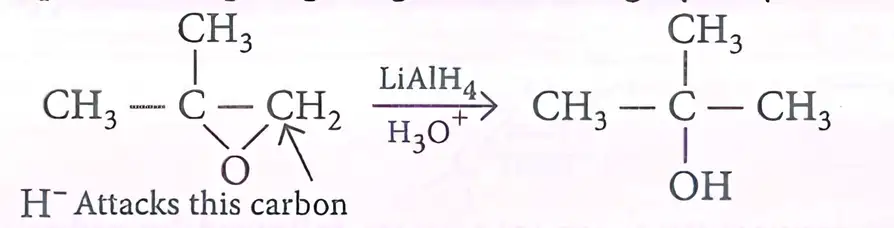
- Epoxides: Hydride from attacks the less substituted epoxide carbon by an pathway; acid work-up gives an alcohol at the more substituted carbon.
Preparation of Phenol
| Starting material / route | Conditions and key intermediate | Product |
|---|---|---|
| Chlorobenzene (Dow’s process) | Fuse with at and ; form sodium phenoxide | Acidification gives phenol |
| Benzenesulphonic acid | Fuse with molten ; form sodium phenoxide | Acidification gives phenol |
| Benzene diazonium salt | Hydrolyse by heating with water or treating with dilute acid | Phenol, nitrogen and hydrogen chloride |
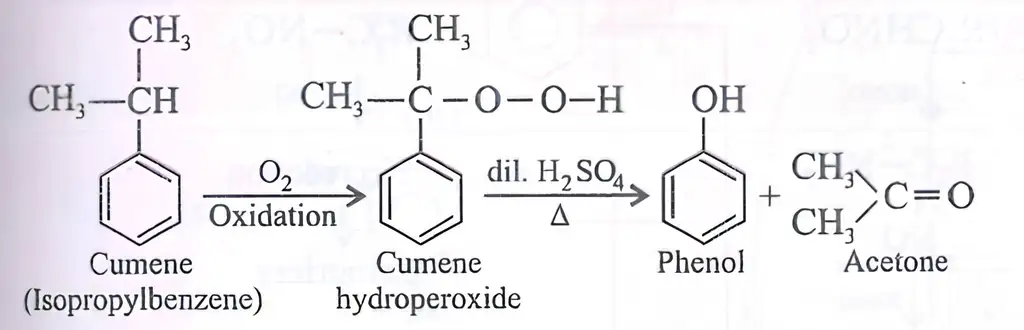
| Cumene process | Oxidise cumene with air to cumene hydroperoxide; decompose with dilute acid | Phenol and acetone |
Other phenol preparation details
- Benzenesulphonic acid preparation: Benzene reacts with oleum to form benzenesulphonic acid.
- Diazonium salt preparation: Benzene is converted to benzene diazonium chloride by nitration, reduction and diazotisation in sequence.
- Cumene preparation: Prepare cumene from benzene using propyl chloride and anhydrous , or propene and .
- Industrial importance: The cumene process is the worldwide production method for phenol.
Physical Properties
| Property | Alcohols | Phenols |
|---|---|---|
| Physical state | Lower members are colourless liquids with characteristic smell; higher members are colourless, odourless waxy solids | Colourless crystalline solids or liquids with characteristic phenolic odour |
| Solubility in water | Hydrogen bonding enables solubility; solubility decreases as alkyl-group size increases and increases with branching | Hydrogen bonding allows solubility, but phenols are less soluble than alcohols because of the large benzene-ring portion |
| Boiling point | Increases with carbon-chain length due to stronger van der Waals forces; decreases with branching due to reduced surface area | Higher than comparable aromatic hydrocarbons and haloarenes because of intermolecular hydrogen bonding |
Chemical Properties of Alcohols
Bond cleavage and acidity
- Nucleophilic behaviour: Alcohols act as nucleophiles when the bond is broken.
- Electrophilic behaviour: Alcohols act as electrophiles in reactions involving cleavage of the bond.
- Acidity order: ; more electron-releasing alkyl groups reduce acidity.
- C–OH cleavage: Reactivity follows .
Oxidation and dehydration
- Tertiary alcohol oxidation: In neutral or alkaline , tertiary alcohols resist oxidation; acidic or can oxidise them with C–C bond cleavage.
- Oxidation products: Acidic oxidation of tertiary alcohols forms a mixture of carboxylic acids with fewer carbon atoms.
- Saytzeff rule: Alcohol dehydration gives the more substituted alkene as the major product.
- Carbocation rearrangement: Dehydration may produce alkenes through rearranged carbocation intermediates.
- Ease of dehydration: , following carbocation stability.
Relative dehydration of alcohols
- Conjugation: Alcohols that form conjugated alkenes dehydrate more readily than those that form non-conjugated alkenes.
- Illustrative order: ; among cyclic alcohols, cyclohexa-2,4-dien-1-ol cyclohex-2-en-1-ol cyclohexanol.
Distinguishing Primary, Secondary and Tertiary Alcohols
Victor Meyer and Lucas tests
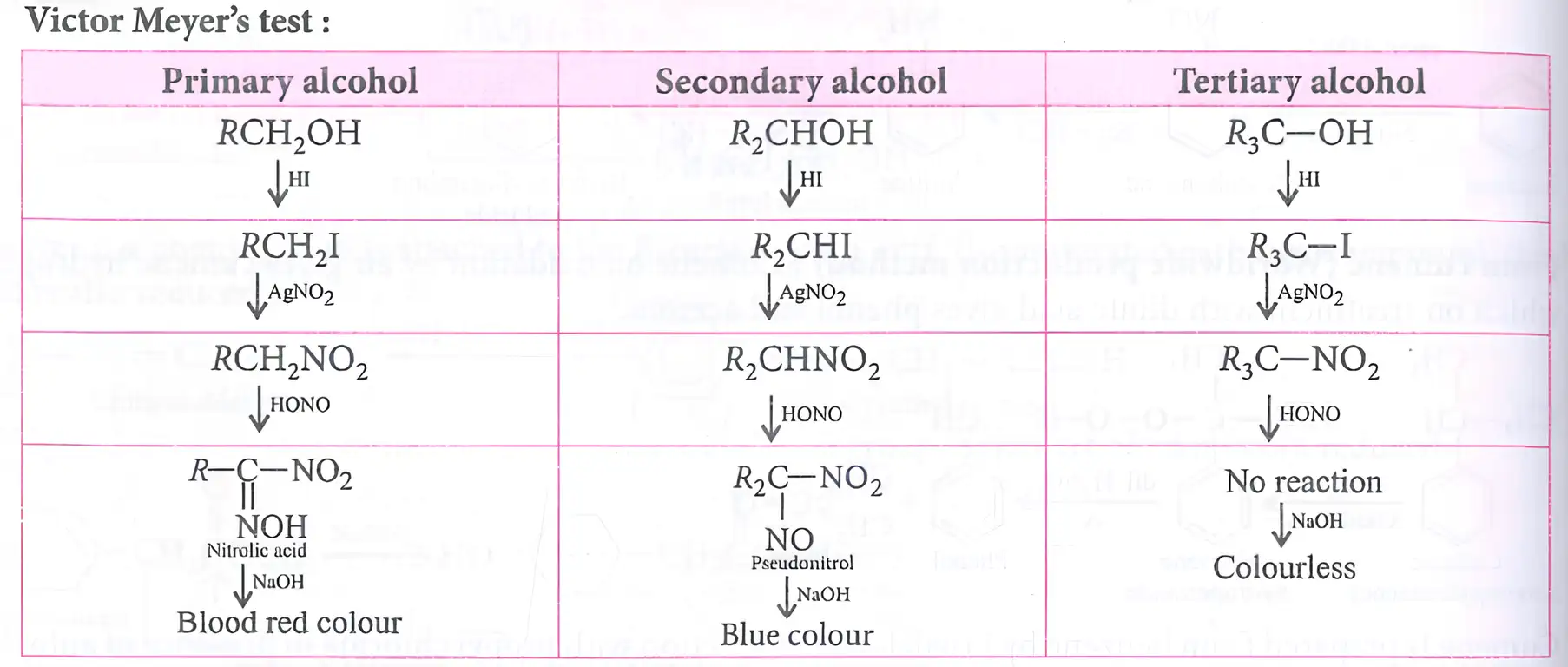
- Victor Meyer test: Distinguishes primary, secondary and tertiary alcohols by their different reaction outcomes and colour changes.
- Lucas reagent: Concentrated and anhydrous .
- Primary alcohol: No cloudiness appears under the stated test conditions.
- Secondary alcohol: Cloudiness appears within 5–10 minutes.
- Tertiary alcohol: Cloudiness appears.
Chemical Properties of Phenols
Acidity of phenols — Phenols are more acidic than alcohols because the phenolic O–H bond ionises more readily and the phenoxide ion is resonance-stabilised.
Why phenols are acidic
- O–H bond polarity: The hydroxyl group is attached directly to an electronegative -hybridised carbon of the benzene ring, reducing electron density on oxygen and increasing O–H bond polarity.
- Conjugate-base stability: Phenoxide ion is more resonance-stabilised than phenol; the corresponding phenol resonance structures involve charge separation.
- Substituent effect: Electron-withdrawing groups increase phenol acidity; electron-releasing groups decrease it.
| Test | Observation |
|---|---|
| Neutral ferric chloride | Violet complex/colour forms |
| Bromine water | White precipitate of 2,4,6-tribromophenol forms |
| Test | Alcohol | Phenol |
|---|---|---|
| Litmus | No effect | Turns blue litmus red |
| Neutral | No reaction | Blue, violet or green colouration |
| Coupling reaction | No reaction | Forms yellow or orange azo dyes |
| Bromine water | No reaction | White precipitate of 2,4,6-tribromophenol |
How do the products of Grignard addition vary with the carbonyl compound?
Why are phenols more acidic than alcohols?
State the Lucas test observations for primary, secondary and tertiary alcohols.
Quick recap
- Acid hydration of alkenes follows Markovnikov’s rule; hydroboration–oxidation gives the anti-Markovnikov alcohol.
- Aldehyde reduction gives primary alcohols; ketone reduction gives secondary alcohols.
- Grignard addition followed by hydrolysis gives primary, secondary or tertiary alcohols from methanal, other aldehydes or ketones, respectively.
- Phenol can be prepared from haloarenes, benzenesulphonic acid, diazonium salts or cumene.
- Alcohol solubility and boiling points reflect hydrogen bonding, chain size, branching and van der Waals forces.
- Alcohol acidity decreases from primary to tertiary; phenols are more acidic than alcohols because phenoxide is resonance-stabilised.
- Lucas test and phenol colour/precipitation tests help distinguish these compounds.
Some Commercially Important Alcohols
Methanol
Ethanol
Denatured alcohol — Commercial alcohol made unfit for drinking by adding copper sulphate and pyridine.
Ethylene Glycol and Commercial Alcohol Mixtures
| Type | Composition |
|---|---|
| Absolute alcohol | 100% ethanol |
| Rectified spirit | 95% alcohol + 5% water |
| Denatured spirit | 95% ethanol + 5% methanol |
| Methylated spirit | 90% ethanol + 9% methanol + 1% other poisonous substances |
| Power alcohol | 80% petrol + 20% ethanol |
How is methanol commercially prepared, and what are two of its uses?
State the compositions of rectified spirit, denatured spirit, methylated spirit, and power alcohol.
Quick recap
- Methanol (wood spirit) is made by catalytic hydrogenation of carbon monoxide and is highly poisonous.
- Methanol is used as a solvent and to make formaldehyde.
- Ethanol is produced by fermentation: sucrose is converted to glucose and fructose, then glucose to ethanol and carbon dioxide.
- Copper sulphate and pyridine are added to commercial alcohol to make it unfit for drinking.
- Ethylene glycol is used in car-radiator antifreeze and as an aeroplane-wing de-icing fluid; the stated 50% aqueous mixture freezes at 34 °C.
- Commercial alcohol mixtures include absolute alcohol, rectified spirit, denatured spirit, methylated spirit, and power alcohol.
Ethers
Preparation by Dehydration of Alcohols
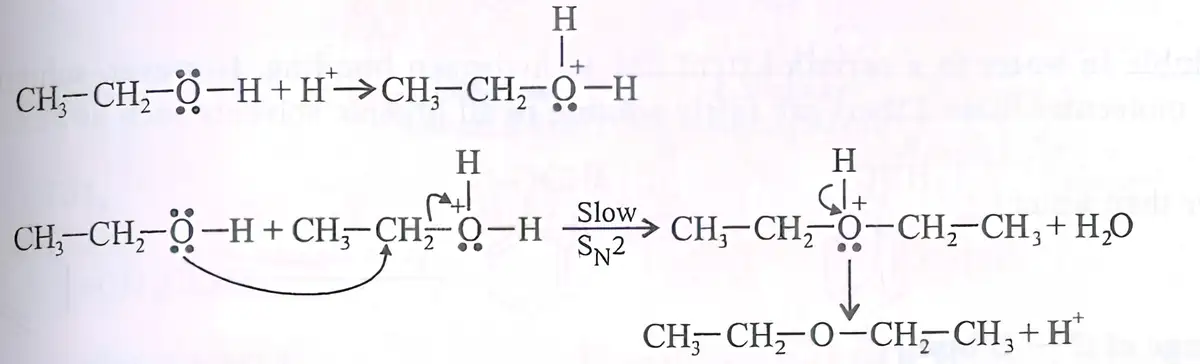
- Conditions: Heating alcohols with a protic acid at 413 K can produce ethers by dehydration.
- Suitable alcohols: This method is best for preparing simple ethers with unhindered primary alkyl groups.
- Competing reaction: Higher temperatures favour alkene formation rather than ether formation.
Mechanism of Alcohol Dehydration
Williamson Ether Synthesis
Preparation of Ethers from Phenols
- Phenoxide route: Convert phenol into sodium phenoxide, then react it with an alkyl halide.
- Product: The phenoxide oxygen bonds to the alkyl group to form an aryl–alkyl ether.
Physical Properties
- Physical state: Dimethyl ether and diethyl ether are gases at room temperature; other ethers are generally colourless liquids with an ethereal smell.
- Polarity and boiling points: Ethers are polar, but their boiling points are much lower than those of comparable alcohols because ether molecules do not form intermolecular hydrogen bonds.
- Solubility and density: Ethers are somewhat soluble in water, with solubility decreasing as molecular mass increases; they are lighter than water and dissolve well in many organic solvents.
Cleavage of the C–O Bond
- Hydrogen halides: Ethers undergo C—O bond cleavage with hydrogen halides; reactivity increases in the order HCl < HBr < HI.
- Alkyl aryl ethers: Cleavage occurs at the alkyl–O bond because the aryl–O bond is strengthened by partial double-bond character.
Cleavage of Mixed Ethers
- Primary or secondary groups: In cleavage of a mixed ether, the smaller alkyl group generally forms the alkyl halide.
- Tertiary group: If one alkyl group is tertiary, cleavage forms a tertiary alkyl halide through an SN1 mechanism.
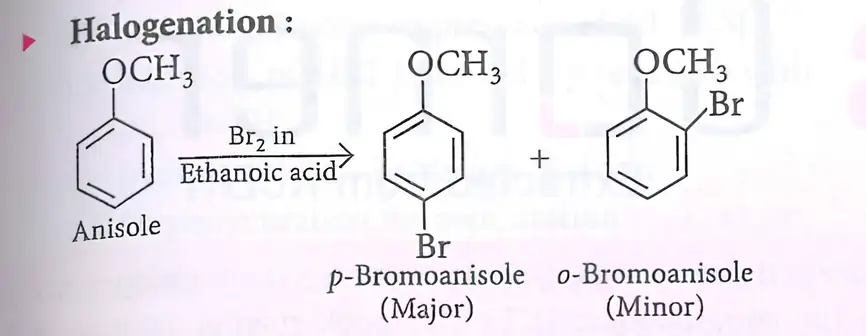
Electrophilic Substitution in Aromatic Ethers
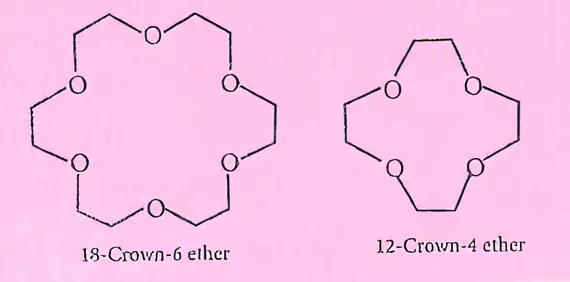
Crown Ethers
- Williamson synthesis: Use a primary alkyl halide for ether formation; secondary or tertiary ether products can be made by choosing an appropriate alkoxide.
- Ether cleavage: Simple ethers cleave with HX by ; tertiary alkyl groups can cleave by , and is the most reactive hydrogen halide listed.
- Aromatic ethers: The group directs ortho/para substitution, usually with para as the major product.
Quick recap
- Primary alcohol dehydration near favours ether formation; higher temperature favours alkene formation.
- Alcohol dehydration forms ethers by an acid-catalysed pathway.
- Williamson synthesis uses a primary alkyl halide and an alkoxide; secondary and tertiary ether products are possible when the suitable alkyl group is supplied by the alkoxide.
- Ethers are polar, have lower boiling points than alcohols, dissolve somewhat in water, and are lighter than water.
- Simple ether cleavage with HX proceeds by ; tertiary groups may react by , and reactivity follows .
- In anisole cleavage, the methyl–oxygen bond breaks to form methyl halide and phenol; aromatic substitution by is ortho/para-directed with para usually major.
- Crown ethers are cyclic polyethers; 18-crown-6 has ring size 18 and six oxygen atoms.
NEET Chemistry — ALL CHAPTERS
1
Some Basic Concepts of Chemistry
2
Structure of Atom
3
Classification of Elements and Periodicity in Properties
4
Chemical Bonding and Molecular Structure
5
Thermodynamics
6
Equilibrium
7
Redox Reactions
8
Organic Chemistry - Some Basic Principles and Techniques
9
Hydrocarbons
10
Solutions
11
Electrochemistry
12
Chemical Kinetics
13
The d- and f- Block Elements
14
Coordination Compounds
15
Haloalkanes and Haloarenes
16
Alcohols, Phenols and Ethers
17
Aldehydes, Ketones and Carboxylic Acids
18
Amines
19
Biomolecules
20
The p-Block Elements (Group 13 and 14)
21
The p-Block Elements (Group 15 to 18)
22
Principles Related to Practical Chemistry