NEET UG . NEET Chemistry . Chemistry . Coordination Compounds
Chapter 14: Coordination Compounds
Ch 14
NEET Chemistry
NEET UG
Werner’s Theory of Coordination Compounds
Coordination Compounds
- Coordination compounds: Central metal atoms or ions are linked to ions or neutral molecules (ligands) by coordinate bonds.
- Examples: Chlorophyll, haemoglobin and vitamin B12 are complexes of magnesium, iron and cobalt, respectively.
Werner’s Theory
| Point | Primary valency | Secondary valency |
|---|---|---|
| Corresponds to | Oxidation state of the central metal | Coordination number of the central metal |
| Ionisation | Ionisable | Non-ionisable |
| Satisfied by | Negative ions | Neutral molecules or ligands |
| Direction and role | Non-directional | Directional; gives the complex a definite geometry |
| Number | May vary with oxidation state | Fixed for a given metal |
Cobalt(III) Chloride–Ammonia Complexes
- Werner’s investigations: His theory was based especially on experimental studies of cobalt(III) chloride–ammonia complexes.
- Significance: These complexes helped Werner explain the different linkages and arrangements found in coordination compounds.
Coordination Entities and Geometry
- Coordination sphere: The central metal and directly attached ligands are enclosed in square brackets; this entity is non-ionisable.
- Counter ions: Ionisable ions outside the square brackets balance the charge of the coordination entity.
- Geometry: Ligands form a coordination polyhedron around the metal; common shapes include octahedral, tetrahedral and square planar.
Double Salts
Do not confuse primary valency with coordination number: primary valency corresponds to oxidation state; secondary valency corresponds to coordination number.
Differentiate between primary and secondary valencies in Werner’s theory.
State the dissociation behaviour of double salts and give examples.
Quick recap
- Coordination compounds contain a central metal linked to ions or molecules by coordinate bonds.
- Werner proposed primary and secondary valencies in 1898.
- Primary valency is ionisable and corresponds to oxidation state; secondary valency is non-ionisable and corresponds to coordination number.
- Secondary valencies are directional and determine the spatial arrangement of groups around the metal.
- Square brackets enclose the coordination entity; ions outside them are counter ions.
- The cobalt(III) complexes illustrate different chloride precipitation counts and cis–trans isomerism.
- Double salts dissociate into ions; examples include carnallite, Mohr’s salt and potash alum.
Definitions of Some Important Terms Pertaining to Coordination Compounds
Coordination Entity and Counter Ions
Coordination entity (coordination sphere) — The central metal atom or ion and the ligands directly attached to it, enclosed in square brackets; it is non-ionisable.
- Counter ions are the ionisable ions or groups written outside the square brackets.
- Example: In , is the coordination sphere and ions are counter ions.
Central Metal Atom or Ion
Central metal atom or ion — The atom or ion to which ligands are linked by coordinate bonds in a definite geometrical arrangement; it acts as a Lewis acid.
- Examples: The central ions are in , in , and in .
Ligands and Their Types
Ligand — An ion or molecule that donates a lone pair from a donor atom to a central metal atom or ion, forming a coordinate bond.
| Type | Binding | Examples / note |
|---|---|---|
| Unidentate | Binds through one donor atom. | , , |
| Didentate | Binds through two donor atoms. | Ethane-1,2-diamine (), oxalate () |
| Polydentate | Binds through several donor atoms. | Example: |
| Chelate ligand | A didentate or polydentate ligand that forms two or more coordinate bonds, creating a five- or six-membered ring. | Forms a ring with the central metal ion. |
| Ambidentate | A unidentate ligand that can coordinate through either of two different atoms. | , |
Coordination Number and Coordination Polyhedron
Coordination number — The total number of coordinate bonds through which ligands are attached to the central metal atom or ion.
- Examples: has coordination number ; has coordination number .
- Didentate ligands: In and , three ligands each bind through two donor atoms, so the coordination number is .
Coordination polyhedron — The spatial arrangement of ligands around the central metal atom or ion.
Oxidation Number
Oxidation number — The charge on the central metal atom or ion after removing the ligands along with the electron pairs shared with the metal.
- Notation: The oxidation number is written as a Roman numeral in parentheses after the coordination entity’s name.
- Example: Copper has oxidation number in ; it is denoted Cu(I).
Homoleptic and Heteroleptic Complexes
| Point | Homoleptic | Heteroleptic |
|---|---|---|
| Ligand types | The metal is bound to only one kind of ligand. | The metal is bound to more than one kind of ligand. |
| Example |
Effective Atomic Number Rule
Effective atomic number (EAN) — The electron count of the central metal after accounting for electrons lost during ion formation and electrons donated by ligands.
is the atomic number of the metal; subtract electrons lost and add electrons gained from ligands.
| Category | Complex | EAN / note |
|---|---|---|
| Follows the rule | ||
| Follows the rule | ||
| Follows the rule | ||
| Does not obey | ||
| Does not obey | ||
| Does not obey | ||
| Does not obey |
- Complexes that do not obey the EAN rule can still form and remain stable.
Quick recap
- The coordination entity, also called the coordination sphere, contains the central metal and directly attached ligands inside brackets; counter ions are outside.
- The central metal acts as a Lewis acid, while ligands donate lone pairs to form coordinate bonds.
- Ligand denticity describes the number of donor atoms through which a ligand binds; chelates form rings and ambidentate ligands can bind through two different atoms.
- Coordination number counts coordinate bonds, while coordination polyhedron describes the ligands’ spatial arrangement.
- Oxidation number is represented by a Roman numeral; homoleptic complexes have one ligand type and heteroleptic complexes have multiple types.
- EAN is the metal atomic number minus electrons lost plus electrons donated by ligands; stable complexes may not obey the rule.
Nomenclature of Coordination Compounds
Writing Coordination-Compound Formulas
Formula rules
- Order: Write the cation first, whether simple or complex, followed by the anion.
- Brackets: Enclose the coordination sphere in square brackets; enclose polyatomic ligand formulas in parentheses.
- Ligand order: List ligands alphabetically, not according to their charges.
- Charge balance: Choose the number of cations and anions so the complete compound is electrically neutral.
Naming Coordination Compounds
Naming rules
- Compound order: Name the cation first, followed by the anion.
- Complex order: Name ligands alphabetically, then the central metal, then its oxidation state in Roman numerals in parentheses.
- Metal ending: For an anionic coordination sphere, the metal name ends in -ate; for a cationic or neutral sphere, use the metal name unchanged.
- Style: Start the compound name with a lowercase letter; write each complex name as one word.
- Oxidation state: Determine the metal’s oxidation state using the ligand charges and the overall charge of the coordination sphere.
| Ligand type | Naming rule | Examples |
|---|---|---|
| Anionic | Names generally end in -ido. | : chlorido |
| Neutral | Usually retain their names, with some special names. | : ammine; : aqua |
| Cationic | Names end in -ium. | : nitronium |
| Abbreviated | An accepted abbreviation may be used in parentheses. | Ethylenediamine: en |
| Ambidentate: thiocyanate | Identify the donor atom in the name. | : thiocyanato-S; : thiocyanato-N (isothiocyanato) |
| Ambidentate: nitrite | Identify the donor atom in the name. | : nitrito-O; : nitrito-N (nitro) |
Prefixes for Ligand Counts
- Simple ligand names: Use di-, tri-, tetra-, penta- and hexa- for 2–6 identical ligands.
- Names containing a prefix: Enclose the ligand name in parentheses and use bis-, tris-, tetrakis-, pentakis- or hexakis- for 2–6.
- Alphabetical order: Do not use multiplicative prefixes to determine the alphabetical order of ligands.
| Formula | Name |
|---|---|
| hexaamminecobalt(III) chloride | |
| diamminesilver(I) chloride | |
| pentacarbonyliron(0) | |
| potassium amminepentachloridoplatinate(IV) | |
| potassium trioxalatoferrate(III) |
| Formula | Name |
|---|---|
| tetraamminechloridonitrito-N-cobalt(III) nitrate | |
| chloridobis(ethane-1,2-diamine)nitrito-O-cobalt(III) ion | |
| potassium trioxalatoaluminate(III) | |
| iron(III) hexacyanidoferrate(II), also called ferric hexacyanidoferrate(II) | |
| tetraamminedichloridoplatinum(IV) tetrachloridoplatinate(II) | |
| tetraammineplatinum(II) tetrachloridocuprate(II) | |
| hexaamminechromium(III) trioxalatocobaltate(III) | |
| bis(dimethylglyoximato)nickel(II) | |
| potassium tetrachloridomercurate(II) |
Do not alphabetise ligands by charge or by multiplicative prefix. Use the -ate metal ending only when the coordination sphere is anionic.
How are ligands and the central metal ordered when naming a coordination sphere?
When does the central-metal name end in -ate?
Quick recap
- Formula order: Write the cation first, then the anion; balance charges to make the compound neutral.
- Formula brackets: Use square brackets for the coordination sphere and parentheses for polyatomic ligand formulas.
- Name order: Name the cation before the anion; within a complex, name ligands alphabetically, then metal and oxidation state.
- Ligand names: Anionic ligands generally end in -ido; neutral and cationic ligands follow their respective naming rules.
- Ambidentate ligands: Indicate the donor atom when needed to distinguish ligand names.
- Metal ending: Use -ate for the metal in an anionic coordination sphere.
Isomerism in Coordination Compounds
Isomerism — Isomerism occurs when compounds have the same composition but differ in the arrangement of their atoms or ligands.
Types of Isomerism
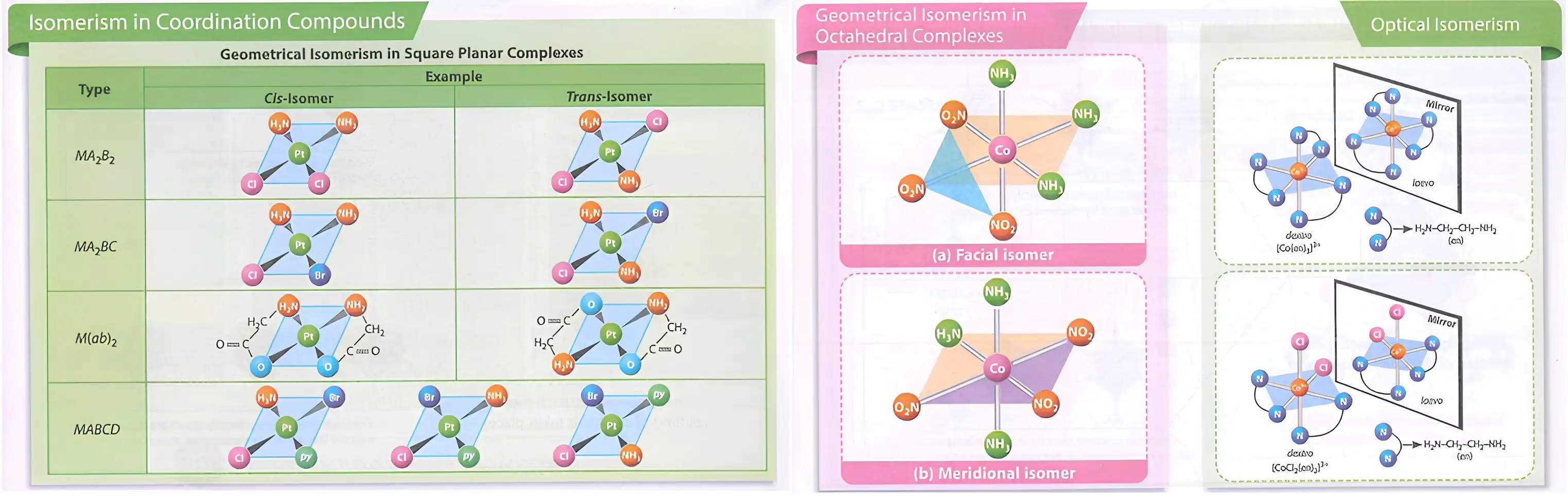
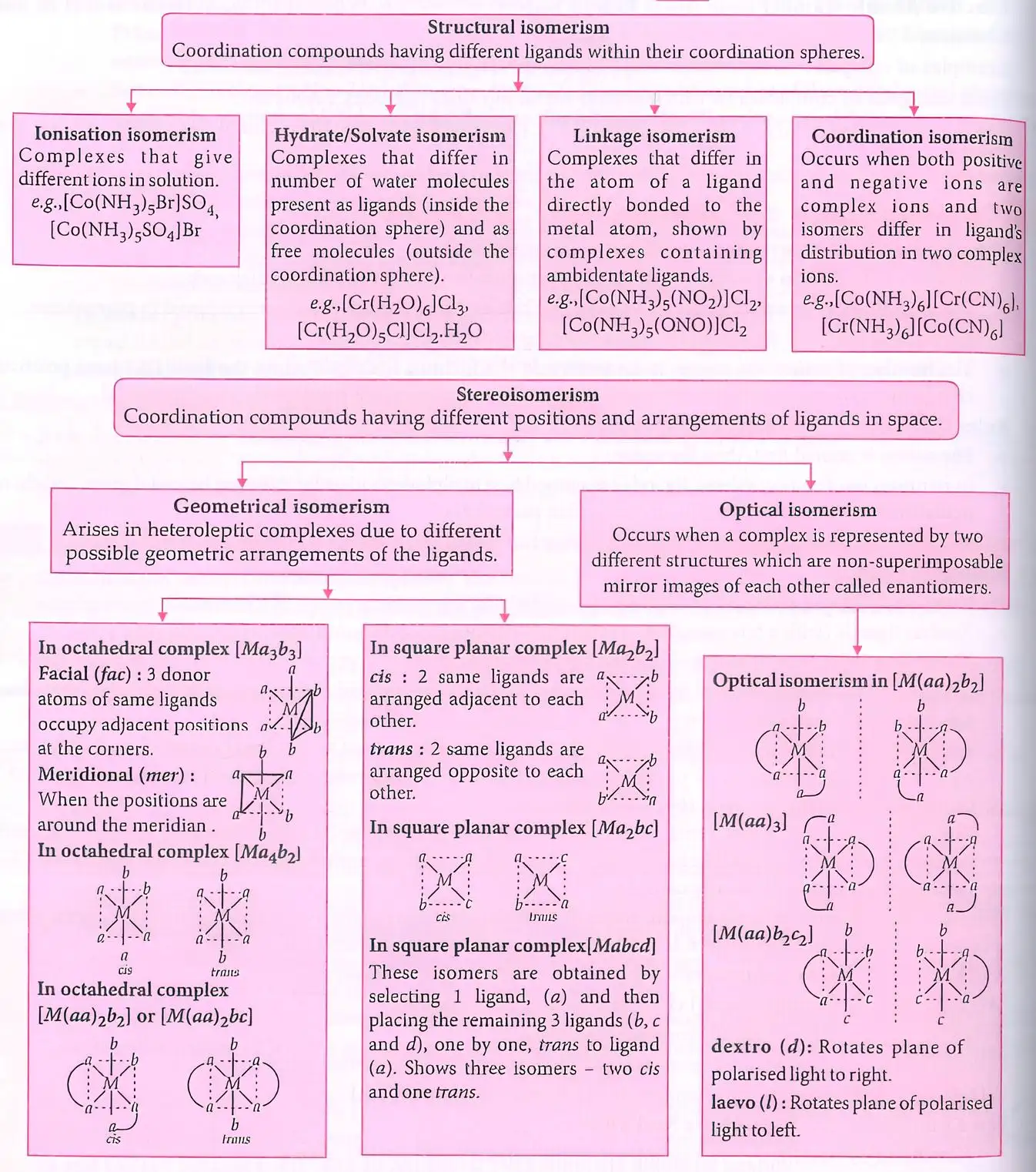
| Category | What differs | Types shown |
|---|---|---|
| Structural isomerism | The arrangement or connections of ligands differ. | Structural isomers |
| Stereoisomerism | The spatial arrangement of ligands differs. | Geometrical and optical isomers |
Octahedral Complex with Six Different Monodentate Ligands
- Example: The complex has six different monodentate ligands.
- Geometrical isomers: Theoretically, 15 geometrical isomers are possible; only three have been isolated.
- Optical forms: Each of the 15 geometrical isomers can exist as optically active - and -forms.
- Total: The theoretical total is optically active isomers.
Optical inactivity — A compound or mixture that does not rotate the plane of polarised light is optically inactive.
Optically Inactive Forms
- Names and notation: Optically inactive forms are referred to as meso or racemic forms and may be written as or .
- Racemic mixture: Equal amounts of the - and -forms cancel each other's optical rotation.
- External compensation: Optical inactivity in a -mixture results from cancellation between the two forms.
Quick recap
- Isomers have the same composition but differ in arrangement.
- The categories shown are structural isomerism and stereoisomerism.
- Geometrical and optical isomerism are types of stereoisomerism.
- The six-ligand octahedral example has 15 possible geometrical isomers, but only three were isolated.
- Each of the 15 geometrical forms has - and -forms, giving 30 theoretical optically active isomers.
- A -mixture is optically inactive because of external compensation.
Bonding in Coordination Compounds
Valence Bond Theory
Valence bond theory (VBT) — The metal atom or ion provides vacant orbitals equal in number to its coordination number; these hybridise to accept ligand lone pairs and form coordinate bonds.
VBT: key ideas
- Orbitals used: Inner-orbital complexes use orbitals; outer-orbital complexes use orbitals. The and orbitals also participate in hybridisation.
- Geometry: Hybrid orbitals are equivalent and point in directions that produce a definite complex geometry.
- Ligand strength: The ligand field influences whether inner or outer orbitals are used.
| Coordination number | Hybridisation | Geometry | Examples |
|---|---|---|---|
| Linear | , | ||
| Trigonal planar | |||
| Tetrahedral | , , , ; | ||
| Square planar | , , | ||
| Trigonal bipyramidal | , | ||
| Square pyramidal | |||
| Octahedral; inner orbital | , | ||
| Octahedral; outer orbital | , , |
| Point | Inner-orbital complexes | Outer-orbital complexes |
|---|---|---|
| Orbitals involved | Inner orbitals | Outer orbitals |
| Spin and unpaired electrons | Usually low spin; fewer or no unpaired electrons | Usually high spin; many unpaired electrons |
| Examples | , | , |
Magnetic Properties
- Diamagnetism: Usually associated with low-spin complexes having no unpaired electrons.
- Paramagnetism: Arises from unpaired electrons; greater number of unpaired electrons generally means stronger paramagnetism.
- Magnetic moment: For unpaired electrons, the spin-only magnetic moment is .
Limitations of Valence Bond Theory
- Assumptions: VBT relies on assumptions and does not distinguish ligand field strengths adequately.
- Magnetism: It does not quantitatively explain magnetic data.
- Stability: It cannot quantitatively account for thermodynamic or kinetic stability.
- Geometry and spectra: It does not explain relative energies of shapes, reliably predict tetrahedral or square-planar structures, or account for colour and spectra.
Crystal Field Theory
Crystal field theory (CFT) — CFT treats metal–ligand bonding as ionic and the interaction between metal ions and ligands as purely electrostatic.
Octahedral crystal-field splitting
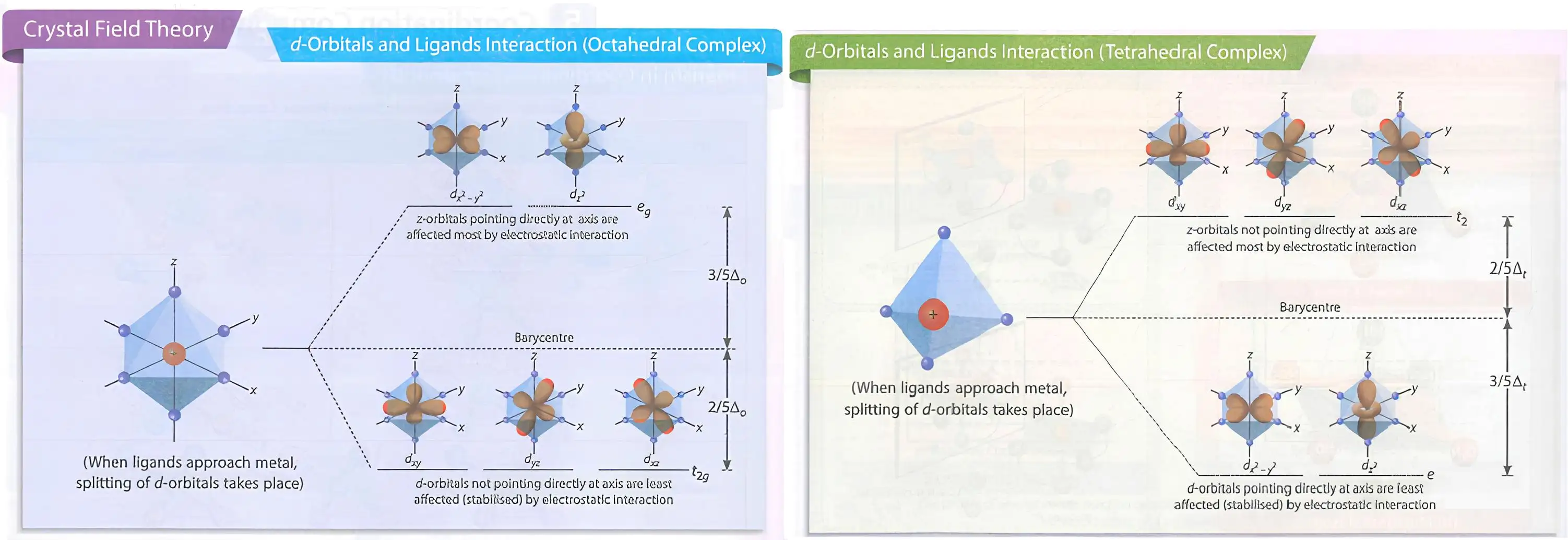
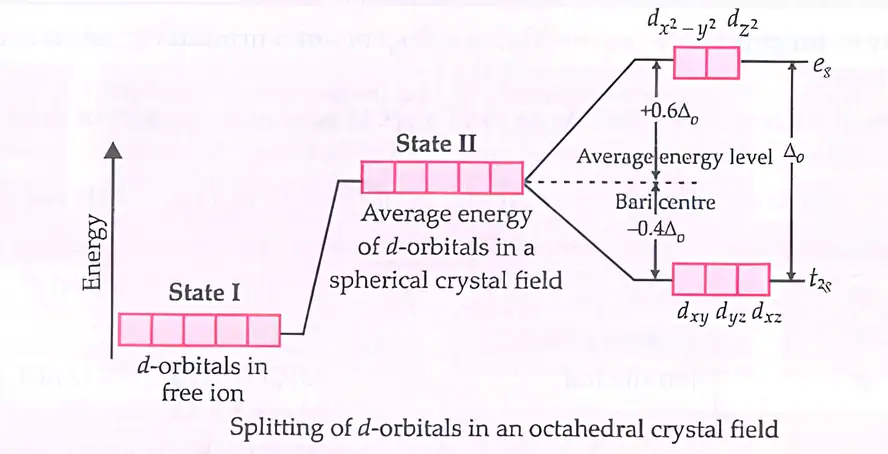
- Splitting: In an octahedral field, the five degenerate orbitals separate into a lower-energy set and a higher-energy set.
- Lower set: , and form .
- Higher set: and form .
- Splitting parameter: The energy gap is the octahedral crystal-field splitting parameter, .
Relative to the barycentre, each electron contributes and each electron contributes ; the weighted total is zero.
Ligand field strength and spectrochemical series
- Field strength: Strong-field ligands produce a large ; weak-field ligands produce a small .
- Spectrochemical series: Ligands are ordered from weaker to stronger field as follows.
Increasing ligand-field strength from left to right.

| Condition | Electron arrangement | Result |
|---|---|---|
| ; typically strong-field ligand | Electrons pair in the lower orbitals before occupying | Low-spin complex; fewer unpaired electrons |
| ; typically weak-field ligand | Electrons occupy available orbitals singly before pairing | High-spin complex; more unpaired electrons |
Tetrahedral splitting
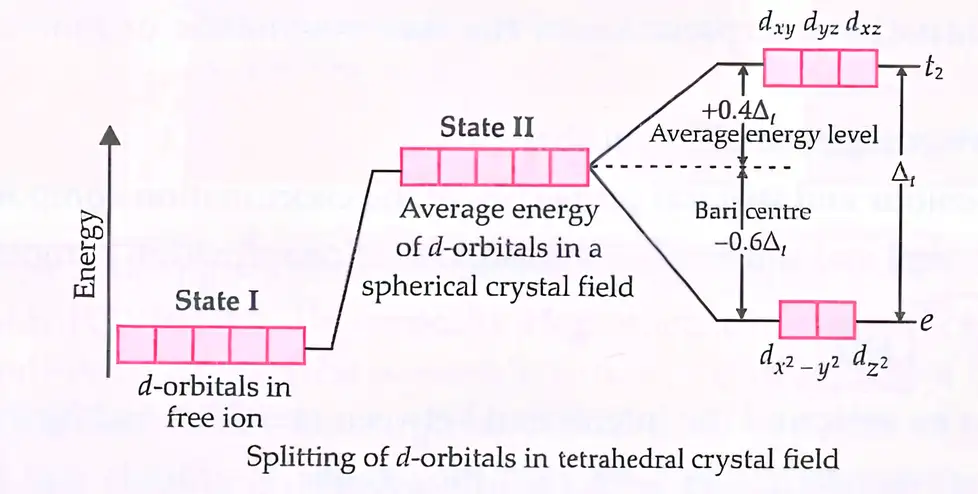
- Reversed order: Tetrahedral splitting has the reverse orbital energy order to octahedral splitting.
- Magnitude: The tetrahedral splitting is smaller, so it is usually insufficient to force electron pairing; tetrahedral complexes are therefore commonly high spin.
- Notation: The subscript denotes a centre of symmetry and is used for octahedral and square-planar complexes, but not for tetrahedral levels.
The tetrahedral splitting parameter is related to the octahedral one by:
Colour in Coordination Compounds
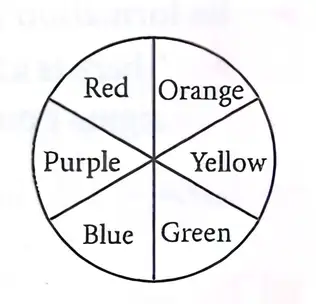
- Origin of colour: CFT attributes colour to – transitions, in which an electron absorbs light and moves between split -orbital levels (for octahedral complexes, commonly ).
- Observed colour: The complex appears in the complementary colour of the light it absorbs.
- Energy and wavelength: Larger means higher-energy, shorter-wavelength light is absorbed; smaller means lower-energy, longer-wavelength light is absorbed.
- No ligand field: Without ligands, crystal-field splitting does not occur and the substance is colourless according to this model.
- Examples: is violet; is blue.
| Absorbed colour | Wavelength () | Frequency () | Observed complementary colour |
|---|---|---|---|
| Violet (highest energy) | – | – | Yellow-green |
| Blue | – | – | Yellow |
| Green-blue | – | – | Orange |
| Blue-green | – | – | Red |
| Green | – | – | Violet (almost purple) |
| Yellow-green | – | – | Violet |
| Yellow | – | – | Blue |
| Orange | – | – | Green-blue |
| Red (lowest energy) | – | – | Blue-green |
Crystal Field Stabilisation Energy and Limitations
If electrons occupy and occupy , the CFSE relative to the barycentre is:
Additional CFT points
- Spin trend: In octahedral complexes, strong-field ligands generally produce large and low-spin configurations; weak-field ligands generally produce small and high-spin configurations.
- Outer-orbital complexes: The lecture identifies octahedral complexes of , , , and as outer-orbital complexes.
Limitations of CFT
- Bonding model: It does not adequately describe the partly covalent nature of metal–ligand bonds.
- Pi bonding: It does not consider the formation of bonds in complexes.
- Ligand strength: It cannot satisfactorily explain relative ligand strengths, such as why is a stronger-field ligand than .
Do not reverse the spin condition: favours low spin, while favours high spin. Also distinguish absorbed light from the complementary colour observed.
How does the ratio of crystal-field splitting to pairing energy determine spin state?
State the relation between tetrahedral and octahedral splitting, and its implication for spin.
Quick recap
- VBT relates coordination number to the number of vacant hybrid orbitals and the resulting geometry.
- Inner-orbital complexes involve orbitals; outer-orbital complexes involve orbitals.
- For unpaired electrons, the spin-only magnetic moment is .
- Octahedral splitting produces lower and higher orbitals, separated by .
- Strong fields with tend to give low-spin complexes; weak fields with tend to give high-spin complexes.
- Tetrahedral splitting is reversed and equals ; tetrahedral complexes are usually high spin.
- Colour arises from absorption during electronic transitions; the observed colour is complementary to the absorbed colour.
Bonding in Metal Carbonyls
Metal Carbonyls: Types and Examples
- Metal carbonyls: These are organometallic compounds containing carbon monoxide ligands; carbonyl-only compounds are homoleptic.
- Mononuclear examples: Cr(CO)6, Fe(CO)5 and Ni(CO)4.
- Polynuclear examples: Co2(CO)8, Co4(CO)12 and Mn2(CO)10.
Structures of Metal Carbonyls
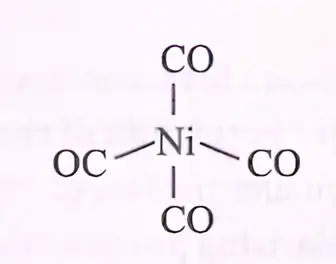
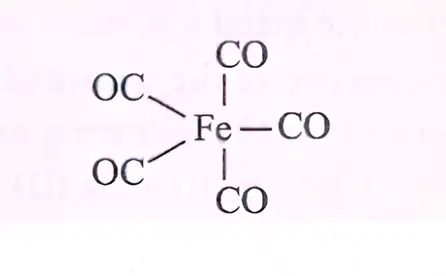
| Carbonyl | Structure |
|---|---|
| Tetrahedral | |
| Trigonal bipyramidal | |
| Octahedral | |
| Two square-pyramidal units joined by an bond | |
| Contains a bond bridged by two groups |
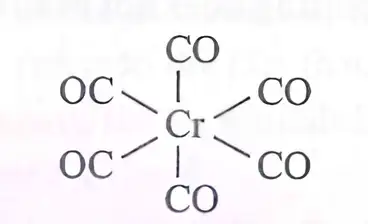
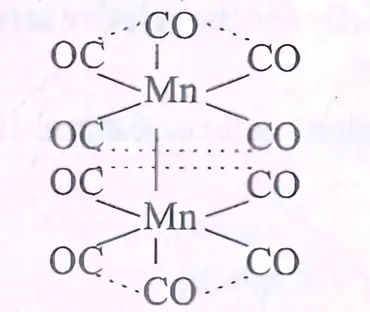
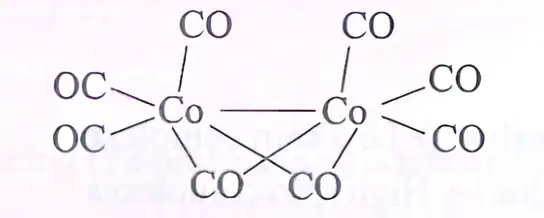
Metal–Carbon Bonding and Synergic Effect

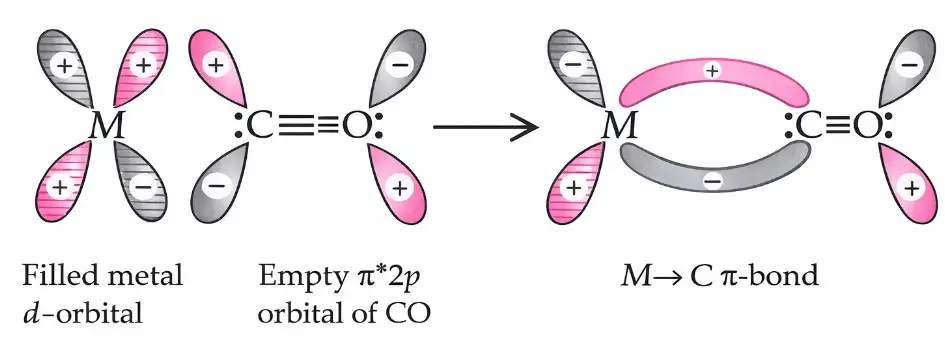
Stability of Coordination Compounds
Irving–Williams Order
Applies to divalent ions of the first transition series.
Quick recap
- Metal carbonyls are homoleptic transition-metal compounds containing only ligands.
- Examples include mononuclear carbonyls such as and polynuclear carbonyls such as .
- is tetrahedral, trigonal bipyramidal, and octahedral.
- Metal–carbon bonding combines donation from with metal-to-ligand back-bonding.
- The synergic effect strengthens the metal–ligand interaction.
- Complex stability depends on the equilibrium constant, metal-ion properties, ligand basicity, and chelation.
- The stated Irving–Williams order is .
Importance and Applications of Coordination Compounds
Qualitative and Quantitative Analysis
Detection and Estimation of Ions
- Nickel detection: forms a characteristic coordination compound with dimethylglyoxime (DMG).
- Cobalt detection: Cobalt is detected using its coordination compound with -nitroso--naphthol.
- Metal estimation: EDTA acts as a ligand for detecting and estimating many metals.
- Water hardness: Titration with estimates hardness because and form stable EDTA complexes.
- Selective estimation: Calcium and magnesium can be estimated separately because their EDTA complexes have different stability constants.
Extraction and Purification of Metals
Metal Extraction and Refining
- General extraction principle: Many metals are extracted from their sources as coordination compounds.
- Silver and gold extraction: These metals are extracted as cyanide complexes, and .
- Metal recovery: Adding zinc to the solution precipitates metals from their cyanide complexes.
- Nickel purification: Impure nickel forms ; decomposition of this coordination compound yields pure nickel.
Coordination Compounds in Biological Systems
| Compound | Metal / Structure | Role |
|---|---|---|
| Chlorophyll | Magnesium complex with a macrocyclic porphyrin | Green pigment responsible for photosynthesis |
| Haemoglobin | Iron complex with a macrocyclic porphyrin | Red blood pigment that carries oxygen |
| Myoglobin | Coordination compound | Stores oxygen and helps regulate respiration |
| Vitamin B-12 (cyanocobalamin) | Cobalt complex | Biological compound |
| Carboxypeptidase-A | Zinc complex with a protein | Enzyme |
Coordination Compounds as Catalysts
Catalytic Applications
- Organometallics: Organometallic compounds are potential catalysts.
- Ziegler–Natta catalyst: Titanium tetrachloride and triethylaluminium, represented as , polymerise alkenes at ambient temperature and atmospheric pressure.
- Wilkinson's catalyst: Chloridotris(triphenylphosphine)rhodium(I), , catalyses hydrogenation.
- Metal carbonyls: Used as industrial catalysts.
Electroplating and Photography
Practical Applications
- Electroplating: Silver and gold give smoother, more even coatings when deposited from and solutions than from solutions of simple metal ions.
- Black-and-white photography: Hypo solution fixes developed film by dissolving undecomposed as the complex ion .
Medical Applications
| Compound / Ligand | Use |
|---|---|
| Penicillamine | Chelates excess copper in animals and plants |
| Desferrioxamine-B | Chelates excess iron in animals and plants |
| EDTA | Used in the treatment of lead poisoning |
| Cisplatin, | Used in cancer treatment |
How is water hardness estimated using coordination chemistry?
How does hypo fix black-and-white photographic film?
Quick recap
- DMG detects nickel, while -nitroso--naphthol detects cobalt; EDTA detects and estimates many metals.
- estimates water hardness by complexing and .
- Many metals are extracted as coordination compounds; silver and gold are extracted as cyanide complexes, and nickel purification uses .
- Chlorophyll, haemoglobin, myoglobin, vitamin B-12 and carboxypeptidase-A are biologically important coordination compounds.
- Organometallics are potential catalysts; Ziegler–Natta catalysts polymerise alkenes and Wilkinson's catalyst enables hydrogenation.
- Complexes are used in smooth electroplating, photographic fixing, chelation therapy and cancer treatment with cisplatin.
NEET Chemistry — ALL CHAPTERS
1
Some Basic Concepts of Chemistry
2
Structure of Atom
3
Classification of Elements and Periodicity in Properties
4
Chemical Bonding and Molecular Structure
5
Thermodynamics
6
Equilibrium
7
Redox Reactions
8
Organic Chemistry - Some Basic Principles and Techniques
9
Hydrocarbons
10
Solutions
11
Electrochemistry
12
Chemical Kinetics
13
The d- and f- Block Elements
14
Coordination Compounds
15
Haloalkanes and Haloarenes
16
Alcohols, Phenols and Ethers
17
Aldehydes, Ketones and Carboxylic Acids
18
Amines
19
Biomolecules
20
The p-Block Elements (Group 13 and 14)
21
The p-Block Elements (Group 15 to 18)
22
Principles Related to Practical Chemistry