NEET UG . NEET Chemistry . Chemistry . The P Block Elements Group 13 and 14
Chapter 20: The p-Block Elements (Group 13 and 14)
Ch 20
NEET Chemistry
NEET UG
Group 13 Elements : The Boron Family
General Features of p-Block Elements
p-block elements — Elements in which the last electron enters the outermost p-orbital.
General trends
- Configuration: The general outer configuration is ; helium is an exception.
- Maximum oxidation state: It generally equals the total number of valence electrons, that is, the sum of the outer and electrons.
- Inert pair effect: In heavier p-block elements, the pair may remain non-bonding, favouring an oxidation state two units below the group oxidation state.
- First-member anomaly: The second-period member often differs from heavier members because of its small size and lack of d-orbitals, despite a similar outer configuration.
Group 13: Members and General Character
| Element | Symbol | Outer configuration |
|---|---|---|
| Boron | ||
| Aluminium | ||
| Gallium | ||
| Indium | ||
| Thallium | ||
| Nihonium |
Occurrence and metallic character
- Character: Boron has high ionisation enthalpy and is a semi-metal, with properties closer to non-metals. Aluminium is metallic but shares chemical similarities with boron; Ga, In, Tl and Nh are predominantly metallic.
- Abundance: Boron is fairly rare. Aluminium is the most abundant metal and the third most abundant element in Earth's crust, after oxygen and silicon; Ga, In and Tl are less abundant.
- Nihonium: Nh has atomic number and atomic mass about . It is radioactive; its most stable isotope has a half-life of about seconds, so its chemistry is not established.
Atomic and Ionic Radii
Periodic trends
- Across Groups 2 and 13: Group 13 atoms and ions are smaller than the corresponding Group 2 species because Group 13 has greater nuclear charge.
- Down the group: Atomic and ionic radii generally increase, with an exception in gallium.
- Gallium anomaly: Ga has a smaller atomic radius than Al because its electrons shield outer electrons poorly; the increased nuclear charge pulls them closer.
| Element | Metallic radius (Å) | ionic radius (Å) | ionic radius (Å) |
|---|---|---|---|
| 0.885 | 0.270 | — | |
| 1.43 | 0.535 | — | |
| 1.35 | 0.620 | 1.20 | |
| 1.67 | 0.800 | 1.40 | |
| 1.70 | 0.885 | 1.50 |
Ionisation Enthalpy
Trends and explanation
- First ionisation enthalpy: The trend is irregular, not a smooth decrease. Poor shielding by intervening d-electrons in Ga and f-electrons in Tl contributes to the anomalies.
- Order: : .
- Compared with Group 2: Group 13 first ionisation enthalpies are lower than those of corresponding alkaline-earth elements because p-electrons are less penetrating and less shielding than s-electrons.
- Successive ionisation: ; the total energy needed to form is very high.
Electronegativity
Trend
- Down the group: Electronegativity first decreases from B to Al, then increases because inner d- and f-electrons shield poorly.
- Relative values: Group 13 elements are more electronegative than Group 1 and Group 2 elements.
| Element | |||||
|---|---|---|---|---|---|
| Value | 2.0 | 1.5 | 1.6 | 1.7 | 1.8 |
Physical Properties
Key properties
- Boron: Extremely hard, black solid; it exists in several allotropic forms. Its strong crystalline lattice gives it an unusually high melting point.
- Other members: Soft metals with relatively low melting points and high electrical conductivity.
- Gallium: Melts at only and may become liquid in summer; its high boiling point, , makes it useful in high-temperature thermometry.
- Density: Increases down the group from boron to thallium.
Oxidation States and Chemical Reactivity
Oxidation-state stability
- Expected states: The valence configuration allows the common oxidation states and .
- Inert pair effect: The stability of increases down the group because the two electrons increasingly remain paired and do not bond.
- Stability order: : ; : .
- Bonding: Compounds in the state are more ionic than those in the state.
Lewis Acidity and Hydrolysis
Boron halides and electron-deficient compounds
- Boron trihalides: has only six electrons around boron, so it accepts a lone pair and acts as a Lewis acid.
- Lewis acid strength: . The tendency of Group 13 elements to behave as Lewis acids decreases down the group as atomic size increases.
- Examples: accepts a lone pair from to form an adduct; electron-deficient can form the bridged dimer .

Hydrolysis and coordination
- Trivalent compounds: Many are covalent and hydrolyse in water. Group 13 trichlorides form tetrahedral species, with hybridisation at M.
- Aluminium in acidified water: It forms octahedral ; the stated hybridisation is , involving Al orbitals.
Reactivity Towards Air
Oxides
- Formation: On heating in oxygen, Group 13 elements form trioxides ; thallium also forms .
- Nature down the group: is acidic; and are amphoteric; , and are basic.
- Boron oxide reactions: reacts with alkalis and metal oxides to form borates.
Nitrides
- Formation: Boron and aluminium form nitrides when heated with nitrogen.
Reactivity Towards Acids and Alkalis
Acid and alkali reactions
- Non-oxidising acids: Boron is not attacked by dilute or dilute . Other Group 13 elements dissolve to form trivalent salts.
- Oxidising acids: Concentrated and react with Group 13 elements. Concentrated passivates aluminium by forming a protective oxide layer.
- Alkalis: Boron, aluminium and gallium react with alkalis. Aluminium produces tetrahydroxoaluminate(III) and hydrogen.
Reactivity Towards Halogens
Trihalide formation
- General reaction: Group 13 elements combine with halogens to form trihalides, .
- Exception: The source lists thallium triiodide, , as an exception to normal trihalide formation.
Why is the atomic radius of gallium smaller than that of aluminium?
State the stability trends of the and oxidation states in Group 13.
Give the Lewis-acid strength order of boron trihalides.
Quick recap
- Group 13 has outer configuration and commonly shows and oxidation states.
- Poor shielding by d-electrons causes the gallium radius anomaly and contributes to irregular ionisation enthalpy trends.
- The inert pair effect stabilises the state down the group.
- Boron trihalides are electron-deficient Lewis acids; their strength increases from to .
- Oxides change from acidic (), to amphoteric ( and ), to basic oxides of heavier members.
- Aluminium reacts with acids and alkalis to release hydrogen; concentrated nitric acid passivates it.
Important Trends and Anomalous Properties of Boron
Anomalous behaviour — Boron, the first member of Group 13, differs markedly from aluminium and the other members of its group.
Reasons for boron’s anomalous behaviour
- Focus: This section examines the distinctive behaviour of boron within Group 13.
- Significance: Its unusual properties distinguish it from the heavier members of the family.
Boron compared with the other Group 13 elements
Why is boron’s maximum covalency four?
Quick recap
- Boron’s small size, high ionisation energy and highest group electronegativity contribute to its anomalous behaviour.
- Boron lacks d-orbitals and has a maximum covalency of four.
- Boron shows +3 oxidation state; the other group members can show +1 and +3.
- Boron halides are monomeric, and boron does not show the inert pair effect.
- Boron forms several volatile, electron-deficient hydrides; thallium forms none.
- Boron forms borides with metals, whereas the other group members can form alloys.
Some Important Compounds of Boron
Borax
Borax — A white crystalline hydrated sodium borate, represented as or, more commonly, .
Properties and uses
- Aqueous solution: Borax dissolves in water to give an alkaline solution, producing sodium hydroxide and orthoboric acid.
- Heating: It first loses water and swells; further heating gives a transparent melt that solidifies as a glass-like borax bead.
- Borax bead test: Coloured metaborates formed with many transition metals give characteristic colours, helping identify the metals.
Orthoboric Acid
Orthoboric acid — Orthoboric acid, (also written ), is a weak monobasic Lewis acid.
Properties and preparation
- Appearance: White crystalline solid with a soapy feel; sparingly soluble in cold water but much more soluble in hot water.
- Preparation: Acidifying an aqueous borax solution with hydrochloric acid produces boric acid.
- Structure: Planar units form layers linked by hydrogen bonds.
- Acid character: It is not a protonic acid; it accepts an electron pair from hydroxide ion, so it behaves as a Lewis acid.
Tests for borates
- Volatile boron fluoride test: Treating a borate with HF, or with concentrated and , forms volatile ; the gas colours a Bunsen flame green.
- Methyl alcohol test: Warm the compound with methanol and concentrated sulfuric acid, then ignite the mixture; the flame is green due to volatile trimethyl borate.
Diborane
Diborane — Diborane, , is the simplest boron hydride.
| Route | Reaction | Condition / use |
|---|---|---|
| Reduction of boron trifluoride | Diethyl ether | |
| Laboratory preparation | Sodium borohydride and iodine | |
| Industrial preparation |
Properties and reactions
- Physical properties: Colourless, highly toxic gas; boiling point is .
- Flammability: Diborane catches fire spontaneously in air; most higher boranes are also spontaneously flammable.
- Hydrolysis: Boranes react readily with water to form boric acid and hydrogen.
- Lewis bases: Diborane undergoes cleavage with Lewis bases, producing borane adducts.
Borazine
Formation and structure
- Formation: Heating the addition product of diborane and ammonia forms borazine, .
- Structure: Borazine is cyclic, with alternating and units; it resembles benzene and is called inorganic benzene.
- Bonding comparison: Borazine is isoelectronic with benzene. Benzene has completely delocalised electrons, whereas delocalisation in borazine is only partial.
Structure of Diborane
Electron-deficient bonding
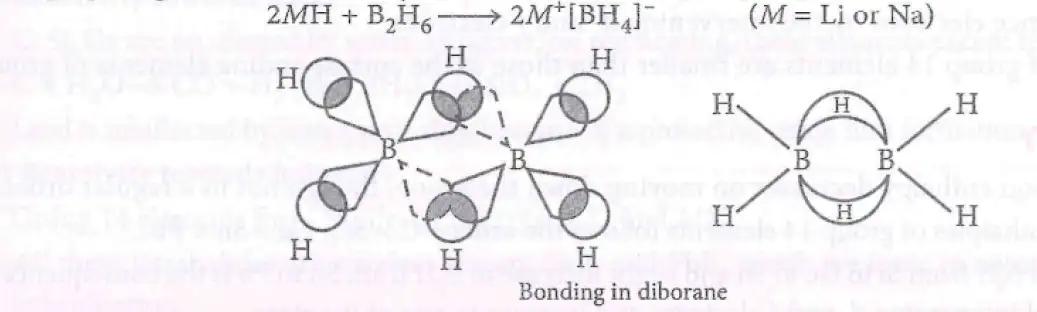
- Shape and hybridisation: Diborane is non-planar; each boron is hybridised.
- Normal bonds: Four terminal bonds are normal two-centre, two-electron () covalent bonds, lying in one plane.
- Bridge bonds: Two bridges lie above and below that plane. Each is a three-centre, two-electron () bond, also called a banana bond.
Borohydrides and Higher Boranes
Borohydrides
- Definition: Borohydrides are metal tetrahydridoborates, containing the ion.
- Preparation: They can be prepared by reacting metal hydrides with diborane in diethyl ether.
- Uses: and are reducing agents in organic synthesis and starting materials for other metal borohydrides.
| Type | General formula |
|---|---|
| Arachnoboranes | |
| Nidoboranes |
Why is orthoboric acid a Lewis acid rather than a protonic acid?
Describe the bonding in diborane.
How does borazine differ from benzene in electron delocalisation?
Quick recap
- Borax dissolves to give an alkaline solution and forms coloured transition-metal metaborates in the bead test.
- Orthoboric acid is a weak monobasic Lewis acid; on heating it forms metaboric acid and then boric oxide.
- Borate tests detect volatile or trimethyl borate through a green flame.
- Diborane is a toxic, spontaneously flammable, electron-deficient hydride with four normal and two banana bonds.
- Diborane hydrolyses to boric acid and hydrogen, and reacts with ammonia to form borazine on heating; the overall formation releases .
- and are useful reducing agents; arachno and nido boranes follow different general formulas.
Uses of Boron and Aluminium and their Compounds
Uses of Boron and Boron Compounds
Boron and borides
- Boron fibres are used in bullet-proof vests and lightweight composite materials for aircraft.
- Boron-10 has a high ability to absorb neutrons; metal borides are used in the nuclear industry as protective shields and control rods.
Borax and boric acid
- Heat-resistant glass: Borax and boric acid are used to manufacture Pyrex, glass-wool and fibreglass.
- Borax as a flux: It is used in soldering metals.
- Glazed coatings: Borax helps make earthenware coatings resistant to heat, scratches and stains.
- Orthoboric acid: Its aqueous solution is used as a mild antiseptic.
Uses of Aluminium
Properties and applications
- Appearance: Aluminium is a bright, silvery-white metal.
- Strength: It has high tensile strength.
- Conductivity: It conducts heat and electricity well; its electrical conductivity is twice that of copper.
- Use: Aluminium is used extensively in industry and everyday life.
Quick recap
- Boron fibres are used in bullet-proof vests and lightweight aircraft composites.
- Boron-10 absorbs neutrons; metal borides are used for nuclear shields and control rods.
- Borax and boric acid are used to make heat-resistant glasses, glass-wool and fibreglass.
- Borax is used as a soldering flux and in durable earthenware glazing.
- Aqueous orthoboric acid is a mild antiseptic.
- Aluminium is strong, highly conductive and widely used.
Group 14 Elements : The Carbon Family
Members and Electronic Configuration
Group 14 — The carbon family comprises carbon, silicon, germanium, tin, lead and flerovium; all have the valence-shell configuration .
| Element | Symbol | Electronic configuration |
|---|---|---|
| Carbon | ||
| Silicon | ||
| Germanium | ||
| Tin | ||
| Lead | ||
| Flerovium |
Occurrence
- Abundance: Silicon is the second most abundant element in Earth's crust, after oxygen.
- Germanium: It occurs only in traces.
- Flerovium: It is synthetic and radioactive, with and an atomic mass of about .
- Flerovium chemistry: Only small amounts have been prepared; its half-life is short and its chemistry is not established.
Periodic Trends
Covalent radius
- Down the group: Covalent radii increase; the increase from silicon onwards is small because intervening - and -electrons shield valence electrons poorly.
- Group comparison: Group 14 covalent radii are smaller than those of corresponding Group 13 elements.
Ionisation enthalpy
- Overall trend: Ionisation enthalpy generally decreases down the group, but not regularly.
- Order: ; it decreases slightly from Si to Sn, then rises slightly from Sn to Pb.
- Irregularity: Increasing atomic size and poor shielding by intervening - and -electrons influence the trend.
- Compared with Group 13: First ionisation enthalpies are higher because Group 14 elements have greater nuclear charge and smaller size.
Electronegativity
- Compared with Group 13: Group 14 elements are slightly more electronegative because of their smaller size.
- Down the group: Electronegativity decreases from carbon to silicon; values from silicon to lead are nearly constant.
Physical Properties
Melting and boiling points
- Compared with Group 13: Group 14 elements have much higher melting and boiling points because strong covalent bonds bind their atoms in solid and liquid states.
- Down the group: Melting and boiling points decrease from carbon to lead as increasing atomic size weakens the bonds.
Oxidation States and Chemical Reactivity
Oxidation states and bonding
- Common states: Group 14 elements show and oxidation states.
- Carbon: The ion does not form because carbon has high ionisation enthalpy and very small size.
- Carbon in carbides: Carbon can have negative oxidation states, occurring as or in carbides such as , , and .
- Carbon bonding: Carbon predominantly forms covalent compounds.
- Silicon: Its oxidation-state behaviour is similar to carbon.
- Inert pair effect: It increases down the group, stabilising the state and reducing the stability of the state.
- Stability orders: For , ; for , .
- Bond character: Compounds in the state are generally covalent due to small cation size (Fajans' rule); those in the state tend to be ionic.
- Example: is an ionic solid, whereas is a covalent liquid.
- Down-group trend: The tendency to form covalent compounds decreases, while the tendency to form ionic compounds increases.
Reactivity with Oxygen
Oxides
- Formation: Group 14 elements form oxides on strong heating in air.
- Lower oxides: The monoxides , and are known; is unstable.
- Acidity: Oxides in higher oxidation states are generally more acidic than those in lower oxidation states.
- Lead(II) oxide: occurs as red litharge and yellow massicot.
- Red lead: The mixed oxide is represented as .
Reactivity with Water
Water and steam
- Water: Carbon, silicon and germanium are unaffected by water.
- Steam on red heating: Carbon, silicon and germanium react with steam; lead remains unaffected, probably because a protective oxide film forms.
- Products: Carbon forms carbon monoxide and hydrogen; silicon forms silicon dioxide and hydrogen.
Reactivity with Halogens
Halides
- Types: Group 14 forms tetrahalides, , and dihalides, .
- Tetrahalides: They are generally covalent and form through hybridisation, except and , which are ionic.
- Dihalides: Ge, Sn and Pb form ; their stability increases down the group from Ge to Pb because of the inert pair effect.
- Hydrolysis: does not hydrolyse because carbon has no available -orbitals and cannot expand its coordination number beyond four.
- Heavier halides: and halides of heavier elements can hydrolyse because vacant -orbitals can accept coordination from water molecules.
- Silicon tetrachloride: Hydrolysis gives silicic acid, (also written ), and hydrogen chloride.
Thermal stability of tetrahalides
- Changing the central atom: For a common halogen, thermal stability decreases down the group: .
- Changing the halogen: For a common central atom, thermal stability decreases as the halogen becomes heavier because the bond becomes weaker: .
How does the inert pair effect change down Group 14?
Why does resist hydrolysis while hydrolyses?
Quick recap
- Group 14 elements have valence-shell configuration ; silicon is abundant in Earth's crust and germanium occurs in traces.
- Covalent radii generally increase down the group; ionisation enthalpy decreases overall but irregularly.
- The inert pair effect increasingly stabilises the state from Ge to Pb.
- Group 14 forms both and compounds; covalent character generally decreases down the group.
- Higher oxides are generally more acidic; lead forms litharge, massicot and red lead.
- Group 14 forms and heavier members form ; tetrahalide thermal stability decreases with heavier central atoms or halogens.
Important Trends and Anomalous Behaviour of Carbon
Anomalous behaviour of carbon — Carbon differs from the other Group 14 elements because of its small size, high electronegativity, high ionisation enthalpy, strong catenation and absence of d-orbitals.
Reasons for Carbon’s distinct behaviour
- Small size distinguishes carbon from the other members of Group 14.
- High electronegativity and high ionisation enthalpy are characteristic differences.
- Catenation is carbon’s ability to form bonds with other carbon atoms; its tendency is strongest in the group.
- Absence of d-orbitals limits carbon’s maximum covalency to four.
Properties showing carbon’s anomalous behaviour
| Property | Carbon | Other Group 14 elements |
|---|---|---|
| Melting and boiling points, ionisation energy and electronegativity | Very high | Lower than carbon |
| Hardness | Diamond, a form of carbon, is one of the hardest elements known | |
| Catenation | Maximum tendency in the group | |
| Multiple bonding | High tendency to form multiple bonds with nitrogen, oxygen and sulphur | |
| Dioxides | is a gas | Dioxides of the other members are solids |
| Maximum covalency | Four, due to the absence of d-orbitals | May expand to six; for example, |
Why is the maximum covalency of carbon four?
Quick recap
- Carbon’s distinct behaviour is associated with its small size, high electronegativity, high ionisation enthalpy, catenation and absence of d-orbitals.
- Carbon has very high melting and boiling points, ionisation energy and electronegativity compared with the other Group 14 elements.
- Diamond is one of the hardest elements known, and carbon has the group’s maximum catenation tendency.
- Carbon has a high tendency to form multiple bonds with nitrogen, oxygen and sulphur.
- is a gas, whereas the dioxides of the other Group 14 members are solids.
- Carbon’s maximum covalency is four; other Group 14 members may reach six, as in .
Allotropes of Carbon
Crystalline Allotropes of Carbon
- Crystalline forms: Diamond, graphite and fullerenes are crystalline allotropes of carbon.
- Structures: Their different arrangements of carbon atoms give them distinct physical properties.
Amorphous Allotropes of Carbon
- Examples: Carbon black, coke and charcoal are common amorphous forms of carbon.
- Preparation: Carbon black is made by burning hydrocarbons in limited air; charcoal and coke are obtained by heating wood and coal, respectively, without air.
Uses of Carbon
- Graphite: Used as a high-temperature lubricant and in crucibles and electrodes.
- Carbon black: Used as a pigment in black ink and as a filler in automobile tyres.
- Other uses: Coal and charcoal are fuels, coal is used to make producer gas and water gas, coke is a metallurgical reducing agent, and diamond is used in jewellery.
Oxidation of Graphite
- Concentrated HNO₃: Oxidises graphite to graphitic acid, C₁₁H₄O₅.
- Alkaline KMnO₄: Oxidises graphite to mellitic acid, C₆(COOH)₆, and oxalic acid.
- Products: These oxidation reactions yield graphitic or carboxylic acids.
Quick recap
- Diamond has a rigid network and is the hardest known substance.
- Graphite is the most stable allotrope, with layered sheets; it is soft, slippery and electrically conducting.
- Fullerene is mainly ; Buckminsterfullerene has 20 six-membered and 12 five-membered rings.
- Carbon black, coke and charcoal are impure forms; their production conditions differ.
- Graphite is used in high-temperature applications, while coke is a metallurgical reducing agent.
- Graphite oxidation gives graphitic acid with concentrated and mellitic plus oxalic acids with alkaline .
Some Important Compounds of Carbon and Silicon
Carbon Monoxide
Carbon monoxide (CO) — A colourless, odourless, poisonous gas that is almost insoluble in water.
Preparation
- Limited oxygen: Burning carbon with a limited supply of oxygen produces CO.
- Formic acid: Concentrated sulfuric acid dehydrates formic acid at to produce CO.
- Water gas: Passing steam over hot carbon at – gives a mixture of CO and hydrogen.
- Producer gas: Passing air over carbon at gives CO mixed with nitrogen.
Properties and importance
- Reducing agent: CO reduces many metal oxides to metals, except oxides of alkali metals, alkaline-earth metals, aluminium and a few transition metals.
- Metal carbonyls: CO acts as a donor molecule and combines with metals to form metal carbonyls.
- Toxicity: CO forms a haemoglobin complex more stable than oxyhaemoglobin, preventing oxygen transport by red blood cells and potentially causing death.
Carbon Dioxide
Carbon dioxide (CO₂) — A colourless, odourless gas with a linear structure.
Preparation
- Complete combustion: Carbon or methane burns in oxygen to form CO₂.
- Commercial preparation: Heating limestone produces CO₂.
- Laboratory preparation: Calcium carbonate reacts with hydrochloric acid to release CO₂.
Properties and importance
- Acidic oxide: CO₂ reacts with bases to form salts.
- Dry ice: Solid CO₂ is called dry ice and is used to freeze foods and ice cream.
- Environmental effect: CO₂ is not poisonous, but excess CO₂ may increase the greenhouse effect.
- Removal from air: Photosynthesis removes CO₂ from the air.
Silicon Dioxide
Silicon dioxide (silica) — A covalent, three-dimensional network solid commonly found as sand and quartz.
Reactivity
- Low reactivity: Silica is almost non-reactive because of its high Si–O bond enthalpy.
- Exceptions: It is attacked by HF and NaOH.
| Form | Use |
|---|---|
| Quartz | Piezoelectric material used in highly accurate clocks and radio, television and mobile-radio communications. |
| Silica gel | Drying agent and support for chromatographic materials and catalysts. |
| Kieselguhr | Amorphous silica used in filtration plants. |
Silicones
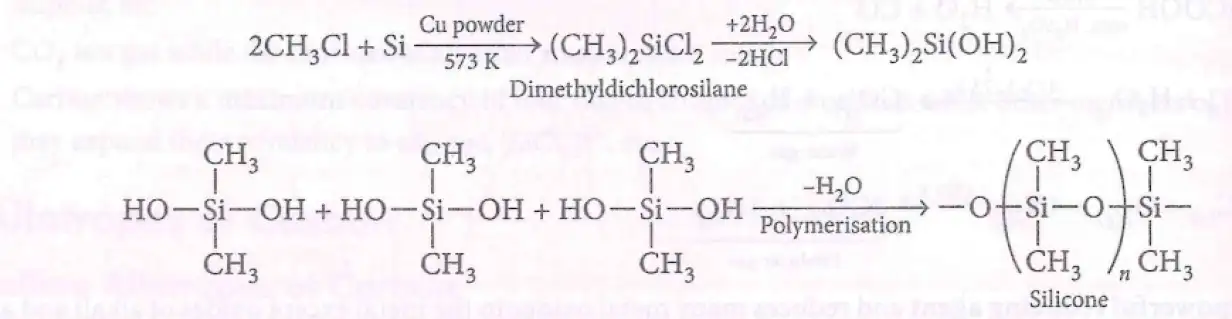
Silicones — Organosilicon polymers with the repeating unit .
Preparation and chain length
- Starting materials: Alkyl- or aryl-substituted silicon chlorides have the general formula .
- Chlorosilane preparation: Heating an organic chloride, , with silicon at using copper as a catalyst produces substituted silicon chlorides.
- Hydrolysis and polymerisation: Dialkyldichlorosilanes or diaryldichlorosilanes are hydrolysed; the resulting silanediols then polymerise by condensation.
- Chain-length control: Adding blocks the polymer ends and controls chain length.
Properties and uses
- Water repellence: Non-polar alkyl groups make silicones water-repelling.
- Stability: They have high thermal stability and dielectric strength, and resist oxidation and chemicals.
- Uses: They are used as sealants, greases, electrical insulators and for waterproofing fabrics.
- Biocompatibility: Silicones are also used in surgical and cosmetic implants.
Silicates
Silicates — Compounds whose basic structural units are tetrahedra.
Silicate structures
- Linking: Tetrahedra may remain discrete or share one, two, three or four oxygen atoms with neighbouring units.
- Structures formed: Sharing can produce chains, rings, sheets or three-dimensional networks.
Zeolites
Zeolites — Three-dimensional aluminosilicates in which some silicon atoms are replaced by aluminium ions.
Properties and uses
- Charge balance: The negative charge created by replacing Si with is balanced by cations such as , and .
- Ion exchange: Zeolites are used to soften hard water.
- Catalysis: They are used as catalysts in petrochemical industries.
- ZSM-5: This zeolite converts alcohols directly into gasoline.
Quick recap
- CO is poisonous, reduces many metal oxides, forms metal carbonyls and is made by several routes.
- Water gas is a CO–hydrogen mixture; producer gas contains CO and nitrogen.
- CO₂ is an acidic oxide; solid CO₂ is dry ice, and photosynthesis removes CO₂ from air.
- Silica is a strong covalent network solid attacked by HF and NaOH; quartz, silica gel and kieselguhr have important uses.
- Silicones are water-repelling, stable polymers; their chain length can be controlled by blocking chain ends.
- Silicates are built from linked tetrahedra; zeolites are ion exchangers and catalysts.
NEET Chemistry — ALL CHAPTERS
1
Some Basic Concepts of Chemistry
2
Structure of Atom
3
Classification of Elements and Periodicity in Properties
4
Chemical Bonding and Molecular Structure
5
Thermodynamics
6
Equilibrium
7
Redox Reactions
8
Organic Chemistry - Some Basic Principles and Techniques
9
Hydrocarbons
10
Solutions
11
Electrochemistry
12
Chemical Kinetics
13
The d- and f- Block Elements
14
Coordination Compounds
15
Haloalkanes and Haloarenes
16
Alcohols, Phenols and Ethers
17
Aldehydes, Ketones and Carboxylic Acids
18
Amines
19
Biomolecules
20
The p-Block Elements (Group 13 and 14)
21
The p-Block Elements (Group 15 to 18)
22
Principles Related to Practical Chemistry