NEET UG . NEET Chemistry . Chemistry . Thermodynamics
Chapter 5: Thermodynamics
Ch 5
NEET Chemistry
NEET UG
Thermodynamic Terms
Thermodynamics and Chemical Thermodynamics
Scope and laws
- Thermodynamics studies energy forms and transformations, especially the conversion of heat into work and vice versa.
- Equilibrium condition Thermodynamic laws apply to systems in equilibrium or to changes between equilibrium states.
- Chemical thermodynamics studies chemical substances and chemical changes.
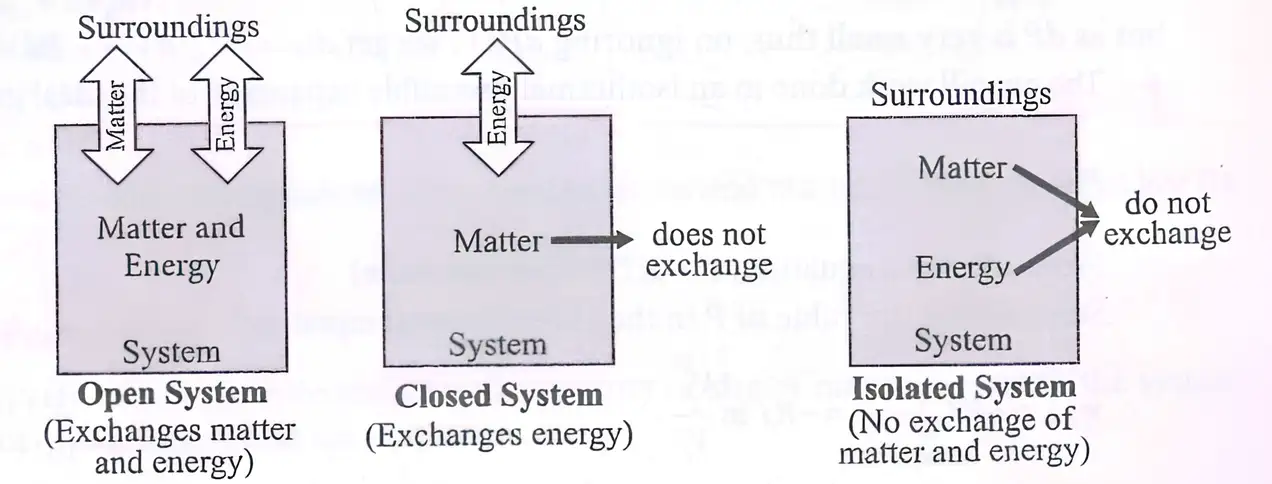
Thermodynamic System and Its Surroundings
Thermodynamic system — The part of the universe selected for observation.
- Surroundings Everything in the universe outside the system.
- Boundary A real or imaginary surface that separates the system from its surroundings.
| Type | Matter exchange | Energy exchange |
|---|---|---|
| Open | Yes | Yes |
| Closed | No | Yes |
| Isolated | No | No |
State and Processes of a System
Thermodynamic state — The set of measurable properties that specifies a system and allows its useful calculations.
State variables and process types
- State functions Properties that depend only on the system's state, not on the path taken to reach it.
- Examples Pressure , temperature , volume , and amount of substance .
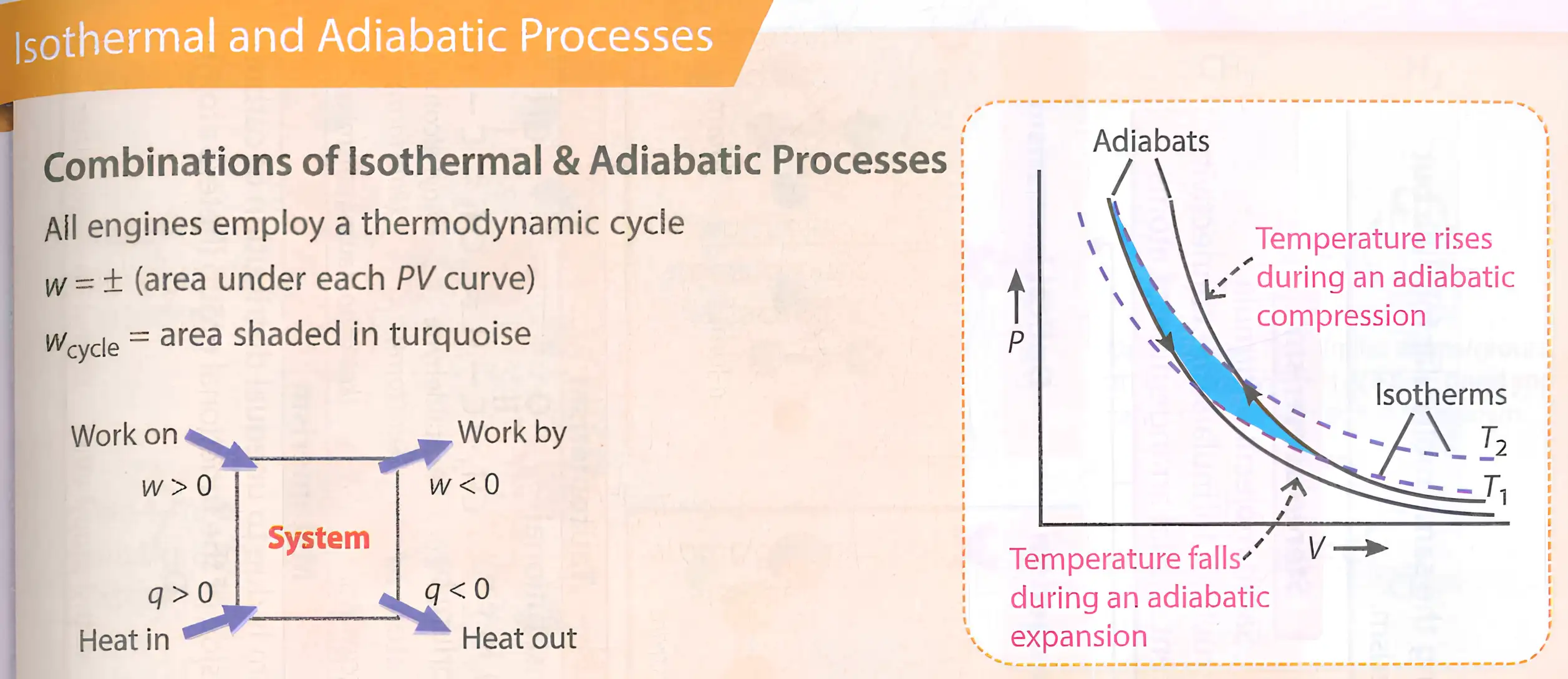
- Isothermal Temperature remains constant: .
- Adiabatic No heat is exchanged: .
- Isobaric Pressure remains constant: .
- Isochoric Volume remains constant: .
Reversibility and heat effects
- Reversible process Its direction can be reversed at any stage.
- Irreversible process Proceeds in only one direction and cannot be reversed.
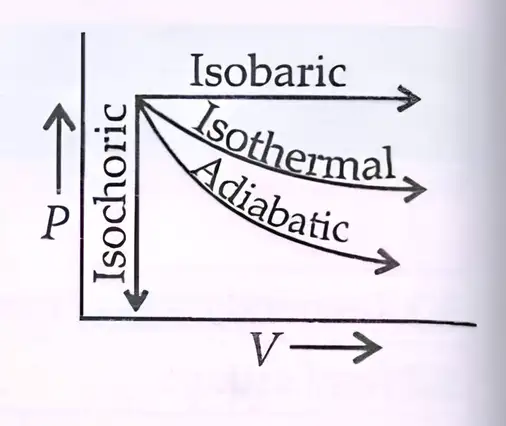
- Cyclic process The system returns to its initial state after a sequence of steps; and .
- Exothermic process Heat is released by the system.
- Endothermic process Heat is absorbed by the system.
Internal Energy and the First Law
Internal energy — The total energy within a system, including its chemical, electrical, mechanical, and other forms of energy; it is a state function.
- Internal energy changes When heat enters or leaves, work is done on or by the system, or matter enters or leaves.
- First law The energy of an isolated system remains constant; energy cannot be created or destroyed.
- State versus path depends only on initial and final states, while heat and work depend on the process path.
| Energy transfer | Sign |
|---|---|
| Heat absorbed by the system | Positive |
| Heat evolved by the system | Negative |
| Work done on the system | Positive |
| Work done by the system | Negative |
Useful special cases
- Adiabatic change Since , the internal-energy change equals the work done on the system: .
- Constant volume When no work is done at constant volume, .
State the first law of thermodynamics and write its equation.
Quick recap
- Thermodynamics studies energy and its transformations; chemical thermodynamics focuses on chemical systems and changes.
- Open systems exchange matter and energy; closed systems exchange energy only; isolated systems exchange neither.
- State functions depend only on the state; examples include , , , , and .
- Isothermal, adiabatic, isobaric, and isochoric processes keep , , , and constant, respectively.
- A reversible process can be reversed at any stage; an irreversible process cannot, while a cycle returns the system to its initial state.
- The first law is ; heat absorbed and work done on the system are positive under this convention.
- For adiabatic changes, ; at constant volume with no work, .
Applications
Work
Using , the same work can be written in terms of initial and final pressures.
Free, irreversible and adiabatic changes
- Free expansion: Expansion into vacuum has , so . For an ideal gas, an isothermal free expansion also has and .
- Irreversible isothermal change: At constant external pressure, . For an ideal gas, , hence .
- Reversible isothermal ideal-gas change: , so ; expansion absorbs heat equal in magnitude to the work done by the gas.
- Adiabatic change: , therefore .
Enthalpy
For an ideal-gas reaction, is gaseous product moles minus gaseous reactant moles.
| Condition | Relation |
|---|---|
| Only solids/liquids, or constant volume |
Extensive and Intensive Properties
- Extensive properties: Depend on the amount of matter; examples include mass, volume, internal energy and enthalpy.
- Intensive properties: Do not depend on the amount of matter; examples include temperature, pressure and density.
Heat Capacity
At constant pressure, heat capacity relates to enthalpy change; at constant volume, it relates to internal-energy change.
| Gas type | |
|---|---|
| Monatomic | |
| Diatomic | |
| Triatomic |
Efficiency of a Heat Engine
| Conversion |
|---|
Joule–Thomson Effect
For an ideal gas undergoing an adiabatic reversible change, .
For moles changing from initial temperature to final temperature , use the lecture's stated relation.
State the relation between enthalpy change and internal-energy change for a gaseous reaction.
What is the work done in reversible isothermal expansion of an ideal gas?
Quick recap
- Reversible isothermal ideal-gas work is ; expansion work is negative.
- Free expansion has ; an adiabatic process has .
- Enthalpy is and, at constant pressure, .
- For an ideal-gas reaction, .
- Heat-capacity relations include , , and .
- Heat-engine efficiency is ; the Joule–Thomson effect is zero for an ideal gas.
Measurement of ΔU and ΔH : Calorimetry
Measurement of Internal Energy Change (ΔU)
- Instrument: A bomb calorimeter is used to measure the change in internal energy.
- Temperature change: The temperature rise, , is used in the calculation.
Here, is the mass of substance taken, its molar mass, the heat capacity of the calorimeter, and the temperature rise.
Measurement of Enthalpy Change (ΔH)
- Method: Carry out the reaction directly in an insulated calorimeter and note the temperature change.
- Exothermic reaction: The temperature rises.
- Endothermic reaction: The temperature falls.
- Measurement: The observed temperature change is used to determine the enthalpy change, .
Quick recap
- A bomb calorimeter is used to measure .
- Calculate using .
- is the mass taken, the molar mass, the calorimeter heat capacity, and the temperature rise.
- For measuring , carry out the reaction directly in an insulated calorimeter and note the temperature change.
- Exothermic reactions raise the temperature; endothermic reactions lower it.
Enthalpy Change, ΔᵣH of a Reaction – Reaction Enthalpy
Reaction Enthalpy
Here, and are the stoichiometric coefficients of products and reactants, respectively.
Here, denotes molar enthalpy.
Standard Enthalpy of Reaction and Standard State
- Standard reaction enthalpy: The enthalpy change when all reactants and products are in their standard states.
- Standard state: The pure form of a substance at a specified temperature and a pressure of 1 bar.
Enthalpy Changes in Phase Transformations
Sublimation can be viewed as fusion followed by vaporisation.
Enthalpy of Formation
Hess’s Law of Constant Heat Summation
Add the enthalpy changes of the intermediate reactions.
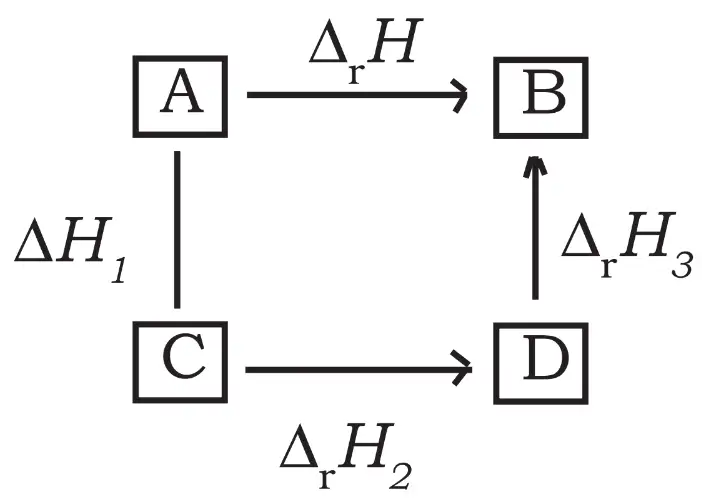
State Hess’s law of constant heat summation.
What is the standard state of a substance?
Quick recap
- Reaction enthalpy is the sum of product enthalpies minus the sum of reactant enthalpies, weighted by stoichiometric coefficients.
- A standard reaction enthalpy applies when all reactants and products are in their standard states: pure forms at and a specified temperature.
- Fusion, vaporisation, and sublimation describe solid-to-liquid, liquid-to-vapour, and direct solid-to-vapour changes, respectively.
- The standard enthalpy of sublimation equals the sum of the standard enthalpies of fusion and vaporisation.
- Enthalpy of formation refers to forming one mole of a substance from elements in their most stable states.
- By Hess’s law, the enthalpy change for an overall reaction equals the sum for its steps at the same temperature.
Enthalpies for Different Types of Reactions
Enthalpy of Combustion
Enthalpy of combustion — The enthalpy change when one mole of a substance is completely burnt in oxygen.
- Sign: Combustion releases heat, so the enthalpy change is always negative.
- Standard example: Complete combustion of carbon forms carbon dioxide.
Enthalpy of Atomization and Bond Enthalpy
Enthalpy of atomization — The enthalpy change when one mole of bonds is completely broken to form gaseous atoms.
Bond dissociation enthalpy — The enthalpy change when one mole of covalent bonds in a gaseous covalent compound is broken to form gaseous products.
Bond enthalpy — The enthalpy change associated with breaking bonds; it can be used to estimate reaction enthalpy for gas-phase reactions.
Use for gas-phase reactions; subtract product bond enthalpies from reactant bond enthalpies.
Lattice Enthalpy and the Born–Haber Cycle
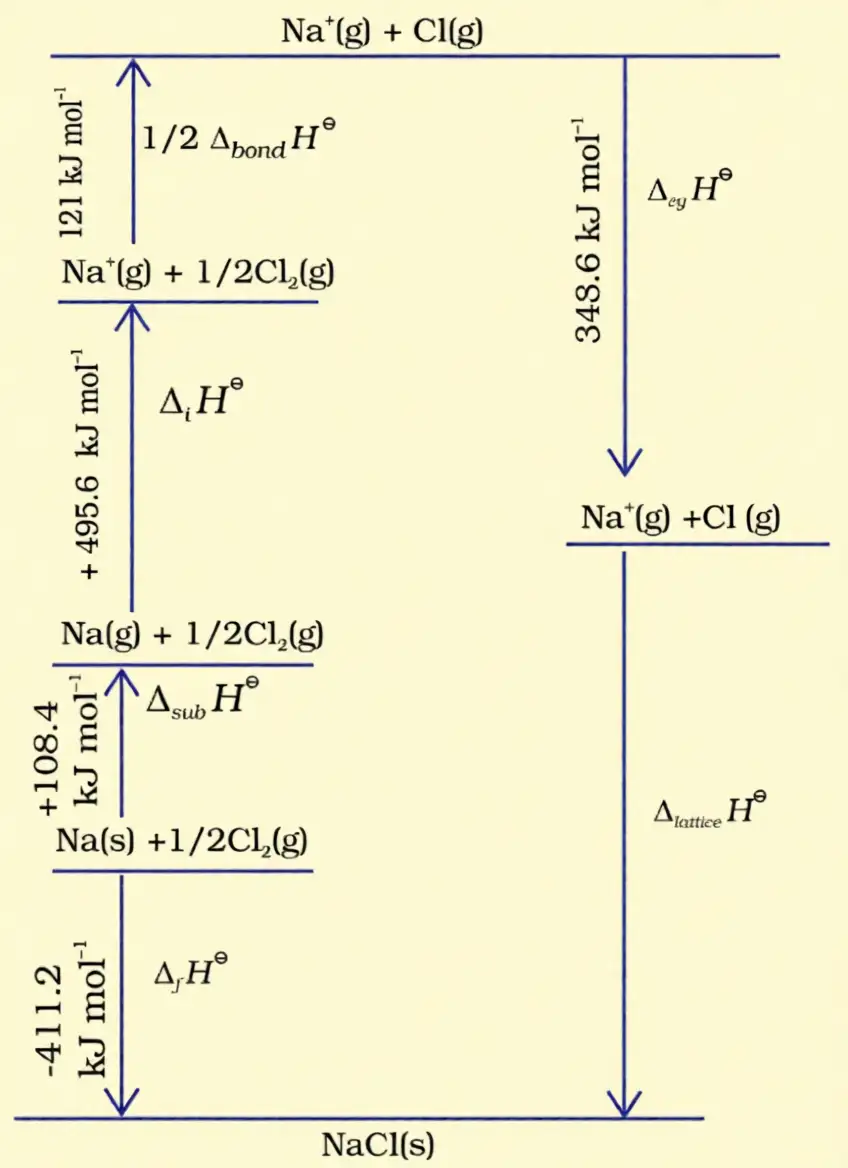
Lattice enthalpy — The enthalpy change when one mole of an ionic compound dissociates into its gaseous ions.
- Calculation: Lattice enthalpy is determined using a Born–Haber cycle, which relates the formation enthalpy to the enthalpy steps involved.
- Sign convention: Use signs consistently with the stated definition and the direction of each cycle step.
The cycle combines sodium sublimation, chlorine dissociation, sodium ionization, chlorine electron gain and lattice enthalpy.
Enthalpy of Solution and Dilution
Enthalpy of solution — The enthalpy change when one mole of a substance dissolves in a specified amount of solvent.
For an ionic solid, it is the sum of lattice and hydration enthalpy changes.
- Most ionic compounds: Their enthalpy of solution is positive, so dissolution is endothermic.
- Temperature and solubility: The solubility of most salts in water increases as temperature rises.
- Very high lattice enthalpy: The compound may not dissociate at all.
Enthalpy of dilution — The heat withdrawn from the surroundings when extra solvent is added to a solution.
- Dependence: Enthalpy of dilution depends on the solution’s original concentration.
- Solution enthalpy conditions: Enthalpy of solution refers to adding a specified amount of solute to a specified amount of solvent at constant temperature and pressure.
Enthalpy of solution at infinite dilution — The enthalpy change when a substance dissolves in an infinite amount of solvent, making interactions between ions negligible.
Enthalpy of Neutralisation
Enthalpy of neutralisation — The heat change when one gram equivalent of an acid is completely neutralised by one gram equivalent of a base in dilute solution.
Enthalpy of Transition
Enthalpy of transition — The enthalpy change when one mole of a substance changes from one allotropic form to another.
Enthalpy of Hydration
Enthalpy of hydration — The heat change when one mole of an anhydrous substance combines with the required amount of water to form a hydrate.
How is reaction enthalpy estimated from bond enthalpies?
Define enthalpy of solution at infinite dilution.
Quick recap
- Combustion enthalpy is negative because complete burning releases heat.
- Atomization forms gaseous atoms; bond enthalpy helps estimate gas-phase reaction enthalpy.
- A Born–Haber cycle relates lattice enthalpy to the formation steps of an ionic solid.
- Enthalpy of solution combines lattice and hydration contributions; most ionic salts dissolve endothermically.
- Enthalpy of dilution depends on the solution’s initial concentration.
- Neutralisation, allotrope transition and hydration each have a characteristic enthalpy change.
Spontaneity
Spontaneous Processes and Entropy
- Spontaneous process: .
- Equilibrium: Entropy is maximum and its change is zero; entropy increases toward this maximum during a spontaneous process.
Entropy Changes
Use the transition enthalpy and the transition temperature.
Here, is the boiling point.
Here, is the temperature at which sublimation occurs.
Subtract the sum for reactants from the sum for products.
Gibbs Free Energy and Spontaneity
Calculate from the standard Gibbs energies of formation of products and reactants.
The same relation applies to standard quantities.
Here, is the standard emf of the cell.
Effect of Temperature on Spontaneity
- Temperature criterion: At constant pressure and temperature, spontaneity is determined by .
- Favourable enthalpy and entropy: If and , the process is spontaneous at all temperatures.
- Temperature-dependent cases: If , spontaneity is favoured at high temperature; if , it is favoured at low temperature. If both are positive, the process is non-spontaneous at all temperatures.
Thermodynamic Laws and Entropy Trends
- Second law: The total entropy change of the system and surroundings is positive for a spontaneous process and zero at equilibrium.
- Third law: The entropy of a pure crystalline substance approaches zero as its temperature approaches absolute zero.
- Entropy trends: Greater molecular symmetry generally means lower entropy; stretching rubber orders its molecules and decreases entropy, while boiling an egg increases entropy as proteins become disordered.
Entropy Change of an Ideal Gas
The two forms use the appropriate heat capacity and state variables.
| Process | Entropy change |
|---|---|
| Isothermal | |
| Isochoric | |
| Isobaric |
Differential Gibbs–Helmholtz Relations
These are equivalent forms at constant pressure.
State the entropy criterion for spontaneity and equilibrium.
How does Gibbs energy indicate spontaneity at constant temperature and pressure?
Quick recap
- Spontaneous processes have and proceed toward maximum entropy at equilibrium.
- Entropy change for reversible heat transfer is ; phase-change entropy is transition enthalpy divided by transition temperature.
- At constant temperature and pressure, Gibbs energy predicts spontaneity: negative, positive and zero values indicate spontaneous, non-spontaneous and equilibrium conditions.
- Temperature effects depend on the signs of and .
- A pure crystal approaches zero entropy as temperature approaches absolute zero.
- Ideal-gas entropy formulas simplify according to whether the process is isothermal, isochoric or isobaric.
Gibbs Energy Change and Equilibrium
Relation Between Gibbs Energy and the Equilibrium Constant
Use in kelvin and as the gas constant.
| Standard Gibbs energy change | Equilibrium mixture and reaction type | ||
|---|---|---|---|
| Reactants and products are present in comparable amounts; for 1 M concentrations and 1 atm partial pressures. | |||
| Products predominate; associated with exothermic reactions. | |||
| Reactants predominate; associated with endothermic reactions. |
What does imply about the equilibrium constant and mixture?
Quick recap
- .
- If , then and reactants and products are present in comparable amounts; this applies for 1 M concentrations and 1 atm partial pressures.
- If , then , products predominate, and the reaction is associated with exothermic reactions.
- If , then , reactants predominate, and the reaction is associated with endothermic reactions.
NEET Chemistry — ALL CHAPTERS
1
Some Basic Concepts of Chemistry
2
Structure of Atom
3
Classification of Elements and Periodicity in Properties
4
Chemical Bonding and Molecular Structure
5
Thermodynamics
6
Equilibrium
7
Redox Reactions
8
Organic Chemistry - Some Basic Principles and Techniques
9
Hydrocarbons
10
Solutions
11
Electrochemistry
12
Chemical Kinetics
13
The d- and f- Block Elements
14
Coordination Compounds
15
Haloalkanes and Haloarenes
16
Alcohols, Phenols and Ethers
17
Aldehydes, Ketones and Carboxylic Acids
18
Amines
19
Biomolecules
20
The p-Block Elements (Group 13 and 14)
21
The p-Block Elements (Group 15 to 18)
22
Principles Related to Practical Chemistry