NEET UG . NEET Chemistry . Chemistry . Chemical Kinetics
Chapter 12: Chemical Kinetics
Ch 12
NEET Chemistry
NEET UG
Rate of a Chemical Reaction
Chemical Kinetics
Chemical kinetics — The branch of chemistry that studies reaction rates and reaction mechanisms.
Why study reaction kinetics?
- Rate: Kinetic studies determine how quickly a reaction occurs.
- Conditions: They show how reaction rates can be altered.
Rate of a Chemical Reaction
Rate of reaction — The change in concentration of a reactant or product per unit time.
Reactant concentration decreases, so its rate expression has a minus sign; product concentration increases, so its expression has a plus sign.
Units of reaction rate
- Concentration-based rate: Concentration per time, such as .
- Gaseous reactions: If pressure is used to express concentration change, the unit may be .
| Point | Average rate | Instantaneous rate |
|---|---|---|
| Meaning | Average rate over a finite time interval | Rate at a particular instant |
| Expression for R → P | ||
| Change symbol | represents a finite or larger change | represents a very small change; take the limit as |
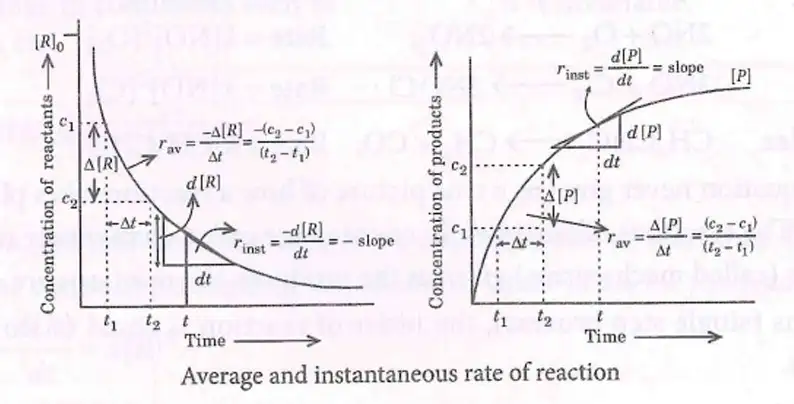
Do not omit the minus sign for a reactant: its concentration falls as the reaction proceeds, while the rate is conventionally positive.
Quick recap
- Chemical kinetics studies reaction rates and mechanisms.
- Reaction rate is concentration change per unit time.
- For , the reactant expression is negative and the product expression is positive.
- Rate units include and, for gaseous reactions, .
- Average rate uses over a finite interval; instantaneous rate uses at a particular instant.
Factors Influencing Rate of a Reaction
Factors Influencing Reaction Rate
Factors
- Concentration: Higher reactant concentrations generally increase the reaction rate.
- Physical state: Reactions involving gaseous reactants are faster than those involving solid and liquid reactants.
- Temperature: Increasing temperature raises the rate; for most reactions, a rise nearly doubles it.
- Catalyst: A catalyst generally increases the speed of a reaction.
- Surface area: For reactions involving a solid reactant or catalyst, greater exposed surface area increases the rate.
- Light: Photochemical reactions take place only in the presence of light.
- Activation energy: Lower activation energy generally means a faster reaction.
Rate Expression and Rate Constant
Rate law (rate expression) — An expression relating reaction rate to reactant concentrations, each raised to an experimentally determined power.
For , the exponents and may differ from the stoichiometric coefficients and . The proportionality constant is the rate constant.
Rate constant () — The proportionality constant in the rate law; its units depend on the overall reaction order.
Order of a Reaction
Order of reaction — The sum of the powers of reactant concentrations in the rate law.
For the rate law above, add the concentration exponents.
Key points
- Possible values: Order may be zero, a positive integer, or fractional.
- Determination: Order is obtained from the rate law, not generally from the balanced equation.
| Order | Example rate law |
|---|---|
| Zero | |
| First | |
| Second | or |
| Third | |
| Fractional |
Do not assume rate-law exponents equal balanced-equation coefficients; this is generally valid only for an elementary reaction.
Elementary and Complex Reactions
| Point | Elementary reaction | Complex reaction |
|---|---|---|
| Steps | Occurs in a single step. | Occurs through a sequence of elementary steps called a mechanism. |
| Balanced equation | Represents the single-step process. | Does not by itself show the full mechanism; reactions rarely finish in one step. |
| Rate relationship | Order equals the stoichiometric coefficients of the reactants in that step. | The slowest step is the rate-determining step and controls the overall rate. |
Rate has units of concentration per time. For overall order , using concentration in and time in :
| Order | Units of |
|---|---|
| Zero | |
| First | |
| Second |
Molecularity of a Reaction
Molecularity — The number of atoms, ions, or molecules that must collide simultaneously in an elementary reaction.
| Type | Number of reacting species | Example |
|---|---|---|
| Unimolecular | 1 | |
| Bimolecular | 2 | |
| Trimolecular | 3 |
Key point
- Collision probability: Simultaneous collision of more than three molecules is very improbable; trimolecular reactions are rare and slow.
| Point | Order | Molecularity |
|---|---|---|
| Meaning | Sum of concentration powers in the rate law. | Number of species in an elementary reaction. |
| How obtained | Determined experimentally; it is not calculated directly from the balanced equation. | Counted by adding the reacting species in an elementary step. |
| Possible values | May be zero, fractional, or an integer. | Always a positive whole number. |
| Applicability | Applies to elementary and complex reactions. | Applies only to elementary reactions. |
| Complex reactions | For a complex reaction, the overall order is given by the slowest step. | Has no significance for the overall complex reaction. |
| Effect of conditions | May change with conditions such as temperature or pressure. | Invariable for a given elementary reaction. |
How is the overall order obtained from a rate law?
State two differences between order and molecularity.
Quick recap
- Rate factors: Concentration, physical state, temperature, catalyst, surface area, light, and activation energy influence reaction rate.
- Rate equation: ; rate-law powers need not match balanced-equation coefficients.
- Order: Add the concentration exponents; reaction order can be zero, integral, or fractional.
- Mechanism: Complex reactions proceed through elementary steps, and the slowest step determines the overall rate.
- Rate-constant units: Units of depend on overall order; zero-, first-, and second-order units are respectively , , and .
- Molecularity: Count the species colliding in one elementary step; it is always a positive whole number.
Integrated Rate Equations
Zero-Order Reactions
Half-life is the time required for half the reactant to be consumed. It increases in proportion to the initial concentration.
First-Order Reactions
Setting gives a half-life independent of the initial reactant concentration.
The time to complete a fraction and the time for reactant to fall to of its initial amount are different quantities.
| Fraction completed | Time |
|---|---|
| Reaction | Order | Rate law | Rate constant |
|---|---|---|---|
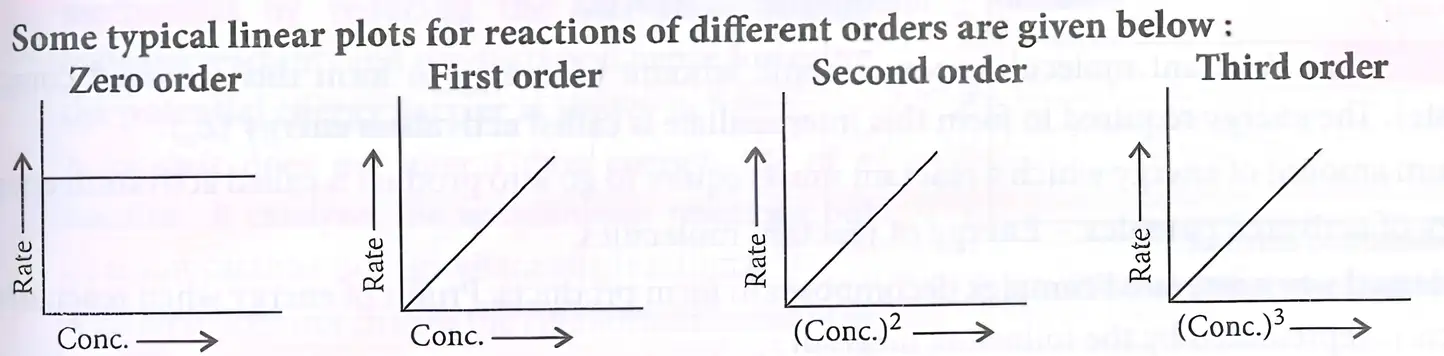
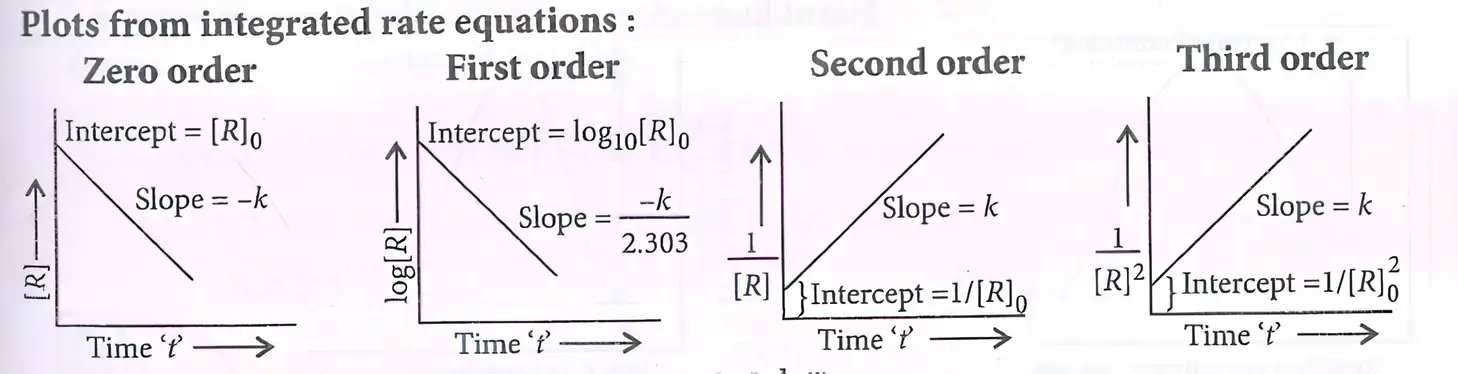
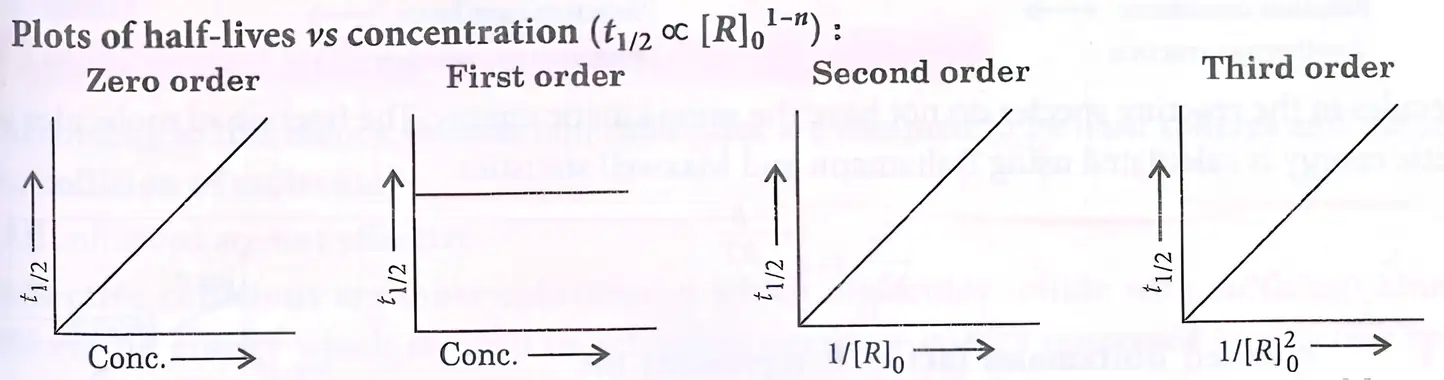
Pseudo-first-order reaction — A reaction that is not truly first order but behaves as first order under particular conditions.
How does the half-life of a zero-order reaction differ from that of a first-order reaction?
Quick recap
- Zero-order rate is constant; and .
- First-order rate is proportional to reactant concentration; .
- First-order half-life is concentration-independent: .
- After first-order half-lives, the remaining amount is .
- Pseudo-first-order reactions behave as first order when conditions make the rate appear to depend on one reactant.
Temperature Dependence of the Rate of a Reaction
Temperature and Rate Constant
Here, is the pre-exponential (frequency) factor, is activation energy, and is the gas constant.
Collision and Activated Complex
- Collision is necessary for reactant molecules to react.
- Activated complex is a short-lived, unstable intermediate formed during an effective collision; it can break up to form products.
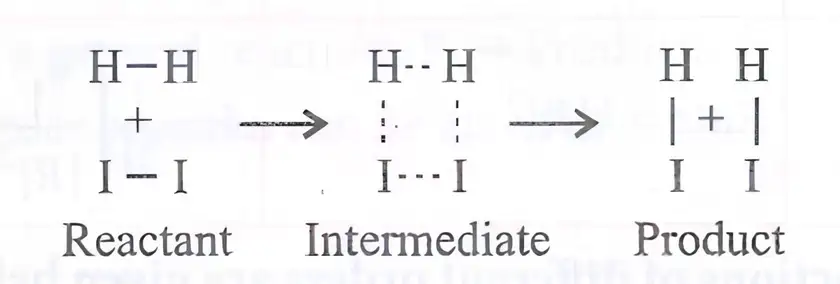
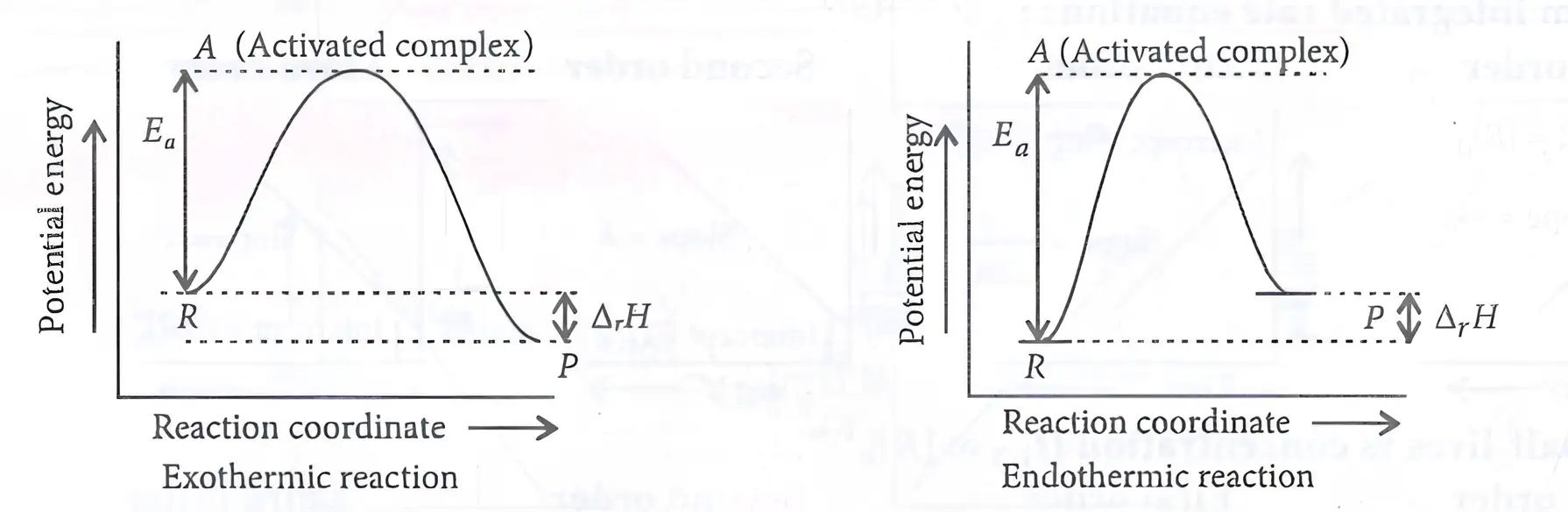
Activation Energy
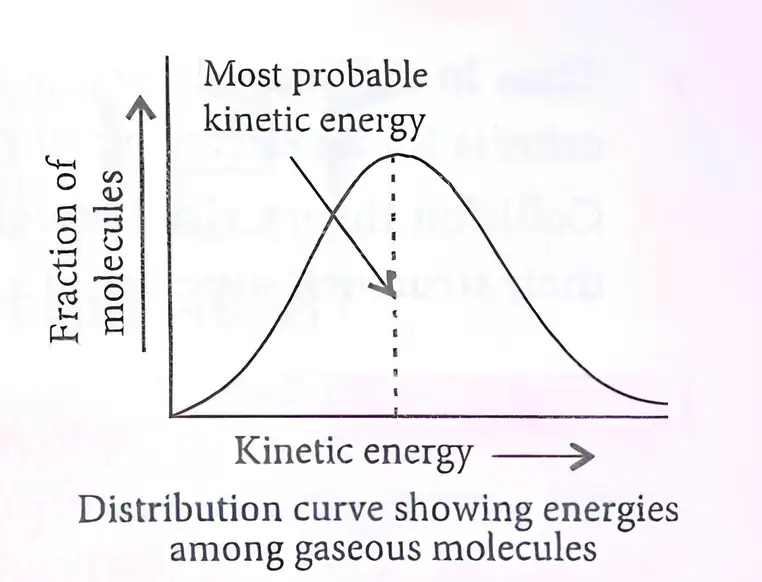
Molecular Energy Distribution
The ratio represents the fraction of molecules with energy at least .
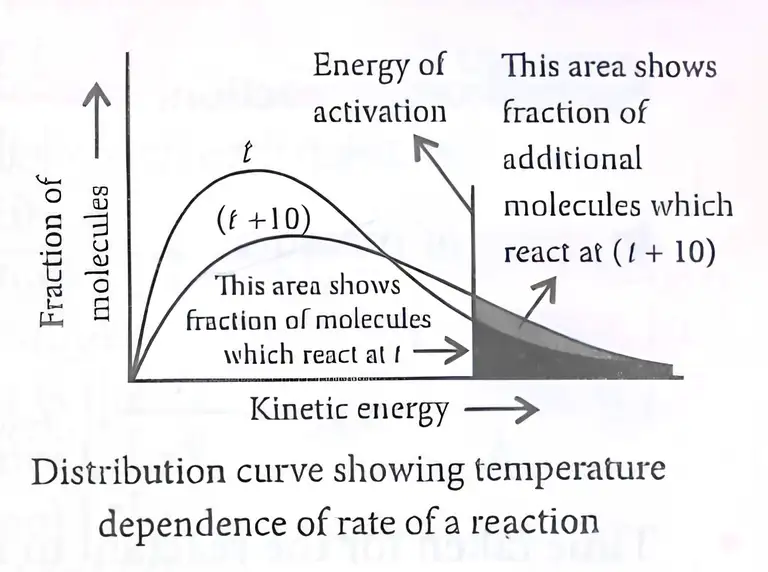
Effect of Increasing Temperature
- Distribution curve With higher temperature, the peak shifts to higher energy and the curve broadens.
- Effective molecules The fraction of molecules with energy at least increases, so more collisions can overcome the activation barrier.
Arrhenius Plot and Two-Temperature Equation
Use this form to identify the slope and intercept of the Arrhenius plot.
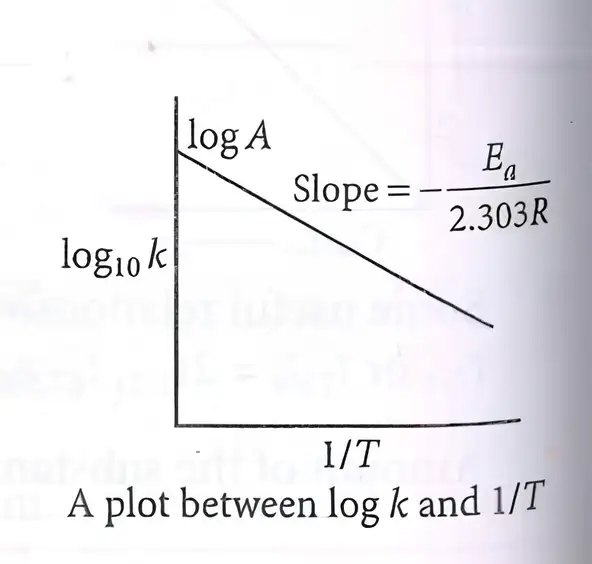
Here, and are the rate constants at absolute temperatures and , respectively.
Effect of a Catalyst
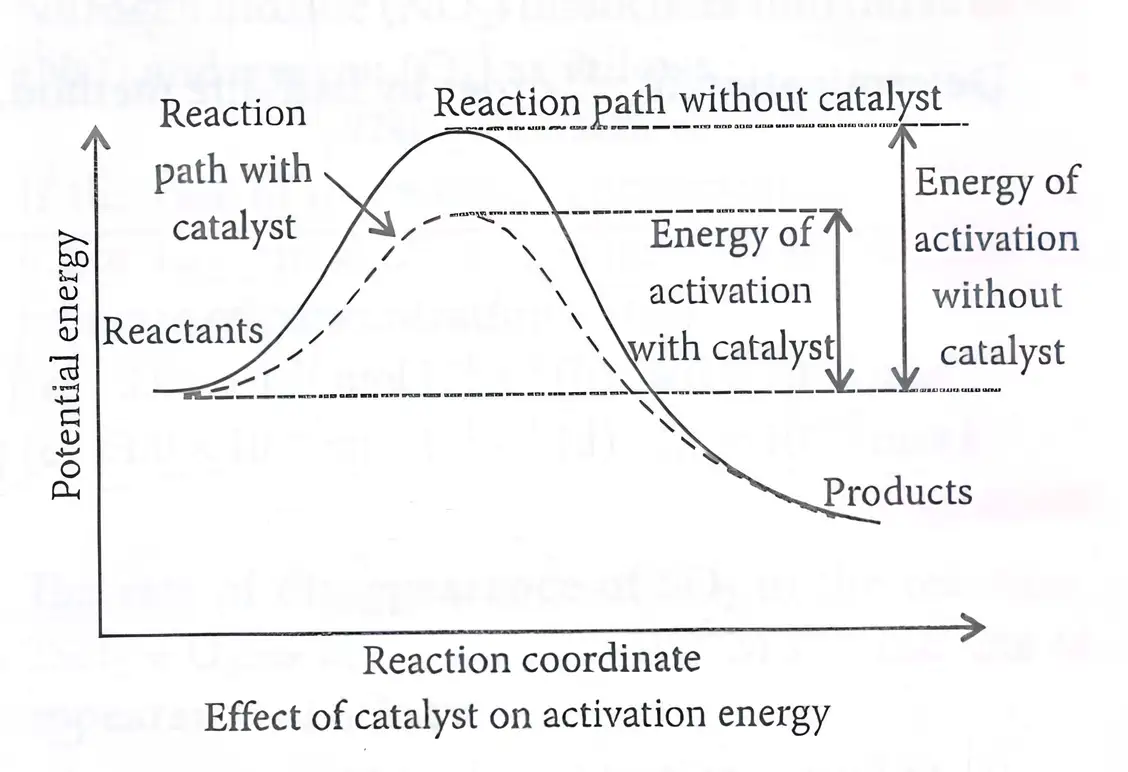
Negative Temperature Coefficient
Quick recap
- Arrhenius equation The rate constant depends on temperature as .
- Activation energy It is the energy gap between reactants and the activated complex.
- Temperature rise Higher temperature increases the fraction of molecules with energy at least .
- Arrhenius plot The slope of versus is .
- Catalyst It lowers activation energy and speeds attainment of equilibrium without changing or the equilibrium constant.
- Exception The reaction has a small negative temperature coefficient.
Collision Theory of Chemical Reactions
Collision Theory
Collision theory — Reactant molecules are treated as hard spheres, and a reaction can occur when they collide.
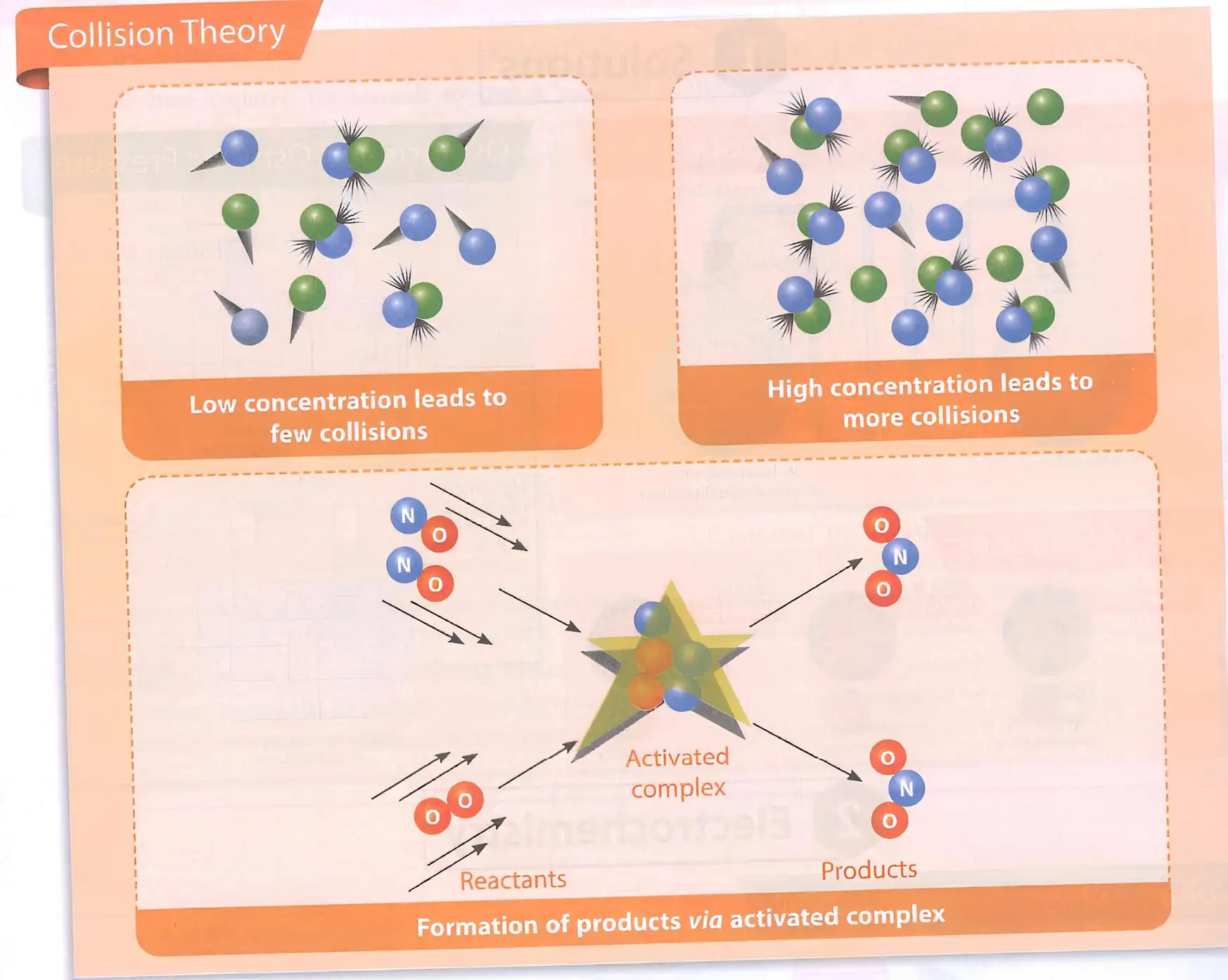
Effective Collisions
- Not every collision produces a reaction; only effective collisions lead to product formation.
- Energy condition: Colliding molecules must have at least the threshold energy, stated as activation energy plus the energy possessed by the reacting species.
- Orientation condition: Molecules must collide with the correct orientation.
- Rate control: Activation energy and proper orientation together determine whether collisions are effective and therefore affect the reaction rate.
is the steric (probability) factor; is the collision frequency of reactants and , measured as collisions per second per unit volume.
A collision alone does not guarantee reaction: the molecules need sufficient energy and proper orientation.
Limitation
- Drawback: The theory models atoms and molecules as hard spheres and ignores their structural features.
Integrated Rate-Law Relations
is the initial concentration and is the concentration after time .
is the time for the reactant concentration to fall to half its initial value.
is the initial amount or concentration and is the amount reacted by time .
For the pressure-based expression given in the lecture, is the initial pressure and is the pressure at time .
| Conversion | Time |
|---|---|
| 60% | |
| 75% | |
| 90% | |
| 99.9% |
For a first-order reaction, the amount remaining is when the reactant has fallen to the th fraction of its initial amount.
Compare half-lives measured at initial concentrations and ; and are the corresponding half-lives.
Quick recap
- A reaction occurs through collisions, but only collisions with sufficient energy and proper orientation are effective.
- The collision-theory rate depends on steric factor, collision frequency and the exponential activation-energy term.
- Collision theory treats molecules as hard spheres and ignores their structure.
- For a zero-order reaction, and .
- For a first-order reaction, and time for specified conversion follows logarithmic relations.
- After first-order half-lives, the remaining concentration is .
NEET Chemistry — ALL CHAPTERS
1
Some Basic Concepts of Chemistry
2
Structure of Atom
3
Classification of Elements and Periodicity in Properties
4
Chemical Bonding and Molecular Structure
5
Thermodynamics
6
Equilibrium
7
Redox Reactions
8
Organic Chemistry - Some Basic Principles and Techniques
9
Hydrocarbons
10
Solutions
11
Electrochemistry
12
Chemical Kinetics
13
The d- and f- Block Elements
14
Coordination Compounds
15
Haloalkanes and Haloarenes
16
Alcohols, Phenols and Ethers
17
Aldehydes, Ketones and Carboxylic Acids
18
Amines
19
Biomolecules
20
The p-Block Elements (Group 13 and 14)
21
The p-Block Elements (Group 15 to 18)
22
Principles Related to Practical Chemistry