NEET UG . NEET Chemistry . Chemistry . Chemical Bonding and Molecular Structure
Chapter 4: Chemical Bonding and Molecular Structure
Ch 4
NEET Chemistry
NEET UG
Kossel—Lewis Approach to Chemical Bonding
Chemical Bonding and the Octet Rule
Chemical bond — An attractive force that holds atoms, ions or other constituents together in a chemical species.
Why atoms interact
- Energy: Atoms interact when net attractive forces exceed repulsive forces, lowering the system’s energy.
- Stability: Atoms tend to attain stable noble-gas configurations by completing an octet or, for hydrogen, a duplet.
- Octet rule: Atoms gain, lose or share valence electrons to complete their outer shell.
| Route | What happens | Bond formed |
|---|---|---|
| Electron transfer | One atom transfers one or more electrons to another; this process is called electrovalency. | Electrovalent or ionic bond |
| Equal contribution to sharing | Each atom contributes to the shared electron pair(s). | Covalent bond |
| One-sided contribution to sharing | One atom supplies the shared pair; both atoms share it. | Coordinate or dative bond |
Covalent Bonds
Covalent bond — A bond formed when two atoms mutually share one or more pairs of electrons; substances containing these bonds are covalent compounds.
How covalent bonds form
- Shared pair: Each electron pair shared between atoms forms one bond; each atom contributes at least one electron.
- Stability: Sharing helps the combining atoms attain noble-gas outer-shell configurations.
- Bond order: The number of shared electron pairs determines whether a bond is single, double or triple.
| Bond | Shared pairs | Example |
|---|---|---|
| Single | 1 | |
| Double | 2 | |
| Triple | 3 | No example specified in this lecture |
Lewis Representations of Simple Molecules
Lewis dot structure — A representation showing an atom’s valence electrons as dots around its symbol.
Reading Lewis structures
- Purpose: Lewis structures represent bonding in molecules and ions through shared pairs and the octet rule.
- Bond line: A line between atoms represents a shared electron pair.
- Lone pair: Valence electrons not used for bonding remain as non-bonding pairs.
- Hydrogen: Each H atom attains a helium-like duplet by sharing one pair.
| Molecule or ion | Representation and key electron pairs |
|---|---|
| or ; each H attains a duplet. | |
| ; each O has two lone pairs. | |
| ; the central O is positive and the single-bonded terminal O is negative. | |
| N has three single bonds and one lone pair; each F has three lone pairs. | |
| ; the double-bonded O has two lone pairs, and each single-bonded O has three. | |
| ; the double-bonded and OH oxygens each have two lone pairs, while has three. |
Formal Charge
Formal charge — The charge assigned to an atom in a Lewis structure by treating bonding electrons as shared equally between the bonded atoms.
Here, is the atom’s valence-electron count, its non-bonding electron count, and its bonding electron count.
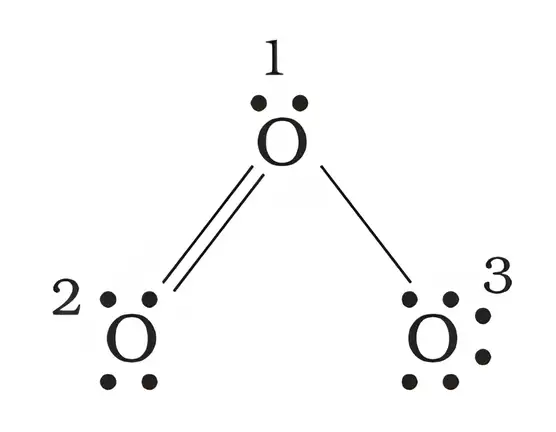
| Atom | Calculation | Formal charge |
|---|---|---|
| Central O (1) | ||
| Double-bonded terminal O (2) | ||
| Single-bonded terminal O (3) |
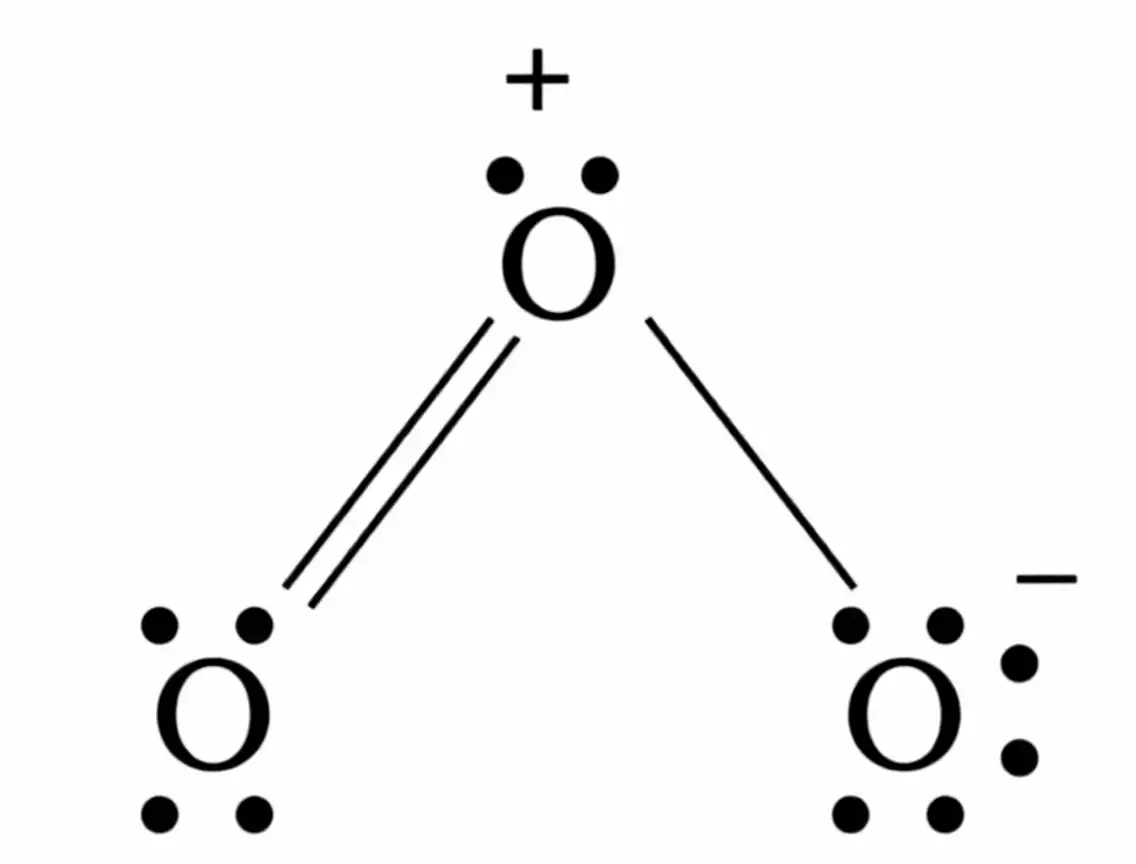
Using formal charges
- Comparison: Formal charges help select the lowest-energy structure from possible Lewis structures of a species.
- Preference: The preferred structure generally has the smallest formal charges on its atoms.
Limitations of the Octet Rule
Cases the octet rule does not explain
- Incomplete octet: Atoms with fewer than four outer electrons may not attain an octet even when all their valence electrons form bonds.
- Expanded valence shell: The rule does not account for atoms using an additional energy level; obeys the rule, but does not.
- Odd-electron species: It cannot describe molecules with an odd total number of electrons, such as and .
- Magnetic behaviour: It does not explain why is paramagnetic and has two unpaired electrons.
- Noble-gas compounds: It cannot account for compounds such as , and .
- Molecular properties: It does not predict molecular shape, relative stability or energy.
Electron-deficient molecule — A molecule in which an atom has an incomplete octet; such molecules behave as Lewis acids.
Examples of electron-deficient molecules
- Examples: , and have incomplete octets and behave as Lewis acids.
Quick recap
- Atoms bond when attraction lowers energy and interaction helps attain a stable outer-shell configuration.
- Electron transfer, called electrovalency, forms ionic bonds; equal sharing forms covalent bonds; one-atom donation forms coordinate bonds.
- One, two and three shared pairs make single, double and triple covalent bonds.
- Lewis structures show shared and lone pairs; formal charges help compare possible structures.
- The octet rule has limitations, including incomplete octets, expanded valence shells and odd-electron species.
- The octet rule alone does not explain paramagnetism, molecular shape, relative stability or energy.
Ionic or Electrovalent Bond
Ionic Bond Formation
- Ionic bond: Electrostatic attraction between oppositely charged ions formed by complete transfer of electrons.
- Formation: Favoured when one atom has low ionisation enthalpy and the other has a highly negative electron-gain enthalpy.
Lattice Enthalpy
| Factor | Effect on attraction | Effect on lattice enthalpy |
|---|---|---|
| Ionic charge | Higher ionic charges increase the force of attraction. | Higher charges give higher lattice enthalpy; typically, bi-bivalent > uni-bi or bi-uni > uni-univalent. |
| Ionic size | Smaller ions are closer together, increasing the force of attraction. | Lattice enthalpy is inversely proportional to ionic size: . |
Quick recap
- An ionic bond is electrostatic attraction between a cation and an anion formed by complete electron transfer.
- Low ionisation enthalpy and highly negative electron gain enthalpy favour ionic bond formation.
- Lattice enthalpy is the energy needed to separate one mole of an ionic solid into gaseous ions.
- Higher ionic charges increase lattice enthalpy; the typical order is bi-bivalent > uni-bi or bi-uni > uni-univalent.
- Smaller ions generally have greater lattice enthalpy because attraction increases as ionic size decreases.
- Ionic stability depends on lattice enthalpy, not solely on octets in isolated gaseous ions.
Bond Parameters
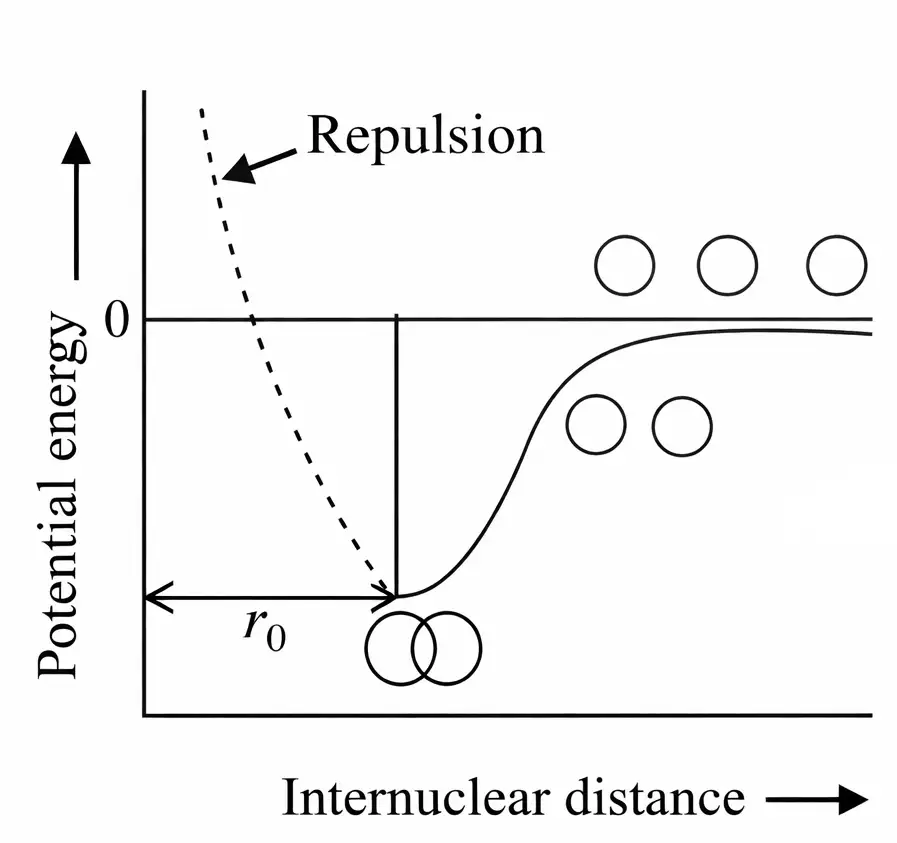
Bond Length
Bond Angle
- Bond angle: The average angle between bonded orbitals in a molecule of three or more atoms; it indicates the three-dimensional arrangement of orbitals around the central atom.
Bond Enthalpy
For the two successive bonds in water:
| Bond | Bond enthalpy () |
|---|---|
Key comparison
- Highest among diatomic molecules: has the greatest bond enthalpy, , exceeding that of ().
- Order of the listed triple bonds: .
Bond Order
- Bond order: The number of bonds between two atoms in a molecule; isoelectronic molecules and ions have the same bond order.
- Correlation: Greater bond order generally means greater bond enthalpy and shorter bond length.
Resonance Structures
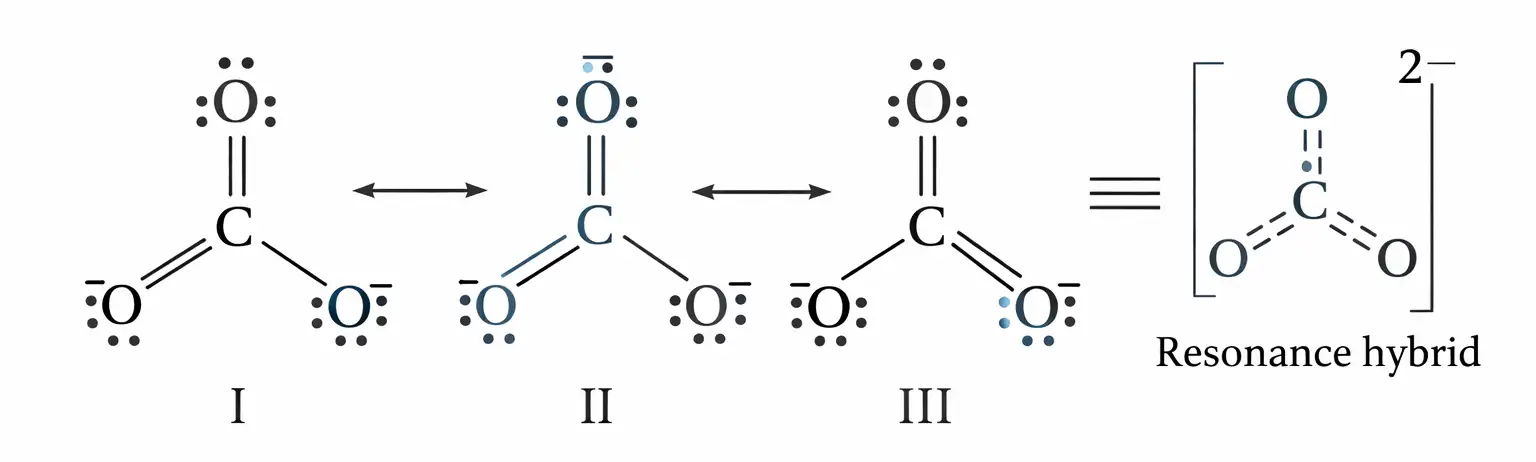
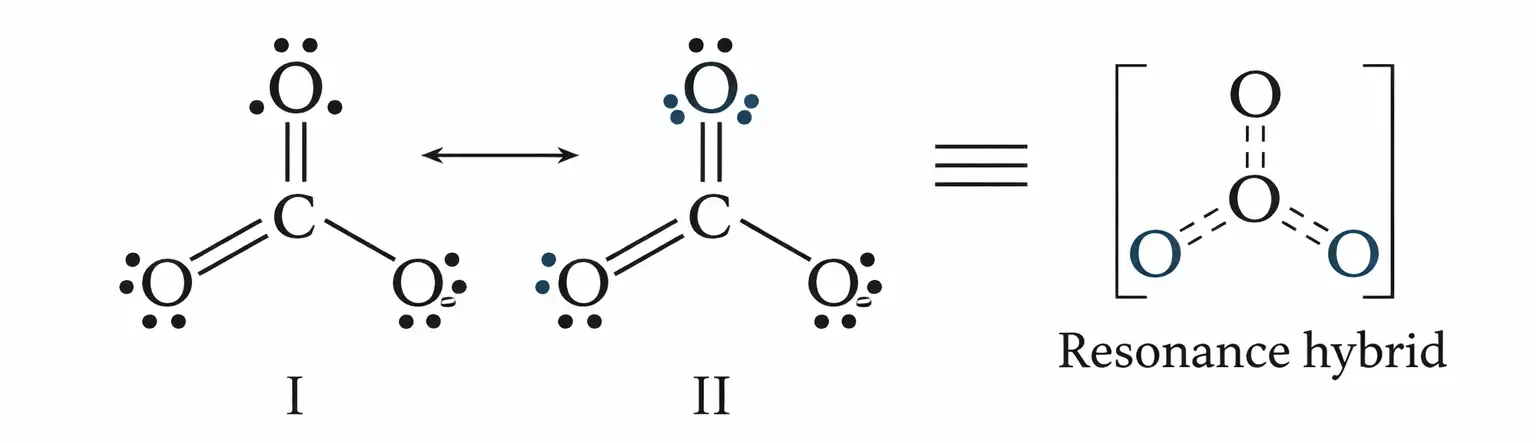
Salient features of resonance
- Same atom arrangement: All contributors have the same positions of atoms and the same total number of shared and unshared electrons.
- Comparable energies: Contributing structures generally have nearly equal energies.
- Actual structure: Individual contributors are imaginary representations; only the resonance hybrid exists.
- Stability: The hybrid is more stable than any contributor; a greater number of comparable-energy contributors generally means greater stability.
is the total number of bonds between the two atoms across all contributors; is the number of contributing structures.
Polarity of Bonds and Dipole Moment
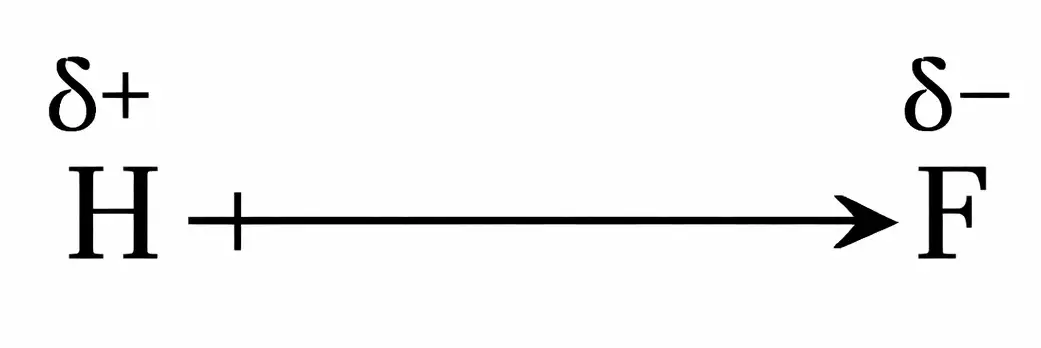
Polar covalent bond — A covalent bond in which unequal attraction shifts the shared electron pair toward the more electronegative atom.
Dipole moment
- Meaning: A measure of charge separation caused by polarisation.
- Relation: Dipole moment is charge multiplied by the distance of separation.
- Unit: Debye (); .
- Vector: It has magnitude and direction; the dipole arrow points from the positive end toward the negative end, toward the more electronegative atom.
Molecular dipole moment
- Diatomic molecules: A non-polar diatomic molecule has zero dipole moment; a polar one has a non-zero moment determined by its bond dipole.
- Molecular geometry: Bond dipoles cancel in suitably symmetrical molecules, giving zero net dipole. Irregular arrangements, including effects from lone pairs, can produce a net dipole.
- Two bond dipoles: The resultant depends on the bond moments and the angle between them.
is the angle between bond moments and .
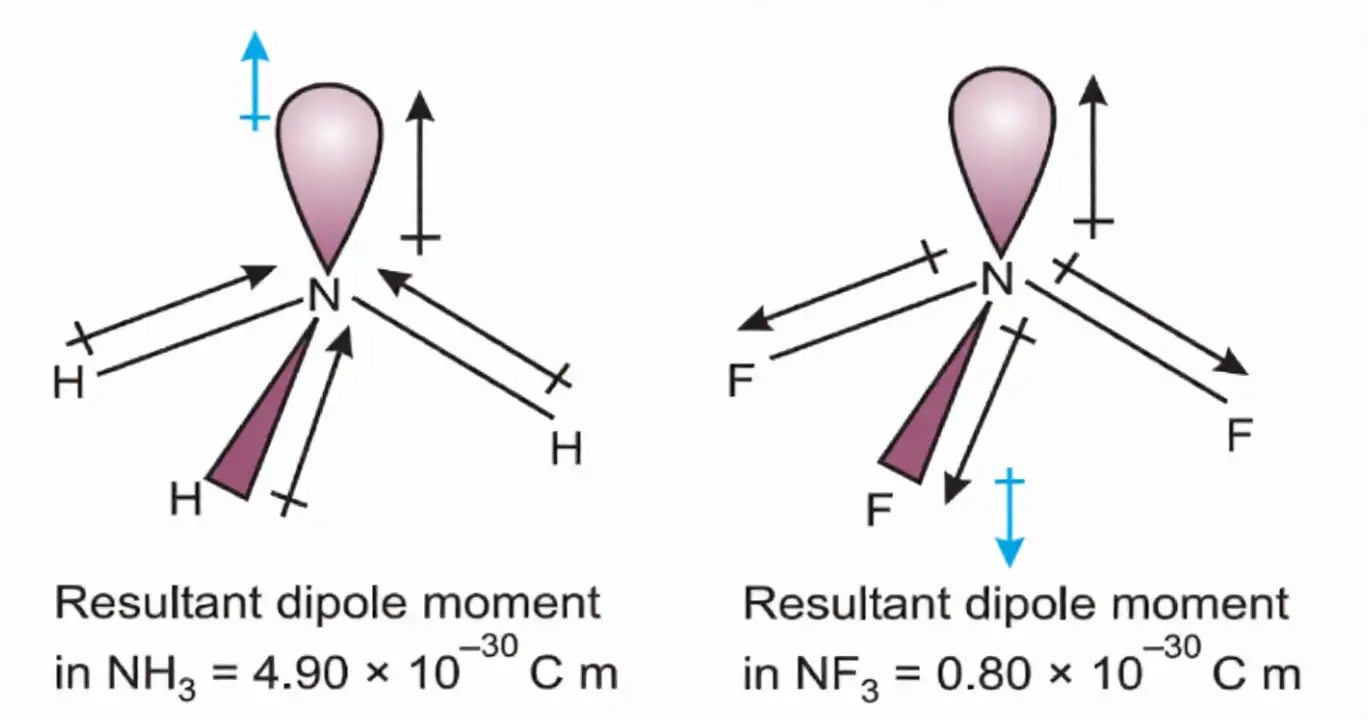
Comparing and
- Result: has a greater dipole moment than , although fluorine is more electronegative than hydrogen.
- Reason: The nitrogen lone-pair contribution reinforces the bond-dipole resultant in but opposes it in .
Applications and related points
- Applications of dipole moment: It helps determine bond polarity and calculate percentage ionic character.
- Electronegativity difference: The lecture gives a difference of at least as the condition for ionic-bond formation.
- Carbon monoxide: Its dipole moment is greater than expected, attributed to the presence of a dative (coordinate) bond.
Compare the observed dipole moment with the value for complete ionic separation.
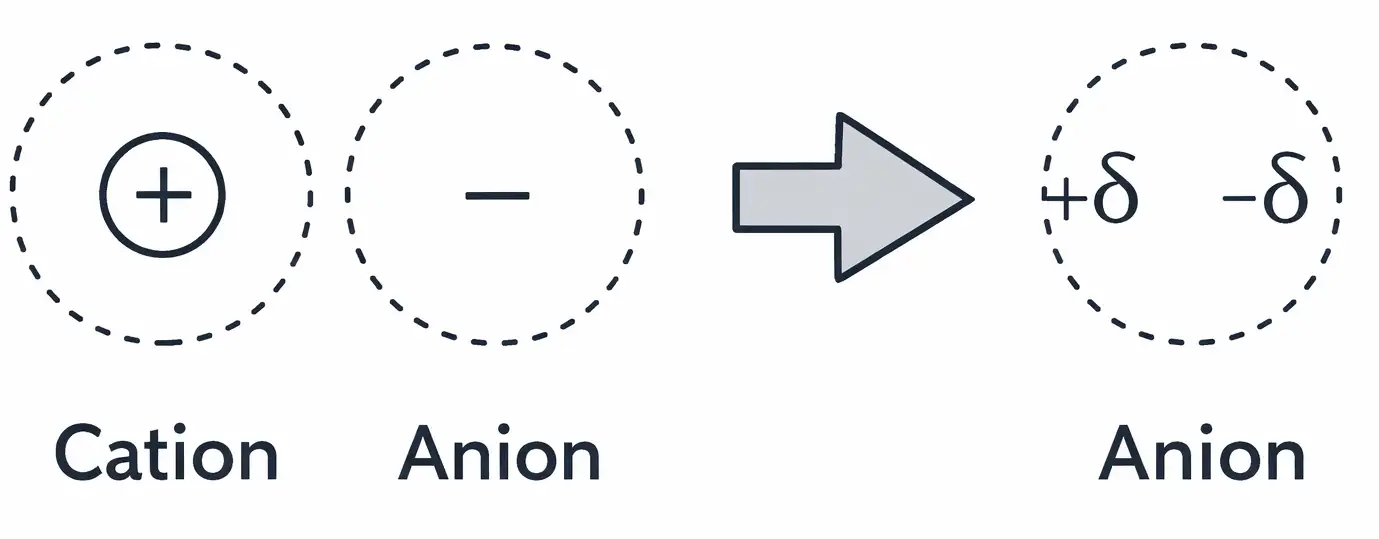
Fajans’ Rule
How are bond order, bond length and bond enthalpy generally related?
Why is the dipole moment of greater than that of ?
Quick recap
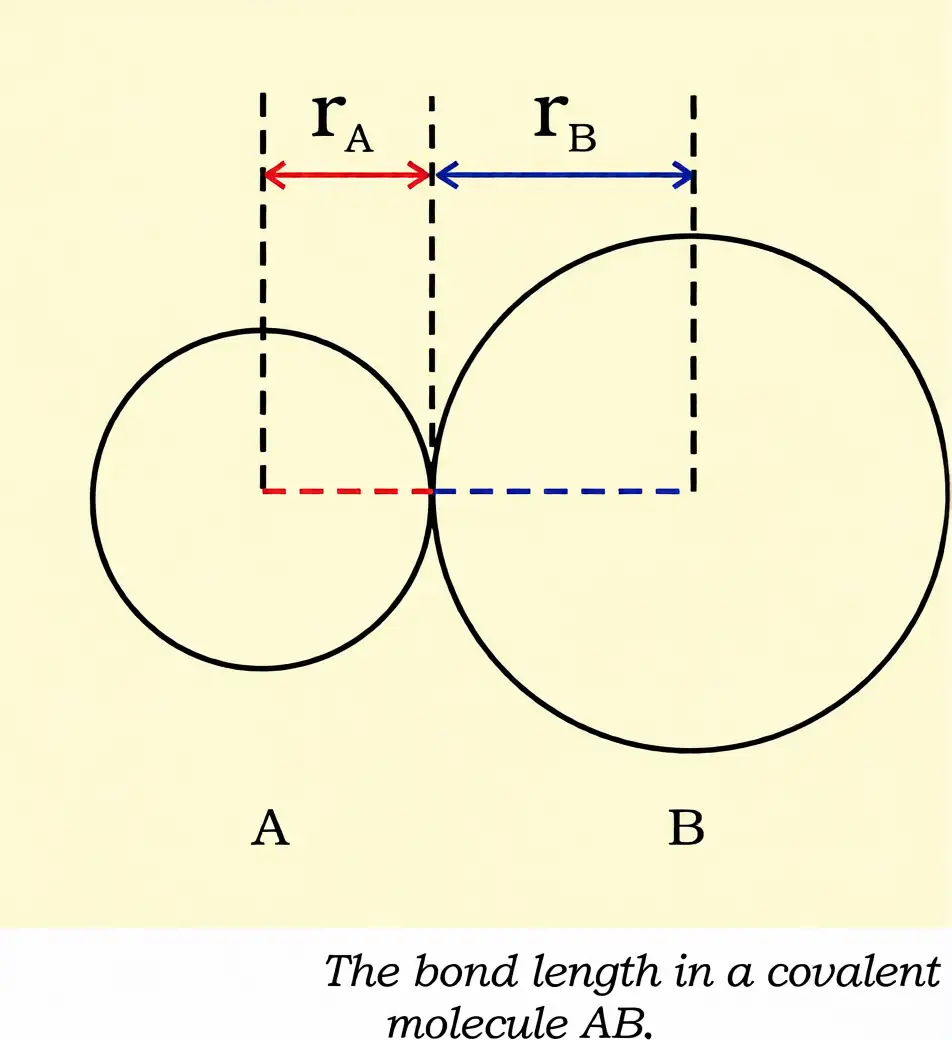
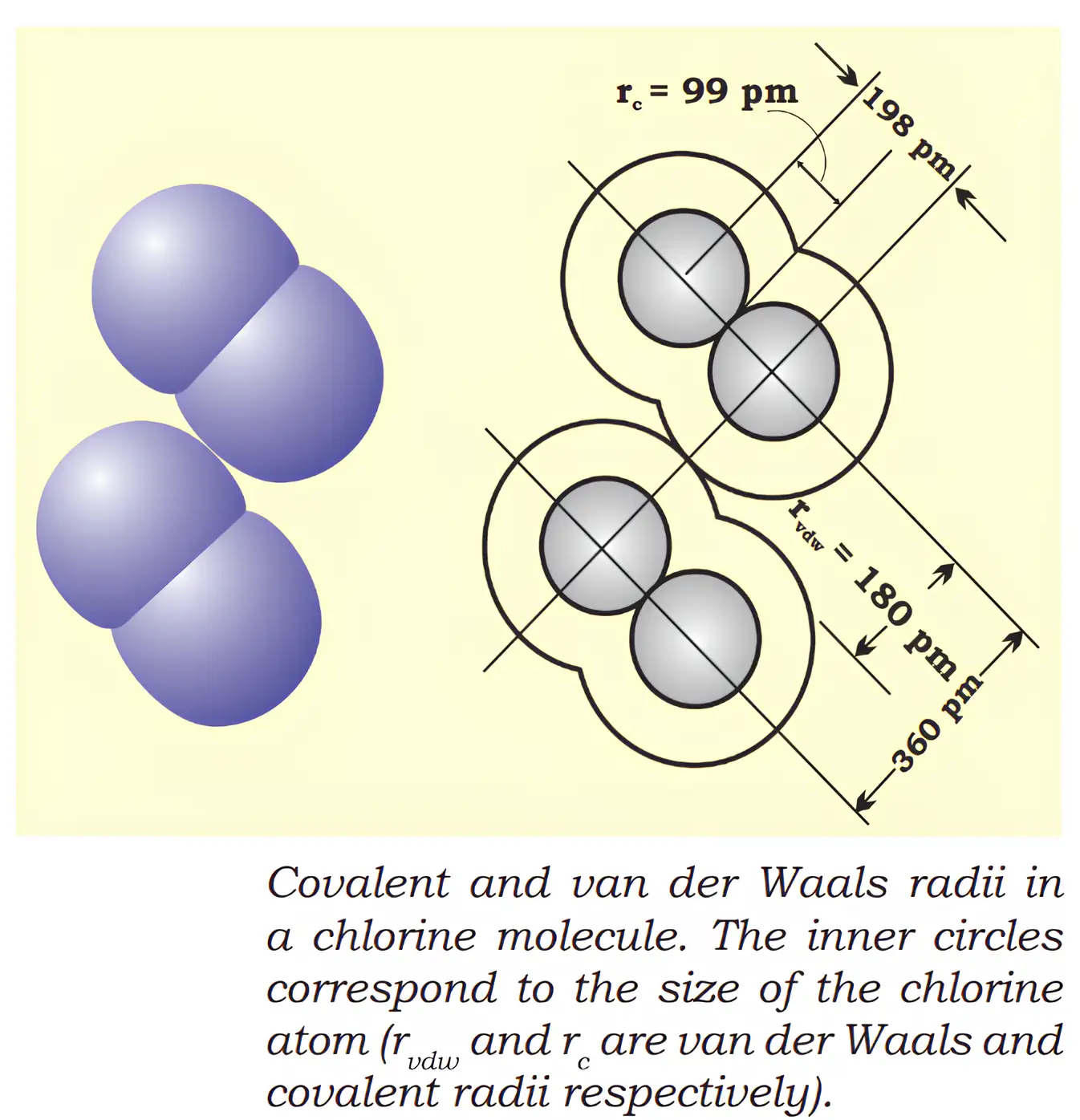
- Bond length is the equilibrium internuclear distance; covalent and van der Waals radii describe bonded and non-bonded situations.
- Bond angle describes the three-dimensional orbital arrangement; bond enthalpy is the energy to break one mole of bonds in the gaseous state.
- Bond order: Increasing bond order generally increases bond enthalpy and decreases bond length; isoelectronic species have the same bond order.
- Resonance hybrid is the real, more stable structure represented by contributing structures with the same atom arrangement.
- Dipole moment is ; molecular dipoles add vectorially and may cancel depending on geometry.
- Fajans’ rule: Smaller, more highly charged cations polarise more strongly, while larger anions are more polarisable.
The Valence Shell Electron Pair Repulsion(VSEPR) Theory
VSEPR Theory and Its Postulates
Valence Shell Electron Pair Repulsion (VSEPR) theory — A model that predicts molecular shape by arranging electron pairs around a central atom as far apart as possible.
Key postulates
- Origin: Nyholm and Gillespie developed the theory in 1957.
- Shape: The number of bonded and non-bonded electron pairs in the central atom’s valence shell determines molecular shape.
- Repulsion: Electron pairs repel one another; the order is .
- Arrangement: Electron pairs occupy positions that minimise repulsion and maximise their separation.
- Resonance: The model can be applied to any valid resonance structure of a molecule.
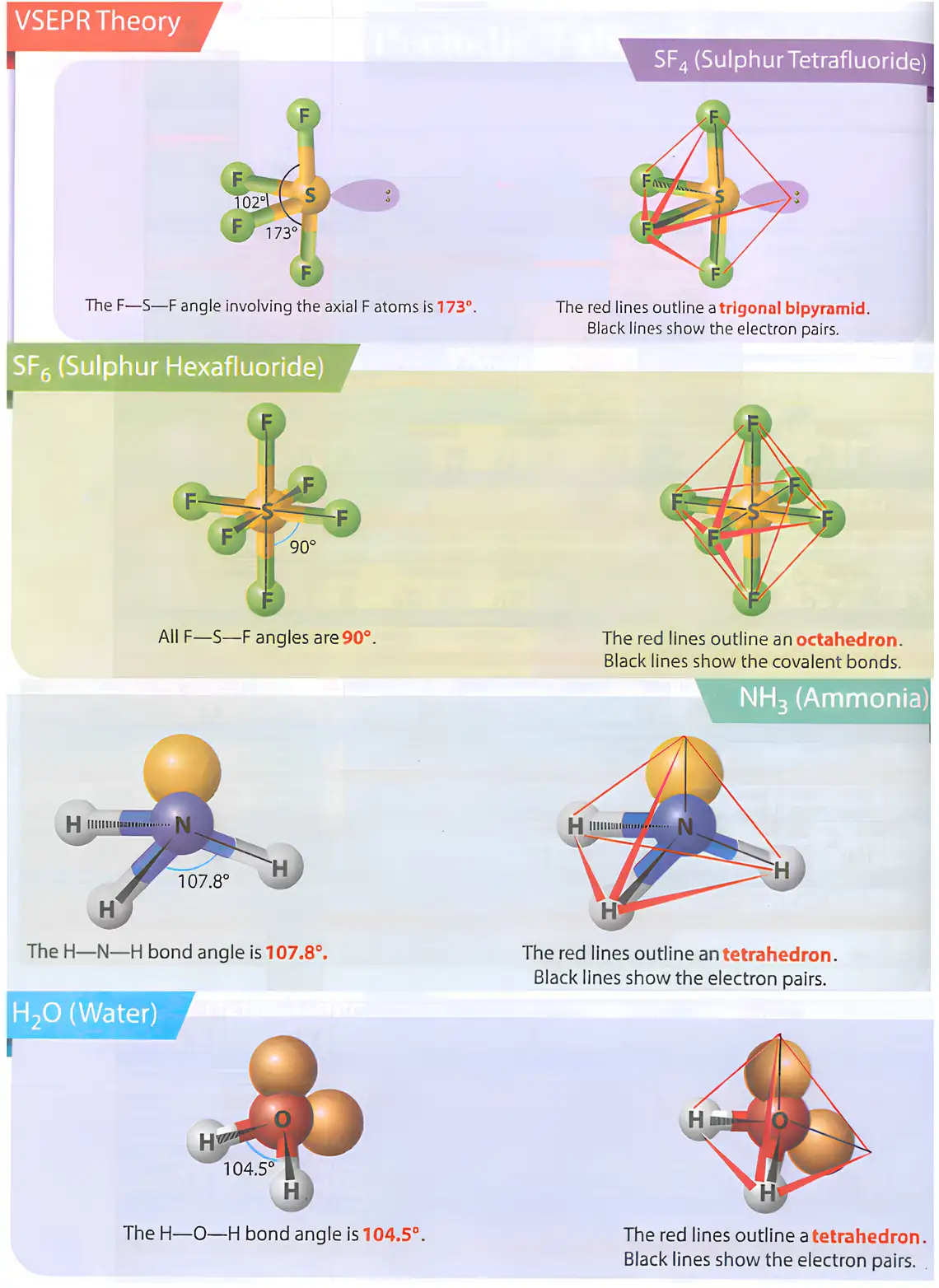
VSEPR notation
- : Central atom; : atoms bonded to the central atom; : lone pairs on the central atom.
- : The subscripts show the numbers of bonded atoms and lone pairs; both contribute to electron-pair repulsion.
Geometry Based on VSEPR Theory
| Total electron pairs | Formula | Molecular geometry | Example |
|---|---|---|---|
| Linear | |||
| Triangular planar | |||
| Bent (V-shape) | |||
| Tetrahedral | |||
| Trigonal pyramidal | |||
| Bent | |||
| Trigonal bipyramidal | |||
| Irregular tetrahedral (see-saw) | |||
| T-shaped | |||
| Linear | |||
| Octahedral | |||
| Square pyramidal | |||
| Square planar | |||
| Pentagonal bipyramidal |
State the order of repulsion between electron pairs in VSEPR theory.
Quick recap
- VSEPR theory, developed by Nyholm and Gillespie in 1957, predicts molecular shape from electron-pair repulsions.
- Both bonded pairs and lone pairs around the central atom affect molecular shape.
- Repulsion strength decreases in the order .
- Electron pairs arrange themselves to minimise repulsion and maximise separation.
- The notation distinguishes bonded atoms from central-atom lone pairs; use the total pair count to identify geometry.
Valence Bond Theory
Postulates of Valence Bond Theory
Types of Orbital Overlap and Covalent Bonds
| Bond type | Overlap | Orbitals involved |
|---|---|---|
| Sigma () | Head-on overlap along the internuclear axis | –, –, or – |
| Pi () | Lateral overlap perpendicular to the internuclear axis | Half-filled orbitals only |
Bond Strength, Length, and Reactivity
| Property | Increasing order |
|---|---|
| Bond energy | Single < Double < Triple |
| Bond length | Triple < Double < Single |
| Reactivity | Single < Double < Triple |
Rotation About Bonds
- bond: Free rotation about the bond is possible.
- bond: Rotation about the bond is not possible.
A bond is never formed alone: it occurs in addition to a bond.
Why is a bond generally stronger than a bond?
State the bond energy and bond length trends as bond order increases.
Quick recap
- Valence Bond Theory was introduced by Heitler and London in 1927 and developed by Pauling and others.
- Valence electrons participate in bond formation; core electrons do not.
- A bond forms by head-on overlap; a bond forms by lateral overlap of orbitals.
- A bond occurs only alongside a bond; no more than three covalent bonds form between two atoms.
- As bond order increases, bond energy and reactivity increase, while bond length decreases.
- Rotation is possible about a bond but not about a bond.
Hybridisation
Hybridisation — Mixing valence-shell atomic orbitals of nearly equal energies in the same atom to form a more stable set of equivalent-energy hybrid orbitals; Linus Pauling proposed this concept in 1931.
Salient Features
- Number: The number of hybrid orbitals equals the number of atomic orbitals mixed.
- Equivalence: Hybrid orbitals have equivalent energy and shape.
- Orientation: Hybrid orbitals point in preferred directions to minimise repulsion between electron pairs.
Hybridisation Number and Conditions
Use this to calculate the number of orbitals involved in hybridisation.
| Symbol / H | Meaning or hybridisation |
|---|---|
| Valence-shell electrons of the central atom | |
| Number of monovalent atoms bonded to the central atom | |
| Charge on the cation | |
| Charge on the anion | |
| , respectively |
Conditions for Hybridisation
- Orbitals used: Only orbitals in the atom’s valence shell are hybridised.
- Energy: The orbitals mixing must have nearly the same energy.
- Promotion: Electron promotion before hybridisation is not essential.
- Occupancy: Hybridisation is not restricted to half-filled orbitals; filled valence orbitals may also participate.
Molecules with Bond Pairs Only
| Hybridisation | Hybrid orbitals | Molecular shape | Bond angle | Examples |
|---|---|---|---|---|
| Linear | , , , , , , , | |||
| Triangular planar | , , , , , , | |||
| Tetrahedral | , , , , | |||
| Square planar | , | |||
| or | Trigonal bipyramidal | and | , , | |
| or | Octahedral | , , , | ||
| or | Pentagonal bipyramidal | and |
Molecules with Bond Pairs and Lone Pairs
Notation
- : is the central atom, represents bonded atoms, and represents lone pairs on the central atom.
| Type | Bond pairs | Lone pairs | Hybridisation | Bond angle | Expected geometry | Actual geometry | Examples |
|---|---|---|---|---|---|---|---|
| Trigonal planar | Bent (V-shaped) | , , , | |||||
| Tetrahedral | Bent (V-shaped) | , , , , , , , | |||||
| Trigonal bipyramidal | Linear | , , | |||||
| Trigonal bipyramidal | T-shaped | , , , | |||||
| Tetrahedral | Pyramidal | , , , , , , , | |||||
| and | Trigonal bipyramidal | See-saw (distorted tetrahedron) | , , , | ||||
| 90° and 180° | Octahedral | Square planar | , | ||||
| Octahedral | Square pyramidal | , , , | |||||
| <90° | Pentagonal bipyramidal | Distorted octahedral |
d-Orbital Participation
- : The orbital participates.
- : The orbital participates.
- or : The and orbitals participate.
- : The , and orbitals participate.
How does the number of hybrid orbitals relate to the atomic orbitals mixed?
What are the hybridisation and actual shape of ?
Quick recap
- Linus Pauling proposed hybridisation in 1931; it mixes nearly equal-energy valence orbitals into a more stable set of equivalent orbitals.
- The hybrid-orbital count equals the number of orbitals mixed; hybrid orbitals are equivalent and directionally oriented.
- Calculate using ; determines the hybridisation type.
- Bond-pair-only arrangements include linear , planar , tetrahedral , and higher-coordinate geometries.
- Lone pairs change the actual molecular shape while the electron-domain arrangement reflects the hybridisation.
- Filled valence orbitals may hybridise, and prior electron promotion is not essential.
Molecular Orbital Theory
Molecular Orbitals and Their Formation
Molecular orbital (MO) — An MO describes the probability distribution of electrons around a group of two or more nuclei in a molecule.
Core ideas
- Development: F. Hund and R. S. Mulliken developed MO theory in 1932.
- Formation: Atomic orbitals of comparable energy and suitable symmetry combine to form MOs.
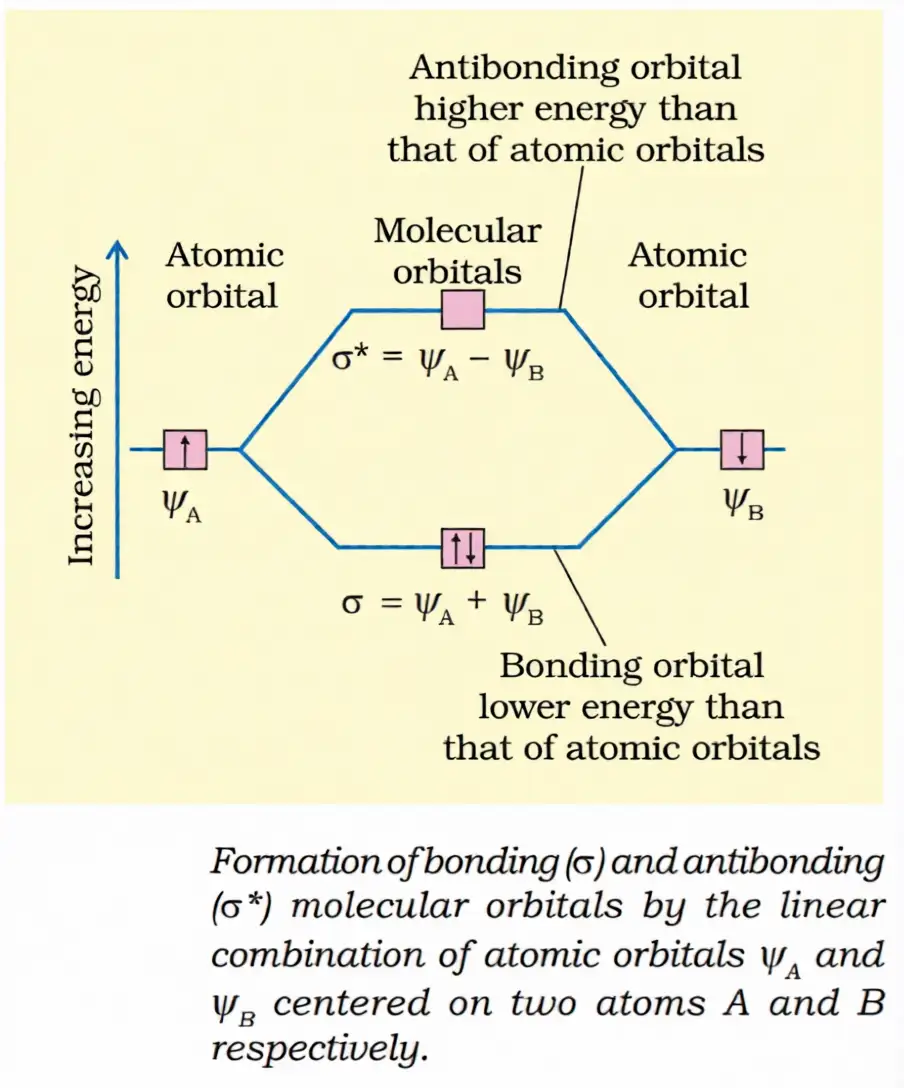
- Number and types: When two atomic orbitals combine, they form two MOs: one bonding and one antibonding. In general, the number of MOs formed equals the number of combining atomic orbitals.
- Polycentric nature: An electron in an MO is influenced by two or more nuclei.
- Filling: MOs are filled according to the Aufbau principle, Pauli exclusion principle and Hund’s rule.
| Point | Bonding MO | Antibonding MO |
|---|---|---|
| Formation | Addition of atomic-orbital wave functions | Subtraction of atomic-orbital wave functions |
| Energy and stability | Lower energy; greater stability | Higher energy; lower stability |
| Notation | or | or |
Molecular Orbital Energy Order
Energy ordering in homonuclear diatomic molecules
- O₂, F₂ and Ne₂:
- Lighter diatomic molecules B₂, C₂ and N₂:
Gerade and Ungerade Molecular Orbitals
Gerade (g) and ungerade (u) — These labels describe whether an MO is symmetric or unsymmetric with respect to the centre of the molecule.
| MO type | Symmetry label |
|---|---|
| Symmetric about the centre | Gerade, |
| Unsymmetric about the centre | Ungerade, |
| bonding | |
| antibonding | |
| bonding | |
| antibonding |
Bond Order and Stability
Bond order (B.O.) — Bond order is half the difference between the number of bonding and antibonding electrons.
Here, is the number of bonding electrons and is the number of antibonding electrons.
| Condition | Conclusion |
|---|---|
| ; bond order is positive | The molecule is stable and exists. |
| ; bond order is negative | The molecule is unstable and does not exist. |
| ; bond order is zero | The molecule is unstable and does not exist. |
Bond properties
- Relationship: bond energy stability .
- Trend: Higher bond order means higher bond-dissociation energy and shorter bond length.
Magnetic Behaviour
| Point | Diamagnetic | Paramagnetic |
|---|---|---|
| Electron arrangement | All electrons are paired | One or more electrons are unpaired |
Quick recap
- Atomic orbitals of comparable energy and suitable symmetry combine; their number equals the number of MOs formed.
- Two combining atomic orbitals form one bonding and one antibonding MO.
- Bonding MOs form by wave-function addition and have lower energy; antibonding MOs form by subtraction and have higher energy.
- B₂, C₂ and N₂ have the orbitals below ; O₂, F₂ and Ne₂ have the reverse order.
- Gerade means symmetric and ungerade means unsymmetric about the molecular centre.
- Bond order is ; a positive bond order indicates a stable, existing species.
- Higher bond order means greater bond energy and stability, shorter bond length; unpaired electrons make a species paramagnetic.
Bonding in Some Homonuclear Diatomic Molecules
Molecular Orbital Configurations and Bond Properties
Here, is the number of electrons in bonding molecular orbitals and is the number in antibonding molecular orbitals.
Configurations and properties
- Magnetism: A molecule or ion with unpaired electrons is paramagnetic; one with all electrons paired is diamagnetic.
- Bonding: A higher bond order generally indicates a stronger bond; bond order means the species is not stable as a molecule.
| Species | Molecular orbital configuration | Bond order | Magnetic behaviour |
|---|---|---|---|
| Diamagnetic | |||
| Paramagnetic | |||
| Paramagnetic | |||
| Does not exist as a stable molecule | |||
| Diamagnetic | |||
| Diamagnetic | |||
| Paramagnetic | |||
| Paramagnetic | |||
| Paramagnetic |
Why is paramagnetic?
Elementary Idea of Metallic Bonding
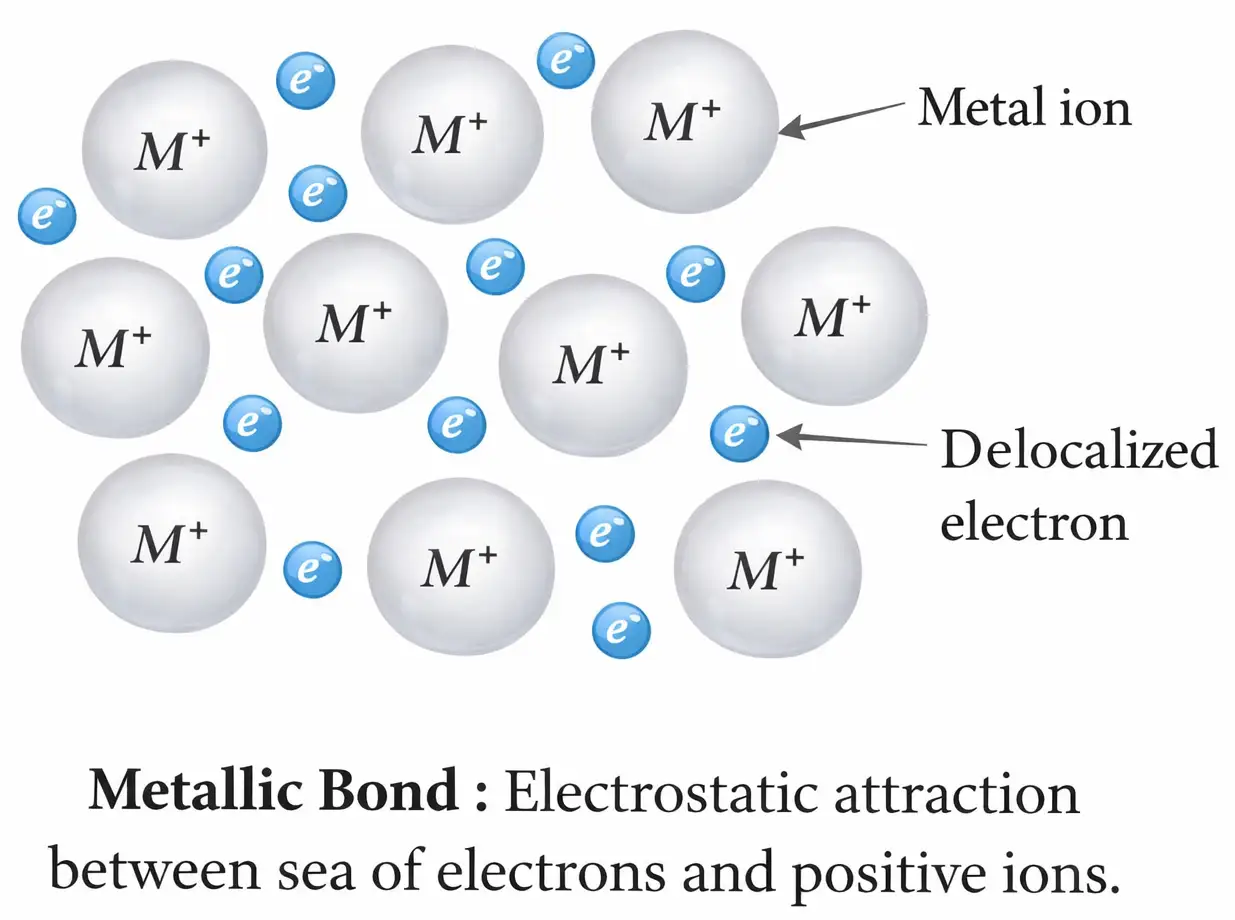
Metallic bond — The electrostatic attraction between positively charged metal kernels (nuclei with core electrons) and mobile, delocalized electrons that holds metal atoms together.
Strength and formation
- Bond strength increases with the number of mobile electrons and with effective nuclear charge.
- Favourable conditions: Low ionization enthalpy, free movement of valence electrons, high cation charge and small cation size.
Quick recap
- Bond order is half the difference between bonding and antibonding electron counts.
- Unpaired electrons cause paramagnetism; fully paired electrons cause diamagnetism.
- has bond order and is not stable as a molecule.
- is paramagnetic because its antibonding orbitals contain unpaired electrons.
- Metallic bonding is attraction between positive metal kernels and delocalized mobile electrons.
- Metallic bond strength rises with mobile-electron number and effective nuclear charge.
Hydrogen Bonding
Hydrogen bond — An attractive force linking a hydrogen atom in one molecule to an electronegative atom—usually , , or —in another molecule.
Types of Hydrogen Bonding
| Point | Intermolecular | Intramolecular |
|---|---|---|
| Bond forms | Between different molecules, which may belong to the same or different compounds. | Within the same molecule. |
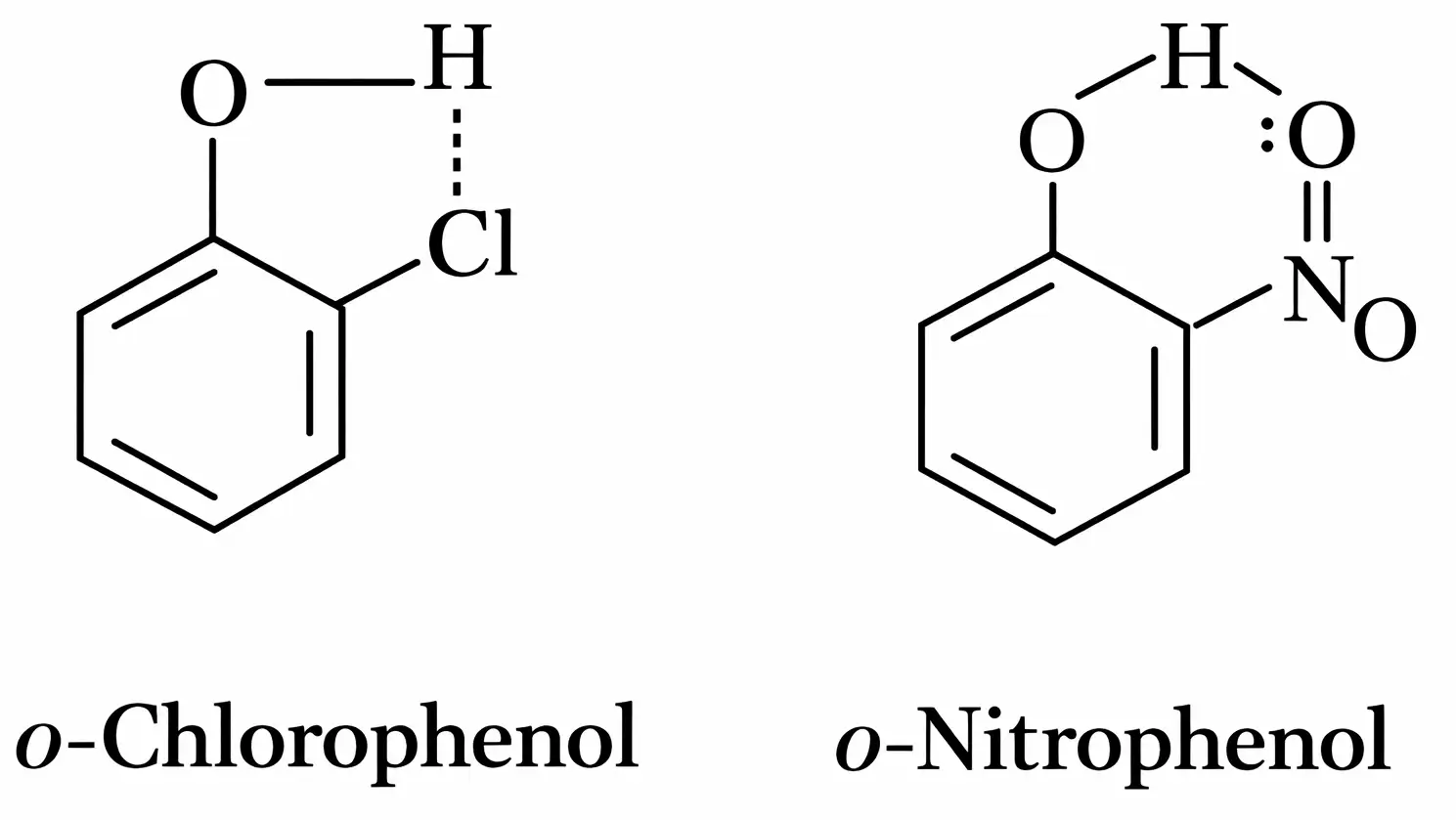
| Examples | , alcohols (), and . | o-nitrophenol; o-chlorophenol is also shown. |
| Effect on molecules | Links molecules to one another. | Causes cyclization and prevents molecular association. |

Geometry and Physical-Property Trends
Geometry
- Double bond: When predicting molecular geometry, count a double bond as one electron pair.
Greater intermolecular hydrogen bonding is associated with greater solubility and boiling point, and lower volatility.
Greater intramolecular hydrogen bonding is associated with lower solubility and boiling point, and greater volatility.
Quick recap
- Hydrogen bonding attracts hydrogen to an electronegative atom, usually , , or .
- Intermolecular hydrogen bonds connect different molecules, including molecules of the same or different compounds.
- Examples of intermolecular hydrogen bonding include , , and .
- Intramolecular hydrogen bonds form within one molecule, cause cyclization, and prevent molecular association.
- Intermolecular hydrogen bonding tends to increase solubility and boiling point while decreasing volatility.
- Intramolecular hydrogen bonding tends to decrease solubility and boiling point while increasing volatility.
- For geometry prediction, treat a double bond as one electron pair.
NEET Chemistry — ALL CHAPTERS
1
Some Basic Concepts of Chemistry
2
Structure of Atom
3
Classification of Elements and Periodicity in Properties
4
Chemical Bonding and Molecular Structure
5
Thermodynamics
6
Equilibrium
7
Redox Reactions
8
Organic Chemistry - Some Basic Principles and Techniques
9
Hydrocarbons
10
Solutions
11
Electrochemistry
12
Chemical Kinetics
13
The d- and f- Block Elements
14
Coordination Compounds
15
Haloalkanes and Haloarenes
16
Alcohols, Phenols and Ethers
17
Aldehydes, Ketones and Carboxylic Acids
18
Amines
19
Biomolecules
20
The p-Block Elements (Group 13 and 14)
21
The p-Block Elements (Group 15 to 18)
22
Principles Related to Practical Chemistry