NEET UG . NEET Chemistry . Chemistry . Classification of Elements and Periodicity in Properties
Chapter 3: Classification of Elements and Periodicity in Properties
Ch 3
NEET Chemistry
NEET UG
Why Do We Need to Classify Elements?
Growth in the Number of Known Elements
Known elements
- 1800: 31 elements were known.
- 1865: 63 elements had been identified.
- At present: 118 elements are known; recently discovered elements are man-made.
Need for Classification
Why organise elements?
- Elements are the basic units of all types of matter.
- Challenge: Studying the chemistry of every element and its many compounds individually is difficult.
- Solution: Classifying elements organises chemical knowledge into systematic, logical patterns.
- Benefit: Similar elements can be studied together, making their behaviour easier to understand and compare.
Classification of elements — A systematic arrangement of elements in a table, grouping those with similar properties and separating those with different properties.
Periodic Table and Chemical Periodicity
Periodic table — A tabular arrangement of elements in which elements with similar properties are grouped together.
Key idea
- Patterns: Elements are not a random collection; they show trends and occur in families with similar chemical properties.
- Chemical periodicity: When elements are arranged systematically, their properties show recurring patterns at regular intervals.
- Importance: The periodic table condenses extensive information about chemical behaviour into a few logical patterns.
Why is classification of elements necessary?
Quick recap
- There were 31 known elements in 1800, 63 in 1865 and 118 at present.
- Recently discovered elements are man-made.
- Classification organises elements systematically to simplify the study of their chemistry.
- The periodic table groups elements with similar properties and separates those with different properties.
- Chemical properties show recurring patterns at regular intervals, called chemical periodicity.
Genesis of Periodic Classification
Dobereiner’s Triads (1829)
Triad — A triad is a group of three elements with similar physical and chemical properties.
- Atomic-mass pattern: The middle element’s atomic mass is the arithmetic mean of the first and third elements’ masses.
| Triad | Mean of first and third atomic masses | Middle element’s atomic mass |
|---|---|---|
| Li (7), Na (23), K (39) | Na: 23 | |
| Cl (35.5), Br (80), I (127) | Br: 80 | |
| Ca (40), Sr (88), Ba (137) | Sr: 88 |
Newlands’ Law of Octaves (1865)
Law of Octaves — When elements are arranged in increasing order of atomic weights, every eighth element has properties similar to the first, like notes in a musical scale.
| Scale note | Sa | Re | Ga | Ma | Pa | Dha | Ne |
|---|---|---|---|---|---|---|---|
| First sequence | Li | Be | B | C | N | O | F |
| Second sequence | Na | Mg | Al | Si | P | S | Cl |
Lothar Meyer’s Atomic Volume Curve (1869)
Atomic volume — Atomic volume is the atomic weight of an element in the solid state divided by its density.
Use atomic weight and solid-state density to calculate atomic volume.
- Graph: Meyer plotted atomic volume against atomic weight; elements with similar properties occupied similar positions.
- Electropositive elements: Group IA alkali metals such as Li, Na, K, Rb and Cs occurred at the top of the curve.
- Group IIA elements: Be, Mg, Ca, Sr and Ba occurred near the mid-points of descending portions.
- Electronegative elements: F, Cl, Br and I occurred on ascending portions.
Mendeleev’s Periodic Law (1869)
Mendeleev’s periodic law — The properties of elements are periodic functions of their atomic weights.
- Arrangement: Elements were arranged generally in increasing order of atomic weight; similar properties recurred at regular intervals.
- Table structure: The table had nine vertical columns and seven horizontal rows.
- Groups: Elements with similar properties were placed in the same vertical column.
- Order changes: At some places, atomic-weight order was changed to keep elements with similar physical and chemical properties together.
- Vacant places: Gaps were left for elements that had not yet been discovered.
Demerits of Mendeleev’s Periodic Table
| Issue | Why it was a demerit |
|---|---|
| Hydrogen’s position | Hydrogen resembles Group 1 alkali metals and Group 7 halogens, but was placed in Group 1. |
| Cobalt and nickel | Cobalt’s atomic mass is greater than nickel’s (), yet cobalt was placed before nickel. |
| Isotopes | Isotopes were not given separate positions, although the classification was based on atomic masses. |
| Cause of periodicity | Mendeleev could not explain why periodicity occurs in elements. |
| Lanthanoids and actinoids | These series were not included in his table. |
State Dobereiner’s triad rule and give one example.
State Newlands’ Law of Octaves.
Give two demerits of Mendeleev’s periodic table.
Quick recap
- Dobereiner grouped similar elements in triads; the middle atomic mass was the arithmetic mean of the other two.
- Newlands’ Law of Octaves states that similar properties recur at every eighth element when arranged by increasing atomic weight.
- Meyer’s curve plotted atomic volume against atomic weight and showed similar elements at similar positions.
- Meyer placed Group IA metals at the curve’s top, Group IIA elements near descending mid-points, and halogens on ascending portions.
- Mendeleev arranged elements mainly by increasing atomic weight, grouped similar elements, and left gaps for undiscovered elements.
- Mendeleev’s table had nine columns and seven rows; its demerits included hydrogen’s position, isotopes, unexplained periodicity, and omitted series.
Modern Periodic Law and the Present Form of the Periodic Table
Modern Periodic Law
Modern periodic law — The physical and chemical properties of elements are periodic functions of their atomic numbers.
Moseley’s finding
- In 1913: Henry Moseley observed regularities in the characteristic X-ray spectra of elements.
- Frequency: In the plot, denotes the frequency of the emitted X-rays.
- Result: A plot of against atomic number gives a straight line; this is not true for a plot against atomic weight.
- Conclusion: Atomic number is a more fundamental property of an element than atomic mass.
- Periodicity: When elements are arranged by increasing atomic number, similar properties recur at regular intervals.
Structure of the Long-Form Periodic Table
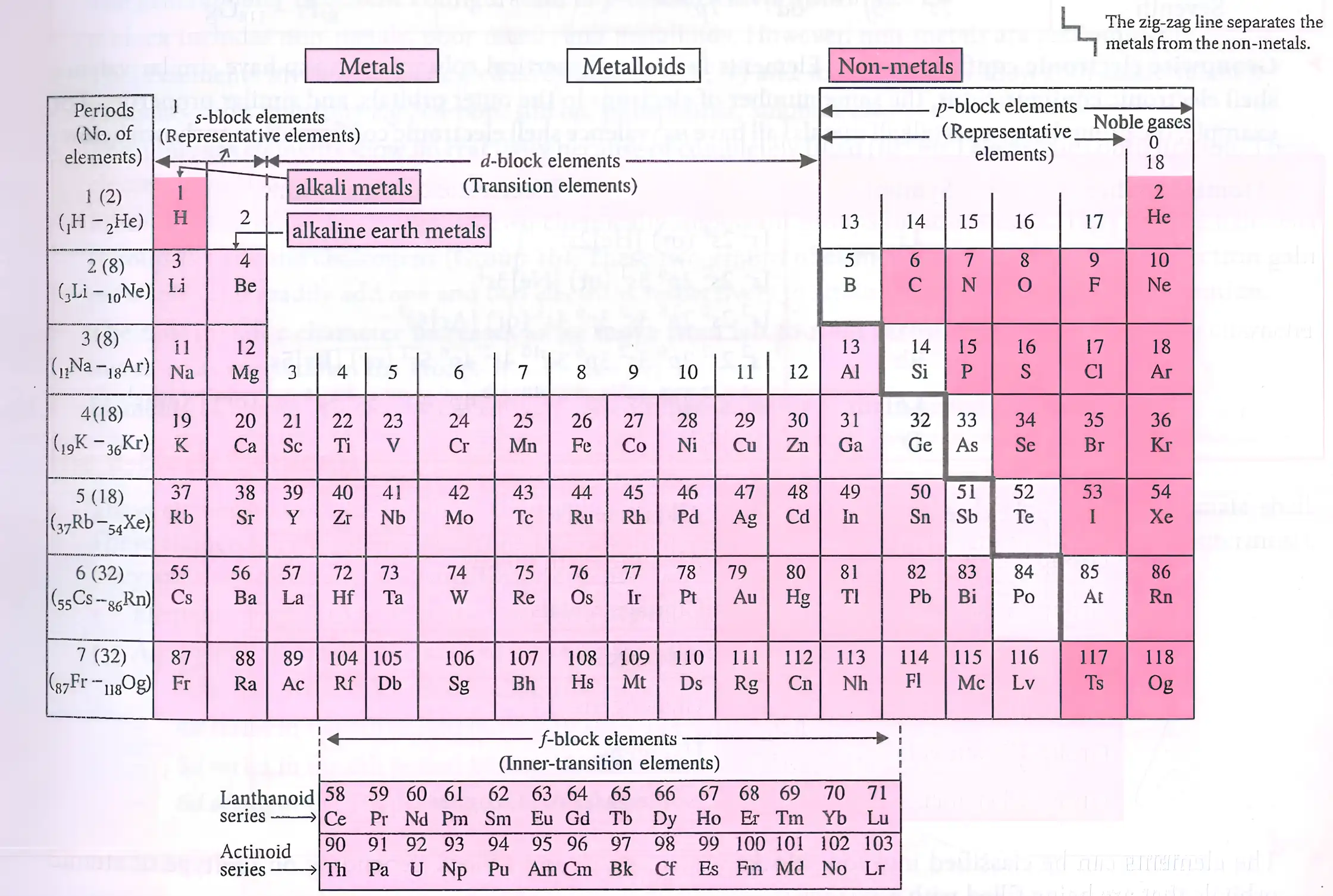
- Periods: The long-form periodic table has seven horizontal rows.
- Groups: It has eighteen vertical columns.
- Period number: It corresponds to the highest principal quantum number, , of the elements in that period.
| Period | Principal quantum number () | Orbitals filled | Number of elements | Atomic number range | Length |
|---|---|---|---|---|---|
| First | 2 | – | Very short | ||
| Second | 8 | – | Short | ||
| Third | 8 | – | Short | ||
| Fourth | 18 | – | Long | ||
| Fifth | 18 | – | Long | ||
| Sixth | 32 | – | Very long | ||
| Seventh | 32 | – | Very long |
Lanthanoids and Actinoids
- Separate panels: Fourteen elements from each of the sixth and seventh periods are placed in separate panels at the bottom of the table.
- Series names: The sixth-period series is the lanthanoids; the seventh-period series is the actinoids.
State the modern periodic law.
How many periods and groups are in the long-form periodic table, and what does the period number indicate?
Quick recap
- Moseley’s 1913 results established atomic number as more fundamental than atomic mass; is the frequency of emitted X-rays.
- A plot of against atomic number gives a straight line.
- Element properties repeat periodically when elements are arranged by increasing atomic number.
- The long-form periodic table contains seven periods and eighteen groups; period number indicates the highest principal quantum number, .
- The periods contain 2, 8, 8, 18, 18, 32 and 32 elements, respectively.
- The lanthanoids and actinoids are displayed in separate panels below the main table.
Nomenclature of Elements with Atomic Numbers > 100
IUPAC Nomenclature for Elements with Z > 100
Systematic nomenclature — Elements with atomic numbers greater than 100 are named using the IUPAC system, deriving their names from the atomic number.
How names and symbols are formed
- Name: Use Latin- and Greek-derived words for the numerical digits of the atomic number, then add the suffix “-ium”.
- Symbol: Use the first letter of the word used for each numerical digit.
Quick recap
- Elements with atomic numbers are named in the IUPAC system.
- Their names are derived from Latin- and Greek-based words for the numerical digits.
- The suffix “-ium” is added to form the element name.
- The symbol is formed from the first letter of the word used for each numerical digit.
Electronic Configurations of Elements and the Periodic Table
Electronic Configuration and Periods
Electronic configuration — The distribution of an atom’s electrons among its orbitals.
How periods relate to electron filling
- Period number indicates the principal quantum number, , of the outermost (valence) shell.
- Across successive periods, filling begins in the next higher principal energy level; the orbitals filled can include lower-energy subshells such as and .
- Periodic-table position reflects the quantum numbers of the last orbital filled.
| Period | Orbitals filled | Elements |
|---|---|---|
| First | H–He (–) | |
| Second | Li–Ne (–) | |
| Third | Na–Ar (–) | |
| Fourth | K–Kr (–) | |
| Fifth | Rb–Xe (–) | |
| Sixth | Cs–Rn (–) | |
| Seventh | Fr–Og (–) |
Groupwise Electronic Configuration
Why elements in a group resemble one another
- Same group elements have similar valence-shell configurations and the same number of electrons in their outer orbitals.
- Similar valence configurations lead to similar chemical properties.
- Group 1 (alkali metals) share the general valence configuration .
| Element | Atomic number | Condensed electronic configuration |
|---|---|---|
| Li | ||
| Na | ||
| K | ||
| Rb | ||
| Cs | ||
| Fr |
| Group | Common name |
|---|---|
| Group 1 | Alkali metals |
| Group 2 | Alkaline earth metals |
| Group 11 | Coinage metals |
| Group 15 | Pnictogens |
| Group 16 | Chalcogens |
| Group 17 | Halogens |
| Group 18 | Noble gases or aerogens |
Blocks of the Periodic Table
Periodic-table block — A classification based on the type of atomic orbital being filled by the differentiating electron.
| Block | Orbital being filled |
|---|---|
| s-block | |
| p-block | |
| d-block | |
| f-block |
Quick recap
- Electronic configuration describes how electrons are distributed among atomic orbitals.
- The period number gives the valence-shell principal quantum number, .
- The last orbital filled helps determine an element’s position and block.
- Elements in one group have similar valence configurations and chemical properties.
- Group 1 elements share the valence configuration .
- The four blocks are -, -, -, and -blocks.
Electronic Configurations and Types of Elements : s-, p-, d-, f-Blocks
s-Block Elements
s-block elements — Elements in which the valence electron enters the outermost s-orbital; except helium, these are the elements of groups 1 and 2.
The s-orbital holds a maximum of two electrons.
Characteristics
- Physical nature: s-block elements are soft metals with generally low melting and boiling points.
- Reactivity: They are reactive metals with low ionisation enthalpies and readily lose their outermost electron(s).
- Ions: Group 1 alkali metals form ions; group 2 alkaline earth metals form ions.
- Chemical nature: They are highly electropositive and strong reducing agents; their metallic character and reactivity increase down a group.
- Occurrence and bonding: Their high reactivity means they are not found pure in nature. Their compounds are predominantly ionic, except those of lithium and beryllium.
p-Block Elements
p-block elements — Elements in groups 13–18, in which the valence electron enters an outermost p-orbital.
Characteristics and important groups
- Composition: The p-block contains non-metals, poor metals and metalloids; non-metals are predominant.
- Bonding: These elements show covalency and electrovalency (notably O, S and N); some also show coordinate valency.
- Allotropy: Several p-block elements show allotropy, including carbon, silicon, phosphorus and sulphur.
- Noble gases: Group 18 elements have a filled configuration, , and are generally unreactive; they are also called inert gases.
- Halogens and chalcogens: Groups 17 and 16, respectively, lie before the noble gases. Their highly negative electron-gain enthalpies favour gaining one and two electrons, respectively, to reach a noble-gas configuration.
- Periodic trend: Non-metallic character increases from left to right across a period; metallic character increases down a group.
- Main-group elements: The s- and p-block elements together are called representative or main-group elements.
d-Block Elements
d-block elements — Elements in groups 3–12 whose valence electrons enter a d-orbital of the penultimate shell; they have electrons in both the outermost and penultimate shells and are called transition elements.
| Series | Period | Elements |
|---|---|---|
| 3d | 4th | 10 elements: Sc–Zn (atomic numbers 21–30) |
| 4d | 5th | 10 elements: Y–Cd (atomic numbers 39–48) |
| 5d | 6th | 10 elements: La, Hf–Hg (atomic numbers 57, 72–80) |
| 6d | 7th | 10 elements: Ac, Rf–Cn (atomic numbers 89, 104–112) |
Characteristics
- Physical nature: d-block elements are metals, generally with high melting and boiling points.
- Colour and magnetism: Most form coloured salts; atoms, ions and compounds are generally paramagnetic because they contain one or more unpaired electrons.
- Bonding and catalysis: They form both ionic and covalent compounds, and most transition elements are good catalysts.
- Oxidation states: They commonly show variable oxidation states; examples include Fe/Fe and Cu/Cu.
- Transition behaviour: Their properties are intermediate between those of s- and p-block elements, which underlies the name transition elements.
Do not assume every d-block element shows typical transition-element properties: Zn, Cd and Hg have the configuration and lack most of these properties.
f-Block Elements
f-block elements — Elements whose last electron enters an f-orbital of the antepenultimate shell, inner to the penultimate shell; they are also called inner-transition elements.
| Series | Number of elements |
|---|---|
| Lanthanoids | 14 |
| Actinoids | 14 |
Characteristics
- Physical nature: f-block elements are heavy metals with high melting and boiling points.
- Oxidation states: They show variable oxidation states; is the most common.
- Colour: They form coloured salts because the salts absorb light at certain visible wavelengths.
- Radioactivity: All actinoids are radioactive.
Transuranium Elements
Transuranium elements — Synthetic elements in the seventh period with atomic numbers greater than 92, the atomic number of uranium.
Metals, Non-metals and Metalloids
| Property | Metals | Non-metals |
|---|---|---|
| Location and abundance | More than 78% of known elements; mostly on the left-hand side of the periodic table. | About 20 elements; located mainly at the top right-hand side. |
| State at room temperature | Usually solids. Mercury is an exception; gallium and caesium also have very low melting points of 303 K and 302 K, respectively. | Usually solids or gases; boron and carbon are exceptions to the generally low melting and boiling points. |
| Melting and boiling points | Usually high. | Usually low. |
| Conductivity | Good conductors of heat and electricity. | Poor conductors of heat and electricity. |
| Mechanical properties | Malleable (can be hammered into sheets) and ductile (can be drawn into wires). | Most solid non-metals are brittle, neither malleable nor ductile. |
Metalloids (semi-metals) — Elements that show properties characteristic of both metals and non-metals.
Examples
- Metalloids: Silicon, germanium, arsenic, antimony and tellurium.
Quick recap
- s-block: groups 1–2; outer configuration ; reactive, electropositive metals.
- p-block: groups 13–18; outer configuration ; includes non-metals, poor metals and metalloids.
- p-block elements show covalency and electrovalency (notably O, S and N); some also show coordinate valency.
- s- and p-block elements together are the representative or main-group elements.
- d-block: groups 3–12; generally shows coloured salts, paramagnetism, catalysis and variable oxidation states.
- f-block elements are inner-transition elements in the lanthanoid and actinoid series; all actinoids are radioactive.
- Metals are generally conductive, malleable and ductile; most non-metallic solids are brittle, and metalloids show mixed properties.
Periodic Trends in Properties of Elements
Periodicity
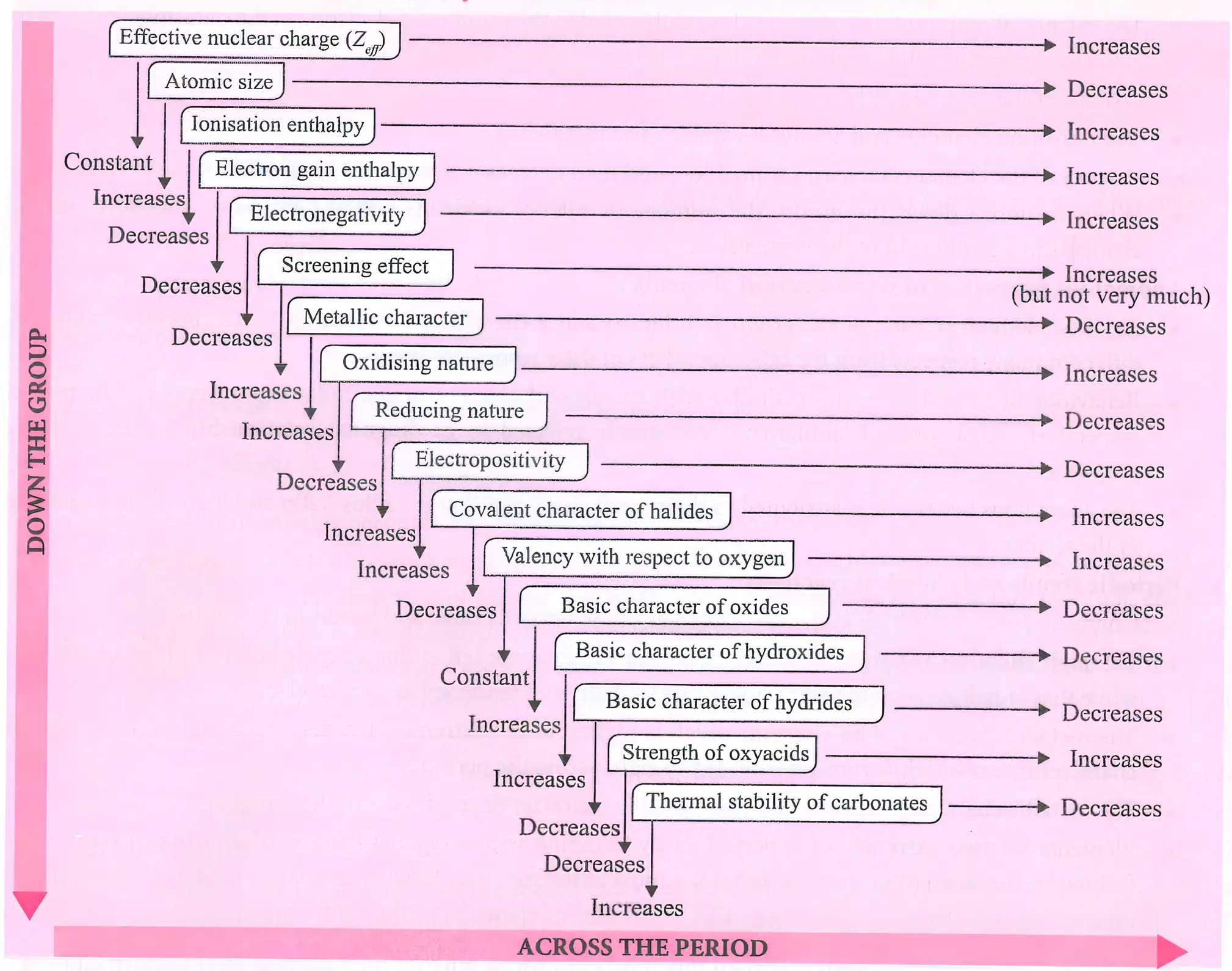
- Periodicity: Similar properties recur at regular intervals when elements are arranged in increasing atomic-number order.
- Cause: Valence-shell electronic configurations repeat after intervals of 2, 8, 8, 18, 18 and 32 elements.
Periodic Trends in Physical Properties
- Physical properties: Their periodic variation is linked to the electronic configurations of the elements.
- Trends: Comparing these properties across periods and down groups helps reveal recurring patterns among elements.
Atomic Radius
Atomic-radius reminders
- Noble gases: Their quoted atomic radii are van der Waals radii because they do not form molecules.
- Relative sizes: For an atom, van der Waals radius metallic radius covalent radius.
Ionic Radius
The ratio helps compare sizes: a higher ratio means stronger attraction and a smaller radius.
Isoelectronic species — Atoms or ions with the same number of electrons but different nuclear charges.
Comparing ionic sizes
- 10-electron series: are isoelectronic.
- 18-electron series: are isoelectronic.
- Order within a series: For equal electron counts, increasing nuclear charge decreases radius; the more positively charged ion is smaller.
Ionisation Enthalpy
| Factor | Effect on ionisation enthalpy |
|---|---|
| Atomic size | Smaller size gives higher ionisation enthalpy; . |
| Nuclear charge | Greater nuclear charge increases ionisation enthalpy. |
| Shielding | Greater shielding lowers ionisation enthalpy. |
| Orbital stability | Completely filled and half-filled orbitals resist electron removal. |
| Orbital type | For electrons in these orbitals, ionisation enthalpy decreases in the order . |
Periodic trends and exceptions
- Down a group: Ionisation enthalpy generally decreases because atomic size and shielding increase.
- Across a period: First ionisation enthalpy generally increases as effective nuclear charge rises while the valence shell remains the same.
- Noble gases: Their ionisation enthalpies are exceptionally high because of stable electronic configurations.
- Symmetrical configurations: Relative stability is given as .
- Zn, Cd and Hg: Their ionisation enthalpies are exceptionally high because of the stability of the subshell.
| Element | (kJ mol) |
|---|---|
| He | 2372 |
| Ne | 2080 |
| Ar | 1520 |
| Kr | 1350 |
| Xe | 1170 |
| Rn | 1037 |
is effective nuclear charge, is total nuclear charge, and is the screening constant.
is the number of other electrons in the th shell, is the number of electrons in the th shell, and is the total number of electrons in inner shells.
A larger effective nuclear charge generally means a smaller atom and higher ionisation enthalpy.
Electron Gain Enthalpy
| Factor | Relationship |
|---|---|
| Atomic size | |
| Effective nuclear charge | |
| Screening effect |
| Less negative | More negative | |
|---|---|---|
| Comparison | ||
| Comparison |
Why F and O are exceptions
- Reason: The added electron enters the compact shell in F or O, where electron–electron repulsion is strong.
- Comparison: In Cl and S, the electron enters a larger region, so repulsion is lower and electron gain enthalpy is more negative.
Electronegativity
is the bond-energy difference, with bond dissociation enthalpies in .
Use ionisation energy and electron affinity in electron volts.
The final form applies when and are in .
is calculated using Slater’s rules, and is the covalent radius in Å.
Here is the electronegativity difference.
| Electronegativity difference | Bond character |
|---|---|
| Purely covalent | |
| 50% covalent and 50% ionic | |
| Predominantly ionic |
Periodic Trends in Chemical Properties
- Chemical properties: Their periodic trends arise from recurring valence-shell electronic configurations.
- Key patterns: Chemical behaviour varies systematically across periods and down groups, including in reactivity and the properties of oxides.
Valence and Oxidation States
- Valence: For representative elements, it is usually the number of outermost electrons or eight minus that number; oxidation state is often used to express valence.
- Across a period: Valency generally increases from 1 to 4 and then decreases from 4 to 0.
- Down a group: Elements have the same number of valence electrons and generally exhibit the same valency; transition elements and actinoids can show variable valencies.
Anomalous Properties of Second-Period Elements
- Anomalous behaviour: The first elements of Groups 1, 2 and 13–17 differ in many respects from the other members of their groups.
- Diagonal relationship: Lithium resembles magnesium, and beryllium resembles aluminium.
- Cause: Small size, high charge-to-radius ratio and high electronegativity contribute to these differences.
Periodic Trends and Chemical Reactivity
| Oxide | Nature |
|---|---|
| Strongly basic | |
| Basic | |
| Amphoteric | |
| Weakly acidic | |
| Acidic | |
| Strongly acidic | |
| Strongly acidic |
Oxide trends and examples
- Across a period: Oxides generally change from basic on the left to acidic on the right; central elements may form amphoteric or neutral oxides.
- Examples: is strongly basic; and are amphoteric; , and are neutral.
- More oxygen: For an element forming several oxides, acidic character generally increases as the percentage of oxygen increases.
- Nitrogen oxides: Acidic character increases in the sequence , , , , ; the first two are neutral.
- Phosphorus oxides: Acidic character increases from through to .
- Manganese oxides: Character progresses from basic (, ), through neutral (), to acidic (, ).
- Neutral oxides: , , and are neutral oxides.
Acid anhydride — An acidic oxide that combines with water to form an oxyacid.
Acid anhydride examples
- Examples: , , , , , and form oxyacids with water.
| Oxide | Oxyacid formed |
|---|---|
Why is a cation smaller and an anion larger than its parent atom?
Why are the electron gain enthalpies of F and O less negative than those of Cl and S?
What is a diagonal relationship? Give the examples stated in the lecture.
Quick recap
- Periodicity arises from the repeated valence-shell electronic configurations of elements.
- Atomic and ionic radii generally decrease across a period and increase down a group; isoelectronic size decreases as nuclear charge increases.
- Ionisation enthalpy generally increases across a period and decreases down a group; stable configurations and shielding explain exceptions.
- Electron gain enthalpy generally becomes more negative across a period and less negative down a group, with notable F/Cl and O/S exceptions.
- Electronegativity increases across a period and decreases down a group; its difference helps estimate bond character.
- Valency, reactivity, metallic character and oxide character show systematic periodic patterns, with second-period anomalies and diagonal relationships.
NEET Chemistry — ALL CHAPTERS
1
Some Basic Concepts of Chemistry
2
Structure of Atom
3
Classification of Elements and Periodicity in Properties
4
Chemical Bonding and Molecular Structure
5
Thermodynamics
6
Equilibrium
7
Redox Reactions
8
Organic Chemistry - Some Basic Principles and Techniques
9
Hydrocarbons
10
Solutions
11
Electrochemistry
12
Chemical Kinetics
13
The d- and f- Block Elements
14
Coordination Compounds
15
Haloalkanes and Haloarenes
16
Alcohols, Phenols and Ethers
17
Aldehydes, Ketones and Carboxylic Acids
18
Amines
19
Biomolecules
20
The p-Block Elements (Group 13 and 14)
21
The p-Block Elements (Group 15 to 18)
22
Principles Related to Practical Chemistry