NEET UG . NEET Chemistry . Chemistry . Equilibrium
Chapter 6: Equilibrium
Ch 6
NEET Chemistry
NEET UG
Equilibrium in Physical Processes
Basic Ideas of Equilibrium
- Equilibrium: A state established when opposing processes occur at equal rates.
- Dynamic nature: Forward and reverse changes continue at equilibrium, while measurable properties remain constant.
- Equilibrium mixture: The mixture of reactants and products present at equilibrium.
Physical Equilibrium
- Physical equilibrium: Equilibrium between opposing processes that involve only physical changes.
- Phases: It may occur between different physical states of a substance.
- Conditions: It is established in a closed system and is dynamic, with the opposing processes occurring at equal rates.
Solid–Liquid Equilibrium
Liquid–Vapour Equilibrium
Solid–Vapour Equilibrium
Dissolution Equilibria
Henry’s law — At a given temperature, the mass of a gas dissolved in a given mass of solvent is proportional to the pressure of that gas above the solvent.
At constant temperature, dissolved gas amount increases with gas pressure.
Gas Solubility
- Pressure: Solubility of a gas in a liquid depends on the gas pressure above the liquid, as described by Henry’s law.
- Temperature: Gas solubility in a liquid decreases as temperature increases.
General Features of Physical Equilibria
- Closed system: Equilibrium can be established only when matter cannot enter or leave the system.
- Dynamic nature: Forward and reverse changes continue at equal rates.
- Constant properties: Measurable properties, including pressure and concentration, remain constant at equilibrium.
- Equilibrium expression: A concentration-related expression for the equilibrium remains constant at a given temperature.
- Equilibrium constant: Its value indicates the extent to which the process has proceeded before equilibrium is reached.
| Process | Constant at a given temperature or pressure |
|---|---|
| Water-vapour pressure, . | |
| Melting point at a given pressure. | |
| Sugar(s) sugar(solution) | Sugar concentration in solution at a given temperature. |
| The ratio . |
Quick recap
- Equilibrium occurs in both physical processes and chemical reactions; it is dynamic because opposing rates are equal.
- Physical equilibrium is a dynamic balance between physical changes and requires a closed system.
- Melting and freezing, evaporation and condensation, and sublimation and deposition occur at equal rates at equilibrium.
- In a saturated solution, dissolution and crystallisation rates are equal.
- Henry’s law states that dissolved gas amount is proportional to gas pressure at a fixed temperature; gas solubility decreases as temperature rises.
- At equilibrium, measurable properties and suitable concentration-related expressions remain constant at a given temperature.
Equilibrium in Chemical Processes - Dynamic Equilibrium
Chemical Equilibrium
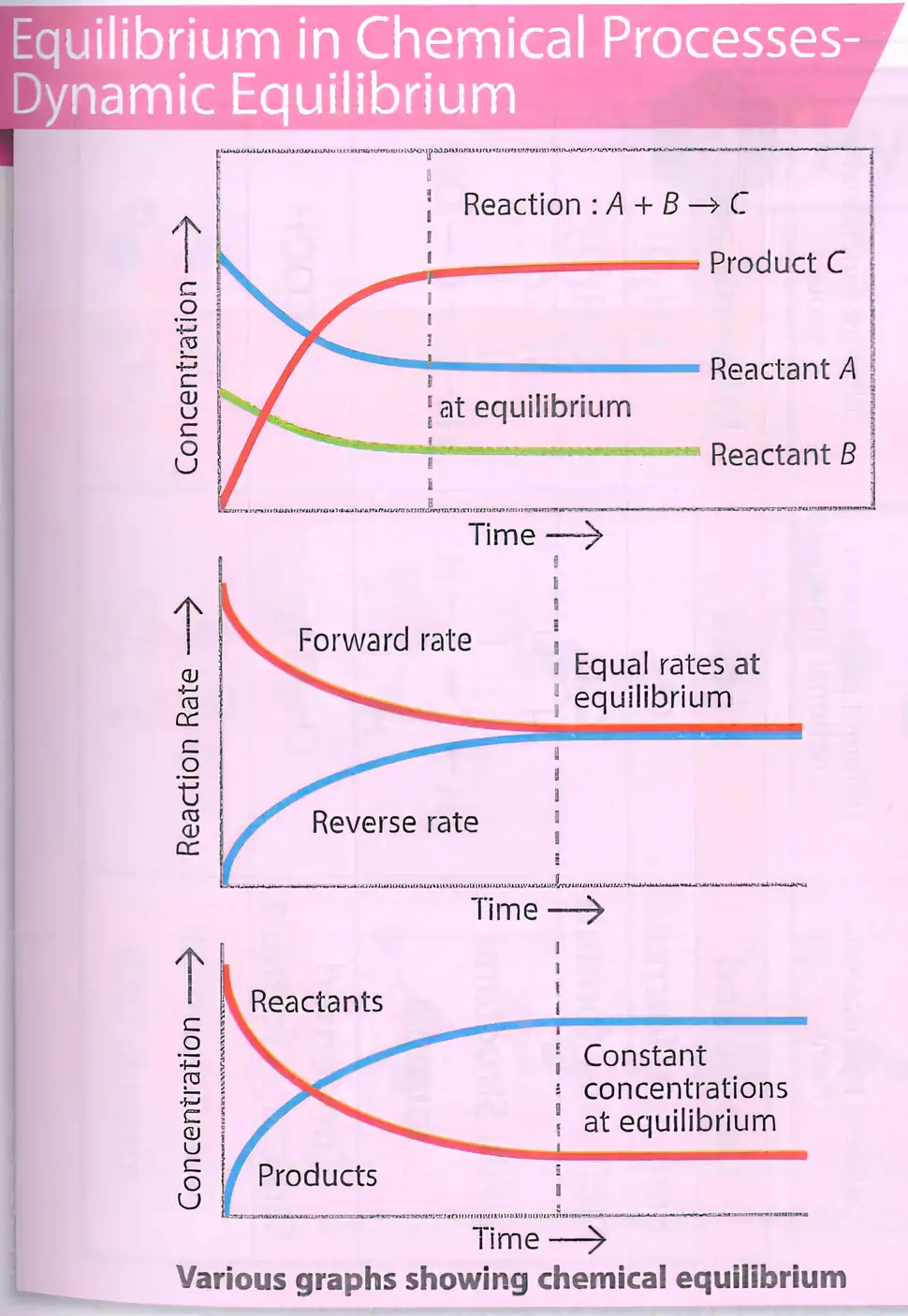
Conditions and Features
At constant pressure and temperature.
Effect of a Catalyst
Do not assume reactions stop at equilibrium: both directions continue at equal rates, so the system is dynamic.
Quick recap
- Chemical equilibrium applies when the process involves only chemical change.
- Equilibrium is dynamic: forward and reverse reactions continue at equal rates.
- Observable properties and concentrations remain constant at equilibrium.
- Equilibrium may be approached from either direction and requires a closed system.
- At constant pressure and temperature, the free-energy change at equilibrium is zero.
- A catalyst speeds up attainment of equilibrium but does not change its state.
Law of Chemical Equilibrium and Equilibrium Constant
Law of Chemical Equilibrium
For , the equilibrium constant is the product concentration term divided by the reactant concentration term.
Changing the Reaction and Its Equilibrium Constant
How does the equilibrium constant change when a reaction is reversed?
What happens to the equilibrium constant when every coefficient is multiplied by ?
Quick recap
- The law of chemical equilibrium is also known as the law of mass action.
- For a balanced reversible reaction, each equilibrium concentration is raised to its stoichiometric coefficient.
- is specific to the reaction and is constant at a given temperature.
- Reversing a reaction changes its constant to .
- Multiplying all reaction coefficients by changes the constant to .
Homogeneous Equilibria
Homogeneous Equilibrium: Meaning and Examples
Homogeneous equilibrium — An equilibrium in which all reactants and products are present in the same phase.
Examples
- Gas phase: Nitrogen and hydrogen form gaseous ammonia.
- Liquid phase: Ester hydrolysis occurs in an aqueous liquid medium; water is the liquid solvent.
- Aqueous phase: Iron(III) ions and thiocyanate ions form an aqueous complex ion.
Equilibrium Constant for Gaseous Reactions
- General reaction: For , the equilibrium constant in terms of partial pressures is .
- Powers: Each partial pressure is raised to the power of its stoichiometric coefficient.
- Gas-mole change: is gaseous product moles minus gaseous reactant moles, using the balanced equation coefficients.
For a gaseous reaction, use equilibrium partial pressures.
Here, is the equilibrium constant in terms of concentration and are the gas constant and absolute temperature.
Count only gaseous species, with their stoichiometric coefficients.
Example: Ammonia Formation
- Mole change: For , .
- Relation: Therefore, for this reaction.
Quick recap
- Homogeneous equilibrium has all reactants and products in the same phase.
- Examples include gas-phase ammonia formation and aqueous equilibria.
- For gases, uses partial pressures raised to stoichiometric powers.
- .
- is gaseous product moles minus gaseous reactant moles.
Heterogeneous Equilibria
Heterogeneous Equilibrium
Heterogeneous equilibrium — An equilibrium in which reactants and products are present in different phases.
Examples
- Different phases: The substances may be solids, liquids or gases.
- Examples: Nickel reacts with gaseous carbon monoxide to form gaseous nickel tetracarbonyl; solid calcium carbonate decomposes into solid calcium oxide and carbon dioxide gas.
Equilibrium Constants for Pure Solids
Omitting pure solids
- Equilibrium expression: The full expression is .
- Pure solids: Their concentrations are constant, so they are absorbed into the equilibrium constant and omitted.
- Modified constants: For this reaction, and .
Units of Equilibrium Constants
Change in gaseous moles — is the total stoichiometric moles of gaseous products minus those of gaseous reactants.
Using concentration in mol L⁻¹ and pressure in atm, the units depend on .
| units | units | |
|---|---|---|
| No units | No units | |
Dimensionless constants
- Standard states: Equilibrium constants can be expressed as dimensionless quantities when the standard states of reactants and products are specified.
Meaning of the Equilibrium Constant
- Large : Products are favoured at equilibrium; the products are relatively more stable and reactants less stable.
- Small : Reactants are favoured at equilibrium.
Quick recap
- Heterogeneous equilibrium involves substances in different phases.
- Pure solids are omitted from equilibrium expressions because their concentrations are constant.
- For calcium carbonate decomposition, and .
- The units of and depend on the change in gaseous stoichiometric moles, .
- Specifying standard states allows equilibrium constants to be dimensionless.
- A larger means products are favoured at equilibrium.
Applications of Equilibrium Constants
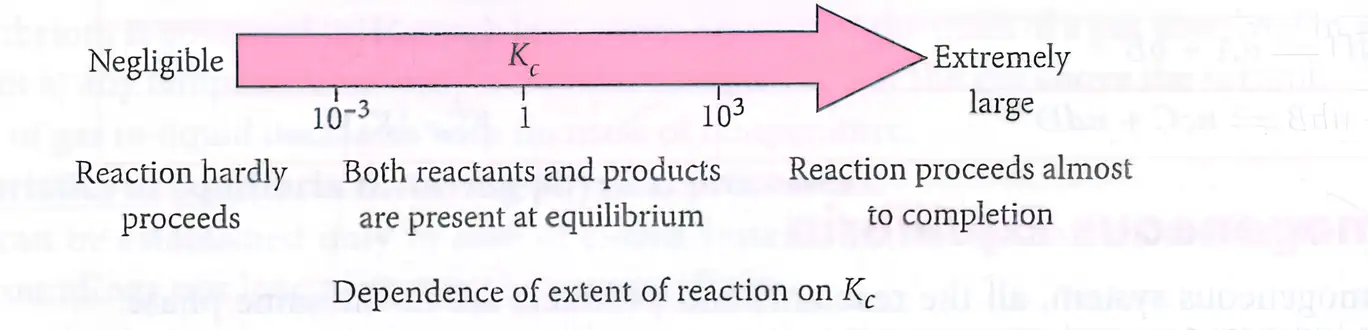
Predicting the Extent of a Reaction
For at :
Predicting the Direction of a Reaction
For , use the current concentrations:
| Comparison | What happens |
|---|---|
| Reaction proceeds in the forward direction, towards products. | |
| Reaction proceeds in the backward direction, towards reactants. | |
| The reaction mixture is at equilibrium. |
How can be used to predict the direction of a reaction?
Quick recap
- The magnitude of indicates the extent of a reversible reaction.
- A large favours products; a small favours reactants.
- uses the concentrations present at the stage being considered.
- If , the reaction proceeds towards products.
- If , the reaction proceeds towards reactants.
- If , the mixture is at equilibrium.
Relationship between Equilibrium Constant K, Reaction Quotient Q and Gibbs Energy G
Equilibrium: Kinetic and Thermodynamic Views
Chemical equilibrium — Chemical equilibrium is defined kinetically by equal forward and backward reaction rates; its properties can also be studied thermodynamically using the Gibbs energies of reactants and products.
Gibbs Energy and Reaction Direction
Gibbs energy change — is the difference in Gibbs free energy between products and reactants under the current conditions.
Reaction direction
- : The forward reaction is spontaneous.
- : The forward reaction is non-spontaneous; the reverse direction is favoured.
- : The reaction is at equilibrium.
Reaction Quotient and Gibbs Energy
Standard Gibbs energy change — is the standard free-energy difference between products and reactants.
Use this relation to determine the direction favoured at the current composition. is the universal gas constant and is the absolute temperature in kelvin.
Equilibrium Constant and Standard Gibbs Energy
At equilibrium
- Equilibrium condition: and .
- Substitution: Applying these conditions to the Gibbs-energy relation links to .
This relation connects the sign of the standard Gibbs energy change to the value of the equilibrium constant.
Combining the Gibbs-energy relations gives a direct test of reaction direction.
| Condition | Sign of | Favoured direction |
|---|---|---|
| Negative | Forward | |
| Zero | At equilibrium | |
| Positive | Reverse |
What the Value of Kc Indicates
| Standard Gibbs energy | Equilibrium constant | Implication |
|---|---|---|
| Products are favoured at equilibrium; the forward direction is spontaneous under standard conditions. | ||
| Reactants are favoured at equilibrium; only a small amount of product is formed. | ||
| Neither side is favoured by the standard Gibbs energy change. |
Do not use alone to determine direction at any composition: use or compare with . refers to standard conditions.
How are and related?
How does comparing and predict reaction direction?
Quick recap
- Chemical equilibrium is defined by equal forward and backward rates and can be analysed using Gibbs energy.
- favours the forward reaction; favours the reverse reaction; marks equilibrium.
- For any composition, .
- At equilibrium, and .
- ; therefore, corresponds to , and to .
- Compare with to determine the direction favoured under current conditions.
Factors Affecting Equilibria
Le Chatelier’s Principle
- Principle: A system at equilibrium responds to a change in conditions in a way that reduces or counteracts that change.
- Scope: Le Chatelier’s principle applies to both physical and chemical equilibria.
General Effects of Changing Equilibrium Conditions
| Change | Favoured direction / effect |
|---|---|
| Increase reactant concentration | Forward reaction |
| Increase product concentration | Backward reaction |
| Increase temperature | Endothermic direction |
| Decrease temperature | Exothermic direction |
| Increase pressure | Direction producing fewer moles of gas |
| Decrease pressure | Direction producing more moles of gas |
| Add inert gas at constant volume | No effect on equilibrium |
| Add inert gas at constant pressure | Direction producing more moles of gas |
| Add a catalyst | No change in equilibrium position |
Key Notes
- Catalyst: It does not change the equilibrium position or equilibrium constant; it helps the system reach equilibrium faster.
- Gas pressure: Compare the total gaseous mole counts on the two sides of the balanced equation.
Applications to Chemical Equilibria
| Disturbance | Shift / result |
|---|---|
| Increase temperature | Forward; favours formation of PCl₃ and Cl₂ |
| Increase pressure | Backward; the reactant side has fewer gaseous moles |
| Add PCl₃ or Cl₂ | Backward |
| Remove PCl₅ | Backward |
| Add inert gas at constant volume | No effect |
| Add inert gas at constant pressure | Forward; the product side has more gaseous moles |
| Disturbance | Shift / result |
|---|---|
| Increase temperature | Forward; favours formation of H₂ and I₂ |
| Change pressure | No effect; gaseous mole counts are equal on both sides |
| Add HI | Forward |
| Remove H₂ or I₂ | Forward |
Temperature and the Equilibrium Constant
Use temperatures in kelvin. and are equilibrium constants at and ; is the reaction enthalpy and is the gas constant.
| Condition | Effect when temperature increases |
|---|---|
| remains unchanged | |
| (endothermic) | increases |
| (exothermic) | decreases |
What is the effect of adding an inert gas at constant volume and at constant pressure?
How does increasing temperature affect the equilibrium constant of an endothermic reaction?
Quick recap
- Le Chatelier’s principle predicts a shift that opposes an imposed change.
- More reactant or less product favours the forward direction; more product favours the reverse direction.
- Heating favours the endothermic direction, while cooling favours the exothermic direction.
- Pressure changes affect gas equilibria according to the gaseous mole counts on each side.
- An inert gas has no equilibrium effect at constant volume; at constant pressure it favours the side with more gaseous moles.
- A catalyst changes neither equilibrium position nor the equilibrium constant.
- Increasing temperature raises for an endothermic reaction and lowers for an exothermic reaction.
Ionic Equilibrium in Solution
Electrolytes
- Electrolytes: Substances that conduct electricity in aqueous solution or in the molten state.
- Strong electrolytes: They are completely ionised in aqueous solutions.
- Weak electrolytes: They are partially ionised in aqueous solutions.
Ionic Equilibrium
- Weak electrolytes: In aqueous solution, an equilibrium is established between their ions and unionised molecules.
- Ionic equilibrium: This equilibrium between ions and unionised molecules in solution is called ionic equilibrium.
- Examples: Weak acids, weak bases and salts may exhibit ionic equilibrium in aqueous solution.
Quick recap
- Electrolyte: Conducts electricity in aqueous solution or when molten.
- Strong electrolyte: Completely ionised in aqueous solution.
- Weak electrolyte: Partially ionised in aqueous solution.
- Ionic equilibrium: Equilibrium between ions and unionised molecules of a weak electrolyte.
- Acids, bases and salts: Each may be classified as a strong or weak electrolyte.
Acids, Bases and Salts
Arrhenius Concept
Arrhenius base — A substance that produces hydroxide ions, , when dissolved in water.
Limitations of the Arrhenius Concept
- Substances not explained: It does not account for acidic behaviour of , and , or basic behaviour of and .
- Water required: It cannot explain acid–base behaviour in the absence of water.
- Ions unexplained: It does not explain the nature of and ions in water.
Brønsted–Lowry Concept
Brønsted–Lowry base — A proton () acceptor. This model is also called the protonic theory.
| Reaction | Role of water | Reason |
|---|---|---|
| Acid | Water donates to . | |
| Base | Water accepts from . |
Amphoteric / amphiprotic — A substance that can act as both an acid and a base; water can donate or accept a proton.
Conjugate Acid–Base Pairs
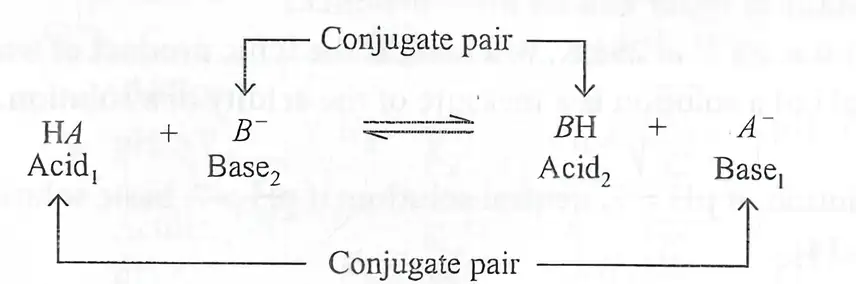
| Starting species | Change | Conjugate species |
|---|---|---|
| Acid | Loses | Conjugate base |
| Base | Gains | Conjugate acid |
Relative Strength and Reaction Direction
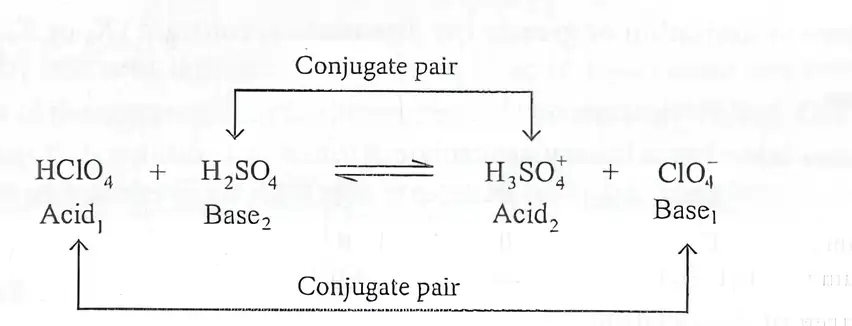
- Conjugate strengths: A strong acid has a weak conjugate base, and a strong base has a weak conjugate acid.
- Relative acid behaviour: When two acids are compared with respect to water, the weaker acid can act as a base toward the stronger acid.
- Reaction direction: Acid–base reactions proceed toward the weaker acid–base combination.
- Example: In the reaction below, and are the stronger acid and base; and are the weaker acid and base.
Lewis Acids and Bases
Lewis base — An electron-pair donor.
| Type | Feature | Examples |
|---|---|---|
| Electron-deficient neutral compounds | Central atom has an incomplete octet | , , |
| Simple cations | Positively charged species accept electron pairs | , , , , |
| Multiple-bond compounds | Multiple bond links atoms with different electronegativities | , |
| Metal centres in coordinate complexes | The metal atom acts as a Lewis acid | Ni in |
| Compounds with empty orbitals | Central atom has empty orbitals | , |
| Type | Feature | Examples |
|---|---|---|
| Electron-rich neutral compounds | Have at least one lone pair | , , |
| Negatively charged ions | Donate an electron pair | , , |
| Ligands in coordination compounds | Donate lone pairs to a central metal | Ligands act as Lewis bases |
Relationship Between Lewis and Brønsted Bases
- Relationship: The lecture states that Lewis bases are also Brønsted bases, and vice versa.
- Reason: A Lewis base donates an electron pair; it can use this pair to accept a proton and act as a Brønsted base.
State the Brønsted–Lowry definitions of an acid and a base.
Define a Lewis acid and a Lewis base, with one example of each.
Quick recap
- Arrhenius acids produce in water; Arrhenius bases produce in water.
- Brønsted–Lowry acids donate protons, while bases accept protons.
- Water is amphiprotic because it can donate or accept .
- Conjugate acid–base members differ by one proton; strong acids have weak conjugate bases.
- Acid–base reactions favour formation of the weaker acid–base pair.
- Lewis acids accept electron pairs; Lewis bases donate them.
Ionisation of Acids and Bases
Ionic Product of Water and the pH Scale
Ionic product of water — At , .
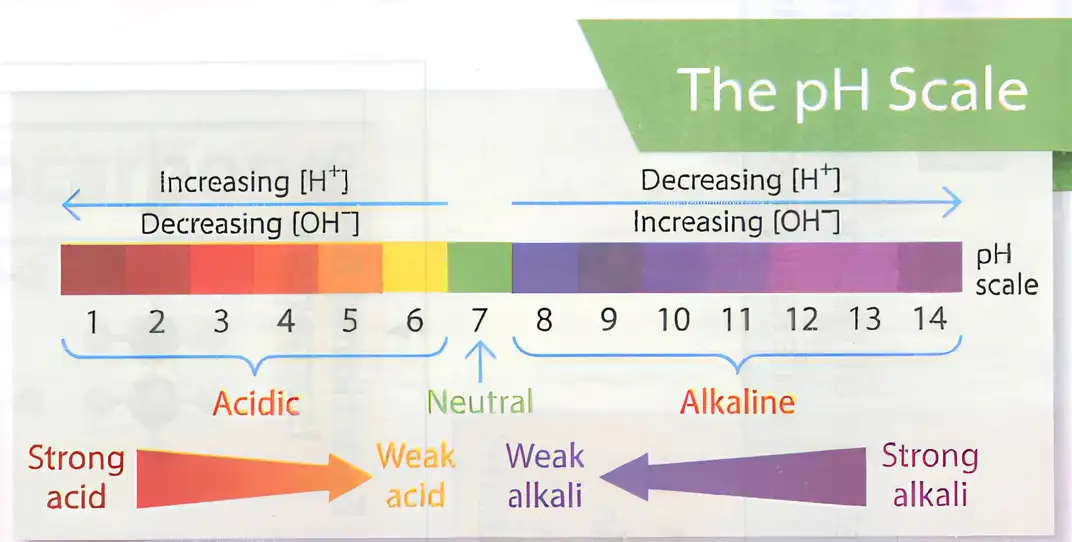
pH
- Meaning: pH measures the acidity of a solution; .
- Classification: pH is acidic; pH is neutral; pH is basic.
- pH and pOH: at .
- Scale change: A decrease of one pH unit means a tenfold increase in hydronium ion concentration.
Ionisation of Acids and Bases
Ionisation constant — The ionisation constant measures how extensively a weak acid or base forms ions in solution.
- Acid: For , .
- Base: For , .
- Degree of ionisation: For a weak acid, ; for a weak base, .
- Strength: Greater ionisation or a larger or indicates a stronger acid or base.
Ostwald’s Dilution Law
Degree of dissociation — The degree of dissociation, , is the fraction of the initial electrolyte that dissociates.
- Initial concentration: If the initial concentration is , the equilibrium concentrations are and .
- Definition: is the number of moles dissociated divided by the total initial moles.
- Dissociation constant: .
- Weak electrolytes: Since , ; hence and , where is the volume containing one mole.
- Strong vs weak: A strong electrolyte has ; a weak electrolyte has .
Relationships Between Ionisation Constants
pKa and pKb
- Definitions: and .
- Conjugate acid–base pair: at .
- Strength relationship: A larger or corresponds to a smaller pKa or pKb and a stronger acid or base.
Polybasic Acids and Polyacidic Bases
- Successive constants: The constants are ; generally, .
- Overall constant: .
Factors Affecting Acid Strength
Acid strength — The strength of an acid depends on the strength and polarity of its bond.
- Hydrogen halides: Acid strength increases down the group: , as the bond becomes easier to break.
- Across the series: Acid strength increases in the order .

Common-Ion Effect
Common-ion effect — The suppression of a weak electrolyte’s dissociation by adding another electrolyte that supplies a common ion.
- Effect: Adding a source of an ion already present shifts the weak electrolyte’s ionisation towards the undissociated form.
Salt Hydrolysis and the pH of Salt Solutions
Salt hydrolysis — The reaction of hydrated salt ions with water is called hydrolysis.
- Strong acid + strong base: The ions are hydrated but do not hydrolyse, so the solution is neutral.
- Weak acid + strong base: Anionic hydrolysis makes the solution alkaline.
- Strong acid + weak base: Cationic hydrolysis makes the solution acidic.
- Weak acid + weak base: Both ions hydrolyse; the solution is neutral when .
| Salt formed from | Hydrolysis | Solution | Hydrolysis constant | Degree of hydrolysis | pH |
|---|---|---|---|---|---|
| Weak acid + strong base | Anionic | Alkaline; pH | |||
| Strong acid + weak base | Cationic | Acidic; pH | |||
| Weak acid + weak base | Anionic and cationic | Neutral if |
Isohydric Solutions
Isohydric solutions — Solutions of different electrolytes with the same concentration of a common ion are called isohydric solutions.
- On mixing: If common-ion concentrations are equal, the degree of dissociation of either electrolyte remains unchanged.
- Example: Solutions of and with the same hydroxide-ion concentration are isohydric.
State Ostwald’s dilution law for a weak binary electrolyte.
How does a salt of a weak acid and a strong base affect solution pH?
Quick recap
- At , and .
- Higher or means greater ionisation and a stronger acid or base.
- For weak electrolytes, Ostwald’s law gives .
- Polybasic acids and polyacidic bases ionise stepwise, usually with .
- Common ions suppress the ionisation of weak electrolytes.
- Salt hydrolysis determines whether a solution is acidic, alkaline or neutral.
- Isohydric solutions have equal common-ion concentrations; mixing them does not change their degree of dissociation.
Buffer Solutions
Buffer solution — A solution that resists a change in pH on dilution or when small amounts of acid or alkali are added.
Types of Buffer Solutions
Mixed buffer — A buffer made by mixing two solutions: a weak acid or weak base and a salt of that acid or base.
| Type | Composition | Example / pH |
|---|---|---|
| Simple buffer | Salt of a weak acid and a weak base | Ammonium acetate, CH₃COONH₄ |
| Acidic mixed buffer | Weak acid + its salt formed with a strong base | CH₃COOH + CH₃COONa; pH < 7 |
| Basic mixed buffer | Weak base + its salt formed with a strong acid | NH₄OH + NH₄Cl; pH > 7 |
pH of an Acidic Buffer
- Composition: A weak acid and its conjugate-base salt form an acidic buffer.
- Salt term: The salt supplies the conjugate base of the weak acid.
- Equation: The Henderson–Hasselbalch equation relates buffer pH to the acid and salt concentrations.
Use for a weak-acid/conjugate-base buffer; is the weak acid and its conjugate base.
pH of a Basic Buffer
- Composition: A weak base and its conjugate-acid salt form a basic buffer.
- Salt term: The salt supplies the conjugate acid of the weak base.
- Conversion: The basic-buffer equation gives pOH; then use to obtain pH.
Use to calculate pOH; is the weak base and its conjugate acid.
Buffer Capacity and Buffer Range
Buffer capacity — The number of moles of acid or base added per litre of buffer divided by the resulting change in pH.
Here, is the moles of acid or base added, is the buffer volume, and is the pH change.
Buffer range — The pH range over which a buffer remains effective.
| Buffer type | Effective pH range |
|---|---|
| Acidic | |
| Basic |
Do not use the acidic-buffer equation directly for a basic buffer: it first gives pOH, which must be converted using .
State the Henderson–Hasselbalch equation for an acidic buffer.
What is the effective pH range of a basic buffer?
Quick recap
- A buffer resists pH change on dilution or after small acid/base additions.
- A simple buffer is a salt of a weak acid and a weak base; a mixed buffer is a mixture of two solutions.
- Acidic mixed buffers contain a weak acid and its salt; basic mixed buffers contain a weak base and its salt.
- Acidic-buffer pH is calculated with .
- The basic-buffer equation gives pOH; convert with .
- Buffer capacity measures acid or base added per litre relative to the pH change.
- Acidic and basic buffer ranges are and , respectively.
Solubility Equilibria of Sparingly Soluble Salts
Solubility and Solubility Product
Solubility — The amount of a substance that dissolves in a specified amount of solvent to form a saturated solution.
- Solubility describes how much solute dissolves per litre of solvent; it is commonly expressed in .
- Solubility product, : At a definite temperature, it is the product of equilibrium ion concentrations in a saturated solution, each raised to its stoichiometric coefficient.
- Nature and unit: is a thermodynamic constant describing equilibrium between a solid and its dissolved ions; its stated unit is .
- Dependence: Solubility can depend on temperature, pressure, pH, and other substances; for a given salt depends only on temperature.
| Aspect | Solubility | Solubility product |
|---|---|---|
| Meaning | Amount of solute dissolved per litre of solvent | Equilibrium constant for a solid and its dissolved ions |
| Common unit | (as stated in the source) | |
| Dependence | May depend on temperature, pressure, pH, and other substances | Depends only on temperature |
Solubility Product and Molar Solubility
Use this relation when the salt dissociates into the indicated ions.
Rearranging the solubility-product expression gives the molar solubility.
Solubility Product and Ionic Product
- is evaluated using equilibrium ion concentrations in a saturated solution.
- Ionic product, , is calculated using the ion concentrations present at any moment, not necessarily at equilibrium.
- At equilibrium: .
Effect of a Common Ion
Common-Ion Effect
- General effect: Adding an ion already present in the dissolution equilibrium lowers the solubility of a sparingly soluble salt.
- Example: Adding to saturated supplies the common ion , reducing the solubility of .
- Concentrations: If the added common-ion concentration is and the new solubility is , then and .
The new solubility follows from the equilibrium expression.
A considerable increase in solubility after adding a common ion or an inert salt can indicate formation of a complex ion; do not assume every added substance lowers solubility.
Applications of Solubility Product
Calculating Solubility of a 1:1 Salt
- Dissolution: For , molar solubility gives .
- Result: , so .
| Comparison | Result |
|---|---|
| Precipitation occurs. | |
| The solution is saturated and at equilibrium. | |
| No precipitation; the solution is unsaturated. |
Precipitation of Common Salt
- Passing gas through saturated impure common-salt solution adds ions.
- The concentration increases, while is present from dissolved .
- The ionic product exceeds .
- Pure precipitates.
Qualitative Analysis
- Use: Solubility products and the common-ion effect help identify and separate different basic radicals (cations) by selective precipitation.
Solubility Relations for Different Electrolyte Types
| Type | Examples | Relation |
|---|---|---|
| Binary, 1:1 () | , | ; |
| Ternary, 1:2 () | , | ; |
| Ternary, 2:1 () | , | ; |
| Quaternary, 1:3 () | , | ; |
| 3:2 type () | , | ; |
Quick recap
- For , when its molar solubility is .
- uses equilibrium concentrations; uses concentrations at the current moment, and they are equal at equilibrium.
- The stated units are for solubility and for .
- Adding a common ion generally lowers the solubility of a sparingly soluble salt.
- A precipitate forms when ; no precipitation occurs when .
- Solubility-product relations allow solubility calculations and selective precipitation in qualitative analysis.
- For different electrolyte types, express each ion concentration in terms of to derive the relation between and molar solubility.
NEET Chemistry — ALL CHAPTERS
1
Some Basic Concepts of Chemistry
2
Structure of Atom
3
Classification of Elements and Periodicity in Properties
4
Chemical Bonding and Molecular Structure
5
Thermodynamics
6
Equilibrium
7
Redox Reactions
8
Organic Chemistry - Some Basic Principles and Techniques
9
Hydrocarbons
10
Solutions
11
Electrochemistry
12
Chemical Kinetics
13
The d- and f- Block Elements
14
Coordination Compounds
15
Haloalkanes and Haloarenes
16
Alcohols, Phenols and Ethers
17
Aldehydes, Ketones and Carboxylic Acids
18
Amines
19
Biomolecules
20
The p-Block Elements (Group 13 and 14)
21
The p-Block Elements (Group 15 to 18)
22
Principles Related to Practical Chemistry