NEET UG . NEET Chemistry . Chemistry . Haloalkanes and Haloarenes
Chapter 15: Haloalkanes and Haloarenes
Ch 15
NEET Chemistry
NEET UG
Classification
Haloalkanes and Haloarenes
Haloalkanes — Compounds formed when one or more hydrogen atoms of an alkane are replaced by the same number of halogen atoms (, , or ).
Haloarenes — Compounds formed when a hydrogen atom of the benzene nucleus is replaced by a halogen; a monosubstituted example has the formula .
Bonding distinction
- Haloalkanes: The source describes the halogen as attached to an -hybridised carbon atom of an alkyl group.
- Haloarenes: The source describes the halogen as attached to an -hybridised carbon atom of an aryl group.
- Occurrence: Many halogen-containing organic compounds occur naturally; some are clinically useful.
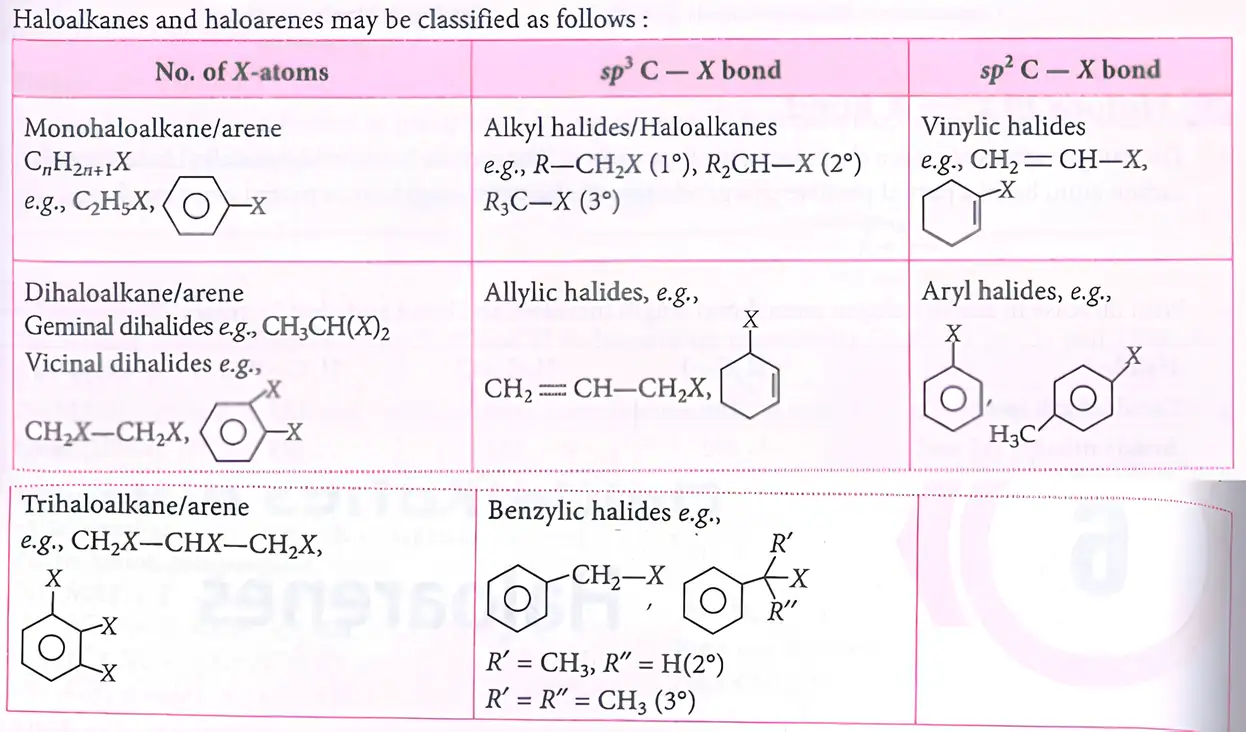
Classification
| Class | Number of halogen atoms |
|---|---|
| Monohalo | One |
| Dihalo | Two |
| Trihalo | Three |
| Polyhalo | More than three |
Quick recap
- Haloalkanes form when one or more alkane hydrogens are replaced by halogens.
- Haloarenes form when a benzene-nucleus hydrogen is replaced; a monosubstituted example is .
- The source assigns haloalkanes to halogen attachment at an carbon of an alkyl group and haloarenes to attachment at an carbon of an aryl group.
- Compounds are classified by the number of halogen atoms and by the type of C–X bond.
- Many halogen-containing organic compounds occur naturally, and some are clinically useful.
Nomenclature
Naming Haloalkanes
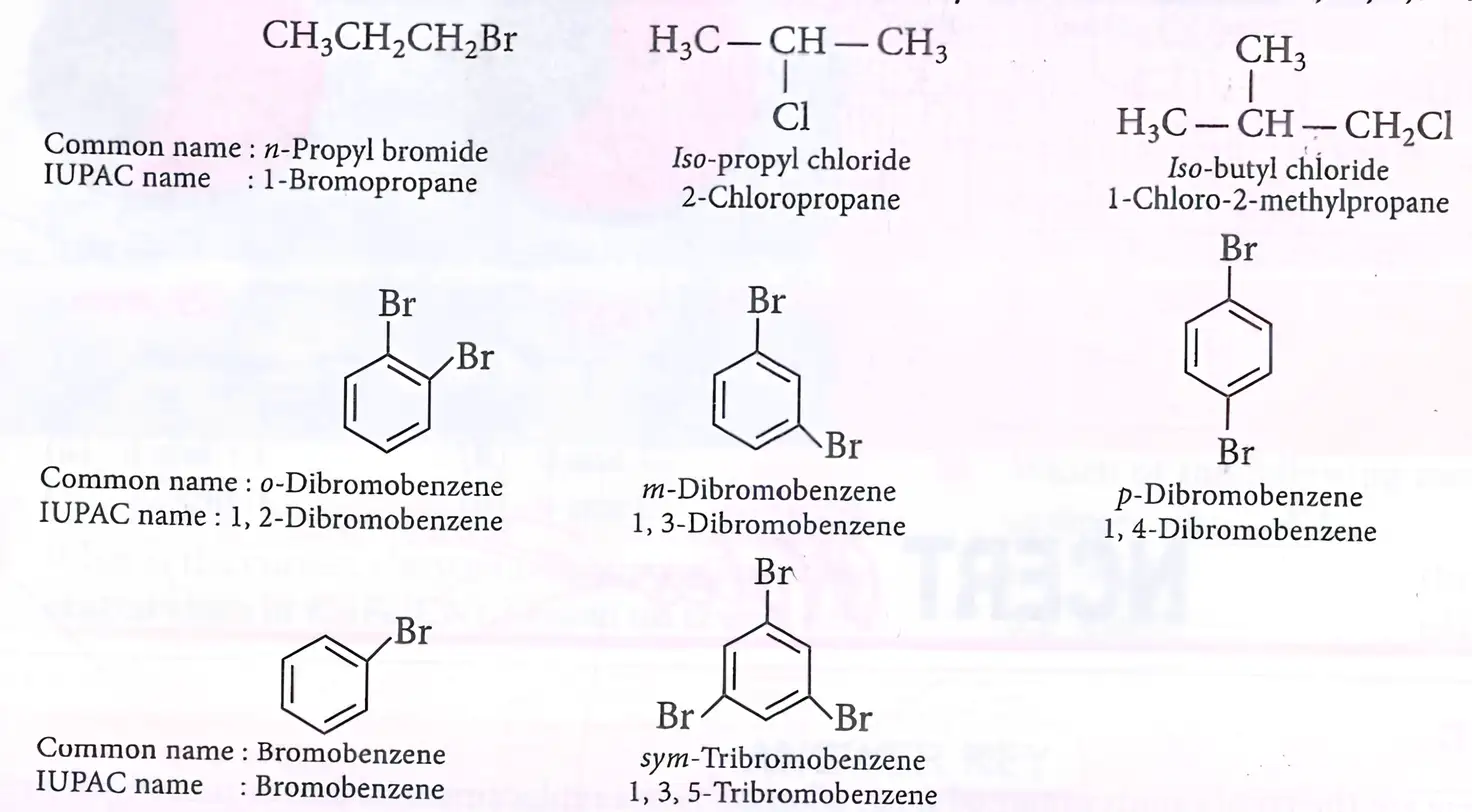
Common and IUPAC names
- Common name: Name the alkyl group first, followed by the halide name; for example, is methyl chloride.
- IUPAC name: Treat the halogen as a substituent on the parent hydrocarbon; for example, is chloromethane.
Naming Halobenzenes
- Monohalobenzene: Common and IUPAC names are the same, such as bromobenzene.
- Dihalobenzene: Common names use -, - and -; IUPAC names use locants -, - and -.
| Common prefix | IUPAC locants | Relationship |
|---|---|---|
| - | - | Adjacent positions |
| - | - | Separated by one ring carbon |
| - | - | Opposite positions |
Geminal and Vicinal Dihalides
Geminal dihalide — In a dihaloalkane with identical halogen atoms, both halogens are attached to the same carbon atom.
Vicinal dihalide — In a dihaloalkane with identical halogen atoms, the halogens are attached to adjacent carbon atoms.
| Type | Halogen positions | Common-name pattern | IUPAC-name pattern |
|---|---|---|---|
| Geminal | Same carbon | Alkylidene dihalide | Dihaloalkane |
| Vicinal | Adjacent carbons | Alkylene dihalide | Dihaloalkane |
Examples
- Geminal: is ethylidene chloride (common) or 1,1-dichloroethane (IUPAC).
- Vicinal: is ethylene dichloride (common) or 1,2-dichloroethane (IUPAC).

How are geminal and vicinal dihalides distinguished?
Quick recap
- Common haloalkane names use the alkyl-group name followed by the halide name.
- IUPAC haloalkane names treat halogens as substituents on a hydrocarbon.
- Monohalobenzene common and IUPAC names are the same.
- For dihalobenzenes, -, -, and - correspond to -, -, and -.
- For same-halogen dihaloalkanes, geminal halogens are on the same carbon and vicinal halogens are on adjacent carbons.
- Common names use alkylidene for geminal and alkylene for vicinal dihalides; IUPAC names use dihaloalkanes.
Nature of C - X Bond
Polarity of the C–X Bond
- Bond polarity: Halogens are more electronegative than carbon, so the C–X bond is polar.
- Partial charges: Carbon bears a partial positive charge and the halogen bears a partial negative charge.
Bond Length and Bond Enthalpy
- Bond length: It increases as the halogen atom becomes larger, from C–F to C–I.
- Bond enthalpy: It decreases as the C–X bond length increases.
Dipole Moment
- Dipole moment: It depends on both the magnitude of the partial charges and the distance between them.
- Trend: From F to I, halogen size increases while electronegativity decreases.
- Variation: The dipole moments of carbon–halogen bonds therefore vary irregularly across the series.
Quick recap
- Halogens are more electronegative than carbon, so the C–X bond is polar.
- Carbon has partial positive charge and halogen has partial negative charge.
- From F to I, C–X bond length increases and bond enthalpy decreases.
- Methyl-halide dipole moments vary irregularly from to .
Methods of Preparation of Haloalkanes
Preparation from Alcohols

Reactions with hydrogen halides
- General conversion: Alcohols react with a hydrogen halide to form a haloalkane and water.
- Primary and secondary alcohols: Reaction with requires as a catalyst.
- Tertiary alcohols: React with concentrated by shaking at room temperature; no catalyst is specified.
- Iodoalkanes: Good yields of are obtained by heating alcohols with or in 95% orthophosphoric acid.
- Reactivity order: For a given haloacid, alcohol reactivity is .
Preparation from Hydrocarbons
Free-radical halogenation
- Reaction: Alkanes react with chlorine under UV light or heat; repeated substitution can produce several haloalkanes.
- Methane products: Chlorination can give , , and , along with .
- Ease of hydrogen replacement: .
Addition to alkenes
- Hydrogen halide addition: Addition of () to an unsymmetrical alkene can give two regioisomers.
- Markovnikov product: The product with halogen on the more substituted carbon is the major product.
- Peroxide effect: In the presence of peroxide, adds by the anti-Markovnikov rule.
- Halogen addition: Addition of halogen to an alkene forms a vicinal dihalide (halogens on adjacent carbons).
Halogen Exchange
- Driving the reaction forward: The formed or precipitates in dry acetone, shifting the equilibrium forward according to Le Chatelier’s principle.
- Other fluorinating agents: , and can also be used.
Relative rates in radical halogenation
- At : Relative abstraction rates for , and hydrogens are with and with .
Direct iodination
- Why direct iodination is difficult: It is reversible and therefore does not proceed readily to the product.
- How it is carried out: An oxidising agent such as or is used.
Quick recap
- Alcohols form haloalkanes with hydrogen halides; is needed for primary and secondary alcohols reacting with .
- Alcohol reactivity with a given haloacid follows .
- Alkanes undergo radical halogenation, while alkenes add or halogens across the double bond.
- Alkene addition follows Markovnikov’s rule, except for peroxide-assisted addition of , which is anti-Markovnikov.
- Finkelstein reaction prepares alkyl iodides; Swarts reaction prepares alkyl fluorides.
- Direct iodination is reversible and is enabled by oxidising agents such as or .
Preparation of Haloarenes
From Hydrocarbons by Electrophilic Substitution
Direct halogenation of arenes
- Reaction: Arenes form aryl chlorides or bromides by electrophilic substitution with chlorine or bromine.
- Catalyst: Use a Lewis acid such as iron or iron(III) chloride; the reaction is carried out in the dark.
- Toluene: Halogenation gives a mixture of ortho- and para-halotoluene isomers.
- Separation: The ortho and para isomers can be separated because their melting points differ substantially.
Limits of direct halogenation
- Iodination: The reaction is reversible; an oxidising agent such as or is needed to remove the formed.
- Fluorination: Fluoroarenes are not prepared by this method because fluorine is highly reactive.
From Benzene Diazonium Chloride
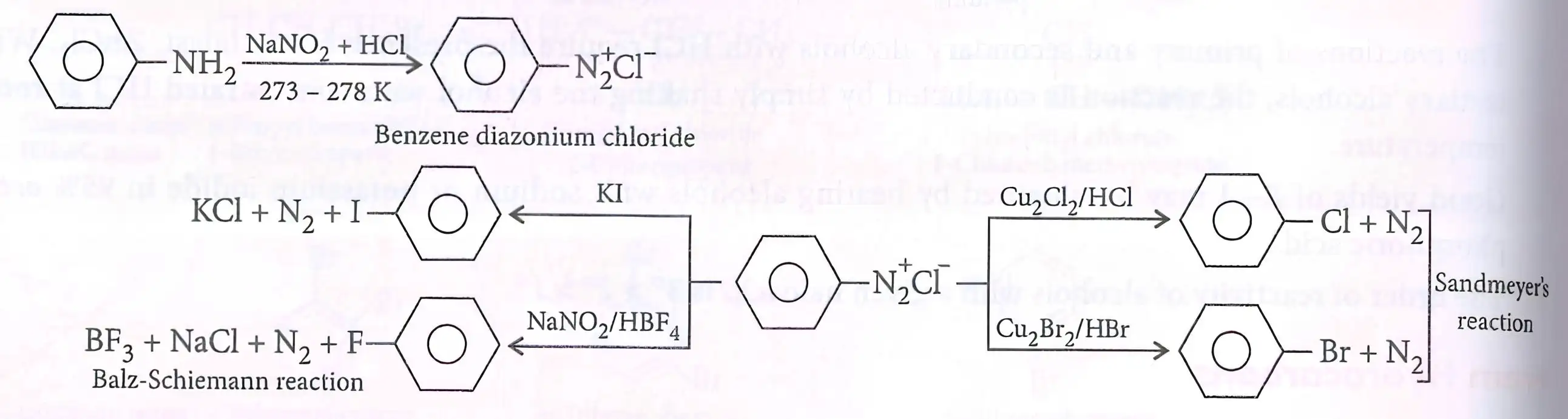
Diazonium route
- Diazotisation: Aniline reacts with sodium nitrite and hydrochloric acid at – to form benzene diazonium chloride.
- Sandmeyer reaction: Replacing the diazonium group with chlorine or bromine using a copper(I) halide releases nitrogen gas.
- Iodination: Potassium iodide converts benzene diazonium chloride to iodobenzene.
- Balz–Schiemann reaction: Heating benzene diazonium tetrafluoroborate produces fluorobenzene.
Quick recap
- Direct route: Chlorination and bromination of arenes use iron or iron(III) chloride as a Lewis acid catalyst.
- Toluene: Direct halogenation gives ortho and para isomers, which can be separated by their melting-point difference.
- Iodination: It is reversible and requires an oxidising agent to remove the hydrogen iodide formed.
- Diazonium route: Benzene diazonium salts provide a route to chloro-, bromo-, iodo- and fluorobenzene.
- Named reactions: Sandmeyer gives aryl chlorides and bromides; Balz–Schiemann gives aryl fluorides.
Physical Properties
Appearance and Physical State
Appearance and state
- Colour: Pure alkyl halides are colourless; bromides and iodides may develop colour on exposure to light.
- Odour: Many volatile halogen compounds have a sweet smell.
- Physical state: Methyl chloride, methyl bromide, ethyl chloride and some chlorofluoromethanes are gases at room temperature; higher members are liquids or solids.
Boiling and Melting Points
Boiling-point trends
- Compared with hydrocarbons: Haloalkanes have greater polarity and higher molecular mass than comparable parent hydrocarbons, strengthening dipole–dipole and van der Waals’ attractions; therefore, their boiling points are higher.
- Halogen effect: For the same alkyl group, boiling points decrease in the order ; larger, heavier halogens give stronger van der Waals’ forces.
- Branching: The boiling points of isomeric haloalkanes decrease as branching increases.
| Property | Trend |
|---|---|
| Boiling point | The isomers have nearly the same boiling points. |
| Melting point | The para-isomer has a higher melting point than the ortho- and meta-isomers because its symmetry allows better crystal-lattice packing. |
Density and Solubility
Density
- Heavier than water: Bromo, iodo and polychloro derivatives of hydrocarbons are denser than water.
- Density increases with: More carbon atoms, more halogen atoms, and greater atomic mass of the halogen.
| Compound | Density () |
|---|---|
Solubility
- In water: Haloalkanes are very slightly soluble.
- In organic solvents: They are more soluble because attractions between haloalkane and solvent molecules are comparable in strength to attractions between haloalkane molecules.
Photodecomposition of Alkyl Iodides
Colour change in alkyl iodides
- Cause: The weak bond allows alkyl iodides to decompose in sunlight.
- Colour: Liberated iodine dissolves in the alkyl iodide, making it violet or brown.
Why do boiling points of alkyl halides increase from alkyl fluorides to alkyl iodides?
Quick recap
- Pure alkyl halides are colourless; light can cause bromides and iodides to develop colour.
- Some small haloalkanes are gases at room temperature; higher members are liquids or solids.
- Haloalkanes have higher boiling points than comparable hydrocarbons because of greater polarity and molecular mass; branching lowers boiling points.
- For the same alkyl group, boiling points follow .
- Para-dihalobenzenes have higher melting points because their symmetry improves crystal packing.
- Haloalkanes are very slightly soluble in water but more soluble in organic solvents; density generally rises with carbon and halogen content and halogen atomic mass.
- Sunlight decomposes alkyl iodides; dissolved iodine gives them a violet or brown colour.
Chemical Reactions
Reactions of Haloalkanes
Main reaction classes
- Haloalkanes undergo nucleophilic substitution, elimination, and reactions with metals.
- C–X bond: Halogens are more electronegative than carbon, so the bond is polar; this polarity makes carbon susceptible to nucleophilic attack.
- Bond polarity: The dipole moment decreases in the order C–F to C–I as the electronegativity difference decreases.
Nucleophilic Substitution in Haloalkanes
Nucleophilic substitution — A nucleophile replaces the halide leaving group in a haloalkane.

| Reagent / nucleophile | Main product |
|---|---|
| Alcohol | |
| Ether | |
| Thiol | |
| from | Alkyl cyanide, |
| from | Alkyl nitrite, |
| Amine |
Ambident nucleophile — A nucleophile with two possible attacking atoms or centres.
Ambident nucleophiles
- Cyanide: Attack through carbon gives alkyl cyanide (); attack through nitrogen gives isocyanide ().
- Nitrite: Linkage through oxygen gives alkyl nitrite (); linkage through nitrogen gives nitroalkane ().
| Point | ||
|---|---|---|
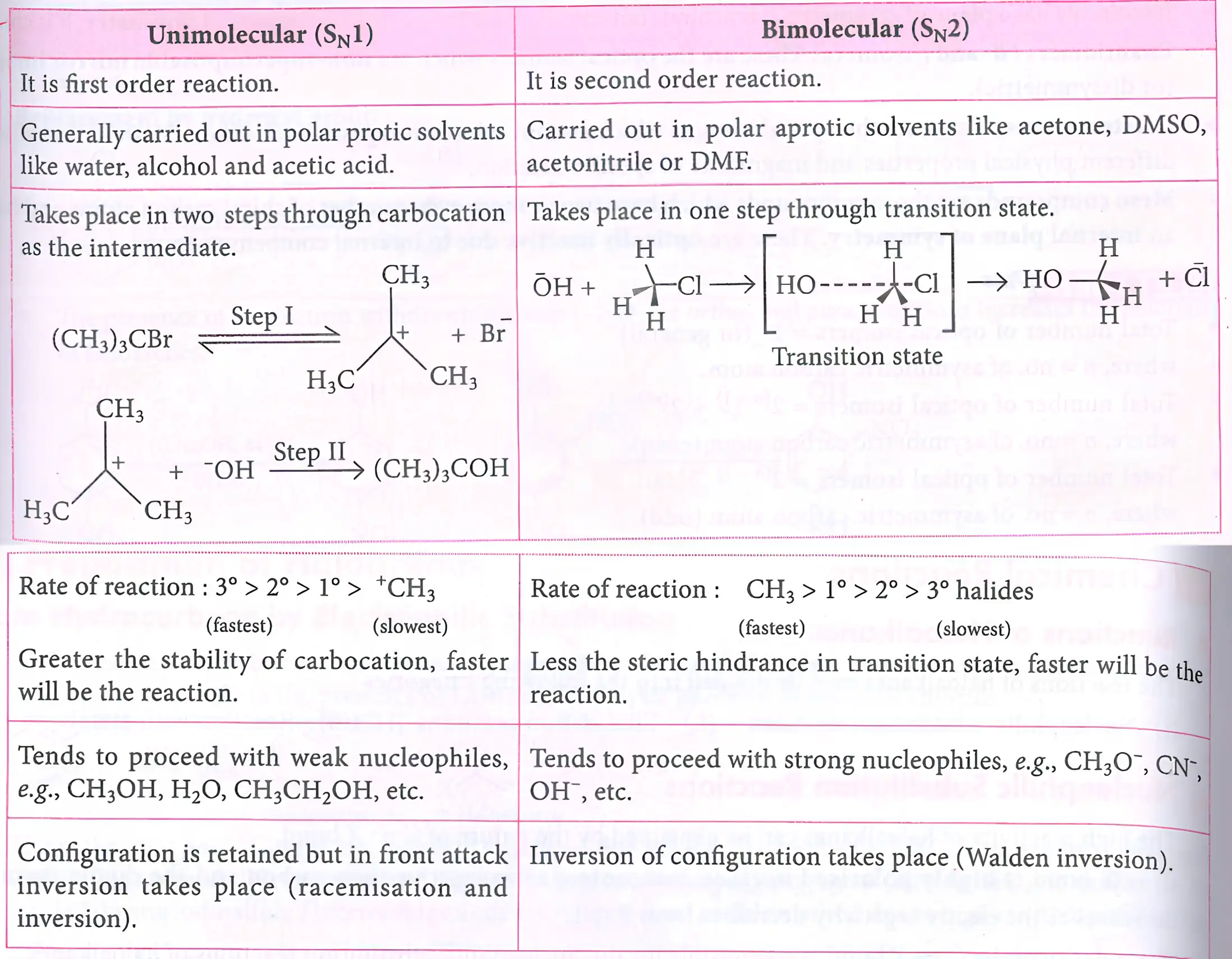
| Steps | Two steps; leaving group departs first, forming a carbocation. | One concerted step; bond formation and bond breaking occur together. |
| Rate law | ; first order. | ; second order. |
| Favoured substrate | More stable carbocations favour the reaction; allylic and benzylic halides react readily. | Less hindered substrates, especially primary halides, favour backside attack. |
| Stereochemical result | A planar carbocation can be attacked from either side, often causing racemisation. | Backside attack causes inversion of configuration. |
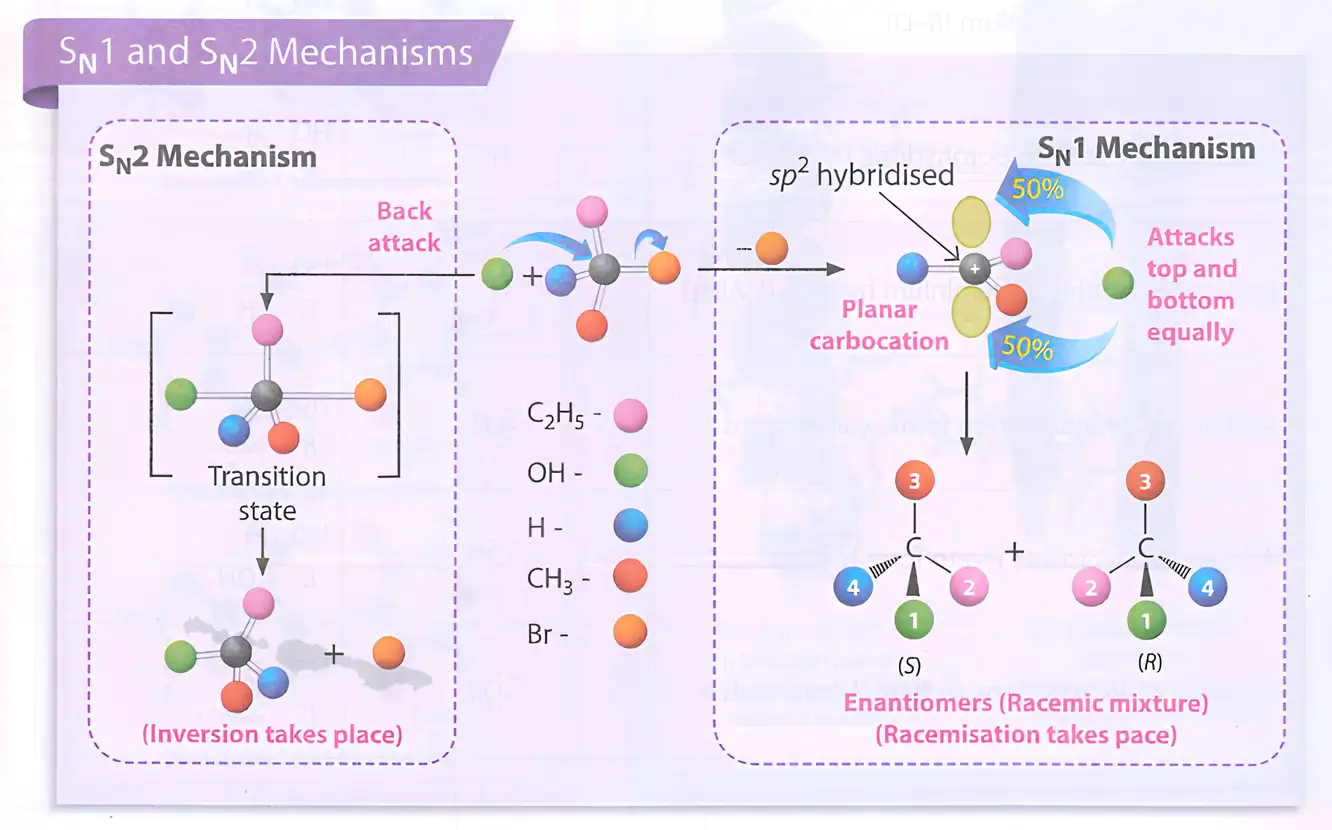
Reactivity and carbocation stability
- Leaving-group effect: For the same alkyl group, both mechanisms follow .
- Allylic and benzylic halides: Primary members are especially reactive in reactions because resonance stabilises their carbocation intermediates.
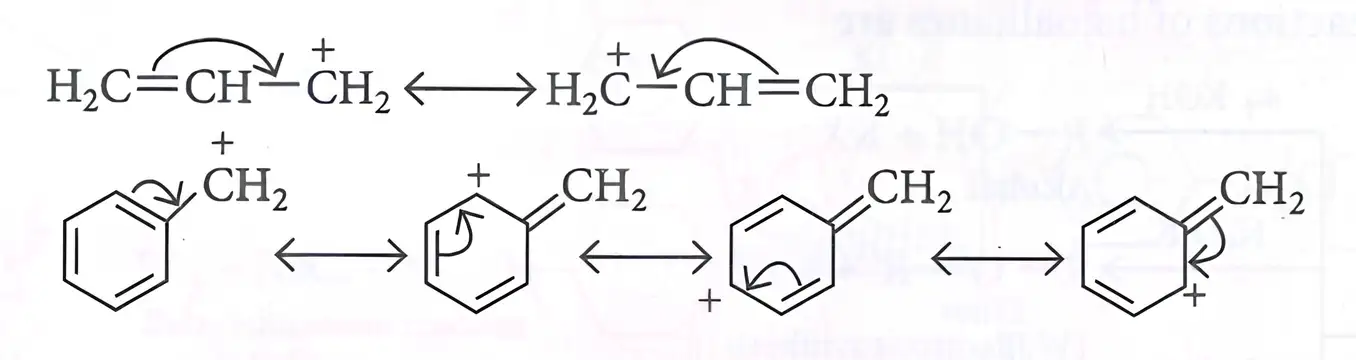
Optical Isomerism and Chirality
- Dextrorotatory ()
- Rotates plane-polarised light clockwise (to the right).
- Laevorotatory ()
- Rotates plane-polarised light anticlockwise (to the left).
- Racemic mixture
- An equimolar mixture of enantiomers; optically inactive because their rotations cancel.
- Racemisation
- Conversion of an enantiomer into a racemic mixture.
- Chiral centre
- A carbon attached to four different groups; also called an asymmetric centre or stereogenic centre.
- Meso compound
- A molecule with multiple chiral centres and an internal plane of symmetry; it is optically inactive by internal compensation.
| Point | Enantiomers | Diastereomers |
|---|---|---|
| Relationship | Non-superimposable mirror images. | Stereoisomers that are not mirror images. |
| Properties | Same physical properties in an achiral environment, except for optical rotation in equal and opposite directions. | Different physical properties and generally different specific rotations. |
Chirality and optical inactivity
- Chiral molecule: Usually has no plane of symmetry; a tetrahedral carbon bonded to four different groups is a chiral centre.
- Achiral centre: A carbon with at least two identical groups is not a chiral centre; a molecule with a plane of symmetry is achiral.
- Meso compounds: Internal symmetry makes these optically inactive even though they contain chiral centres.
For chiral centres with no symmetry reducing the count.
Symmetry and stereoisomer counts
- Internal symmetry: A molecule with a plane of symmetry may have fewer distinct stereoisomers than the maximum ; meso forms are included in the total stereoisomer count.
- Count used for a symmetric arrangement: For even , the stated count is ; for odd , it is .
Elimination Reactions
Dehydrohalogenation — Removal of a hydrogen from the β-carbon and a halogen from the adjacent α-carbon to form an alkene.
Conditions and alkene product
- Condition: Heat a haloalkane containing a β-hydrogen with alcoholic .
- Saytzeff’s rule: If more than one alkene can form, the major product has the greater number of alkyl groups attached to the double-bonded carbons.
Reactions of Haloalkanes with Metals
Grignard reagent behaviour
- High reactivity: Grignard reagents react with proton sources to form hydrocarbons.
- Important handling point: They must be kept away from water and other proton sources, which destroy the reagent.
| Reaction | Reagent and conditions | Product / significance |
|---|---|---|
| Lithium insertion | Haloalkane with in dry ether | Organolithium compound, |
| Wurtz reaction | Two haloalkane molecules with sodium in dry ether | Coupled alkane, |
Reactions of Haloarenes
- Reaction types: Haloarenes undergo substitution reactions at the benzene ring.
- Electrophilic substitution: Halogens are deactivating but direct incoming electrophiles mainly to the ortho and para positions.
- Examples: Ring reactions include halogenation, nitration, sulphonation and Friedel–Crafts reactions.
Nucleophilic Substitution in Haloarenes
Why haloarenes are less reactive
- Resonance: The halogen lone pair overlaps with the benzene ring, giving the aryl C–X bond partial double-bond character and making it harder to break.
- Bond polarity: The carbon bonded to halogen is more electronegative than an carbon, so the aryl C–X bond is less polar than the alkyl C–X bond.
- pathway: The phenyl cation is unstable and is not resonance-stabilised, so the usual route is unfavourable.
- Nucleophile approach: The electron-rich aromatic ring repels an electron-rich nucleophile.
Effect of electron-withdrawing groups
- Ortho/para : An electron-withdrawing nitro group at an ortho or para position increases haloarene reactivity toward nucleophilic substitution.
- More nitro groups: Additional ortho/para nitro groups can make substitution possible under milder conditions.
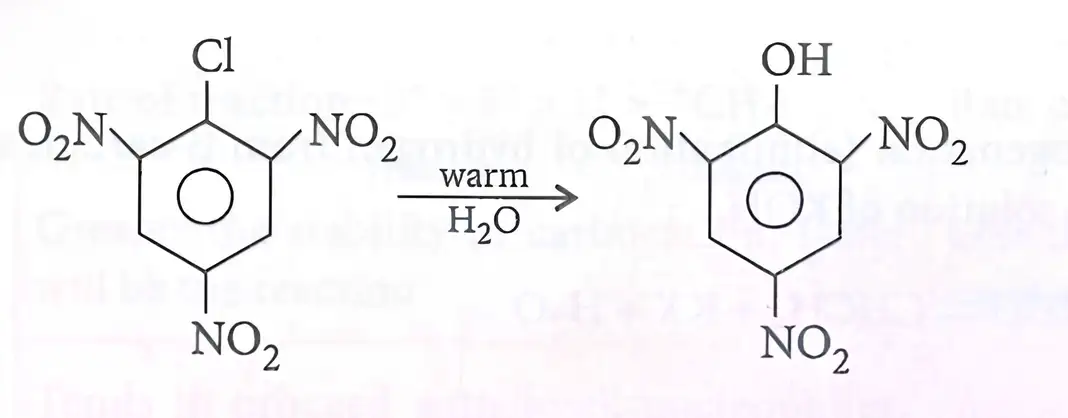
Electrophilic Substitution in Haloarenes
| Effect | Effect on ring | Result |
|---|---|---|
| effect | Halogen withdraws electron density through the sigma bond. | Deactivates the ring; haloarenes react more slowly than benzene. |
| effect | Halogen donates a lone pair by resonance, increasing electron density at ortho and para positions. | Directs electrophilic substitution mainly to ortho and para positions. |
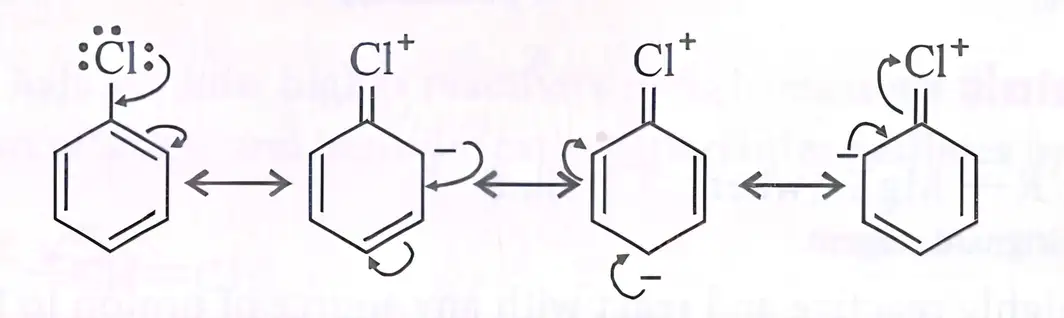
| Reaction | Reagents / conditions | Products |
|---|---|---|
| Halogenation | Halogen with a Lewis acid catalyst | Ortho- and para-dihalobenzenes; para is often major. |
| Nitration | Concentrated and concentrated | Mixture of ortho- and para-halonitrobenzene. |
| Sulphonation | Concentrated | Mixture of ortho- and para-haloarene sulphonic acids. |
| Friedel–Crafts alkylation | Alkyl halide with a Lewis acid catalyst | Mixture of ortho- and para-haloalkylbenzene. |
| Friedel–Crafts acylation | Acid halide with a Lewis acid catalyst | Mixture of ortho- and para-haloacylbenzene; para is often major. |
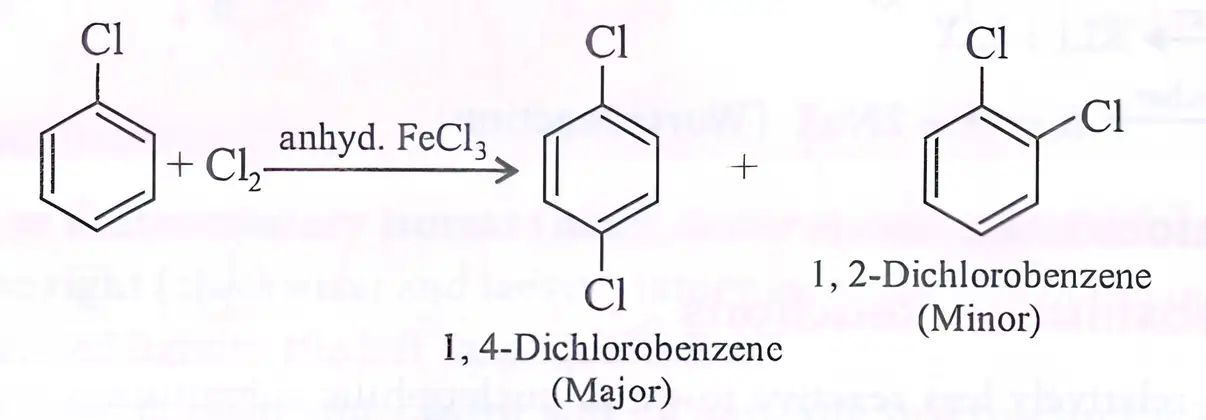
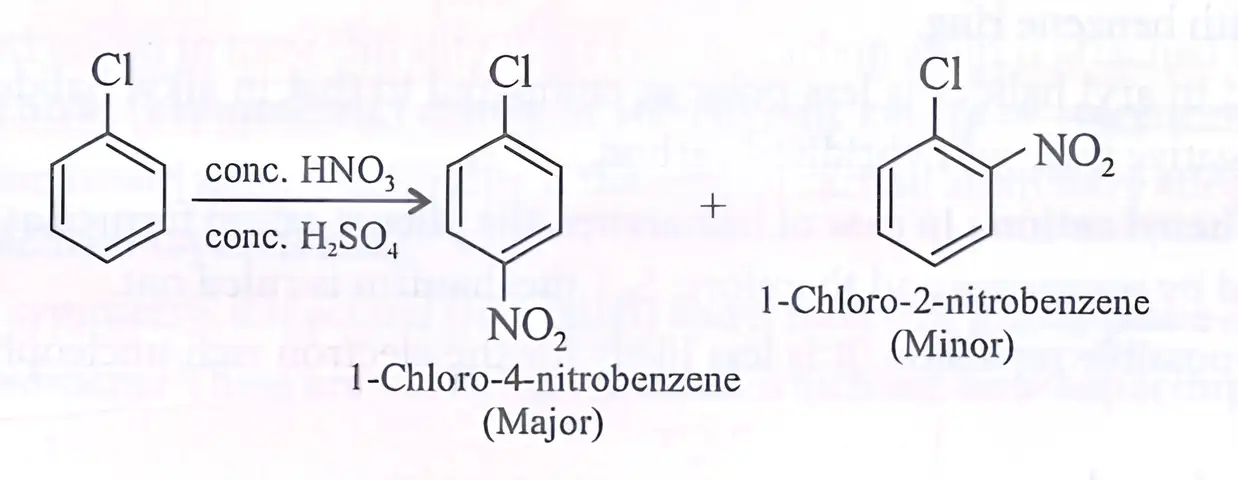
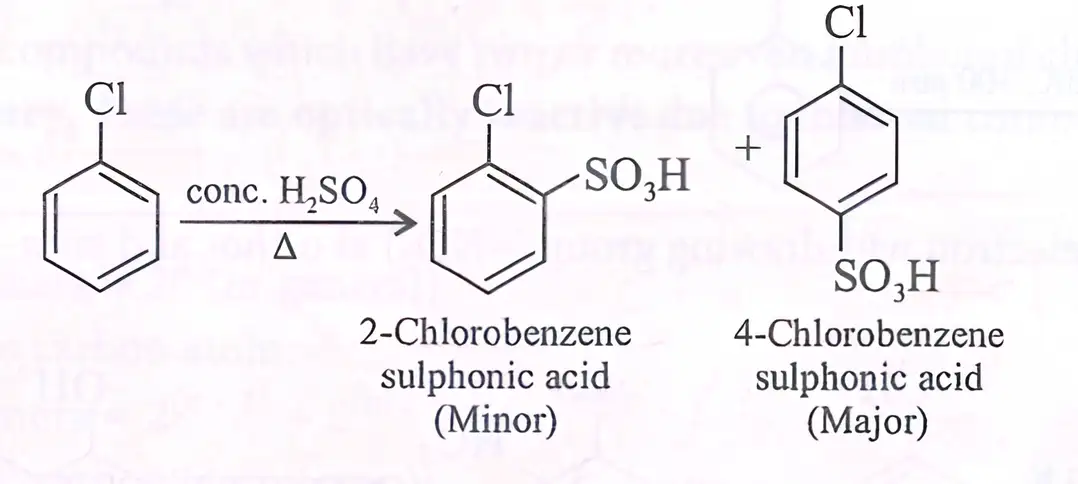
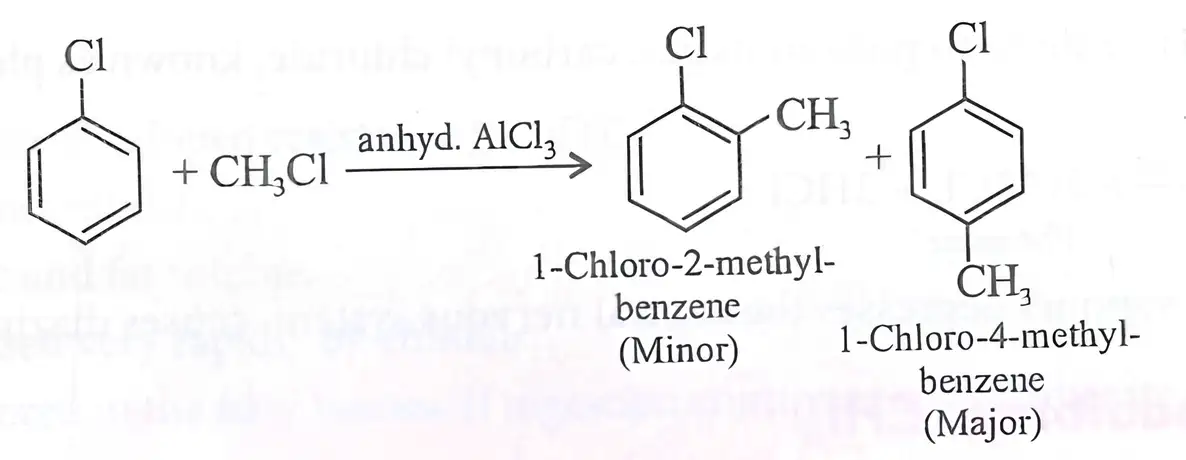
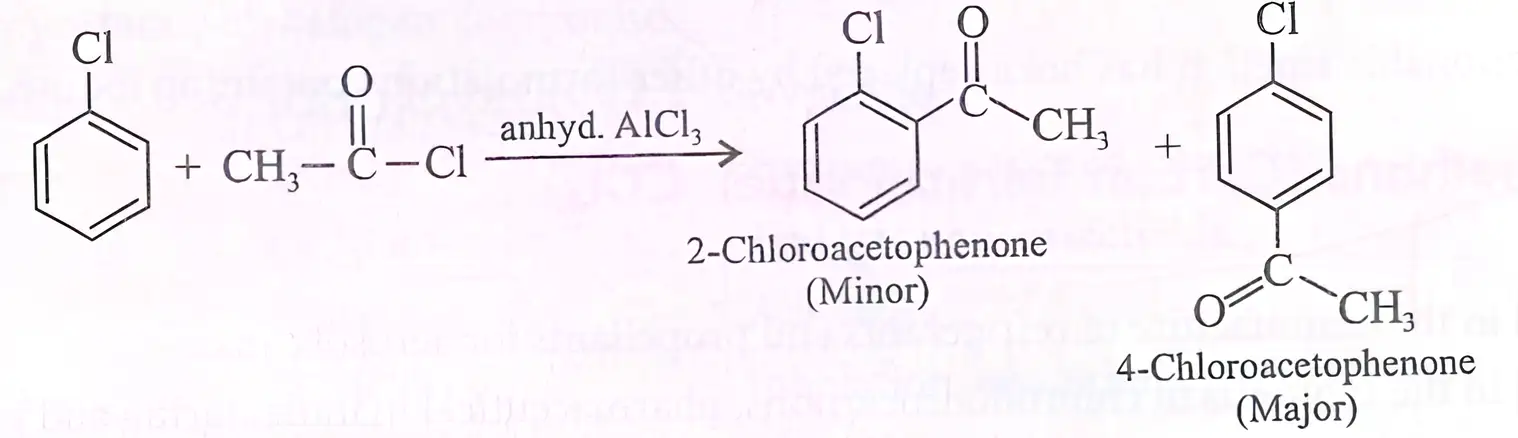
Coupling Reactions of Haloarenes
| Reaction | Reactants | Product |
|---|---|---|
| Wurtz–Fittig | A haloarene and a haloalkane with sodium in dry ether | Alkylbenzene |
| Fittig | Two haloarene molecules with sodium in dry ether | Biaryl, such as diphenyl |
Why are haloarenes less reactive than haloalkanes toward nucleophilic substitution?
Why are halogens deactivating yet ortho/para-directing in electrophilic substitution?
Quick recap
- Haloalkanes react by nucleophilic substitution, elimination, and metal-mediated coupling or reagent formation.
- Ambident cyanide and nitrite can bond through different atoms to form different products.
- proceeds through a carbocation; is concerted and causes inversion.
- Alcoholic promotes dehydrohalogenation; Saytzeff’s rule favours the more substituted alkene.
- Haloarenes resist nucleophilic substitution, but ortho/para nitro groups increase their reactivity.
- Halogens deactivate benzene rings by but direct electrophilic substitution to ortho and para positions.
- Wurtz–Fittig couples aryl and alkyl groups; Fittig couples two aryl groups.
Polyhalogen Compounds
Polyhalogen compounds — Carbon compounds containing more than one halogen atom; examples include and .
Dichloromethane (Methylene Chloride)
Dichloromethane — A polyhalogen compound with formula .
Uses and harmful effects
- Uses: A widely used solvent, paint remover and aerosol propellant.
- Nervous system: It harms the central nervous system; low exposure can slightly impair hearing and vision.
- High exposure: May cause dizziness, nausea, tingling and numbness in fingers and toes.
- Skin and eyes: Direct skin contact can cause intense burning and mild redness; eye contact can burn the cornea.
Trichloromethane (Chloroform)
Chloroform — Trichloromethane has the formula .
Uses and harmful effects
- Uses: A major starting material for Freon-22; also a solvent for resins, rubber, oils, fats, alkaloids and iodine.
- Other uses: Used to prepare chloretone and chloropicrin, and to preserve anatomical specimens.
- Oxidation hazard: In air and light, chloroform oxidises to poisonous phosgene, which can damage the liver and kidneys.
- Vapour effects: Inhalation depresses the central nervous system and may cause dizziness, fatigue and headache.
Triiodomethane (Iodoform)
Iodoform — Triiodomethane has the formula .
Use and limitation
- Antiseptic: Formerly used in wound dressings because it liberates iodine.
- Organic synthesis: Also used as a methylating agent.
- Limitation: Its objectionable smell led to its replacement by other iodine-containing formulations.
Tetrachloromethane (Carbon Tetrachloride)
Carbon tetrachloride — Tetrachloromethane has the formula .
Uses and harmful effects
- Uses: Used to manufacture refrigerants and aerosol propellants, and in chlorofluorocarbon synthesis, pharmaceutical manufacture and as a general solvent.
- Cleaning and fire control: Used as a cleaning agent and spot remover; formerly used in fire extinguishers under the name pyrene.
- Health hazards: Can cause liver cancer; common effects include dizziness, light-headedness, nausea and vomiting.
- Severe exposure: May permanently damage nerve cells, causing coma, unconsciousness or death; it may also irritate the eyes.
- Environmental effect: Depletes the ozone layer.
Freons
Freons — Chlorofluorocarbon compounds derived from methane or ethane, containing chlorine and fluorine; an example is Freon-12, .
Preparation, properties and effects
- Preparation: Freon-12 is made from carbon tetrachloride by the Swarts reaction using silver fluoride.
- Properties: Freons are highly stable, unreactive, non-toxic and non-corrosive; they are easily liquefied.
- Uses: Used as aerosol propellants and in refrigeration and air conditioning.
- Ozone depletion: Stable Freons diffuse unchanged into the stratosphere, where they initiate free-radical chain reactions that destroy ozone.
DDT
DDT — p,p′-Dichlorodiphenyltrichloroethane is a powerful insecticide.
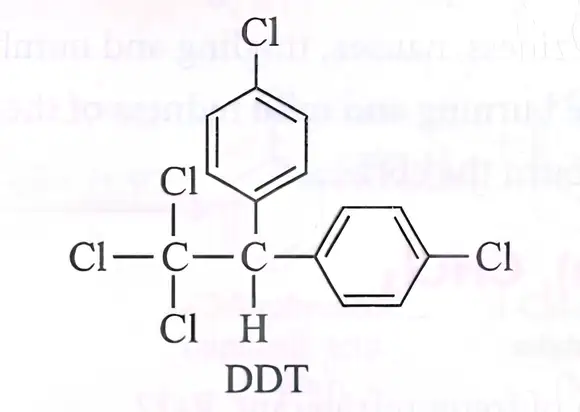
Uses and harmful effects
- Effectiveness: Effective against malaria-carrying mosquitoes and typhus-carrying lice.
- Resistance: Many insect species have developed resistance to DDT.
- Persistence: Chemically stable, fat-soluble and not rapidly metabolised by animals.
- Bioaccumulation: Stored in fatty tissues; continued intake causes its concentration to build up over time.
- Other toxicity: Highly toxic to fish.
Other Important Polyhalogen Compounds
| Compound | Formula | Use |
|---|---|---|
| Chloretone | Hypnotic drug | |
| Phosgene | Poisonous gas; used in warfare | |
| Chloropicrin | Tear gas and insecticide | |
| Iodoform | Antiseptic | |
| Halothane | Inhalation anaesthetic | |
| Pyrene | Fire extinguisher | |
| Freon-12 | Refrigerant | |
| Gammaxane | Insecticide | |
| Westron | Industrial solvent | |
| Westrosol | Industrial solvent |
Distinguishing Chloroform and Iodoform
| Test | Chloroform () | Iodoform () |
|---|---|---|
| Heating with | No yellow precipitate | Gives a yellow precipitate of |
How does chloroform form poisonous phosgene?
Why does DDT accumulate in animals?
How can chloroform and iodoform be distinguished using silver nitrate?
Quick recap
- Polyhalogen compounds contain more than one halogen atom.
- Dichloromethane is used as a solvent, paint remover and aerosol propellant, but exposure harms the nervous system and can irritate skin and eyes.
- Chloroform can oxidise in light to poisonous phosgene; it is also a precursor to Freon-22.
- Freons are stable, useful refrigerants and aerosol propellants, but contribute to ozone depletion in the stratosphere.
- DDT is an effective insecticide, but persistence and fat solubility lead to bioaccumulation; it is also toxic to fish.
- On heating with silver nitrate, iodoform forms yellow precipitate; chloroform does not.
NEET Chemistry — ALL CHAPTERS
1
Some Basic Concepts of Chemistry
2
Structure of Atom
3
Classification of Elements and Periodicity in Properties
4
Chemical Bonding and Molecular Structure
5
Thermodynamics
6
Equilibrium
7
Redox Reactions
8
Organic Chemistry - Some Basic Principles and Techniques
9
Hydrocarbons
10
Solutions
11
Electrochemistry
12
Chemical Kinetics
13
The d- and f- Block Elements
14
Coordination Compounds
15
Haloalkanes and Haloarenes
16
Alcohols, Phenols and Ethers
17
Aldehydes, Ketones and Carboxylic Acids
18
Amines
19
Biomolecules
20
The p-Block Elements (Group 13 and 14)
21
The p-Block Elements (Group 15 to 18)
22
Principles Related to Practical Chemistry