NEET UG . NEET Chemistry . Chemistry . Principles Related to Practical Chemistry
Chapter 22: Principles Related to Practical Chemistry
Ch 22
NEET Chemistry
NEET UG
Organic Practical Chemistry
Detection of Extra Elements: Lassaigne’s Test
Nitrogen and Nitrogen–Sulphur Detection
Sulphur Detection
Halogen Detection
| Halide | Silver halide result | Solubility in ammonium hydroxide |
|---|---|---|
| Chloride | White precipitate | Soluble |
| Bromide | Pale-yellow precipitate | Sparingly soluble |
| Iodide | Yellow precipitate | Insoluble |
Chlorine-water test observations
- Bromide: Orange colour in the layer confirms bromine.
- Iodide: Violet colour in the layer confirms iodine.
- Procedure note: Boil the extract with dilute , cool, then add a few drops of (or another stated organic solvent) and excess chlorine water with shaking.
Detection of Organic Functional Groups
- Functional group: An atom or group of atoms that largely determines the characteristic properties and reactions of an organic compound.
- Identification: Characteristic qualitative tests are used to detect groups such as alcohol, phenol, carbonyl, carboxylic acid and amino groups.
Alcoholic Group
Distinguishing Primary, Secondary and Tertiary Alcohols
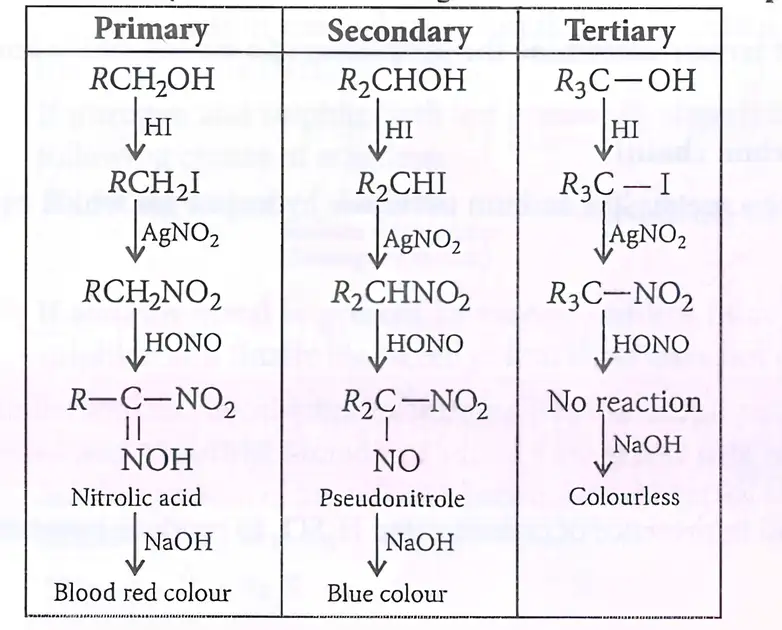
| Alcohol | Product at | Reaction type |
|---|---|---|
| Primary | Aldehyde | Dehydrogenation |
| Secondary | Ketone | Dehydrogenation |
| Tertiary | Alkene | Dehydration |
Phenolic Group
Carbonyl Group: Aldehydes and Ketones
Distinguishing Aldehydes and Ketones
| Test | Aldehydes | Ketones |
|---|---|---|
| Tollens’ | Silver mirror | Negative |
| Fehling’s | Red precipitate; aromatic aldehydes respond poorly | Negative |
| Schiff’s | Pink, magenta or red colour | Negative |
Distinctive Tests for Ketones
- m-Dinitrobenzene test: An alkaline mixture turning violet, then slowly fading, indicates a ketone; benzophenone and aldehydes do not give this test.
- Sodium nitroprusside test: Ketones give a coloured ion with alkaline sodium nitroprusside; aldehydes do not respond.
Carboxylic Acid Group
Amino Group
Azo-dye and aromatic tertiary amine reactions
- Azo coupling: Benzenediazonium chloride couples with β-naphthol to form an orange precipitate of 1-phenylazo-2-naphthol.
- Aromatic tertiary amines: The nitroso group enters the para position of the phenyl ring.
Hinsberg Test for Amines
| Amine | With Hinsberg reagent | Behaviour in alkali |
|---|---|---|
| Primary | Sulphonamide with acidic | Soluble in |
| Secondary | Sulphonamide without | Insoluble in |
| Tertiary | No reaction | Insoluble in ; dissolves in |
Preparation of Acetanilide
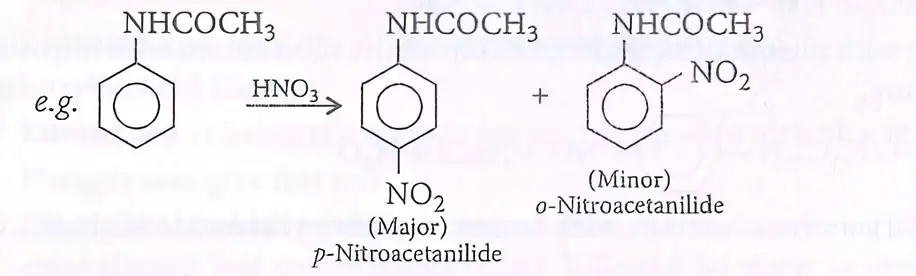
Preparation of p-Nitroacetanilide
- Preparation: Acetanilide is nitrated with a mixture of concentrated nitric and sulphuric acids while keeping the temperature below 25 °C.
- Products: The reaction gives mainly p-nitroacetanilide and a smaller amount of the ortho isomer; recrystallisation from ethanol separates the less soluble para product.
- Purpose of acetylation: Aniline is first converted to acetanilide because nitric acid can oxidise the amino group of aniline.
Preparation of Aniline Yellow
Preparation and Test for Iodoform
- Lassaigne’s colours: Nitrogen—Prussian blue; sulphur—violet with nitroprusside or black with lead acetate; nitrogen plus sulphur—blood red.
- Alcohol classification: Lucas cloudiness appears fastest for tertiary, then secondary, then primary alcohols.
- Aldehyde tests: Tollens’ gives a silver mirror; Fehling’s gives red ; Schiff’s turns pink, magenta or red.
- Iodoform: A yellow precipitate indicates a suitable methyl carbinol or methyl carbonyl group.
Quick recap
- Lassaigne’s fusion converts nitrogen, sulphur and halogens into detectable sodium salts.
- Characteristic colours and precipitates identify elements and many functional groups.
- Lucas, Victor Meyer and hot-copper reactions distinguish alcohol classes.
- Tollens’, Fehling’s and Schiff’s tests distinguish aldehydes from ketones; Schiff’s reagent is made using sulphur dioxide and dilute p-rosaniline hydrochloride.
- Hinsberg’s test distinguishes primary, secondary and tertiary amines through reaction and solubility.
- Acetanilide protects aniline during nitration; para-nitroacetanilide is the major product.
- Iodoform is a yellow product and test for suitable methyl carbinol and methyl carbonyl groups.
Inorganic Practical Chemistry
Double Salts: Mohr’s Salt and Potash Alum
Preparation, Properties and Uses
- Crystallisation: The prepared solution is crystallised; crystals are separated from the mother liquor by filtration and dried.
- Mohr’s salt preparation: Boil the water for 5 minutes first to expel dissolved oxygen, which could oxidise to .
- Acid addition: A little is added during preparation to prevent hydrolysis.
- Mohr’s salt stability: It does not lose water of crystallisation and resists oxidation in air, unlike green vitriol, .
- Mohr’s salt use: It is used as a primary standard in volumetric analysis.
- Burnt alum: On heating, potash alum first melts and then swells as it loses water of crystallisation.
- Water purification: Potash alum coagulates colloidal impurities; the precipitate is removed by filtration or decantation.
- Stopping bleeding: Alum coagulates negatively charged blood colloids.
Qualitative Salt Analysis: Dry Tests
| Flame colour | Ion |
|---|---|
| Golden yellow | |
| Lilac | |
| Brick red | |
| Apple green |
Borax Bead Test
| Metal | Oxidising flame: hot | Oxidising flame: cold | Reducing flame: hot | Reducing flame: cold |
|---|---|---|---|---|
| Copper | Green | Blue | Colourless | Brown-red |
| Iron | Bluish-yellow | Pale yellow | Bottle green | Bottle green |
| Chromium | Green | Green | Green | Green |
| Cobalt | Blue | Blue | Blue | Blue |
| Manganese | Violet | Amethyst red | Grey | Grey |
| Nickel | Violet | Brown | Grey | Grey |
Wet Tests: Identification of Acid Radicals
| Radical | Gas and diagnostic observation | Inference |
|---|---|---|
| Colourless, odourless gas turns lime water milky; excess gas makes the precipitate soluble. | forms white , then soluble . | |
| Colourless gas with a rotten-egg smell turns lead acetate paper black. | forms black . | |
| Colourless gas with a suffocating smell turns acidified solution green. | reduces dichromate. | |
| Colourless gas is followed by brown gas; the gas also turns ferrous sulphate solution black. | The sequence of gases and the black ferrous sulphate solution indicate nitrite. |
| Radical | Observation |
|---|---|
| Colourless pungent gas; dense white fumes form with a glass rod dipped in . | |
| Brown gas evolves; its production intensifies on adding . | |
| Deep violet gas evolves. | |
| Light-brown gas evolves; its production intensifies on adding copper turnings. |
| Ion | Test | Positive observation |
|---|---|---|
| Chromyl chloride test: heat salt with solid and concentrated ; pass vapours into , then add dilute and lead acetate. Alternatively, acidify the salt solution with dilute and add . | Reddish-brown vapours form; the absorbed solution turns yellow and gives yellow . Alternatively, white dissolves in . | |
| Acidify salt solution with dilute and add . | Pale-yellow precipitate forms; it is slightly soluble in . | |
| Use starch-moistened paper at the mouth of the tube during the acid test; also perform the acidified test. | Violet iodine vapour turns starch paper blue. Yellow precipitate is insoluble in . |
Nitrate and Sulphate Confirmatory Tests
Identification of Basic Radicals
| Test | Observation | Inference |
|---|---|---|
| Heat salt with ; expose the evolved gas to moist red litmus and a glass rod dipped in concentrated . | Pungent colourless gas; moist red litmus turns blue and dense white fumes form. | may be present. |
| Pass the evolved gas through Nessler’s reagent. | Brown solution or precipitate. | is confirmed. |
Group I Cations
- Cations: Group I contains lead(II) and silver ions, and .
- Group reagent: Dilute hydrochloric acid precipitates these ions as insoluble chlorides, and .
Group II Cations
- Cations: Group II includes ions such as , , , , , and .
- Group reagent: Hydrogen sulphide precipitates Group II cations as sulphides in the presence of dilute hydrochloric acid.
Group III Cations
- Cations: Group III includes , and .
- Group reagent: Ammonium hydroxide, in the presence of ammonium chloride, precipitates these ions as hydroxides.
Group IV Cations
- Cations: Group IV includes , , and .
- Group reagent: Hydrogen sulphide in an ammoniacal or alkaline medium precipitates these ions as sulphides.
Group V and Group VI Cations
- Group V cations: , and are precipitated as carbonates by ammonium carbonate in the presence of ammonium chloride and ammonium hydroxide.
- Group VI cation: Magnesium, , remains in solution after the preceding groups are removed and is tested separately.
Why Dilute Hydrochloric Acid Is Used for Group II
- Acid-radical order: Group 1 uses dilute ; Group 2 uses concentrated ; Group 3 uses the acidified test.
- Cation analysis: Add group reagents successively and remove each precipitate before testing the filtrate for the next group.
- Quick diagnostics: Carbonate turns lime water milky; sulphide blackens lead acetate paper; sulphite turns acidified dichromate green; nitrate gives a brown ring; nitrite also blackens ferrous sulphate solution.
What observation confirms sulphate ions?
What are the confirmatory observations for chloride, bromide and iodide with silver nitrate?
Quick recap
- Mohr’s salt and potash alum are double salts; they crystallise from equimolar constituent salts and dissociate into their ions in water.
- Dry identification uses heating, flame colours and borax-bead colours.
- Acid radicals are grouped by their reagents: dilute or concentrated sulphuric acid, or the acidified barium chloride test.
- Characteristic tests identify anions through gases, colour changes, precipitates and solubility; nitrite gives brown gas and blackens ferrous sulphate solution.
- Cations are analysed by successive selective precipitation from Groups I to VI, with ammonium tested first.
- Dilute hydrochloric acid suppresses sulphide-ion concentration by the common-ion effect, enabling selective precipitation of Group II sulphides.
Physical Practical Chemistry
Volumetric Analysis and Titration Basics
Volumetric analysis — A method for finding the concentration or strength of a substance by measuring the volume of its solution that reacts with another solution.
Titration terms
- Titration: The main process used in volumetric analysis; types include acid–base, redox, iodine and complexometric titrations.
- Analyte (titre): The substance being analysed.
- Titrant: The solution added to the analyte, usually from a burette.
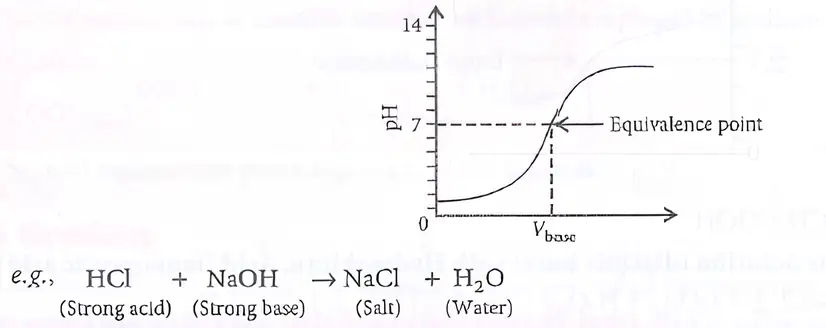
- Equivalence point: The theoretical point at which the titrant and analyte have reacted in exact stoichiometric amounts; a property such as pH or colour changes near it.
- End point and indicator: The end point is the observed signal of completion; an indicator changes a physical property, usually colour, near the equivalence point.
Standard solutions and standards
- Standard solution: A solution whose concentration is known.
- Standardization: Determining a reagent’s concentration by reacting it with a known amount of another reagent of known concentration.
| Point | Primary standard | Secondary standard |
|---|---|---|
| Preparation | A definite mass can be dissolved to prepare a solution of known concentration directly. | Its solution concentration cannot be established accurately by direct preparation; it must be standardized. |
| Properties | Very pure, stable in air, non-hygroscopic and highly water-soluble. | Often impure or unstable in air; may be hygroscopic or deliquescent. |
| Examples | Crystalline oxalic acid, anhydrous , Mohr’s salt. | , , |
Law of Chemical Equivalence
Law of chemical equivalence — At the equivalence point, equal numbers of equivalents of the two reacting substances have reacted.
Use volumes in litres for equivalents; the same normality relation works with both volumes in mL.
The dilution equation applies when the amount of solute is conserved; for reaction stoichiometry, include each substance’s valency factor.
How a Titration Is Performed and Calculated
Titration principle
- Flask: Place a measured volume of one solution (often ) in a conical flask and add a suitable indicator.
- Burette: Add the other solution gradually while stirring; near the end point, add it dropwise.
- Reading: A sudden, persistent change in a property—commonly colour—signals the end point; record the titrant volume from the burette.
- Calculation: Apply or, when appropriate, to find the unknown concentration.
Let denote strength in , equivalent mass and molar mass.
Let be percentage purity, the strength due to the pure substance and the strength of the given sample.
Acid–Base Titrations
Acid–base titration — A titration based on the neutralization of acid-derived ions by base-derived ions to form water.
Indicators and indicator choice
- Acid–base indicators: Usually weak organic acids or bases whose unionized and ionized forms have different colours.
- Indicator range: Choose an indicator whose colour-change pH range overlaps the steep pH change around the equivalence point.
- Indicator pK: corresponds to the pH at the indicator’s half-equivalence point.
- Strong acid–strong base: Methyl orange, bromothymol blue, thymol blue or phenolphthalein can be suitable, depending on the transition range.
- Strong acid–weak base: Methyl orange or methyl red; weak acid–strong base: phenolphthalein is suitable.
| Indicator (acidic → alkaline colour) | pH range | Suitable titration example | |
|---|---|---|---|
| Methyl orange (red → yellow) | 3.7 | 3.1–4.4 | Weak base–strong acid |
| Bromocresol green (yellow → blue) | 4.0 | 3.8–4.6 | Weak base–strong acid |
| Methyl red (red → yellow) | 5.1 | 4.2–6.3 | Weak base–strong acid |
| Bromothymol blue (yellow → blue) | 7.0 | 6.0–7.6 | Strong acid–strong base |
| Phenol red (yellow → red) | 7.9 | 6.4–8.2 | Strong acid–strong base |
| Thymol blue, basic transition (yellow → blue) | 8.9 | 8.0–9.6 | Acid–strong base |
| Phenolphthalein (colourless → pink) | 9.3 | 8.3–10.0 | Weak acid–strong base |
| Alizarin yellow (yellow → violet) | — | 10.1–12.0 | Weak acid–strong base |
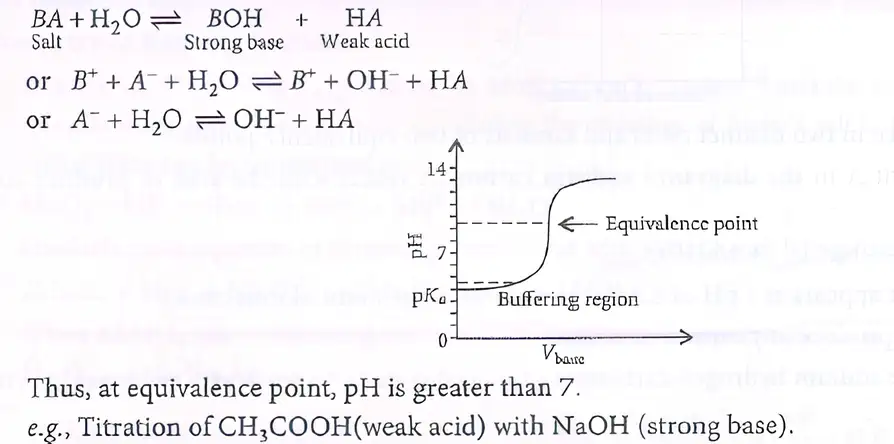
pH Curves for Acid–Base Titrations
| Titration | Before equivalence | At equivalence |
|---|---|---|
| Strong monoprotic acid + strong base | pH changes sharply near the end point. | pH is ; the salt does not undergo hydrolysis. |
| Weak monoprotic acid + strong base | Weak acid and its salt form an acidic buffer. | Salt undergoes anionic hydrolysis; equivalence pH is above . |
| Weak monoprotic base + strong acid | Weak base and its salt form a basic buffer. | Salt undergoes cationic hydrolysis; equivalence pH is below . |
| Weak acid + weak base | The pH curve has little steepness. | No sharp end point; equivalence pH is approximately . |
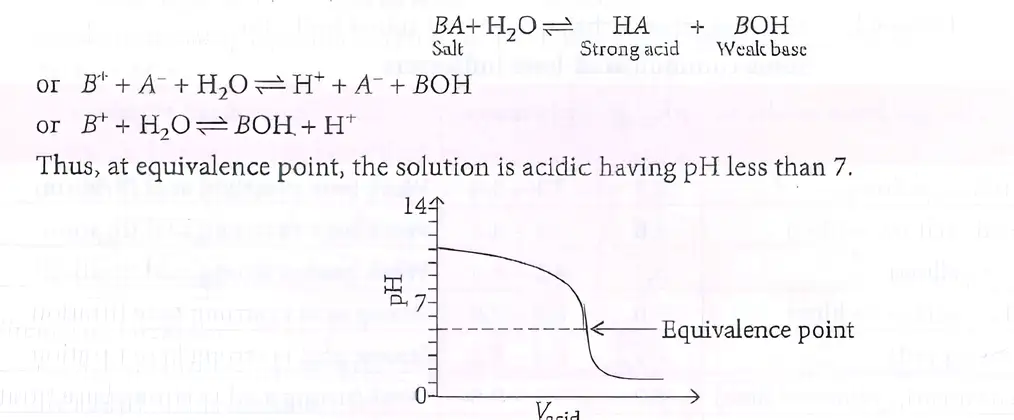
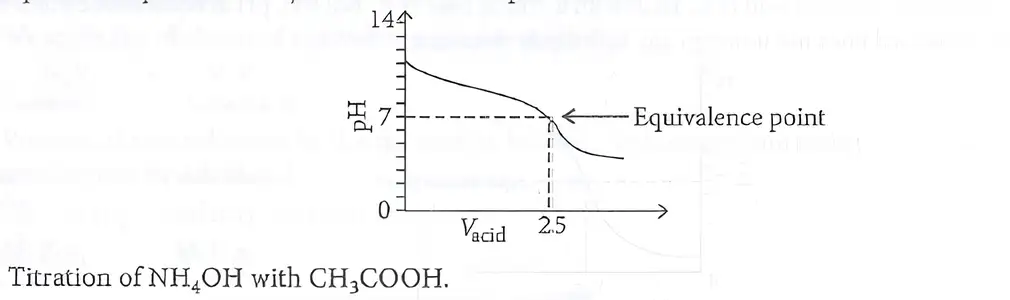
Sodium Carbonate–Hydrochloric Acid Titration
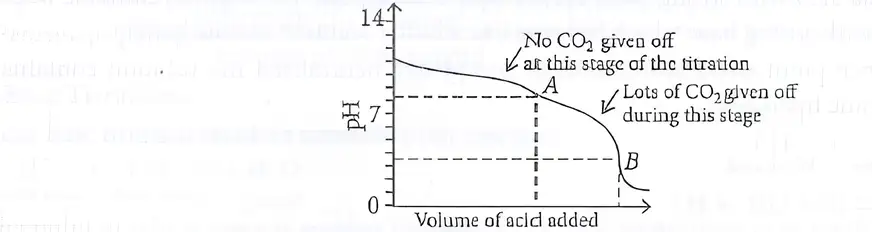
Two-stage neutralization
- Two equivalence points: Carbonate is neutralized in two successive steps: first to hydrogen carbonate, then to carbon dioxide and water.
- Equal concentrations: The complete reaction uses twice as much hydrochloric acid volume as sodium carbonate solution volume.
- First end point: Near pH ; use phenolphthalein.
- Second end point: Near pH ; use methyl orange.
Oxalic Acid–Sodium Hydroxide Titration
Diprotic acid behaviour
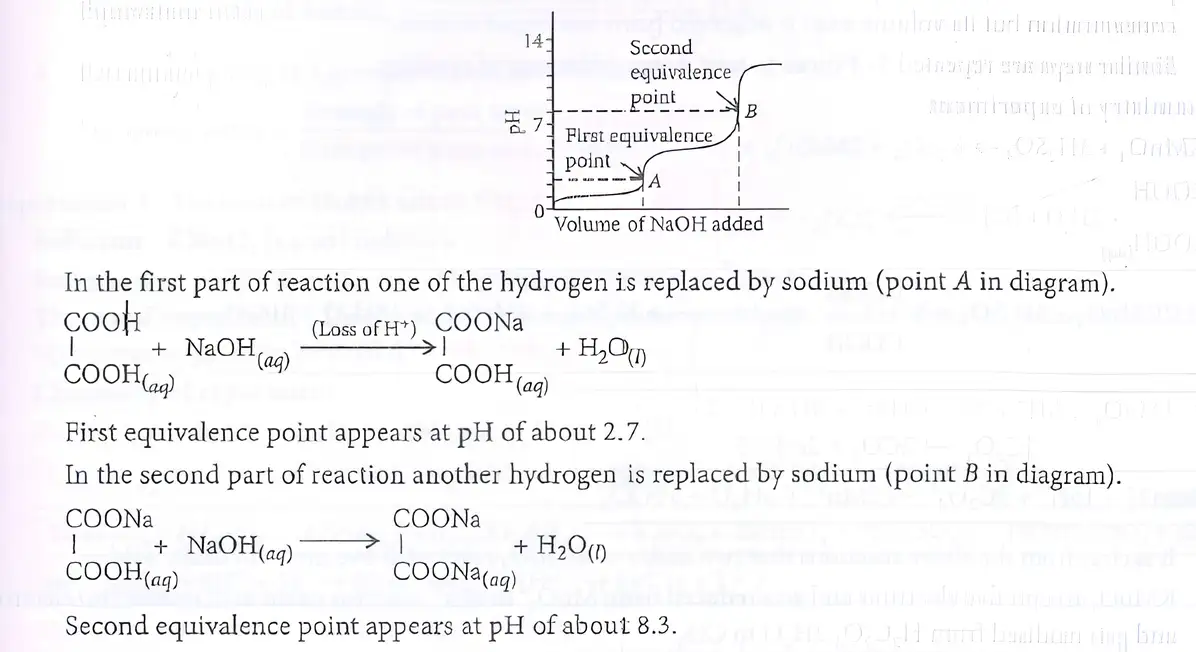
- Two stages: Diprotic oxalic acid loses its two acidic protons in successive neutralization steps, giving two equivalence points.
- Relative ionization: The first proton is released more readily than the second, so .
Redox Titrations with Potassium Permanganate
Permanganometric titration — A redox titration in which is the oxidizing agent, generally in acidic medium.
Principle and end point
- Titrated reducing agents: Include Mohr’s salt, ferrous salts, hydrogen peroxide, oxalic acid and oxalates.
- Self-indicator: Purple is reduced in acid to nearly colourless ; once the reductant is used up, a slight excess gives a permanent light-pink colour.
- End point: Colourless to permanent light pink, with in the burette.
- Acid medium: Sulfuric acid is used to support reduction of to .
Each mole of accepts five electrons when reduced to .
Oxalic Acid–Permanganate Practical Titration
Oxalic Acid vs
- Pipette a measured volume, commonly , of oxalic acid solution into a conical flask.
- Add an equal volume of dilute sulfuric acid (about ) to make the solution acidic.
- Warm the solution to – and titrate with from the burette while swirling.
- Stop at the first permanent light-pink colour; repeat until concordant burette readings are obtained.
Why heating is needed
- Slow reaction when cold: The reaction is initially slow because little has formed.
- Autocatalysis: Heating speeds formation of , which catalyses the reaction and makes it proceed faster.
- Carbon dioxide: Heating also helps expel evolved , supporting completion of the reaction.
- Unexpected brown precipitate: Insufficient sulfuric acid can produce brown hydrated instead of the desired acidic reduction product.
Use volumes in consistent units in the normality equation. The molar ratio is based on the balanced reaction.
Equivalent masses for this titration
- Oxalic acid dihydrate: ; each mole supplies two electrons’ worth of reducing capacity.
- Acidic permanganate: .
Mohr’s Salt–Permanganate Practical Titration
Reaction and calculations
- Indicator and end point: is self-indicating; the end point is the first permanent light-pink colour.
- Heating: Unlike the oxalic acid titration, the Mohr’s salt solution does not need to be heated.
- Electron transfer: One mole of reacts with five moles of ; each iron(II) ion loses one electron.
- Normality: .
- Molarity ratio: .
- Equivalent masses: Mohr’s salt has equivalent mass equal to its molar mass (); acidic has equivalent mass . Apply the strength and purity formulas above.
Enthalpy of Solution of Copper Sulfate
Enthalpy of solution — The enthalpy change when one mole of a substance dissolves in excess solvent, so further solvent addition produces no further heat change.
Calorimetric principle
- Measurement: Dissolve a known mass of powdered salt in excess water in a simple insulated calorimeter; stir and record the temperature change.
- Sign: Dissolution can be endothermic () or exothermic ().
- Water equivalent (): The mass of water that would absorb the same heat as the calorimeter for the same temperature rise.
- Symbols: is water mass, is solute mass, is solute molar mass and is temperature change.
The factor converts calories to joules; use the first form for joules per mole and the second for calories per mole.
| Comparison | Lattice energy | Hydration energy |
|---|---|---|
| Meaning | Energy needed to separate one mole of ionic solid into gaseous ions. | Energy released when ions become fully hydrated in water. |
| Effect on dissolution | If lattice energy is greater, dissolution is endothermic (). | If hydration energy is greater, dissolution is exothermic (). |
Examples of dissolution enthalpy
- Anhydrous copper sulfate: Dissolution is exothermic.
- Potassium chloride: Dissolution is endothermic.
- Copper sulfate pentahydrate: Dissolution is endothermic.
Enthalpy of Neutralization
Calorimetric measurement
- Method principle: Mix known volumes of standard acid and alkali in a simple calorimeter and measure the temperature rise.
- Symbols: is calorimeter water equivalent, is mass of the final mixture, is temperature change, and are the normality and volume (mL) of the acid or base used.
- Strong acid–strong base: Average molar enthalpy of neutralization is (about ).
Use for joules and omit it for calories; is in mL as specified for this practical calculation.
Why weak acid/base neutralization releases less heat
- Weak electrolytes: They are only partly ionized, so some heat is absorbed to ionize them during neutralization.
- Result: The measured neutralization enthalpy is less exothermic in magnitude than for a strong acid–strong base pair.
- Example: Ionization of acetic acid is endothermic, about in the stated practical context.
Colloids and Sol Preparation
Colloid — A heterogeneous system intermediate between a true solution and a suspension, with particle sizes of about –.
Colloid components
- Dispersed phase: The particles distributed through the mixture; analogous to solute.
- Dispersion medium: The continuous medium in which the particles are distributed; analogous to solvent.
| Property | Lyophilic sol | Lyophobic sol |
|---|---|---|
| Affinity | Dispersed phase has strong affinity for medium. | Dispersed phase has little affinity for medium. |
| Stability | Generally stable; not easily precipitated. | Less stable; readily coagulated by small amounts of electrolyte, heating or shaking. |
| Reversibility | Reversible: sol can often be remade by mixing precipitate with medium. | Irreversible: simple remixing usually does not restore the sol. |
| Preparation | Often made by direct mixing. | Usually needs special preparation methods. |
| Examples | Gum, gelatin, starch, proteins and some polymers; water-based examples are hydrophilic. | Metal sols and insoluble compounds such as , and . |
Direct preparation and hydrolysis examples
- Lyophilic sols: Mix the dispersed phase directly with the medium; starch is mixed with boiling water. Egg albumin is prepared in cold water because hot water precipitates it.
- Hydroxide sols: Hydrolysis of ferric or aluminium chloride forms insoluble hydroxide particles; dialysis removes the by-product hydrochloric acid, which could destabilize the sol.
- Arsenious sulphide sol: Prepare by hydrolysing arsenious oxide and then passing hydrogen sulphide through the solution.
Methods for Preparing Lyophobic Sols
Condensation method — A method that combines atoms or molecules to form particles of colloidal size.
| Reaction type | Example reaction | Sol formed |
|---|---|---|
| Double decomposition | ||
| Oxidation | Sulfur | |
| Reduction | Gold | |
| Hydrolysis |
Other condensation examples
- Silver halides: Mix dilute silver salt and alkali halide solutions in equivalent amounts.
- Silica gel: Mix dilute sodium silicate solution with hydrochloric acid.
- Solvent exchange: Add excess miscible solvent in which the solute is insoluble; alcoholic sulphur or phosphorus solutions added to excess water form sols.
- Excessive cooling: Freezing a water solution in an organic solvent such as chloroform or ether can produce an ice sol.
Dispersion method — A method that breaks larger particles into colloidal-sized particles in a dispersion medium; stabilizers may be added because the sols can be unstable.
| Method | Principle | Example or key detail |
|---|---|---|
| Mechanical dispersion | Mill a coarse suspension until particles reach colloidal size. | Mechanical breaking of larger particles. |
| Electrical disintegration (Bredig’s arc) | Strike an arc between metal electrodes immersed in the medium; vaporized metal condenses as colloidal particles. | Used for gold, silver and platinum sols. |
| Peptization | Shake a freshly prepared precipitate with dispersion medium and a small amount of electrolyte. | The electrolyte is the peptizing agent; it converts precipitate into a sol. |
Kinetic Study: Iodide Ion and Hydrogen Peroxide
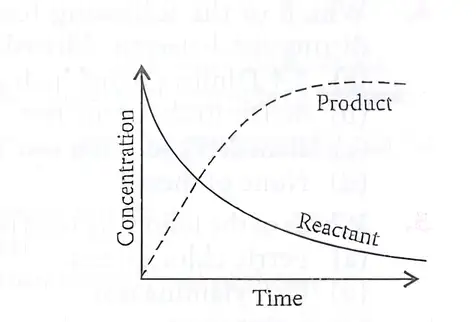
Rate of reaction — The change in concentration of a reactant or product per unit time; reactant concentrations decrease while product concentrations increase.
Negative signs show reactant disappearance; positive signs show product formation.
Clock reaction observation principle
- Thiosulfate: Add a known amount of sodium thiosulfate; it rapidly reduces liberated iodine back to iodide.
- Starch: Once thiosulfate is used up, iodine forms a blue complex with starch.
- Rate indication: The time until blue colour appears tracks how quickly iodine is produced; at the same indicator threshold, a shorter time means a faster reaction.
- Concentration comparison: With other conditions fixed, the blue colour appears sooner at higher iodide concentration, indicating a faster reaction.
Rate Law, Order and Molecularity
For the written reaction, the law of mass action gives a rate proportional to reactant concentrations raised to their stoichiometric coefficients.
The exponents and are determined experimentally; they need not equal the balanced equation coefficients.
Key kinetic terms and rate factors
- Rate constant (): The proportionality constant in the rate law; its value depends on conditions such as temperature.
- Order: Sum of the experimentally determined powers in the rate law, here .
- Molecularity: Number of reacting species in an elementary step; for the written step it is .
- Rate factors: Besides reactant concentration, reaction rate can depend on reactant nature, temperature, catalyst, surface area and light.
Do not assume stoichiometric coefficients always give the rate-law exponents: the exponents are measured experimentally, except for an elementary reaction.
Why is oxalic acid solution heated before titration with potassium permanganate?
Why does a strong acid–strong base titration have equivalence pH , while the other strong–weak combinations do not?
State the end point and self-indicator action in a permanganate titration.
Quick recap
- Volumetric titration uses measured solution volumes; the equivalence point is stoichiometric, while the end point is the observed indicator signal.
- Use or the molarity relation with valency factors; calculate strength from normality or molarity and equivalent or molar mass.
- Indicator choice must match the pH jump; carbonate–acid titration and diprotic oxalic acid titration each have two equivalence stages.
- Acidic permanganate is self-indicating, accepts five electrons per mole, and has equivalent mass .
- Solution and neutralization enthalpies are obtained calorimetrically; lattice versus hydration energy determines the sign of dissolution enthalpy.
- Lyophilic sols are stable and readily formed; lyophobic sols need special condensation or dispersion methods.
- In the iodide–peroxide clock reaction, blue starch colour appears after thiosulfate is consumed; law-of-mass-action powers describe the written reaction, while rate-law orders are experimentally determined.
NEET Chemistry — ALL CHAPTERS
1
Some Basic Concepts of Chemistry
2
Structure of Atom
3
Classification of Elements and Periodicity in Properties
4
Chemical Bonding and Molecular Structure
5
Thermodynamics
6
Equilibrium
7
Redox Reactions
8
Organic Chemistry - Some Basic Principles and Techniques
9
Hydrocarbons
10
Solutions
11
Electrochemistry
12
Chemical Kinetics
13
The d- and f- Block Elements
14
Coordination Compounds
15
Haloalkanes and Haloarenes
16
Alcohols, Phenols and Ethers
17
Aldehydes, Ketones and Carboxylic Acids
18
Amines
19
Biomolecules
20
The p-Block Elements (Group 13 and 14)
21
The p-Block Elements (Group 15 to 18)
22
Principles Related to Practical Chemistry